The Efect of Cr Content on the Glass Forming Ability of Fe68-xCrxNb8
B
24 (x =8,10,12) AlloysMarcio Andreato Batista Mendesa*, Ana Karla Melleb, Carlos Alberto Caldas de Souzac, Claudio
Shyinti Kiminamib, Régis Daniel Cavab, Claudemiro Bolfarinib, Walter José Botta Filhob
Received: April 9, 2016; Revised: September 10, 2016; Accepted: October 2, 2016
Based on the Fe60Cr8Nb8B24 alloy, reported in the literature as good Glass Forming Ability (GFA), in this study the GFA of two new compositions was proposed, Fe68-xCrxNb8B24 (x=10,12). They were evaluated as good candidates to be new compositions of Bulk Metallic Glasses (BMG) with better
corrosion resistance due to the high Cr content. Rapidly solidiied glassy ribbons were processed,
and based on their thermal characteristics, the critical thickness of the glassy structure formation (Zc) was estimated. The critical thickness (Zc) obtained experimentally using the wedge-shaped casting method was evaluated and it presented a much lower value than that estimated theoretically. However, the GFA of the compositions analyzed was ranked and this ranking (i.e. whichever has the most or least GFA) is in agreement with the result predicted theoretically. The GFA of Fe58Cr10Nb8B24, which presented a maximum thickness of the amorphous region of wedge-shaped samples of about 0.6 mm
(but estimated it would be 3.56 mm), ofered good prospects to be a new Fe-based glass former alloy
which has better resistance to corrosion than the Fe60Cr8Nb8B24 alloy reported.
Keywords: Bulk metallic glasses, Glass forming ability, Rapid-solidiication processing, Fe-based
alloys
* e-mail: [email protected]
1. Introduction
Over the last few years, extensive research has been carried out to improve the properties of metallic glasses, such as the physical, chemical, magnetic and mechanical properties. The corrosion behavior of Bulk Metallic Glasses (BMG) is important when these materials are used in aggressive and hostile environments (high temperatures, oxidizing atmospheres and corrosive media)1. In Fe-based alloys, addingsome elements such as Cr is known to improve the corrosion resistance of theses alloys, however it also reduces the Glass Forming Ability (GFA)2. The percentage of Cr in the glass former alloy could be lower than
that of stainless steel as only 2% is suicient to be resistant to
pitting and crevice corrosion. In 1 N HCl solutions, the Fe67.6 C7.1Si3.3B5.5P8.7Cr2.3Mo2.5Al2.0Co1.0 alloy containing 2.3 at% Cr showed a corrosion resistance similar to the 304 stainless steel that contains high Cr (19 at% Cr) and Ni (9 at% Ni) contents3. This behavior indicates a promising replacement of stainless steel alloys by glassy alloys in various applications.
Despite the fact that Cr reduces the GFA of the alloy, it has been reported in the literature that a Fe-based BMG can be obtained containing up to 15 at.% Cr and 16 at.% Cr4,5,6,7,8 and the corrosion resistance can be signiicantly improved
due to this higher amount of Cr.
Besides Cr, molybdenum and niobium additions have
also been extensively studied because both are also efective
in promoting anodic passivation (similar to what happens to Cr), even in acidic chloride solution2. Kiminami et al. reported that a small quantity of Nb and/or Mo, lower than the minimum concentration generally used in commercial
stainless steel (0.6 wt.%), is suicient to increase the general
corrosion resistance, as well as the pitting corrosion resistance of glassy Fe-Cr-based alloys9. It has been shown that Mo is more efective in enhancing corrosion resistance than the
Nb in 4.0 M HCl solution, and the alloy containing both Nb and Mo presented more overall corrosion resistance than the alloy containing only one of these elements10. Furthermore, the presence of these two elements favors the increase in the GFA of the alloy.
Regarding the design and selection of compositions in Fe-based BMG with additions of Cr, Nb and B elements, Cheney and Vecchio11 reported a modeling criterion that simultaneously analyzes the thermodynamics and kinetics of
the vitriication behavior in a potential glass-forming alloy. The authors used a liquidus model (parameter α) to determine
and rank the presence of deep eutectics. Moreover, this model was cross-checked with an elastic strain model (parameter
ε) in a pseudo-ternary phase diagram. The authors analyzed
19 samples of this Fe-Cr-Nb-B system, and both theoretical
a Departamento de Engenharia de Materiais, Universidade Federal Tecnológica do Paraná – UTFPR,
Av. dos Pioneiros, 3131, CEP 86036-370, Londrina, PR, Brasil
b Departamento de Materiais, Universidade Federal de São Carlos – UFSCAR, São Carlos, SP, Brasil
c Departamento de Ciência e Tecnologia dos Materiais, Universidade Federal da Bahia – UFBA,
and experimental results showed that one of the optimal compositions is the Fe60Cr8Nb8B24. However, the authors did not consider the compositions with a high percentage of both
Cr and Nb, which can ofer better resistance to corrosion.
To analyze the liquidus temperature calculations, a
dimensionless parameter, α, is used to quantify the depth of
the eutectic, where a high value of alpha means a potentially good glass-forming alloy11,12. The parameter α is described by Eq. (1), where xi is the atomic percent of the ith element and Tl is the liquid temperature of the alloy.
evaluated using diferential scanning calorimetry (DSC) and diferential thermal analysis (DTA) at a heating rate of 0.67 K/s under a lowing Ar atmosphere.
3. Results and Discussion
Figure 1 presents the thermograms of the as-quenched ribbon. The arrows in Figure 1a indicate the glass transition temperature (Tg) and the crystallization temperature (Tx), and the arrows in Figure 1b indicate the liquidus temperature (Tl). These measured thermal parameters (Tg, Tx and Tl), and
the calculated ΔTx (supercooled liquid region, ΔTx = Tx-Tg), γ parameter (Tx/(Tg+Tl))
13 and Z
C (critical thickness of the composition calculated using the relationship Zc=2.80e(−7)
exp (41.70γ))13 are summarized in Table 1. According to Lu and Liu13, γ values for BMGs vary from 0.350 to 0.500, therefore it would be possible to obtain a BMG with these alloy compositions, and it is theoretically possible to obtain an amorphous structure up to 3.5 mm for the Fe58Cr10Nb8B24 alloy and up to 1.6 mm for the Fe56Cr12Nb8B24 alloy. The Fe60Cr8Nb8B24 alloy obtained a higher ΔTx (=60 K) and ZC (=4.35 mm) value than that reported by Cheney and Vecchio
(ΔTx=55 K and Zc=3.44 mm) 11.
Figure 2 shows the X-ray difraction patterns of the
as-quenched ribbons. It can be observed that all the alloys have a halo without any peaks, which is a characteristic of an amorphous structure, i.e. indicating that there was a formation of an amorphous structure. Despite these XRD results for the Fe56Cr12Nb8B24 alloy, Figure 3b shows the SEM micrograph in which the crystalline phases can be observed in the cross-section of the ribbon at a quantity that the XRD certainly did not detect. The SEM micrograph of the melt-spun Fe58Cr10Nb8B24 ribbon showed no evidence of crystalline phases, as shown in Figure 3a. This result, which showed higher GFA of Fe58Cr10Nb8B24 compared with Fe56Cr12Nb8B24, was predicted by the γ parameter (0.39 and 0.37 respectively) and by the critical thickness ZC (3.56 and 1.63 mm respectively), as presented in Table 1.
The low tendency of the GFA of the Fe56Cr12Nb8B24 alloy is attributed to the high Cr content. Nevertheless, in the literature, cases can be found reporting BMG for alloys with a high Cr content, such as in the Fe43Cr16Mo16C10B5P10 (at%)5 and Fe43Cr16Mo16C15B10 (at%)7 alloys, and this behaviour has been attributed to the high Mo content in these alloys, which is favorable in terms of increasing the GFA14. Moreover, in these alloys, the partial substitution of B by C and/or P also helps to increase the GFA5.
The Fe58Cr10Nb8B24 alloy bulk sample, which has a thickness as high as 45 mm processed by the suction casting method, was analyzed by SEM. Figure 4a shows the SEM micrographs of a region (thickness around 1.0 mm) where some crystallized phases in the wedge-section of the Fe58Cr10Nb8B24 alloy can be observed. In this region, the microstructure consists of a few crystalline phases embedded
( )
T
T
1
l i i i n 1a
\
=
/
=The parameter ε, which calculates the elastic strain energy
that must be stored in an emerging crystalline nucleus, is described in ref. 5. This elastic strain criterion states that the mean local strain must exceed 0.054 in order to destabilize the crystal lattice formation and encourage amorphization11,12.
Based on these modeling criteria and on the Fe60Cr8Nb8B24 alloy reported by Cheney and Vecchio11 as a good GFA, for this study the Fe68-xCrxNb8B24 (x=10,12) compositions were considered as candidates to be new compositions of BMG with higher corrosion resistance due to the higher Cr content. It can be observed that these compositions have the desirable conditions established by Cheney and Vecchio11, i.e., high value of alpha, ε > 0.054 and a chemical short
range order parameter (CSRO)< (-0.04). A Nb concentration above 8 at.% was not used because it reduces the GFA11. Concerning the B element, a concentration above 24 at.% slightly increases the GFA11, thus it was maintained at this concentration as the Fe60Cr8Nb8B24 alloy. Thus, in order to increase the Cr, it was decided to decrease the Fe content and not the B one because it favors the GFA4.
This paper analyzes the efect of the increase in the
Cr content on the structure and thermal stability of Fe 68-xCrxNb8B24 (x=10,12) alloys. For the sake of comparison, the Fe60Cr8Nb8B24 alloy reported by Cheney and Vecchio was also evaluated in this work.
2. Experimental Procedures
The Fe68-xCrxNb8B24 (x=8,10,12) alloy ingots were produced by arc-melting the pure elements under an argon
atmosphere. Rapidly solidiied ribbons, approximately 1.4 mm wide and 45 μm thick were produced from the ingots,
using a single-roller melt spinner at a tangential wheel speed of 40 m/s in an argon atmosphere. Bulk wedge-shaped samples with 0.5 µm up to 5 mm thick and 40 mm long were produced by the suction casting method in a copper mold. The samples were structurally characterized by X-ray
difraction (XRD) with Cu-Kα radiation and scanning electron
Figure 1: (a) DSC thermograms for as-quenched ribbon. Arrows indicate glass transition temperature (Tg) and crystallization temperature (Tx); (b) DTA scans for the glass-forming alloys. Arrows indicate liquidus temperature (Tl).
Table 1: Thermal characteristics of as-quenched ribbon and calculated critical thickness for glassy structure formation (ZC).
Alloy Tg (K) Tx (K) ΔTx (K) Tl (K) γ ZC (calc.) (mm)
Fe56Cr12Nb8B24 845 916 71 1607 0.37 1.63
Fe58Cr10Nb8B24 832 914 82 1498 0.39 3.56
Fe60Cr8Nb8B24(*) 870 930 60 1472 0.40 4.35
Figure 2: X-ray difraction patterns for selected Fe-Cr-Nb-B alloys as-quenched ribbon.
Figure 3: Scanning electron microscopy (SEM) images of cross section of the (a) Fe58Cr10Nb8B24 and (b) Fe56Cr12Nb8B24 alloys
as-quenched ribbon.
in an amorphous matrix (featureless region). Figure 5 shows
the X-ray difraction patterns of three diferent regions of
this sample (with 0.6 mm, 1.0 mm and 3 mm thicknesses).
The difraction pattern shows a fully glassy structure of
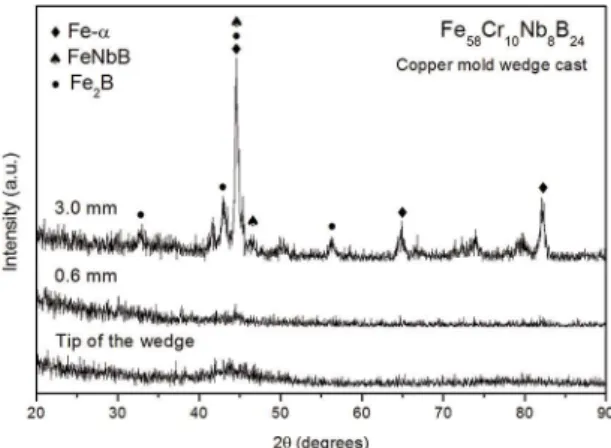
0.6 mm thickness and this is in agreement with Figure 4, where it can be observed that the early crystallized phases appear in the range of 0.6 to 1.0 mm. Combining the SEM and XRD analysis, the experimental critical thickness, ZC, of around 0.6 mm for Fe58Cr10Nb8B24 alloy is lower than that theoretically predicted (3.56 mm as shown in Table 1).
For the Fe60Cr8Nb8B24 alloy, the same procedure of characterization of the bulk sample was performed by XRD and SEM. Combining the SEM and XRD analysis, the experimental critical thickness (ZC) achieved was approximately 1 mm for this alloy, which is lower than that
Figure 4: (a) Scanning electron micrograph (BSE) showing the critical thickness for the wedge specimen of Fe58Cr10Nb8B24 alloy; (b) morphology of the crystallized phases.
Figure 5: X-ray difraction patterns of samples extracted from regions of diferent thicknesses of a copper mold wedge cast alloy.
theoretically predicted in this paper (4.35 mm as shown in Table 1) and also lower than that theoretically predicted by Cheney and Vecchio (3.4 mm)11.
Studies to determine the experimental critical thickness by using the bulk wedge-shaped casting method, as seen in this
paper, is widely used in this ield of research. Nevertheless,
the reproducibility of this method is a challenge, as reported by Sanders et al.15, where the experimental critical thickness for Al86La5Ni9 alloy reported was 685±95 µm after processing three samples. In view of this, the critical thicknesses for the Fe-Cr-Nb-B presented here might be higher, by improving the experimental procedures such as optimizing the alloy preparation and processing parameters. Therefore, the three compositions considered in this paper were ranked and this is in agreement with that predicted theoretically: the GFA decreases with increasing Cr content.
4. Conclusions
Rapidly solidiied glassy ribbons were processed, and
based on their thermal characteristics, the theoretical critical thickness (ZC) was obtained. The estimated ZC of the two
new compositions with a higher Cr content were lower than those estimated by Cheney and Vecchio11. Furthermore, the critical thickness (Zc) was obtained experimentally using the wedge-shaped casting method, however this value of Zc was much lower than the one estimated theoretically. Furthermore, the GFA ranking among the three compositions studied here was established experimentally and is in agreement with that predicted theoretically, which foresaw that GFA decreases when the Cr percentage is increased. The glass forming ability of Fe58Cr10Nb8B24, with a fully amorphous bulk sample which was around 0.6 mm thick according to the DRX analysis (estimated theoretically as high as 3.56
mm), ofers a good prospect for a new Fe-based glass former
alloy with improved corrosion resistance compared with the already reported Fe60Cr8Nb8B24 alloy.
5. Acknowledgements
The authors would like to thank FAPESP (ProjetoTemático
n. 2013/05987-8) and CNPq for the inancial support. The
authors would also like to thank Mr. Filipe Belandrino Swerts and Mr. Victor Felipe Moscoso Linares for their help in processing the samples.
6. References
1. Suryanarayana C, Inoue A. Iron-based bulk metallic glasses.
International Materials Reviews. 2013;58(3):131-166. 2. Archer MD, Corke CC, Harji BH. The electrochemical properties
of metallic glasses. Electrochimica Acta. 1987;32(1):13-26. 3. Wang SL, Li HX, Zhang HF, Yi S. Efects of Cr contents in
Fe-based bulk metallic glasses on the glass forming ability and the corrosion resistance. Materials Chemistry and Physics. 2009;113(2-3):878-883.
5. Pang SJ, Zhang T, Asami K, Inoue A. Synthesis of Fe–Cr–Mo– C–B–P bulk metallic glasses with high corrosion resistance.
Acta Materialia. 2002;50(3):489-497.
6. Jayaraj J, Kim KB, Ahn HS, Fleury E. Corrosion mechanism of N-containing Fe–Cr–Mo–Y–C–B bulk amorphous alloys in highly concentrated HCl solution. Materials Science and
Engineering: A. 2007;449-451:517-520.
7. Bakare MS, Voisey KT, Chokethawai K, McCartney DG. Corrosion behaviour of crystalline and amorphous forms of the glass forming alloy Fe43Cr16Mo16C15B10. Journal of Alloys
and Compounds. 2012;527:210-218.
8. Ni HS, Liu XH, Chang XC, Hou WL, Liu W, Wang JQ. High performance amorphous steel coating prepared by HVOF thermal spraying. Journal of Alloys and Compounds. 2009;467(1-2):163-167.
9. Kiminami CS, Souza CAC, Bonavina LF, de Andrade Lima LRP, Suriñach S, Baró MD, et al. Partial crystallization and corrosion resistance of amorphous Fe-Cr-M-B (M = Mo, Nb) alloys. Journal of Non-Crystalline Solids. 2010;356(44-49):2651-2657.
10. Souza CAC, Bolfarini C, Botta Jr. WJ, de Andrade Lima LRP, Falcão de Oliveira M, Kiminami CS. Corrosion resistance and glass forming ability of Fe47Co7Cr15M9Si5B15Y2 (M=Mo, Nb) amorphous alloys. Materials Research. 2013;16(6):1294-1298.
11. Cheney J, Vecchio K. Development of quaternary Fe-based bulk metallic glasses. Materials Science and Engineering A. 2008;492(1-2):230-235.
12. Marcus M, Turnbull D. On the correlation between glass-forming tendency and liquidus temperature in metallic alloys. Materials
Science and Engineering. 1976;23(2-3):211-214.
13. Lu ZP, Liu CT. A new glass-forming ability criterion for bulk metallic glasses. Acta Materialia. 2002;50(13):3501-3512. 14. Takeuchi A, Inoue A. Mixing enthalpy of liquid phase calculated
by miedema’s scheme and approximated with sub-regular solution model for assessing forming ability of amorphous and glassy alloys. Intermetallics. 2010;18(9):1779-1789.