Inluence of the concrete structural coniguration
in the seismic response
Estudo da inluência da coniguração estrutural na
resposta sísmica de uma estrutura de concreto armado
a Universidade de Brasília, Brasília D.F, Brasil.
Received: 26 Jun2015 • Accepted: 14 Jul 2015 • Available Online: 24 Nov 2015
Abstract
Resumo
The recent increase in seismic records in Brazil boosted the publication of NBR 15421 (ABNT, 2006) - Design of Earthquake-Resistant Structures- which requires the seismic loads to be considered in the design due to the dissipation of energy in the inelastic regime structures and seismicity of the Brazilian territory. Many buildings built before the publication of this code were not designed to withstand seismic activity, increasing its fragility and
vulnerability to earthquakes of any intensity. Some of these buildings were designed and built with irregular distributions of mass, stifness or resis
-tance over its height, which can lead to insuicient seismic performance. Therefore, it is essential for engineers to understand the seismic response of structures with irregular distributions of mass, stifness or resistance along its height, which are referred to in this paper as structures with irregulari -ties. In this sense, the aim of this work is to evaluate the seismic behavior of a reinforced concrete structure with horizontal structural irregularities
by observing their inluence in the loss of the ability to resist lateral loads and energy dissipation. For this purpose, were used the Equivalent Lateral Force (ELF) Method, Modal Response Spectrum (RSA) Method and Pushover Analysis, described in NBR15421: 2006 [1] standard and the Ameri
-can Standard FEMA 356 [2]. Similarly, the seismic behavior of models using the capacity spectrum method deined in the ATC-40 [3] was calculated. All results were compared with those obtained from a regular structure classiied as the reference model or base case, in order to view the various
changes caused by irregularities. The proposed study was carried out numerically and the simulations were performed using CSI ETABS Nonlinear ® v9.5 program. The results show that the ability of the structure to withstand collapse depends on the plasticity of its elements and of the adequate details to permit response without critical loss of strength of the structural system.
Keywords: seismic analysis, seismic resistant structures, irregular structures.
Os recentes aumentos dos registros de abalos sísmicos no Brasil impulsionaram a publicação da NBR 15421:2006 [1] – Projeto de Estruturas Resistentes a Sismos – na qual são deinidas as cargas sísmicas a serem consideradas no projeto em função da capacidade de dissipação de energia no regime inelástico das estruturas e da sismicidade do território brasileiro. Algumas ediicações construídas antes da publicação dessa norma não foram projetadas para resistir a ações sísmicas aumentando a sua fragilidade e vulnerabilidade para terremotos de qualquer intensidade. Observa-se ainda que alguns desses edifícios foram projetados e construídos com distribuições irregulares de massa, rigidez ou resistência ao longo da sua altura que podem levar a um desempenho sísmico inadequado. Assim, torna-se essencial para os engenheiros e projetistas uma melhor compreensão dos efeitos dos abalos sísmicos no comportamento sísmico de ediicações, especialmente aquelas com diversas irregularidades. Por simplicidade, utiliza-se neste trabalho o termo “estruturas irregulares” para referenciar estruturas como as descritas. Nesse sentido, o objetivo deste
trabalho é avaliar o comportamento sísmico de uma estrutura de concreto armado de oito pavimentos e com diversas irregularidades introduzidas
na planta da mesma, a im de veriicar a inluência dessas irregularidades na perda da capacidade de resistir cargas laterais e dissipação de energia, as quais são calculadas utilizando o método dinâmico espectral e uma análise pushover, procedimentos descritos nas normas NBR15421:2006 [1] e na norma americana FEMA 356 [2]. Do mesmo modo, calcula-se o desempenho sísmico dos modelos usando o método do espectro de capacidade deinido na norma ATC-40 [3]. Todos os resultados são comparados com os obtidos para uma estrutura totalmente regular chamada de caso base ou de referência, com o intuito de visualizar as diversas mudanças provocadas pelas irregularidades. O estudo proposto é realizado de forma numé
-rica e as simulações são feitas no programa CSI ETABS® Nonlinear v9.5 [4]. Os resultados mostram que a capacidade da estrutura dependerá da
plasticidade de seus elementos para não colapsar e do detalhamento adequado para garantir o bom funcionamento do sistema resistente.
Palavras-chave: análise sísmica, estruturas resistentes a sismos, estruturas irregulares.
L. A. P. PEÑA a
G. N. D. DE CARVALHO a
1. Introduction
The development of cities and their growing population has leads to a shortage of space and the spread mid-rise buildings. This type of construction can be very vulnerable to one of the most
destruc-tive natural phenomena: earthquakes. According to Santos et al. [5] in the smaller buildings of 20 stories, the inluence of seismic activity may be as important as the efects of wind.
Brazil is largely in the central region of the South American Plate,
which is a stable area. However, part of the country near the edges of the plate, where there have been considerable seismic activity and there is still the possibility of intraplate earthquakes. There are about 40 seismically active faults, including faults in the central
re-gion of the South American plate, from north to south. Failure BR-47, for example, cuts the state of Minas Gerais and has already
recorded a 4.7-magnitude earthquake in the city of Itacarambi in 2007. Therefore, these conditions have favored the development
of a Brazilian Code, NBR 15421:2006 - Design of seismic resistant structures - Procedure [1] - to select locations where structures subject to seismic action require speciic actions and controls. Since 2006, research aiming to evaluate the efects of earthquakes
on structures has been increasing in Brazil, but there are few studies compared to countries with high seismic activity and high economic
growth. In general, these studies make comparisons between difer -ent seismic design standards in South America, as well as the main
parameters that inluence the natural period of the structure, the im -portance of seismic acceleration and the type of soil at the site where
the building is constructed. The work of Santos et al. [6]; Miranda [7] and Parisenti [8] outlined some of the highlights in this area.
Santos et al. [6] published a comparative study of South American
seismic design standards with special attention to the following
de-sign parameters of the building: return period for the establishment
of the application of seismic forces, seismic zoning, response
spec-tra design, liquefaction efects, among others. Miranda [7] aimed to
estimate the seismic vulnerability in some constructions in a
quali-tative manner using the Hirosawa method and NBR15421: 2006 [1]. Similarly, Parisenti [8] carried out a study of dynamic analysis of reinforced concrete buildings subjected to earthquakes, aimed at assisting engineers in the implementing the NBR15421: 2006 [1] in structural projects.
Many buildings constructed in the country have asymmetrical loor
plans and asymmetrical front elevation. In general, these changes in earthquake-resistant standards are called irregularities and
in-luence the ability of the structure to dissipate the energy gener -ated by earthquakes. In the most of the work done in the country
is observed that the study of the inluence of these changes on the
seismic behavior is rare.
In the international context, several researchers have provided
useful information on the study of structural irregularities located in
the front elevation, such as Chintanapakdee and Chopra [9] Galín
-dez [10] Michalis et al. [11] Peña [12] Bobadilla and Chopra [13] Jianmeng et al. [14] Le Trung, et al. [15] and Inan et al. [16].
These researchers worked with a symmetrical (regular) structure,
introducing along its height diferent distributions of mass, stifness
and strength, called vertical irregularities. These irregularities were
examined one by one through linear dynamic analysis, nonlinear dy -namic analysis and nonlinear static analysis or pushover analysis, in order to know the changes in the structural behavior under seismic actions and the possible failure mechanisms that may arise.
However, researches on the efects of earthquakes on structures that present uneven distribution of mass, stifness or resistance located on the loor plans of the buildings seems to be insuicient.
This work aims to study the seismic behavior of a reinforced
con-crete structure with eight loors and various horizontal structural irregularities located in loor plan, in order to evaluate the inluence
A
B
Figure 2 – Horizontal structural irregularities – (a) re-entrant corner irregularity;
(b) diaphragm discontinuity irregularity
of such irregularities in the loss of the ability to resist lateral loads
and the ductility. For this purpose the Equivalent Lateral Force Analysis, Modal Response Spectrum Analysis and Pushover Anal
-ysis, described in NBR15421: 2006 [1] standard and the American Standard FEMA 356 [2], are used. In addition, the seismic perfor
-mance of the models using the capacity spectrum method deined in the American Standard ATC-40 [3] was calculated.
2. Methodology
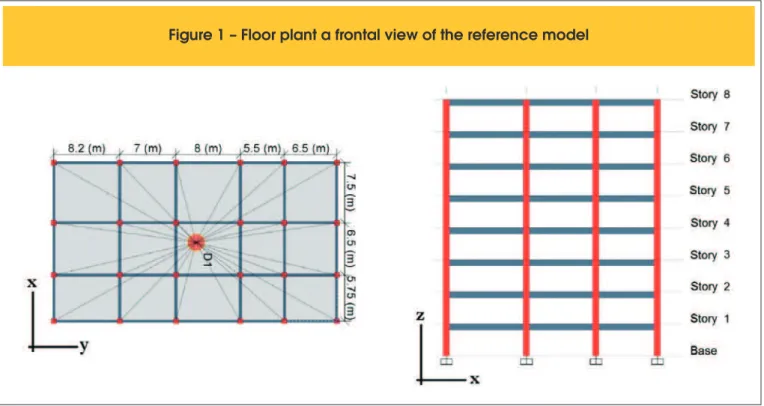
A symmetrical building as shown in Figure [1] was initially con
-sidered. This building has a rectangular plan of 19.75 m x 35.2 m
and consists of special reinforced concrete frames, columns of 60
x 60 cm and beams of 28 x 60 cm. The height between loors is 3
meters and the total height is 24 m, hypothetically located in the city of Brasilia. Elevators, escalators, electrical construction, sani-tary hydroelectric systems, air conditioning, among others, were
not considered in the structural model except the lid of the water
tank. The properties of the materials used in this work are provided
by NBR 6118: 2014 [17]:
n Compressive concrete characteristic strength (fck) = 21 MPa;
n Modulus of elasticity of concrete (ECi) = 210.00 MPa;
n Unit weight of concrete (γ) = 25 kN/m³;
n Characteristic strength of steel or yield strength (fy) = 410 Mpa;
n Modulus of elasticity of steel (ES) = 200000 MPa.
To assess the response of the model shown in Figure [1], each loor slabs were modeled as rigid diaphragms considering NBR15421:2006 [1], indicating that the rigid diaphragm is con -sidered if the width to depth ratio of the diaphragm is less than three. These diaphragms are horizontal three-dimensional struc-tures, where one of their main functions is to distribute the hori-zontal forces to the vertical resisting elements in direct proportion to the relative rigidity. The diaphragm is not deformed and likewise
causes each vertical member to delect the same amount.
In the structure of Figure [1] the center of the rigid diaphragm “D1”
coincides with the center of mass and the center of rigidity of the
loor plan. Therefore, this structure can be considered symmetrical
in the horizontal, which is the reference model in numerical analysis. In this reference model were introduced two types of horizontal
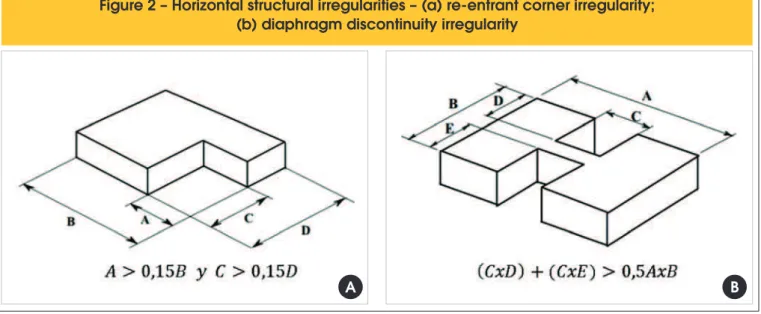
irregularities deined in NBR 15421:2006 [1] as “re-entrant corner
irregularity” and “diaphragm discontinuity irregularity”, illustrated in
Figure [2]. In Figure [2a], the letters “B” and “D” correspond to the
length and width of the structure, “A” and “C” characterize the
ir-regularity. In the case of Figure [2b], “A” corresponds to the length
of the structure, “B” indicated the width of the structure while “E”, “D” and “C” characterize the irregularity.
For modeling and analysis of these irregularities, four models were deined and are shown in Figure [3], in which the irregularities in
-dicated in Figure [2] were located in many parts of the structure repeating on every loor of the same.
Numerical analysis was conducted in two stages. The irst stage,
for each model a static and dynamic analysis was performed to calculate the absolute displacements and story drift in order to
estimate the lateral stifness of each model. The methods used in this stage are elucidated in the NBR 15421:2006 [1]: Equiva
-lent Lateral Force Analysis (ELF) and Modal Response Spectrum
Analysis (RSA). In the second stage, employed a nonlinear static
pushover analysis to estimate the loss of lateral stifness and dis -sipation of energy due to the introduction of irregularities in the
reference model. FEMA 356 [2] explains this method. Finally, the
seismic performance of the models was calculated using the
Ca-pacity Spectrum Method deined in in ATC-40 [3] standard.
2.1 Computational tool
In this study, all analyses were performed with ETABS (Extend -ed Three Dimensional Analysis of Building Systems) program.
ETABS [4] is a computational program based on the Finite Element
Figure 4 – (a) Frame object; (b) Shell object
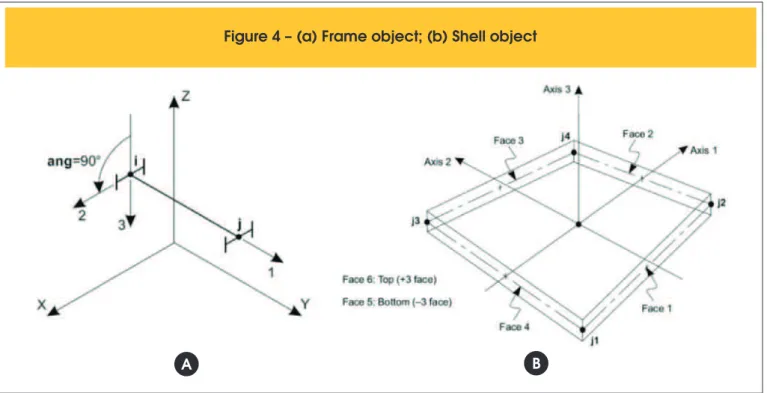
Method for the analysis and structural design of buildings. In this program, beams and columns are modeled with Frame element. This element has two nodes denoted by I and J with six degrees
of freedom per node: three translations and three rotations on the axes 1, 2 and 3. The Frame element used is shown in Figure [4a].
To represent the concrete slabs was employed a Shell element,
illustrated in Figure [4b]. This element has four nodes (j1, j2, j3, j4) with six degrees of freedom, three translations called U1, U2 and U3 and three rotations denoted by R1, R2, R3.
3. Numerical simulations
As mentioned, the numerical analysis was performed in two stages.
On the irst stage, the Equivalent Lateral Force (ELF) Method and Response Spectrum (RSA) Method (given by NBR 15421:2006 [1])
to calculate the seismic response and story drift were used. These
values were calculated on the center of mass of loor plan. On the second stage, the pushover technique (given by FEMA 356 [2]) was
used to estimate the capacity of the structure to resist lateral loads as soon as new irregularities are introduced in the models.
Torsion occurs under the action of seismic forces when the
cen-Figure 5 – Brasília response spectra
for a < 0,10g - NBR 15421:2006 [1]
gTable 1 – Natural frequencies and associated modes of vibration to each model
Reference model
# modes of
vibration T [s] Γx [%] Γy [%]
1 0,983 77,16 0,78
2 0,958 78,26 79,95
3 0,858 80,72 80,97
4 0,308 90,47 81,1
5 0,301 90,65 90,94
Model 2
# modes of
vibration T [s] Γx [%] Γy [%]
1 0,939 72,76 7,48
2 0,934 80,29 80,63
3 0,868 80,55 80,67
4 0,294 89,72 81,75
5 0,292 90,81 90,87
Model 1
# modes of
vibration T [s] Γx [%] Γy [%]
1 0,935 78,94 0,0011
2 0,929 78,96 80,1
3 0,855 80,62 80,71
4 0,293 90,67 80,71
5 0,291 90,67 90,91
Model 3
# modes of
vibration T [s] Γx [%] Γy [%]
1 0,934 79,98 0,3
2 0,922 80,28 80,63
3 0,87 80,47 80,63
4 0,292 90,8 80,66
5 0,288 90,83 90,88
Model 4
# modes of
vibration T [s] Γx [%] Γy [%]
1 0,927 80,32 0,0004
2 0,907 80,33 78,54
3 0,87 80,38 80,58
4 0,289 90,77 80,58
ter of mass of a building does not match the center of stifness. In order to prevent elevated values of torsion on the loor plan of the models of Figures [1] and [3], was veriied that the distance between the center of stifness and the center of mass parallel to each major axis was lower than 5 percent of the greatest width of the loor plan parallel to that axis.
3.1 First stage
It is considered that the building of Figure [1] is used for residence
and is located in Brasilia City. The characteristic soil of Brasilia is a
porous clay with SPT larger that 40 (N = 40) (Alves [18]). From these information and following the NBR 15421:2006 [1], assumed that:
n Seismic zone zero;
n Soil Type D (hard ground) - SPT with N = 40;
n The response modiication factor of one (R = 1) for all mod -els, therefore, the seismic base shear forces obtained
are elastic;
n Importance Factor of one (I = 1).
According to NBR 15421:2006 [1], the response spectrum for horizontal accelerations corresponds to the maximum elastic re -sponse of a system of one degree of freedom with a fraction of critical damping equal to 5 percent. Thus, in the spectral analysis was considered a horizontal seismic acceleration 0.025g (zone 0 -
GMT) and the spectrum shown in Figure [5], the curve correspond -ing to soil type D.
In the ETABS [4] program it is possible to make a spectral analy -sis introducing the response spectra and the damping ratio, but it is necessary to set the number of vibration modes. According to
Chopra [19] must be considered three modes of vibration per loor,
therefore, used in each model 24-vibration modes.
In the modal spectral analysis must consider all modes that have
signiicant contributions to the to the structure’s response. The
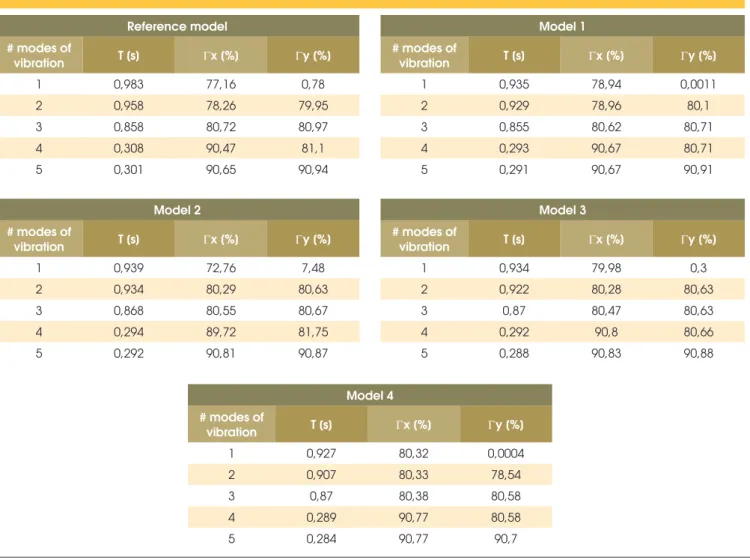
number of modes used in the analysis must be larger enough for the modes to represent at least 90 percent of the total mass of the
structure. In this work, the irst ive vibrational modes were suf
-icient to capture more than 90 percent of the mass of the structure as illustrated in Table [1]. Following, the maximum responses of
the structure were obtained from a combination of the response of each of the modes using the CQC (Complete Quadratic
Combina-tion) Method available in ETABS [4] program.
According to NBR 15421:2006 [1], the spectrum should be applied
in each of the orthogonal directions of models, 100 percent of the
forces for one direction plus 30 percent of the forces for the per -pendicular direction. As mentioned, CQC Method for bidirectional load combination was used.
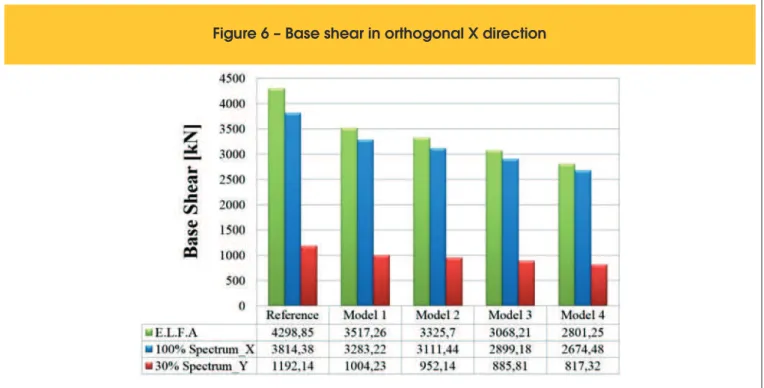
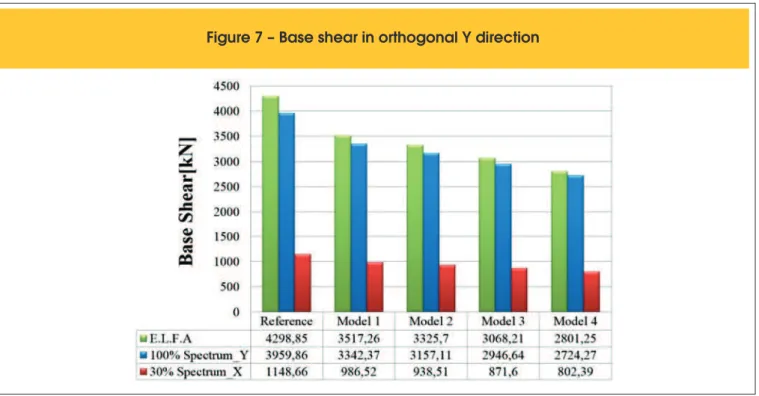
The results obtained with the two methods described in
NBR15421:2006 [1] shown in igures [6] and [7]. These igures il -lustrate the calculated orthogonal horizontal forces in X and Y di-rections for each model.
According to NBR 15421:2006 [1], the forces obtained from the
Response Spectral Method should be larger than 85 percent of
the calculated force to the ELF Method. It is noted in Figure [6] that
model 1 has a force on the base in the orthogonal X direction of
4298.85 kN calculated using ELF Method. For the RSA method, the force in the base in the same orthogonal direction was 3814.38
kN, being larger than 85 percent of the force obtained with the
ELF method. Therefore, the irst model meets the code require -ments. Analyzing the results of the other models was concluded
that all other designs exhibit the same behavior. Consequently, it
proceeds to calculate the drifts using the results form RSA method.
The maximum displacements calculated on top of each model are listed in Table [2] and are compared with those obtained in the
pushover analysis to assess the seismic demand of the models.
The maximum drift may not exceed 2 percent of the height of the story according to NBR 15421:2006 [1]. In all models, the height
Figure 7 – Base shear in orthogonal Y direction
Table 2 – Maximum displacements measured
at the top of the models obtained from
response spectrum analysis in two
orthogonal directions
Model δDIRECTION-X
[cm]
δDIRECTION-Y
[cm]
Reference 3,41 3,34
1 2,63 2,62
2 3,14 3,11
3 3,16 3,08
4 3,12 2,98
is 3.0 m between stories; therefore, the maximum drift may not exceed 0.06 m or 6 cm. Figure [8], the maximum drift in the ive models was approximately 4.69 cm in the orthogonal direction X
and 4.67 cm in the orthogonal Y direction. In both cases, drifts did
not exceed the maximum value.
An initial estimative of lateral stifness of the models could be obtained by analyzing the drifts of Figure [8]. Note that the maximum drifts in
the orthogonal X direction were slightly higher in relation to Y direction,
so it is understood that in the X direction the lateral stifness is less by presenting high displacements. It can be seen in igures [1] and [3]
that in X direction the structure has fewer connections relative to the Y direction to balance the applied load and to dissipate the energy generated by such forces. Could be say that the elements located in the X direction are less able to withstand lateral loads than the el-ements located in the other orthogonal direction. Then, a nonlinear static analysis is performed to corroborate these results.
3.2 Second stage
At this stage, a nonlinear static analysis or pushover analysis
de-scribed in American Standard FEMA 356 [2] was performed. Push -over analysis is a series of incremental static analysis carried out to develop a capacity curve for the building. This technique is
avail-able in ETABS program [4].
A Pushover analysis produces a capacity curve that presents the
relationship between the base shear and roof displacement (mea-sured in one point named as control node). To obtain this curve, the
building is subjected to an incrementally lateral load until it reaches the maximum displacement (called target displacement) at a con
-trol node. FEMA 356 [2] recommends a target displacement equal
to 4 percent of the total building height. In this work, the center of
the rigid diaphragm “D1” (Figure [3]) was used as a control node.
The capacity curve is generally constructed by the fundamental
vibration mode according to FEMA 356 [2]. This is generally valid
for buildings with fundamental periods of vibration up to about one
second. It is observed in Table [1] that all models meet this require -ment, consequently, this procedure was used.
Pushover analysis requires the development of the force-deforma
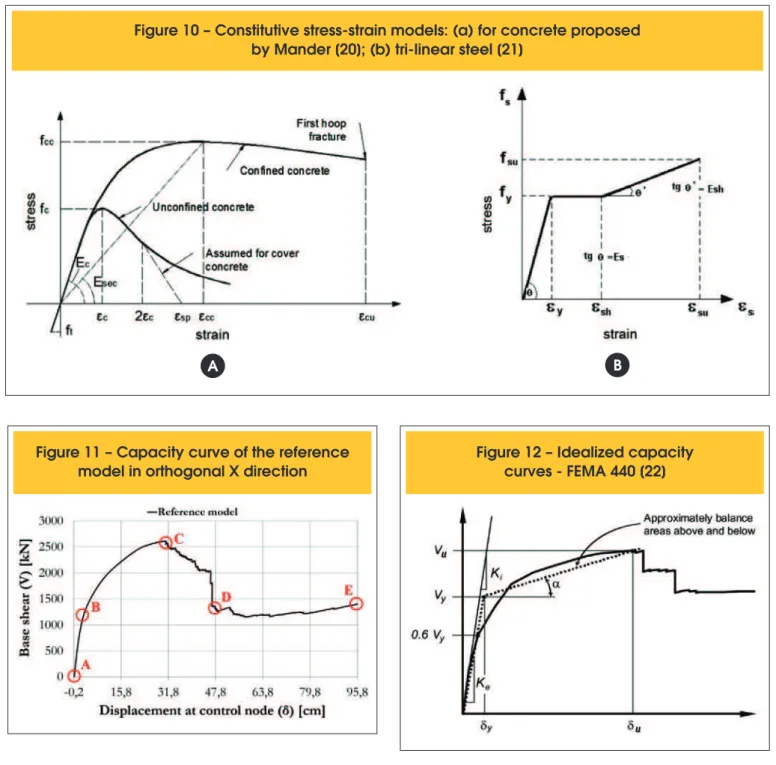
-tion curve in the critical sec-tion of beams and columns using FEMA 356 [2] (Figure[9]), the Mander’s [20] constitutive models for con
-ined concrete (Figure [10a]) and tri-linear model for steel (Figure [10b], Falconi [21]).
In Figure [9], the linear response is depicted between point A (un
-loaded component) and an efective yield point B. The slope of the BC line represents the strain hardening. Point C indicates
the nominal strength of the structural element. The CD line
corresponds to an initial failure of the member. Finally, point E indicates inal loss of resistance or structural collapse. At de -formations greater than point E, the component strength is
structural elements are represented by means of plastic hinges
and are located at the extremes of the beams and columns. Therefore, using the method described in FEMA 356 [2] in the sym -metric model and considering the criteria described above, the
re-sult is the global capacity curve illustrated in Figure [11]. This curve
represents the global nonlinear behavior of the structure and the
slope at any point indicates the lateral stifness of the structure.
Under incrementally increasing lateral load, the structure compo-nent yielded.
In Figure [11], the AB line represents the elastic behavior of the
structure, where the point “B” denotes yield point. The slope of
the BC curve represents the strain hardening. Point C indicates the nominal strength of the structural element and the inal capac
-ity of the structure according FEMA 356 [2]. Therefore, in this pa
-per is only used the AC segment of the capacity curve. Point C represents the inal deformation and the whole loss of rigidity of
the structure. Beyond point D, the element responds with substan-tially reduced strength to point E. The seismic design standards
For this purpose, has been used an iterative procedure graph
which balances the upper and lower sections of the curve as
shown in Figure [12]. FEMA 356 [2] and FEMA 440 [22] deine this method. In the Figure [12], VY corresponds to yield strength
of the building in the direction under consideration, δY is the dis-placement produced by VY and called yield displacement, VU is
the base shear that causes the collapse of the irst structural com
-ponent and δU the rupture or collapse displacement produced by VU. The bilinear models for the two orthogonal directions of all the
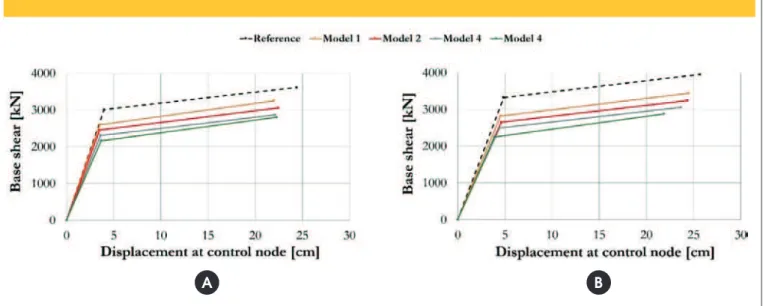
analyzed cases are shown in Figure [13]. The comparison of the
bilinear models obtained for structures with irregularities in rela-tion to those obtained for the reference model in two orthogonal
directions is shown in Figure [14]. In Table [3] can be observed the displacements δY and δU.
!!!" ! # !$%&' ()$*+,,!- - &
by Mander [20]; (b) tri-linear steel [21]
B
B
A
Figure 11 – Capacity curve of the reference
./01234567/8/93:2;<=38<>?@3A:B:A/?CA12D3?<3:A@;<=38
δY [cm] δU [cm] mx δY [cm] δU [cm] my
Reference 3,98 24,38 6,13 4,86 25,69 5,29
1 3,51 21,96 6,26 4,53 24,49 5,41
2 3,50 22,45 6,42 4,61 24,36 5,29
3 3,60 22,10 6,13 4,43 23,65 5,34
A
B
Figure 14 – Comparison of bilinear models of the cases analyzed – (a) X-direction; (b) Y-direction
In the previous igures, it is observed that in all models the forces
that generate yield (VY) and collapse (VU) decrease as horizontal
irregularities are introduced into the reference model. Furthermore,
the frames located in orthogonal Y direction require a greater force to generate yield or collapse compared to frames located in the
or-thogonal X direction. Figure [14] shows that the lateral stifness of the model 4 varies signiicantly compared to the reference model in
the two orthogonal directions with a reduction in yield strength and the collapse of up to 28 percent in the orthogonal X direction and
38 percent in the orthogonal Y direction.
Using bilinear models is possible to calculate the available ductility of each model analyzed. Ductility was calculated as the ratio
be-tween the collapse displacement (δU) and the yield displacement
(δy). Table [3] presents the ductilities calculated for each model. In the Table [3], it is observed that in all cases analyzed ductility in
the orthogonal X direction was higher compared to the orthogonal
Y direction, exceeding the value of the ductility of the reference model and resulting in more lexible structures. The table also
shows that the model 4 presented a ductility value in the X direc-tion smaller than the other models. This means that there was a force concentration in some points of this model, which has in-creased the stresses and strains values causing the collapse with forces with low intensity compared to others models.
A sense of the seismic performance in the models can be
ob-tained by comparing the maximum spectral displacements (Ta
-ble [2]) with the displacements obtained from nonlinear analysis (Table [3]). In all cases, the maximum spectral displacement was
smaller than the yield displacement, which indicates that all ana-lyzed models had a linear elastic behavior and the seismic design was well conceived.
Building performance level can be determined using the Capacity
Spectrum Method deined in ATC-40 [3]. The capacity spectrum
method allows for a graphical comparison between the structure capacity and the seismic demand. This method aims to estimate
the maximum displacement required, called performance point.
The performance point is obtained by superimposing the response spectrum curve (represents the seismic demand) on the global ca-pacity curve (lateral resisting caca-pacity) into spectral coordinate or ADRS (Acceleration Displacement Response Spectrum) format.
The capacity curve points (V, δ) are transformed into spectral coor -dinates (SD, SA) so that the capacity curve and the demand curve
are in the same format. The results are shown in Figure [15].
If the elastic response spectrum intersects the linear range of the
capacity spectrum, this point is called the Performance Point and represents the maximum displacement of the structure submitted to the proposed action. In Figure [14] the maximum displacement
of each model is less than respective yield displacement (Table
[3]), therefore the analyzed models had a linear elastic behavior. As expected, as the model becomes irregular, the performance
point is near to the yield point. Consequently, the recommendation is to work wherever possible with symmetric structures, as they
tend to distribute eforts in a uniform way, reducing the likelihood of damage to structural elements, as well as reducing the efects
of rotation (torsion).
4. Conclusions
The design of a building structure involves the establishment of an
appropriate combination of the various existing structural elements and on the deinition of the actions to meet safety requirements,
durability, aesthetics, and functionality, among other parameters
that buildings must be submitted. A great design deines the struc -tural quality of a property that is crucial for earthquake resistance. Often small or moderate earthquakes cause severe losses if they occur in an area whose buildings were not designed with the nec-essary calculation considerations.
From the analysis of seismic behavior of a symmetrical structure
model. It was found that an uneven structure could operate in the elastic regime, which is achieved by appropriate detailing, thus ensuring that the energy dissipation mechanism works properly. In this case, the capacity to structural collapse depends on the
plasticity of its elements. It is more important to pay attention to details that create a good structural redundancy, which means increasing the number of to balance the applied loads and dis-sipate energy generated by earthquakes.
EFGHIJKLMNOOJPJIQRFSTUFVWPQOJXJTRYJVWSTVJZWJORIHX[NUYZ\
If it is not possible to dissipate seismic energy through the
plastic-ity of structural components, the use of external devices that could
help in this role would be necessary.
5. References
[1] ASSOCIAÇÃO BRASILEIRA DE NORMAS TÉCNICAS. Projeto de estruturas resistentes a sismos – Procedimento, NBR 15421:2006. Rio de Janeiro, Brasil, 2006.
[2] FEDERAL EMERGENCY MANAGEMENT AGENCY. NHERP. Guidelines for the seismic rehabilitation of buildings (FEMA 356), Washington, D.C, U.S.A, 518p, 2000.
[3] SEISMIC EVALUATION AND RETROFIT OF CONCRETE BUILDINGS. Applied Technology Council (ATC-40), Red -wood City, California, U.S.A, 1996.
[4] ETABS. Extended Three Dimensional Analysis of Building
Systems - Nonlinear v9.7.2, Computers and Structures, Inc., California, U.S.A, 2010.
[5] SANTOS, S.H.C., SOUZA LIMA, S., SILVA, F.C.M. Risco sís
-mico na região Nordeste do Brasil. In: Revista IBRACON de Estruturas e Materiais, Vol. 3, No. 3, p. 374-389, Brasil, 2010. [6] SANTOS, S. H. C.; LIMA, S. S. and ARAI, A., Comparative
study of seismic standards in south american countries. 35th
International Symposium on Bridge and Structural
Engineer-ing, London, 2011.
[7] MIRANDA P. S. T. Avaliação da vulnerabilidade sísmica na realidade predial brasileira. Dissertação de mestrado – Uni
-versidade Federal do Ceará, Brasil, 2012.
[8] PARISENTI, R. Estudo de análise dinâmica e métodos da NBR-15421 para o projeto de edifícios submetidos a sismos. Dissertação de mestrado, Universidade Federal de Santa Catarina, Florianópolis, Brasil, 2011.
[9] CHINTANAPAKDEE, C. AND CHOPRA, A.K. Seismic re
-sponse of vertically irregular frames: re-sponse history and
modal pushover analyses. International Journal of Structural Engineering ® ASCE, 1777-1785, 2004.
[10] GALÍNDEZ, N. Desempeño de pórticos de acero resistentes a momento diseñados de acuerdo con la NSR-98. Tesis de Maestría, Facultad de Ingeniería, Universidad del Valle, Cali,
Colombia, 2005.
[11] MICHALIS, F., DIMITRIOS, V. AND MANOLIS, P (2006). Evaluation of the inluence of vertical irregularities on the seismic performance of a nine-story steel frame. WILEY In -teScience, Earthquake Engineering and Structural
Dynam-ics, No. 35:1489-1509, 2006.
[12] PEÑA, M. A. M. Análisis “push-over” de ediicios con pórticos
de acero en Bogotá. Tesis de maestría, Departamento de
Ingeniería del Terreno, Cartográica y Geofísica, Universidad Politécnica de Cataluña, Barcelona, España, 2010.
[13] BOBADILLA, H., CHOPRA, A.K. Evaluation of the MPA pro
-cedure for estimating seismic demands: RC-SMRF build
-ings. The 14th World Conference on Earthquake Engineer
-ing. Beijing, China, 2008.
[14] JIANMENG, M., CHANGHAI, Z. AND LILI, X. An improved
modal pushover analysis procedure for estimating seismic
demands of structures. Paper published in Earthquake Engi
-neering and Engi-neering Vibration, Vol. 7, No. 1, 25-31, 2008.
[15] LE-TRUNG, K., LEE, K., LEE, J. AND LEE, H. Evaluation
of seismic behavior of steel special moment frame buildings
with vertical irregularities. Paper published online Wiley On
-line Library, 215-232, 2010.
[16] İNAN, T. AND KORKMAZ, K. Evaluation of structural irregu -larities based on arquitectural design consideration in turkey.
Paper published in Structural Survey, Emerald Group Pub
-lishing Limited, Vol.29, No. 4, 303-319, 2011.
[17] ASSOCIAÇÃO BRASILEIRA DE NORMAS TÉCNICAS. Projeto de estruturas de concreto – Procedimento, NBR 6118:2007. Rio de Janeiro, Brasil, 2007.
[18] ALVES, P. C. (2009). Cartograia geotécnica para obras subterrâneas: condições de construções de garagens sub -terrâneas e metrô no plano piloto de Brasília. Dissertação
de Mestrado, Publicação G.DM 178/09, Departamento de
Engenharia Civil e Ambiental, Universidade de Brasília,
Bra-sília, DF, 168 p.
[19] CHOPRA, A.K. Dynamics of Structure, Vol. 1. Earthquake
Engineering Research Institute, University of California, Berkeley, U.S.A, 1995.
[20] MANDER, J. B.; PRIESTLEY, M. J. N. Theoretical stress-strain model for conined concrete. Journal of Structural En -gineering, v.114, nº 8, p. 1804-1826, 1988.
[21] FALCONI, R. A. Veriicación del desempeño en el diseño sismo resistente. In: Revista Internacional de Desastres Na -turales, Accidentes e Infraestructura Civil, Vol. 2, No. 1, p.
41-54. Puerto Rico, 2002.
[22] FEDERAL EMERGENCY MANAGEMENT AGENCY. NHERP.
Improvement of nonlinear static seismic analysis procedures.
(FEMA 440), Washington, D.C, U.S.A, 392p, 2005.
[23] GUERRA, C.J; QUINTANA, M.M. Desempeño sísmico de un ediicio aporticado de 5 pisos diseñado con el reglamento nacional de ediicaciones pero aceptando una deriva máx