*e-mail: [email protected]
Study of Hygral Behavior of NON-asbestos Fiber
Cement Made by Similar Hatschek Process
Carlos Eduardo Marmorato Gomesa*, Holmer Savastano Jrb
aDepartment of Architecture and Construction, School of Civil Engineering, Architecture and Urban Design, University of Campinas – UNICAMP, Campinas, SP, Brazil
bRural Construction Group, Department of Food Engineering, College of Animal Science and Food Engineering – FZEA,
University of São Paulo – USP, Pirassununga, SP, Brazil
Received: January 21, 2013; Revised: October 1, 2013
Fiber cement, similarly to all cementitious materials, undergoes dimensional and volumetric changes when it is exposed to dry and wet environments. When exposed to natural weathering, cement-based materials absorbs and may also release water to their surroundings via a very complex inherent pore structure. In this work initialized a few years ago, some properties of asbestos-free
iber cement composites were studied, such as density, porosity and loss or absorption of water. For the understanding of the behavior of this material, modiiers were employed in the cement matrix
such as styrene- acrylic, styrene-butadiene and vinyl acetate-versatic vinylester copolymers to verify
their inluence on the variables described above. All composites were analyzed by mercury intrusion
porosimetry (MIP). For monitoring the expansion/shrinkage movements, the specimens were exposed inside a controlled environmental chamber with constant temperature and relative humidity (RH) during the test time. The results showed no interference on hygral behavior because particular casting
process of these composites but, as showed by literature, increase of toughness. Also, it was possible to verify that moisture movement within the asbestos-free iber cement can be very complex and the
variables density and porosity (pore structure) play a very important role in the expansion/shrinkage properties of these composites.
Keywords: copolymers, fiber cement, moisture movement, expansion/shrinkage
1. Introduction
Cement-based composites exposed to natural weathering absorb water and may also release water to the surroundings via a very complex inherent pore structure. The extent of pore water exchange and the speed at which it occurs depend on numerous factors1, for example, the type of application (rooing or steel frame system), the shape of the product,
the temperature of the surrounding environment, the relative humidity, the weather conditions, the porosity and pore structure of the material, the orientation of structure
(anisotropy), the type of iber (cellulose or synthetic), the
type of coating or impregnation applied and the age of material.
After iber cement undergoes expansion or shrinkage it
may produce cracking and also to be aesthetically displeasing and eventually can lead to structural unsoundness and poor durability in a component. In Brazil, frequently failures
have been observed in joints of asbestos-free iber cement
sheets because the excessive moisture movements of these composites.
Various forms of shrinkage are associated with cementitious materials and since drying shrinkage is among the most troublesome, it is a useful tool for the performance evaluation in the development of improved materials.
It is evident from the factors mentioned above that it
would be an extremely dificult task to describe the exchange of water in the pores of cement-based iber composite during
exposure to natural weathering. In fact not much has been reported in the literature regarding the moisture movement
of asbestos-free iber cement.
In general, it is observed that in concrete the presence of large volume fractions of rigid aggregates retrains the
amount of moisture-induced movements. In iber cement composites the volume concentration of ibers is very low
compared to the aggregate volume and the matrix tends to be slightly richer in binder in comparison with normal concrete.
Although the transportation of pore water in iber cement
composites is complex, it is important to describe in general terms the behavior of the material under certain climatic conditions as the exchange of water in the pores results in dimensional changes (expansion or shrinkage) within the product. It is the reason for the study of the effect of water movement within the composites.
This paper shows the inluence of density, porosity (pore
structure) and sorption of water in the moisture movements
of asbestos-free iber cement where exchanges in these
2. Literature Review
2.1.
Asbestos-free fiber cement composites
Over the last decades many research studies related to the substitution of asbestos by other raw materials have
been published. In this way, natural ibers from different softwood and hardwood species and synthetic ibers such as polypropylene (PP) and polyvinyl alcohol (PVA) have been an important group of studied ibers.
Natural ibers are frequently characterized by the low
cost and poor durability because of vulnerability to chemical decomposition in the alkaline environment of cement.
Regardless, these ibers are very important in countries with
agricultural based economies2.
Synthetic (polymeric) fibers have become more attractive in recent years for reinforcement of cementitious
materials. In this way, PP and PVA have been studied extensively, with ibers formulated and produced speciically
for reinforcement of cement-based composites. However,
polymeric ibers present low modulus of elasticity compared
to asbestos. To increase the strength of the composites, the
ibers must have a modulus of elasticity greater than that
of matrix. For cementitious materials, where the modulus de elasticity ranges from approximately 15 to 30 GPa, this
condition is dificult to meet with synthetic ibers. Moreover, iber-matrix interface may constitute a problem to the
engineering of these composites3.
Asbestos is a natural occurring ibrous silicate very compatible with cement. Its chemical structure and its iber
size make composites of higher strength and lower moisture movements than asbestos-free cement-based composites.
This situation conirms the importance of understanding
the hygral behavior of these composites, one of the most important variables for asbestos replacement, principally in
applications such as corrugated sheets for rooing and lat
sheets for dry-wall buildings.
2.2.
Polymer addition
The concept of polymer modiication is well known and the irst patent was obtained in 1923. This patent refers to the use of cement as iller in polymer matrix. In 1924, the irst patent was published using the concept of polymer modiication for cement mortar and concrete4-7.
As a principle of polymer modification, it is very
important that both Portland cement hydration and polymer
ilm formation proceed well in order to producea monolithic matrix phase with a network structure in which the cement hydrate phase and polymer phase interpenetrate. The
modiication with redispersible polymer powders is similar
to that of latex formation except that it also involves the redispersion of the polymer powders8-15. In these cases, the modiication is governed by both Portland cement hydration and polymer ilm formation processes in their
binder phase16-22. The cement hydration process generally precedes the polymer ilm formation by coalescence of
polymer particle.
According to the theory, during the hydration of Portland
cement the hydrophilic part of the polymer is oriented towards the water phase whereas the hydrophobic part heads towards the air phase (pores and capillaries not pilled
with water). Upon drying, the water is taken away and the
hydrophobic particles coalesce together and form the ilm.
Drastic changes in the matrix properties such as density and porosity can be achieved by combining the matrix with polymers and it can also reduce the shrinkage of the composites3. It is the reason by which in this work the polymer addition is showed as one alternative to the studies
of moisture movements of non-asbestos iber cement. Due to their hygroscopic nature, iber cement composites are
sensitive to moisture changes in the material and in the ambient environment. Several studies have been conducted
to assess the performance of pulp iber-cement composites
under different moisture states, particularly in the wet and oven-dry states.
It was possible to verify in the literature some works about polymer-modified cement matrix reinforced by
E-glass and neither about other kind of iber. As related23, the GRFC (Glass Fiber Reinforced Cement) was developed by Bijen and Jacobs using a special acrylic polymer (Forton) which was developed for that purpose. In the production of
this composite, the tiny polymer latex particles iniltrate and ill the spaces between the ilaments in the strand and eventually coalesce into a ilm. Thus they can provide a
protective effect, both o reduce the chemical attack, and to reduce the extent of the microstructural mechanism, by eliminating the growth of dense and rigid hydration around
the ilaments. Also, some authors describe the formation of the ilm in the matrix provide an additional sealing effect
to slow down moisture movement, and consequently the
expansion/shrinkage of iber cementitious composites24-27.
3. Experimental
3.1.
Material
The materials employed for composite preparations were Portland Slag Cement according to EN 197-1 – European Standards28 - type (CEM II /B-S), cellulose pulp (solombola, Russian specie), Chinese PVA ibers
(length: 6 mm; diameter: 20 µm), carbonate powder as inert
iller, silica fume and styrene-acrylic, styrene-butadiene
and Va/Veova copolymers. Some characteristics of these materials are shown in Tables 1-6.
Table 1. Chemical analysis of Portland cement.
Chemical analysis of ordinary Portland cement (% by mass)
Element Average of 4
analyses
Standard deviation
SiO2 19.52 0.10
Al2O3 5.03 0.05
Fe2O3 3.02 0.04
CaO 64.76 0.10
MgO 0.62 0.03
SO3 2.85 0.03
CO2 2.25 0.28
K2O 0.70 0.01
Loss on ignition 2.86 0.16
3.2. General procedures
The established compositions are shown in Table 7. For
the analyzes of the inluence of density, porosity and pore
distribution on moisture movement of the composites, the range was formed by four compositions with different kinds
of copolymer (A - without copolymer; B - styrene-acrylic
addition; C - Va/Veova addition and D - styrene-butadiene addition).
The following procedure was employed for the mixing of
iber cements: (i) submission of the unreined cellulose pulp to a stirring process in water and post-reining by several passes through 300 mm disc reiner until the achievement of CSF 220 mL reinement degree; (ii) dispersion of PVA iber in water; (iii) dispersion of silica fume by ultrasonic
equipment; (iv) mixing of all these materials in water;
(v) addition of carbonate iller; (vi) addition of ordinary
Portland cement; (vii) high-speed mechanical mixing during 300 s; (viii) sheet molding by vacuum dewatering process; (ix) cutting of the specimens (160 mm × 40 mm × 5 mm) 24 h after production; (x) cure in water until the 28th day of age; (xi) preparation of the specimens for physical and mechanical tests and mercury intrusion porosimetry (MIP).
3.3. Physical and mechanical
characterization tests
Water absorption and bulk density results were obtained from the average of ten specimens for each formulation,
following the procedures speciied by ASTM C 948-8129. Mechanical (lexural) tests were performed in a universal
testing machine Emic DL-30000 equipped with 5 kN load
cell. A span of 135 mm and a delection rate of 5 mm/min were adopted in the lexural test. The delection during the bending test was collected by the delectometer positioned in
the down side of the specimen. Modulus of rupture (MOR) and toughness were obtained. The absorbed energy was
calculated by the integration of the load-delection curve
to the point corresponding to a reduction in load carrying capacity to 50% of the maximum observed. Toughness was
deined as the energy absorbed during the lexural test and
divided by the cross sectional area of the specimen.
3.4. Soak & dry accelerated ageing cycles
To study the inluence of product age on the studied
variables a soak & dry accelerated ageing cycles test was employed. It involved comparative analysis of the physical properties (water absorption and bulk density - except moisture movements) and mechanical performance of the composites before and after this test. The specimens were repeatedly immersed in water at 20 °C ± 5 °C during 170 min, followed by interval of 10 min, and then exposed to the temperature of 70 °C ± 5 °C for 170 min in a ventilated
oven and inal interval of 10 min. This procedure is similar
to ISO 833630, however it was based on recommendations of the EN 49431 Standards and carried out in automated equipment for the application of the successive cycles. Each soak & dry set represents one cycle and was performed by 100 times (i.e., 100 cycles). The moisture movements were
measured thru the expansion and shrinkage of the iber
cements composites, before and after their exposition to the Table 2. Physical characteristics of styrene-acrylic copolymer
dispersion.
Physical analyses
Solids content (% by mass) 50 ± 1*
Viscosity (MPa.s) 2,000-5,000
Glass Transition (°C) ~ –8
Apparent density (g/cm3) 1.0 ± 0.1*
Particle size (µm) 80 ± 10*
*Standard deviation.
Table 3. Physical characteristics of Va/Veova copolymer powder.
Physical analyses
Solids content (% by mass) 99 ± 1
Glass Transition (°C) ~ + 9
Apparent density (g/cm3) 0.45 to 0.60
Particle size (µm) 80 ± 10
Table 4. Physical characteristics of styrene-butadiene copolymer dispersion.
Physical analyses
Solids content (% by mass) 50 ± 1
Viscosity (MPa.s) 2,000-5,000
Glass Transition (°C) ~ +3
Apparent density (g/cm3) 1.0 ± 0.1
Particle size (µm) 80 ± 10
Table 5. Chemical analysis of carbonate iller.
Element (%)
SiO2 6.48
Al2O3 1.67
Fe2O3 1.10
MgO 18.8
CaO 31.6
Na2O < 0.10
K2O 0.40
SO3 0.14
Table 6. Chemical analysis of silica fume.
Element (%)
SiO2 93.5
Al2O3 0.43
Fe2O3 0.45
MgO 0.47
CaO 0.23
Na2O 0.16
K2O 0.83
-natural ageing of these materials (i.e., six months exposed to weathering).
3.5.
Water Sorption
The expansion/shrinkage properties of the composites were monitored in a controlled environmental chamber. The relative humidity and temperature were pre-conditioned (70% RH and 40 °C respectively) and kept constant by
speciic equipment (Thermotron). The specimens with 28 days of age were also pre-conditioned. A group of 20 specimens was established for each composition (A, B, C and D as in Table 7) being the irst ten specimens
pre-conditioned by submerging in water for 48 h at 25 °C and the other ten specimens dried in the temperature of
105 °C by 48 h. After these procedures, all specimens were
positioned inside the chamber and their expansion/shrinkage measured each week by a digital caliper. The behavior of the specimens was then plotted in expansion/shrinkage versus time curves.
3.6.
Moisture movement
For the determination of the moisture movement of
the iber cements, the specimens were pre-conditioned in the temperature of 105 °C by 48 h. After this, they were
cooled and measured by a digital caliper. Subsequently, the specimens were submerged in water at room temperature by 48 h. The moisture movement was obtained as function of the linear changes based on the length at dry and saturated conditions.
3.7.
Mercury intrusion porosimetry (MIP)
MIP analyses were carried out in a PoreSizer
9320 – Micromeritics equipment. At 28 days the specimens
were cut with a diamond saw and submitted to ultrasonic
cleaning equipment during 10 min. The samples were initially removed and vacuum-oven-dried at 40 °C for 24 h. The porosimeter used for pore size distribution was able to apply a pressure of approximately 410 MPa. For the analysis of the results, the intruded mercury values (intruded mercury volume by sample mass, in mL/g) were arranged within four distinct pressure intervals corresponding to different pore size ranges. The selected pore size ranges permit a good approach to cement matrix properties based on intruded
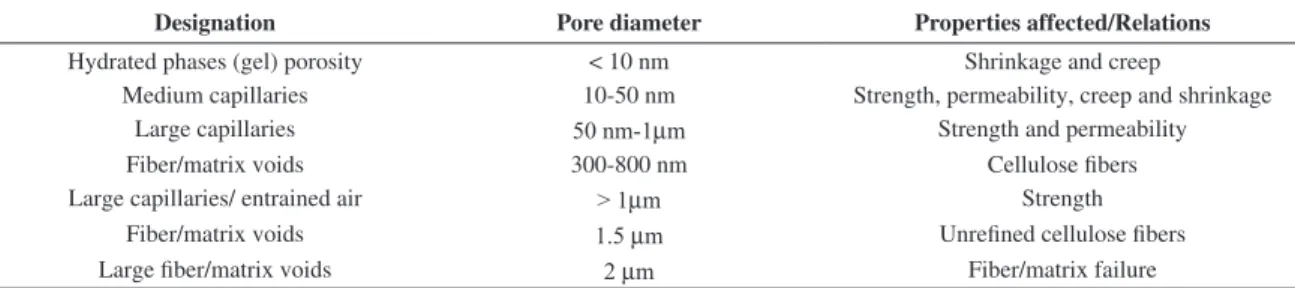
mercury volumes. According to literature9, these pore size ranges can be correlated to cement matrix properties as shown in Table 8.
All analyses mentioned above were carried out in the Faculty of Animal Science and Food Engineering of Pirassununga (FZEA), Institute of Physics of São Carlos and in the Institute of Chemistry of São Carlos, University of São Paulo.
4. Results and Discussion
Table 7 shows the mixture proportions analyzed. Tables 9-13 show the results of analyses. Results of moisture movement are shown in Table 14.
As seen in Table 10, the copolymer additions not change water absorption of the iber cements in the contents
employed. It is unlike the literature for cementitious composites such as mortars and concretes reinforced by
glass iber24-27. The authors attribute this particular behavior to water excess for mixing and consequently vacuum form to simulate Hatschek process adopted by the industry. In
this way, it turns not possible the formation of polymer ilm into matrices. Despite to be common the use of locculent
polymers in Hatschek process, there is not works in the
literature about the use of these copolymers for iber cement
Table 7. Mixture proportions (% by mass).
Fiber cement
Ordinary Portland
cement
Silica fume
Carbonate filler
PVA fiber
Cellulose fiber
Copolymer (*)
Approximated water/cement
ratio
A
without copolymer 80 8 7 2 3 - 0.22
B
styrene-acrylic 80 8 7 2 3 2.7 0.22
C
Va/Veova 80 8 7 2 3 2.7 0.22
D
styrene-butadiene 80 8 7 2 3 2.7 0.22
*Percentage of copolymer addition applied to the total dry mass.
Table 8. Classiication of pore size in hydrated cement paste/iber cement.
Designation Pore diameter Properties affected/Relations
Hydrated phases (gel) porosity < 10 nm Shrinkage and creep
Medium capillaries 10-50 nm Strength, permeability, creep and shrinkage
Large capillaries 50 nm-1µm Strength and permeability
Fiber/matrix voids 300-800 nm Cellulose ibers
Large capillaries/ entrained air > 1µm Strength
Fiber/matrix voids 1.5 µm Unreined cellulose ibers
formulations. In this way, these copolymers appear not to be appropriated to this process and probably the polymer matrix phase it was not made into cement hydrate phase. Considering the results of porosimetry, it turns evident because as known the use of polymers decrease the pore diameters. Table 13 not evidences this behavior.
However, the principal aim of copolymer addition was accomplished, that is, changes in the density and porosity variables as showed in the Table 13. The mercury intrusion porosimetry (MIP) showed to be an important technique to
measure the inluence of the copolymers in these variables.
In relation to lexural tests, all copolymer additions increased the toughness of the iber cements as described
by the literature3. It was also observed that the soak and dry procedure decreased the energy absorption of the composites. These results have probably correlation to copolymer degradation in the alkaline environment of Portland cement matrices and the increasing of Young’s
modulus of these composites from densiication of the
matrixes as showed in Table 13.
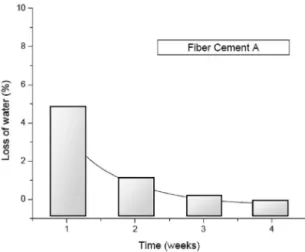
Figures 1-8 show the moisture sorption of the iber
cements under evaluation. It is pointed out that movement of water within composites is very complex. Regardless Table 9. Mechanical properties at 28 days of age.
Fiber cement
Modulus of rupture
MOR (MPa) SD*
Limit of
proportionality (MPa) SD
Toughness
(kJ/m2) SD
A 11.35 0.90 9.05 1.05 2.65 0.85
B 10.50 1.25 7.00 0.90 3.40 1.15
C 11.30 1.45 8.90 2.10 2.95 1.30
D 11.20 1.35 9.50 1.15 2.60 0.90
*Standard deviation.
Table 10. Physical characteristics at 28 days of age.
Fiber cement
Water
absorption (%) SD*
Bulk density
(g/cm3) SD
Apparent
porosity (%) SD
A 20.55 1.25 1.65 0.05 33.40 1.15
B 20.00 0.60 1.65 0.01 33.05 0.75
C 20.85 1.40 1.60 0.05 33.75 1.35
D 20.40 0.55 1.60 0.02 32.65 0.55
*Standard deviation.
Table 11. Mechanical properties after soak & dry cycles.
Fiber cement
Modulus of rupture
MOR (MPa) SD*
Limit of
proportionality (MPa) SD
Toughness
(kJ/m2) SD
A 11.50 1.00 9.85 1.45 1.25 0.40
B 11.25 0.35 9.05 1.05 1.80 0.45
C 10.55 0.80 9.80 1.35 1.65 0.50
D 12.90 1.20 11.60 2.00 1.80 0.70
*Standard deviation.
Table 12. Physical characteristics after soak & dry cycles.
Fiber cement
Water
absorption (%) SD*
Bulk density
(g/cm3) SD
Apparent
porosity (%) SD
A 18.50 0.80 1.65 0.03 30.70 0.90
B 20.65 1.20 1.55 0.03 32.20 1.20
C 18.00 1.45 1.65 0.04 29.40 1.85
D 17.00 2.20 1.62 0.06 27.70 2.60
*Standard deviation.
Table 13. Results from porosimetry analyses.
Fiber cement
Opened porosity at 28 days (%)
Opened porosity 6 months old (%)
Real density at 28 days (g/cm3)
Real density 6 months old (g/cm3)
Mean diameter at 28 days (µm)
Mean diameter 6 months old (µm)
A 6.53 6.17 1.64 1.64 0.0243 0.0501
B 7.64 6.70 1.53 1.62 0.0312 0.0423
C 7.62 5.48 1.63 1.76 0.0269 0.0406
of this, the composites performed hygral behavior with
intensive loss of water and water adsorption during the irst
weeks and tendency to be close to zero after certain period of time. For the conditions established in the present study, this stabilization was observed after four weeks.
The moisture movements perform the principal target of this study and are showed in Table 14. The changes in the variables density and porosity made composites with different properties. Both the bulk density and the water absorption strongly influence the moisture expansion/
shrinkage of the asbestos-free iber cement. On the other
hand, the total porosity did not show to be very important.
Despite of that, the pore structure or pore size distributions showed to be the most important characteristic in the control of moisture movement of these composites.
Figures 9-16 show the curves of intruded mercury volume in function of pore diameter (incremental volume)
for the iber cements under analyses. Pore size distribution
Table 14. Moisture movement.
Fiber cement
Moisture movement at 28 days (mm/m)
SD*
Moisture movement at 6 months (mm/m)
SD
A 2.0 0.1 4.0 0.4
B 1.4 0.1 4.3 0.3
C 2.1 0.3 3.8 0.2
D 1.9 0.2 2.4 0.4
*Standard deviation.
Figure 1. Water absorption evolution up to 28 days – iber cement A.
Figure 2. Water absorption evolution up to 28 days – iber cement B.
Figure 3. Water absorption evolution up to 28 days – iber cement C.
Figure 4. Water absorption evolution up to 28 days – iber cement D.
curves exhibit several characteristic peaks showed in Table 8. The peaks around 3-10 nm and 40-100 nm are related to pores of gel (hydrated phases) and medium capillaries respectively. These peaks showed to be higher at 28 days than after 6 months of age. Probably, these results are from matrix carbonation and continued hydration of
ordinary Portland cement phases. The decrease of these peaks showed correlation to the increment of moisture expansion/shrinkage of the analyzed composites. The peaks
around 1-5 µm are probably from voids in the iber/matrix
interface. These peaks showed to be higher in the composites of lower moisture movements.
The density of the non-asbestos iber cement plays a very
important role in the moisture expansion/shrinkage of these composites like their pore structures or pore distribution. Figure 6. Loss of water evolution up to 28 days – iber cement B.
Figure 7. Loss of water evolution up to 28 days – iber cement C.
Figure 8. Loss of water evolution up to 28 days – iber cement D.
Figure 9. Porosimetry of iber cement A at 28 days.
Figure 10. Porosimetry of iber cement A at six months of age.
Although the hygral behavior of the iber cements is very
complex, concluding remarks are showed below:
• Migration of the pore water of iber cements can be
related to the density;
• Moisture movements (expansion/shrinkage) are
related to water absorption and density of these materials and also not strongly related to total porosity;
• Density and porosity are related to each other;
however, for products of equivalent density having different pore distribution, the pore structure appeared
to be the most important characteristics to the moisture movements;
• The capillary pores around 40-100 nm have strong inluence in the hygral behavior of these composites
when exposed to weather;
• The hydration during the time of the non-hydrated
phases of cement paste and carbonation may increment the expansion/shrinkage of these composites;
• The pores around 1-5 µm probably relate to voids in the iber/matrix interface and may collaborate to decrease of expansion/shrinkage of asbestos-free iber
cements;
• The use of copolymers in the Hastschek process is not suficient to control the moisture movement and
expansion/shrinkage of this cementitious composite.
Acknowledgments
The authors acknowledge the support of The Institute
of Chemistry of São Carlos, The Institute of Physics of São Carlos and specially The Faculty of Animal Science and Food Engineering (FZEA), Department
of Food Engineering, Environmental Buildings Group,
Pirassununga, University of São Paulo, Brazil. The authors are also in debt with The National Council for Scientiic
and Technological Development- CNPq due to the offered to the development of the research.
Figure 12. Porosimetry of iber cement B at six months of age.
Figure 13. Porosimetry of iber cement C at 28 days.
Figure 14. Porosimetry of iber cement C at six months of age.
Figure 15. Porosimetry of iber cement D at 28 days.
References
1. Arkers S and Partl M. Hygral and Thermal Expansion/ Shrinkage Properties of Asbestos-Free Fibre Cement. Cement
and Concrete Composites. 1990; 12:19-27. http://dx.doi.
org/10.1016/0958-9465(90)90032-S
2. Savastano H and Agopyan V. Transition Zone Studies of
vegetable ibre-cement paste composites. Cement and Concrete
Composites. 1999; 21:40-57.
http://dx.doi.org/10.1016/S0958-9465(98)00038-9
3. Bentur A and Mindess S. Fibre Reinforced Cementitious
Composites. London: Elsevier Applied Science; 1990. 449 p.
4. Chandra S and Flodin P. Interactions of polymers and organic admixtures on Portland Cement Hydration. Cement Concrete
Research. 1990; 17:975-890.
5. Ohama Y. Polymer-base admixtures. Cement and Concrete
Composites. 1998; 20:189-212. http://dx.doi.org/10.1016/
S0958-9465(97)00065-6
6. Ohama Y. Recent Progress in Concrete-Polymer Composites.
Advn. Cement Bas. Materials. 1997; 5:31-40.
7. Fowler DW. Polymers in concrete: a vision for the 21st century.
Cement and Concrete Composites. 1999; 21:449-452,. http://
dx.doi.org/10.1016/S0958-9465(99)00032-3
8. Kong XM and Li QH. Properties and microstructure of polymer
modiied mortar based on different acrylate latexes. Journal of
the Chinese Ceramic Society. 2009; 37(1):107-14.
9. Zhang Z, Wang P and Wu J. Dynamic Mechanical Properties
of EVA Polymer-Modiied Cement Paste at Early Age. Physics
Procedia. 2012; 25:305-310. http://dx.doi.org/10.1016/j.
phpro.2012.03.088
10. Wang R, Wang PM and Li XG. Physical and mechanical
properties of styrene-butadiene rubber emulsion modiied
cement mortars. Cement and Concrete Composites. 2005; 35:900-6. http://dx.doi.org/10.1016/j.cemconres.2004.07.012 11. Wang R and Wang PM. Physical properties of SBR
latex-modiied mortar under different curing methods. Journal of
the Chinese Ceramic Society. 2009; 37(12):2118-23.
12. Wang R and Wang PM. Function of styrene-acrylic ester copolymer latex in cement mortar. Materials and Structures. 2010; 43:443-51. http://dx.doi.org/10.1617/s11527-009-9501-3
13. Wang R and Wang PM. Action of redispersible vinyl
acetate and versatate copolymer powder in cement mortar.
Construction and Building Materials. 2011; 25:4210-4214
http://dx.doi.org/10.1016/j.conbuildmat.2011.04.060 14. Gomes CEM and Ferreira OP. Analyses of Microstructural
Properties of VA/VeoVA Copolymer Modiied Cement Pastes.
Polímeros. 2005; 15(3).
http://dx.doi.org/10.1590/S0104-14282005000300009
15. Wang PM, Zhang GF and Zhang YM. Inluence of polymer powders on mechanical properties of cement mortar. New Build
Materials. 2005; 1:32-6.
16. Afridi MUK, Ohama Y, Demura K, Iqbal MZ. Development of polymer ilms by the coalescence f polymer particles in powdered and aqueous polymer modiied mortars. Cement
and Concrete Composites. 2003; 33:1715-21. http://dx.doi.
org/10.1016/S0008-8846(02)01094-3
17. Jansen L, Götz-Neunhoeffer F, Neubauer J, Haerzschel R and
Hergeth W-D. Effect of polymers on cement hydration: A case study using substituted PDADMA. Cement and Concrete
Composites. 2013; 35:71-77. http://dx.doi.org/10.1016/j.
cemconcomp.2012.08.022
18. Nestle N, Kühn A, Friedemann K, Horch C, Stallmach F
and Herth G. Water balance and pore structure development
in cementitious materials in internal curing with modiied
superabsorbent polymer studied by NMR. Microporous
and Mesoporous Materials. 2009; 125:51-7. http://dx.doi.
org/10.1016/j.micromeso.2009.02.024
19. Zhang GF, Wang PM and Wu JG. Inluence of polymer powder on the bulk density and capillary water adsorption of cement mortar. New Build Materials. 2004:29-31.
20. Ollitrault-Fichet R, Gauthier C, Calmen G and Boch P.
Microstructural aspects in a polymer-modiied cement. Cement
and Concrete Research. 1998; 28(12):1687-1693. http://dx.doi.
org/10.1016/S0008-8846(98)00153-7
21. Knapen E and Gemert DV. Cement hydration and microstructure formation in the presence of water-soluble polymers. Cement
and Concrete Research. 2009; 39:6-13. http://dx.doi.
org/10.1016/j.cemconres.2008.10.003
22. Stark J. Recent advances in the ield of cement hydration
and microstructure analysis. Cement and Concrete
Research. 2011; 41:666-678. http://dx.doi.org/10.1016/j.
cemconres.2011.03.028
23. Bentur A and Mindess S. Fibre Reinforced Cementitious Composites. Modern Concrete Technology Series. 2006.
24. Ball HP. The effect of Forton compound on GFRC curing requirements. In: Proceedings 4th Biennial Congress of the
GRCA; 1993; Stratford-upon-Avon. Stratford-upon-Avon;
1983. p. 56-65.
25. Bijen J. Curing of GRC. In: Proceedings 6th Biennial
International Congress of the GRCA; 1987; Edinburgh.
Edinburgh; 1987, p. 71-77.
26. Bijen J. Polymer modified glass fibre reinforced cement
(Polymermodiizierter [22] Glasfaserbeton). Concrete
Pre-castingand Technology. 1989; 12:44-51.
27. Bijen J and Jacobs MJN. Properties of Glass Fiber Reinforced,
Polymer Modiied Cement. Journal of Material and Structures. 1981; 15(89):445-452.
28. European Standards. EN 197-1 – Cement (Part 1): Composition,
speciications and conformity criteria for common cements.
EN; 2001.
29. American Society for Testing and Materials. ASTM C 948-81:
Standard Test Method for Dry and Wet Bulk Density, Water
Absorption, and Apparent Porosity of Thin Sections of Glass-Fiber Reinforced Concrete. ASTM; 2009.
30. International Organization for Standardization. ISO 8336:
Fibre-cement flat sheets. Product specification and test methods. ISO; 2009.
31. European Standards. EN 494: Fibre-cement proiled sheets