Effect of Indole-3-Acetic Acid-Producing Bacteria on Phytoremediation of Soil
Contaminated with Phenanthrene and Anthracene by Mungbean
Waraporn Chouychai a, Thidarat Paemsom a, Chittra Pobsuwan a, Khanitta Somtrakoon b and Hung Lee c
a
Biology Program, Faculty of Science and Technology, Nakhonsawan Rajabhat University, Nakhonsawan 60000, Thailand
b
Department of Biology, Faculty of Science, Mahasarakham University, Kantharawichai, Mahasarakham 44150, Thailand
c
School of Environmental Sciences, University of Guelph, Guelph, Ontario, N1G 2W1, Canada
Abstract
The use of indole-3-acetic acid (IAA)-producing bacteria isolated from non-contaminated weed rhizosphere to enhance plant growth and PAH phytoremediation capacity was investigated. IAA-producing bacterial isolates, designated NSRU1, NSRU2, and NSRU3, were isolated from the rhizosphere of Eleusine indica (Poaceae) and Chromolaena odorata (Asteraceae). The isolates were able to produce IAA in nutrient broth. However, when grown in the presence of 100 mg/l of either phenanthrene or anthracene, the amount of IAA produced by each isolate was reduced signiicantly. Mungbean seedlings were planted in 100 mg/kg phenanthrene - or anthracene-contaminated soil without or with inoculation of ≈ 106
CFU/g dry soil with one of the bacterial isolates. Inoculation with either NSRU1 or NSRU2 was effective at enhancing shoot length of mungbean in phenanthrene-contaminated soil on day 16. Also, inoculation with isolate NSRU1 led to increased root dry weight of mungbean in phenanthrene-contaminated soil on day 30. Phenanthrene and anthracene degradation on day 16 and 30 in planted and inoculated soil ranged between 92 - 93.8% and 92.2 - 94.1%, respectively, which were not signiicantly different from planted and uninoculated soil (93.9 and 94.9%). These data showed that IAA-producing bacteria could enhance plant growth, but was unable to increase PAH biodegradation under the conditions tested.
Keywords : IAA-producing bacteria; phytoremediation; polycyclic aromatic hydrocarbons
The international journal published by the Thai Society of Higher Education Institutes on Environment
E
nvironment
A
sia
by Micronucleus (MN) test in fish erythrocytes as a biomarker for marine environmental contamination. Micronucleus
fish erythrocytes. Significant increase in MN frequency was observed in erythrocytes of fish exposed to mercuric chloride. Concentration of 0.25 ppm induced the highest MN frequency (2.95 micronucleated cells/1000 cells compared to 1 MNcell/1000 cells in control animals). The study revealed that micronucleus test, as an index of cumulative
Mercuric chloride has been used in agriculture as a
., 1993, Al-Sabti and Metcalfe, 1995). The micronucleus (MN) test has been developed
The MN tests have been successfully used as
by MN and binucleate (BN)
in static systems. Mercuric chloride is toxic,
animals. Mutagenic studies with native fish species
test (MN) for the estimation of aquatic pollution
Mannar, Southeast Coast of India.
Available online at www.tshe.org/ea/index.html EnvironmentAsia 9(2) (2016) 128-133 DOI
1. Introduction
Indole-3-acetic acid (IAA) is a natural plant auxin which exerts important effects on plant growth and development, such as elongation, differentiation, apical dominance and flowering. IAA biosynthesis in plant occurs via either Trp-dependent or Trp-independent pathway (Mano and Nemoto, 2012). IAA-producing bacteria are a group of plant growth promoting bacteria (PGPB) generally detected in the rhizosphere and in plant tissues. Strains from several bacterial genera have been reported to produce IAA, such as Bacillus, Klebsiella, Pseudomonas, Rhizobium, Sphingomonas and Xanthomonas (Tsavkelova et al., 2006). IAA-producing bacteria have been used to enhance crop growth. For example, immersion of seeds of Tanzania grass in Yeast Manitol (YM) broth containing 108 CFU/ml IAA-producing Mesorhizibium sp. or Bradyrhizobium sp. and then planted in soil led to increased root dry weight of this plant on day 60 after germination. These bacterial strains could produce about 0.2 - 4.0 µg/ml of IAA in YM broth supplemented with 50 mg/l Trp for 48 h (Machado et al., 2013). In another study, immersion of cowpea seeds in broth containing 108 CFU/ml of IAA-producing Enterobacter strain for
45 min increased shoot and root lengths of cowpea 3 weeks after seed germination. This strain could produce 23.8 - 104.8 µg/ml of IAA in broth supplemented with 1 g/l Trp for 48 h (Deepa et al., 2010).
IAA-producing bacteria have been used in phytoreme-diation to enhance plant growth in polluted soil as well as accumulate heavy metals in plant tissues. In one study, suspensions of the IAA-producing and copper-tolerant Burkhoderia sp. strain LD-11 (109 CFU/ml) were inoculated in surface soil near the plant root system of 7 day-old flowering Chinese cabbage (Brassica campestris ssp. chinensis) and sweet mustard (B. juncea) seedling. There were 2 plants of the same species/pot and each pot contained soil contaiminated with 800 mg/kg copper and 1,000 mg/kg lead. After 42 days, bacterial inoculation was found to increase copper accumulation in the shoots of sweet mustard and roots of lowering Chinese cabbage without any apparent enhancement of plant growth. Bacterial inoculation also increased lead accumulation in the shoots of lowering Chinese cabbage and roots of sweet mustard (Huang et al., 2013). In another study, Golubev et al. (2011) examined the effect of IAA-producing bacteria on PAH phytotoxicity. These authors studied the effect of phenanthrene on the
129 IAA-producing and PAH-degrading Sinorrhizobium meliloti and growth of sorghum in phenanthrene-contaminated sand. The bacterial cells suspended in Ruakura nutrient solution were applied to planted sand to inal concentration of 106 cell/g sterile sand. In the presence of 100 mg/kg phenanthrene, the amount of IAA (measured by HPLC) produced was 1.56 x 10⁻¹⁰ M in the uninoculated rhizosphere; the amount increased to 2.18 x 10⁻¹⁰ M when S. meliloti was inoculated. Furthermore, inoculation with S. meliloti led to increased root biomass of sorghum grown in 100 mg/kg phenanthrene-contaminated sand but the effect of bacterial inoculation on phenanthrene removal was not reported (Golubev et al., 2011).
The toxicity of PAH on IAA production can adversely affect the success of IAA-producing bacteria used in PAH phytoremediation. This in turn can affect the positive effect of these bacteria on plant growth and the plant’s capacity to enhance PAH biodegradation. In this study, several bacteria isolated from non-contaminated rhizosphere of Thai weeds were shown to produce IAA when exposed to PAH.The ability of these bacteria to enhance phenanthren and anthracene phytoremediation in soil was assessed The plant selected for phytoremediation was mungbean which is a legume previously found to not tolerate PAH- and engine oil-contaminated soil well (Chouychai et al., 2007). We were interested in testing if the IAA-producing bacterial isolates could enhance the growth of mungbean in PAH-contaminated soil and if so whether improved growth may translate into improved PAH degradation.
2. Materials and Methods
2.1 Isolation of IAA-producing bacteria
Bacteria used in this experiment were isolated from the rhizospheric soil of Chromolaena odorata (Asteraceae) and Eleusine indica (Poaceae), two common weeds in Thailand. The weeds were collected from grassland behind building 7 in Nakhonsawan Rajabhat University (Nakhonsawan, Thailand). The 1-g soil sample from the rhizosphere of each plant was placed in 9.5 ml of sterile distilled water and shaken at 180 rpm for 2 h. The suspension was serially diluted in sterile distilled water and spread on Nutrient agar (NA) plates. After 48 h, different colonies were picked and streaked onto fresh NA plates to obtain single colonies. In total, 36 isolates were obtained from the rhizospheric soil of both plants. All isolated bacteria were tested for IAA production as described by Ahmad et al. (2008). Samples of each colony were grown individually in Nutrient Broth (NB) supplemented with 0.05 g/l Trp for 72 h. The culture was centrifuged at 1400 xg and two ml of supernantant were transferred to a new tube and mixed with 2 ml of Salkowski’s reagent and 2 drops of orthophosphoric acid. A pink color indicates the presence of IAA. Based on this test, ten isolates were selected and subcultured individually in fresh 50 ml NB media in a 125-ml lask for 3 days. Then 106 cfu/ml (enumerated by plate count in NA) of each culture were transferred to 50 ml NB supplemented with
0.05 g/l Trp in a 125-ml flask. The IAA concentration was determined spectrophotometrically at 530 nm. IAA concentrations in the samples were estimated from a standard curve constructed with 1 - 100 µg/ml IAA (Fluka, purity 90%) dissolved in distilled water.
2.2 Effect of PAHs on IAA production
Each bacterial isolate was grown in 50 ml NB supplemented with 0.05 g/l Trp in a 125-ml lask which was shaken at 150 rpm at room temperature (25 0C) for 72 h. Then 106 cfu/ml of each culture were transferred to NB supplemented with 0.05 g/l Trp with or without PAHs. Phenanthrene (Sigma-Aldrich, purity 98%) or anthracene (Fluka, purity 98%) dissolved in dimethyformamide was added to separate lasks to inal concentrations 100 mg/l in NB. The experiment was done in triplicate. After 3 and 10 days, IAA production in the culture supernatant was measured according to Ahmad et al. (2008) as described above.
2.3 Soil preparation
Alkaline agricultural soil with no previous history of hydrocarbon contamination was collected at the Khaorad Agricultural Station, Faculty of Agricultural Technology and Industrial Technology, Nakhonsawan Rajabhat University, Nakhonsawan, Thailand as described in Chouychai and Lee (2012). The soil was air-dried at room temperature (250C) for at least 24 h to constant weight before use. The soil used in this experiment was alkaline (pH 8.9) with low total phosphorus content (below 0.29 g/100 g soil). The soil contained (per 100 g dry soil): 0.21 g total nitrogen (N), 0.13 g total potassium (K), and 1.78 g organic matter. Soil was mixed with either phenanthrene or anthracene individually dissolved in acetone to inal concentration of 100 mg/kg.
2.4 Experimental design.
3.2 Effect of PAHs on IAA production
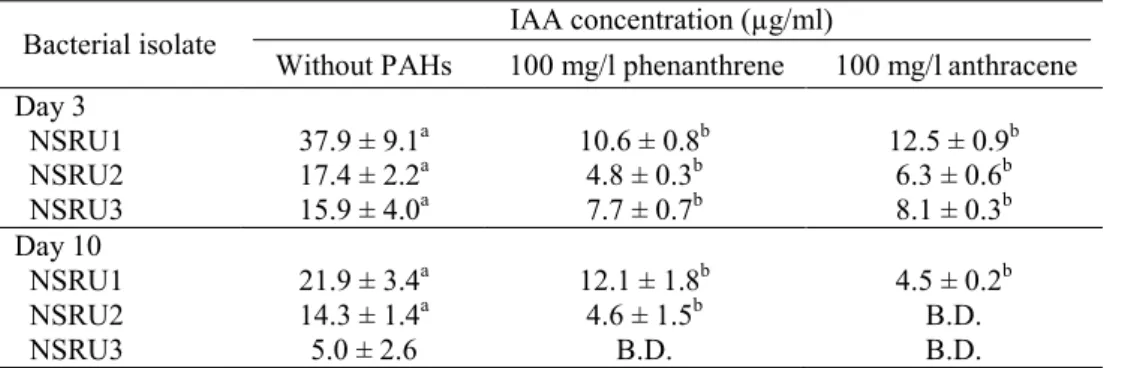
Different amounts of IAA were produced by each of the 3 bacterial isolates when cultured in NB supplemented with 0.05 g/l Trp for 3 days. Isolate NSRU1 produced the highest amount of IAA (37.9 ± 9.1 µg/ml), while isolates NSRU2 and NSRU3 produced lower amounts of 17.4 and 15.9 µg/ml, respectively. When 100 mg/l phenanthrene were added to the culture, the amounts of IAA produced by isolates NSRU1, NSRU2 and NSRU3 were reduced to 10.6, 4.8, and 7.7 µg/ml, respectively (Table 1). Addition of anthracene reduced the amount of IAA produced by each strain to 12.5 - 6.3 µg/ml. The amounts of IAA remaining in the medium on day 10 were generally lower than those on day 3. In particular, the amounts of IAA remaining were below the detection limit in the supernatant of isolate NSRU3 grown in the presence of the PAHs (Table 1).
3.3 Effect of IAA-producing bacteria on mungbean growth
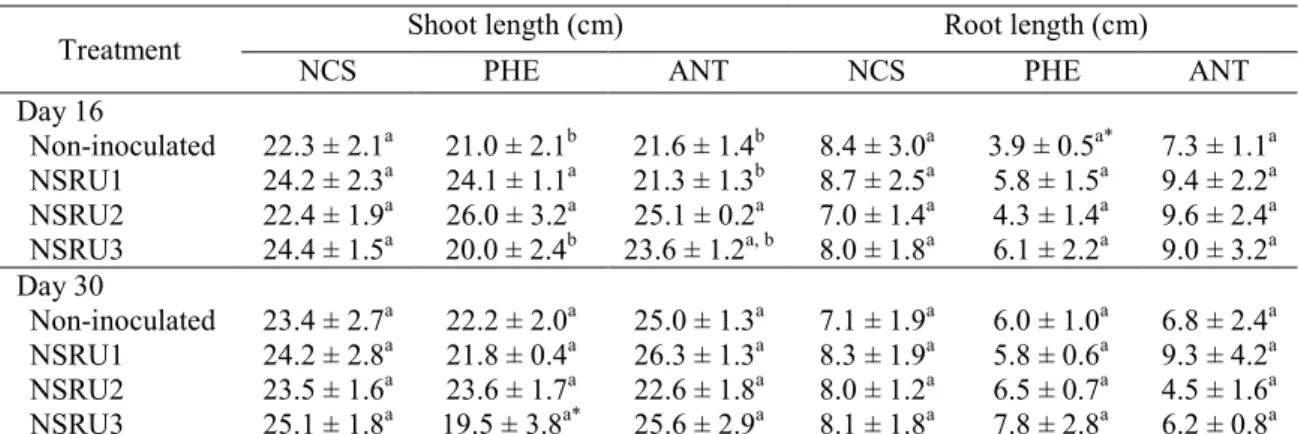
In non-contaminated soil, growth of mungbean appeared normal and was not affected by inoculation with any of the 3 IAA-producing bacterial isolates (Tables 2-4). The presence of phenanthrene in soil led to decreased root length of mungbean on day 16 to 3.9 ± 3.0 cm from that in non-contaminated soil (8.4 ± 3.0 cm). Inoculation with isolates NSRU1 or NSRU2 led to increased shoot length of mungbean in phenanthrene-contaminated soil on day 16 to 24.1 and 26.0 cm, respectively, from that in non-inoculated treatment (21.0 cm). On day 30, only the treatment which was inoculated with isolate NSRU1 showed increased root dry weight of mungbean to 15.2 ± 3.7 mg in phenanthrene-contaminated soil; this value was signiicantly higher than the root dry weight of mungbean in other treatments (Table 4). In anthracene-contaminated soil, innoculation of any of the isolates did not result in altered growth parameters of mungbean (Tables 2-4). 2.5 Pot experiment
Ten-day old mungbean seedlings were planted in soil containing 100 mg of either phenanthrene or anthracene per kg dry soil at one plant per pot. This phenanthrene concentration has been reported that there were toxic to mungbean root (Chouychai et al., 2007). The diameter of the pot was 7 inches, with each pot holding 1 kg dry weight of soil. The pots were kept in a nursery in which the temperature was around 24oC during the day and 21oC at night and exposed to natural sunlight. Each pot was watered every day with about 20 ml water for 30 days. The experiment was conducted in triplicate. On days 16 and 30, the mungbean plants were removed and the pots terminated. The length, fresh weight, and dried weight of shoot and root of mungbeans were measured.
One g of soil sample was collected from each treatment on days 16 and 30 for analysis of remaining PAHs. The amount of phenanthrene or anthracene remaining in soil was determined by gas chromatography using a Shimadzu model AOC-5000 GC equipped with a mass spectroscopic detector (Shimadzu MS-QP2010) according to Somtrakoon et al. (2014). One g of soil was mixed with an equal amount of anhydrous Na2SO4, and subjected to Soxhlet extraction
prior to GC analysis. Phenanthrene and anthracene were separated on a Rtx®-5MS capillary column (30 m x 25 mm, I.D. = 25 μm) as described in Somtrakoon et al. (2014). The detection limit of this analysis was 0.4 mg/kg.
3. Results
3.1 Isolation of IAA-producing bacteria
Three bacterial isolates which showed the highest IAA concentrations were selected for use in subsequent experiment. All were Gram-positive bacteria, and they were designated NSRU1, NSRU2, and NSRU3. NSRU1 was isolated from the rhizosphere of E. Indica and its colonies were white, circular, transparent, raised and smooth. NSRU2 and NSRU3 were isolated from the rhizosphere of C. odorata. Colonies of NSRU2 were yellow, circular, undulated, opaque and umbonate while colonies of NSRU3 were yellow, circular, and umbonate.
W. Chouychai et al. / EnvironmentAsia 9(2) (2016) 128-133
NB supplemented with 0.05 g/l Trp for 3 days. Isolate NSRU1 produced the highest amount of IAA
Table 1. IAA production of selected bacterial isolates cultured in NB containing 0.05 g/l tryptophan and 100 mg/l PAH for 3-10 days. Starting cell concentration of each bacterial isolate was 106CFU/ml.
Bacterial isolate IAA concentration (µg/ml)
Without PAHs 100 mg/l phenanthrene 100 mg/l anthracene Day 3
NSRU1 NSRU2 NSRU3
37.9 ± 9.1a 17.4 ± 2.2a 15.9 ± 4.0a
10.6 ± 0.8b 4.8 ± 0.3b 7.7 ± 0.7b
12.5 ± 0.9b 6.3 ± 0.6b 8.1 ± 0.3b Day 10
NSRU1 NSRU2 NSRU3
21.9 ± 3.4a 14.3 ± 1.4a 5.0 ± 2.6
12.1 ± 1.8b 4.6 ± 1.5b
B.D.
4.5 ± 0.2b
B.D. B.D.
Different lower case letters showed significant difference (P<0.05) between treatments in same strain.
131
different bacterial strain inoculation
Treatment Shoot length (cm) Root length (cm)
NCS PHE ANT NCS PHE ANT Day 16
Non-inoculated NSRU1 NSRU2 NSRU3
22.3 ± 2.1a 24.2 ± 2.3a 22.4 ± 1.9a 24.4 ± 1.5a
21.0 ± 2.1b 24.1 ± 1.1a 26.0 ± 3.2a 20.0 ± 2.4b
21.6 ± 1.4b 21.3 ± 1.3b 25.1 ± 0.2a 23.6 ± 1.2a, b
8.4 ± 3.0a 8.7 ± 2.5a 7.0 ± 1.4a 8.0 ± 1.8a
3.9 ± 0.5a* 5.8 ± 1.5a 4.3 ± 1.4a 6.1 ± 2.2a
7.3 ± 1.1a 9.4 ± 2.2a 9.6 ± 2.4a 9.0 ± 3.2a Day 30
Non-inoculated NSRU1 NSRU2 NSRU3
23.4 ± 2.7a 24.2 ± 2.8a 23.5 ± 1.6a 25.1 ± 1.8a
22.2 ± 2.0a 21.8 ± 0.4a 23.6 ± 1.7a 19.5 ± 3.8a*
25.0 ± 1.3a 26.3 ± 1.3a 22.6 ± 1.8a 25.6 ± 2.9a
7.1 ± 1.9a 8.3 ± 1.9a 8.0 ± 1.2a 8.1 ± 1.8a
6.0 ± 1.0a 5.8 ± 0.6a 6.5 ± 0.7a 7.8 ± 2.8a
6.8 ± 2.4a 9.3 ± 4.2a 4.5 ± 1.6a 6.2 ± 0.8a Different lower case letters showed significant difference (P<0.05) between the same soil on the same day;
*
showed significant difference (P<0.05) from non-contaminated soil
Symbol: NCS = non-contaminated soil, PHE = phenanthrene-contaminated soil and ANT = anthracene-contaminated soil.
ANT
Table 3. Shoot and root fresh weight of mungbean grown in non-contaminated or PAH-contaminated soil with different bacterial strain inoculation
Treatment Shoot fresh weight (mg) Root fresh weight (mg)
NCS PHE ANT NCS PHE ANT
Day 16
Non-inoculated NSRU1 NSRU2 NSRU3
473.8 ± 64.9a
504.9 ± 78.3a 428.3 ± 52.5a 481.8 ± 59.7a
382.3 ± 156.7a
443.3 ± 51.3a 480.0 ± 99.0a 373.3 ± 85.0a
372.5 ± 28.6a
548.3 ± 227.6a 381.6 ± 7.1a 522.9 ± 9.4a
113.9 ± 20.4a
132.6 ± 31.1a 103.4 ± 31.2a 119.0 ± 23.0a
66.7 ± 15.3b
133.3 ± 28.9a 120.0 ± 14.1ab 116.7 ± 5.8ab
118.0 ± 52.9a
159.5 ± 75.2a 123.2 ± 25.1a 148.1 ± 15.3a
Day 30
Non-inoculated NSRU1 NSRU2 NSRU3
492.3 ± 79.5a 652.0 ± 224.2a
557.1 ± 72.2a
616.1 ± 107.6a
550.2 ± 244.6a 495.1 ± 125.5a 627.8 ± 115.5a
451.3 ± 203.8a
461.3 ± 85.7a 614.2 ± 82.2a 519.1 ± 16.8a
597.3 ± 112.6a
113.4 ± 10.5a 166.3 ± 79.8a 180.0 ± 51.9a
208.5 ± 49.7a
110.5 ± 9.1a 159.4 ± 47.0a 167.2 ± 73.0a
136.6 ± 67.5a
116.7 ± 28.5a 167.7 ± 105.7a
89.0 ± 20.7a
175.4 ± 28.0a Different lower case letters showed significant difference (P<0.05) between the same soil on the same day
Symbol: NCS = non-contaminated soil, PHE = phenanthrene-contaminated soil and ANT = anthracene-contaminated soil
Table 4. Shoot and root fresh weight of mungbean grown in non-contaminated or 100 mg/kg each PAH-contaminated soil with different bacterial strain inoculation
Treatment Shoot dried weight (mg) Root dried weight (mg) NCS PHE ANT NCS PHE ANT Day 16
Non-inoculated NSRU1 NSRU2 NSRU3
45.9 ± 6.7a 51.0 ± 7.1a 50.5 ± 8.1a 47.9 ± 11.1a
39.5 ± 12.1a 46.8 ± 8.6a 42.6 ± 11.8a
40.1 ± 7.9a
37.9 ± 7.0a 57.2 ± 25.0a 51.0 ± 12.9a 54.5 ± 3.4a
5.5 ± 0.6ab 7.1 ± 1.4a 4.6 ± 0.6b 5.5 ± 1.0ab
4.5 ± 1.2b 8.9 ± 3.5a 5.6 ± 2.3b 7.5 ± 1.9a
7.0 ± 3.5a 7.0 ± 1.3a 7.5 ± 0.4a 7.9 ± 1.6a Day 30
Non-inoculated NSRU1 NSRU2 NSRU3
62.2 ± 14.2a 85.9 ± 34.7a 74.5 ± 19.0a 92.5 ± 27.7a
70.5 ± 23.0a 66.0 ± 19.3a 85.0 ± 24.5a 58.6 ± 26.3a
79.9 ± 28.8a 102.4 ± 29.0a
64.8 ± 23.9a 101.3 ± 27.8a
10.9 ± 2.7a 19.5 ± 9.2a 17.7 ± 5.2a 17.5 ± 4.0a
7.1 ± 0.9b 15.2 ± 3.7a
8.3 ± 2.1b 5.9 ± 0.9b
132
Table 5. Percentages of phenanthrene or anthracene remaining in soil grown with mungbean and non-inoculated or inoculated with IAA producing bacteria in phenanthrene or anthracene -spiked soil for 30 days
Plant % remaining Day 16 Day 30 Phenanthrene
Non-planted soil 19.0 ± 1.0a 15.2 ± 3.8a Planted soil 6.1 ± 2.1b 2.8 ± 1.8b Planted soil + NSRU1 6.2 ± 1.6b 3.6 ± 2.7b Planted soil + NSRU2 7.3 ± 4.9b 2.0 ± 0.8b Planted soil + NSRU3 8.0 ± 1.8b 1.4 ± 1.1b* Anthracene
Non-planted soil 58.4 ± 6.0a 8.4 ± 6.0a* Planted soil 5.1 ± 0.6b 6.6 ± 2.4a Planted soil + NSRU1 5.9 ± 4.0b 3.0 ± 1.1a Planted soil + NSRU2 7.8 ± 7.6b 5.0 ± 3.6a Planted soil + NSRU3 8.8 ± 3.3b 5.2 ± 0.8a Different lower case letter showed significant difference (P<0.05) between same PAH in same day and *showed significant difference (P<0.05) between PAH-remaining on day 16 and 30.
4. Discussion
MRC4 culture by
6.0 mg/l Monocrotophos or 2.8 mg/l Dichorvos
PAL5 (Madhaiyan
W. Chouychai et al. / EnvironmentAsia 9(2) (2016) 128-133
3.4 Effect of IAA-producing bacteria on PAH removal
In non-planted soil, phenanthrene and anthracene were degraded rapidly with the extent of degradation reaching 81 and 42%, respectively on day 16. Planting with mungbean increased the removal of phenanthrene and anthracene from soil to 93.9 and 94.9%, respectively, on day 16 (Table 5). Further inoculation of planted soil with bacterial strains did not result in faster rate or extent of phenanthrene and anthracene degradation relative to that seen in planted soil. This trend was seen also on day 30 (Table 5). Likely, the PAHs were degraded so rapidly that any differences were masked and the removal of both PAHs seems to depend on mungbean and soil indigenous bacteria more than the inoculated IAA-producing bacteria.
4. Discussion
In this study, 100 mg/l phenanthrene and anthracene were found to adversely affect IAA production by the 3 bacterial isolates. IAA production by NSRU 1 was inhibited by 72.0 and 67.0%, while IAA production by NSRU2 and NSRU3 was inhibited by 72.4% and 63.8%, and 51.6% and 49.0% when phenanthrene and anthacene, respectively, were added to the cultures. There were previous reports that IAA production by IAA-producing bacteria was sensitive to pesticides. For example, addition of 0.04 - 0.12 mg/l hexaconazole reduced IAA production by Mesorhizobium sp. MRC4 culture by 36.4 - 52.3% from that produced by the culture in a pesticide-free medium (44.0 µg/ml) (Ahemad and Khan, 2012). In another study, IAA production by Gluconacetobactor diazotrophicus strain PAL5 was reduced by 77.6 - 93.2% to 0.63 - 0.19 µg/ml in the presence of either 6.0 mg/l Monocrotophos or 2.8 mg/l Dichorvos from that produced in a pesticide-free medium (2.81 µg/ml).
Interestingly, addition of 2.5 mg/l lindane completely inhibited IAA production by G. diazotrophicus PAL5 (Madhaiyan et al., 2006).
Although pesticides could reduce IAA production, some authors reported the use of IAA-producing bacteria to improve plant growth in pesticide-contaminated soil. For example, inoculation of Mesorhizobium sp. MRC4 signiicantly increased the dry weight of chickpea grown in 0.6 mg/kg Fibronil or 3.9 mg/kg pyrifroxyfen-contaminated soil to 2.67 and 2.61 g/plant from those of chickpea in un-inoculated soil of 1.42 and 1.08 g/plant, respectively. In our study, bacterial inoculation led to increased shoot length and dry root weight of mungbean grown in phenanthrene-contaminated soil on day 16. NSRU1 which produced the highest amount of IAA seemed to be the most beneicial to mungbean in phenanthrene-contaminated soil.
133 indolebutyric acid, which is auxin also, did not enhance corn growth but could increase hexachlorocyclohexane removal in soil within 30 days (Chouychai et al., 2015). The role of IAA on phytoremediation process in PAH-contaminated soil should be studied in more detail.
5. Conclusions
In summary, IAA-producing bacteria isolated from non-contaminated weed rhizosphere exhibited some tolerance to PAHs and produced IAA in PAH- containing media. In soil experiment, inoculation with these IAA-producing bacterial strains led to enhanced root growth of mungbean in phenanthrene- contaminated soil but not PAH biodegradation. Given the potential benefit of IAA-producing bacteria to phytoremediation, further studies are warranted. These may include inoculum size and selecting conditions in which PAHs were poorly degraded to further assess the potential beneficial effect of IAA-producing bacteria.
Acknowledgements
We thank Nakhonsawan Rajabhat University for infrastructure and equipment support for this research
References
Ahemad M, Khan MS. Effects of pesticides on plant growth promoting traits of Mesorhizobium strain MRC4. Journal of the Saudi Society of Agricultural Sciences 2012; 11(1): 63-71.
Ahmad F, Ahmad I, Khan MS. Screening of free-living rhizospheric bacteria for their multiple plant growth promoting activities. Microbiological Research 2008; 163(2): 173-81.
Chouychai W, Lee H. Phytotoxicity assay of crop plants to lindane and alpha-endosulfan contaminants in alkaline Thai soil. International Journal of Agriculture and Biology 2012; 14(5): 734-38.
Chouychai W, Thongkukiatkul A, Upatham S, Lee H, Pokethitiyook P, Kruatrachue M. Phytotoxicity assay of crop plants to phenanthrene and pyrene contaminants in acidic soil. Environmental Toxicology 2007; 22(6): 597-604.
Chouychai W, Kruatrachue M, Lee H. Effects of plant growth regulators on phytoremediation of hexachlo- rocyclohexane-contaminated soil. International Journal of Phytoremediation. 2015; 17(11): 1053-59. Deepa CK, Dastager SG, Pandey A. Isolation and
characterization of plant growth promoting bacteria from non-rhizospheric soil and their effect on cowpea (Vigna unguiculata (L.) Walp.) seedling growth. World Journal of Microbiology and Biotechnology 2010; 26(7): 1233-40.
Golubev SN, Muratova AY, Wittenmayer L, Bondarenkova AD, Hirche F, Matora LY, Merbach W, Turkovskaya OV. Rhizosphere indole-3-acetic acid as a mediator in the Sorghum bicolor-phenanthrene-Sinorhizobium meliloti interactions. Plant Physiology and Biochemistry
2011; 49(6): 600-08.
Huang G, Tian HH, Liu HY, Fan XW, Liang Y, Li YZ. Characterization of plant-growth-promoting effects and concurrent promotion of heavy metal accumulation in the tissues of the plants grown in the polluted soil by Burkholderia strain LD-11. International Journal of Phytoremediation 2013; 15(10): 991-1009.
Li W, Xu L, Wu J, Ma L, Liu M, Jiao J, Li H, Hu F. Effects of indole-3-acetic acid (IAA), a plant hormone, on the ryegrass yield and the removal of luoranthene from soil. International Journal of Phytoremediation. 2015; 17(1-6): 422-28.
Machado RG, De Sá ELS, Bruxel M, Giongo A, da Silva Santos N, Nunes AS. Indoleacetic acid producing rhizobia promote growth of Tanzania grass (Panicum maximum) and Pensacola grass (Paspalum saurae). International Journal of Agriculture and Biology 2013; 15(5): 827-34.
Madhaiyan M, Poonguzhali S, Hari K, Saravanan VS, Sa T. Influence of pesticide on the growth rate and plant-growth promoting traits of Gluconacetobacter diazotrophicus. Pesticide Biochemistry and Physiology.
2006; 84(2): 143-54.
Mano Y, Nemoto K. The pathway of auxin biosynthesis in plants. Journal of Experimental Botany 2012; 63: 2853-72. Siciliano SD, Germida JJ. Mechanisms of phytoremediation:
biochemical and ecological interactions between plants and bacteria. Environmental Reviews 1998; 6(1): 65-79. Somtrakoon K, Chouychai W, Lee H. Comparing anthracene
and luorene degradation in anthracene and luorene-contaminated soil by single and mixed plant cultivation. International Journal of Phytoremediation 2014; 16 (4): 415-28.
Tsavkelova EA, Klimova SY, Cherdyntseva TA, Netrusov AI. Microbial producers of plant growth stimulators and their practical use: a review. Applied Biochemistry and Microbiology. 2006; 42(2): 117-26.
Received 10 May 2016 Accepted 1 June 2016
Correspondence to
Dr.Waraporn Chouychai
Biology Program, Department of Science, Faculty of Science and Technology, Nakhonsawan Rajabhat University, Nakhonsawan, 60000
Thailand
Tel: +66-5621-9100, ext. 2528