Fiabilitate si Durabilitate - Fiability & Durability No 1/ 2015
Editura “Academica Brâncuşi” , Târgu Jiu, ISSN 1844 – 640X 119
DIRECT CALCULUS FORMULAS FOR THE LATHE TOOL
EQUIVALENT STRESS VALUES DURING THE MANUFACTURING
OF STEEL SHAFTS
1
Phd.Eng. Catălin ROŞU, S.C. DICO Romania S.R.L., Pieleşti, Cîrcea Street, No. 2, Romania, [email protected]
Abstract. In this paper, starting from the stress values presented in Roşu (2015) [1], a method for determining direct calculus formulas for the lathe tool equivalent stress values during the manufacturing of steel shafts is established. There is used the regression analysis for the formulas determination. The equivalent stress will be dependant on the cutting depth. The obtained formulas will be verified by using an analytical model from Strength of Materials. The results and the calculus formulas are presented from an original point of view.
Keywords: regression analysis, equivalent stress, bending, turning.
1. INTRODUCTION
In this paper, starting from the researches presented in Roşu (201η) [1] regarding the stress determination from the lathe cutters that manufacture steel products through turning, I will establish a method to determine direct calculus formulas for the equivalent stress by using the regression analysis. I will also take into account the researches from Miriţoiu (2014) [2] and Miriţoiu (2014) [3]: there will be searched for linear, logarithmic, power and exponential functions to approximate the experimental results in order to obtain a correlation factor close to 1 value. The polynomial functions were avoided because their obtained factors insert errors if the experimental results are repeated (see Miriţoiu (2014) [2] and Miriţoiu (2014) [3] for these aspects). Also, some researches regarding the regression analysis applied in the manufacturing process can be found in Zamfirache (2009) [4] (titan alloys manufactured by turning) and Zamfirache (2009) [5] (stainless steels manufactured by grinding).
The stress results from Roşu (201η) [1] are presented in table 1.
Table 1. Stress values versus the cutting depth (Roşu (201η) [1])
ap [mm] 0,5 0,7 0,9 1,1 1,3 1,5
σechexp [MPa]
(varianta 1) 6,6895 9,3591 12,118 14,826 16,43 19,677
σechexp [MPa]
(varianta 2) 38,785 56,143 73,365 90,629 108,37 123,67
I have used the next chipping parameters: the feeding f= 0,2 mm/rot; the cutting depth ap= 0,5; 0,7; 0,9; 1,1; 1,3; 1,5 mm; the speciffic pressure pm= 310 MPa (according to Cârstea
Fiabilitate si Durabilitate - Fiability & Durability No 1/ 2015
Editura “Academica Brâncuşi” , Târgu Jiu, ISSN 1844 – 640X 120
2. REGRESSION ANALYSIS USED TO DETERMINE DIRECT CALCULUS FORMULAS
In this paprt of the paper I will use the regression analysis to determine a direct calculus formula for the equivalent stress experimentally obtained. I have searched for the next correlation functions:
- linear:
v 1v2- logarithmic:
v 1ln
v 2 - power:
21
v v
- exponential:
v e 2v 1
Tensiune-adancime de aschiere
0 5 10 15 20 25
0.5 0.7 0.9 1.1 1.3 1.5
ap[mm]
s
i[
M
P
a
]
siexp
Fig. 1. Stress vs. cutting depth (variant 1)
Tensiune-adancime de aschiere
0 20 40 60 80 100 120 140
0.5 0.7 0.9 1.1 1.3 1.5
ap[mm]
s
i[
M
P
a
]
siexp
Fiabilitate si Durabilitate - Fiability & Durability No 1/ 2015
Editura “Academica Brâncuşi” , Târgu Jiu, ISSN 1844 – 640X 121
By using the regression analysis and the experimental data, I have obtained the values
for α, β, , λ, ξ, parameters. For every set, I have written the results in tables 2 (variant 1) and 3 (variant 2).
Important remark: the free length of the lathe cutter is 50 mm.
Table 2. The parameters α, β, , λ, ξ, values– variant 1
Function type
Linear Logarithmic Power Exponential
Parameters α1=
2,5388
α2=
4,2974
β1= 6,9766
β2= 5,5332
1=
6,4547
2=
0,5955
λ1= 5,9853
λ2= 0,2081
Correlation factor R2
[%]
99,52 94,29 99,18 96,58
Table 3.The parameters α, β, , λ, ξ, values – variant 2
Function type
Linear Logarithmic Power Exponential
Parameters α1=
17,096
α2=
21,99
β1= 46,821
β2= 30,486
1=
37,228
2=
0,6519
λ1= 34,249
λ2= 0,2281
Correlation factor R2
[%]
99,97 94,406 99,32 96,89
From the tables 2 and 3 it is seen that the linear function approximate the best the experimental results. So, for the variant 1 I propose the formula (1) and for the variant (2) I propose the formula (2).
Important remark: because there was no distributed force to act upon the lathe cutter, it was expected to obtain, for the stress, a first degree function.
3. THE RESULTS VALIDATION
In the next part of the paper I will validate the experimental results obtained in Roşu (2015) [1], used in this study to obtain the direct calculus formula. If I consider that the lathe cutter is loaded only to bending in the vertical plane (according to the theory from Cârstea (2007) [6]), the relation (3) can be used for stress calculus.
max 2 60 2
6
h b
a f p
h b
l F W
M z m p
y
ss
(3)
2,5388 4,2974exp p p
ech a a
(1)
17,096 21,99exp p p
ech a a
Fiabilitate si Durabilitate - Fiability & Durability No 1/ 2015
Editura “Academica Brâncuşi” , Târgu Jiu, ISSN 1844 – 640X 122
If I take into account all the loadings (from axial force, shear force and bending moments in vertical and horizontal planes), then I will use the direct calculus formulas from Roşu (2013) [7].
2 8 20 3 2 h b h l b l h b a f p W l F W l F A F p m z y y z x echB (4)
2 2
2 19 20 100
6
1 h l h l
h b
a f pm p
echB
(5)
2 2
2 13 16 64
3
3 h b b l b l
a f pm p
echB
(6)
The Bi points (i=1,2,3) are determined accordhing to the scheme from fig. 3 (presented
in Roşu (2013) [7]).
In (3), (4), (5) and (6) I have marked with: - f the feeding;
- ap the cutting depth;
- pm the specific pressure;
- b,h the base and the height of the lathe tool; - l the free length of the lathe tool.
The obtained results for the variant 1 and 2 are written in tables 4 and 5. f
F
Fz Fy
Fx
x z
y
B1 B2
B3 1 2 Fz Fy Fx
Fiabilitate si Durabilitate - Fiability & Durability No 1/ 2015
Editura “Academica Brâncuşi” , Târgu Jiu, ISSN 1844 – 640X 123
Table 4. Stress values (variant 1)
ap
[mm] 0,5 0,7 0,9 1,1 1,3 1,5
σechB1
[MPa] 6,235 8,73 11,224 13,718 16,212 18,706
σechB2
[MPa] 8,482 11,874 15,267 18,66 22,052 25,445
σechB3
[MPa] 2,582 3,614 4,647 5,679 6,712 7,745
σss [MPa] 5,952 8,333 10,714 13,094 15,475 17,856
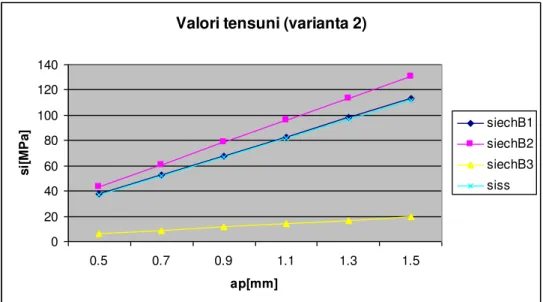
Table 5. Stress values (variant 2)
ap
[mm] 0,5 0,7 0,9 1,1 1,3 1,5
σechB1
[MPa] 37,71 52,794 67,878 82,962 98,046 113,13
σechB2
[MPa] 43,524 60,934 78,343 95,753 113,162 130,572
σechB3
[MPa] 6,454 9,036 11,617 14,199 16,78 19,362
σss [MPa] 37,2 52,08 66,96 81,84 96,72 111,6
The stress values versus the cutting depth, for both variants are presented in fig. 4 and fig. 5
Valori tensiuni (varianta 1)
0 5 10 15 20 25 30
0.5 0.7 0.9 1.1 1.3 1.5
ap[mm]
s
i[
M
P
a
] siechB1
siechB2 siechB3 siss
Fiabilitate si Durabilitate - Fiability & Durability No 1/ 2015
Editura “Academica Brâncuşi” , Târgu Jiu, ISSN 1844 – 640X 124
Valori tensuni (varianta 2)
0 20 40 60 80 100 120 140
0.5 0.7 0.9 1.1 1.3 1.5
ap[mm]
s
i[
M
P
a
] siechB1
siechB2 siechB3
siss
Fig. 5. Stress values versus the cutting depth (variant 2) – analytical values
4. CONCLUSIONS
From the fig. 1,2,4 and 5 and tables 1,4 and 5 we can see the next tendencies: - the stress increases with the cutting depth;
- the stresses are higher if the second lathe tool is used; - the graphics variation is almost linear;
- the maximum stress is in point B2 and minimum in point B3;
- the stress determined from the simple bending in the vertical plane is almost equal with the equivalent stress in point B1 (this shows that the shear stress given by shear force Fz
has small influence over the equivalent stress);
- the σss values and the experimental stress values have small errors, under 12% (the
errors may appear because of the vibration from the manufacturing process);
- the σechB1 values and the experimental stress values have small errors, under 8% (the
errors may appear because of the vibration from the manufacturing process);
- the σechB2 values and the experimental stress values have high errors (maximum is
around 35%) because the influence of the horizontal plane moment is high, and its value has not been determined in the experimental part;
One of the added values of this paper is also the determination of some direct calculus formulas for the equivalent stress, depending on the lathe tool type and on the cutting depth value.
REFERENCES
1. Roşu, C., (201η) Experimental investigation regarding the stress values from lathe cutters during the manufacturing of steel shafts, Fiability and Durability, ISSN 1844-6ζ0X, 1, Editura Academica Brâncuşi.
Fiabilitate si Durabilitate - Fiability & Durability No 1/ 2015
Editura “Academica Brâncuşi” , Târgu Jiu, ISSN 1844 – 640X 125
3. Miriţoiu, C.M., (201ζ) Some calculus relations for determining some of the mechanical properties of composite sandwich bars reinforced with metal fabric, Fiability and Durability, ISSN 1844-6ζ0X, 1, Editura Academica Brâncuşi, 119-126.
4. Zamfirache., M., Stanimir, A., (2009) Research regarding the roughness of the surfaces titanium alloys (TiAl5 Fe2.5) turning, Annals of the University of Craiova, Mechanical Series, 107-112.
5. Zamfirache., M., (2009) Research regarding the roughness of the surfaces at stainless steel grinding, Annals of the University of Craiova, Mechanical Series, 161-164.
6. Cârstea, V., et. al., (2007) Course Support for Turning Processes, Sitech Publishing House, Craiova.
7. Roşu, C., (2013) Some considerations regarding the strength calculus of a lathe tool, Fiability and Durability, ISSN 1844-6ζ0X, 1, Editura Academica Brâncuşi, 153-158.
8. Alexandru, I., R., (2011) Studiul comportamentului dinamic al sistemului port-scula –scula aşchietoare –Piesa în cazul operaţiei de frezare cu viteze înalte, Teză
de Doctorat, Universitatea « Transilvania » din Braşov, Facultatea de Inginerie Tehnologică, Catedra «Tehnologia construcţiilor de maşini, Brasov.
9. Cernăianu, A., (2005) Maşini-unelte. Elemente de proiectare, organologie şi
Cinematică, Editura Universitaria, Craiova.
10. Cernăianu, A., (2007) Researches Regarding the Linear and Angular Deformations of the Shafts of the Centerless Grinding Machines, Annals of the University of Craiova, Faculty of Mechanics, 123-135.
11. Freudenberger, J., s.a., (2010) Springer Handbook of Mechanical Engineering. Volume 10. Materials Science and Engineering, pp. 75-218, Springer.
12. Inţă, M., E., E., (2010) Contribuţii privind monitorizarea proceselor şi a echipamentelor pentru aşchierea materialelor, Teză de Doctorat, Universitatea


![Fig. 3. The loading of a lathe tool Roşu (2013) [7]](https://thumb-eu.123doks.com/thumbv2/123dok_br/18352351.353179/4.892.179.658.436.844/fig-loading-lathe-tool-roşu.webp)