Address for Correspondence: Dr. Thomas Herdin, University of Salzburg, Department of Communication Science, email: [email protected] and Dr. Wolfgang Aschauer, University of Salzburg, Department of Sociology and Cultural Science, email: [email protected] Article received on the 21th November,
2012. Article accepted on the 28th May, 2013
Conflict of Interest: The authors declare no conflict of interest.
Dr. Thomas Herdin
University of Salzburg, Department of Communication Science
Dr. Wolfgang Aschauer
University of Salzburg, Department of Sociology and Cultural Science
Abstract: The People’s Republic of China (PRC) is back on the global agenda. In the late 1970s, the process of modernization (reform and opening up under Deng Xiaoping) brought enormous changes to the economy, society and cultural landscape. China has rapidly emerged as a major world power, despite the current global economic crisis. This article explores the changes in Chinese values caused by the expanding economic and cultural exchange processes within the country. Of specific theoretical interest is the role played by the mass media and information and communication technologies (ICT), and their bearing on modern
Chinese society. Empirically, we first examine China’s placement on a global map
of values (based on the World Value Survey), noting recent value shifts. We then offer a comprehensive view of attitudes of Chinese managers, drawing on a quantitative study from Beijing and Shanghai, to highlight the importance of cultural differences deeply rooted in Chinese society. Finally, implications for cultural relations between West and East are discussed.
Keywords: value change, modernization, cultural proximity, Beijing and Shanghai, identity and lifestyles
Introduction: Cultural proximity in times of globalization
In today’s era of globalization cultures cannot be perceived as homogeneous units, because they are complex and diverse in themselves. Distances are getting smaller and the world seems to be growing together, as captured by the expression ‘time-space compression’ (Harvey 1990). The ‘Other’ no longer seems so far away. Welsch (1999) coined the term
‘transculturality’ to describe how cultures are becoming interconnected, with similar lifestyles merging and getting assimilated. As Welsch notes (1999: 197f), ‘Cultures today are extremely interconnected and entangled with each other. Lifestyles no longer end at the borders of
Value changes in
transforming China
KOME − An International Journal of Pure Communication Inquiry Volume 1 Issue 2 p. 1-22.
national cultures, but go beyond these and are found in the same way in other cultures. The way of life for an economist, an academic or a journalist is no longer German or French, but rather European or global in tone.’
With globalization, processes of cultural exchange have expanded dramatically, based mainly on communication activities between and among members of society. All negotiation is communication, with the inherent cultural connotations. Communication is central in shaping relations between individuals as well as on the societal level. It serves as a vehicle for cultural negotiations in a world of economic cooperation, wider political debates and cultural exchanges. To optimize mutual understanding and minimize conflict, communication activities must be adapted to cross-cultural challenges. Interconnectedness is an unavoidable fact: it may prove an important stimulus facilitating constructive cooperation in facing new global challenges.
Other authors, however, hold that globalization does not lead to homogenization, and maintain that the binary logic of homogeneity/heterogeneity or unity/diversity must be discarded (see Featherstone1990: 2).The local culture must be taken into consideration, and this leads to a cultural mix. The connectedness of the local and global and the ‘linking of localities’ (Robertson 1995: 35) are reflected in terms like ‘indigenisation’ (Appadurai 1996),
‘glocalisation’ (Robertson 1995), ‘hybridity’ and ‘third space’ (Bhabha 1994), ‘third culture’ (Featherstone 1995), ‘creolisation’ (Hannerz 1987), vernacularization and métissage, among others.
A way out of this dispute between these two theoretical approaches is to differ precisely between cultural globalization on a macro-level (e.g. Beck, 2000), influencing certain institutions in society and cultural patterns at the micro-level (e.g. Schwartz, 1994). Cultural habits are deeply grounded in society, transmitted from generation to generation and clearly reflected in certain basic values of the citizens. In this article dealing with value changes in contemporary China we highlight the thesis of a cultural surface synchronization which means that cultural globalization should be seen hierarchical, influencing and changing culture more on a superficial level while the basic value structures of the Chinese are more or less unviolated.
Consensus or conflict: the role of mass media, ICTs and other forms of communication
Communication as symbolic interaction is carried out through intermediaries such as language, signs, gestures, symbols. As Blumer (1969: 14) puts it, the human being is an organism ‘that engages in social interaction with itself by making indications to itself and responding to such indications’. Meanings are negotiated between dialogue partners, so subjective experiences and cultural backgrounds play an important role in the communication process. Meaning is constructed within a context of cultural processes by (verbal and nonverbal) communication activities and influenced by media, ICTs and other forms of communication. Information and images are disseminated around the globe, with an undeniable impact on our worldview.
Appadurai (1996) sees the complexity of today’s world as involving certain disjunctures of
economy, culture and politics. He operates with five different streams of global cultural flows, which he calls ethnoscapes, mediascapes, technoscapes, finanscapes and ideoscapes. These five factors contribute to the global exchange of ideas and information and will lead to a deterritorialization of identities in a culturally hybridized world. With the shared suffix
KOME − An International Journal of Pure Communication Inquiry Volume 1 Issue 2 p. 1-22.
perspective constructs. They are fluid, constantly shifting and irregularly shaped. These set of landscapes he calls ‘imagined worlds’ (1996: 296). Mediascapes suggests the global scale of information and refers to the rise in media production and distribution. Mediascapes involve
both the ‘distribution of electronic capabilities to produce and disseminate information’ as well ‘the images of the world created by these media’ (Appadurai 1996: 298f).
Interconnectedness has increased dramatically since the turn of the millennium. China’s infrastructure, once a white spot on the digital map, has developed with enormous speed. Traditional mass media, ICTs and various forms of communication (interpersonal, verbal, non-verbal, visual) have all facilitated greater cultural proximity in Eastern and Western encounters. The once insular Chinese culture – strange, unknown and unapproachable for people from the West – now seems much closer, perhaps even familiar. Media and ICTs speed up these intercultural exchanges via worldwide distributed images, virtual meeting places and interpersonal encounters, facilitating connectedness and resulting in a form of perceived intimacy.
China’s rising importance in the world economy has boosted its presence in new coverage around the world. However, this does not mean that what gets disseminated is a complex and finely nuanced picture. Information is often reduced to simplified images, producing stereotypes that may lead to misunderstanding and prejudice. In the German media, for instance, simplified, stereotyped pictures of China are presented (Wobst 2007; Richter and Gebauer 2011), and this necessarily has an impact on popular perceptions. the German public have be shown to hold negative view of China: some 69% of Germans evaluate China’s influence in the world as ‘mainly negative’; only 11% rated China’s influence 2009 as
‘mainly positive’– even lower than in 2008 (28%) and 2005 (34%) (Bersick 2010: 247f). A recent research report (Richter and Gebauer 2011) confirms this. The study collected 8,766 reports from seven German media sourcesi throughout 2008. Even in the most opinion-influential media, over half of the contributors were found to refer to China in stereotyped form, and these articles spread images and clichés already commonplace in society.
Whereas mass media distributes worldwide information and images, ICTs facilitate interpersonal contacts. The internet community communicates through bits and bytes: e-mail, VoIP, video conferencing, social media, etc., enabling people from all over the world to stay in frequent contacts, even with permanent real-time interconnectedness readily available on a cost-effective basis. In the course of merely the past five years, the number of internet users quadrupled. According to data from CINNIC (2011) the proportion of internet use rose from 103 mil (6.9% of the population) to 420 mil. (31.6%) in 2010. Even medium-sized and small enterprises rely on computers (94.8%), and 92.7% of them have Internet access. For 57.2% of these enterprises (again, according to CINNIC 2011) the Internet has become a main channel for communication and providing customer service. Despite the explosive growth of Internet use in China there are huge differences regarding the access. Amnesty International reported about violations of the freedom of expression and the suppression of dissent (Amnesty International UK 2006). It is important to have a close focus on the current shifts regarding
these issues: “The tools and methods used by the authorities to control the content and flow of information, and the emerging dynamics between Chinese Internet users, or “netizens,” and
censors shows that the expansion of the Internet and Web-based media is changing the rules
of the game between state and society.” (Xiao 2011: 47)
KOME − An International Journal of Pure Communication Inquiry Volume 1 Issue 2 p. 1-22.
vestimentary communication (similar clothing styles), synchronization of body language (observable at international meetings), forms of visual synchronization (as when China’s hutongsii is replaced by anonymous apartment blocks and modern skyscrapers; living styles), availability of globally distributed products (the ‘McDonaldization of Society’, Ritzer 1996), language (English as lingua franca), etc.
This globalized synchronization is accelerated by personal mobility, both long-term (expatriatism) and short-term (business trips, tourism). With these exchanges comes transculturalism, which ‘sketches a different picture of the relation between cultures, not one of isolation and conflict, but one of entanglement, intermixing, and commonness’ (Welsch 1999: 205).
On the other hand, several studies (e.g. Schwartz, 2006) have shown that cultural values still vary profoundly between countries. Signs and symbols as basis of communication are deeply culturally rooted. Culture plays a central role in social relations: it is ‘the way the social relations of a group are structures and shaped: but it is also the way those shapes are
experienced, understood and interpreted’ (Clarke et al. 1976: 11).The more the one culture differs from the other, the greater are the chances of misunderstanding. More effort is needed to implement communication, precisely because norms and values, the models of ‘correct’ behaviour, differ so widely. Successful communication is achieved when the participants can correctly interpret the symbols in the interaction of the interlocutor.
Deciphering the map of meaning through cultural values and norms
Culture is ‘the learned set of beliefs, values, norms, and material goods shared by group members’ (Thompson and Hickey 1999: 68). Values and norms are culturally dependent, and representations of reality differ. Here Korzybski (1933: 58) has applied a geographical metaphor: ‘a map is not the territory it represents, but, if correct, it has a similar structure to the territory, which accounts for its usefulness.’ Objective reality is an illusion, just as a map represents the landscape by using symbolic meaning. ‘The ‘culture’ of a group or class is the peculiar and distinctive ‘way of live’ of the group or class, the meanings, values and ideas embodied in institutions, in social relations, in system of beliefs, in mores and customs, in the
use of objects and material life… A culture includes the “maps of meaning” which makes things intelligible to its members’ (Clarke et al. 1976: 10). Culture functions as codes of meanings which are constructed and can be conveyed and understood. This social-constructivist view of culture sees the human being as ‘suspended in webs of significance he himself has spun’ (Geertz 1973: 5). Analysing those webs of significance cannot be done by experimental science in search of laws, but requires ‘an interpretative one in search of meaning’ (Geertz 1973: 5). This subjective dimension of these maps of meaning is determined by individuals who share the same values and norms: thus, a ‘culture has to be studied in term of its own meaning and values’ (Giddens 1997: 24).
Values provide an important gateway for deciphering the hidden dimension of culture, because values are ‘key aspects of variations in human culture. What individuals value is strongly influenced by the specific culture in which they happen to live’ (Giddens, 1997: 586). But culture is not a fixed entity. Especially in times of globalization – as highlighted by the concept of transculturality – culture is dynamic, not static. It is an ever-changing matrix,
‘a constant invitation to change, not their “systemness”’ (Bauman 1999: xxix).
KOME − An International Journal of Pure Communication Inquiry Volume 1 Issue 2 p. 1-22.
much about inventing as it is about preserving; about discontinuity as much as about pattern-braking; about norm-following as much as about the transcendence of norm; about the unique as much as about the regular; about change as much as about monotony of reproduction; about the unexpected as much as about the predictable.’ (Bauman 1999: xiv)
The present study follows this dichotomy, with empirical research based on this assumption. Modernization, globalization, cultural dynamics and changing patterns of social relations are affecting the values of China’s people today. The fast-paced development and increasing relevance in the world economy, with World Trade Organization membership from 2001 and the resulting opening of the country, the influx of foreign cultures through internationalization
– all these necessarily have a bearing on China’s society, its culture and therefore its values. As pointed out by Inglehart and Baker (2000: 50), ‘Economic development is associated with major changes in prevailing values and beliefs’. A closer look at Chinese value systems and their shifts can help us to understand what appears to be a transformation spurred by current developments in this rapidly-changing country.
Aims of the empirical research
The focus of the study is on people who have been brought up in and are living the local lifestyle, but who are also exposed to Western lifestyle influences. The specific target group are managers who work on a daily basis with people from the West, who travel frequently, dealing with business partners in international ventures and are in ongoing contact with them.
First, the value characteristics of China are presented in relation to several countries, on the basis of the World Value Survey (fourth wave 2005–2008). Cultural characteristics are measured with the value concept of Schwartz (originally developed 1992), which seems currently to be the leading approach to measure values. The value theory of Schwartz was operationalized in the European Social Survey, the main cross-national survey in Europe and a short scale (10 items) was also included in the most recent World Value study. This database is used to illustrate Chinese values in relation to those of other countries. Based on the individual value concept of Schwartz (1992) major value transitions over the last decades within China are measured by comparing different value studies using the Schwartz concept in Shanghai.
After this secondary analysis, which seeks to provide insights into value characteristics and value transitions in China, we present the main results of our own empirical study. We begin with the procedures followed (sampling, fieldwork, operationalization). Next, due to the explorative character of the study, we formulate broad research questions instead of highly specific hypothesis. These research questions structure the presentation of our empirical analysis. Concerning basic values, grounded in personality we deal with the following research questions:
What values have high priority in the managerial sphere in China? Are there differences between Beijing and Shanghai?
What socio-demographic and occupational characteristics influence the importance of basic values?
KOME − An International Journal of Pure Communication Inquiry Volume 1 Issue 2 p. 1-22. Two research questions guide the analysis of the second part of the survey:
What central constructs of identity formation, attitudes towards work and internationalization can be observed within Chinese managerial culture?
What differences emerge regarding the two major cities, Beijing and Shanghai?
In summary, then, our study examines whether the above-mentioned processes and recent experiences have led to shifts in the value system of the Chinese people, resulting in fundamental changes in society. Our preliminary hypothesis would expect this to be a matter of a kind of cultural proximity that develops through visible transcultural lifestyles, but that
on the whole, people’s values remain deeply rooted and little altered.
Basic values of China in a cross-national and time perspective
This study uses the Schwartz Value Survey (SVS), an empirically sound concept of cultural values grounded in cross-cultural psychology, as its theoretical and empirical basis (Schwartz 1992). The SVS takes into account the complexity of culture and is well suited for comparative research. Its value approach refers to basic values which can be seen as encompassing fundamental beliefs referring to desirable goals and inextricably linked to affect. Important here is Schwartz’s claim for universality. The theory ‘concerns the basic values that people in all cultures recognize’ (Schwartz, 2009, p.1). The major assumption of the Schwartz concept is that value types are arranged in a circular position. The closer two values are in either direction around the circle, the more similar are their underlying motivations, whereas values located opposite to each other represent conflicting and incompatible orientations. The first comprehensive measurement, the Schwartz Value Scale (SVS) itself, gathers 57 multiple values categorized into ten value types: power, achievement, hedonism, stimulation, self-direction, universalism, benevolence, conformity, tradition, security. These ten value types can be subsumed into four value dimensions: openness to change, self-enhancement, conservation/conservatism, self-transcendence) (see figure 1).
KOME − An International Journal of Pure Communication Inquiry Volume 1 Issue 2 p. 1-22.
These four value dimensions form two bipolar conceptual dimensions, yielding a spectrum with successive closely-related values: the dimension of openness to change (individualistic efforts and action) vs. conservation (preservation of the existing order) and the dimension self-enhancement (pursuit of one’s own success and dominance) vs. self-transcendence (acceptance of others as equal individuals).
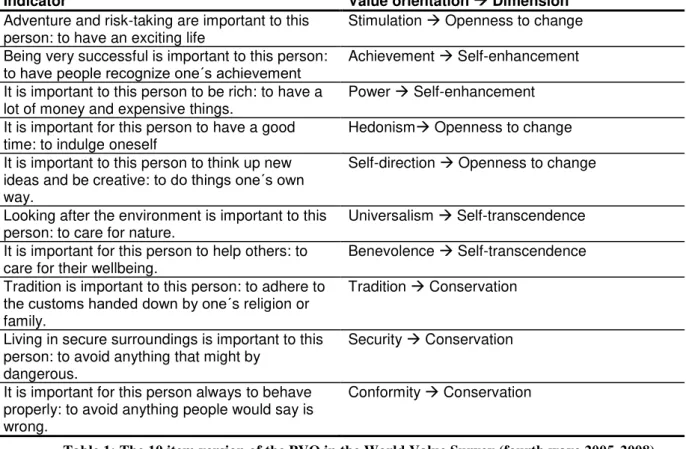
Schwartz et al. (2001) decided to develop the Portraits Value Questionnaire (PVQ) because the SVS was not considered appropriate for studies involving persons with low formal education. The new version of the PVQ (40 items) has high proven reliability and appears more suited for measuring basic values in representative samples within cultures. The designers of the European Social Survey opted for a shorter version of this scale, consisting of 21 portraits, in their survey, with the consequence that the ten value orientations are only poorly measured with at least two items, and with low reliability. The current leading role of the Schwartz concept due to extensive research based on ESS data has led to the decision to include a very short battery (every value is operationalized with only one item) of the PVQ in the fourth World Value Survey (2005–2008). Due to the short scale it is feasible to compare cross-nationally only the two bipolar value dimensions conservation vs. openness (6 items) and self-enhancement vs. self-transcendence (four items). The items used in the worldwide comparison based on WVS data are listed in table 1.
Indicator Value orientation Dimension
Adventure and risk-taking are important to this person: to have an exciting life
Stimulation Openness to change
Being very successful is important to this person:
to have people recognize one´s achievement Achievement Self-enhancement
It is important to this person to be rich: to have a lot of money and expensive things.
Power Self-enhancement
It is important for this person to have a good time: to indulge oneself
Hedonism Openness to change
It is important to this person to think up new
ideas and be creative: to do things one´s own
way.
Self-direction Openness to change
Looking after the environment is important to this person: to care for nature.
Universalism Self-transcendence
It is important for this person to help others: to care for their wellbeing.
Benevolence Self-transcendence
Tradition is important to this person: to adhere to
the customs handed down by one´s religion or family.
Tradition Conservation
Living in secure surroundings is important to this person: to avoid anything that might by
dangerous.
Security Conservation
It is important for this person always to behave properly: to avoid anything people would say is wrong.
Conformity Conservation
Table 1: The 10 item version of the PVQ in the World Value Survey (fourth wave 2005-2008)
Source: http://www.worldvaluessurvey.org/wvs/articles/folder_published/article_base_136
KOME − An International Journal of Pure Communication Inquiry Volume 1 Issue 2 p. 1-22.
negative correlation between the two bipolar dimensions (r = -0,74 between conservation and openness and r = -0,52 between self-enhancement and self-transcendence), it was justified to construct two major value orientations: openness vs. conservation and self-enhancement vs. self-transcendence. Figure 2 draws a worldwide map of value orientations based on the country-samples of the World Value survey. All data is based on the fourth wave of the survey (2005–2008).
Fig.2: A global map of Schwartz values (based on 10 item PVQ measurement of the WVS) Source: own computations based on the WVS data (http://www.wvsevsdb.com/wvs/WVSData.jsp)
KOME − An International Journal of Pure Communication Inquiry Volume 1 Issue 2 p. 1-22.
an outlier, according higher relevance to achievement and power than other Western European countries. Some emerging nations in Latin America (like Brazil or Argentina) are characterized by a completely different value structure. Self-transcendence is far more important than self-enhancement, with Brazil occupying the very global position on this value dimension.
This worldwide comparison of value characteristics clearly shows that there is no universal, global unification of values. There are still cultural spheres with distinctions between African/Arabic, Asian and Eastern European, Latin American and Western European countries.
Analysing value transitions over time on the basis of survey data is difficult, because until recently comparable value data have hardly existed for China. In addition the quality of the samples (also in the WVS) is open to criticismiii. The Schwartz Value Survey Dataset included at least two student samples from Shanghai (1988, 1995). For this study, we decided to compare those samples with our sample of managers from Shanghai (2007)iv. Again, we followed Swartz’s instructions for computing the ten value orientations and four value dimensions (Schwartz 2009).
These three timepoints lead us to conclude that no clear value changes are evident in the metropolitan area of Shanghai: values have remained basically stable from 1988 to 2007. Only slight changes appear, in particular within the dimension of enhancement vs. self-transcendence. Values such as status, power and achievement seem to have gained in importance in Shanghai, but on the dimension of conservation vs. openness to change, no clear trend emerges. We can note a resurgence of conservative values between 1988 and 1995, but otherwise the managers demonstrated more progressive values in 2007 than did the student samples.
Value changes in Shanghai
-1 -0,8 -0,6 -0,4 -0,2 0 0,2 0,4 0,6 0,8 1
conservation openness selftrans selfenhancement
Students 1988 Students 1995 Employees 2007
KOME − An International Journal of Pure Communication Inquiry Volume 1 Issue 2 p. 1-22.
Procedures and empirical findings of our survey
Sampling procedures and fieldwork
For our own empirical study, we decided to select a homogeneous sample of managerial personnel and to restrict our analysis to the metropolitan areas of Beijing and Shanghai, instead of attempting to achieve a representative sample all over China. The study was conducted in close cooperation with Chinese colleaguesv to avoid ethnocentric research bias and to ensure a cultural-linked approach.
Based on our theoretical approach, we saw Chinese business people as driving forces of modernity, and we wanted to distinguish between generations (those who have experienced the eras of Consolidation, Cultural Revolution and Social Reform; see Egri & Ralston, 2004), type of firm (foreign, joint venture, Chinese private, Chinese public) and managerial position (lower, middle, upper management). Therefore we decided to select our sample in China’s two major cities on the basis of certain criteria as to age, gender, occupational position and type of firm, and a Chinese company was engaged to arrange the fieldwork accordingly. The study was conducted in May 2007.
KOME − An International Journal of Pure Communication Inquiry Volume 1 Issue 2 p. 1-22.
Shanghai (N=559; 50.5 %)
Beijing (N=549; 49.5 %)
Total Sample (N=1.108) Age M SD Range 39,25 10,56 20–59
39,43 10,17 21–59
39,34 10,36 20–59
Gender (valid %) Males Females
277 (49.6 %) 282 (50.4 %)
275 (50.,1 %) 274 (49.9 %)
552 (49.,8 %) 556 (50.2 %)
Education (valid %)
Compulsory School Apprenticeship Professional institute University entrance diploma Professional institute requiring diploma
University degree Master
3 (0.5 %) 13 (2.3 %) 26 (4.7 %) 60 (10.7 %) 143 (25.6 %) 281 (50.3 %) 33 (5.9 %)
3 (0.5 %) 0 (0.0 %) 8 (1.5 %) 92 (16.8 %) 229 (41.7 %) 191 (24.8 %) 26 (4.7 %)
6 (0.5 %) 13 (1.2 %) 34 (3.1 %) 152 (13.7 %) 372 (33.6 %) 472 (42.6 %) 59 (5.3 %)
Firm (valid %)
Foreign firm Joint venture
139 (24.9 %) 142 (25.4 %)
135 (24.6 %) 139 (25.3 %)
274 (24.7 %) 281 (25.4 %) Chinese – private
Chinese – public
138 (24.7 %) 140 (25 %)
137 (25.0 %) 138 (25.1 %)
275 (24.8 %) 278 (25.1 %)
Career position (valid %)
Lower management Middle management Upper management
188 (33.9 %) 184 (33.1 %) 183 (33.0 %)
183 (33.4 %) 182 (33.2 %) 183 (33.4 %)
371 (33.6 %) 366 (33.2 %) 366 (33.2 %)
Income (valid %)
1,001 – 2,000 RMB
2,001 – 3,000 RMB
3,001 – 5,000 RMB
5,001 – 7,500 RMB
7,501 – 10,000 RMB
10,001 – 15,000 RMB
15,001 – 20,000 RMB
> 20,001 RMB
17 (3.0 %) 127 (22.7 %) 166 (29.7 %) 103 (18.4 %) 87 (15.6 %) 42 (7.5 %) 16 (2.9 %) 1 (0.2 %)
41 (7.5 %) 110 (20 %) 178 (32.4 %) 108 (19.7 %) 66 (12.0 %) 26 (6.6 %) 7 (1.3 %) 3 (0.5 %)
58 (5.2 %) 237 (21.4 %) 344 (31.0 %) 211 (19 %) 153 (13.8 %) 78 (7.0 %) 23 (2.1 %) 4 (0.4 %)
Table 2: Sociodemographic and occupational characteristics of our sample
Operationalization
KOME − An International Journal of Pure Communication Inquiry Volume 1 Issue 2 p. 1-22.
The first independent variable refers to a generation cluster. Respondents were divided into three generation categories: ‘future’ (20–35 years; they did not experience the Cultural Revolution), ‘opening up’ (36–45 years; experienced the Cultural Revolution as adolescents, as well as the ‘Reform and Opening Up ‘) and ‘cultural revolution’ generation (over 45 years of age; have experienced two difficult times, the ‘Cultural Revolution ‘as well as the’ Three Years of Natural Disasters ‘) (similar to the concept of Egri & Ralston, 2004).
In addition the ‘working area’ represents another central variable of our survey: whether the respondent is working in international surroundings like foreign companies (e.g. joint ventures), in Chinese private companies or in state-owned institutions. A further factor is the
individual’s career position within the firm. People in higher positions might experience more freedom and Western working values in foreign firms, while those working in Chinese firms might be still attached to Chinese values and hierarchical working styles.
The dependent variables were the basic values of Schwartz as well as some ‘secondary values’. Secondary values represent a broader value concept similar to the approach of Inglehard and Welzel (2005). We developed several item batteries to measure the lifestyle and identity of Chinese managers (e.g. determination in life through family or society, fears of the future, responsibility and commitment to family and society, expenditures for work and leisure time), the working environment (e.g. career objectives, attitudes towards leadership, importance of qualifications, working styles) and attitudes towards internationalization (consequences of foreign investment, view of Chinese managers and people, view of European managers and Europeans, connections with Europe and China). All scales were constructed as Likert scales (five categories with equal intervals). Explanatory factor analysis (PCA with varimax rotation) and reliability analysis were used to detect latent constructs behind the indicators, which were used for further analysis.
Before we turn to these secondary values, the analysis will refer to basic values of managers surveyed in Beijing and Shanghai based on the Schwartz Value Survey as well as on predictors explaining certain value orientations.
Empirical findings
KOME − An International Journal of Pure Communication Inquiry Volume 1 Issue 2 p. 1-22.
Socio-demographic
characteristicsvi Occupational characteristics
Basic values and
dimensions measurement
City (Shanghai/Beijing)
Income (five categories) Security
Index based on the instructions of Schwartz (1992), additionally scale use corrections
because of individually different
response styles Education (non-academic/academic)
Middle management level
Conformity Tradition
Gender (male/female) Upper management level
Self-direction Stimulation Company (foreign/Chinese)
Experience with European colleagues (no/yes)
Hedonism
Age (in years)
Power
Experience with European bosses
(no/yes) Achievement
Benevolence
Marital status (not married/married)
Work experience in other countries
(no/yes) Universalism
Value dimensions: Openness to
change Index based on
Schwartz (1992) with scale-use corrected values Children (no/yes)
Preserving the existing order Self-enhancement Self-transcendence
Table 3: Overview of predictors on basic values and value dimensions
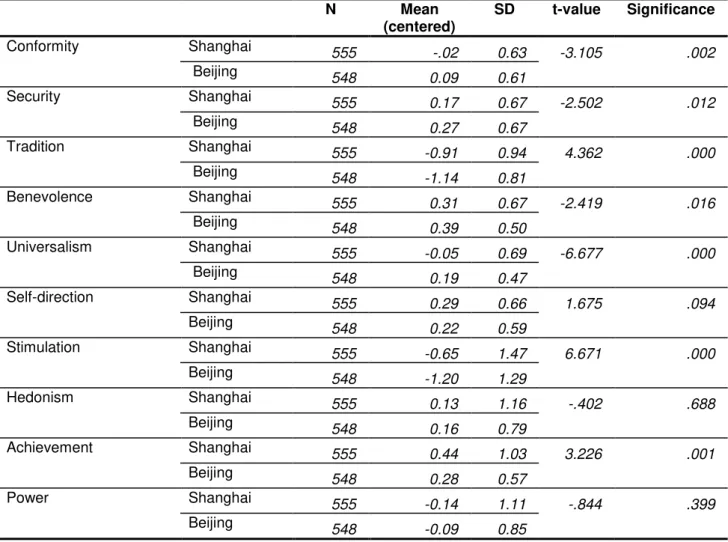
As regards value differences between Beijing and Shanghai, we note significant results on nearly every value orientation. Conformity and security are of higher importance to respondents in Beijing, whereas tradition is seen as slightly more relevant in Shanghai. Respondents in Beijing can be characterized by a higher social value orientation as reflected in the values of universalism and benevolence. This result is also backed up by higher achievement orientation in Shanghai, a value which is negatively correlated with universalism and benevolence. Business people in Shanghai tend toward an individualistic orientation, expressed by higher relevance accorded to self-direction and stimulation. The only values where no differences can be seen are hedonism and power: both these are basically neutral in importance to respondents in both cities.
KOME − An International Journal of Pure Communication Inquiry Volume 1 Issue 2 p. 1-22.
N Mean (centered)
SD t-value Significance
Conformity Shanghai 555 -.02 0.63 -3.105 .002
Beijing 548 0.09 0.61
Security Shanghai 555 0.17 0.67 -2.502 .012
Beijing 548 0.27 0.67
Tradition Shanghai 555 -0.91 0.94 4.362 .000
Beijing 548 -1.14 0.81
Benevolence Shanghai 555 0.31 0.67 -2.419 .016
Beijing 548 0.39 0.50
Universalism Shanghai 555 -0.05 0.69 -6.677 .000
Beijing 548 0.19 0.47
Self-direction Shanghai 555 0.29 0.66 1.675 .094
Beijing 548 0.22 0.59
Stimulation Shanghai 555 -0.65 1.47 6.671 .000
Beijing 548 -1.20 1.29
Hedonism Shanghai 555 0.13 1.16 -.402 .688
Beijing 548 0.16 0.79
Achievement Shanghai 555 0.44 1.03 3.226 .001
Beijing 548 0.28 0.57
Power Shanghai 555 -0.14 1.11 -.844 .399
Beijing 548 -0.09 0.85
Table 4: Mean differences between Beijing and Shanghai in 10 basic values
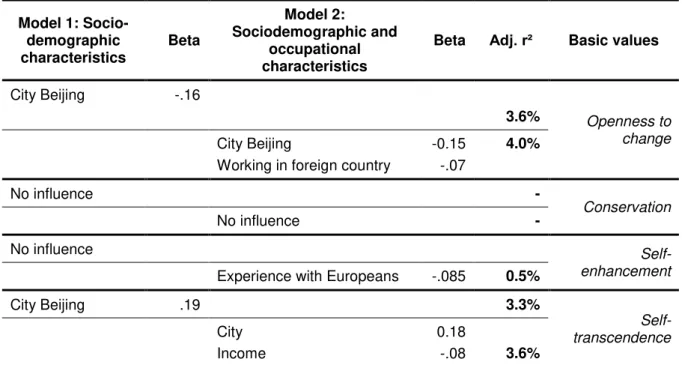
The influence of socio-demographic and occupational characteristics on values can explain only a surprisingly low amount of variance. While conservation and self enhancement seems to be completely independent with regard to socio-demographic and occupational characteristics, only 4% of the variance of openness values and 3,6% of the variance of self transcendence values could be explained by the predictors. In total, only the city differences remain strong enough to achieve significance. Additionally, only three predictors exert an influence on value orientations. The experience of working in a foreign country leads to a slightly lower importance of ‘openness to change’ values, and experiences with European bosses leads to a somewhat lower relevance of ‘self-enhancement’ values. Higher income tends to go together with lower interest in benevolence or universalism.
KOME − An International Journal of Pure Communication Inquiry Volume 1 Issue 2 p. 1-22.
Note: Hierarchical OLS-Regression on four value dimensions Only significant influences (p<0,05) were shown (standardized coefficients)
Table 5: Results of the four OLS-hierarchical regressions
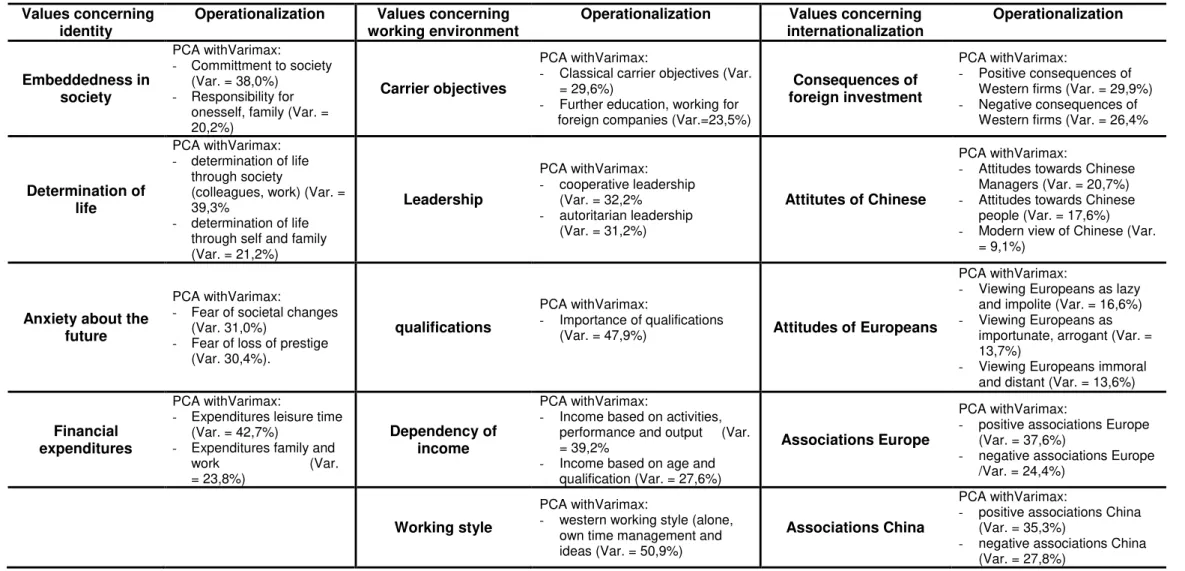
The second part of the empirical analysis focuses on secondary values, the attitudes towards identity formation in China, lifestyle features, working styles and internationalization. Because the design of our empirical analysis is explorative we tried to detect empirically which latent constructs are hidden behind the scales we used. We decided to use Principal component analysis (Varimax Rotation) to judge the quality of the scales. The following table provides all necessary information of our scales and our latent constructs (percentages of explained variance).
Values concerning the identity of the respondents refer on the one hand to general attitudes towards individual life in examination with society. We measured the individual and family responsibility in contrast with the commitment to society (embeddedness), the determination of life through reference groups and anxieties with regard to future developments. Here we could clearly distinguish between fears of societal changes and fears of a loss of status. The item battery referring to expenditures was more lifestyle-oriented and measures the importance of rather personal expenditures in comparison to classical leisure time expenditures. To measure attitudes towards the working environment we used classical item batteries measuring career objectives (such as like income, security of position and social climate in relation to further education and working in foreign firms). Concerning leadership it was possible to differentiate between a preference for an authoritarian leadership styles vs. a cooperative, liberal leading role. Qualifications like foreign experience, education, important contacts, foreign languages and experience in different occupational fields were all seen as
important and could be summarized as one latent variable.
Model 1: Socio-demographic characteristics
Beta
Model 2:
Sociodemographic and occupational characteristics
Beta Adj. r² Basic values
City Beijing -.16
3.6% Openness to
change
City Beijing
Working in foreign country
-0.15 -.07
4.0%
No influence -
Conservation
No influence -
No influence
Self-enhancement
Experience with Europeans -.085 0.5%
City Beijing .19 3.3%
Self-transcendence
City Income
0.18
KOME − An International Journal of Pure Communication Inquiry Volume 1 Issue 2 p. 1-22.
Values concerning identity
Operationalization Values concerning working environment
Operationalization Values concerning internationalization
Operationalization
Embeddedness in society
PCA withVarimax:
- Committment to society (Var. = 38,0%)
- Responsibility for onesself, family (Var. = 20,2%)
Carrier objectives
PCA withVarimax:
- Classical carrier objectives (Var. = 29,6%)
- Further education, working for foreign companies (Var.=23,5%)
Consequences of foreign investment
PCA withVarimax:
- Positive consequences of Western firms (Var. = 29,9%)
- Negative consequences of Western firms (Var. = 26,4%
Determination of life
PCA withVarimax:
- determination of life through society
(colleagues, work) (Var. = 39,3%
- determination of life through self and family (Var. = 21,2%)
Leadership
PCA withVarimax:
- cooperative leadership (Var. = 32,2%
- autoritarian leadership (Var. = 31,2%)
Attitutes of Chinese
PCA withVarimax:
- Attitudes towards Chinese Managers (Var. = 20,7%)
- Attitudes towards Chinese people (Var. = 17,6%)
- Modern view of Chinese (Var. = 9,1%)
Anxiety about the future
PCA withVarimax:
- Fear of societal changes (Var. 31,0%)
- Fear of loss of prestige (Var. 30,4%).
qualifications
PCA withVarimax:
- Importance of qualifications
(Var. = 47,9%) Attitudes of Europeans
PCA withVarimax:
- Viewing Europeans as lazy and impolite (Var. = 16,6%)
- Viewing Europeans as importunate, arrogant (Var. = 13,7%)
- Viewing Europeans immoral and distant (Var. = 13,6%)
Financial expenditures
PCA withVarimax:
- Expenditures leisure time (Var. = 42,7%)
- Expenditures family and work (Var. = 23,8%)
Dependency of income
PCA withVarimax:
- Income based on activities, performance and output (Var. = 39,2%
- Income based on age and qualification (Var. = 27,6%)
Associations Europe
PCA withVarimax:
- positive associations Europe (Var. = 37,6%)
- negative associations Europe /Var. = 24,4%)
Working style
PCA withVarimax:
- western working style (alone, own time management and ideas (Var. = 50,9%)
Associations China
PCA withVarimax:
- positive associations China (Var. = 35,3%)
- negative associations China (Var. = 27,8%)
KOME − An International Journal of Pure Communication Inquiry Volume 1 Issue 2 p. 1-22.
Regarding income, a clear distinction could be noted when viewing salaries on the basis of age and qualification or on activities, performance and output. Finally, also the working style was operationalized as one construct, in terms of preferences for a Western style of working. Attitudes towards internationalization focused on a comparison between Europe and China.
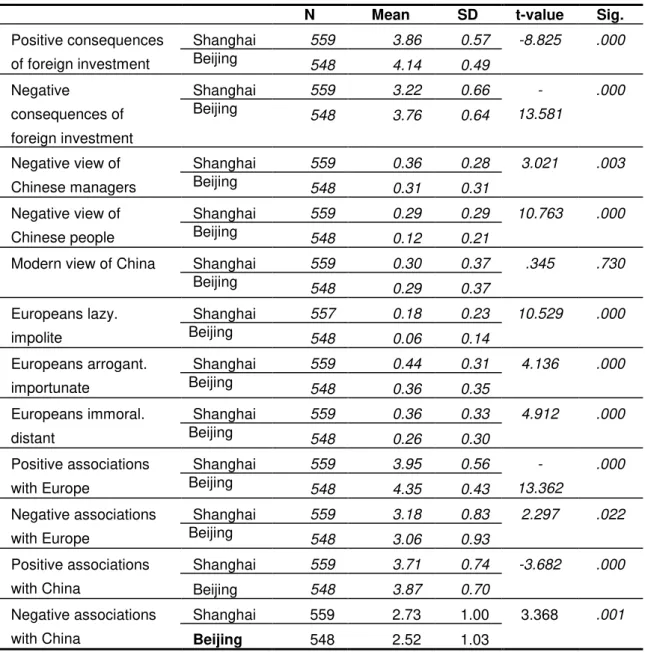
The first item battery referred to positive consequences (important business partner, new technologies, responsibility for booming cities) or negative consequences of foreign investment (e.g. exploitation, societal changes in values).
In addition, the perception of personality traits of European and Chinese people were compared. Interestingly, explorative factor analysis indicated that attitudes towards other Chinese managers could be clearly distinguished from attitudes towards Chinese people, while European people and managers were viewed in equal ways (lazy and impolite; arrogant and importunate; immoral and distant).
The final item battery concerned associations with Europe and China. Both principal component analyses showed a clear distinction between positive associations (economic power region, high quality of life, beauty of nature) and negative associations (like criminality and terrorism, bad manners).
All those indicators which were extracted through exploratory factor analysis were used as index variables (computing the mean attitudes towards items). Again, hierarchical regressions were run where socio-demographic and occupational characteristics as well as basic values were used to measure the influence on all different indicators. The analyses yielded virtually similar results: in general, we found very weak predictorsvii. Because city differences accounted for most of the explained variance in nearly all analysis, we decided to compare the mean importance of the index variables with reference to the two metropolitan areas, again using t-tests for independent samples.
KOME − An International Journal of Pure Communication Inquiry Volume 1 Issue 2 p. 1-22.
N Mean SD t-value Sig.
Self and family
determination of life
Shanghai 559 4.20 0.63 -8.107 .000
Beijing 548 4.49 0.57
Determination of life
through society
Shanghai 559 3.17 0.76 -9.030 .000
Beijing 548 3.57 0.69
Fear of loss of prestige Shanghai 559 3.63 0.69 -4.421 .000
Beijing 548 3.85 0.98
Fear of societal
changes
Shanghai 559 3.63 0.71
-10.087
.000
Beijing 548 4.07 0.73
Having sole and family
responsibility
Shanghai 559 4.24 0.62 -7.668 .000
Beijing 548 4.49 0.47
Commitment to society Shanghai 559 3.38 0.66 -1.333 .183
Beijing 548 3.43 0.69
Expenditures for family
and further education
Shanghai 559 4.26 0.70 -7.847 .000
Beijing 548 4.55 0.48
Expenditures for
leisure-time activities
Shanghai 557 3.51 0.63 -9.896 .000
Beijing 548 3.91 0.72
Table 7: Mean differences between Beijing and Shanghai in identity and lifestyle scales
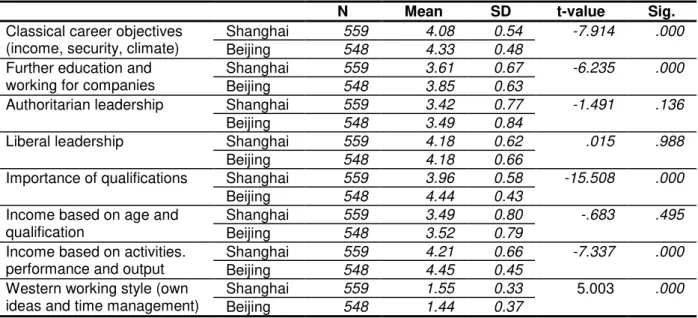
As to the working environment, the general conclusion of higher importance of values among the Beijing respondents remains the same. However, no significant differences could be observed concerning preferences as regards leadership or the relevance of income based on age and qualification.
N Mean SD t-value Sig.
Classical career objectives (income, security, climate)
Shanghai 559 4.08 0.54 -7.914 .000
Beijing 548 4.33 0.48
Further education and working for companies
Shanghai 559 3.61 0.67 -6.235 .000
Beijing 548 3.85 0.63
Authoritarian leadership Shanghai 559 3.42 0.77 -1.491 .136
Beijing 548 3.49 0.84
Liberal leadership Shanghai 559 4.18 0.62 .015 .988
Beijing 548 4.18 0.66
Importance of qualifications Shanghai 559 3.96 0.58 -15.508 .000
Beijing 548 4.44 0.43
Income based on age and qualification
Shanghai 559 3.49 0.80 -.683 .495
Beijing 548 3.52 0.79
Income based on activities. performance and output
Shanghai 559 4.21 0.66 -7.337 .000
Beijing 548 4.45 0.45
Western working style (own ideas and time management)
Shanghai 559 1.55 0.33 5.003 .000
Beijing 548 1.44 0.37
KOME − An International Journal of Pure Communication Inquiry Volume 1 Issue 2 p. 1-22.
In general, classical career objectives seem to be more important than further education or working for foreign or Chinese companies. All respondents opt more for a liberal leadership than for an authoritarian leadership. The majority thinks that income should be based on activities, performance and output, and not too strictly on age and qualifications. Interestingly, preference for a more progressive working style (being able to manage one’s own time and
develop one’s own ideas) was found to be more common among respondents in Shanghai
than in Beijing.
The attitudes towards internationalization reveal finally a clear and coherent view of managers in Beijing in comparison to Shanghai. In Shanghai the view towards Chinese people as well as towards Europeans is expressed more critically than in Beijing. There are also less positive and more negative associations with Europe and less positive and more negative associations with China. Regarding the consequences of foreign investment, respondents in Beijing see more positive signs but considerable fear negative developments such as effects on Chinese values and identity or a potential exploitation of Chinese workers.
N Mean SD t-value Sig.
Positive consequences
of foreign investment
Shanghai 559 3.86 0.57 -8.825 .000
Beijing 548 4.14 0.49
Negative
consequences of
foreign investment
Shanghai 559 3.22 0.66
-13.581
.000
Beijing 548 3.76 0.64
Negative view of
Chinese managers
Shanghai 559 0.36 0.28 3.021 .003
Beijing 548 0.31 0.31
Negative view of Chinese people
Shanghai 559 0.29 0.29 10.763 .000
Beijing 548 0.12 0.21
Modern view of China Shanghai 559 0.30 0.37 .345 .730
Beijing 548 0.29 0.37
Europeans lazy.
impolite
Shanghai 557 0.18 0.23 10.529 .000
Beijing 548 0.06 0.14
Europeans arrogant.
importunate
Shanghai 559 0.44 0.31 4.136 .000
Beijing 548 0.36 0.35
Europeans immoral.
distant
Shanghai 559 0.36 0.33 4.912 .000
Beijing 548 0.26 0.30
Positive associations
with Europe
Shanghai 559 3.95 0.56
-13.362
.000
Beijing 548 4.35 0.43
Negative associations
with Europe
Shanghai 559 3.18 0.83 2.297 .022
Beijing 548 3.06 0.93
Positive associations
with China
Shanghai 559 3.71 0.74 -3.682 .000
Beijing 548 3.87 0.70
Negative associations with China
Shanghai 559 2.73 1.00 3.368 .001
Beijing 548 2.52 1.03
KOME − An International Journal of Pure Communication Inquiry Volume 1 Issue 2 p. 1-22.
Discussion of the results - a cultural surface synchronization?
The first empirical part of the paper (secondary analysis of value characteristics of china in a cross-national and time perspective) demonstrated that basic values held in China remain stable over time, and quite distinct from values held in Europe or Latin America. Also at the managerial sphere, as our own survey clearly demonstrates, the homogeneity of values is striking. Neither socio-demographic characteristics nor occupation predictors could explain the evolvement of different value orientations. Only between the two metropolitan areas, remarkable differences in basic values and central attitudes could be found. Respondents in Beijing tend to be more socially open and tolerant while respondents in Shanghai favour achievement and individualism. Concerning identity and lifestyle, business people in Beijing give a higher priority to several identity and lifestyle features, which may reflects their higher personal involvement with Chinese society. This can also be confirmed with regard to attitudes towards internationalization. Respondents in Shanghai clearly express a critical view towards Europe and China. It seems that respondents in Beijing see themselves in the heart of China while respondents in Shanghai demonstrate a tendency to develop a more independent and critical perspective towards domestic and foreign influences.
KOME − An International Journal of Pure Communication Inquiry Volume 1 Issue 2 p. 1-22.
Notes
i
Quality dailies and Information formats from the public-service television broadcasting network ii
A hutong is an ancient city alleyway or lane lined with single-story dwellings in which generations of families have lived together. In recent decades these hutongs have been replaced by modern buildings, and this has had a massive influence on the collective way of life in China.
iii
It is highly questionable, if the Chinese sample of the World Value Survey can be seen as representative for the Chinese population. Representativity means in a strict sense that all inhabitants of China should have an equal chance to be part of the proposed sample of about 2000 per country individuals in the WVS.
iv
Again, the conclusions based on three different samples must be recognized as limited, but at least the same survey instrument (the 57 item SVS) was used in all samples.
v
from Fudan University/Shanghai, Tsinghua University/Beijing and Beijing Foreign Studies University/Beijing vi
Socio-demographic and occupational characteristics were dichotomized to use the variables as predictors in multiple regression analysis. It was decided to use age in the original form to avoid a theoretical determination of regression models based on the three-generation approach.
vii
Due to space limits, the full analyses are not reproduced here, but can be obtained on request from the authors
References
Amnesty International UK (2006). Undermining freedom of expression in China. London: The Human Rights Action Centre.
Appadurai, A. (1996). Modernity at Large: Cultural Dimensions of Globalization. Minneapolis, MN: University of Minnesota Press.
Bauman, Z. (1999). Culture as Praxis (2nd edition). London: Sage.
Beck, U. (2000). What is globalization? Cambridge: Polity Press.
Bersick, S. (2010). Perceptions of Asia in Europe. Asia Europe Journal, 8(2), 245-255. DOI: 10.1007/s10308-010-0261-z
Bhabha Homi, K. (1994). The Location of Culture. London: Routledge.
Blumer, H. (1969). Symbolic Interactionism: Perspective and Method. Berkeley, CA: University of California Press.
China Internet Network Information Center (CNNIC). (2011). The 27th survey report on the Internet development in China. Retrieved from: http://www1.cnnic.cn/uploadfiles/pdf/2011/2/28/153752.pdf (accessed 7 February 2013)
Clarke, J., Hall, S., Clarke, J., Jefferson, T., Roberts, B. (1976). Subcultures, cultures and class: A theoretical overview. In: S. Hall and T. Jefferson (Eds.), Resistance Through Rituals. Youth Subcultures in Post-war Britain
(9-74). London: Routledge.
Egri, C.P., Ralston, D.A. (2004). Generation cohorts and personal values. A comparison of China and the US.
Organization Science, 15(2),210-220. DOI: 10.1287/orsc.1030.0048
Fabrigar, L.R., Wegener, D. T., MacCallum, R. C., Robert C., Strahan, E. J. (1999). Evaluating the use of exploratory factor analysis in psychological research. Psychological Methods, 4(3), 272-299. DOI: 10.1037/1082-989X.4.3.272
Featherstone, M. (1990). Global culture: An introduction. In: M. Featherstone (Ed.) Global Culture. Nationalism, Globalization and Modernity (1-14). London: Sage.
KOME − An International Journal of Pure Communication Inquiry Volume 1 Issue 2 p. 1-22.
Giddens, A. (1997). Sociology (3rd edition). Cambridge: Polity Press.
Hannerz, U. (1987). The World in Creolisation. Africa, 57(4), 546-559. DOI: 10.2307/1159899
Harvey, D. (1990). The Condition of Postmodernity: An Enquiry into the Origins of Cultural Change.
Cambridge, MA: Blackwell.
Inglehart, R., Baker, W.E. (2000). Modernization, cultural change, and the persistence of traditional values.
American Sociological Review, 65(1), 19–51. DOI: 10.2307/2657288
Inglehart, R.F., Welzel, C. (2005). Modernization, cultural change and democracy: the human development sequence. New York: Cambridge University Press.
Korzybski, A. (1933). Science and Sanity. An Introduction to Non-Aristotelian Systems and General Semantics. Lakeville, CT: International Non-Aristotelian Library Publishing Co.
Richter, C., Gebauer, S. (2011). The Portrayal of China in German Media. Retrieved from:
http://www.boell.de/downloads/TXT_20110606_Media_Study_Summary-CR.pdf (accessed 7 February 2013)
Ritzer, G. (1996). The McDonaldization of Society.Thousand Oaks, CA: Pine Forge Press.
Robertson, R. (1995). Glocalization: time-space and heterogeneity-homogeneity. In: M. Featherstone, S. Lash, R. Robertson (Eds.), Global Modernities (25-44). London: Sage.
Schwartz, S.H. (1992). Universals in the Content and Structure of Values: Theoretical Advances and Empirical Tests in 20 Countries. Advances in Experimental Social Psychology, 25, 1-65. DOI: 10.1016/S0065-2601(08)60281-6
Schwartz, S.H., Melech, G., Lehmann, A. Burgess, S., Harris, M., Owens, V. (2001). Extending the cross-cultural validity of the theory of basic human values with a different method of measurement. Journal of Cross-Cultural Psychology, 32(5), 519-542. DOI: 10.1177/0022022101032005001
Schwartz, S.H. (2006). A Theory of Cultural Value Orientation. Explication and Applications. Journal of Comparative Sociology, 5(2-3), 137-182. DOI: 10.1163/156913306778667357
Schwartz, S.H. (2009). Draft Users Manual: Proper Use of the Schwartz Value Survey. Retrieved from:
http://crossculturalcentre.homestead.com/DraftManual_SVS_14Feb2009.doc, accessed May 24 2013.
Thompson, W., Hickey, J. (1999). Society in Focus: Introduction to Sociology (3rd edition). New York: Addison Wesley Longman.
Urban, D., Mayerl, J. (2011). Regressionsanalyse: Theorie, Technik und Anwendung (3rd edition). VS-Verlag: Wiesbaden.
Welsch, W. (1999). Transculturality - the Puzzling Form of Cultures Today. In: M. Featherstone, S. Lash (Eds.),
Spaces of Culture: City, Nation, World. (194-213) London: Sage. Available at: http://www2.uni-jena.de/welsch/Papers/transcultSociety.html (accessed 7 February 2013)
Wobst, M. (2007). Deutschland und China: Die wechselseitige Wahrnehmung in den vergangenen 15 Jahren. In: A. Richter (Ed.), China und die Wahrnehmung der Welt (321-330). Wiesbaden: Harrassowitz.