Implementation of a Viscoelastic Constitutive Model Using
the Object-Oriented Programming Approach
H. N. Silva1, J. B. Soares1, E. Parente Jr.2, P. C. Sousa1
Summary
The numerical implementation of the time-dependent linear viscoelastic constitutive model using object-oriented programming is discussed here. This paper is divided in two main parts: (i) a brief discussion of the numerical integration of linear viscoelastic constitutive equations, including the use of Prony series for characterization of viscoelastic materials (e.g. asphalt pavement surfaces) and (ii) the class organization and methods implemented in viscoelastic related classes of an object-oriented framework. The implementation is part of an ongoing development Finite Element (FE) computer system for pavement analysis and research.
Introduction
There is a still a current need for new methodologies for pavement analysis and design that can more accurately predict pavement distresses. The evolution of numerical methods such as the Finite Element Method (FEM) and the Boundary Element Method (BEM) has made the mechanistic-empirical methods more popular for pavement analysis applications. Nevertheless, it is generally assumed the pavement system to have a linear elastic behavior and subjected to static loads. Efforts to implement more advanced material models as well as dynamic loading in pavement analysis are found in [1] and [2], respectively.
Asphalt mixtures are known to present a viscoelastic behavior and many moduli can be used to describe their viscoelastic behavior, in both time and frequency domain [3, 4, 5, 6, 7, 8]. Christensen [3] mentions that for isotropic materials it is convenient to divide the material characterization in two parts: simple shear and dilatation. A reasonable simplification is to assume a constant Poisson’s ratio ν [9], therefore requiring a single material characterization. In fact, it is convenient to perform a simple shear test in frequency domain and then interconvert to a dilatation expression in time domain [6], for proper use in a Finite Element code. The latter modulus, named relaxation modulus E(t), is experimentally obtained for constant strain, that is ε(t)=H(t−τ0)ε0, where H
is the unit step function and ε0 is a prescribed strain [3, 4]. A proper
1 Departamento de Engenharia de Transportes, Federal University of Ceará, 60455/760, Fortaleza, Brazil 2 Departamento de Engenharia Estrutural e Construção Civil, Federal University of Ceará, 60455/760,
mathematical representation of the relaxation modulus E(t) is an exponential series (1), also known as Prony series, fitted with the collocation method [5].
∑
= −∞+
= p
i t ie i
E E
t E
1
)
( ρ (1)
The number of terms p is usually between 5 and 11 terms and depends on the time range of material behavior. The use of a Prony series (1) is due its semi-group property which enables a computationally efficient recursive expression to update the stress field [10].
Numerical Implementation of Linear Viscoelasticity
The numerical implementation of the viscoelastic model can be performed by direct integration of the convolution integral (2) in some set of discrete time [3].
∫
= − ∂∂= t
t
d t
E
0
0
)
( τ
τ ε τ
σ (2)
Although this is the most direct manner [11], it is computationally inefficient. In fact, using such approach to evaluate the response of a given discrete time
t
t+Δ , it is mandatory to store the response of all previous discrete times from initial time of loading t0 =0 to immediately previous discrete time t [12, 13]. It requires significant storage memory and computational effort, even in the case of isotropic materials. To deal with such computational drawbacks, alternative formulations have been proposed by many authors [13, 14, 15, 16, 17, 18].
In this paper we present an incremental numeric method for the isotropic linear viscoelastic constitutive model characterized by a Prony series (1), which is simple to implement in a Finite Element program [15, 19]. This method was first proposed by Taylor et al. [18] and it enables a computationally efficient recursive expression to update the stress field. For the sake of convenience, the expressions that follow are proper for the one-dimensional case, but this method was also implemented for two-dimensional (plane stress, plane strain), axisymmetric and three-dimensional isotropic cases.
According to Eq. (3), we assume stress σt is known at a given discrete time
σ σ
σt+Δt = t +Δ (3)
σ ε σ = Δ +Δˆ
Δ E (4)
∑
= −Δ∞ + Δ −
= p
i
t i
i e i
E t E E 1 ) 1 (
1 ρ ρ (5)
The main task in this method is to provide an efficient expression to evaluate the second term of the r.h.s of Eq. (4). Again, using the convolution integral (2) and Prony series (1), we can analytically develop Eq. (6) containing internal recursive variables Si(t) (7), which depends only on the respective internal variables of the second previous time of interest t−Δt. The internal variable at initial time Si(t0) can be considered zero without incurring in much error. This formulation express an efficient recursive way to update the stress, avoiding direct numerical integration of the convolution integral and consequently this method saves computational memory and effort.
(
)
∑
= − −Δ −=
Δ p
i
i t S t
e i 1 ) ( 1 ˆ ρ σ (6)
[
e S t t E e]
tt
S i t i
i i i t i Δ Δ − + Δ −
= −Δ ρ ( ) ρ (1 −Δ ρ ) ε
)
( , i=1,...,p (7)
When the formulation previously described is considered in a generalized two or three dimensional Finite Element problem, the basic local equilibrium equation assumes the vector form in Eq. (8) [13], where B is the stress-strain matrix and ft+Δt is the current external force vector. For the isotropic formulation the modulus E (5) is still a scalar, but the stresses σt (first part of r.h.s of Eq. (5)), Δσˆ of Eq. (6) and the incremental displacement Δu are vectors. The latter substitutes the incremental strain.
(
∫
)
Δ = +Δ −∫
V t +ΔT t t V
TEBdV u f B (σ σˆ)dV
B (8)
OOP Approach for Viscoelastic Constitutive Model Implementation
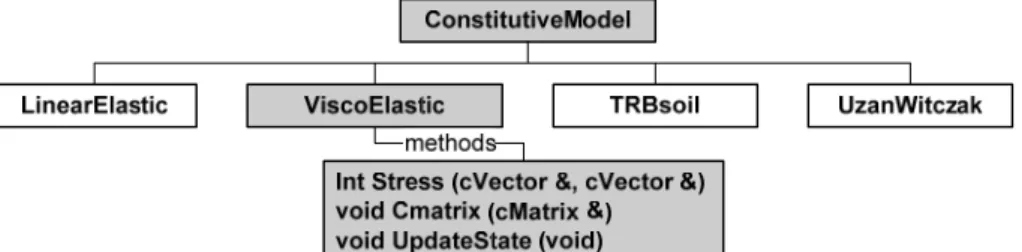
previous section was numerically implemented in a FE computer system under development that use OOP techniques and whose hierarchy of the main classes is described in Figure 1. The relationships among these main classes if of type “has a”. For generality, these main classes are abstraction of essential components of the Finite Element Method [23]. This paper concern just in the classes related to the viscoelastic constitutive material. For more details of the description of all classes the reader is referred to [20, 25].
Figure 1: Classes hierarchy of FE computer system
For the viscoelastic constitutive model implemented, a derived class
MatViscoElastic from Material abstract class storages material parameters –
Poisson’s ratio ν and coefficients E∞,
E
i, ρi of Prony series (1) – and creates query methods to be used by other classes. On the other hand, theConstitutiveModel abstract class is responsible for the computation of the current
stress vector σt+Δt for a given strain vector εt+Δt. The current development of the
ConstitutiveModel base class enables the classical linear elastic, two resilient
models for soils and the linear viscoelastic analysis, as depicted in the derived classes presented in Figure 2.
The Constitutive Model has access to the Material data and AnalysisModel
methods through the associated element, so duplication of Material data is avoided and minimizes the amount of computer memory required by the system [20]. It is important to say that each region of the domain has a different stress/strain history, so an object of the ConstitutiveModel class is defined for each integration point of the finite element mesh [2, 13, 20]. Specifically looking at the viscoelastic problem, a derived class ViscoElastic is created. The method
Stress computes the stress field according to proper corresponding vector
problem it was implemented the method Cmatrix to compute the tangent constitutive matrix C. Finally, it was implemented the UpdateState method to update the internal variables of the problem, such as Si(t) of Eq. (5).
Example Problem
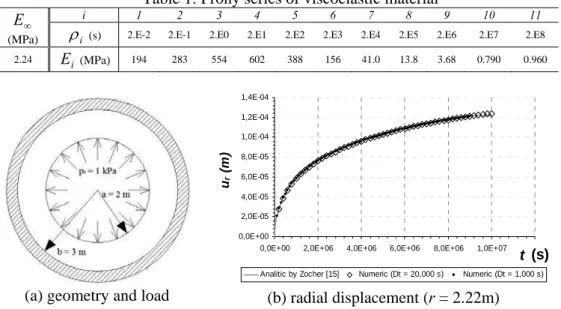
In order to validate the implementation the viscoelastic constitutive model discussed in this paper, this section shows a simple example of the radial displacement ur of a thick-walled viscoelastic cylinder encased in a shell of infinite stiffness [15]. The internal radius a, external radius b and constant internal pressure p0 are indicated in Figure 3a. The Poisson’s ration used was ν= 0.30. The analysis was performed in axisymmetric mode with the viscoelastic properties extracted from [6] and presented in Table 1. The numerical responses were compared with analytical solution of Eq. (9) in which
D(t) is the creep compliance interconverted from relaxation modulus E(t) also extracted from [6].
Table 1: Prony series of viscoelastic material
∞
E
(MPa)
i 1 2 3 4 5 6 7 8 9 10 11
i
ρ (s) 2.E-2 2.E-1 2.E0 2.E1 2.E2 2.E3 2.E4 2.E5 2.E6 2.E7 2.E8 2.24
i
E (MPa) 194 283 554 602 388 156 41.0 13.8 3.68 0.790 0.960
(a) geometry and load
0,0E+00 2,0E-05 4,0E-05 6,0E-05 8,0E-05 1,0E-04 1,2E-04 1,4E-04
0,0E+00 2,0E+06 4,0E+06 6,0E+06 8,0E+06 1,0E+07 1,2E+07 t (s)
u
r
(m
)
Analitic by Zocher [15] Numeric (Dt = 20,000 s) Numeric (Dt = 1,000 s)
(b) radial displacement (r = 2.22m) Figure 3: viscoelastic cylinder encased in a shell of infinite stiffness
( )(
)
(
)
() 2 1 2 1 1 ) ,( 2 2
2
0 D t
b r r b b a b a p t r
ur ⎟
⎠ ⎞ ⎜ ⎝ ⎛ − − + + − = ν ν ν (9)
The results of Figure 3b indicate the time function radial displacement
) , (r t
A good agreement between the analytic and FE results were found for both time steps, which indicate a correct implementation of the viscoelastic constitutive model on the proposed system for pavement analysis and research.
Conclusion
A formulation has been briefly reported for modeling the response of linear viscoelastic materials, as asphalt pavement surfaces. This formulation was correct implemented in a Finite Element computer system for pavement analysis and research using comprehensively Object-Oriented techniques, which enables more efficient data management and simpler expansion of the code under development in order to include more accurate models for mechanistic pavement analysis.
Acknowledgments
The authors gratefully acknowledge the financial support of CNPq-Brazil and FINEP-Brazil research agencies.
References
1. Oeser, M and Möller, B. (2004): “3D Constitutive model for asphalt pavements”, Int. Journal of Pavement Engineering, Vol. 5, n. 3, Sep., pp. 153-161.
2. Evangelista Jr, F., Parente Jr, E., Holanda, A. S., Araújo, T. D. P. and Soares, J. B. (2007) “Dynamic Analysis of Asphaltic Pavements”, 27th Iberian Latin-American Congress on Computational Methods in
Engineering - CILAMCE, Belém, Brazil.
3. Christensen, R. M. (1982): Theory of Viscoelasticity, an Introduction, Academic Press, United Kingdom.
4. Schapery, R. A. (1982) Theory of viscoelasticity, Lecture notes. Not published.
5. Park, S. W. and Y. R. Kim (2001): “Fitting Prony-Series Viscoelastic Models with Power Law Presmoothing”, Journal of Materials in Civil
Engineering, Vol. 13, n. 1, Jan./Feb.
based on Prony series”. Int. Journal of Solids and Structures, Vol 36, pp. 1653-1675.
7. Souza, F. V., Soares, J. B. and Allen, D. H. (2003): “Repeated Load Creep Test Predictions Using the Theory of Linear Viscoelasticity”, International Conference on Computational & Experimental Engineering and Sciences,
ICEES.
8. Sousa, P. C. and Soares, J. B. (2007): “Método da Colocação para Obtenção de Séries de Prony Usadas na Caracterização Viscoelástica de Materiais Asfálticos”, Anais do XX Congresso de Pesquisa e Ensino em
Transportes, ANPET, Brazil. In Portuguese.
9. Shapery, R. A. (1975): “A Theory of crack initiation and growth in viscoelastic media I. Theorical development”, Int. Journal of Fracture, Vol. 11, pp. 141-159.
10. Simo, J. C. and Hughes, T. J. R. (1997): Computational Inelasticity, Springer-Verlag, New York, USA.
11. Lee, E. H. and Rogers, T. G., (1963). “Solution of viscoelastic stress analysis problems using measured creep or relaxation functions”, Journal
of Applied Mechanics, Vol. 30, n. 1, pp. 127-133.
12. Hammerand, D. C. (1999): Geometrically-Linear and Nonlinear Analysis
of Linear Viscoelastic Composites Using the Finite Element Method, PhD
dissertation, Virginia Polytechnic and State University, Blacksburg, VA, USA.
13. Zienkiewicz, O. C. and Taylor, R. L. (2000): The Finite Element Method,
Solid Mechanics, Fitth edition, Vol. 2, Butterworth-Heinemann, United
Kingdom.
14. Hinterhoelzl, R. M. and Schapery, R. A. (2004): “FEM Implementation of a Three-Dimensional Viscoelastic Constitutive Model for Particulate Composites with Damage Growth”, Mechanics of Time-Dependent
Materials, Vol. 8, pp. 65-94, Netherlands.
15. Zocher, M. A. (1995): A Thermoviscoelastic Finite Element Formulation
for the Analysis of Composites, PhD dissertation, Aerospace Engineering
16. Zak, A. R. (1967): “Structural analysis of realistic solid-propellant materials”, Journal of Spacecraft and Rockets, Vol. 5, n. 3, pp. 270-275.
17. White, J. L. (1968): “Finite elements in linear viscoelasticity”, 2nd
Conference on Matrix Methods in Structural Mechanics, pp. 498-516,
Dayton, OH, USA.
18. Taylor, R. L., Pister, K. S. and Goudreau, G. L. (1970): “Thermomechanical analysis of viscoelastic solids”, International Journal
for Numerical Methods in Engineering, Vol. 2, pp. 45-79.
19. Evangelista Jr, F. (2006): Análise Quase-Estática e Dinâmica de
Pavimentos Asfálticos. DSc thesis, Departamento de Engenharia de
Transportes, Federal University of Ceará, Fortaleza, Brazil. In portuguese.
20. Holanda, A. S., Parente Jr., E., Araújo, T. D., Melo, L. T. B., Evangelista Jr., F. and Soares, J. B. (2006): “An Object-Oriented System for Finite Element Analysis of Pavements”, III European Conference on Computational Mechanics Solids, Structures and Coupled Problems in
Engineering, pp. 1-16.
21. Mackerle, J. (2004): “Object-oriented programming in FEM and BEM: a bibliography (1990–2003)”, Advances in Engineering Software, Vol. 35, pp. 325-336.
22. Zimmermann, T., Bomme, P., Eyheramendy, D., Vernier L. and Commend, S. (1998): “Aspects of an object-oriented finite element environment”, Computers and Structures, Vol. 68, pp. 1-16.
23. Archer, G. C., Fenves, G. and Thewalt, C. (1999): “A new object-oriented finite element analysis program architecture”, Computers and Structures, Vol. 70, pp. 63-75.
24. Fang, H., Hand, A.J., Haddock, J.E., White and T.D. (2007): “An object-oriented framework for finite element pavement analysis”, Advances in
Engineering Software, Vol. 38, pp. 763–771.
25. Martha, L. F. and Parente Jr, E. (2002): “An Object-Oriented Framework for Finite Element Programming”, Proceedings of the Fifth World