Cholesterol granulomas of the central nervous sys-tem are rare lesions and the petrous apex is the intra-cranial site most frequently involved. Cases of intracra-nial cholesterol granuloma have been reported asso-ciated with familial hypercolesterolemia and high se-rum lipid levels. With few cases reported in the litera-ture, the pathogenesis of the event is until unclear.
The following report shows a case of a young woman with a temporal mass with cholesterol gran-uloma diagnosed in the pathologic examination.
CASE
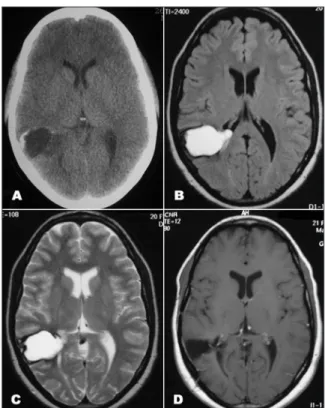
A black 20 year-old woman, presented at our service due to severe progressive headache and drowsiness. Physi-cal and neurologic examination were normal. Neuroimag-ing showed a heterogeneous cystic mass in the posterior right temporal lobe, extending to the ventricular trigone (Fig 1A, B, C). A temporal craniotomy was performed, and the lesion was resected completely. The post-operative peri-od was uneventful. Pathologic examination was consistent with cholesterol granuloma. There was no dislipidemia nor familial hypercholesterolemia hystory. At 3-month follow-up, the patient resumed a normal life, with no complaints. The post-operative image shows no recurrence (Fig 1D).
CEREBRAL CHOLESTEROL GRANULOMA
Case report
Rodrigo Mendonça
1, Cleiton Schweitzer Peron
1, Marco Antônio Stefani
2, Pasquale Gallo
2ABSTRACT - Intracranial cholesterol granulomas are rare lesions, and have been registered in petrous apex region. The presence of an intracerebral cholesterol granuloma is an uncommun event. We report the case of a 20-years-old woman who undergone craniotomy for resection of a temporal mass. Pathologic exam-ination show a cholesterol granuloma.
KEY WORDS: granuloma, foreign-body, cholesterol, brain diseases.
Granuloma de colesterol cerebral: relato de caso
RESUMO - Granulomas de colesterol intracranianos são lesões raras, sendo observados na região do ápice petroso. A ocorrência de granuloma de colesterol intracerebral é um evento incomum. Relata-se o caso de mulher de 20 anos submetida a craniotomia para ressecção de processo expansivo temporal, com exame anátomo-patológico evidenciando um granuloma de colesterol.
PALAVRAS-CHAVE: granuloma de corpo estranho, colesterol, doenças cerebrais.
Serviço de Neurocirurgia do Hospital Cristo Redentor, Porto Alegre RS, Brazil: 1MD, Neurosurgery Resident; 2MD, Neurosurgery Preceptor.
Received 1 October 2006, received in final form 16 January 2007. Accepted 13 March 2007.
Dr. Rodrigo Mendonça - Rua Domingos Rublo 20 / 260 - 91040-000 Porto Alegre RS - Brasil.
Arq Neuropsiquiatr 2007;65(2-B):540-541
Arq Neuropsiquiatr 2007;65(2-B) 541
DISCUSSION
Intracranial cholesterol granulomata are rare le-sions, and are thought to occur as a foreign body reaction against cholesterol crystals1-4. Cholesterol
granulomata occur in about 1 per 2–3 million popula-tion each year5. In the region of mastoid air cells, the
mucosal swelling blockage of the pneumatic path-ways to apical air cell system, leading to hypoxia and further tissue and blood cells necrosis. Trapped gas resorption results in a vacuum that triggers bleed-ing, and cholesterol crystals forms through anaerobic breakdown of blood products3. Another theory, the
exposed marrow hypothesis, was postulated to ex-plain the cholesterol granuloma formation 3.
The petrous apex is the most intracranial site fre-quently involved by cholesterol granulomata2,5-7
, fol-lowed by orbital bones4,8,9. Further reports indicate
that cholesterol granulomas account for 60% of pe-trous apex lesions 10.There are cases of xanthomas in
the third ventricle, including associated with colloid cyst11.
One case report was found concerned intrace-rebral localization of cholesterol granuloma1, in a
patient with familial hypercolesterolemia and high serum lipid levels, who presented with an asymptom-atic cholesterol granuloma of the brain. Intracranial cerebral cholesterol granulomata have not been as-sociated with genetic hypercholesterolemia5,6, with
only one previous case linked to homozygous FH12
. In the present case, the patient was not dislipidemic, neither history of familial hypercolesterolemia was present. There was no history of pregress neurologic illness, such as cerebral hemorhage or traumatic brain injury, wich could explain the presence of blood
deg-radation products in the cerebral parenchyma. Thus, no risk factor could be assesed.
Imaging of the lesions with computed tomography and magnetic resonance imaging can help differenti-ate cholesterol granulomas from other lesions on the basis of a characteristic appearance. In general, the le-sion is hyperintense in both T1 and T2-weight images, because of presence of lipid. A dark signal rim in T2, suggestive of hemosiderin, also could be seen.
The treatment of cholesterol granuloma is the surgical excision, with very low incidence of recur-rence in cases with complete removal 4.
REFERENCES
1. Francis GA, Johnson RL, Findlay JM, Wang J, Hegele RA. Cerebral cholesterol granuloma in homozygous familial hypercholesterolemia. CMAJ 2005;172:495-497
2. Verret DJ, Samy RN. Bilateral cholesterol granulomas.Otol Neurotol 2005;26:1041-1044.
3. Jackler RK, Cho M. A new theory to explain the genesis of petrous apex cholesterol granuloma. Otol Neurotol 2003;24:96-106.
4. Arat YO, Chaudhry IA, Boniuk M. Orbitofrontal cholesterol granulo-ma: distinct diagnostic features and management. Ophthal Plast Re-constr Surg 2003;19:382-387.
5. Lo WW, Solti-Bohman LG, Brackmann DE, Gruskin P. Cholesterol gran-uloma of the petrous apex: CT diagnosis. Radiology 1984;153:705-711.Radiology 1984;153:705-711. 6. Gherini SG, Brackmann DE, Lo WW, Solti-Bohman LG. Cholesterol
granuloma of the petrous apex. Laryngoscope 1985;95:659-664. 7. Terao T, Onoue H, Hashimoto T, Ishibashi T, Kogure T, Abe T.
Choles-terol granuloma in the petrous apex: case report and review. Acta Neu-Acta Neu-rochir (Wien) 2001;143:947-952.
8. McNab AA, Wright JE. Orbitofrontal cholesterol granuloma. Ophthal-mology 1990;97:28-32.
9. Selva D, Chen C. Orbitofrontal cholesterol granuloma: percutaneous endoscopic-assisted curettage. Orbit 2004;23:49-52.Orbit 2004;23:49-52.
10. Muckle RP, De la Cruz A, Lo WM. Petrous apex lesions. Am J Otol 1998;Petrous apex lesions. Am J Otol 1998; 19:219-225.
11. Shuangshoti S, Phonprasert C, Suwanwela N, Netsky MG. Combined neuroepithelial (colloid) cyst and xanthogranuloma (xanthoma) in the third ventricle. Neurology 1975;25:547-552.