Rev Bras
Cineantropom
Hum
DOI: http://dx.doi.org/10.5007/1980-0037.2017v19n1p74
original article
Factors associated to performance eficacy
of technical-tactical actions in volleyball
Fatores associados à eicácia no desempenho
das ações técnico-táticas do voleibol
William das Neves Salles1
Carine Collet1
Margareth Porath1
Michel Milistetd1
Juarez Vieira do Nascimento1
Abstract – he aim of the study was to investigate the factors associated to performance eicacy of technical-tactical actions in volleyball. Based on the protocol of the Instrument for Technical and Tactical Performance Assessment in Volleyball (IAD-VB), 44.025 match actions performed by male and female athletes from u-15, u-16 and u-17 inalist teams of the 2010 Santa Catarina Volleyball Championship in Brazil were observed. Data were analyzed on SPPS 21 software using the logistic regression technique, adopting 5% sig-niicance level for the interpretation of results. Adjusted model explained 51.40% eicacy variance, and the factors associated with this variable were decision making, adjustment, eiciency, and competition level.
Key words: Observation; Regression analysis; Sport performance; Volleyball.
Resumo – O objetivo do estudo foi investigar os fatores associados à eicácia no desempenho das ações técnico-táticas do voleibol. Com base no protocolo do Instrumento de Avaliação do Desempenho Técnico-Tático do Voleibol (IAD-VB), observaram-se 44.025 ações de jogo de-sempenhadas por atletas de equipes inalistas do Campeonato Catarinense de Voleibol de 2010, nas categorias mirim (sub-15 anos), infantil (sub-16) e infanto-juvenil (sub-17), nos naipes masculino e feminino. Os dados foram analisados no programa SPSS 21 a partir da técnica de
he evaluation of the technical-tactical performance of athletes in team sports, although being a complex task due to the random and dynamic characteristics of such sports1,2, becomes important in the sense of
identify-ing the potentialities and weakness of players in trainidentify-ing and competition situations. Speciically in competitions, the comparison of results of athletes of the same team or of distinct participating teams allows the reorganiza-tion of teaching-learning-training activities in funcreorganiza-tion of the individual and collective characteristics presented in the game3, and contributes to
stimulate the learning process4.
he technical gesture used in the execution of a particular skill or game action is conditioned by the momentary and unpredictable tactic of the game5, and materializes in the sports teams under the form of defensive
and ofensive actions, both individual and collective. In this way, the pro-cess of evaluating sports performance should always take into account the multidimensionality in the domain of skills, addressing not only aspects related to know-how (eiciency) and achievement of results according to the action purposes (eicacy), but also the cognitive-motor ability to adjust the dynamics of movements to the game scene (adjustment to situations and decision making), which is determinant for the technical-tactical performance in team sports6.
Supported on increasingly robust theoretical bases and on the advance-ment of technological resources, game analysis has progressively sought to predict and contextualize athletes’ behaviors in real game / competition situations. his becomes possible from the understanding of the game as a complex system of random and dynamic relationships, which triggers multiple problem situations that inluence athletes’ performance7,8.
In volleyball, technical-tactical performance components (adjustment, decision making, eiciency and eicacy) are in constant interaction, con-sidering that the actions of this sport are highly linked and interdepend-ent due to the impossibility of retaining the ball and the limited number of contact with the ball in each play5. In fact, the result (eicacy) of each
technical-tactical action performed is inluenced both by the outcome of previous actions and by the athlete’s behavior in the present moment, also contributing to inluence the subsequent actions9-11, or even to determine
score / loss during the game.
Ações técnico-táticas do voleibol Salles et al.
METHODOLOGICAL PROCEDURES
his observational study adopted the technique of notational analysis12 to
analyze all the technical-tactical actions (n = 44,025) performed by athletes of teams that competed in the inals of the 2010 Santa Catarina Volleyball Championship belonging to U-15 (four male and six female teams), U-16 (four male and six female teams) and u-17 (four male and six female teams) categories. After authorization from the Volleyball Federation of Santa Catarina, the research project was submitted and approved by the Ethics Committee for Research with Human Beings of a public Higher Education institution of the state of Santa Catarina / Brazil (Protocol No. 377.922).
Data were collected from ilming of 48 games of teams investigated (u-15 = 17, u-16 = 17, u-17 = 14). Two camcorders (Sony Handycam) were placed behind the serving areas of both teams (one in each zone) and aligned with the center of the court, so that a wide and clear view of the athletes’ movement and technical-tactical actions was obtained during the match. he actions performed during the games were later recorded in speciic observation grids and analyzed based on the proposal of the Instrument for Technical and Tactical Performance Assessment in Volleyball (IAD-VB)13. In addition to validation of content by experts with experience in
volleyball, IAD-VB has high levels of intra-rater (Kappa = 0.84) and inter-rater reproducibility (intraclass correlation coeicient = 0.78)13.
In the process of evaluating actions (serve, reception, setting, attack, block and defense), the IAD-VB considers four components: adjustment, decision making, eiciency and eicacy. Adjustment is deined as the player’s ability to read the game and all elements that surround it, acting in order to establish the best action; decision-making consists of the ability to observe and analyze quickly and to deine the best response to be given in certain situations when the player is in the possession of the ball; eiciency is characterized as the process of performing basic fundamentals related to the technical part of the sport; and eicacy is deined as the result obtained by the execution of fundamental skills of the game13.
he information recorded in observation grids was inserted and descrip-tively and inferentially analyzed using the SPSS statistical software (Sta-tistical Package for the Social Sciences), version 21. Independent variables were: gender (male, female); competition level (u-15, u-16 and u-17); level of experience (higher, lower); decision-making (inadequate, intermediate, adequate); adjustment (inadequate, intermediate, adequate) and eiciency (inadequate, intermediate, adequate). Speciically for the analysis of variable eicacy response, “inadequate” and “intermediate” categories, originally proposed by IAD-VB, were grouped into “inadequate” category.
categories was adopted14. In this sense, more experienced athletes were
those who, at the time of data collection, had ive years or more of sports practice and have participated in ive or more championships (state, national and / or international level).
Descriptive analysis showed eicacy prevalence (simple and percentage frequency), considering the independent variables. he inferential analysis, in turn, was performed in two stages. In the irst, crude binary logistic regression models were applied to test the level of association of eicacy with each of the independent variables. As inclusion criteria, at this stage, signiicance level of 20% (α = 0.20) was considered. In the second step, adjusted binary logistic regression was applied for inal model testing. In this process, the Forward (Wald) method was used to select variables that met the inclusion criterion established in the irst step. As a criterion for entry of variables into the model, as well as for the interpretation of odds ratios (OR), signiicance level of 5% was adopted. he criterion for establishing the reference categories of each independent variable in the inferential analysis was the lower prevalence of adequate eicacy in that category compared to the other categories, which was obtained from the descriptive analysis.
RESULTS
he analysis of games totaled 44,025 technical and tactical volleyball actions, of which 15,957 were carried out by 10 u-15 teams, 13,396 by 10 u-16 teams and 14,672 by 9 u-17 teams. In total, 16,493 actions were performed by male athletes (12 teams) and 27,532 by female athletes (17 teams). Regarding the level of experience, more than 2/3 of actions were performed by athletes with less than ive years of experience in the sport.
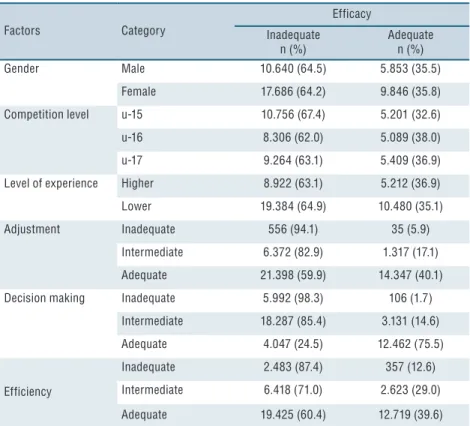
In the analysis of the prevalence of performance eicacy considering the independent variables (Table 1), predominance of actions with inadequate eicacy regardless of gender, competition level, level of experience, quality of adjustment and eiciency quality was veriied. he only variable that presented distinct behavior was decision making (“appropriate” category), which presented higher prevalence of adequate eicacy (75.5%).
Ações técnico-táticas do voleibol Salles et al.
Table 1. Prevalence of efficacy considering the independent variables
Factors Category
Efficacy
Inadequate n (%)
Adequate n (%)
Gender Male 10.640 (64.5) 5.853 (35.5)
Female 17.686 (64.2) 9.846 (35.8)
Competition level u-15 10.756 (67.4) 5.201 (32.6)
u-16 8.306 (62.0) 5.089 (38.0)
u-17 9.264 (63.1) 5.409 (36.9)
Level of experience Higher 8.922 (63.1) 5.212 (36.9)
Lower 19.384 (64.9) 10.480 (35.1)
Adjustment Inadequate 556 (94.1) 35 (5.9)
Intermediate 6.372 (82.9) 1.317 (17.1)
Adequate 21.398 (59.9) 14.347 (40.1)
Decision making Inadequate 5.992 (98.3) 106 (1.7)
Intermediate 18.287 (85.4) 3.131 (14.6)
Adequate 4.047 (24.5) 12.462 (75.5)
Efficiency
Inadequate 2.483 (87.4) 357 (12.6)
Intermediate 6.418 (71.0) 2.623 (29.0)
Adequate 19.425 (60.4) 12.719 (39.6)
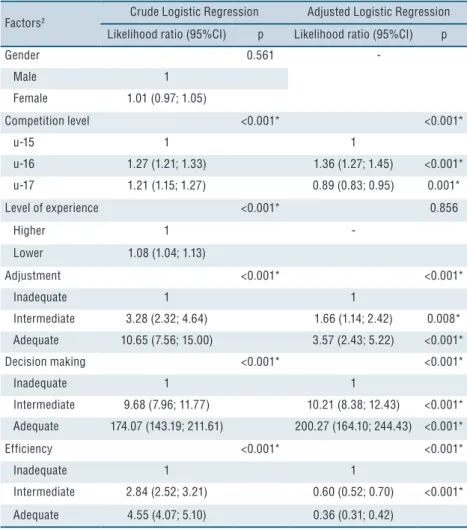
he adjusted logistic regression model presented statistical signiicance (p <0.001) and was able to explain 51.40% (G2 Nagelkerke = 51.40) the
eicacy variance. Speciically, eicacy was shown to be associated with decision-making, adjustment and eiciency components, as well as to com-petition level (Table 2). he level of experience, which showed signiicant association in the crude analysis, did not conirm this relationship in the adjusted analysis.
he likelihood of an athlete to achieve adequate eicacy in the tech-nical-tactical action was higher in the u-16 category (OR = 1.36) in rela-tion to the u-15 category. On the other hand, the likelihood of an athlete achieving adequate eicacy was 11% lower in the u-17 category than in the u-15 category (OR = 0.89).
Regarding decision making, it was veriied that the likelihood of an athlete to achieve adequate eicacy was higher when making intermediate decision than when making inadequate decision (OR = 10.21). In the same direction, the likelihood of adequate eicacy was greater when the athlete made an adequate decision than when making an inadequate decision (OR = 200.27). Regarding adjustment, it was veriied that the likelihood of ad-equate eicacy was higher when the athlete made intermediate (OR = 1.66) and adequate adjustment (OR = 3.57) compared to inadequate adjustment.
In the adjusted analysis, on the other hand, it was veriied that the likeli-hood of achieving adequate eicacy was 40% lower when the athlete pre-sented intermediate eiciency and 64% lower when the athlete prepre-sented adequate eiciency. he evidence found in the adjusted analysis diverged from the proile observed in the descriptive analysis, which indicated higher prevalence of intermediate and adequate eiciency.
Table 2. Factors associated with efficacy1 in the performance of technical-tactical actions in
volleyball
Factors2 Crude Logistic Regression Adjusted Logistic Regression
Likelihood ratio (95%CI) p Likelihood ratio (95%CI) p
Gender 0.561
-Male 1
Female 1.01 (0.97; 1.05)
Competition level <0.001* <0.001*
u-15 1 1
u-16 1.27 (1.21; 1.33) 1.36 (1.27; 1.45) <0.001*
u-17 1.21 (1.15; 1.27) 0.89 (0.83; 0.95) 0.001*
Level of experience <0.001* 0.856
Higher 1
-Lower 1.08 (1.04; 1.13)
Adjustment <0.001* <0.001*
Inadequate 1 1
Intermediate 3.28 (2.32; 4.64) 1.66 (1.14; 2.42) 0.008*
Adequate 10.65 (7.56; 15.00) 3.57 (2.43; 5.22) <0.001*
Decision making <0.001* <0.001*
Inadequate 1 1
Intermediate 9.68 (7.96; 11.77) 10.21 (8.38; 12.43) <0.001*
Adequate 174.07 (143.19; 211.61) 200.27 (164.10; 244.43) <0.001*
Efficiency <0.001* <0.001*
Inadequate 1 1
Intermediate 2.84 (2.52; 3.21) 0.60 (0.52; 0.70) <0.001*
Adequate 4.55 (4.07; 5.10) 0.36 (0.31; 0.42)
1 Variable Response: Efficacy (1 = Effective; 0 = Ineffective); 2 Method for the selection of independent
factors / variables: Forward: Wald; * Statistically significant result (considering α = 0.05).
DISCUSSION
Ações técnico-táticas do voleibol Salles et al.
actions in each rally. In women matches, most points are usually obtained during game complex II (counter-attack, starting from the defense of the opponent’s attack), unlike the characteristics of men’s games, in which there is a high incidence of points during complex I (attack from the reception of the service)15.
Athletes in the more advanced categories (u-16 and u-17) presented greater likelihood of adequate eicacy than players of the u-15 category, conirming the studies that consider volleyball a sport of late specializa-tion16,17, whose beginning of systematic practice is recommended from
the age of 13 years18. he sporting experience, on the other hand, was not
associated with eicacy, which diverges from the results of investigations that indicate that athletes’ knowledge and decision-making capacity are attributes developed over time and are fundamental for good performance in team sports19,20. Experience is one of the predictors of children’s
perfor-mance in basketball matches20 and is associated with the level of
perfor-mance of volleyball athletes of more experienced categories (u-16 and u-17), where the teaching-learning-training processes become more specialized14.
In addition to the fact that sports experience has the potential to exert a certain inluence on performance, it is important to point out that other psychological factors, such as intrinsic motivation21 and cognitive state
anxiety22, may contribute to change the level of performance presented
in team sports, even among more experienced athletes. Considering that such factors were not addressed in the present study, further investigations should be carried out that analyze their inluence on the technical-tactical performance of athletes with diferent levels of sports experience.
he evidence found in this study indicates that the components of sports performance are associated with adequate eicacy in technical-tactical ac-tions. In fact, athletic performance may be higher when athletes have the capacity to adequately perform the technical and tactical components of the game13, given the interdependence of these aspects in team sports23.
he competitive success of the volleyball athlete is determined by tactical-strategic abilities (from cognitive development), in which adjustment and decision-making are fundamental24.
It should be emphasized that individual and collective tactics in vol-leyball must be strictly linked to the technical performance of athletes5.
Due to the constant changes of ball possessions and the impossibility of retaining the ball, the precision of movements is determinant for the adequate linking of the game actions, as well as to obtain the dominion of the game. In addition, good collective performance depends on each athlete’s ability / capacity to control movements with proiciency and to make efective decisions about motor response25.
a good predictor of eicacy in volleyball game actions, either because only certain eiciency indicators can adequately predict the variance of eicacy results of the suspension touch (in attack situations) and the forearm pass (in defensive situations), or because the demands of tasks interfere in the type of relationship established between both5.
In the present study, decision-making was the component that most stood out in the relation to adequate eicacy in game actions, considering that the likelihood of an athlete to be efective was more than 200 times greater (adjusted analysis) when he / she made an adequate decision than when he / she made an inadequate decision. he abilities of observation and rapid analysis, as well as of decision about the best response to be given in certain situations when one is in possession of the ball27, have been
emphasized in diferent studies, mainly due to its association with success in games6,21.28. One aspect that deserves attention is that decision-making
capacity depends not only on the objective contextual factors of the game, but also on the athlete’s perception of these situations29 and on elements
related to attention and emotion21,22.
More experienced volleyball players usually act based on the famili-arity they perceive between the problem situation presented by the game and certain situations previously experienced in the sport, performing the action typically more adequate to solve the present problem30. In this
way, coaches need to balance explicit and implicit instruction strategies25,
ofering many problem situations in which players try to make decisions to discover solutions, as well as qualiied guidelines regarding possible mo-tor responses to the problems presented. hus, the adoption of systematic training strategies for relection and decision-making is suggested from the initial stages of volleyball training, considering its potential for the positive development of athletes in the long term.
It is necessary to emphasize that the present study has some limita-tions. Although only teams participating in the inal phase of the state championship of Santa Catarina were selected, the analysis of the actions of athletes did not take into account the moment of the match in which they were performed. Depending on the timing and situation of the game, players may be inluenced to make certain decisions to ensure the victory of their team (e.g., increasing the setting frequency to the best team striker) or to try to induce the other team to make a mistake (to force the serve, to direct the serve to the opposing player with more diiculty in reception), but this possibility of analysis was not included in this investigation.
CONCLUSION
Ações técnico-táticas do voleibol Salles et al.
volleyball is in fact very closely associated with intelligent performance. he dynamicity characteristic of this sport requires the players to quickly and appropriately process the information, as well as to perform actions that allow anticipating the reading of the game made by the opponents and, consequently, cause imbalance in the other team.
As the adjusted model was able to explain just over half of the vari-ation in eicacy, there is a need to broaden the scope and depth of the technical-tactical performance analysis in volleyball training categories. In addition to addressing psychological factors such as competitive moti-vation, anxiety and stress, future investigations could include the context of the game in the analysis of actions performed, considering variables such as number and time of the set, the partial result of the game and the opponent’s quality, which are factors that may also directly inluence the technical-tactical performance of volleyball athletes.
REFERENCES
1. Matias CJAS, Greco PJ. Análise de jogo nos jogos esportivos coletivos: a exemplo
do voleibol. Pensar Prat 2009;12(3):1-16.
2. Garganta JA. Análise da performance nos jogos desportivos: revisão acerca da
análise do jogo. Rev Port Cien Desp 2001;1(1):57-64.
3. Menezes RP, Reis HHB. Análise do jogo de handebol como ferramenta para sua
compreensão técnico-tática. Motriz: Rev Educ Fis 2010;16(2):458-67.
4. Milistetd M, Mesquita I, Nascimento JV, Sousa Sobrinho AEP. Concepções
dos treinadores acerca do papel da competição na formação desportiva de jovens jogadores de voleibol. Rev Educ Fís/UEM 2008;19(2):151-8.
5. Mesquita I, Marques A, Maia J. A relação entre a eiciência e a eicácia no domínio
das habilidades técnicas em voleibol. Rev Port Cien Desp 2001;1(3):33-9.
6. Matias CJAS, Greco PJ. Cognição e ação nos jogos esportivos coletivos. Cien
Cogn 2010;15(1):252-71.
7. Marcelino R, Sampaio J, Mesquita, I. Investigação centrada na análise do jogo: da
modelação estática à modelação dinâmica. Rev Port Cien Desp 2011;11(1):481-99.
8. Medeiros AIA, Palao JM, Marcelino R, Mesquita I. Systematic review on sports
performance in beach volleyball from match Analysis. Rev Bras Cineantropom Desempenho Hum 2014;16(6):698-708.
9. Marques Jr. NK. Evidências científicas sobre os fundamentos do voleibol:
importância desse conteúdo para prescrever o treino. Rev Bras Presc Fis Exe 2013;7(37):78-97.
10. Costa GCT, Afonso J, Brant E, Mesquita I. Diferences in game patterns between
male and female youth volleyball. Kinesiology 2012;44(1):60-6.
11. Marcelino R, Afonso J, Moraes JC, Mesquita I. Determinants of attack players in
high-level men`s volleyball. Kinesiology 2014;46(2):234-41.
12. O’Donoghue P. Research methods for sports performance analysis. New York:
Routledge; 2010.
13. Collet C, Nascimento JV, Ramos V, Stefanello JMF. Construção e validação do
instrumento de avaliação do desempenho técnico-tático no voleibol. Rev Bras Cineantropom Desempenho Hum 2011;13(1):43-51.
14. Porath M, Nascimento JV, Milistetd M, Collet C, Salles WN, Quinaud R. Nível
de desempenho técnico-tático e experiência esportiva dos atletas de voleibol das categorias de formação. Rev Educ Fís/UEM 2012;23(4):565-74.
CORRESPONDING AUTHOR
William das Neves Salles Douglas Seabra Levier st., 376; Carvoeira
Postal Code 88040-410; Florianópolis, SC, Brazil.
E-mail: [email protected]
17. Baker J, Cotê J, Abernethy B. Sport speciic training, deliberate practice and the
development of expertise in team ball sports. J Appl Sport Psychol 2003;15:12-25.
18. Milistetd M, Mesquita I, Nascimento JV, Sousa Sobrinho AEP. Concepções de
treinadores “experts” brasileiros sobre o processo de formação desportiva do jogador de voleibol. Rev Bras Educ Fís Esp 2010;24(1):79-93.
19. Janelle CM, Hillman CH. Expert Performance in Sport: Current Perspectives and
Critical Issues. In: Starks L, Ericsson KA, organizadores. Expert Performance in Sports: advances in Research on Sport. Champaign: Human Kinetics; 2003. p. 19-48.
20. Iglesias D, Moreno MP, Santos-Rosa FJ, Cervelló EM, Del Villar F. Cognitive
expertise in sport: relationships between procedural knowledge, experience and performance in youth basketball. J Hum Mov Stud 2005;49(1):65-76.
21. Claver F, Jiménez R, Del Villar F, García-Mas A, Perla Moreno M. Motivación,
conocimiento y toma de decisiones: Un estudio predictivo del éxito en voleibol. Rev Psicol Deporte 2015;24(2):273-79.
22. Sonoo CN, Gomes AL, Damasceno ML, Silva SR, Limana MD. Ansiedade e
desempenho: um estudo com uma equipe infantil de voleibol feminino. Motriz: Rev Educ Fis 2010;16(3);629-37.
23. Silva TAF, De Rose Jr. D. Iniciação nas modalidades coletivas: a importância da
dimensão tática. Rev Mackenzie Educ Fís Esporte 2005;4(4);71-93.
24. Lima C, Martins-Costa HC, Greco PJ. Relação entre o processo de
ensino-aprendizagem treinamento e o desenvolvimento do conhecimento tático no voleibol. Rev Bras Educ Fís Esp 2011;25(2)251-61.
25. Lola AC, Tzetzis GC, Zetou H. he efect of implicit and explicit practice in
the development of decision making in volleyball serving. Percept Motor Skill 2012;144(2):665-78.
26. Mesquita I. O ensino do voleibol: proposta metodológica. In: Graça A, Oliveira
J, organizadores. O ensino dos jogos desportivos. 3. ed. Lisboa: Universidade do Porto; 1998. p.153-99.
27. Oslin JL, Mitchell SA, Griin LL. he Game Performance Assessment
Instru-ment (GPAI): DevelopInstru-ment and Preliminary Validation. J Teach Phys Educ 1998;17(2):231-43.
28. Afonso J, Mesquita I, Marcelino R. Estudo de variáveis especiicadoras da tomada
de decisão, na organização do ataque, em voleibol feminino. Rev Port Cien Desp 2008;8(1):137-47.
29. Schläppi-Lienhard O, Hossner EJ. Decision making in beach volleyball defense:
Crucial factors derived from interviews with top-level experts. Psychol Sport Exerc 2015;16(1):60-73.
30. Macquet AC. Recognition Within the Decision-Making Process: A Case Study