DOI: http://dx.doi.org/10.5007/1980-0037.2013v15n4p458
original article
RBCDH
1 Faculdade da Serra Gaúcha. Ins-tituto Integrado de Saúde. Caxias do Sul, RS. Brazil.
2 University of Alberta. Human Neurophysiology Laboratory. Edmonton, AB. Canada.
Received: 13 April 2012 Accepted: 06 December 2012
Efects of a subsequent task after sit-to-stand
movement on muscle activation and
initiation of movement
Efeitos da tarefa subsequente ao sentar e levantar sobre
a ativação muscular e início do movimento
Franciele Camila da Silva1
Ana Melissa Rodrigues1
Matheus Joner Wiest2
Abstract– Muscle activation (activation time) and the beginning of movement (motor reaction time) can be changed depending on the complexity of the task. he objectives of this study were to compare the time for activation of the paraspinal and the vastus lat-eralis muscles, and the motor reaction time during the execution of the tasks sit-to-stand (STS) and sit-to-walk (STW), which includes the execution of the subsequent task of gait initiation. Twelve healthy young subjects participated in the study. hey performed two tasks (STS and STW), ive times each, randomly, separated by two minutes of rest. he kinematics of the movement were recorded using a digital electrogoniometer attached to the hip joint and muscle activation using surface electromyography in both muscles. he average of the ive repetitions was calculated for each task. he beginning of the task was signaled by a luminous device, which was also used to identify the initial point for calcu-lating the activation time and motor reaction time. Both muscles showed a longer latency for the activation time and motor reaction time during the STW task when compared with STS. Based on these results, it can be concluded that both the postural (paraspinal) and prime mover muscles (vastus lateralis) undergo change in the motor programming during the execution of the STS task when a subsequent task (gait initiation) is included. Motor programming is dependent on task complexity, where a more complex task (STW) will result in delays of movement programming and execution.
Key words: Dual-task; Electromyography; Movement initiation.
he physiological and biomechanical mechanisms that allow humans to maintain a bipedal posture, generally called postural control, are frequent
topics in the area of biomechanics and motor control1-4. herefore, an
ei-cient control of the muscles by the central nervous system (CNS) is required
in order to maintain the position and body orientation in space3. hus, it
is vital that sensory and motor information are precisely coordinated so
that the desired task is performed successfully1,5.
he sit-to-stand (STS) movement is common in our everyday lives and is essential in maintaining an individual’s independence. his movement requires synergistic actions among the extensor and lexor muscles of the
trunk and knees. Studies1,6,7 that analyzed electromyographic patterns during
the STS task in healthy young adults have assigned the role of prime movers to the quadriceps and hamstring muscles, while the paraspinal, tibialis anterior, soleus, abdominal, sternocleidomastoid, and trapezius muscles were considered responsible for ine postural adjustments during the action of the prime movers.
Disturbances caused by a subsequent task have been explored during dual tasks (where the posture and the subsequent task are independently controlled) or in tasks that recognize posture as being dependent on the
goals of the next task with integrated control between both8. Within the
context of analyzing the response of the subsequent task, it is important to emphasize that the anticipation is primarily a perceptual function that is associated with the term “what is to come.” However, anticipation only
occurs when existence of the perturbation is known4. he eiciency of
an-ticipatory movements depends on 1) the perception of the initial position of the limbs and body in space, 2) the evaluation of the distance between a body segment and the desired position and inally, 3) programming of
the timed commands for muscle activation9,10. Studies that have sought
to understand sequential tasks addressed basically postural tasks
associ-ated with subsequent manual tasks11,12, unlike in the present study. hus,
to our knowledge, there is a gap in the literature on studies that address the relationship of the STS task with the subsequent task of gait initiation.
herefore, we aimed to compare the anticipatory activation of the paraspinal and vastus lateralis muscles during the STS and STS with the execution of the subsequent task of gait initiation, or sit-to-walk (STW). Furthermore, we checked whether anticipatory activation changes the
beginning of the movement itself. In this article we will use the terms “
ac-tivation time” (AT) as being the time interval between the visual stimulus
and the beginning of muscle activation, and “motor reaction time” (MRT)
as being the time interval between the visual stimulus and the beginning of the movement itself. We hypothesized that the inclusion of the subsequent
task of gait initiation would result in longer latency for AT and MRT13
Efects of a subsequent task after sit-to-stand movement Silva et al.
METHODS
he participants in this study were chosen unintentionally. he exclusion criteria were any history of pain or dysfunction in the spine and/or any condition that might interfere with static and dynamic postural control. All subjects signed a term of informed consent approved by the local Ethics Committee and in accordance with the Declaration of Helsinki. Twelve male subjects with average ± standard deviation of 24.5±3.7 years old, body mass of 70.92±3.85kg, and a height of 172±0.04cm participated in the study.
Instrumentation
Muscle activity was recorded using electromyography (Miotool 400,
Mio-tec, Brazil) and surface electrodes (Kendal Meditrace, Ag/AgCl, 2.2cm in diameter) in bipolar coniguration. he preparation and ixation techniques used were those recommended in SENIAM (Surface Electromyography
for the Non-Invasive Assessment of Muscles)14, aiming to ensure the best
positioning of the surface recording electrodes. Ater the preparation of the skin, the electrodes were placed parallel with the approximate direction of the muscle ibers of the paraspinal and vastus lateralis muscles on the subject’s preferred lower limb (dominant) between the motor point and the muscle’s insertion tendon. hese muscles are strongly active during the STS
task1,6. he ground electrode was positioned on the bone protuberance of
the lateral malleolus on the subject’s preferred lower limb. he kinematic analysis of the movement was measured using a digital electrogoniometer (Miotool 400, Miotec, Brazil) attached to the hip joint in order to identify the beginning and end of the movement (MRT). All data was acquired at a sampling frequency of 1000Hz.
Experimental procedures
Subjects were seated on a chair without armrest, but with a height-adjustable seat, remaining with both feet on the ground and with the knee and hip joints at a 90-degree angle.
To carry out each task, subjects were instructed as to the existence of luminous device responsible for informing the beginning of the task execu-tion, determined by the researcher. In addition to triggering the start of the task, the device also generated an electrical impulse used to synchronize the signals from the electromyograph and electrogoniometer.
he identiication of the MRT was performed using an electrogoniom-eter attached to the hip joint of the subject’s preferred limb, with one of the rods connected to the lateral region of the thigh and the other connected to the side of the trunk with the axis of movement on the greater trochanter of the femur. Previous studies have shown that the irst movement to perform
the STS task occurs at the hip level15.
performed randomly, where the irst task was deined by drawing and sub-sequently repeated ive times, followed by ive repetitions of the second task. he subject was instructed to always perform the task as soon as the lumi-nous devices was turned on and to perform the task as naturally as possible.
Data analysis
Data of muscle activation (AT) and angular movement (MRT) were stored in Microsot Excel 2007 spreadsheets (Microsot Corp., USA) and analyzed using scripts developed in the sotware Matlab 7.3 (MATLAB 7.3, Math-works Inc., Novi, MI, USA). he EMG data was iltered using a bandpass ilter of 10-1000Hz and ampliied 500 times. No ilter was used for angular movement data.
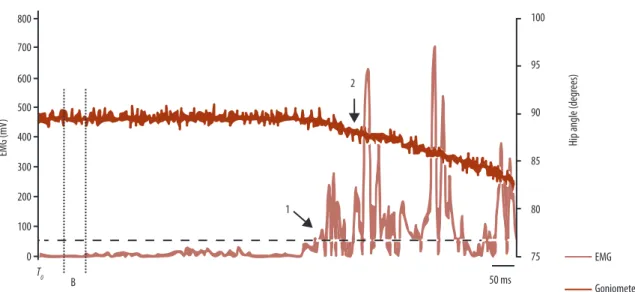
he EMG data of each trial was analyzed as follows: ater the electro-myographic signal was rectiied, the instant that the light signal went on was identiied (the moment when the subject was instructed to begin the
task), which was called T0. Starting from T0, a baseline epoch was created
starting at 50ms ater T0 and ending 100ms ater T0 while the subject was
still at rest. From there the average and a value greater than two times the standard deviation of the electromyographic signal was calculated. Values greater than twice the standard deviation of the average electromyographic signal at rest (baseline epoch) and lasting longer than 5ms were used to
identify the point in time when muscle activation (AT)took place4. he
same procedures used in the analysis of the electromyographic signal were performed for the electrogoniometer’s data (MRT). A baseline epoch was created and the beginning of movement was deined by a value greater than twice the standard deviation of the rest angle (Figure 1).
Efects of a subsequent task after sit-to-stand movement Silva et al.
Statistical analysis
Standard descriptive statistics was performed and the data is reported as mean ± standard deviation. he normality of the data was veriied using
the Shapiro-Wilk test. Dependent Student’s t test was used to compare the
AT and MRT (dependent variables) between the muscles analyzed and between the STS and STW tasks. Statistical analysis was performed using
SPSS for Windowsversion 13.0 (Statistical Package for Social Sciences Inc.,
Chicago IL, USA) with α=0.05.
RESULTS
he data was veriied as having normal distribution. he speed of move-ment between the two tasks was not signiicant (p=0.06).
he paraspinal muscle showed lower values of AT for the STS task
compared with the STW task [t(11) = -3.132; p=0.010] (Figure 2A). he
vas-tus lateralis muscle also showed signiicantly lower values of AT for the
STS task compared with the STW task [t(11) = -4.776; p=0.001] (Figure 2B).
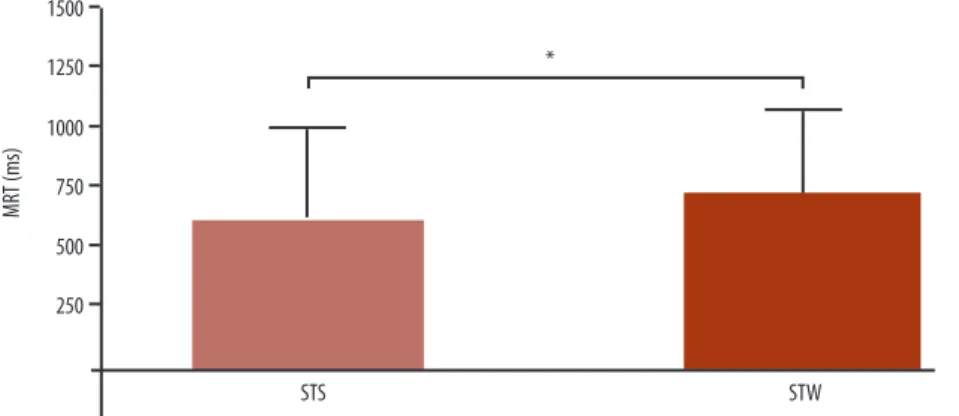
Similarly, MRT had signiicantly lower values on the STS task when
compared to the STW task [t(11) = -3.902; p=0.002] (Figure 3).
Figure 2. Activation time (AT) of the paraspinal (2A) and the vastus lateralis (2B) muscles for the STS and STW tasks (*p<0.05)
his study aimed to compare muscle activation time (AT) and motor reaction time (MRT) between the STS and STW tasks. Our main results show that both the paraspinal muscle as well as the vastus lateralis muscle had a longer latency for starting muscle activation for the STW task when compared with STS task. Furthermore, the MRT was shorter when only one task was assigned (STS). hus, our results indicate that the introduction of a new task implies in a new motor planning illustrated by the longer latency in muscle activation and longer MRT when executing the subsequent task (STW), which conirms our initial hypothesis.
he activation of the muscles involved in postural control occurs prior to the main movement aiming to avoid excessive or unnecessary
move-ments that could result in loss of body stability16. Some studies1,6,7 observed
the patterns of muscle activation during the STS task. Goulart6 analyzed
muscle activation during the sit-to-stand task in healthy young adults. hese authors attributed the role of prime movers of the STS task to the quadri-ceps and hamstring muscles while the paraspinal muscle was considered responsible for ine postural adjustments, stabilizing the body during the action of the prime movers. Our results are consistent with this theory as we found greater anticipation for the paraspinal muscle when compared to the vastus lateralis muscle. herefore, we believe that anticipatory muscle activation is a representation of the subject’s postural stability protection, especially in relation to the spine.
he electrical activity of the trunk’s stabilizing muscles, in this case the paraspinal muscle, has been reported as anticipatory and related not only
with arm movements, but also with lower limbs16. Moreover, we found a
signiicant diference in the AT of the paraspinal and vastus lateralis mus-cles when comparing the STS and STW tasks. herefore we can infer that motor programming is dependent on the complexity of the task, so when a second task is established, the CNS needs to process a larger amount of information, slowing down the anticipatory activation. Furthermore, these efects extend not only to the prime movers (knee extensors), but also to secondary movers (spine extensors) which are responsible for controlling the inclination of the trunk forward in the beginning of the STS movement and extend the spine ater the subject loses contact with the chair.
As already cited in another study17, anticipatory activity can improve
the eiciency of the movement and move the body segments to a more suitable position for performing the activity without excessive expenditure of energy and loss of postural stability. Anticipatory postural adjustments
are important since they stabilize the body against perturbations2.
Efects of a subsequent task after sit-to-stand movement Silva et al.
be dependent on the objectives of the subsequent task with an integrated
control between the two18. Some studies11,12,19 observed that when the subject
aims a target with a pointer at diferent speeds and distances, the center of mass always moves toward the target, while the upper limbs have diferent behaviors depending on the distance and the speed at which the pointer reaches the target. hese results demonstrate that during a subsequent hand task, posture was not signiicantly afected by the perturbation, perhaps due to the coordinated movements of the entire body in order to keep the
hand function. Another study20, however, states that integration occurs
between tasks and suggests that posture adjusts itself depending on the task in order to optimize its execution, considering that the subsequent task imposes restrictions on postural control so that it adjusts according to the demand from the irst task. Taking into consideration our results, we can suggest that the amount of time to plan the movement is inluenced by multiple tasks. he results showed that more time was needed to plan and execute the STW task when compared with the STS task. his idea is
supported by the results of Eversheim and Block21, which suggest that in
all taken actions, there is an interval of time between the intention to act and the beginning of the movement, and this time period is occupied by the decision-making process and is called reaction time.
hus, we suggest that the individual plans in advance what is to come, in this case the task of walking, even before performing the sit-to-stand task. he primary motor cortex in the CNS, known to be active during the execution and preparation of movements, increases its activity when individuals perform sequential movements. he cerebellum is essential for motor coordination, adaptation, and predictive control, and is therefore inevitably involved in the programming and execution of sequential
move-ments22. hus, the agreement of the results of AT and MRT strengthens the
idea that there is a longer latency in processing information during dual tasks. hus, based on the idea that the decision and planning processes afects the reaction time, the result of this study acknowledges that the subsequent task of walking initiation is dependent on the sit-to-stand task with integrated control between the two.
A limitation of the study was not using other kinematic equipment to analyze the movement of the body as a whole. hese results would con-tribute to analyze the movement and motor programming more precisely. Moreover, a greater number of electromyography channels could help to understand which other muscles are active during speciic periods of the movement.
CONCLUSION
ming and executing the movement. he results indicate that the initial motor programming of the paraspinal muscle is generated before the movement starts and any change that this motor program has to undergo needs enough time to generate the postural corrections necessary to maintain postural stability. Our results can contribute to the development of postural rehabili-tation protocols and guide treatment strategies involving sequential tasks.
REFERENCES
1. Millington PJ, Myklebust BM, Shambes GM. Biomechanical analysis of the sit-to-stand motion in elderly persons. Arch Phys Med Rehabil 1992;73(7):609-17. 2. Mochizuki L, Amadio AC. Sensory information for posture. Fisioter Mov
2006;19(2):11-8.
3. Pavol MJ, Pai YC. Feedforward adaptations are used to compensate for a potential loss of balance. Exp Brain Res 2002;145(4):528-38.
4. Santos MJ, Kanekar N, Aruin AS. he role of anticipatory postural adjustments in compensatory control of posture: 1. Electromyographic analysis. J Electromyogr Kinesiol 2010;20(3):388-97.
5. Schenkman M, Berger RA, Riley PO, Mann RW, Hodge WA. Whole-body move-ments during rising to standing from sitting. Phys her 1990;70(10):648-51. 6. Goulart FR, Valls-Sole J. Patterned electromyographic activity in the sit-to-stand
movement. Clin Neurophysiol 1999;110(9):1634-40.
7. Hodges PW, Cresswell AG, horstensson A. Perturbed upper limb movements cause short-latency postural responses in trunk muscles. Exp Brain Res 2001;138(2):243-50. 8. Berrigan F, Simoneau M, Martin O, Teasdale N. Coordination between posture
and movement: interaction between postural and accuracy constraints. Exp Brain Res 2006;170(2):255-64.
9. Goodman SR, Latash ML. Feed-forward control of a redundant motor system. Biol Cybern 2006;95(3):271-80.
10. Strother L, Obhi SS. he conscious experience of action and intention. Exp Brain Res 2009;198(4):535-9.
11. Norrie RG, Maki BE, Staines WR, McIlroy WE. he time course of attention shits following perturbation of upright stance. Exp Brain Res 2002;146(3):315-21. 12. Pozzo T, Stapley PJ, Papaxanthis C. Coordination between equilibrium and hand
tra-jectories during whole body pointing movements. Exp Brain Res 2002;144(3):343-50. 13. Tombu M, Jolicoeur P. A central capacity sharing model of dual-task performance.
J Exp Psychol Hum Percept Perform 2003;29(1):3-18.
14. Hermens HJ, Freriks B, Disselhorst-Klug C, Rau G. Development of recommenda-tions for SEMG sensors and sensor placement procedures. J Electromyogr Kinesol 2000;10(5):361-74.
15. Lomaglio MJ, Eng JJ. Muscle strength and weight-bearing symmetry relate to sit-to-stand performance in individuals with stroke. Gait Posture 2005;22(2):126-31. 16. Paula FVR, Faria CDC, Vieira DSR. Teoria de programação motora: uma
perspec-tiva da sua evolução teórica. Fisioter Mov 2007;20(2):63-71.
17. Goulart F, Chaves CM, Vallone MLDC, Carvalho JA, Saiki KR. O movimento de passar de sentado para de pé em idosos: implicações para o treinamento funcional. Acta Fisiatr 2003;10(3):138-43.
18. Bloem BR, Valkenburg VV, Slabbekoorn M, van Dijk JG. he multiple tasks test. Strategies in Parkinson’s disease. Exp Brain Res 2001;137(3-4):478-86.
Efects of a subsequent task after sit-to-stand movement Silva et al.
Corresponding author
Matheus Joner Wiest
Human Neurophysiology Laboratory Faculty of Physical Education and Recreation
E-488 Van Vliet Centre, University of Alberta
Edmonton, Alberta T6G 2H9. Canada E-mail: [email protected]
20. Stofregen TA, Hettinger LJ, Haas MW, Roe MM, Smart LJ. Postural instability and motion sickness in a ixed-based light simulator. Hum Factors 2000;42(3):458-69. 21. Eversheim U, Bock O. he role of precues in the preparation of motor responses in
humans. J Mot Behav 2002;34(3):271-6.