The General Mechanisms of Attack of Nitrogen Nucleophiles on
Carbonyl Compounds. Facts That Determine the Change of the
Rate-pH Profiles
Inês Maria Costa Brighentea, and Rosendo Augusto Yunesa*
a
Departamento de Química, Universidade Federal de Santa Catarina,
Campus Universitário, Trindade, 88040-900 Florianópolis - SC, Brazil
Received: December 21, 1996; July 15, 1997
Foi descrito um mecanismo geral para a etapa de ataque da reação de nucleófilos nitrogenados com compostos carbonílicos para formar intermediários de adição neutro. Este mecansimo geral está baseado na importância relativa do mecanismo “concertado” com respeito ao mecanismo “por etapas”. O mecanismo “concertado” envolve o ataque da base nitrogenada ao composto carbonílico catalisado pelo íon hidrônio, enquanto que o mecanismo “por etapas” envolve a formação prévia de um intermediário tetraédrico zwiteriônico (T±), com posterior transferência de próton a partir do íon hidrônio. A importância relativa destes dois passos origina três diferentes tipos de perfis de velocidade em função do pH. A importância do mecanismo “por etapas” depende da estabilidade do intermediário T±, que por sua vez depende do pKa do nucleófilo nitrogenado e da constante de equilíbrio (Kad) para a formação do intermediário neutro (T0). A comparação entre as reações de
p-clorobenzaldeído e norcanfor com diferentes nucleófilos nitrogenados mostra que o mecanismo geral depende de cada tipo de composto carbonílico. Isto deve-se a dois fatos: A grande influência dos efeitos estéricos e eletrônicos na estrutura dos compostos carbonílicos, e o fato de que o valor do pKa do nucleófilo nitrogenado é o fator mais importante na predição dos perfis. O pKa do nucleófilo nitrogenado está mais relacionado com a estabilidade do intermediário T± que de T0, enquanto que o valor de Kad está relacionado apenas com a estabilidade do intermediário T0.
It have been described a general mechanism for the attack step of the reactions between nitrogen nucleophiles and carbonyl compounds to form a neutral tetrahedral addition intermediate. This general mechanism is based on the relative importance of the “concerted” hydronium-ion catalyzed attack of the nitrogen base on the carbonyl compound with respect to the “step wise” mechanism that involves the previous formation of a zwitterionic tetrahedral intermediate (T±) and the posterior proton transfer to it from the hydronium-ion. The relative importance of this pathway gives origin to three kinds of profile rates vs pH for these reactions. On the other hand, the importance of the “stepwise” mechanism was attributed to a dependence on the stability of the T± intermediate that is related to the pKa of the nitrogen base and the Kad (the equilibrium constant for the formation of
the neutral tetrahedral addition intermediate (T0)). The comparison of the reactions of p-chloroben-zaldehyde and norcamphor with different nitrogen nucleophiles led to the observation that the general mechanism depends on each type of carbonyl compound. This is due to the great influence of the steric and electronic effects of the compound’s structure, and the fact that the pKa value of the nitrogen base, which is more related to the stability of the T± than the T0 intermediate, is more important as a factor of prediction of the profiles than the value of Kad, this value being more related
to the stability of the T0 intermediate.
Keywords:carbonyl compounds, nitrogen nucleophiles, general mechanism of attack
Article
Introduction
Sayer et al.1 have described a general mechanism for the reaction between nitrogen nucleophiles and carbonyl compounds in aqueous solution, based on Scheme 1. This generalization is based on the relative importance of the hydronium-ion catalyzed concerted attack of the nitrogen nucleophile on the carbonyl compound (pathway I - “con-certed mechanism”) with respect to a mechanism that in-volves the previous formation of a zwitterionic tetrahedral intermediate (T±) and the posterior proton transfer to it from the hydronium-ion (pathway II - “step wise mechanism”). The importance of stepwise pathway II depends on the stability of the intermediate T± which is related to the pKa of the nitrogen nucleophile and to the equilibrium constant value Kad for the formation of the neutral addition
tetrahe-dral intermediate T0 from the reagents.
The relative importance of pathway I with respect to pathway II originates different kinds of shape of the profile of log k2 (k2 = second-order rate constant) vs. pH for these
reactions. Three profiles were indicated by Sayer1, called types A, B and C. These will be discussed later.
It should be noted that Sayer et al.1 based their studies only on the reactions between benzaldehyde and substi-tuted benzaldehydes with amines of different basicity. Thus, an important question is whether the pKa of the amine and the equilibrium constant Kad are of sufficiently
equal importance to enable prediction of the profile of reactions of non-aromatic carbonyl compounds with amines.
The reaction between norcamphor, a bicyclic ketone of fixed geometry2-4, with amines of different basicity, was
studied in order to evaluate the above- mentioned question.
Experimental
Materials
Organic reagents employed were commercially avail-able products and were either redistilled or recrystallyzed. Inorganic chemicals and carboxylic acids used in buffers were of reagent grade and were used without further puri-fication.
Kinetics
Reaction of the carbonyl compounds with nitrogen nucleophiles in water at 25.0 °C and ionic strength 0.5 M (KCl) were followed on a Varian DMS 80 spectrophotome-ter, equipped with a thermostated cell holder, by monitor-ing the formation of the oxime at 240 nm, the nitrone at 255 nm, the semicarbazone at 255 nm, and the phenylhydra-zone at 320 nm. The concentration of norcamphor and ciclopentanone did not exceed 3.3 x 10⁻² M. A sufficient excess of nitrogen nucleophile was employed to ensure pseudo first-order kinetic behaviour.
The determination of the rate constants was carried out using known procedures5. Reactions were followed for three half-lives (t1/2) and first-order rate constants (kobs)
were calculated by computer. Apparent second-order rate constants (k2ap) were calculated by dividing the first-order
rate constants (kobs) by the concentration of the free
nitro-gen nucleophile, Eq. 1. The experimental error in the de-termination of the pseudo-first order constants (kobs) was
±2%.
k2 ap = kobs
[Nu]l fc (1)
where fc = 1 + Kad [Nu]l , and [Nu]l is the concentration of
free nitrogen nucleophile, calculated by the equation of Henderson-Hasselbalch.
Steady-state treatment of the mechanism in Scheme 1 yields Eqs. 2 and 3 for product formation in the regions of rate-determining neutral intermediate formation (kad) and
dehydration (kdeh), respectively.
kad= kobs
[Nu]l= k1aH++
k2(Kn k4+ Kn k3 aH+)
(k2+ Kn k4+ Kn k3 aH+)
(2)
kdeh= kobs
[Nu]l fc =
kad Kad k5 aH+
(kad+ Kad k5 aH+)
(3)
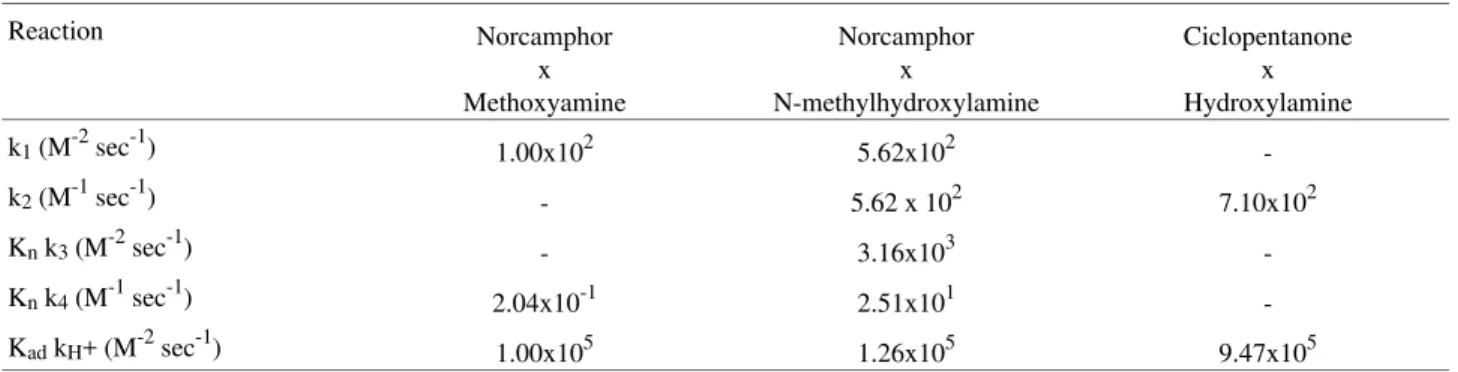
k2ap was calculated employing Eq. 4, together with the rate
constants in Table 2.
k2 ap = kad kdeh
(kad+ kdeh)
(4) C
O -N + R H
H
K = kn 2 / k-2
k-3 k3aH+ k-4 k4
k2
k-2
II
R N H2 + C O
k1aH + k-1
I
C O H
N H2 R
T +
+ k6
k-6aH +
C O H
N H R T 0
k5aH +
C N R
Third-order rate constants (k1, Knk3, Kadk5) were
ob-tained from the slopes of plots of apparent second-order constants against the concentration of hydronium-ion. The pH-independent rate constants (k2, Knk4) were obtained
directly from the plot of log k2ap vs. pH.
Equilibrium Constants
The equilibrium constants - Kad - for the addition
inter-mediate formation from several amines with norcamphor and hydroxylamine with ciclopentanone in aqueous solu-tion and ionic strength 0.5 M (KCl) were determined spec-trophotometrically6, from the initial decrease in absorbance of the carbonyl group at 285 nm extrapolated to zero time, on mixing a solution of ketone with several concentrations of amines, at pH 8.5 (0.01 M borate buffer). At this pH, dehydration of the addition intermediate is relatively slow, so that the observed absorbance could be extrapolated to zero time to determine the initial rapid decrease in ketone absorbance caused by addition intermediate formation. The calculated values of the fraction of ketone converted to addition intermediate (T0) were based on an assumed ab-sorbance of zero for the addition compound at 285 nm. The measurements were made in triplicate for each
concentra-tion of amine, using the equaconcentra-tion Kad = [C=O]t - [C=O]l /
{[C=O]l x [hydroxylamine]}, where [C=O]t is the initial
carbonyl concentration and [C=O]l is the free carbonyl
concentration.
Results and Discussion
In order to discuss the results of this work, we should consider previously the three types of profiles (A, B, C) indicated by Sayer,1 and a fourth profile (D) indicated by ourselves7,8.
Profile of type A: For very weakly basic amines and/or carbonyl compound for which the value of Kad is small, the
tetrahedral zwitterionic intermediate should be unstable and consequently the pathway I is predominant. The profile exhibits a linear dependence of the rate as a function of the pH corresponding to hydronium-ion catalized attack (k1) at
low pH. When the pH is increased, a break of the linearity with a pH-independent region corresponding to the intra-molecular proton transfer in the intermediate T± (Knk4)
appers. Finally, there emerges a new pH-dependent region corresponding to the hydronium-ion catalized dehydration of the intermediate T0 (Kadk5). (Fig. 1, III).
Profile of type B: for moderate basic amine or moderate values of the Kad, the contribution of the pathway (II)
increases. The profile shows two breaks of linearity with five different kinetic regions: the hydronium-ion catalyzed attack at low pH, the pH-independent uncatalyzed attack (k2), the hydronium-ion proton transfer to the T±
interme-diate (Knk3), the pH independent intramolecular proton
transfer in the T± intermediate, and the hydronium-ion catalyzed dehydration of T0. (Fig. 1, II).
Profile of type C: For very strong basic amines or carbonyl compound with high values of Kad, the stability
of the T± intermediate is increased still further, so that the rate pathway II is greater than the hydronium-ion catalyzed dehydration of T0, giving a profile where the only change
in rate-determining step is the transition at low pH from uncatalyzed attack to hydronium ion-catalyzed dehydra-tion of T0 (Fig. 1, I).
Table 1. Type of Profile, pKa of the Amine and Equilibrium Constants (Kad) for Addition Intermediate Formation from Norcamphor and Differ-ent Amines at 25 °Ca.
Amine pKa Type of
profile
Kad (M-1)
Phenylhydroxylamine 1.96c
A Semicarbazide 3.65d
A 0.064 ± 0.006 Methoxyamine 4.70e A
0.049 ± 0.007 Phenylhydrazine 5.25f
A N-Methylhydroxylamine 5.97d
B 0.068 ± 0.007 Hidroxylamineb 5.96 B 0.58 ± 0.07
a
Ionic strength 0.5 (KCl) and 20% ethanol v/v, [C=O] = 0.033M. bRef. 8. cRef. 10. dRef. 11. eRef. 12. fRef. 13.
Table 2. Kinetic Constants for Product Formation from Different Reactionsa.
Reaction Norcamphor
x Methoxyamine
Norcamphor x
N-methylhydroxylamine
Ciclopentanone x Hydroxylamine
k1 (M-2 sec-1) 1.00x10² 5.62x10²
-k2 (M-1 sec-1) - 5.62 x 10² 7.10x10²
Kn k3 (M-2 sec-1) - 3.16x10³
-Kn k4 (M-1 sec-1) 2.04x10⁻¹ 2.51x101
-Kad kH+ (M-2 sec-1) 1.00x10⁵ 1.26x10⁵ 9.47x10⁵
Profile of type D: Corresponds to the case in which dehydration of the neutral addition intermediate is the rate-determining step over the whole pH range7,8.
The basicity of the amines studied in this work, the values of Kad and the type of profile determined, are
indi-cated in Table 1.
Figure 1 shows the plot of log k2ap (k2ap = apparent
second-order rate constant) as a function of pH for the reactions of hydroxylamine with cyclopentanone (profile C), methoxyamine and N-methylhydroxylamine with nor-camphor (profiles A and B respectively).
It may be observed that from phenylhydroxylamine with pKa=1.96 until phenylhydrazine pKa = 5.25, and with the Kad values determined only for semicarbazide Kad =
0.064 M-1 and methoxyamine Kad = 0.049 M-1, a profile of
type A is obtained. With the moderately strong basic N-methylhydroxylamine pKa = 5.97, the profile changes to type B. However, its Kad value (Kad = 0.068 M-1) is similar
to that of semicarbazide and methoxyamine, and cannot be considered to indicate or permit the prediction of change of profile. The important difference of behaviour of semicar-bazide and methoxyamine, in their reactions with norcam-phor compared to their reactions with p-chlorobenzalde-hyde1, should be observed. In the latter case, methoxyamine exhibits a Kad = 13.4 M-1, which is
approxi-mately 4 times greater than that of semicarbazide where Kad = 3.1 M-1, giving a profile of type B, while
semicar-bazide gives a profile of type A. Evidently, effects of the structure of norcamphor change the stability of the inter-mediates T0 and T± and of the transition state of the
“con-certed” acid catalyzed attack mechanism in its reaction with semicarbazide and methoxyamine. It should also be noted that phenylhydrazine-p-sulfonate, with a pKa = 4.90 that is greater than that of semicarbazide, but with a Kad = 1.8 M-1 (equilibrium constant with
p-chlorobenzal-dehyde) that is smaller, exhibits a profile of type B1. In this
case, it should be observed that the pKa of the amine is also more consistent with the predicted profile.
In the case of the reaction of norcamphor with hydroxy-lamine, a nitrogen nucleophile of similar basicity to N-methylhydroxylamine, considering the value of Kad = 0.58 M-1 which is approximately 10 times greater
than that of semicarbazide, the change of profile from A to B could be predicted. However, the reaction of cyclopen-tanone with hydroxylamine exhibits a similar Kad = 0.53 M-1
but a profile of type C9.
The small value Ka d of N-methylhydroxylamine
(Kad = 0.068 M-1) compared with that of hydroxylamine
(Kad = 0.58 M-1) must be caused by the steric effects of the
methyl group bonded to the nitrogen atom, and this fact affects the value of Kad as a parameter of prediction of the
predominance of the “concerted” or the “stepwise” mecha-nism.
It has been suggested10 that in the reaction between
hydroxylamine and norcamphor, the conformacional and electronic effects, and especially the hydrogen bond be-tween the hydroxyl group of hydroxylamine and the nega-tively-charged carbonyl oxygen, stabilize the zwitterionic tetrahedral intermediate (T±), increasing the importance of pathway II and leading to the change of profile from A to B. The same stabilization must occur in the case of the T± intermediate of the reaction of N-methylhydroxylamine and norcamphor.
On the other hand, in the case of the reaction of phenyl-hydroxylamine with furfural7 and benzaldehyde8, it has
been demonstrated that the profile that should be of type A according to its pKa was in fact of type D, where the dehydration of the T0 intermediate is the only
rate-deter-mining step over the entire range of the pH-rate profile. In this case, it has been suggested8 that there should exist a
mechanism of pre-association for the attack step which is different to that of pathways I or II.
These results indicate that the general mechanism should be considered for each type of carbonyl compound, due to the great influence of the steric and electronic effects of their structure. They also indicate that the pKa value of the amine, which is more related to the stability of the T± than the T0 intermediate, is more important as a factor of
prediction than the value of Kad which is more related to the
stability of the T0 intermediate.
The correlation of structure and reactivity with respect to the nucleophile considered in Scheme 1 leads to the prediction that a plot of log kH+ (k1 and Knk3, corresponding
to the rate constant for “concerted” and “stepwise” attack Figure 1. pH dependence of the logarithms of apparent second-order rate
mechanism respectively) for hydronium-ion catalyzed neu-tral intermediate formation against log Kn (the equilibrium
constant for formation of T± intermediate from starting materials) should be non-linear, and for this reason, indi-cates that a change in the mechanism from “concerted” to “stepwise” occurs as the stability of T± is increased.
Considering that:
Kn = Kad Kz (5)
where Kz corresponds to isomerization of T0 to T±, and ∆log
Kz is equal to 0.8 ∆pKnuc1, it is possible to derive Eq. 5:
∆logKn = ∆logKad + 0.8 ∆pKnuc (6)
The slope of the plot of log kH+vs. (logKad + 0.8 pKnuc)
should measure the degree of resemblance of the transition state, of the “concerted” mechanism, with the T± interme-diate. For the diffusion-controlled protonation of T±, this slope should be 1.0.
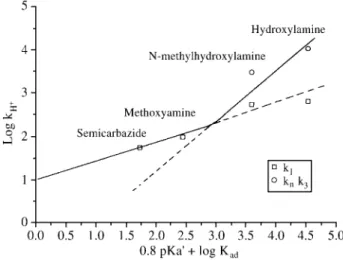
Figure 2 shows a plot of log kH+vs. log Kad + 0.8 pKanuc
for semicarbazide (k1 = 56 M-2 s-1), methoxyamine (k1 =
100 M-2 s-1), hydroxylamine (k1 = 667 M-2 s-1 and Knk3 =
11200 M-2 s-1)8 and N-methylhydroxylamine (k1 = 562 M-2
s-1 and Knk3 = 3160 M-2 s-1).
As has been established in previous works,10 the value of k3 for the reaction of hydroxylamine with norcamphor is
not diffusion-controlled, and logically the same behaviour is expected for the reaction of N-methylhydroxylamine and norcamphor. As the value k3 could be different for both
amines, we take into consideration the line that passes through the two points giving a slope of 0.60, and this slope
is greater than the slope of least-squares line for the bases that exhibit the “concerted” mechanism (k1) of value 0.42
(r = 0.96). In the case of p-chlorobenzaldehyde with differ-ent amines, the slope for the “stepwise” mechanism is 1.0 and the corresponding value for the “concerted” mecha-nism 0.33. This fact suggests that for norcamphor the transition state for the “concerted” mechanism is more similar to the T± intermediate than in the case of p-chlo-robenzaldehyde.
Conclusions
From the analysis of the reaction of different nitrogen nucleophiles with norcamphor, it is suggested that in the general mechanism for the attack step of the reactions of nitrogen nucleophiles and carbonyl compounds, forming a neutral tetrahedral intermediate, the pKa value of the nitro-gen nucleophile is a more important parameter of predic-tion of the different log k2 vs. pH profiles than the value of
Kad (equilibrium constant of the neutral addition
interme-diate formation).
Acknowledments
We are grateful to CNPq, FINEP and CAPES for finan-cial support.
References
1. Sayer, J.M.; Pinsky, B.; Schonbrunn, A.; Washtien, W. J. Am. Chem. Soc.1974, 96, 7998.
2. Chiang, J.F.; Wilcox, Jr, C.F.; Bauer, J.H. J. Am. Chem. Soc.1968, 90, 3149.
3. Altona, A.; Sundaralingam, M. J. Am. Chem. Soc. 1970, 92, 1995.
4. Yokozeki, A.; Kuchitzu, K. Bull. Chem. Soc. jpn. 1970, 43, 2017.
5. Rosemberg, S.; Silver, S.M.; Sayer, J.M.; Jencks, W.P. J. Am. Chem. Soc. 1974, 96, 7986.
6. Jencks, W.P. J. Am. Chem. Soc.1959, 81, 475. 7. Fett, R.; Simionatto, E.L.; Yunes, R.A. J. Phys. Org.
Chem.1990, 3, 620.
8. Brighente, I.M.C.; Budal, R.M.; Yunes, R.A. J. Chem. Soc. Perkin Trans.1991, 861.
9. In preparation.
10. Brighente, I.M.C.; Vottero, L.R.; Terezani, A.J.; Yunes, R.A. J. Phys. Org. Chem.1991, 4, 107. 11. Smith, R.M.; Martell, A.E.; Motekaitis, R.J. In
Criti-cal Stability Constants of Metal Complexes, Gaithers-burg, USA, 1994.
12. Lamaty, G.; Roque, J.P.; Natat, A.; Silou, T. Tetrahe-dron1986, 42, 2667.
13. Do Amaral, L.; Sandstron, W.A.; Cordes, E.H.. J. Am. Chem. Soc.1966, 88, 2225.