Medidas antropométricas orofaciais de crianças paulistanas e
norte-americanas: estudo comparativo***
Anthropometric orofacial measurements of children from Sao Paulo
and from North America: comparative study
*Fonoaudióloga. Doutora em Ciências pela Faculdade de Medicina da Universidade de São Paulo. Professora do Centro de Especialização em Fonoaudiologia Clínica (Cefac). Endereço para correspondência: Rua Barão da Passagem, 1330 Apto 91C São Paulo SP
-CEP 05087-000 ([email protected])
**Fonoaudióloga. Livre-Docente. Professora Associada do Curso de Fonoaudiologia da Faculdade de Medicina da Universidade de São Paulo.
***Trabalho Realizado na Faculdade de Medicina da Universidade de São Paulo
Artigo Original de Pesquisa
Artigo Submetido a Avaliação por Pares
Conflito de Interesse: não
Recebido em 26.05.2008. Revisado em 05.10.2008.
Aceito para Publicação em 03.02.2009.
Abstract
Background: anthropometric orofacial measurements of children from Sao Paulo and from North America. Aim: to describe the anthropometric orofacial measurements of children from Sao Paulo and to compare the obtained means to the North American norms. Method: participants were 254 children, leukoderm, in mixed dentition period, with ages ranging from 7 to 11 years and 11 months, with no history of speech, language and hearing disorders or treatment. The investigated anthropometric orofacial measurements were the height of the upper lip, the height of lower lip, the length of the philtrum and the height of lower face. In order to obtain these measurements, an electronic digital sliding caliper Starrett Series 727 was used. Results: the obtained data for the height of the upper lip, the height of the lower lip and the height of the lower face are below the means described for North American children. When considering the length of the philtrum, similar results were found between the research sample and North American children. Conclusion: the results of the measurements of the present sample referring to the height of the upper lip, the height of the lower lip and height of the lower face are below the values reported for North American children. The North American norms are not valid for the children of our population, except for the length of the philtrum.
Key Words: Face; Measurements; Anthropometry; Child; Stomatognathic System.
Resumo
Tema: medidas antropométricas orofaciais de crianças paulistanas e norte-americanas. Objetivo: descrever medidas antropométricas orofaciais em crianças paulistanas e comparar as médias dessas medidas com os padrões de normalidade publicados para a população norte-americana. Método: participaram 254 crianças, leucodermas, em dentição mista, com idades entre 7 e 11 anos e 11 meses, sem histórico de distúrbios ou tratamento fonoaudiológicos. As medidas antropométricas orofaciais coletadas foram a altura do lábio superior, a altura do lábio inferior, o comprimento do filtro e a altura do terço inferior da face. O instrumento utilizado foi um paquímetro eletrônico digital Starrett Series 727. Resultados: os dados obtidos nesta amostra para a altura do lábio superior, altura do lábio inferior e altura do terço inferior da face encontram-se abaixo das médias descritas para as crianças norte-americanas. Os resultados desta amostra, referentes ao comprimento do filtro, coincidem com as médias descritas para as crianças norte-americanas. Conclusão: os resultados das medidas da presente amostra referentes a altura do lábio superior, altura do lábio inferior e altura do terço inferior da face foram menores do que aqueles publicados para as crianças norte-americanas. Os dados de normalidade da população norte-americana não são válidos para as crianças da nossa população, exceto para o comprimento do filtro.
Palavras-Chave: Face; Medidas; Antropometria; Criança; Sistema Estomatognático.
Referenciar este material como:
Cattoni DM, Fernandes FDM. Medidas antropométricas orofaciais de crianças paulistanas e norte-americanas: estudo comparativo (original title: Anthropometric orofacial measurements of children from Sao Paulo and from North America: comparative study). Pró-Fono Revista de Atualização Científica. 2009 jan-mar;21(1):25-30.
Débora Martins Cattoni*
Introduction
Anthropometry is the biological science of
measuring the size, weight and proportion of the
human body (1) and provides objective data to the
craniofacial morphology evaluation, through a
series of head and face measurements (2). The
anthropometry presents many advantages to the
evaluation of craniofacial morphology by using
simple, noninvasive, low-risk and inexpensive
techniques. It is an important clinical tool due to its
simplicity, besides providing reference normality
data about a great variety of facial measurements
of the Caucasian population (3-5).
Facial morphologic differences are described in
studies of different populations because the
craniofacial complex, specially the face, is one of
the most varying parts of the human body (6-8).
Therefore, it is important to use references based
on race correspondent populations. With this
perspective, Farkas and Deutsch (9) state that the
validity of normal measurements necessarily
depends of the comparison with appropriate
population norms. It is extremely important that the
clinic understands that the population norms of a
given group are not necessarily valid to other
samples or groups, specially when there are
geographic and racial variations (10).
In respect to anthropometric orofacial
measurements, the height of the upper lip (sn-sto)
corresponds to the distance between the subnasale
(sn) and the stomion (sto) (1,11). The heigth of the
lower lip (sto-gn) is the distance between the
stomion (sto) and the gnathion (gn) (11). The length
of the philtrum (sn-ls) corresponds to the distance
between the subnasale (sn) and the labiale superius
(ls) (1). The heigth of the lower face (sn-gn) is the
distance between the subnasale (sn) and the
gnathion (gn) (12,13).
On a research with healthy Caucasian North
American population, it was observed that height
of the upper lip (sn-sto) is between 18,7 e 19,9
millimeters (mm) at 6 years old, with a small growth
until 12 years old (measurements between 19,9 and
20,9mm). The authors also suggest that the heigth
of the lower lip (sto-gn) measures between 40 and
41mm at 6 years old, increasing to 44mm at 12 years
old. They also described that the length of the
philtrum (sn-ls) measures between 12,6 and 14,44mm
at 6 years old and 14,4mm with 12 years old (14).
The interest to the proposition of this research
has grown as it was observed the lack of studies
that determine if the international reference values
of the anthropometric orofacial measurements can
be applied to our population. The purpose of this
research was to describe anthropometric orofacial
measurements in children from Sao Paulo and to
compare the mean of these measurements with
North American norms.
Methods
Caregivers authorized the data collection by
signing the informed consent form approved by
the institution's committee for Ethics and Research
from the Faculty of Medicine of University of Sao
Paulo (protocol number 668/01). Subjects were 254
children with ages between 7 years and 11 years
and 11 months, being 137 boys (54%) and 117 girls
(46%), attending private schools of the city of Sao
Paulo.
Children were divided in five groups according
to their ages: 48 children between 7 years and 7
years and 11 months; 52 with ages varying between
8 years and 8 years and 11 months; 50 children
between 9 years and 9 years and 11 months; 54
children between 10 years and 10 years and 11
months and 50 children between 11 years and 11
years and 11months.
Inclusion criteria to this study were: leukoderm
and mixed dentition period, with complete eruption
of the first permanent molars. Exclusion criteria were:
audiologic, speech or language complaints, prior
or current speech pathology treatments and history
of syndromes and/or neurologic diseases and/or
bifid uvula.
The instrument used to obtain the
anthropometric orofacial measurements was the
electronic digital sliding caliper Starrett Series 727,
made in Brazil, made of steel and with LCD display
with unit system in milimetres and resolution and
repeatability of 0,01mm.
Statistical Analysis
The comparison between the averages of
anthropometric orofacial measurements separated
boys and girls, according to the ages. To each
anthropometric measure the confidence interval of
95% was determined. All analysis were processed
with SPSS for Windows version 12.0 and the
considered level of significance was 5%.
Results
1016 anthropometric orofacial measurements
were obtained.
In respect to the heigth of the upper lip (sn-sto)
and to the heigth of the lower lip (sto-gn), it is possible
to observe that the means values obtained in the
present study were always smaller than those
obtained in researches by Farkas et al. (14). Those
have values that are above the confidence interval
obtained in the present study on all age groups and
for both subjects of both genders. It can be
concluded, by this data, that the mean values of the
upper lip (sn-sto) and the lower lip (sto-gn) identified
by Farkas et al. (14) are statistically larger than those
of the present sample. In respect to the length of the
philtrum (sn-ls), the mean values described to North
American children are within the confidence value
obtained by the present research to boys of 7, 8 and
9 years old. The data obtained by the present study
coincide with the results presented in researches by
Farkas et al. (14) (Table 1).
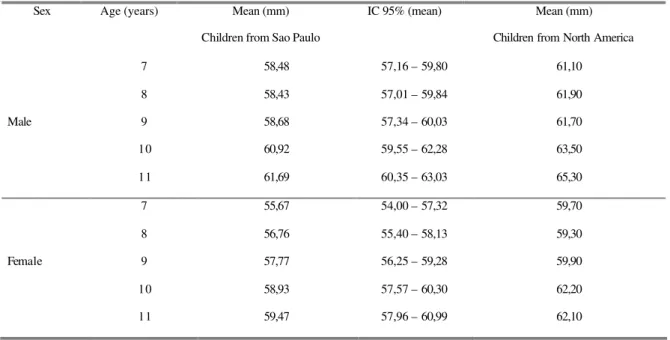
On Table 2, it can be noted that in respect to the
heigth of the lower face (sn-gn) all means determined
by Farkas et al. (14) are above the confidence interval
identified in the present study, on all age groups and
on both genders. These results suggest that there
are statistically significant differences between the
means from the both populations.
TABELA 1. Comparação das medidas antropométricas orofaciais da região nasolabial.
Heigth of upper lip (sn-sto)
Sex Age (years) Mean (mm)
Children from Sao Paulo
IC 95% (mean) Mean (mm)
Children from North America
7 18,45 17,81 – 19,08 19,30
8 18,51 17,83 – 19,19 19,70
Male 9 18,58 17,93 – 19,22 19,30
10 18,53 17,87 – 19,18 20,30
11 18,85 18,21 – 19,49 20,80
Female
7 8 9
17,54 17,34 17,57
16,74 – 18,34 16,69 – 18,00 16,84 – 18,29
18,80 19,00 19,20 10
11
17,76 17,63
17,10 – 18,41 16,90 – 18,36
19,60 19,40 Heigth of lower lip (sto-gn)
Sex Age (years) Mean (mm)
Children from Sao Paulo
IC 95% (mean) Mean (mm)
Children from North America
7 39,26 38,15 – 40,37 42,40
8 39,14 37,95 – 40,34 42,20
Male 9 39,19 38,06 – 40,32 42,40
10 41,04 39,89 – 42,19 43,30
11 42,05 40,92 – 43,17 44,00
Female
7 8 9
37,38 38,25 39,20
35,98 – 38,79 37,10 – 39,39 37,93 – 40,47
40,70 40,60 40,90 10
11
39,96 41,05
38,80 – 41,10 39,78 – 42,32
42,50 42,20 Length of the philtrum (sn-ls)
Sex Age (years) Mean (mm)
Children from Sao Paulo
IC 95% (mean) Mean (mm)
Children from North America
7 13,32 12,70 – 13,94 13,70
8 13,48 12,81 – 14,15 14,00
Male 9 13,20 12,57 – 13,83 13,30
10 13,66 13,02 – 14,31 14,40
11 13,74 13,11 – 14,38 14,50
Female
7 8 9
13,00 12,70 12,10
12,22 – 13,79 12,06 – 13,34 11,38 – 12,81
12,90 13,20 13,40 10
11
12,96 12,74
12,31 – 13,60 12,02 – 13,45
Discussion
The researchers opted by the methodology
described by classical anthropometric studies
(1-3,5,15-19). In respect to the criteria for the children
selection, it was considered the researches described
by several authors (2,15-17,20-21). It was also
selected only leukoderm children as in some studies
(14,16-18), because some report facial measurements
differences with multi-racial samples (7-9,22).
As it was possible to observe in this sample, the
mean determined to heigth of the upper lip (sn-sto),
to heigth of the lower lip (sto-gn) and to heigth of
the lower face (sn-gn) were smaller on all age groups
and on both gender, than those reported to North
American population (14). The means obtained by
this author are above the means and the confidence
intervals of the present study, suggesting that the
heigth of the upper lip (sn-sto) is larger in North
American population.
The results obtained in this study referring to
the length of the philtrum (sn-ls) coincide with the
ones obtained by Farkas et al. (14]), indicating that
this structure has the same height in North American
population and in this population.
This research has some limitations, because it
compares two specific populations and also
because the sample is relatively restricted; it should
be an important step for future investigations.
The knowlegde about orofacial measurements
of children, and also its variations referring to the
origin, verifying if there are statistically differences
among different populations, brings precision in
the results analysis. Moreover, it contributes to
orofacial motricity evaluation and to establish the
functional diagnosis done by the speech language
pathologist, due to the possibility to quantify the
structures of the face and to provide objective
data about the orofacial morphology.
Conclusions
The results obtained to children from Sao Paulo
to the heigth of the upper lip, heigth of the lower
lip and heigth of the lower face (sn-gn) are below
the means reported to North American children.
The results to length of the philtrum coincide in
the both studied populations.
TABLE 2. Comparison of heigth of the lower face (sn-gn).
Legend: mm = milimeters; IC = confidence interval.
Sex Age (years) Mean (mm)
Children from Sao Paulo
IC 95% (mean) Mean (mm)
Children from North America
7 58,48 57,16 – 59,80 61,10
8 58,43 57,01 – 59,84 61,90
Male 9 58,68 57,34 – 60,03 61,70
10 60,92 59,55 – 62,28 63,50
11 61,69 60,35 – 63,03 65,30
Female
7 8 9
55,67 56,76 57,77
54,00 – 57,32 55,40 – 58,13 56,25 – 59,28
59,70 59,30 59,90 10
11
58,93 59,47
57,57 – 60,30 57,96 – 60,99
References
1. Farkas LG. Examination. In: Farkas LG, editor. Anthropometry of the head and face. 2nd ed. New York: Raven Press; 1994. p. 3-56.
2. Ward RE, Jamison PL, Farkas LG. Craniofacial variability index: a simple measure of normal and abnormal variation in the head and face. Am J Med Genet. 1998;80(3):232-40. 3. Ward RE. Facial morphology as determined by anthropometry: keeping it simple. J Craniofac Genet Dev Biol. 1989;9:45-60.
4. Allanson JE. Objective techniques for craniofacial assessment: what are the choices? Am J Med Genet. 1997;70:1-5.
5. Ward RE, Jamison PL, Allanson JE. Quantitative approach to identifying abnormal variation in human face exemplified by a study of 278 individuals with five craniofacial syndromes. Am J Med Genet. 2000;91(1):8-17.
6. Farkas LG, Ngim RCK, Venkatadri G. Racial and ethnic morphometry differences in the craniofacial complex. In: Farkas LG, editor. Anthropometry of the head and face. 2nd ed. New York: Raven Press; 1994. p. 201-18. 7. Borman H, Ozgur F, Gursu G. Evaluation of soft-tissue morphology of face in 1,050 young adults. Ann Plast Surg. 1999;42(3):280-8.
8. Le TT, Farkas LG, Ngim RCK, Levin S, Forrest CR. Proportionality in Asian and north American Caucasian faces using neoclassical facial canons as criteria. Aesth Plast Surg. 2002;26(1):64-9.
9. Farkas LG, Deutsch CK. Anthropometric determination of craniofacial morphology [editorial]. Am J Med Genet. 1996;65(1):1-4.
10. Enlow DH, Hans MG. Noções básicas de crescimento facial. São Paulo: Santos; 1998. p. 304.
11. Suguino R, Ramos AL, Terada HH, Furquim LZ, Maeda L, Silva Filho OG. Análise facial. R Dental Press Ortodon Ortop Maxilar. 1996;1(1):86-107.
12. Psillakis JM, Lucardi V. Proporções estéticas da face. In: Psillakis JM, Zanini AS, Mélega JM, Costa EA, Cruz RL. Cirurgia craniomaxilofacial: osteotomias estéticas da face. Rio de Janeiro: Medsi; 1987. p. 297-313.
13. Gregoret J. Ortodontia e cirurgia ortognática: diagnóstico e planejamento. São Paulo: Santos; 1999.
14. Farkas LG, Hreczko TM, Katic MJ. Craniofacial norms in north American Caucasians from birth (one year) to young adulthood. In: Farkas LG, editor. Anthropometry of the head and face. 2nd ed. New York: Raven Press; 1994. p. 241-312.
15. Farkas LG, Hreczko TA, Kolar JC, Munro IR. Vertical and horizontal proportions of the face in young adult north American Caucasians: revision of neoclassical canons. Plast Reconstr Surg. 1985;75(3):328-37.
16. Farkas LG, Posnick JC. Growth and development of regions units in the head and face based on anthropometric measurements. Cleft Palate-Craniofac J. 1992;29(4):301-2 .
17. Farkas LG, Posnick JC, Hreczko TM. Growth patterns of the face: a morphometric study. Cleft Palate-Craniofac J. 1992;29(4):308-15.
18. Farkas LG, Posnick JC, Hreczko TM, Pron GE. Growth patterns of the nasolabial region: a morphometric study. Cleft Palate-Craniofac J. 1992;29(4):318-24.
19. Shaner DJ, Bamforth S, Peterson AE, Beattie OB. Technical note: different techniques, different results -comparison of photogrammetric and caliper-derived measurements. Am J Phys Anthropol. 1998;106(4):547-52.
20. Ward RE, Jamison PL. Measurement precision and reliability in craniofacial anthropometry: implications and suggestions for clinical application. J Craniofac Genet Dev Biol. 1991;11:156-64.
21. Ferrario VF, Sforza C, Poggio CE, Schmitz JH, Colombo A. Soft-tissue facial morphology related to headform: a three-dimensional quantitative analysis in childhood. J Craniofac Genet Dev Biol. 1997;17:86-95.