Article
Printed in Brazil - ©2017 Sociedade Brasileira de Química0103 - 5053 $6.00+0.00
*e-mail: [email protected]
A Green Extraction of Trace Iodine in Table Salts, Vegetables, and Food Products
Prior to Analysis by Inductively Coupled Plasma Optical Emission Spectrometry
Nunticha Limchoowong,a Phitchan Sricharoen,a Suchila Techawongstien,b Supalak Kongsric and Saksit Chanthai*,a
aMaterials Chemistry Research Center, Department of Chemistry and Center of Excellence for
Innovation in Chemistry, Faculty of Science and bDepartment of Plant Science and Agricultural
Resources, Faculty of Agriculture, Khon Kaen University, 40002 Khon Kaen, Thailand
cNuclear Research and Development Division, Thailand Institute of Nuclear Technology (Public
Organization), Chatuchak, 10900 Bangkok, Thailand
In this study, we report a new method for iodine extraction from table salts, vegetables, and other food products using ultrasound-assisted extraction, prior to the iodine determination by inductively coupled plasma optical emission spectrometry. For the ultrasound-assisted extraction, deionized water as the extraction solvent and an extraction time of 5 min were found to be the most optimum condition. A linear calibration curve was plotted for 0.1 to 200.0 mg L−1 iodine
convention. The limits of detection and quantification were 0.049 and 0.164 mg L−1, respectively.
The precision for intra- and inter-day analyses was 2.75 and 4.54%, respectively. The accuracy of the method was confirmed with certified reference materials. Recoveries in 47 real samples were ranged between 80.48 and 118.1%. Therefore, the proposed method could be considered as a rapid, simple, and environmental-friendly method (the green extraction) to determine the trace amounts of iodine in different kinds of food products.
Keywords: iodine, ultrasound assisted extraction, green extraction, food products, ICP OES
Introduction
Iodine is one of the most essential trace elements for humans and other higher animals.1 Iodine is physiologically
required by thyroid gland to synthesize thyroid hormones, such as thyroxin and triiodothyronine, which are required for several normal metabolic processes.2 The
roles of thyroid hormones include the control of growth, development, and some metabolic processes in the body. These hormones affect physical and intellectual development, functioning of muscles and nerve tissues, circulatory system, regulation of body heat and energy, and the metabolism of all nutrients.3 Thus, iodine deficiency
may lead to various clinical abnormalities including mental retardation, deafness, stunted growth, and neurological problems.4 Iodine deficiency in human nutrition results in
iodine deficiency disorders (IDDs), the most well-known among them is goiter that shows an enlargement of the thyroid gland. World Health Organization reported that IDD
affects around 35% of the world’s population.5 Therefore,
concentrations of iodine usage need to be controlled on a daily uptake of about 180-200 µg to avoid iodine deficiency and associated disorders.6
The analytical method for iodine determination is tedious due to its very low concentrations in foods (few µg L−1 at most), and losses also occur due to its high
volatility. Therefore, the determination of iodine in food has been a big challenge since a long time.7 The analytical
methods that have been used for the determination of iodine in food samples include mid-infrared (IR) or 1H nuclear magnetic resonance (NMR) spectroscopy,8 the
classic Sandell and Kolthoff kinetic-catalytic method,9
neutron activation analysis,10 kinetic spectrophotometry,11
chemiluminescence,12 X-ray fluorescence,13
energy-dispersive X-ray fluorescence spectrometry (EDXRF), electrospray ionization tandem mass spectrometry,14
inductively coupled plasma optical emission spectrometry (ICP OES),13 and amperometry.15 In addition, iodine is not
stable in acidic media that may result in low recovery.16
based on alkaline extraction such as by ammonia solution and tetramethyl ammonium hydroxide (TMAH), which is a toxic substance and poses a serious risk to human health. Therefore, it is highly desirable to conduct TMAH extraction at high temperatures (90 °C).17-19 The extraction
at high temperatures may cause changes in quality and lead to iodine loss, resulting in low extraction efficiency. The disadvantages of the existing extraction methods, such as high temperature, high energy consumption (more than 10% of the total energy required by the process), and the use of harmful chemicals, have forced the food and chemical industries to find environmental-friendly techniques such as ultrasound extraction. The ultrasonic technique has been applied for the extraction of some biological compounds.20-23 It can be used either as a diagnostic tool or
as a source of energy. Ultrasonic treatments are considered efficient for shorter extraction time and lower liquid-solid ratios by increasing the mass transfer rate.24,25 Thus, it is
necessary to find out the green alternatives, efficient and simple methods for iodine extraction from food samples.
The aim of this study was to improve the extraction method for the trace amounts of iodine using ultrasonic-assisted extraction (UAE) with either deionized water or 3% (v/v) ammonia solution. The green extraction method was applied in association with UAE followed by ICP OES for a rapid determination of iodine in food samples.
Experimental
Instruments
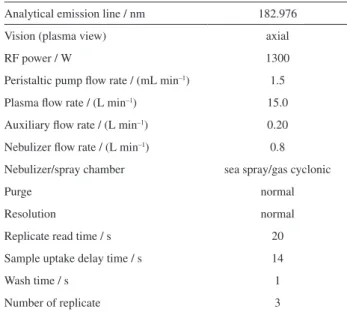
The measurement of iodine was carried out with a PerkinElmer (Wellesley, USA) model OPTIMA 2100 DV inductively coupled plasma optical emission spectrometer using a standard ICP torch, axially viewed plasma system and a peristaltic pump. The entire system is controlled by the PE Winlab software. The plasma viewing mode and instrumental condition used are presented in Table 1.
Chemicals
All aqueous solutions were prepared with deionized water (with a resistivity of 18.2 MΩ cm−1; Milli Q
Millipore) using a simplicity water purification system, Model Simplicity 185 (Millipore Corporation, USA). An iodine stock solution of 1000 mg mL−1 was prepared from
potassium iodide (KI; Carlo Erba, France) with deionized water. Because iodide is sensitive to light, its exposure to light was minimized. The stock solution was used to prepare all standard solutions on a daily basis. A series of the calibration solutions (iodide concentrations of 0.1, 0.5,
1.0, 5.0, and 10.0 mg L−1) were made from KI. Ammonia
solution with 3% (v/v) was prepared by diluting 10 mL of concentrated ammonia solution (analytical grade was obtained from Carlo Erba, Milan, Italy) with 100 mL of deionized water.
Sample preparation
The representative iodine samples that include table salts, seaweeds, dried seafoods, rice porridge, seasoning powder, seasoned crispy, and milk were purchased from the convenient retail stores in Khon Kaen City, Thailand. In particular, tomato and chili samples used in this study were obtained from the cultivar areas of Department of Plant Science and Agricultural Resources, Faculty of Agriculture, Khon Kaen University, Thailand. The local names of the six varieties of tomato used are Seeda, Mani Siam, Tor, Black Cherry Kham Kaen, Mo Kho 40, and Phuang, whereas those of five varieties of chili pepper are Akkhani Phirot, Mokho 2, Thapthim Mo Dindaeng, Som, and Ratchaburi. All tomato and chili fruits were washed with distilled water, cut into pieces, and homogenized. The homogenized sample was placed in the polytetrafluoroethylene (PTFE) centrifuge tube and frozen at −20 °C. Then, this frozen puree was freeze-dried (SCANVAC Centrifuge for Vacuum Concentrator Freeze-Dry, China). Further, the sample was enclosed in a container of the laboratory mill and ground into a fine powder. These materials were later stored in a freezer at −20 °C until further analysis. Seaweeds, dried seafoods, rice porridge, seasoning powder, and seasoned crispy were ground in a kitchen grinder (Philips, Indonesia) to pass a 100 mesh sieve and analyzed as soon as they were
Table 1. Working conditions and parameters of ICP OES spectrometer
Analytical emission line / nm 182.976
Vision (plasma view) axial
RF power / W 1300
Peristaltic pump flow rate / (mL min–1) 1.5
Plasma flow rate / (L min–1) 15.0
Auxiliary flow rate / (L min–1) 0.20
Nebulizer flow rate / (L min–1) 0.8
Nebulizer/spray chamber sea spray/gas cyclonic
Purge normal
Resolution normal
Replicate read time / s 20
Sample uptake delay time / s 14
Wash time / s 1
brought to the laboratory. Otherwise, they were stored in plastic bottles and kept in a desiccator until analysis.
Ultrasound-assisted extraction
Approximately 0.1 g of the sample was accurately weighed and extracted with 10 mL of two kinds of the extraction solvent (deionized water and 3% (v/v) ammonia solution) by an ultrasonic-assisted extraction method (Sonorex Digitec DT 510 H, Bandelin, Germany) for different extraction times (1, 5, 10, and 15 min) under a controlled temperature of about 35 °C under the protection from light using a commercial foil. The clear extract in the supernatant was immediately analyzed by ICP OES after centrifugation at 5000 rpm (Compact Centrifuge Z 206A, Germany).
Method accuracy evaluation
For a spiked iodine solution, a stock solution (1000 mg L−1
iodide) was used to obtain working concentrations. To measure the recovery of iodine from real food samples and to determine the effect of cellular matrix of the sample materials, an optimal condition was chosen and applied by spiking with a standard iodide solution (5 mg L−1) to the
samples before ultrasound-assisted extraction. However, only deionized water was ultimately selected as an extraction solvent for the tomatoes, chili peppers, and other food samples. The certified reference material analysis was carried out by weighing 0.1 g of material sample in triplicate followed by the same procedure.
Linearity
The iodine standard solutions (0.1, 0.5, 1, 5, 10, 15, 20, 25, 50, 100, and 200 mg L−1) were used to draw a
calibration curve. In order to ensure accuracy, the iodine concentrations of all the analyzed samples were required to fall within the range of the calibration curve. Otherwise, the sample extracts were diluted.
Results and Discussion
Merits of the proposed method
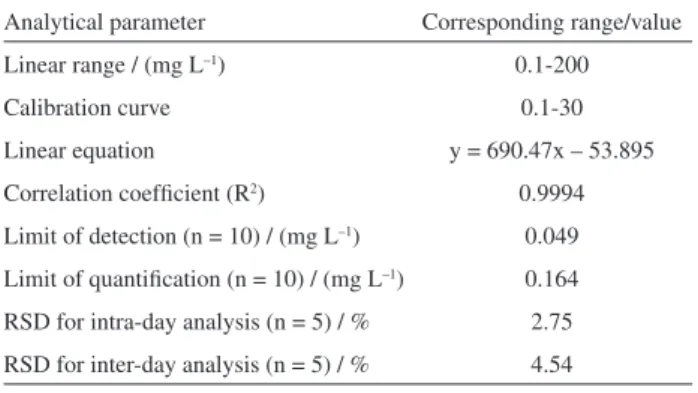
The analytical characteristics of the proposed method were validated under the optimized conditions in terms of linearity, limit of detection (LOD), limit of quantification (LOQ), and precision (expressed as the relative standard deviation (RSD) of the slope of the calibration curve obtained from both intra-day and inter-day analyses) to
estimate the efficiency and feasibility of the method using table salts, vegetables, and food products and samples. The results thus obtained are presented in Table 2. A linear calibration curve was obtained by titrating an iodine solution of 0.1 mg L−1 to 200 mg L−1 (r2 > 0.9994). The
equation of the linear calibration curve can be expressed as y = 690.47x − 53.895, where y is the analytical signal and x is the concentration of iodine (mg L−1). The limit of
detection and limit of quantification calculated for three and ten times standard deviation of an analytical signal of 10 reagent blanks divided by the slope of the standard calibration curve were found to be 0.049 and 0.164 mg L−1,
respectively. The LOD was lower than that reported previously (0.280 mg L−1).26 Precision, expressed as RSD
of the slope of the calibration curve, was evaluated in terms of repeatability (data were taken from five independent standard preparations, intra-day RSD) and reproducibility (work performed for five consecutive days, inter-day RSD) and found to be 2.75 and 4.54%, respectively, indicating an acceptable repeatability of the method.
Ultrasound-assisted extraction optimization
To optimize the extraction efficiency, following factors were studied. First of all, the effect of ammonia concentration on the extraction of iodine was studied. The iodide solutions (5 mg L−1) with varying ammonia
solutions (1-4%, v/v) were tested for an extraction time of 5 min. The results showed that the recovery of iodine increased from about 80 to 100% when extracted with 1-3% NH3 solution, and then slightly decreased at 4%
NH3 solution (Figure 1). Therefore, in this case, 3% (v/v)
NH3 solution could be chosen as the extraction solvent.
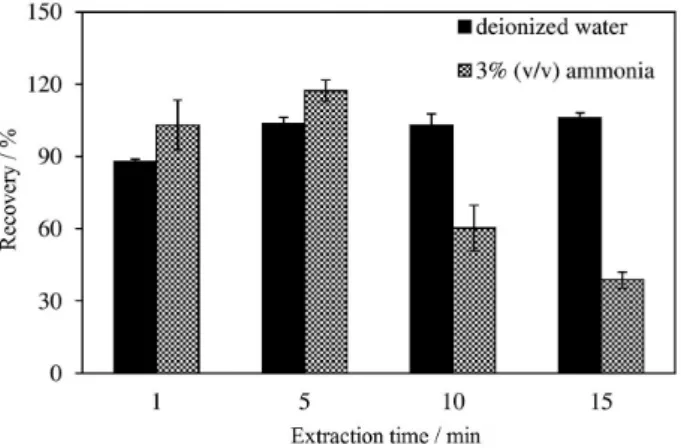
However, when deionized water was used as background solvent, the recovery of iodine was found to be better than those of ammonia solutions. The results are presented in
Table 2. Analytical characteristics of UAE-ICP OES for determination of iodine
Analytical parameter Corresponding range/value
Linear range / (mg L–1) 0.1-200
Calibration curve 0.1-30
Linear equation y = 690.47x – 53.895
Correlation coefficient (R2) 0.9994
Limit of detection (n = 10) / (mg L–1) 0.049
Limit of quantification (n = 10) / (mg L–1) 0.164
RSD for intra-day analysis (n = 5) / % 2.75
RSD for inter-day analysis (n = 5) / % 4.54
Figure 2. The effect of different extraction times on the iodine extraction was also investigated. The recovery of iodine using deionized water as an extraction solvent was found consistently around 100% for the extraction times of 5 and 15 min, whereas that of 3% NH3 solution was lower
with varying extraction times. The long extraction time with this basic solution may increase volatility of iodine. Thus, we obtained deionized water as solvent and 5 min extraction time as the best condition for iodine extraction.
Therefore, only deionized water was chosen for the green extraction (nontoxic) using an ultrasound-assisted method. The recoveries of the real tomato sample under the extraction conditions were found to be 103.5 ± 2.7% and 117.2 ± 4.4% using deionized water and 3% (v/v) ammonium hydroxide solution, respectively.
Ultrasound-assisted extraction mechanism
The ultrasound-assisted extraction (UAE) of the target compounds for a given matrix is a complex mechanism that
involves mass transfer and a variety of possible chemical reactions influencing the yield and associated biological activities. In general, the effect of sonication on mass transfer shows a direct relationship with the sound energy introduced in the extraction system and the ultrasonic frequency.27 UAE in food products is applied for the
extraction of organic and inorganic compounds because this provides improved solvent penetration into the plant body and can also break down cell walls. A review of the literature28 suggests that combinations of various physical,
mechanical, chemical, and biochemical processes take place during the application of ultrasound in chemical processing and extraction processes. The mechanism of UAE using a solvent and a solid matrix can be summarized as follows:
(i) using ultrasonic waves, a cavitation bubble can be generated close to the material surface;
(ii) during a compression cycle, this bubble collapses and a microjet directing toward the plant matrix is created;
(iii) the high pressure and temperature applied in this process destroy the cell walls or damage the surface at solvent-matrix interfaces by shock waves and microjets, and its contents or analytes are released into the extraction buffer or solvent.
This is a very effective technique for the extraction of natural products from a biomass. As a consequence, the method of UAE has a number of advantages that include increased mass transfer, better solvent penetration, less dependence on solvent use, extraction at lower temperatures, faster extraction rates, and greater yields of the product.29
Working concentration of iodine
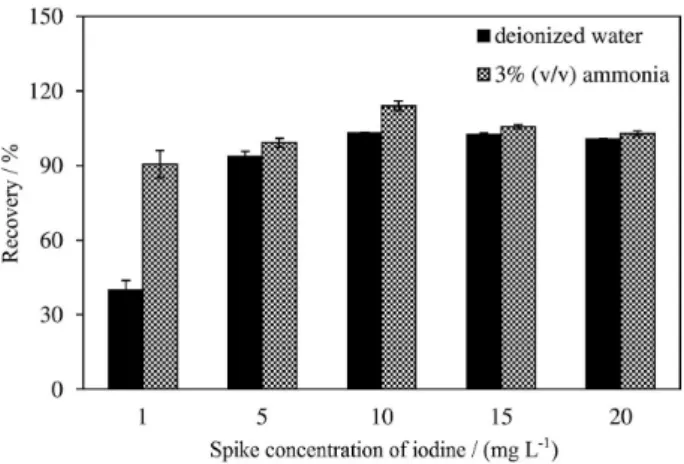
The concentration of iodine also has a significant effect on its sensitivity. Figure 3 shows the effect of spiked iodine concentrations using both extraction solvents, which ranges between 1 and 20 mg L−1, resulting in similar
recoveries in the range of 90.5-114.0%. However, the iodine concentration of 5 mg L−1 was selected for further
experiments.
Iodine contents in real samples and recovery
The accuracy of the proposed method was evaluated by analyzing the certified reference materials (NIST SRM 1549 Non-Fat Milk Powder, NIST SRM 1573a Tomato Leaves, and NIES No. 9 Sargasso). The results are presented in Table 3. A comparison between the certified and the obtained concentration values was statistically nonsignificant. It was concluded that the presented
Figure 1. The effect of ammonia concentration on the extraction recovery of iodide in the tomato sample. Conditions: sample mass, 0.1 g; iodide concentration, 5 mg L−1; volume of the extraction solvent, 10 mL;
extraction time, 5 min.
Figure 2. The effect of extraction time on the recovery of iodine in the tomato sample using both deionized water and 3% (v/v) ammonia solution. Conditions: sample mass, 0.1 g; iodide concentration, 5 mg L−1; volume
extraction method can be successfully applied to food samples.
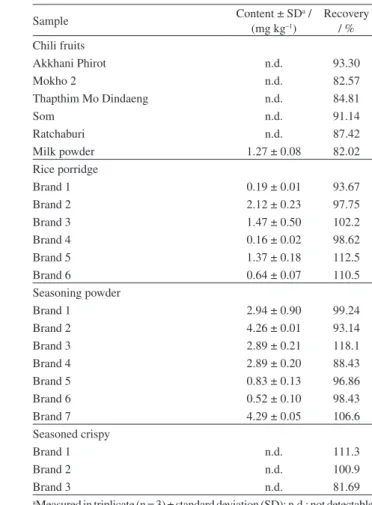
To demonstrate the applicability and reliability of the proposed method, it was successfully applied to 47 samples of food products including salt, seaweed, dried seafood, tomato fruit, chili fruit, milk powder, rice porridge, seasoning powder, and seasoned crispy. Table 4 shows both iodine contents and their recoveries. Salt samples contain rather higher amounts of iodine (40.93-58.77 mg kg−1),
which are in good agreement with those previously reported.30,31 Iodine in seaweeds was found from a
non-detectable (n.d.) value to 20.30 mg kg−1, whereas there was
a wide range of 16-8,165 mg kg−1 iodine depending on the
type of the samples.32,33 Dried seafoods’ iodine contents
are also contained at trace levels (0.85-6.18 mg kg−1).
Milk powder (1.27 mg kg−1) could be supplemented
with iodine, whereas some were found between 0.07 and 13.07 mg kg−1.31 Rice porridge (0.19-2.12 mg kg−1),
seasoning powder (0.52-4.29 mg kg−1), and seasoned
crispy were unavoidably examined for being commercially available food products. In particular, iodine was not detectable in tomatoes and chili fruits, even in a background amount, probably because of its low detection limit (0.05 mg L−1). Moreover, to test the accuracy and evaluate
the effect of the matrix by the green extraction method, the recovery study of all used samples was conducted along with their iodine contents. Each sample was spiked with a concentration (5 mg L−1) of the standard solution of iodide.
Then, the relative percentage recoveries were calculated as follows:
% Recovery = [(Cfound – Creal) / Cadded] × 100 (1)
where Cfound, Creal, and Cadded are the concentration of analyte
after the addition of the known amount of the standard in the real sample, the concentration of analyte in the real sample, and the concentration of the known amount of the standard that was spiked in the real sample, respectively.
From the results (Table 4), it can be observed that the recoveries by the proposed method, which are expressed as the mean percentage (n = 3), vary between 80.48 and 118.1%. They are rather found in wide range probably due to the sample matrices, but some are satisfactorily close to 80% observed for several samples (brand 2 of seaweed, Mokho 2 of chili fruits, etc.), however, the I2 that could
be formed by sonication is easily volatile and lost during the sample preparation, leading to low recovery study.34
This demonstrates that this method provides acceptable recovery (> 80%) for the determination of iodine in real samples and implies that the matrix has a negligible effect on the efficiency of the proposed method. Therefore, the adopted procedure demonstrated that using deionized water as an extraction solvent with ultrasound-assisted extraction for 5 min could be considered as simple, fast, and green extraction conditions in association with ICP OES.
By the way, this UAE method for iodine in various samples was compared with other sample extraction ones in terms of the sample preparation method, type of solvent, extraction time and recovery (Table 5). The accuracy of the method was well lined out within the generally acceptable range. In addition, the proposed method is superior to the others in terms of using green solvent, short extraction time and simple procedure. Therefore, it can be used as an alternative technique to the other complicated extraction methods for analysis of iodine in real samples.
Conclusion
In this study, a new approach for trace iodine extraction based on ultrasound-assisted extraction is proposed. It is a fast (with an extraction time of only 5 min), simple, and safe method, and therefore can be called a green
Figure 3. The effect of spiked iodine concentrations on the tomato sample using both deionized water and 3% (v/v) ammonia solution. Conditions: sample mass, 0.1 g; volume of the extraction solvent, 10 mL; extraction time, 5 min.
Table 3. The results for certified reference materials (µg g–1) for the determination of iodine
Element NIST SRM 1549 Non-fat milk powder NIST SRM 1573a Tomato leaves NIES No. 9 Sargasso Certified value Our value Certified value Our value Certified value Our value
Iodine 3.38 3.30 ± 0.05a 0.85 0.83 ± 0.02a 520 519.66 ± 2.11a
Table 4. The iodine contents and its recovery from salts, vegetables, and other food products
Sample Content ± SD
a /
(mg kg–1)
Recovery / % Salt
Brand 1 46.06 ± 3.93 99.37
Brand 2 53.54 ± 6.59 99.21
Brand 3 40.93 ± 3.69 83.73
Brand 4 52.13 ± 9.93 105.7
Brand 5 58.77 ± 2.23 95.51
Seaweed
Brand 1 13.39 ± 1.78 96.74
Brand 2 5.85 ± 0.05 80.48
Brand 3 10.74 ± 0.57 96.06
Brand 4 15.60 ± 1.65 92.71
Brand 5 20.30 ± 2.61 91.96
Brand 6 9.74 ± 0.04 85.74
Brand 7 n.d. 99.23
Brand 8 7.39 ± 1.92 92.13
Dried Seafood
Minnow (Parachela oxygastroides) 3.65 ± 0.44 102.7 Dried shrimp (Penaeus sp.) 1.16 ± 0.11 114.4 Splendid squid (Loligo duvauceli) 2.07 ± 0.22 103.0 Splendid Squid Middle (Teuthida) 1.91 ± 0.36 87.01 Blue eye Rice fish (Oryzias Minutillus) 6.18 ± 0.18 98.01
Octopus (Coleoidea) 0.85 ± 0.11 85.60
Tomato fruits
Seeda n.d. 93.66
Mani Siam n.d. 102.6
Tor n.d. 101.2
Black Cherry Kham Kaen n.d. 110.2
Mo Kho 40 n.d. 105.0
Phuang n.d. 103.9
Sample Content ± SD
a /
(mg kg–1)
Recovery / % Chili fruits
Akkhani Phirot n.d. 93.30
Mokho 2 n.d. 82.57
Thapthim Mo Dindaeng n.d. 84.81
Som n.d. 91.14
Ratchaburi n.d. 87.42
Milk powder 1.27 ± 0.08 82.02
Rice porridge
Brand 1 0.19 ± 0.01 93.67
Brand 2 2.12 ± 0.23 97.75
Brand 3 1.47 ± 0.50 102.2
Brand 4 0.16 ± 0.02 98.62
Brand 5 1.37 ± 0.18 112.5
Brand 6 0.64 ± 0.07 110.5
Seasoning powder
Brand 1 2.94 ± 0.90 99.24
Brand 2 4.26 ± 0.01 93.14
Brand 3 2.89 ± 0.21 118.1
Brand 4 2.89 ± 0.20 88.43
Brand 5 0.83 ± 0.13 96.86
Brand 6 0.52 ± 0.10 98.43
Brand 7 4.29 ± 0.05 106.6
Seasoned crispy
Brand 1 n.d. 111.3
Brand 2 n.d. 100.9
Brand 3 n.d. 81.69
aMeasured in triplicate (n = 3) ± standard deviation (SD); n.d.: not detectable.
Table 5. Comparison of ultrasound-assisted extraction with other extraction techniques for the determination of the iodine
Sample Sample preparation Solvent Extraction time Recovery / % Reference
Leaves of spinach incubation (90 °C) 25% TMAH 3 h 89.3 35
Vegetable oils magnetic stirrer 99% ethanol 5 min – 36
Milk water bath (40 °C) 3% acetic acid 5 min 87-14 37
Milk whey proteins microwave 25 mmol L−1 NH
4OH 25 min 105 26
Oil microwave HNO3 20 min – 38
Food microwave HNO3 and H2O2 – 85-95 39
Coal microwave HNO3, H2O2 and S2O82− – 82-120 40
Food ultrasound deionized water 5 min 80.48-118.1 this work
extraction method. This method using only deionized water as extraction solvent was applied for the analysis of the trace amounts of iodine in table salts, tomatoes, chili, and different kinds of other food samples. This method resulted in high iodine recoveries from all samples. Although both the limit of detection and the limit of quantification were lower than 0.2 mg L−1, the amount of iodine in
some vegetables could not be detected, indicating that the background residual contents of iodine in these vegetables
are quite low for daily food consumption. In summary, our method can effectively be used for the detection of trace levels of iodine in different food products.
Acknowledgments
Commission, through the Food and Functional Food Research Cluster of Khon Kaen University, Materials Chemistry Research Center, Department of Chemistry, Center of Excellence for Innovation in Chemistry (PERCH-CIC), Thailand, for financial support.
References
1. Rana, R.; Raghuvanshi, R. S.; J. Food Sci. Technol. 2013, 50, 1212.
2. Haldimann, M.; Alt, A.; Blanc, A.; Blondeau, K.; Food Compos. Anal. 2005, 18, 461.
3. Erkan, N.; Int. J. Food Sci. Technol. 2011, 46, 1734.
4. Waszkowiak, K.; Szymandera-Buszka, K.; Int. J. Food Sci. Technol. 2008, 43, 895.
5. Anderson, M.; Takkouche, B.; Egli, I.; Allen, H. E.; de Benoist, B.; Bull. W. H. O. 2005, 83, 518.
6. Pop, F.; Int. J. Food Sci. Technol. 2010, 45, 327.
7. Heckman, M. M.; J.- Assoc. Off. Anal. Chem. 1979, 62, 1045. 8. Shimamoto, G. G.; Favaro, M. M. A.; Tubino, M.; J. Braz.
Chem. Soc. 2015, 26, 1431.
9. Gasior, R.; Szczypula, M.; Szybinski, Z.; Ann. Anim. Sci. 2013,
13, 375.
10. El-Ghawi, U. M.; Al-Sadeq, A. A.; Biol. Trace Elem. Res. 2006,
111, 31.
11. Ni, Y.; Wang, Y.; Microchem. J. 2007, 86, 216.
12. Fujiwara, T.; Mohammadzai, I. U.; Inoue, H.; Kumamaru, T.;
Analyst 2000, 125, 759.
13. Varga, I.; Microchem. J. 2007, 85, 127.
14. Minakata, K.; Yamagishi, I.; Kanno, S.; Nozawa, H.; Suzuki, M.; Suzuki, O.; J. Chromatogr. B 2010, 878, 1683.
15. Souza, F. C.; Da Silva, D. A. I.; Ribeiro, M. S.; Faria, R. B.; Melo, M. A.; Toledo, R. M. M.; D’Elia, E.; J. Braz. Chem. Soc.
2013, 24, 1582.
16. Julshamn, K.; Dahl, L.; Eckhoff, K.; J. AOAC Int. 2001, 84, 1976.
17. Fecher, P. A.; Goldmann, I.; Nagengast, A.; J. Anal. At. Spectrom. 1998, 13, 977.
18. Niedobová, E.; MacHát, J.; Kanický, V.; Otruba, V.; Microchim. Acta 2005, 50, 103.
19. Tagami, K.; Uchida, S.; Hirai, I.; Tsukada, H.; Takeda, H.; Anal. Chim. Acta 2006, 570, 88.
20. Perlatti, B.; Fernandes, J. B.; Silva, M. F. G. F.; Ardila, J. A.; Carneiro, R. L.; Souza, B. H. S.; Costa, E. N.; Eduardo, W. I.; Boiça Junior, A. L.; Forim, M. R.; J. Braz. Chem. Soc. 2016,
27, 475.
21. Dong, J.; Cai, L.; Zhu, X.; Huang, X.; Yin, T.; Fang, H.; Ding, Z.; J. Braz. Chem. Soc. 2014, 25, 1956.
22. Santos, O. O.; Montanher, P. F.; Bonafé, E. G.; Do Prado, I. N.; Maruyama, S. A.; Matsushita, M.; Visentainer, J. V.; J. Braz.
Chem. Soc. 2014, 25, 1712.
23. Gasmalla, M. A.; Yang, R.; Hua, X.; J. Food Sci. Technol. 2015,
52, 5946.
24. Kim, Y. U.; Wang, M. C.; Ultrasonics 2003, 41, 539. 25. Kumcuoglu, S.; Yilmaz, T.; Tavman, S.; J. Food Sci. Technol.
2014, 51, 4102.
26. Naozuka, J.; da Veiga, M. A. M. S.; Oliveira, P. V.; de Oliveira, E.; J. Anal. At. Spectrom. 2003, 18, 917.
27. Albero, B.; Sánchez-Brunete, C.; García-Valcárcel, A. I.; Pérez, R. A.; Tadeo, J. L.; TrAC, Trends Anal. Chem. 2015, 71, 110. 28. Picó, Y.; TrAC, Trends Anal. Chem. 2013, 43, 84.
29. Tiwari, B. K.; TrAC, Trends Anal. Chem. 2015, 71, 100. 30. Dasgupta, P. K.; Liu, Y.; Dyke, J. V.; Environ. Sci. Technol.
2008, 42, 1315.
31. Barikmo, I.; Henjum, S.; Dahl, L.; Oshaug, A.; Torheim, L. E.;
J. Food Compos. Anal. 2011, 24, 637.
32. Teas, J.; Pino, S.; Critchley, A.; Braverman, L. E.; Thyroid 2004,
14, 836.
33. Romarís-Hortas, V.; Moreda-Piñeiro, A.; Bermejo-Barrera, P.;
Talanta 2009, 79, 947.
34. Nascentes, C. C.; Korn, M.; Sousa, C. S.; Arruda, M. A. Z.; J. Braz. Chem. Soc. 2001,12, 57.
35. da Silva, S. V.; Picoloto, R. S.; Flores, E. M. M.; Wagner, R.; Richards, N. S. P. S.; Barin, J. S.; Food Chem. 2016, 190, 364. 36. Shimamoto, G. G.; Aricetti, J. A.; Tubino, M.; Food Anal.
Methods 2016, DOI 10.1007/s12161-016-0401-1.
37. Lu, H.; Wei1, C.; Fu, H.; Li, X.; Zhang, Q.; Wang, J.; J. Am. Oil Chem. Soc. 2015, 92, 1549.
38. Smoleń, S.; Strzetelski, P.; Rożek, S.; Ledwożyw-Smoleń, I.;
Acta Sci. Pol., Hortorum Cultus 2011, 10, 29.
39. Melichercik, J.; Szijarto, L.; Hill, A. R.; J. Dairy Res. 2006, 89, 934.
40. Sun, M.; Gao, Y.; Wei, B.; Wu, X.; Talanta 2010, 81, 473.
Submitted: May 25, 2016