Full Terms & Conditions of access and use can be found at
http://www.tandfonline.com/action/journalInformation?journalCode=cjri20
Download by: [b-on: Biblioteca do conhecimento online UL] Date: 09 May 2016, At: 01:14
Journal of Reproductive and Infant Psychology
ISSN: 0264-6838 (Print) 1469-672X (Online) Journal homepage: http://www.tandfonline.com/loi/cjri20
The Portuguese version of the Placental Paradigm
Questionnaire at the third trimester of pregnancy
M. Eduarda Carvalho & J.M. Miranda Justo
To cite this article: M. Eduarda Carvalho & J.M. Miranda Justo (2015) The Portuguese version of the Placental Paradigm Questionnaire at the third trimester of pregnancy, Journal of Reproductive and Infant Psychology, 33:5, 478-487, DOI: 10.1080/02646838.2015.1046122 To link to this article: http://dx.doi.org/10.1080/02646838.2015.1046122
Published online: 28 May 2015.
Submit your article to this journal
Article views: 64
View related articles
The Portuguese version of the Placental Paradigm Questionnaire
at the third trimester of pregnancy
M. Eduarda Carvalhoa*and J.M. Miranda Justob
aCentro de Estudos de Sociologia e Estética Musical da Universidade Nova, Lisboa,
Portugal;bDepartamento de Psicologia da Faculdade de Psicologia da Universidade de Lisboa, Lisboa, Portugal
(Received 4 September 2014; accepted 26 April 2015)
Objective: The purpose of this article is to present the adaptation and factorial validation of the Placental Paradigm Questionnaire (PPQ) for the Portuguese pop-ulation. Method: The original PPQ was translated into Portuguese (designated as ‘Questionário do Paradigma Placentário’, QPP) and then back-translated into English; the Portuguese and the back-translated versions were evaluated by a panel of experts. The participants were 189 pregnant Portuguese women, inter-viewed twice while waiting for sonogram examinations. Atfirst, between 20 and 24 weeks of gestation, an Informed Consent was obtained as well as sociodemo-graphic information. Between 28 and 36 weeks of gestation, participants answered the QPP. Results: The principal components analysis showed items to load mainly on two factors: in factor one, loads ranged between .778 and .522, while in factor 2, loads ranged between .658 and .421. Accordingly, two subscales of prenatal maternal orientation to motherhood were considered: (1) Facilitator Factor (α = .815) and Regulator Factor (α = .770). Conclusion: Overall, these data suggest that the Portuguese version of the QPP is a reliable and valid mea-sure for the assessment of prenatal orientation for motherhood. In the future, QPP measurements will allow to relate maternal orientation to motherhood with other variables of psychic organisation in pregnancy and after birth.
Keywords: attitudes; emotional; mothers; pregnancy; quantitative methods
Introduction Background
The original version of the Placental Paradigm Questionnaire (PPQ) is based on the placental paradigm model which concerns representations about the psychological exchanges between the mother and the fetus (Raphael-Leff, 2009) and emerges from psychotherapy with pregnant women (Raphael-Leff, 1980). Because of the Dutch and Australian versions, the PPQ acquired a psychometric basis (Roncolato & McMahon, 2011; Roncolato, McMahon, & Grant, 2014; van Bussel, Spitz, & Demyttenaere, 2009a, 2009b), offering an empirical ground for clinical interven-tions and for research.
Raphael-Leff’s theory concerns four typologies of maternal orientation (facilita-tor, regula(facilita-tor, reciprocator and conflicted) that are built upon only two dimensions (facilitator and regulator) and has already been developed into psychometric *Corresponding author. Email:[email protected]
© 2015 Society for Reproductive and Infant Psychology
Journal of Reproductive and Infant Psychology, 2015
Vol. 33, No. 5, 478–487, http://dx.doi.org/10.1080/02646838.2015.1046122
instruments (Roncolato & McMahon, 2011; Roncolato et al., 2014; van Bussel et al., 2009a, 2009b).
This model anticipates some of the most important characteristics of the future mother–baby relationship, showing us how mothers-to-be are preparing themselves for motherhood, and can be used as a pathway for the prevention of maladaptive maternal behaviours.
This theoretical model was used in empirical research and provided good results in the field of maternal separation anxiety (Scher & Blumberg, 1999) and baby’s attachment style (Scher, 2001).
Because Portuguese research in this domain usually underlines variables associ-ated with psychopathology (Bjorn, Saul, & Murales, 2013; Pires de Almeida, Cunha, Pires, & Sá, 2013a; Pires de Almeida, Sá, Cunha, & Pires, 2012; Sereno, Leal, & Maroco, 2013), it seems important to generate alternatives. Although some Portuguese authors are concerned with attitudes about specific functional areas of pregnancy (Nazaré, Fonseca, & Canavarro, 2012; Pires de Almeida, Sá, Cunha, & Pires, 2013b), the evaluation of adaptation in a more global way is missing; changes in pregnant women’s identity assessed in a whole perspective will allow to define a structural style of psychological functioning in motherhood.
The PPQ, as an alternative, offers the chance to evaluate variables of the psy-chic organisation during pregnancy related with maternal representations about the pregnancy and the fetus. This way, it allows a more global reading of aspects that can promote a healthy adaptation to gestation as opposed to more classical diagnos-tic perspectives. Possibly, future research will be supported by PPQ measurements as statistical predictors of variables involved in transition to parenthood, such as postnatal attachment, maternal perception about the baby’s behaviour, mother–baby interaction, etc.
The placental paradigm model allowed the understanding of two approaches to pregnancy, birth, bonding and motherhood: the facilitator and the regulator styles (Raphael-Leff, 1983, 1985a, 1985b). The theoretical understanding of these options articulates, on the one hand, psychoanalytical contributions (Bion, Balint, Winnicott, Klein, Spitz, Guntrip) regarding intrapsychic division, maternal orienta-tion and care and, on the other hand, empirical research on neonates and mother– infant interaction (Raphael-Leff, 1986). This model offers four configurations of maternal orientation: facilitator, regulator, reciprocator and conflicted.
The future facilitator has an introspective attitude about pregnancy, showing affective proximity and idealisation of the baby she is carrying inside. She invests her maternal fantasies, being mostly turned towards the introspective world and less focused at the outside world of the usual social and working relationships.
The future regulator shows a controlling attitude with weak introspection about pregnancy and affective detachment, although vigilant towards her internal baby. She mostly invests in the outside world, focusing her social and working relation-ships as a way of controlling her internal world.
The future reciprocator experiences a mother–fetus relationship based on interaction and empathic communication. According to Raphael-Leff (2009), the future reciprocator maintains a balance between her introspective needs and her awareness about positive and negative external conditions. This woman manages, simultaneously, her own needs and those of the baby and is associated with a reciprocal and flexible attitude of negotiation in the future mother–baby relationship. So, the future reciprocator seems to be working simultaneously and
moderately with the two psychological dimensions that regulators and facilitators work in isolated and extreme terms.
Atypical situations are also possible, as some pregnant women may stand between opposite trends about maternity. These women, called conflicted by Raphael-Leff (2009, p. 585), are alternating between extreme feelings typical of both facilitator and regulator approaches to pregnancy.
According to Raphael-Leff (2009), during thefirst trimester, facilitators’ identity becomes one of the fusion kind, while regulators show control identity and reciprocators display ambivalent identity. In the second trimester, maternal percep-tion about fetal movements begins and future mothers start to imagine the baby. The facilitator’s baby is represented in an idealised way as being perfect. The regulator imagines the baby as an intruder. The reciprocator imagines the baby as differenti-ated from herself and having its own identity. The future facilitator shows a mater-nal–fetal relationship of the fusion kind, becoming involved in an idealised way with the baby as perfect, sacred or saviour. The future regulator shows a relationship of separation and affective detachment, characterised by medical control, supervision and health care. The future reciprocator rehearses a maternal–fetal differentiation, assigning characteristics to the baby. By the last trimester, the attitude of surrender and self-confidence of the future facilitator will induce a preference for natural deliv-ery. The future regulator is afraid of losing control during labour and becomes detached and passive, delegating responsibilities to the medical team. The future reciprocator, aware that complications may happen, wishes a quiet birth, raises nei-ther positive nor negative expectations, preparing a cooperative attitude during deliv-ery. The reciprocator mothers-to-be display attitudes of negotiation and reciprocity between their internal aspects and the needs of their baby, namely in terms of empa-thy while interacting with him. Probably, this maternal psychic organisation is originated in the maternal capacity to represent the baby as a differentiated being and having its own identity. As an alternative profile, facilitator mothers-to-be orient themselves for a fusion-like connection because they represent the baby as a narcissistic extension of themselves, thus delaying the process of differentiation and autonomy. At the opposite profile, the regulator mothers-to-be orient themselves for a connection of the avoiding type. They also seem not to have enough internal space for the baby to take place in maternal fantasies.
In a prospective way, the future facilitator orientates herself towards a bond of the symbiotic kind. The future regulator will promote the child’s autonomy, delegating maternal functions to other caregivers. The future reciprocator shows an attitude of flexibility and empathy, articulating her own rhythms with the rhythms of the baby. The Placental Paradigm Questionnaire
The Placental Paradigm Questionnaire (PPQ; Raphael-Leff,2009) assesses the sev-eral kinds of pregnant women’s psychic organisation, based on the representation of the Self, of the baby and of the experience of pregnancy. According to the author, the PPQ, besides identifying the facilitator and the regulator styles, also assesses the reciprocator prenatal maternal style, articulating aspects of both previous styles.
The psychometric analysis by van Bussel, Sptiz and Demyttenaere (2010a) pre-sents a bidimensional structure whose dimensions are known as facilitator scale and regulator scale. In this sense, the future reciprocator should reflect a combination of
480 M.E. Carvalho and J.M.M. Justo
low levels of these two dimensions. Roncolato and McMahon (2011) and Roncolato et al. (2014) also used PPQ data in a bidimensional sense.
The original version of the PPQ contains 28 items (answers ranging from 0 to 3) organised as self-report statements related to three aspects of the internal experience of pregnancy, namely the experience of the pregnant woman’s Self (e.g. ‘Pregnancy is the peak of my female experience’), maternal representations about the imagined baby (e.g. ‘In some ways, I feel my baby tries to communicate with me’) and general feelings about the internal experience of pregnancy (e.g. ‘Both the baby and I are enjoying pregnancy’).
The Dutch study of PPQ reliability (van Bussel et al.,2009a), with a sample of third-trimester pregnant women, showed a good internal consistency for the facilitator scale (α = .75) and a moderate internal consistency for the regulator scale (α = .59) using five items in each scale: regulator scale, 13, 15, 16, 20 and 23; facilitator scale, 1, 8, 10, 11 and 21. The Australian version of the PPQ (Roncolato & McMahon, 2011) presents a similar internal consistency for the facilitator scale (α = .73) and a much better internal consistency for the regulator scale (α = .66) than the previously described version, maintaining the samefive items.
Research with PPQ
Higher values of the PPQ regulator scale are significantly related to higher values of general and pregnancy-related anxiety (van Bussell et al., 2009b). Depression in pregnancy and after birth is positively and significantly related to prenatal regulator orientation (van Bussell et al., 2009a). The PPQ regulator dimension shows: (a) a negative and significant correlation with the preoccupation subscale of the maternal antenatal attachment scale; and (b) negative and nearly significant (p = .06) correla-tions with total maternal antenatal attachment and with quality of maternal antenatal attachment (van Bussel et al., 2010a). In the same study, the PPQ Facilitator dimen-sion shows nearly significant correlations with all dimensions of maternal prenatal attachment. With data from the Portuguese adaptation of the PPQ (Carvalho,2011), similarities and discrepancies regarding the Dutch population were observed: (a) the regulator dimension of the PPQ correlates negatively and significantly with maternal prenatal quality of attachment; and (b) the facilitator dimension of the PPQ shows a significant and negative correlation with prenatal maternal quality, preoccupation and total attachment.
Expectations about childbirth seem to be related to prenatal maternal orientation (van Bussel, Spitz, & Demyttenaere,2010b) because facilitators anticipate more ful-filment and less distress and regulators anticipate less fulful-filment and more distress. Finally, postnatal parenting practices also relate to prenatal maternal orientation because low levels of the regulator dimension in pregnancy predict exclusive breastfeeding, less scheduling of feeds and sleep and fewer probabilities of mothers allowing babies to cry until sleep (Roncolato et al.,2014).
Method Procedure
Adaptation of the PPQ was performed using data from an investigation about relations between prenatal maternal orientation and variables related to pregnancy psychology, namely prenatal maternal attachment (Carvalho, 2011). In this study,
the Sociodemographic and Clinical Questionnaire was applied at the first data col-lection point and the PPQ was always applied at the second data colcol-lection point.
After the author’s authorisation, the PPQ was translated into Portuguese by the two authors of this study and, from now on, will be designated as‘Questionário do Paradigma Placentário’ (QPP). After that, the Portuguese version was translated back into English. In a final stage, the back-translated and the original versions were compared and both versions were quite similar. Very recently, the Portuguese version as well as the back-translated version were submitted to a panel of 10 Portuguese psychologists working in Portuguese institutions of higher education (9 universities and 1 polytechnic), answering a questionnaire with 8 questions about the validity of both versions and about compatibility with the guidelines of the International Test Commission (2005): (a) compatibility between the original English version and the Portuguese version about instructions (60% ‘total’ and 40% ‘very much’); (b) compatibility between the original English version and the Portuguese version about items contents (60% ‘total’ and 40% ‘very much’); (c) compatibility between the original English version and the Portuguese version about answers to the items (60% ‘total’, 30% ‘very much’ and 10% ‘some’); (d) linguisticfluency and accessibility of contents in the Portuguese version (90% ‘yes’ and 10% ‘no’); (e) compatibility with the orientations of the International Test Commission (100% ‘yes’); (f) equivalence between the original English version and the English back-translated version (80% ‘always’ and 20% ‘almost always’); (g) comparing words’ adequacy used in the original English version and the English back-translated version (80% ‘always’ and 20% ‘almost always’); and (h) the possibility that the differences found between the original English version and the English back-translated version will prevent the use of the Portuguese version (100% ‘no’).
In this study, the QPP was administered to pregnant women interviewed while waiting for the third trimester sonogram (28–36 weeks) at Centro Ecográfico de Entrecampos, Lisbon. Sampling was done after contact with the Administration of the Centre which authorised this research. The institution performs specialised work in prenatal diagnosis and clinical screening for customers from several different areas of the country. Subjects were contacted for the first time (20–24 weeks) while waiting for the morphological sonogram. At that moment, participants were informed about the objectives and procedures of the research, and verbal informed consent was obtained. At this first data collection point the Sociodemographic and Clinical Questionnaire was administered together with other instruments. All data were collected by the first author who performed all interviews, which were conducted in a specific room of the institution.
Participants
At the first data collection point, 213 women were invited to participate, but only 211 accepted, so the refusal rate was .94%. At the second data collection point, only 189 were interviewed and the attrition rate was 11.64%, due to changes in personal agenda, hospitalisation or preterm delivery. This way, at the second data collection point when the QPP was administered, our sample had 189 women, between 22 and 42 years old (M = 32.24, SD = 3.91) with a university level of education (M = 15.68, SD = 2.99). Most of these women were Portuguese (93.7%) and the remaining spoke Portuguese fluently. The majority was married (68.8%),
482 M.E. Carvalho and J.M.M. Justo
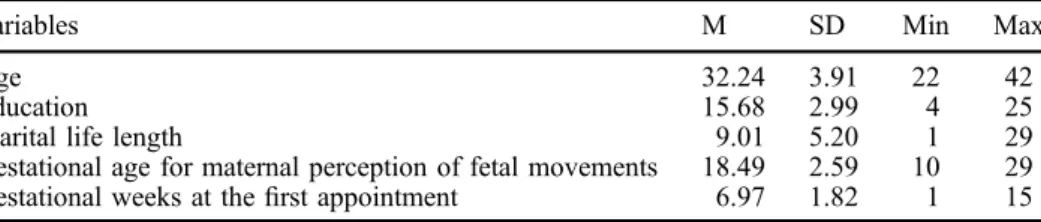
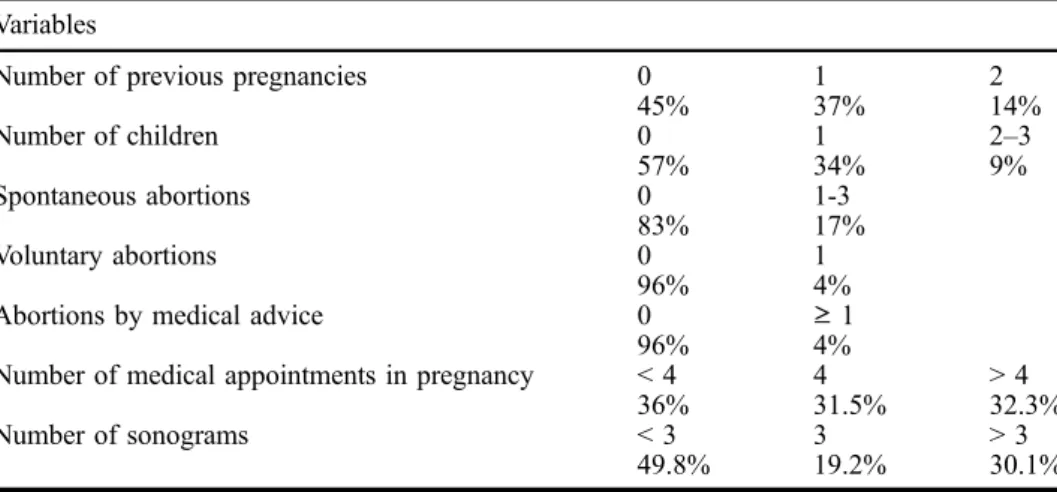
while almost all others were living with their partners (27.5%). For 93.7% of the sample, the occupational level was situated in the two first categories of Graffar’s (1956) classification system. Most of the women reported having a desired (99.5%) and planned pregnancy (82%) with no reference to either risk factors (84.1%) or traumatic events (86.8%). Almost half of the women were in their first pregnancy (43.9%), 39.2% in their second and 13.2% in their third. Most of the women had no children (56.6%), 34.4% had only one child and the remaining had two or three children. The descriptive statistics for sociodemographic and clinical data can be observed in Table1.
The percentages for some sociodemographic and clinical variables are displayed in Table2.
Comparing women interviewed at the second data collection point with women present at the first data collection point but absent afterwards, differences were very small regarding descriptive variables such as age, education, length of marital life, number of previous pregnancies, abortions and number of previous children. Never-theless, a trend was detected for women present at the second data collection point to have a higher chance of being Portuguese (93.7% vs. 81.8%; χ2 = 6.58, .01 < p < .02), being married (68.8% vs. 54.5%;χ2= 4.32, .02 < p < .05), being at thefirst rank of occupation according to Graffar (37.6% vs. 9.1%; χ2 = 22.68, p < .001), having no references to traumatic events (86.8% vs. 77.3%;χ2= 3.06, .02 < p < .05), being more positive when informed about the fetus’ gender (70.9% vs. 63.6%; χ2 = 1.22, .2 < p < .3), having a preference regarding the fetus’ gender (60.3% vs.
50%; χ2 = 2.14, .1 < p < .2) and having already chosen the name for the future baby (70.4% vs. 59.1%;χ2= 2.8, .05 < p < .1).
Results
Factorial analysis of QPP data
Results of sample adequacy to factor analysis were good (KMO = .767; Bartlett’s = 1349.349, sig. = .000) and in the anti-image analysis all items were above .5. According to the QPP theory and keeping in mind van Bussel and colleagues’ (2009a) psychometric work, we tried tofind a two-factor solution. Principal compo-nents factor analysis yielded 10 factors (eigenvalues > 1) explaining 65.33% of variance. Items’ loadings higher than .5 only allowed the first 2 factors to be con-sidered. Varimax rotation did not change this situation. Finally, factor analysis with Varimax rotation was forced to 2 factors and a bifactorial model emerged explain-ing 28.43% of the variance. Usexplain-ing .4 as the lowest eigenvalue, the QPP changes from 28 into 19 items. In a theoretical view, those two factors seem to be close to
Table 1. Descriptive statistics for sociodemographic and clinical data of the sample (n = 189).
Variables M SD Min Max
Age 32.24 3.91 22 42
Education 15.68 2.99 4 25
Marital life length 9.01 5.20 1 29
Gestational age for maternal perception of fetal movements 18.49 2.59 10 29
Gestational weeks at thefirst appointment 6.97 1.82 1 15
the original concepts of facilitator and regulator maternal orientations. Checking items’ contents against factors’ concepts, item 23 emerges as an exception once that its content is not compatible with the facilitator concept. Therefore, it was excluded for further analysis turning the QPP into a set of 18 items. The results are presented in Table3.
Table 2. Percentages for sociodemographic and clinical data of the sample (n = 189). Variables
Number of previous pregnancies 0 1 2
45% 37% 14% Number of children 0 1 2–3 57% 34% 9% Spontaneous abortions 0 1-3 83% 17% Voluntary abortions 0 1 96% 4%
Abortions by medical advice 0 ≥ 1
96% 4%
Number of medical appointments in pregnancy < 4 4 > 4
36% 31.5% 32.3%
Number of sonograms < 3 3 > 3
49.8% 19.2% 30.1%
Table 3. QPP data factorial analysis.*
Items F1Facilitator F2Regulator
22. Both the baby and I are enjoying pregnancy. .778
10. Pregnancy makes me feel special. .746
21. This pregnancy is perfect. .729
8. Pregnancy is the peak of my female experience. .664
14. In some ways I feel my baby tries to communicate with me.
.620
18. Ifind myself talking to the baby. .593
5. I have daydreams about the baby. .552
1. I feel more of a woman now that I’m pregnant. .522
25. Over the past months I have felt very unhappy without knowing why.
.658 6. I worry that my bad thoughts during pregnancy may affect
my baby.
.635 20. I feel as though there is a battle going on inside me
between what I need for myself and what the baby wants from me.
.627
19. I experience panic attacks. .626
28. I have felt anxious and don’t know why. .599
9. Strange thoughts pop into my mind about harming the baby. .570
27. During this pregnancy I have had thoughts of harming myself.
.507
26. I worry I will lose control during the labour. .500
7. I feel in touch with my emotions. -.461
4. I doubt I have enough goodness inside me for both of us. .421
*Item 23 was excluded in afirst analysis. Items 2, 3, 11, 12, 13, 15, 16, 17 and 24 were eliminated because factor loadings were not higher than .4.
484 M.E. Carvalho and J.M.M. Justo
Factor 1 is constituted by 8 items (1, 5, 8, 10, 14, 18, 21 and 22) and content analysis shows that it is close to the facilitator style according to the original model. We choose to call this factor facilitator because content analysis of the items shows an experience of pregnancy with feelings of idealisation and the baby being invested as a narcissistic object.
Factor 2 is constituted by 10 items (4, 6, 7 inverted, 9, 19, 20, 25, 26, 27 and 28) and content analysis shows that it is close to the regulator style according to the original model. We choose to call this factor regulator because content analysis of the items show an experience of pregnancy with attitudes of avoidance and the expression of emotional states such as anxiety and depression.
Internal consistency analysis
Internal consistency of the two dimensions is displayed in Table4and it is possible to see Bthat both dimensions present adequate values.
QPP factors correlate positively but not significantly (r = .119, p = .103). The Facilitator Factor presents a mean of 6.81 (SD = 3.84) and scores range from 0 to 23. The Regulator Factor presents a mean of 8.12 (SD = 3.95) and scores range from 1 to 21. The Regulator Factor correlates negatively and significantly with the number of previous pregnancies (r = –.154, p = .035). The Facilitator Factor pre-sents significant and positive correlations with age (r = .173, p = .017), education (r = .209, p = .004) and number of children (r = .240, p = .001) as well as a negative and significant correlation with the number of spontaneous abortions (r =–.154, p = .034).
Bearing in mind Raphael-Leff’s (2009) model, we conceived four hypotheses about the articulation of the two dimensions: (a) the future facilitator mother pre-sents high results in the Facilitator Factor and low in the Regulator Factor, (b) the future regulator mother presents low results in the Facilitator Factor and high in the Regulator Factor, (c) the future reciprocator mother presents low results at the same time in the Facilitator Factor and in the Regulator Factor and, finally, (d) the future conflicted mother presents high results at the same time in the Facilitator Factor and in the Regulator Factor.
Conclusion
The psychometric analysis allowed to obtain an instrument with adequate internal consistency in two subscales related with two dimensions (facilitator and regulator) of prenatal maternal orientation for motherhood. The fact that the alpha coefficients in our sample’s data are somewhat higher than those found by other authors (Roncolato et al., 2011; van Bussel et al., 2009a) should be appreciated together with the information that the Portuguese version uses more items than the Dutch or the Australian versions.
Table 4. Internal consistency for the QPP dimensions. QPP dimensions Cronbach’s alpha Inter-item medium correlation Item-total correlation range F1–Facilitator .815 .36 .417–.668 F2–Regulator .770 .26 .317–.542
According to our results, in the Portuguese population we observe that the Regulator Factor is associated with item contents linked to anxiety and to depres-sion. Moreover, the Regulator Factor presents a negative correlation with the number of previous pregnancies showing that the experience of pregnancy is quite different if it is the first one or a subsequent one. The Facilitator Factor presents characteristics linked to idealisation and fusion. Furthermore, we found positive correlations between the Facilitator Factor and age, education and number of chil-dren as well as a negative correlation with the number of spontaneous abortions. This way, women with more spontaneous abortions seem to protect themselves using defences such as idealisation and fusion as a resource to deal with the possi-ble repetition of pregnancy loss.
Because the Portuguese version of the PPQ is composed of 18 items (8 items for the Facilitator Factor and 10 items for the Regulator Factor) and the Dutch and Australian versions only use 10 items (5 per factor), comparisons should be interpreted carefully. Looking at the items’ contents, it can be observed that the Facilitator Factor of the Portuguese version uses items related to interaction with the baby and related to satisfaction with pregnancy, while versions with five items use items related mostly to satisfaction with pregnancy. About the Regulator Factor, the Portuguese version uses items related to the lack of maternal resources and possible negative consequences for the baby while versions with five items use items related to maternal feelings about the baby being perceived as a threat.
The fact that the Facilitator Factor deals with attitudes related to psychological mechanisms (idealisation and fusion) and that the Regulator Factor deals with atti-tudes linked with psychopathological aspects (anxiety and depression) will enable original research to be done in the future. This way, in the future, research with Portuguese pregnant women will be able to connect psychopathology with inner psychic organisation. Postnatal observations of parenting may be articulated with variables of pre-natal maternal orientation; if supported by data, these relationships will enable prevention and psychological intervention to start earlier in pregnancy.
Disclosure statement
No potential conflict of interest has been reported by the authors. References
Bjorn, M. B., Saul, N. J., & Morales, M. I. (2013). Estrategías de relajación durante el período de gestación. Benefícios para la salud. Clínica y Salud, 24, 77–83.
Carvalho, M. (2011). O bebé imaginário, as memórias dos cuidados parentais e as repre-sentações sonoro-musicais na gravidez no estudo da representação da vinculação materna pré-natal e da orientação para a maternidade. Doctoral Thesis in Clinical Psychology at the Lisbon University.
Graffar, M. (1956). Une méthode de classification sociale d’échantillons de population. Courrier du Centre International de l’Enfance, 6, 455–459.
International Test Commission. (2005). ITC Guidelines for Translating and Adaptating Tests. Document reference: ITC-G-TA-20140617. Retrieved from http://www.intestcom.org/ upload/sitefiles/40.pdf
Nazaré, B., Fonseca, A., & Canavarro, M. C. (2012). Grief following termination of preg-nancy for fetal abnormality: Does marital intimacy foster short-term couple congruence? Journal of Reproductive and Infant Psychology, 30, 168–179.
486 M.E. Carvalho and J.M.M. Justo
Pires de Almeida, C., Sá, E., Cunha, F., & Pires, E. (2012). Common mental disorders dur-ing pregnancy and baby’s development in the first year of life. Journal of Reproductive and Infant Psychology, 30, 341–351.
Pires de Almeida, C., Sá, E., Cunha, F., & Pires, E. (2013b). Violence during pregnancy and its effects on mother–baby relationship during pregnancy. Journal of Reproductive and Infant Psychology, 31, 370–380.
Pires de Almeida, C. P., Cunha, F. F., Pires, E. P., & Sá, E. (2013a). Common mental disorders in pregnancy in the context of interpartner violence. Journal of Psychiatric and Mental Health Nursing, 20, 419–425.
Raphael-Leff, J. (1980). Psychotherapy with pregnant women. In B. Blum (Ed.), Psychological aspects of pregnancy, birthing and bonding (pp. 174–205). New York, NY: Human Science Press.
Raphael-Leff, J. (1983). Facilitators and regulators: Two approaches to mothering. British Journal of Medical Psychology, 56, 379–390.
Raphael-Leff, J. (1985a). Facilitators and regulators: Vulnerability to postnatal disturbance. Journal of Psychosomatics Obstetrics and Gynaecology, 4, 151–168.
Raphael-Leff, J. (1985b). Facilitators and regulators; participators and renouncers: Mothers’ and fathers’ orientations toward pregnancy and parenthood. Journal of Psychosomatics Obstetrics and Gynaecology, 4, 169–184.
Raphael-Leff, J. (1986). Facilitators and regulators: Conscious and unconscious processes in pregnancy and early motherhood. British Journal of Medical Psychology, 59, 43–55. Raphael-Leff, J. (2009). Psychological processes of childbearing. London: The Anna Freud
Centre.
Roncolato, W., & McMahon, C. (2011). Facilitators and regulators: Psychometric properties of maternal orientation measures in pregnancy. Journal of Reproductive and Infant Psychology, 29, 420–438.
Roncolato, W., McMahon, C., & Grant, K.-A. (2014). Facilitators and regulators: Antenatal maternal orientation and postnatal parenting practices. Journal of Reproductive and Infant Psychology, 32, 214–229.
Scher, A., (2001). Facilitators and regulators: Maternal orientation as an antecedent of attachment security. Journal of Reproductive and Infant Psychology, 19, 325–333. Scher, A., & Blumberg, O. (1999). Night waking among 1-year olds: A study of maternal
separation anxiety. Child Health, Care and Development, 25, 323–334.
Sereno, S., Leal, I., & Maroco, J. (2013). The role of psychological adjustment in the deci-sion-making process for voluntary termination of pregnancy. Journal of Reproduction & Infertility, 14, 143–151.
van Bussel, J. C., Spitz, B., & Demyttenaere, K. (2009a). Depressive symptomatology in pregnant and postpartum women. An exploratory study of the role of maternal antenatal orientations. Archives of Women’s Mental Health, 12, 155–166.
van Bussel, J. C., Spitz, B., & Demyttenaere, K. (2009b). Anxiety in pregnant and postpartum women. An exploratory study of the role of maternal orientation. Journal of Affective Disorders, 14, 232–242.
van Bussel, J. C., Spitz, B., & Demyttenaere, K. (2010a). Reliability and validity of the Dutch version of the maternal antenatal attachment scale. Archives of Women’s Mental Health, 13, 267–277. doi:10.1007/s00737-009-0127-9
van Bussel, J. C., Spitz, B., & Demyttenaere, K. (2010b). Childbirth expectations and experiences and associations with mother’s attitudes to pregnancy, with child and motherhood. Journal of Reproductive and Infant Psychology, 28, 143–160.