Edited by
Major-General Vieira Borges
and
Lieutenant-Colonel José Carlos Dias Rouco
Military Academy, Lisbon, Portugal
Proceedings of the
17th European Conference on
Digital Government
Military Academy
Lisbon, Portugal
12-13 June 2017
The Proceedings of
17th European Conference on
Digital Government
ECDG 2017
Hosted By
Military Academy
Lisbon, Portugal
12
th
-13
th
June 2017
Edited By
MGen João Vieira Borges Lt
Col José Carlos Dias Rouco
Copyright The Authors, 2017. All Rights Reserved.
No reproduction, copy or transmission may be made without written permission from the
individual authors.
Review Process
Papers submitted to this conference have been double-blind peer reviewed before final
acceptance to the conference. Initially, abstracts were reviewed for relevance and
accessibility and successful authors were invited to submit full papers. Many thanks to the
reviewers who helped ensure the quality of all the submissions.
Ethics and Publication Malpractice Policy
ACPIL adheres to a strict ethics and publication malpractice policy for all publications –
details of which can be found here:
http://www.academic-conferences.org/policies/ethics-policy-for-publishing-in-the-conference-proceedings-of-academic-conferences-and-publishing-international-limited/
Conference Proceedings
The Conference Proceedings is a book published with an ISBN and ISSN. The proceedings
have been submitted to a number of accreditation, citation and indexing bodies including
Thomson ISI Web of Science and Elsevier Scopus.
Author affiliation details in these proceedings have been reproduced as supplied by the
authors themselves.
The Electronic version of the Conference Proceedings is available to download from
DROPBOX
http://tinyurl.com/ecdg2017
Select Download and then Direct Download to
access the Pdf file. Free download is available for conference participants for a period of 2
weeks after the conference.
The Conference Proceedings for this year and previous years can be purchased from
http://academic-bookshop.com
E-Book ISBN: 978-1-911218-37-1
E-Book ISSN: 2049-1034
Book version ISBN: 978-1-911218-38-8
Book Version ISSN: 2049-1026
Published by Academic Conferences and Publishing International Limited
Reading
UK
44-118-972-4148
Contents
Paper Title Author(s) Page
No
Preface v
Committee vi
Biographies ix
EU General Data Protection Regulation: The Impact on English Local Authorities
Deborah Adshead and Frances Slack 1 User Acceptance of M-Government Services in Saudi
Arabia: an SEM Approach
Sultan Alotaibi and Dr Dmitri Roussinov 10 eService Adoption During Geopolitical Instabilities:
Case Study of the Syrian Refugees
Abraheem Alsaeed, Carl Adams and Rich Boakes
20 Assessment of Federal Government Websites M. Irfanullah Arfeen, Syed Iftikhar H.
Shahand Javed Iqbal Chaudhary
29 Mail-Doc-Web: A Technique for Faster, Cheaper and
More Sustainable Digital Service Development
Choompol Boonmee 36 e-Health and User Experience in Spanish Public Health
Portals
Ramon Bouzas-Lorenzo, Xose Mahou-Lago, Luca Chao and Andres Cernadas
47 Accessibility of African E-Government Services for
Persons with Disabilities
Natheer Davids, Salah Kabanda and Millicent Agangiba
54 E-Government in Africa: Perceived Concerns of
Persons with Disabilities (PWDs) in South Africa
Mujahid Dollie and Salah Kabanda 63 The Role of Digital Literacy in Citizens’ Adoption of
Digital Public Services: the Portuguese Case
Ana Maria Evans and Rosário Garcia Gomes
71 The Concept of the Blockchain-Based Governing:
Current Issues and General Vision
Oleksii Konashevych 79 Culture, Motivation and Advocacy: Relevance of
Psycho Social Aspects in Public Data Disclosure
Francesco Molinari and Grazia Concilio 86 Communication with Citizens in the First EU Citizen
Observatories Experiences
Filipe Montargiland Vitor Santos 96 Regulating E-government in Denmark Hanne Marie Motzfeldt and Ayo
Næsborg-Andersen
104 Cybersecurity Challenges to American Local
Governments
Donald F. Norris, Laura Mateczun, Anupam Joshi and Timothy Finin
110 Building Foundations before Technology: An
Operation Model for Digital Citizen Engagement in Resource Constrained Contexts
Caroline Pade-Khene, Hannah Thinyane and Mwazvita Machiri
118
Implementation of e-Invoicing Principles in Estonian Local Governments
Ingrid Pappel, Ingmar Pappel, Terje Tampereand Dirk Draheim
127 Overcoming T-Government Challenges: Lessons from
Danish Library
Keld Pedersen and Gitte Tjørnehøj 136 Categorisation of Digital Government Services
Informed by User Research
Marco Pretorius 145
Paper Title Author(s) Page No
Towards an Open Government Data Success Model: A Case Study from Indonesia
Arie Purwanto, Marijn Janssen and Anneke Zuiderwijk
154 Social Inclusion, E-Exclusion and Re-Directing Digital
Development Policies
Andres Cernadas Ramos, Xose Mahou-Lago and Ramon Bouzas-Lorenzo
163 Implementation of e-Government in the Slovak
Republic at the Level of Local Self-Government
170 Modernization of Greek Public Sector: Results from
eGovernment Law Application and Next Steps
Demetrios Sarantis 179 Developing IT Systems in a d-Government Era:
Contemporary South Africa
Shawren Singh 188 Information and Telecommunication Aspect of
Russian Regions Development
Viacheslav Sirotin and Marina Arkhipova 197 Community ‘Broadband Islands’ for Digital
Government Access in Rural South Africa
Alfredo Terzoli, Ingrid Siebörger and Sibukele Gumbo
204 Role of ICTs in Safeguarding Migrant Workers Hannah Thinyane 212 Investigating an Architectural Framework for Small
Data Platforms
Mamello Thinyane 220 Communicative Ecologies and Mobile Phones: Forging
a Way to Increased Citizen Engagement
Hannah Thinyane, Ingrid Siebörger, Caroline Khene and Hafeni Mthoko
228 Log File Analytics for Gaining Insight into Actual Use
of Open Data
Bastiaan van Loenen, Jolien Ubacht, Wouter Labotsand Anneke Zuiderwijk
238 A Phenomenological Study of how Caribbean Youth
use ICTs to Engage Democracy
Lloyd G. Waller 247 Impact of Globalization on Interoperability in Digital
Government
Nawaporn Wisitpongphan and Tawa Khampachua
254 Reasons for low Participation in German Participatory
Budgeting: A Public Administration Perspective
Robert Zepic, Marcus Dappand Helmut Krcmar
262 E-government in Israel – Transformation into the
Post-Truth Era
Joseph Zernik 270
Phd Research Papers 281
Comparison and Evaluation of International e-government Benchmarking Studies
Mustafa Afyonluoglu and Ali Ziya Alkar 283 Developing a Digital Government Framework for
Sub-Saharan Africa
Ebenezer Agbozo 294 Understanding the Current Situation of
E-Government in Saudi Arabia: A Model for Implementation and Sustainability
Majed Alfayad and Edward Abbott-Halpin
306
A New Model for E-Government in Local Level Administrations in Libya
Yousef Bashir Forti and Martin George Wynn
315 Success Factors for Public Sector Information System
Projects: Qualitative Literature Review
Iwona Kolasa 326
Paper Title Author(s) Page No
Non Academic Paper 337
REST and BPEL for E-Government Shared Services Avinash Ramtohul and Bukola Ogunleye 339
Work In Progress Papers 349
A Methodology to Explore Key Factors and Barriers Affecting the Adoption of ICTs in E-Government
Joshep Stevens Borja Acosta and Jenny Marcela Sánchez Torres
351 E-government Policies in Health Care: The Social Cost
of Digitalization
Jorge Prado Casal and Andres Cernadas Ramos
356
Communication with Citizens in the First EU Citizen Observatories
Experiences
Filipe Montargil
1and Vitor Santos
21
ESCS (School of Communication and Media Studies) and ICML (Lisbon Institute of
Communication and Media Studies), Lisbon, Portugal
2
NOVA IMS (NOVA Information Management School) and MagIC (NOVA IMS Research and
Development Center), Lisbon, Portugal
[email protected]
[email protected]
Abstract: This paper presents the emerging concept and reality of Citizen Observatories (COs). We offer a brief overview of its
opportunities and its areas of application and discuss some central elements of the first generation of Citizen Observatories pilot projects’ funded by the European Union, between 2012 and 2016, in what regards communication with citizens. The concept of CO implies, according to the existing definitions, an open and shared information system dedicated to the collection of data on the environment and natural resources, using ICT, and the volunteer participation of individuals in data collection. The EU has adopted a more specific concept of CO in the projects funded, so that the resulting information complements existing earth observation systems (including the European Copernicus satellite program). In the 2012 In the 2012—2016 period five CO projects have been funded by the EU, covering different areas: natural waters monitoring, odour monitoring, air quality monitoring, flood risk management and a platform for citizen science surveys. These COs allowed to develop and test the concept’s implementation. According to our analysis, we can identify different communication strategies with citizens, in these projects, ranging from all-inclusive strategies (using websites, Android and IOS apps, both to collect and disseminate information) to more focused communication strategies. Besides this, awareness is also a critical issue for COs, since they need to attract a relevant number of citizens in order to justify their existence and to thrive. Most projects make extensive use of social networking sites (SNS), including Facebook, Twitter, YouTube, LinkedIn, Google+ and Slideshare. Despite this use, however, it cannot yet be considered that COs reach a vast number of citizens. Rather, the number of citizens involved was very limited, in the first generation of pilot projects. But societal challenges may assume a more relevant role in the following stages, with the projects that will be developed between 2016 and 2020.
Keywords: Citizen Observatories, Crowdsensing, Volunteered Geographic information (VGI)
1. Introduction
The concept of Citizen Observatories (COs) is emerging, and started to assume public relevance mainly since the 2010s. COs represent an opportunity to use ICT (mostly through mobile sensors and smartphones) in the creation of a relation between public authorities and citizens able to produce valuable return for the latter. It also represents an opportunity for public authorities to perform some duties and obligations in a more efficient way. In the 2012—2016 period, the European Union funded five pilot projects, covering different areas: natural waters monitoring, odour monitoring, air quality monitoring, flood risk management and a platform for citizen science surveys.
We proceed in this paper to a presentation of the concept and of its implementation, in these first EU projects. In the first section we present and discuss the concept. In the second we discuss the concept’s justification and relevance, from an institutional perspective (EU, national and local authorities). In the following section we offer a brief overview of its opportunities and areas of application, for citizens. In the fourth we summarize and discuss some central elements regarding the EU pilot projects’ communication with citizens and in the final section we present the conclusions.
2. The emerging concept of Citizen Observatories
The concept of citizen-enabled observatories of the environment and of natural resources through the use of information and communication technologies (ICT), usually referred to as Citizen Observatories (COs), gathered the conditions to emerge mainly with the development of Community-Based Environmental Monitoring (CBM) (MSH and UNICEF 1998, McKenzie et al. 2000, Bliss et al. 2001, Conners et al. 2001) and, later, with Volunteered Geographic Information (VGI), allowing private individuals to participate directly in the collection of geographic information, using equipment and sensors, as opposed to a task carried exclusively by public agencies (Goodchild 2007, Craglia 2007).
Filipe Montargil and Vitor Santos
According to the main definitions of Citizen Observatories proposed until now, two central features stand out (Montargil and Santos 2017): i) an open and shared information system dedicated to the collection of data on the environment and on natural resources, using ICT; ii) the volunteer participation and involvement of individuals in data collection.
The European Union (EU) closely follows the possibilities of COs and has started to fund pilot projects in 2012. EU adopts in these projects a more specific concept of COs (European Commission 2015: 63), directly related to earth observation systems (the Copernicus satellite program, in the European case).
Earth observation systems use satellites for the observation of variables related to earth, such as land surface, biosphere, atmosphere or oceans, usually in a long-term perspective. This can be done, for instance, to monitor the evolution of human use of land or to understand key components of the climate system and their interactions. Besides information gathered through satellites, these systems can also use and integrate in situ information, such as ground-based, air-borne and ship or buoy-based observations and measurements. In situ data are essential in earth observation systems, being integrated into forecasting models, providing for the calibration and validation of space-based information and contributing to fill gaps in information from satellites.
In the concept adopted by the EU a citizen observatory is a subsystem that uses devices (mostly smartphones) operated by citizens to gather information used as in situ input from an earth observation system. A citizen observatory, according to this concept, must therefore rely on information gathered by citizens, essentially through what we can call a mobile crowdsensing strategy (Ganti et al. 2011, Angelopoulos et al. 2015), but it is also intended that this data “should complement those from existing systems (e.g. the Copernicus Land Service) and surveys, including national surveys”. For this reason, COs funded by the EU are required to cooperate with the global repository of information from earth information systems, the Global Earth Observation System of Systems (GEOSS), and “data should be made available through the GEOSS without any restriction” (European Commission 2014: 3).
3. Justification and relevance of the concept
Data gathered through earth observatories can be used for several purposes. The European project Copernicus (based on a partnership between the European Union, ESA and the Member States), for instance, addresses six main thematic areas: land monitoring, marine environmental monitoring, atmosphere monitoring, emergency management and security and climate change.
This information is publicly available, being potentially useful for national governments, regional or local authorities, private companies and individual citizens, in monitoring activities and supporting decision-making processes. In the Copernicus project, for instance, it is stated that “considered as ‘public goods’, a full and open access to these services will be organised. Data from the Sentinels [satellites] will be free of charge to users” (Copernicus 2017).
National governments and regional and local authorities have, therefore, the opportunity to use free information from earth observation systems, integrating it into their regular and already established routines and systems, according to their legal duties and powers.
One of the critical issues regarding earth observatories is, naturally, financing the initial and ongoing operating costs. Copernicus cost between 1998 and 2020 is estimated at 6.7 billion euros. A part of this cost relates to the in situ information. Creating and maintaining a network of ground stations covering all the extension of the European territory, for instance, is logistically demanding and expensive.
A citizen-enabled earth observatory represents an opportunity to lower these costs – or to attain a wider reach, maintaining the costs. If a relevant number of citizens are mobilized to gather and share information with an earth observation system, through forms and practical and affordable sensors, connected through devices they use in their daily life (mostly smartphones), we can benefit from a reliable network with lowered costs:
“it is clear that Citizens' Observatories have a very positive cost-benefit ratio. While in-situ networks are very costly to setup and maintain, citizens can now provide a far denser network of local, up-to-date and
Filipe Montargil and Vitor Santos
near-real time observations using their personal devices. These data can be automatically uploaded into data repositories on the Internet, facilitating its analysis and comparison with official data.” (idem: 15).
On the other side, a citizen-enabled earth observatory also represents the opportunity to ensure that the information shared by the observatory is effectively used by citizens and useful, in their lives.
One of the key issues about citizen observatories is mass participation. For a specific sensor or a specific type of variables, if the goal is to establish a reliable network with good territorial coverage (with high granularity), we are probably considering a dimension of thousands of users, for each country. Considering several types of variables and sensors, at the European level, probably a network of tens or even hundreds of thousands of participants may be required.
Since participation in citizen observatories is naturally voluntary, depending on the citizens’ decision and willingness to gather and share information, citizen-enabled earth observatories become an interesting societal and political challenge. User engagement and effective communication with the public becomes, in this context, a central part of the challenge and a key issue to its success. Although there are many technical issues to tackle in the development of COs, users needs and expectations must be a central component, from an early stage. COs probably cannot afford to be, for this reason, exclusively a technology-push innovation process. Since citizen participation is central for their survival and growth, COs must also have a strong market-pull innovation component.
4. Opportunities and areas of application
It is argued here that citizen observatories are also an opportunity for government informatisation. Applications and services offered by the public administration, using this concept, can give citizens valuable information, going beyond bureaucratic incremental innovation. As many authors argue, information and communication technologies are often used in government and public administration services with no significant return for citizens, or strengthening the role of state bureaucracies and helping public authorities fulfilling its extractive function – and not so much a distributive function (Bekkers and Homburg 2007, Yang and Rho 2007, Montargil 2010, Paulin 2015 and Anthopoulos et al. 2016, to mention a few).
Taking advantage of a large European infrastructure, citizens’ observatories have the opportunity to become a source of useful information and services for the citizens, contributing at the same time to fulfill the public administration goals and objectives.
One area of application (air quality) is presented here, using the social personas approach, to illustrate how COs can be meaningful for citizens. This approach contributes to shorten empathy gaps (Van Boven, Dunning and Loewenstein 2000; Van Boven and Loewenstein 2005) and better understand user motivations and behaviors. These scenarios intend to give examples of the concept’s application and must, therefore, be understood as illustrative – not as an exhaustive description of areas of application.
We have, therefore, sketched a persona, aiming to illustrate one of the possible areas of application for the concept of Citizen Observatories – Alessandra. Alessandra is an Italian citizen, 52, living in Milan and traveling frequently, due to professional and familiar reasons. Alessandra suffers from pollen allergies, occasionally breathing difficulties and asthma. She made a small investment and bought a sensor that measures air quality. This compact and mobile sensor is connected to her smartphone and measures air quality on a regular basis. Using her smartphone’s Internet connection, Alessandra shared publicly the sensor’s information and enrolled in a citizens’ observatory dedicated to air quality and pollution monitoring. Besides sensor information (objective measurements), Alessandra also shares regularly with the citizens’ observatory her own evaluation of air quality and its impact on her allergies and breathing condition (subjective evaluations).
Alessandra has, through the citizen’s observatory mobile application, access to the history of her own measurements and to information from other users (in Milan and in other cities where she is travelling to), including objective and subjective measurements. She also receives risk assessments, alerts and other meaningful content according to her preferences, through the mobile app – and e-mail, when the information is considered as very relevant. Simultaneously, this in situ information is articulated with satellite information, in order to refine algorithms and analysis based on satellite imagery.
Filipe Montargil and Vitor Santos
This persona illustrates a simple scenario, based on air quality monitoring. But we can consider many different scenarios, focusing on water quality or soil quality variables, involving actors such as interested citizens, amateurs, activists or professional users (either in the private or public sector). We can also consider other areas, such as land monitoring activities or security management, for instance. But this example gives a useful reference, to understand how citizens’ observatories can be meaningful for citizens.
COs are not just an opportunity to develop useful services for citizens, however. They can also contribute to the duties of public authorities. These authorities have legal obligations, for instance in natural resources monitoring (such as air or water quality) that can be performed in a more efficient (and cheaper) way through COs.
5. Communication with citizens
In the 2012—2016 period, the European Commission funded a total of 5 projects: Citclops (water monitoring), OMNISCIENTIS (odour monitoring), WeSenseIt (flood monitoring), CITI-SENSE (air quality monitoring) and COBWEB (a platform for citizen science surveys).
These COs established a relationship with citizens not only with different areas of focus, but also with some differences in communication strategies. In Table 1 we present a summary on the way these projects involve objective and subjective evaluation of variables and how they deal with information collection and dissemination. All COs imply, therefore, the observation of objective variables by citizens (with the exception of OMNISCIENTIS, dedicated to odour nuisance, where objective measurements are managed centrally). Also, all COs dedicated to monitoring activities (Citclops, OMNISCIENTIS and CITI-SENSE) involve subjective evaluations by users.
A difference between all-inclusive communication strategies and more focused communication strategies can be considered, in this analysis. On one side, WeSenseIt adopts a rather specialized and focused strategy, heavily based on mobile apps, since no CO information is collected or shared through the website: the only way to collect and disseminate information is through a mobile app (Android). On the other side of this continuum, we can identify CITI-SENSE, with a rather all-inclusive strategy, using the website, Android and IOS apps, both to collect and disseminate information. OMNISCIENTIS communication seems at first sight closer to an all-inclusive strategy, allowing to use both the website and a mobile app to collect and to share information, but some relevant limitations arise in its implementation: (i) citizens do not participate in objective evaluation (likely due to the focus on odour monitoring, technically a challenging area); (ii) non-registered users have no access to information (and it was not possible for the authors to register, either through the website or the Android app); (iii) it seems like registered users only have access to their own history of observations and (iv) there is no IOS app available (therefore covering a smaller percentage of potential users). Regarding Citclops, it only allows collection of information through the mobile apps and only disseminates through the website (in what we could call a transmedia strategy).
One interesting issue consists in the fact that mobile apps seem more relevant to collect than to disseminate information, in Citclops and OMNISCIENTIS. Citclops uses Android and IOS apps to gather information, but dissemination only occurs through the website. In OMNISCIENTIS it is possible to participate in information collection using the Android app, but dissemination is limited to registered users – that seem to have access only to their own subjective observations (and registration seems closed, for citizens not involved in the pilot case studies).
If we consider the collection of information as an extractive function that the CO performs in its community of users and dissemination of information as a distributive function, it seems reasonable to say that these projects adopt a communication strategy for their mobile apps more focused in the extractive function that in the distributive function.
Filipe Montargil and Vitor Santos
Table 1: Objective and subjective evaluation, collection and dissemination of information in European COs, 2012—
2016
Filipe Montargil and Vitor Santos
Although this can happen due to technical and implementation limitations (these COs intend mainly to demonstrate the concept, and they are still in an early stage of development), it can represent an unbalanced participation/return ratio for CO users, between how they value their participation (time spent learning about the CO, looking for the app, installing it, figuring out how it works and starting to use it) and their return (such as access to valuable and relevant information, participating in a community or fulfilling a duty as citizen, for instance), affecting their willingness to use the COs mobile app.
This can turn out to be a relevant issue since one of the hypotheses to consider is that the distributive function relates positively with the perceived return users get from participating in a CO – or, to put it another way, it can be one of the relevant variables to explain citizen engagement in COs. Making sure citizens get the maximum possible return through the channels they use in their relation with COs can be, therefore, a critical success factor. Citizen Observatories face, obviously, relevant technical challenges. But they also face relevant societal challenges. Engaging and involving citizens, making them participate in activities and making sure these citizens receive in return valuable information is a clear societal challenge for COs, since they need to attract a relevant number of citizens in order to justify their existence and to thrive.
Awareness is, therefore, a critical issue for COs. One of the ways to reach citizens is through the use of social networking sites (SNS). The analysed COs clearly value this communication dimension: all projects, with the exception of OMNISCIENTIS, used SNS to communicate with users and potential users.
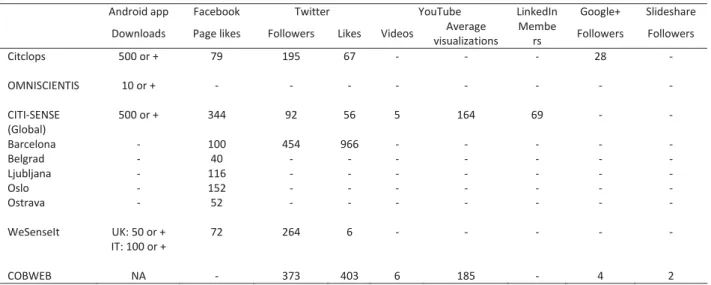
Table 2 presents a summary of some basic public metrics on engagement and citizen involvement.
Table 2: Android app downloads and SNS usage by European COs, 2012—2016
Android app Facebook Twitter YouTube LinkedIn Google+ Slideshare Downloads Page likes Followers Likes Videos Average
visualizations Membe rs Followers Followers Citclops 500 or + 79 195 67 - - - 28 - OMNISCIENTIS 10 or + - - - - CITI-SENSE (Global) 500 or + 344 92 56 5 164 69 - - Barcelona - 100 454 966 - - - - - Belgrad - 40 - - - - Ljubljana - 116 - - - - Oslo - 152 - - - - Ostrava - 52 - - - - WeSenseIt UK: 50 or + IT: 100 or + 72 264 6 - - - - - COBWEB NA - 373 403 6 185 - 4 2
Values as of July 30, 2016. No publicly available information on IOS apps number of downloads was found. NA: not applicable (download exclusively through website).
The metrics presented in Table 2 are rather limited, in terms of interpretation (for instance, Facebook page likes are not necessarily a good variable to analyse engagement), but they are publicly available and give a general idea of these projects’ ability to engage users and effectively communicate with the public.
The first generation of European COs used several SNS, including Facebook, LinkedIn, Twitter, YouTube, Google+ and Slideshare. CITI-SENSE can be considered as the most relevant example of SNS use: not only the project used Facebook, LinkedIn, Twitter and a YouTube channel, but several of the city-based projects developed their own SNS resources: Barcelona (Facebook and Twitter) and Belgrad, Ljubliana, Oslo and Ostrava (Facebook). It is interesting to note that CITI-SENSE, the CO closer to an all-inclusive strategy in the usage of website and mobile apps to collect and disseminate information (meaning it uses the website and mobile apps both to collect and to disseminate information) is also the project with a more significant use of SNS. Several factors can account for this, which will not be discussed here. OMNISCIENTIS, on the other hand, did not use SNS, according to the available sources.
Although 4 of the 5 projects made extensive use of SNS, it cannot yet be considered that COs reach a vast number of citizens. The Android app downloads varied between the ‘10 or +’ and the ‘500 or +’ categories, showing
Filipe Montargil and Vitor Santos
significant differences in app downloads (although these numbers do not include IOS app users and Android app users that did not use Google Play – receiving the app directly from the project team, for instance). The project with the larger number of Facebook page likes reached 344 likes (CITI-SENSE). Citclops and WeSenseIt reached, respectively, 79 and 72 page likes. Regarding Twitter, CITI-SENSE Barcelona stands out from the rest of the cases, attaining 454 followers and 966 page likes. In the case of YouTube channels, CITI-SENSE reaches an average number of 164 visualizations for each video and COBWEB an average of 185 visualizations.
We propose to consider three dimensions, when discussing the drivers for reach and citizen engagement in CO projects. A first dimension to consider is the return the project offers to its potential users. An air quality monitoring CO, for instance, will probably offer a more relevant return to a citizen suffering from allergies, asthma or other breathing problems. This concept of “return” is naturally multi-dimensional and can involve several subdimensions. A second dimension possibly affecting reach and citizen engagement is the relevance of barriers to engagement. A more difficult, lengthy or less friendly process to install and use the required apps will probably reduce the number of people available to participate and engage. Essentially, this dimension relates to usability. The third dimension we can consider is the public awareness of the project. Awareness is considered here as the percentage of potential users that get to know, somehow, that the project exists. Keeping all other variables constant, we assume that the larger the number of potential users who are aware of a CO, the larger the final number of people involved will be. The relevance of these dimensions is not, however, further developed here.
6. Conclusions
The goals of this paper consist mainly in presenting the emerging concept of citizen observatories (CO), explore the way the first generation of European funded experiences, held between 2012 and 2016, established communication with citizens and understand the opportunities this concept represents for public authorities to go beyond incremental bureaucratic innovation.
As we have seen, the concept of CO implies, according to the existing definitions, an open and shared information system dedicated to the collection of data on the environment and natural resources, using ICT, and the volunteer participation of individuals in data collection. The EU has adopted a more specific concept of CO in the projects funded, so that their information complement existing earth observation systems (including the European Copernicus satellite program).
In the 2012—2016 period five CO projects have been funded by the EU, covering different areas: natural waters monitoring, odour monitoring, air quality monitoring, flood risk management and a platform for citizen science surveys. These COs allowed to develop and test the concept’s implementation, although the societal impact is still very limited. These projects have, however, established a valuable set of resources, knowledge and expertise. It is clear that COs are an opportunity to offer citizens meaningful information, in their day to day life, taking also advantage of the European investment in the Copernicus program and its freely available information. This is an emerging field with interesting perspectives and possibilities. Although there is an economic rationale behind it (lowering the cost of in situ observation networks), it encloses the possibility of using ICT in the creation of a relation between public authorities and citizens that can produce valuable return for citizens. This represents many opportunities for public administrations (at national, regional or local level) or other stakeholders (such as private companies, NGOs or associations, for instance), to offer relevant services to citizens, going beyond a simple bureaucratic relation. This must be done taking into consideration a balance between authorities' fears and citizens’ expectations, as well as the cultural and social specificities in each context (Rubio-Iglesias 2014: 22). Although almost all of the EU pilot projects made extensive use of SNS it cannot yet be considered that COs reach a relevant number of citizens. The number of citizens involved is still very limited, with some of the projects engaging only a few dozen people, through SNS.
Considering these are multi-annual projects with large consortiums and multi-million budgets, aiming to demonstrate the concept and contributing to its dissemination, these numbers still show a very limited impact. One possible reason for this might be that these first generation projects were still very concerned with technical challenges. But societal challenges will probably assume a more relevant role in the following stages.
Filipe Montargil and Vitor Santos
The next generation of COs to be developed between 2016 and 2020 with European funding represents an opportunity to tackle these issues. These new COs will represent a total investment of around 20 million euros, and have already been announced (Lambert 2016: 9): GROW, coordinated by the University of Dundee (UK); LANDSENSE, coordinated by IIASA, the International Institute for Applied Systems Analysis (Austria); SCENT, coordinated by ICCS/NTUA, the Institute of Communications and Computer Systems of the National Technical University of Athens (Greece) and Ground Truth 2.0, coordinated by UNESCO-IHE Institute for Water Education (Netherlands).
References
Angelopoulos, Constantinos Marios, Sotiris Nikoletseas, Theofanis P. Raptis and José Rolim (2015). “Design and evaluation of characteristic incentive mechanisms in Mobile Crowdsensing Systems”, Simulation Modelling Practice and Theory, 55 (2015): 95–106.
Anthopoulos, Leonidas, Christopher G. Reddick, Irene Giannakidou and Nikolaos Mavridis (2016). “Why e-government projects fail? An analysis of the Healthcare.gov website”, Government Information Quarterly, 33: 161–173.
Bartonova, Alena (2016). Development of a community-based air quality monitoring system: the CITI-SENSE project experience. Bekkers, Victor and Vincent Homburg (2007). “The Myths of EGovernment: Looking Beyond the Assumptions of a New and
Better Government”, The Information Society, 23(5): 373–382.
Bliss, John, Greg Aplet, Cate Hartzell, Peggy Harwood, Paul Jahnige, David Kittredge, Stephan Lewandowski and Mary Lou Soscia (2001). “Community-based ecosystem monitoring”, Journal of Sustainable Forestry, 12: 143–167.
Conners, Deanna E., Susan Eggert, Jennifer Keyes and Michael Merrill (2001). “Community-based water quality monitoring by the Upper Oconee Watershed Network”, in K. J. Hatcher (Ed.), Proceedings of the 2001 Georgia Water Resources Conference (pp. 706–709). Georgia: Athens.
Copernicus (2017). FAQs, http://www.copernicus.eu/main/faqs, (Retrieved February 22nd, 2017).
Craglia, Max (2007). “Volunteered Geographic Information and Spatial Data Infrastructures: when do parallel lines converge?”, Specialist Meeting on Volunteered Geographic Information. 13-14 December, Santa Barbara (CA).
European Commission (2014). Citizens’ Observatories: Empowering European Society Conference Report Version 1.0, http://citizen-obs.eu/Portals/25/Downloads/Citizens%20Observatories%20Conference%20Reportv1%200.pdf (Retrieved August 25th, 2016).
European Commission (2015). HORIZON 2020 Work Programme 2014 – 2015. 12. Climate action, environment, resource efficiency and raw materials – Revised (European Commission Decision C (2015)2453 of 17 April 2015).
Ganti, Raghu K., Fan Ye and Hui Lei (2011). “Mobile crowdsensing: Current state and future challenges”, IEEE Communications Magazine, vol. 49, no. 11, Nov.: 32–39.
Goodchild, Michael F. (2007): “Citizens as sensors: Web 2.0 and the volunteering of geographic information”, GeoFocus (Editorial), 7: 8-10.
Lambert, Patrick (2016). “EASME, Horizon 2020 and GEO”, 10th GEO European Projects Workshop, 31 May – 2 June 2016, Berlin, https://ec.europa.eu/easme/sites/easme-site/files/gepw_plenary_easme_lambert.pdf (Retrieved August 25th, 2016).
McKenzie, L. J., W. J. Lee Long, R. G. Coles and C. A. Roder (2000). “Seagrass-Watch: Community-based monitoring of seagrass resources”, Biologia Marina Mediterranea, 7(2): 393-396.
Montargil, Filipe and Vitor Santos (2017). “Citizen Observatories: concept, opportunities and communication with citizens in the first EU experiences”, in Alois A. Paulin, Leonidas G. Anthopoulos and Christopher G. Reddick, Beyond Bureaucracy – Towards Sustainable Governance Informatisation. Cham (CH): Springer, p. 167-184.
Montargil, Filipe (2010). “Electronic government and government transformation: technical interactivity, political influence and citizen return”, in Paul Nixon and Vassiliki Koutrakou (Org.), E-Government in Europe: Issues and Challenges. London: Routledge, pp. 61-77.
MSH and UNICEF (1998). “Community-Based Monitoring”, The Guide to Managing for Quality, http://erc.msh.org/quality/pstools/psmoncv.cfm (Retrieved August 25th, 2016).
Paulin, Alois (2015). “Twenty Years After the Hype: Is E-Government Doomed? Findings from Slovenia”, International Journal of Public Administration in the Digital Age 2 (2): 1–21.
Rubio-Iglesias, José Miguel (2014). “Citizens' Observatories - Five approaches to empower European citizens”, Copenhagen, 12th March 2014.
Van Boven, Leaf, David Dunning and George Loewenstein (2000). “Egocentric empathy gaps between owners and buyers: Misperceptions of the endowment effect”, Journal of Personality and Social Psychology, 79: 66–76.
Van Boven, Leaf and George Loewenstein (2005). “Cross-situational projection”, in M. D. Alike, D. Dunning, and J. Krueger (Eds.), The Self in Social Judgment, New York: Psychology Press, pp. 43–64.
Yang, Kaifeng and Seung-Yong Rho (2007). “E-Government for Better Performance: Promises, Realities, and Challenges”, International Journal of Public Administration, 30:11: 1197-1217.