(Annals of the Brazilian Academy of Sciences) ISSN 0001-3765
www.scielo.br/aabc
COL18A1
is highly expressed during human adipocyte differentiation
and the SNP c.1136C
>
T in its “frizzled” motif is associated with
obesity in diabetes type 2 patients
FLAVIA I.V. ERRERA1,2, LUÍS H. CANANI3, ERIKA YEH1, ÉRIKA KAGUE1, LUCIA M. ARMELIN-CORRÊA1, OSCAR T. SUZUKI1, BALDUÍNO TSCHIEDEL5, MARIA ELIZABETH R. SILVA4, ANDRÉA L. SERTIÉ1 and MARIA RITA PASSOS-BUENO1 1Centro de Estudos do Genoma Humano, Departamento de Genética e Biologia Evolutiva, Instituto de Biociências,
Universidade de São Paulo, Rua do Matão 277, 05509-900 São Paulo, SP, Brasil 2Faculdade de Medicina, Escola Superior de Ciências da Santa Casa de Vitória (EMESCAM),
Av. Nossa Senhora da Penha, 2190, 29045-102 Vitória, ES, Brasil
3Departamento de Endocrinologia, Hospital de Clínicas de Porto Alegre, Universidade Federal do Rio Grande do Sul Rua Ramiro Barcellos, 2350, 90035-903 Porto Alegre, RS, Brasil
4Laboratório de Investigação Médica, LIM-18, Hospital das Clínicas da Universidade de São Paulo Faculdade de Medicina, Av. Dr. Arnaldo, 455, 01246-903 São Paulo, SP, Brasil
5Sessão de Endocrinologia, Hospital Conceição, Av. Francisco Trein, 596, 90013-901 Porto Alegre, RS, Brasil
Manuscript received on October 3, 2007; accepted for publication on January 21, 2008; presented byROGÉRIOMENEGHINI
ABSTRACT
Collagen XVIII can generate two fragments, NC11-728 containing a frizzled motif which possibly acts in Wnt sig-naling and Endostatin, which is cleaved from the NC1 and is a potent inhibitor of angiogenesis. Collagen XVIII and Wnt signaling have recently been associated with adipogenic differentiation and obesity in some animal models, but not in humans. In the present report, we have shown thatCOL18A1expression increases during human adipogenic dif-ferentiation. We also tested if polymorphisms in the Frizzled (c.1136C>T; Thr379Met) and Endostatin (c.4349G>A; Asp1437Asn) regions contribute towards susceptibility to obesity in patients with type 2 diabetes (113 obese, BMI ≥30; 232 non-obese, BMI<30) of European ancestry. No evidence of association was observed between the allele c.4349G>A and obesity, but we observed a significantly higher frequency of homozygotes c.1136TT in obese (19.5%) than in non-obese individuals (10.9%) [P=0.02; OR=2.0 (95%CI: 1.07-3.73)], suggesting that the allele c.1136T is associated to obesity in a recessive model. This genotype, after controlling for cholesterol, LDL cholesterol, and triglycerides, was independently associated with obesity (P=0.048), and increases the chance of obesity in 2.8 times. Therefore, our data suggest the involvement of collagen XVIII in human adipogenesis and susceptibility to obesity. Key words:COL18A1, obesity, adipogenesis, endostatin, frizzled.
INTRODUCTION
COL18A1, located at chromosome 21q22.3, was first shown to have an important role in humans when we demonstrated that homozygous null mutations in this gene cause Knobloch syndrome (KS) (Sertié et al. 2000).
Correspondence to: Maria Rita Passos Bueno E-mail: [email protected]
KS is an autosomal recessive condition characterized by vitreo and retinal degeneration, macular abnormal-ities and occipital encephalocele (KS; OMIM 267750). The importance of collagen XVIII in retinal angiogen-esis was further confirmed through the observation of ocular delayed hyaloid vessel regression in knockout col18a-/- mice (Fukai et al. 2002).
most basement membranes of the body which belongs to a distinct class of nonfibrillar collagens, called mul-tiplexins. This protein forms homotrimers and contains a N-terminal non-collagenous domain (NC-11), 10 col-lagenous repeats alternated with 9 non-colcol-lagenous re-peats and a C-terminal non-collagenous region, NC-1 (Oh et al. 1994, Saarela et al. 1998). COL18A1can be transcribed as 3 distinct isoforms by use of two promoters and an alternative splicing of the third exon. The three encoded collagen XVIII proteins differ only by their sig-nal peptides and by part of the N-termisig-nal region of the NC11 domain, which contain respectively 303 (NC11-303), 493 (NC11-493) and 728 (NC11-728) amino acid residues (Saarela et al. 1998, Elamaa et al. 2003). Colla-gen XVIII presents high expression levels in liver, kidney, retina and adipose tissue and the predominant isoform varies according to the tissue type (Saarela et al. 1998, Suzuki et al. 2002, Elamaa et al. 2003, NCBI UniGene Hs.517356).
At least two functional fragments can be released from collagen XVIII: Endostatin, a 20 kDa fragment cleaved from the NC1 region- common to the three col-lagen XVIII isoforms (ES-C18) (O’Reilly et al. 1997, John et al. 2005) and the N-terminal Frizzled cysteine-rich domain cleaved from the NC11-728 variant (Friz-zled-C18) (Elamaa et al. 2003). ES-C18 is a potent in-hibitor of endothelial cell proliferation and migration with the ability to reduce tumor growth (O’Reilly et al. 1997, Sasaki et al. 1998). Collagen XVIII and ES-C18 play several other functions, including apoptosis induction (Dhanabal et al. 1999, Schmidt et al. 2004) and maintenance of vascular permeability (Moulton et al. 2004). The Frizzled-C18 motif shows homology to secreted frizzled related proteins (sFRP). These proteins can block Wnt signaling either by interacting with Wnts to prevent them from binding to frizzled receptors or forming nonfunctional complexes with them (Wodarz and Nusse 1998). The function of the soluble Frizzled-C18 motif is still unknown, but it is possibly involved in Wnt signaling as sFRPs does (Elaama et al. 2003, Quelard et al. 2006).
Although the molecular mechanisms regulated by collagen XVIII and its NC11 and NC1 functional frag-ments are still being investigated, it is unquestionable the functional role of collagen XVIII in angiogenesis.
There-fore, variability in quantity or quality of collagen XVIII and its related fragments could be associated with the predisposition of human disorders dependent on angio-genesis (Passos-Bueno et al. 2006). Substantial evidence has established that growth of solid tumors is angiogen-esis dependent whereas angiogenangiogen-esis inhibition prevents it and can lead to regression of the lesions (Udagawa et al. 2002, Folkman 2002). Although we and others were not able to confirm the association between the SNP Asp 1437 Asn (D104N) at the endostatin region and prostate cancer (Iughetti et al. 2001, Macpherson et al. 2004, Passos-Bueno et al. 2006), several reports have shown that lower ES-C18 levels have been correlated with a worse tumor prognosis (Musso et al. 2001) and that the SNP D104N might be associated with breast cancer (Lourenço et al. 2006, Balasubramanian et al. 2007). Therefore, analysis of COL18A1gene SNPs in
diseases in which angiogenesis plays a role can pro-vide further insights in the functional importance of this molecule in humans.
Adipose tissue is very unique as it can grow and regress throughout adulthood. Its growth, which can arise through increases in cell size (due to accumula-tion of triglycerides) and/or cell number (due to prolif-eration of preadipocytes and their subsequent differen-tiation into mature adipocytes), is largely angiogenesis dependent (Rupnick et al. 2002, Cao 2007, Nishimura et al. 2007). Collagen XVIII, which is abundant in adi-pose tissue (NCBI UniGene Hs.517356), is involved in angiogenesis control and it has been shown that its tran-scription levels increase during bovine adipocyte differ-entiation (Inoue-Murayama et al. 2000). However, the function of collagen XVIII in the molecular control of adipogenesis and obesity is very poorly characterized and it has not yet been investigated in humans. There-fore, in this study we have first evaluated ifCOL18A1
mRNA levels vary during in vitro adipogenesis of hu-man adipose tissue-derived stem cells. In addition, we also aimed to verify if collagen XVIII would have any effect on the predisposition of obesity, as this is known to be a major risk factor for several diseases such as type 2diabetes mellitus(DM2) and cardiovascular
disor-ders. To achieve this goal, we tested if SNP c.1136C>T
with obesity in a cohort of Brazilian patients with DM2. These SNPs are missense mutations in the coding region of the humanCOL181Aand are located respectively in
the NC11-728 (Frizzled-C18) and Endostatin (ES-C18) domains of the protein.
MATERIALS AND METHODS
In vitroADIPOGENICDIFFERENTIATION
Adipose tissue-derived mesenchymal stem cells were obtained from lipoaspirates of abdominal subcutaneous fat. The cells were isolated and cultured as described previously (Zuk et al. 2002, Costa et al. 2008, Bueno 2007). Their differentiation into adipocytes was induced by treatment of semi-confluent cells for 14 days with DMEM-HG supplemented with 10% FBS (Hyclone), 1µM dexamethasone, 100µM indomethacin, 500µM
3-isobutyl-1-methylxanthine (IBMX), and 10µg/ml
in-sulin as standard protocol (Zuk et al. 2002). To assess neutral lipid content at day 14 after exposure to inducers of differentiation, mature adipocytes were washed with PBS, fixed with 4% paraformaldehyde and stained with Oil Red O. A successful differentiation process was con-sidered when it was observed that the majority of cells accumulated lipid vesicles in the cytoplasm. The use of human lipoaspirates to establish stem cell populations was accordingly to the guidelines of our local Ethical Committee.
QUANTITATIVEREAL-TIMEPCR (QRT-PCR)
RNA extraction was conducted with trizol (Gibco) re-agent at days 0 (no adipogenic induction medium), 3, 7 and 14 of the differentiation process. 5µg of total RNA
was treated with 5 units of RQ1 RNase- Free DNAse (Promega). cDNAs were synthesized from 1µg of total
RNA using SuperScript II (Invitrogen). Quantitative real time PCR was performed with SYBR Green PCR master mix in an ABI Prism 7100 system (Applied Biosystems) and approximately 50 ng of cDNA was used to final re-action volume of 25µL. The primers used in this study
are listed in Table I; theCOL18A1primers amplify all
isoforms. The PCR conditions were: 94◦C for 15
sec-onds, 60◦C for 30 seconds, and 72◦C for 30 seconds for
45 cycles. The four samples acquired from adipogenic differentiation (time points 0, 3, 7 and 14 days) were submitted to qRT-PCR and the threshold cycle (ct) for
each individual PCR product was calculated by the in-strument software. Ct was calculated with the
ence between sample Cts of each time point of differ-entiation and reference sample, which was the time 0 of differentiation. AndCts was calculated based on the
efficiency of each primer. GeNorm (Vandesompele et al. 2002) was used to obtain the normalization factor for each sample based on the 2 best endogenous controls that the program selects. Among the 4 internal control genes analyzed (GAPDH,SDHA,HMBSandHPRT1) GeNorm
program selectedGAPDHandSDHAto generate the
nor-malization factor used to normalize the samplesCts.
DM2 PATIENTS
Associa-TABLE I
Sequence of the primers used in the Quantitative Real-Time PCR experiment.
Gene Sense Primer(5′→3′) Antisense Primer(5′→3′)
SDHA TGGGAACAAGAGGGCATCTG CCACCACTGCATCAAATTCATG
HPRT1 TGACACTGGCAAAACAATGCA GGTCCTTTTCACCAGCAAGCT
HMBS GGCAATGCGGCTGCAA GGGTACCCACGCGAATCAC
GAPDH CCATCTTCCAGGAGCGAGAT TTCTCCATGGTGGTGAAGAC
LPL CTGGCATTGCAGGAAGTCTG GCATCATCAGGAGAAAGACGA
COL18A1 AAGGACGAGCTGCTGTTTCC TTGCCGTCAAAGGAGAAGATG
tion, 2005). Hypertension was defined as blood pressure
≥ 140/90 mmHg, or use of antihypertensive
medica-tion. Weight without shoes and in light outdoor clothes and height were measured, and body mass index (BMI) was calculated as weight/height2(kg/m2). Obesity was classified according Word Health Organization (WHO) criteria (World Health Organization 2000). Patients with BMI ≥ 30 kg/m2 were considered cases and patients
with BMI<30 kg/m2as controls.
PERIPHERALBLOODCOLLECTION, DNA EXTRACTION ANDBIOCHEMICALDOSAGES
Genomic DNA was extracted from peripheral blood leucocytes with salting-out procedure as previously de-scribed (Miller et al. 1988). In diabetic patients, glucose was determined by a glucose oxidase method; creatinine by the Jaffé reaction; A1c test by an ion-exchange HPLC procedure (Merck-Hitachi L-9100 Glycated hemoglobin analyzer; reference range: 2.7-4.3%; Merck, Darmas-tadt, Germany), and triglyceride and cholesterol levels by enzymatic methods. Albuminuria was measured by immunoturbidimetry (SERA-PAK immuno Microal-buminuria; Bayer, Tarrytown, NY, mean intra- and in-terassay CV: 4.5% and 7.6%, respectively). Total choles-terol, HDL cholesterol and triglycerides were measured by standard enzymatic methods.
ANALYSIS OFSNPS IN THECOL18A1GENECODING REGIONS OFFRIZZLED ANDENDOSTATIN
SNPs c.1136C>T (Thr379Met) and c.4349G>A
(Asp1437Asn) were analyzed by SNuPE (Single Nu-cleotide Primer extension – Amersham Pharmacia) method. Exons 3 (coding region of frizzled domain) and 42 (coding region of endostatin domain) ofCOL18A1
gene were amplified using PCR buffer, 0.2 mM dNTPs, 0.6µM of each primer; 0.2 U Taq polymerase, in 35
cy-cles with 100 ng of DNA, according to the following steps: 5 minutes denaturation at 95◦C, 10 minutes
ex-tention at 72◦C, and using the following primers and
respective annealing temperature: exon 3F: cccaacca-cctccaccacgaga and exon 3R: ctggatgaaccgcagccgatgt (66◦C); 42F: acaaacacccacacccatc and 42R:
gaaactgca-gataggaggccc (59◦C). PCR products were submitted to
SNuPE reaction and then analyzed in automatic se-quencer (MegaBACETM1000 DNA Analysis Systems),
using the correspondent software and following the User’s guide instructions (General Electrics Health Sci-ence) and 2 pmols of oligonucleotide [c.1136C>T:
CG-AGGAAGGGGTGGCAGTGC, and c.4349G>A:
GG-GCACGCATCTTCTCCTTT (5’-3’)].
STATISTICALANALYSIS
Statistical analysis was performed using the SPSS pack-age (SPSS for Windows, version 10.0). Continuous vari-ables were expressed by mean and standard deviation and the groups were compared by unpaired Student t test. Allele frequencies were determined by gene counting, and departures from the Hardy–Weinberg equilibrium (HWE) were verified using theχ2 test. Genotype and
RESULTS
COL18A1GENEEXPRESSIONDURINGHUMAN
ADIPOGENESIS
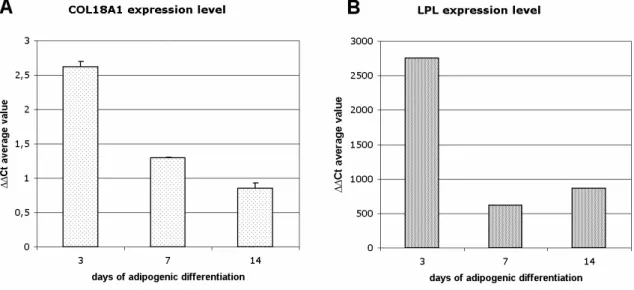
On day 14 after inducing adipocyte differentiation of adipose tissue-derived human mesenchymal stem cells (hMSCs), we observed that the majority of cells accu-mulated lipid droplets in the cytoplasm (Fig. 1). In ad-dition,LPL, an adipogenic marker, was quantified as a control of the differentiation experiment and it showed extreme high expression levels after the induction of the adipogenesis process (Fig. 2). Therefore, we considered that the stem cell population successfully differentiated into adipocytes.
COL18A1 expression was analyzed at four time points (0, 3, 7 and 14 days) during the differentiation induction and we observed relatively higher expression of this gene at day 3 of the differentiation processes, when it increased 2,5 fold in comparison with undifferentiated cells. At days 7 and 14 the expression was 1.4 and 0.85 fold-higher than that of untreated stem cells (time 0), respectively (Fig. 2).
ASSOCIATIONSTUDYBETWEENCOL18A1ANDOBESITY
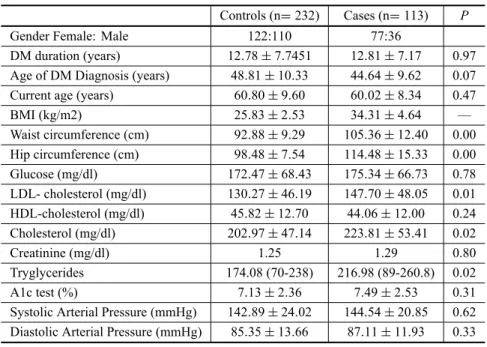
The main clinical features of the patients are depicted in Table II. Among the 345 patients analyzed, 113 were classified as obese (BMI: 34.31±4.64; cases) and 232
as non-obese (BMI: 25.83±2.53; controls). Cases also
had higher waist and hip circumferences as compared to controls (P<0.05). They also presented higher
tri-glycerides, total and LDL cholesterol (P<0.05). There
were no differences for other clinical or laboratorial characteristics. The genotype distribution for SNPs c.1136C>T and c.4349G>A were in HWE (Table III; P>0.05). There was no difference in the genotype
or allelic frequencies of the SNP c.4349G>A between
obese and non-obese patients (P =0.11). However, a
borderline association between SNP c.1136C>T
geno-types and obesity was found (P = 0.07). Assuming
a recessive model (TT vs. CT+CC), the genotype TT
was significantly more frequent in obese diabetic tients (22/113, 19.5%) than in non-obese diabetic pa-tients (25/232, 10.5%;χ2 = 4.73 and P = 0.02). In
this model, patients with TT genotype had an odds ra-tio (OR) of 2.57 (95% CI: 1.21-5.47) for obesity. This effect was more pronounced if we exclude individuals
with overweight, that is those with BMI between 28 and 30 kg/m2[TT genotype frequency in controls (BMI < 27 kg/m2, 12/140) was 8.5% (χ2 = 6.38 and P =
0.01)]. In a logistical model, after controlling for
choles-terol, triglycerides, LDL cholesterol levels, the TT geno-type still held associated with the presence of obesity (P=0.048; OR 2,8 CI 95% 1.01-7.74).
DISCUSSION
In the present work, we have shown for the first time that human collagen XVIII mRNA levels increase during dif-ferentiation of human mesenchymal stem cells (hMSCs) into adipocytes. Its transcription profile observed dur-ing the differentiation process suggests that COL18A1
expression increases at an earlier stage of hMSCs adi-pogenesis, which is comparable to other well known genes associated with adipocyte differentiation, such as C/EBPβ and C/EBPδ (Rosen 2005). These results are
in accordance with those observed in the differentiation of bovine preadipocytes obtained from intramuscular fat (Inoue-Murayama et al. 2000). Our results thus indicate that collagen XVIII may play an important role in hu-man adipogenesis and the higher increase ofCOL18A1
expression in the early phase of adipogenic differentia-tion point to the importance of this gene in the adipogenic commitment of the cells. It was observed that collagen XVIII expression levels did not vary during adipogene-sis of the mouse preadipocyte cell line 3T3-L1 (Inoue-Murayama et al. 2000). It is therefore possible that the effect of collagen XVIII in adipocyte differentiation de-pends on the origin of the preadipocyte or it is species related. It is worth to note that we have used primer pairs that recognize the three collagen XVIII isoforms to quantify its expression in human adipocity differenti-ation, but it would be important to verify if a specific or all collagen XVIII isoforms are involved in this process. We have also evaluated whether there was an association between COL18A1 gene polymorphisms
c.1136C>T and c.4349G>A, located respectively in
the NC11- 728/Frizzled-C18 and NC-1/ES-C18 domains of collagen XVIII, and obesity in type 2 diabetes pa-tients. The allele frequency and genotype distribution for the SNP c.4349G>A in our sample is similar to those
TABLE II
Clinical variables in DM2 patients according to presence of obesity. Controls (n=232) Cases (n=113) P
Gender Female: Male 122:110 77:36
DM duration (years) 12.78±7.7451 12.81±7.17 0.97 Age of DM Diagnosis (years) 48.81±10.33 44.64±9.62 0.07 Current age (years) 60.80±9.60 60.02±8.34 0.47
BMI (kg/m2) 25.83±2.53 34.31±4.64 —
Waist circumference (cm) 92.88±9.29 105.36±12.40 0.00 Hip circumference (cm) 98.48±7.54 114.48±15.33 0.00 Glucose (mg/dl) 172.47±68.43 175.34±66.73 0.78 LDL- cholesterol (mg/dl) 130.27±46.19 147.70±48.05 0.01 HDL-cholesterol (mg/dl) 45.82±12.70 44.06±12.00 0.24 Cholesterol (mg/dl) 202.97±47.14 223.81±53.41 0.02
Creatinine (mg/dl) 1.25 1.29 0.80
Tryglycerides 174.08 (70-238) 216.98 (89-260.8) 0.02
A1c test (%) 7.13±2.36 7.49±2.53 0.31
Systolic Arterial Pressure (mmHg) 142.89±24.02 144.54±20.85 0.62 Diastolic Arterial Pressure (mmHg) 85.35±13.66 87.11±11.93 0.33
TABLE III
Genotypic and allelic distribution for SNP c.1136C>T and
SNP c.4349G>A according to body mass index. Body Mass Index
>30 kg/m2(n=113) <30Kg/m2(n=232) SNP c.1136C>T
Genotypes
CC - n (%) 46 (40.7) 111 (47.8)
CT - n (%) 45 (39.8) 96 (41.4)
TT - n (%) 22 (19.5) 25 (10.8)
Alleles
C 60.6% 68.5%
T 39.4% 31.5%
SNP c.4349G>A Genotypes
GG - n (%) 102 (90.3) 198 (85.4%)
GA - n (%) 11 (9.7) 33 (14.2%)
AA - n (%) 0 (0) 1 (0.4%)
Alleles
G 95.1% 92.5%
Fig. 1 – Oil red staining of the cells after 14 days of the beginning of adipogenic differentiation showing accumulated lipid vesicles in the cytoplasm.
Fig. 2 – A) Quantitative real time PCR showing expression ofCOL18A1during human adipogenic differentiationin vitro. B)LPLwas quantified as a control of the differentiation experiment and, as expected, it showed high expression levels after the beginning of the adipogenesis process.
between the SNP c.4349G>A and obesity. However,
we observed consistent evidence of association between SNP c.1136C>T and obesity.
Our results suggest that the allele c.1136T when in homozygosis increases about two-fold the chance of a DM2 patient to develop obesity. When overweight DM2 patients were excluded from the control group, we found a more pronounced difference in c.1136T frequency be-tween cases and controls, further supporting the asso-ciation between this SNP and obesity in DM2 patients. The importance of TT genotype for obesity was still con-firmed by logistic regression analysis with the following
and ascertained in a common cohort of patients, we still cannot exclude the possibility that these results are due to population stratification.
It is well established that proteins with frizzled mo-tif act in Wnt signaling through different pathways in various processes, including adipogenesis, obesity, in-sulin secretion and DM2 (Ross et al. 2000, Bennett et al. 2002, Kennel and MacDougald 2005, Guo et al. 2006). It has been suggested that the N-terminal portion of collagen XVIII containing the Frizzled-C18 motif could be involved in Wnt signaling (Elaama et al. 2003, Vainio et al. 2003, Marneros and Olsen 2005) and, more recently, Quelard et al. (2006) showed that the Frizzled-C18 module acts as an extracellular inhibitor of Wnt-B-catenin signaling by quenching Wnts in the hep-atocarcinoma tumor. The SNP c.1136C>T/Thr379Met
is being described in the present work for the first time. In a comparative genomic analysis we verified that thre-onine at position 379 is conserved among mammals (hu-man, rat, mouse, cow, cat) and is substituted for another polar aminoacid with an uncharged side chain (serine) in other vertebrates (chicken, xenopus, zebrafish, medaka, fugu, stickleback), suggesting that this residue might be important for normal protein function. The frizzled mo-tif of the NC11-728 has a cysteine-rich domain, that con-tains 10 cysteine-conserved sites, and threonine 379 is located very close to the third cysteine residue. There-fore, it is possible that the presence of a methionine in-stead of a threonine can partially impair the function of this domain in preadipocyte proliferation or differ-entiation through a direct or indirect effect of the Wnt pathway.
Recently, we verified that allele c.1136T is in link-age disequilibrium with the G allele of the polymor-phism –700G>T, which confers higher transcription
lev-els to this collagen in hepatocytes (Armelin-Correa et al. 2005). Therefore, we cannot exclude the possibility that the mutated allele is in linkage disequilibrium with an-other one, which would be actually the responsible for the phenotype.
It has not been reported obesity in patients with null mutations in the collagen XVIII or in the knockout col18-/- mice (Suzuki et al. 2002, Fukai et al. 2002). However, it is possible that the obesity phenotype is in-duced only in the presence of high food intake or
de-pending on the genetic background of the individual. In contrast, obesity is very common in Down syndrome pa-tients, who have three functional copies ofCOL18A1
gene as the consequence of trissomy of chromosome 21 (Zorick et al. 2001).
COL18A1and its receptor glypican has been iden-tified as promising candidate genes to be involved with body weight and adiposity in DM2 mice (Brown et al. 2005, Gesta et al. 2006), thus supporting our finding that collagen XVIII is important in adipogenesis and in obesity of DM2 patients.
In conclusion, the present study shows for the first time that collagen XVIII mRNA levels increase during human adipogenesis and that the SNP c.1136C>T in
the frizzled motif of theCOL18A1doubles the chance of a patient with type 2 diabetes to develop obesity. Considering the functional role of collagen XVIII in an-giogenesis and that it may be involved in Wnt signal-ing, we could speculate that this collagen might act in the regulation of adipose tissue mass through different mechanisms: by controlling angiogenesis in fat tissue and by stimulating the differentiation of mesenchymal stem cell into mature adipocytes. Therefore, although preliminary, our present data may be a starting point towards understanding this novel role of collagen XVIII in humans.
ACKNOWLEDGMENTS
RESUMO
Colágeno XVIII pode gerar dois fragmentos, um correspon-dendo à região NC11-728 contendo o motivo “frizzled”, o qual possivelmente atua na sinalização Wnt, e outro corres-pondendo a Endostatina, que é clivada a partir da região NC1 e é uma potente inibidora de angiogênese. Colágeno XVIII e a via de sinalização Wnt foram recentemente associados à diferenciação adipogênica e obesidade em alguns modelos animais, porém ainda não em humanos. No presente trabalho, mostramos que os níveis de expressão gênica doCOL18A1 au-mentam durante o processo de diferenciação adipogênica em humanos. Também testamos se polimorfismos localizados no motivo “Frizzled” (c.1136C>T; Thr379Met) e na região da Endostatina (c.4349G>A; Asp1437Asn) contribuem na pre-disposição a obesidade em pacientes com diabetes tipo 2. (113 obesos, BMI≥30; 232 não-obesos, BMI< 30) de ances-tralidade Européia. Nenhuma evidência de associação entre o alelo c.4349G>A e obesidade foi observada, contudo, observa-mos uma freqüência significativamente maior de homozigotos c.1136TT em obesos (19.5%) do que em não-obesos (10.9%) [P = 0.02; OR = 2.0 (95%CI: 1.07-3.73)], sugerindo que o alelo c.1136T está associado com obesidade conforme um modelo recessivo. Este genótipo manteve-se associado à obe-sidade (P=0.048) mesmo após o controle das variáveis coles-terol, LDL e triglicérides, e confere um risco 2.8 vezes maior de obesidade. Portanto, nossos dados sugerem o envolvimento do colágeno XVIII em adipogênese humana e predisposição a obesidade.
Palavras-chave: COL18A1, obesidade, adipogênese, endos-tatina, “frizzled”.
REFERENCES
AMERICANDIABETESASSOCIATION. 2005. Diagnosis and classification ofdiabetes mellitus. Diabetes Care [WIN-DOWS-1252?] 28: S37–S42.
ARMELIN-CORREALMET AL. 2005. Characterization of human Collagen XVIII promoter 2: interaction of Sp1, Sp3 and YY1 with the regulatory region and a SNP that increases transcription in hepatocytes. Matrix Biol 24: 550–559.
BALASUBRAMANIAN SP, CROSS SS, GLOBE J, COX A, BROWN NJ AND REED MW. 2007. Endostatin gene variation and protein levels in breast cancer susceptibil-ity and seversusceptibil-ity. BMC Cancer 7: 107–114.
BENNETTCN ET AL. 2002. Regulation of Wnt signaling
during adipogenesis. J Biol Chem 277: 30998–31004. BROWNAC, OLVERWI, DONNELLYCJ, MAYME, NAG
-GERT JK, SHAFFER DJAND ROOPENIAN DC. 2005. Searching QTL by gene expression: analysis of diabesity. BMC Genet 6: 12–20.
BUENODF. 2007. Uso de células tronco adultas para estudo da etiopatogenia das fissuras lábio palatinas e bioenge-nharia de tecidos. Tese de doutorado, Instituto de Bio-ciências, Universidade de São Paulo, SP, Brasil.
CAOY. 2007. Angiogenesis modulates adipogenesis and obe-sity. J Clin Invest 117: 2362–2368.
CANANILHET AL. 2005. The fatty acid-binding protein-2 A54T polymorphism is associated with renal disease in patient with type 2 diabetes. Diabetes 54: 3326–3330. COSTAAM, BUENODF, MARTINSMT, KERKISI, KERKIS
A, FANGANIELLORD, CERRUTIH, ALONSO NAND PASSOS-BUENO MR. 2008. Reconstruction of Large Cranial Defects in Non Immunosuppressed Experimental Design With Human Dental Pulp Stem Cells. J Craniofac Surg 19: 204–210.
DHANABAL M, RAMCHANDRANR, WATERMANMJ, LU H, KNEBELMANNB, SEGALM ANDSUKHATMEVP. 1999. Endostatin induces endothelial cell apoptosis. J Biol Chem 274: 11721–11726.
DUPONT WDAND PLUMMER JR WD. 1998. Power and sample size calculations for studies involving linear re-gression. Control Clin Trials 19: 589–601.
ELAMAAH, SNELLMANA, REHNM, AUTIO-HARMAINEN HANDPIHLAJANIEMIT. 2003. Characterization of the human type XVIII collagen gene and proteolytic process-ing and tissue location of the variant containprocess-ing a frizzled motif. Matrix Biol 22: 427–442.
ERRERAFIET AL. 2007. Functional vascular endothelial growth factor -634G>C SNP is associated with prolifera-tive diabetic retinopathy: a case-control study in a Brazil-ian population of European ancestry. Diabetes Care 30: 275–279.
FOLKMANJ. 2002. Role of angiogenesis in tumor growth and metastasis. Semin Oncol 29 (6 Suppl 16): 15–18. FUKAINET AL. 2002. Lack of collagen XVIII/endostatin
results in eye abnormalities. EMBO J 21: 1535–1544. GESTASET AL. 2006. Evidence for a role of developmental
genes in the origin of obesity and body fat distribution. Proc Natl Acad Sci USA 103: 6676–6681.
INOUE-MURAYAMAM, SUGIMOTOY, NIIMIYANDASO H. 2000. Type XVIII collagen is newly transcribed during bovine adipogenesis. Differentiation 65: 281–285. IUGHETTIPET AL. 2001. A polymorphism in endostatin, an
angiogenesis inhibitor, predisposes for the development of prostatic adenocarcinoma. Cancer Res 61: 7375–7378. JOHNH, RADTKEK, STANDKERLANDFORSSMANNWG. 2005. Identification and characterization of novel en-dogenous proteolytic forms of the human angiogenesis inhibitors restin and endostatin. Biochim Biophys Acta 1747: 161–170.
KENNELLJAANDMACDOUGALDAO. 2005. Wnt signal-ing inhibits adipogenesis through beta-catenin-dependent and -independent mechanisms. J Biol Chem 280: 24004– 24010.
LOURENÇOGJET AL. 2006. High risk of occurrence of sporadic breast cancer in individuals with the 104NN polymorphism of theCOL18A1gene. Breast Cancer Res
Treat 100: 335–338.
MACPHERSON GR, SINGH AS, BENNETT CL, VENZON DJ, LIEWEHR DJ, FRANKS ME, DAHUT WL, KANTOFFPW, PRICEDKANDFIGGWD. 2004. Geno-typing and Functional Analysis of the D104N Variant of Human Endostatin. Cancer Biol Ther 3: 1298–1303. MARNEROSAGANDOLSENBR. 2005. Physiological role
of collagen XVIII and endostatin. Faseb J 19(7): 716–728. MILLERSA, DYKESDDANDPOLESKYHF. 1988. A sim-ple salting out procedure for extracting DNA from human nucleated cells. Nucleic Acids Res 16: 1215.
MOULTON KS, OLSEN BR, SONN S, FUKAI N, ZURA -KOWSKIDANDZENGX. 2004. Loss of collagen XVIII enhances neovascularization and vascular permeability in atherosclerosis. Circulation 110: 1330–1336. MUSSOOET AL. 2001. Tumor hepatocytes and basement
membrane-producing cells specifically express two differ-ent forms of the endostatin precursor, collagen XVIII, in human liver cancers. Hepatology 33: 868–876.
NISHIMURASET AL. 2007. Adipogenesis in Obesity Re-quires Close Interplay Between Differentiating Adipo-cytes, Stromal Cells, and Blood Vessels. Diabetes 56: 1517–1526.
OHSP, WARMANML, SELDIN MF, CHENG SD, KNOLL JH, TIMMONS S AND OLSEN BR. 1994. Cloning of cDNA and genomic DNA encoding human type XVIII collagen and localization of the alpha-1 (XVIII) collagen gene to mouse chromosome 10 and human chromosome 21. Genomics 19: 494–499.
O’REILLYMSET AL. 1997. Endostatin: an endogenous in-hibitor of angiogenesis and tumor growth. Cell 88: 277– 285.
PASSOS-BUENOMRET AL. 2006. Mutations in Collagen 18A1 (COL18A1) and their relevance to the human
phe-notype. Anais Acad Bras Cienc 78: 123–132.
QUELARDDET AL. 2006. The frizzled module of col18a1 induces tumor cell death through inhibition of the wnt-bcatening signaling pathway. Hepatology, AASLD Ab-stract, 588A p.
ROSENED. 2005. The transcriptional basis of adipocyte de-velopment. Prostaglandins Leukot Essent Fatty Acids 73: 31–34.
ROSSSE ET AL. 2000. Inhibition of adipogenesis by Wnt signaling. Science 289: 950–953.
RUPNICK MA ET AL. 2002. Adipose tissue mass can be regulated through the vasculature. Proc Natl Acad Sci USA 99: 10730–10735.
SAARELAJ, YLIKARPPAR, REHNM, PURMONENSAND PIHLAJANIEMIT. 1998. Complete primary structure of two variant forms of human type XVIII collagen and tissue-specific differences in the expression of the corre-sponding transcripts. Matrix Biol 16: 319–328.
SASAKIT, FUKAIN, MANNK, GOHRINGW, OLSENBR AND TIMPL R. 1998. Structure, function and tissue forms of the C-terminal globular domain of collagen XVIII containing the angiogenesis inhibitor endostatin. EMBO J 17: 4249–4256.
SCHMIDTA, WENZELD, FERRINGI, KAZEMIS, SASAKI T, HESCHELER J, TIMPL R, ADDICKS K, FLEISCH -MANNBKANDBLOCHW. 2004. Influence of endostatin on embryonic vasculo- and angiogenesis. Dev Dyn 230: 468–480.
SERTIÉAL, SOSSIV, CAMARGOAAA, ZATZM, BRAHEC ANDPASSOS-BUENOMR. 2000. Collagen XVIII, con-taining an endogenous inhibitor of angiogenesis and tumor growth, plays a critical role in the maintenance of retinal structure and in neural tube closure (Knobloch syndrome). Hum Mol Genet 9: 2051–2058.
SUZUKI OT ET AL. 2002. Molecular analysis of collagen XVIII reveals novel mutations, presence of a third iso-form and possible genetic heterogeneity in Knobloch syn-drome. Am J Hum Genet 71: 1320–1329.
VAINIO S, LIN Y AND PIHLAJANIEMI T. 2003. Induced Repatterning of Type XVIII Collagen Associates with Ectopic Sonic Hedgehog and Lung Surfactant C Gene Expression and Changes in Epithelial Epigenesis in the Ureteric Bud. J Am Soc Nephrol 14 (Suppl 1): S3–8. VANDESOMPELE J, DEPRETERK, PATTYNF, POPPE B,
VAN ROYN, DE PAEPE AAND SPELEMAN F. 2002. Accurate normalization of real-time quantitative RT-PCR data by geometric averaging of multiple internal control genes. Genome Biol 3(7): RESEARCH0034.
WHO. 2000. Obesity: preventing and managing the global epidemic. In: REPORT ON A WHO CONSULTATION. Geneva, World Health Organization, Technical Report Series 894.
WODARZ A AND NUSSE R. 1998. Mechanisms of Wnt signaling in development. Annu Rev Cell Dev Biol 14: 59–88.
ZORICK TS ET AL. 2001. High serum endostatin levels in Down syndrome: implications for improved treatment and prevention of solid tumours. Eur J Hum Genet 9: 811–814.