Universidade de Lisboa
Faculdade de Ciências
Departamento de Biologia Vegetal
Analysis of molecular diversity and cis-regulatory elements
in the promoters of lignin genes in Eucalyptus species
Priscila Miriam Santos Pereira
Dissertação
Mestrado em Biologia Molecular e Genética
Universidade de Lisboa
Faculdade de Ciências
Departamento de Biologia Vegetal
Analysis of molecular diversity and cis-regulatory elements
in the promoters of lignin genes in Eucalyptus species
Priscila Miriam Santos Pereira
Dissertação
Mestrado em Biologia Molecular e Genética
Orientador interno: Professor Doutor Pedro Fevereiro
Orientador externo: Doutor Jorge Almiro B. C. Pinto Paiva
“Science, my lad, is made up of mistakes, but they are mistakes which it is useful to make, because they lead little by little to the truth.” Jules Verne
i Agradecimentos
Gostava de mostrar o meu agradecimento a várias pessoas que das mais diversas formas foram essenciais para a realização deste trabalho.
Em primeiro lugar à Fundação para a Ciência e Tecnologia (FCT) e ao Projeto TreeForJoules (PKBBE/AGR-GPL/0001/2010), designado “Improving eucalypt and poplar wood properties for bioenergy”, financiado por fundos nacionais através da FCT/MCTES, no âmbito do qual foi desenvolvida esta dissertação de Mestrado.
Ao meu orientador Dr. Jorge Paiva, por guiar o desenvolvimento do trabalho, pela partilha do seu conhecimento e pelos seus úteis conselhos e correções.
Ao professor Pedro Fevereiro, orientador e diretor do grupo de Biotecnologia de Células Vegetais (BCV), por zelar pelo bem do laboratório, das pessoas e dos trabalhos. Por todas as sugestões e conselhos.
À Dra. Maria de Jesus Fernandes e ao Eng. Rui Pombo responsáveis pelo Departamento de Conservação da Natureza e Florestas de Lisboa e Vale do Tejo, pertencente ao Instituto da Conservação da Natureza e das Florestas, pela autorização da colheita de material vegetal na Mata Nacional do Escaroupim.
Aos colegas Victor Carocha e Filipe Cadete, pela preciosa ajuda no decorrer do trabalho, com esclarecimento de dúvidas e sugestões. Às colegas Susana Pera e Clara Graça, pela ajuda prática no decorrer do trabalho e pela amizade que já vem de trás. A todos os restantes colegas do grupo do BCV por me terem acolhido mais uma vez e proporcionado um bom ambiente de trabalho. Em especial, às colegas Olívia Costa, Maria Assunção e Rita Severino pelas palavras de ânimo e ajuda que disponibilizaram.
Um agradecimento especial às senhoras Fátima e Graça da Mata Nacional do Escaroupim, pela ajuda na recolha e identificação das amostras. Também pela simpatia e disponibilidade que sempre mostram.
Aos meus amigos, por serem uma parte essencial da minha vida e darem brilho a dias cinzentos. Pelo especial apoio, preocupação e sensibilidade a esta fase da minha vida gostava de destacar: Eliana, Filipa, tios Licas e Carlos, Ricardo, Adriana, Catarina, Vinicyus, Ruben, Rita, Diva e Eliseu. As vossas palavras e orações foram mesmo importantes.
ii À minha comunidade (Comunidade Cristã em Albergaria), a todos sem exceção, por serem família em todos os momentos. Por me lembrarem a razão da nossa esperança.
À minha família, o alicerce, o meu chão. Paizinhos não há palavras para descrever o que vocês são para mim. Sem vocês nada disto seria possível. Obrigada pela oportunidade, por nunca desistirem de mim mesmo quando falho. Tota, por seres meu maninho e isso bastar. Pelo teu carinho e conversas à distância.
Por último mas tão importante, a Deus. Por nunca falhar, por ser a minha força na fraqueza. Por ser a razão de uma vida com propósito.
iii Resumo
O género Eucalyptus tem grande importância comercial e ecológica. Os eucaliptos são as principais espécies produtoras de madeira usadas na indústria da celulose e pasta de papel. A quantidade e a composição em lenhina na madeira é uma das maiores barreiras para a qualidade da polpa. Vários estudos têm surgido para a identificação dos mecanismos de transcrição e pós-tradução envolvidos no controlo da lenhificação. Apesar disso, são muitas as lacunas na compreensão desses mecanismos, nomeadamente no género Eucalyptus.
A regulação da transcrição é determinante na regulação da expressão génica. A região promotora contém elementos cis-regulatórios que se ligam a fatores de transcrição específicos, dirigindo a expressão espacial e temporal da transcrição. O conhecimento da composição dos promotores em elementos cis-regulatórios é essencial para a compreensão dos mecanismos inerentes à regulação da transcrição. Nos últimos anos têm surgido várias ferramentas bioinformáticas para a predição destes elementos nos promotores. Este tipo de metodologia é desenvolvido, maioritariamente, por comparação de regiões reguladoras ortólogas, de um mesmo gene em várias espécies com diferentes graus de divergência e polimorfismo. Desta forma tem sido possível, ao perceber quais os motivos com maior probabilidade de possuírem função biológica, economizar tempo e recursos no decorrer do projeto experimental.
Os fatores de transcrição (FT) da família MYB ligam-se a elementos cis-regulatórios específicos nos promotores de vários genes que codificam para enzimas envolvidas nas vias biossintéticas dos fenilpropanóides e lenhina. A existência comum destes elementos nos promotores de vários genes da via da lenhina tem suportado a hipótese de que estes são regulados de forma coordenada a nível transcricional. Existem outros FT, que em cooperação com os FT da família MYB, são responsáveis pela regulação coordenada dos genes da via biossintética da lenhina. A melhor compreensão desta via passa pela descoberta de novos elementos cis-regulatórios, tendo em conta a evolução e função de famílias de genes da biossíntese de lignina em todo o género Eucalyptus.
Nesta dissertação é descrita a análise da região promotora de quatro genes envolvidos na via biossintética da lenhina, PAL9, F5H2, CSE e CAD3, isolados a partir de nove espécies do género Eucalyptus. A análise foi realizada em termos de diversidade nucleotídica, composição e conservação em elementos cis-regulatórios.
iv Dos 30 pares de primers desenhados para amplificação por PCR da região promotora de cada gene pertencente à via biossintética da lenhina em eucalipto, foram escolhidos 11 para amplificação da região promotora de 62 espécies do género Eucalyptus e quatro do género Corymbia. Dez dos 11 pares de primers amplificaram com sucesso em mais de metade das espécies analisadas, sendo que o sucesso total na amplificação foi de 73%. Estes resultados confirmaram a existência de um grau de conservação considerável entre os promotores ortólogos. As espécies com menor sucesso na amplificação foram as espécies pertencentes ao género Corymbia e aquelas pertencentes ao subgénero Eucalyptus (género Eucalyptus). Estes resultados eram espectáveis uma vez que estas espécies são as mais afastadas filogeneticamente da espécie E. grandis, para o qual os primers foram desenhados.
Com base na hipótese de que os promotores contêm regiões específicas mais conservadas, garantindo a manutenção e funcionalidade de elementos cis-regulatórios, foi realizada uma abordagem genómica comparativa ao nível da espécie. Para isso, as regiões promotoras dos genes PAL9, F5H2, CSE e CAD3 foram amplificadas por PCR para um indivíduo de cada uma de 9 espécies do género Eucalyptus, 7 delas pertencentes ao subgénero Symphyomyrtus. Posteriormente, estas regiões promotoras foram diretamente sequenciadas, e em alguns casos primeiramente clonadas e só depois sequenciadas. Foram seguidamente alinhadas para uma análise mais detalhada em termos de diversidade nucleotídica (π) e para identificação e mapeamento de elementos cis-regulatórios. De uma forma geral a diversidade nucleotídica foi elevada. Os valores de π variaram de 0.026, para as regiões promotoras PAL9 a 0.078 para as regiões promotoras CAD3. O facto da enzima fenilalanina amónia-liase (PAL) ser essencial para a síntese de todos os fenilpropanóides, catalisando o primeiro passo dessa via biossintética, pode ser a razão da manutenção deste promotor ao longo do processo de divergência e especiação.
Apesar dos elevados valores de π, foram identificadas regiões específicas, em todos os grupos de promotores, com valores de diversidade nucleotídica espectáveis para regiões codificantes conservadas (π inferior a 0.02), podendo significar a existência de restrições funcionais para essas regiões.
O conjunto de elementos cis-regulatórios putativos mapeados ao longo das regiões promotoras analisadas foi obtido por uma seleção prévia através de duas estratégias. A primeira foi a identificação de elementos cis-regulatórios por homologia com elementos cis-regulatórios descritos na base de dados PLACE. Essa identificação foi
v realizada nas regiões promotoras (1000pb anteriores ao ATG) de todos os genes pertencentes à via biossintética da lenhina em eucalipto e dos respetivos ortólogos nas espécies A. thaliana, P. trichocarpa and V. vinífera, consistindo num total de 75 sequências. De um total de 219 elementos identificados, foram selecionados 32 elementos representativos do conjunto de dados, sendo mais provavelmente envolvidos na regulação génica da lenhina. A segunda estratégia utilizada consistiu na identificação in silico de motivos sobrerepresentados no conjunto das mesmas 75 sequências, utilizando para essa deteção três programas, MEME, MotifSampler e oligo-analysis (RSAT). A ferramenta STAMP foi utilizada para agrupar os 77 motivos, identificados pelo conjunto dos três programas, por similaridade e redundância. Isto permitiu obter um conjunto de cinco novos elementos-cis putativos que não seriam normalmente identificados por pesquisas em bases de dados. Três deles foram identificados por mais do que um programa, aumentando a confiabilidade e precisão da predição.
O mapeamento do conjunto de elementos cis-regulatórios previamente selecionados, nos quatro grupos de promotores, permitiu verificar a existência de um padrão de conservação nas espécies de eucalipto.
Ao analisar o efeito potencial da evolução das sequências de DNA nas ocorrências de elementos cis-regulatórios identificados em regiões de baixa diversidade nucleotídica, nos quatro grupos de promotores, verificou-se que mais de metade dessas ocorrências de elementos-cis (52%) eram conservadas nas sequências promotoras das nove espécies em análise. Ainda assim, foram identificados alguns casos, a maioria em E. tereticornis (56%), onde alterações nucleotídicas causaram a perda de determinado elemento-cis putativo, nas espécies onde essas alterações ocorreram. As diferenças encontradas na região promotora de mais do que um gene, na espécie E. tereticornis, poderão ter implicações na regulação transcricional dos genes da lenhina nesta espécie.
Os elementos CRPE31, GT1CONSENSUS, SEF4MOTIFGM7S,
PYRIMIDINEBOXOSRAMY1A e o motivo sobrerepresentado LRPE2, identificado de novo neste estudo, foram identificados com múltiplas ocorrências em todos os grupos de promotores ortólogos. Indicando a sua eventual importância na regulação de genes com expressão sincronizada ou no controlo dos níveis de mRNA. Para além disso, todos estes elementos foram identificados, nas regiões promotoras de um ou mais genes, em regiões com valores de π inferiores a 0.02 podendo ter potencialmente maiores restrições funcionais. Adicionalmente, todos estes elementos, exceto o
vi PYRIMIDINEBOXOSRAMY1A, parecem estar posicionalmente conservados nas regiões promotoras de genes diferentes. Esta informação pode ser relevante pois a posição relativa dos elementos tem influência nos perfis de transcrição dos genes. Todos os elementos-cis necessitam de validação experimental. Ainda assim, todas estas evidências em consonância com as funções biológicas dos vários elementos descritas em literatura permitiram perceber de forma mais concreta quais as funções putativas destes elementos nos promotores dos genes da lenhina em Eucalyptus.
Em conclusão, este trabalho permitiu compreender novos aspetos da diversidade e evolução dos promotores de genes da lenhina em Eucalyptus. Além disso, foram revelados elementos cis-regulatórios que podem ser responsáveis por aumentar a atividade dos promotores ou pelo controlo temporal e/ou espacial da expressão de vários genes no decorrer da biossíntese da lenhina em Eucalyptus. Esta informação será capaz de acelerar a caracterização funcional de novos elementos cis-regulatórios e dos respetivos FT, sendo um passo fundamental na compreensão da regulação transcricional da via biossintética da lenhina e da sua heterogeneidade no género Eucalyptus.
vii Abstract
The genus Eucalyptus has great commercial and ecological importance, being the principal hardwood species used for pulp and paper manufacturing. The fact that the quantity and composition of lignin in wood has implications in pulping quality and bioethanol production has made lignin biosynthesis an extensively studied pathway. However, more information regarding diversity and transcriptional regulation of the genes involved in the lignin regulation biopolymer is needed.
In this work a comparative analysis of orthologous phenylpropanoid-lignin genes promoters from four angiosperm genera Eucalyptus, Arabidopsis, Populus and Vitis, was performed to identify overrepresented conserved and novel motifs being putative cis-regulatory sequences (CREs). Comparative analysis identified 33 conserved sequence motifs, consisting of known and novel CREs, significantly overrepresented in those promoter sequences. Subsequently, were analyzed patterns of species-level nucleotide diversity and the distribution and composition in putative cis-regulatory elements in the promoters of four phenylpropanoid-lignin genes from different Eucalyptus tree species using in silico tools. Species-level nucleotide diversity (π) varied from 0.026 to 0.078, and the different lignin promoters studied showed different patterns of sequence conservation. All the promoters of the studied Eucalyptus lignin genes contained highly conserved regions at the species level. Some putative CREs were identified in all the promoters with multiple occurrences and positioned in specific regions with low nucleotide diversity. This suggested functional restrictions on such regions and biological function for those specific motifs.
These findings provide new information capable to accelerate the functional characterization of CREs and their interacting TFs responsible for driving high or specific activity of corresponding promoters in lignin biosynthesis in Eucalyptus. Thus, this work contributes to a step forward in the understanding of the mechanisms underlying the regulation of lignin heterogeneity in Eucalyptus. This knowledge, in turn, will benefit Eucalyptus breeding programs or enable the alteration of lignin composition, increasing its degradability in industrial processes.
Key words: cis-regulatory elements, promoter evolution, lignin, phenylpropanoid biosynthetic pathway
viii Contents
1 INTRODUCTION ... 1
2 OBJECTIVES ... 5
3 MATERIAL AND METHODS ... 6
3.1 PLANT MATERIAL AND NUCLEIC ACIDS EXTRACTION ... 6
3.2 SELECTION OF PROMOTER REGION ... 6
3.3 PRIMER DESIGN ... 7
3.4 DNAAMPLIFICATION ... 7
3.5 SEQUENCING OF PROMOTER REGIONS ... 8
3.6 DNA SEQUENCE ANALYSIS ... 8
3.7 PUTATIVE CIS-REGULATORY ELEMENTS IN SILICO PREDICTION AND SELECTION ... 9
3.8 CIS-ELEMENT MAPPING ... 10
3.9 CIS-ELEMENT CONSERVATION ANALYSIS ... 10
4 RESULTS ... 11
4.1 EXTRACTION INTEGRITY AND QUANTIFICATION OF EUCALYPTUS SPECIES DNA .. 11
4.2 PRIMER TESTING FOR PCRAMPLIFICATION ... 11
4.3 ISOLATION AND ANALYSIS OF PROMOTER REGIONS OF THE FIVE LIGNIN GENES IN 9 EUCALYPTUS SPECIES AND ONE CORYMBIA. ... 12
4.4 SPECIES-LEVEL DNA SEQUENCE VARIATION AND DIVERSITY IN THE PROMOTER REGIONS OF EUCALYPTUS LIGNIN GENES. ... 15
4.5 IN SILICO IDENTIFICATION OF PUTATIVE CRES ... 17
4.5.1 Identification of known CREs ... 17
4.5.2 Identification of unknown CREs using three software programs... 19
4.6 CRES MAPPING IN THE PROMOTER REGION SEQUENCES ... 20
4.7 CIS-ELEMENT CONSERVATION ANALYSIS ... 23
5 DISCUSSION AND CONCLUSION ... 24
REFERENCES ... 30
SUPPLEMENTARY MATERIAL ... 34
SUPPLEMENTARY TABLES ... 34
ix List of figures and tables
Fig. 1: The monolignol biosynthetic pathway.. ... 2 Fig. 2: Example of the results of PCR colony screening to EgrCSE in E. camaldulensis.. ... 14 Fig. 3: Species-level nucleotide diversity profiles of the promoter regions from four Eucalyptus phenylpropanoid metabolism and lignin pathway genes in nine Eucalyptus and one Corymbia tree species.. ... 16 Fig. 4: Occurrences of 36 putative cis-regulatory elements mapped in the promoters of four orthologs groups of lignin genes in 9 Eucalyptus species, C. corymbia, A. thaliana, P. trichocarpa and V. vinifera.. ... 22 Fig. 5: Conservation of the cis-elements consensus sequences founded in specific regions of particularly low nucleotide diversity in four lignin gene promoters under study across studied Eucalyptus specie………..23 Fig. S1: Sequence logos of overrepresented sequences in the promoters of genes highly or preferentially expressed in secondary xylem and involved in phenylpropanoid-lignin metabolism in Eucalyptus, detected using MEME, MotifSampler and oligo-analysis (RSAT)……….39 Fig. S2: Frequency of cis-elements occurrences along the length of the four lignin genes promoter regions averaged across the 9 Eucalyptus species in 100-bp intervals compared to a randomly generated sequence dataset. ... 39
Table 1: PCR conditions for amplification of 1000bp upstream ATG region of eleven lignin and success of amplification results by genera (Corymbia vs Eucalyptus) and Eucalyptus subgenera (Eucalyptus vs Symphyomyrtus) ... 13 Table 2: Species-level nucleotide diversity in the promoter regions of four lignin genes from 9 Eucalyptus tree species ... 15 Table 3: Details of 33 cis-regulatory elements selected from PLACE database scans and literature and used for DNA pattern matching ... 18 Table 4: Over-represented motifs identified by MEME, Oligo-analysis (RSAT) and MotifSampler in the promoters of gene members belonging to the Eucalyptus core lignin toolbox and respective orthologous promoter sequences, of A. thaliana, P. trichocarpa and V. vinifera ... 20 Table 5: Groups of promoters where CREs appear to be positionally conserved and respective position of the occurrences ... 21
Table S1: Classification and identification of Eucalyptus species samples from the collection plots in Eucalyptus Arboretum in National Forest in Escaroupim ... 34
x Table S2: Novel primers used for end-to-end amplification of the Eucalyptus lignin genes toolbox promoter regions from E. grandis genomic DNA ... 35 Table S3: Results of the matching of promoter sequences, in this study, with the E.grandis genome sequences ... 37 Table S4: Results of the matching of orthologs promoter sequences of Arabidopsis, Populus and Vitis using Eucalyptus grandis genes as target ... 38 Table S5: MEME motif search results ... 39 Table S6: CREs identified in regions of promoters with π below 0.02……….39
1
1 INTRODUCTION
Natives from Australia, eucalypts, are one of the most valuable and widely planted hardwoods with more than 20 million hectares planted worldwide [1]. Eucalyptus is an angiosperm dicotyledonous genus, belonging to the Myrtaceae family [2, 3]. Currently, about 800 eucalypt species can be recognized [4-6]. This genus has a huge commercial and ecological importance due to their interesting properties including fast growth, superior wood and fiber properties, outstanding diversity and adaptability [1, 2]. According to the United Nations Food and Agriculture Organization, eucalypts are the principal hardwood used for pulp and paper manufacturing [7].The sector of pulp and paper is of great importance for the economy of Portugal. In this country forests occupy about 35% of the national territory and Eucalyptus spp. are the first most abundant species occupying about 812.0 hectares [8].
Pulp and paper manufacturing is highly dependent of the wood quality, mainly of the composition and structure (physical and chemical) of wood traits [9]. A major barrier for pulping quality and bioethanol production is the quantity and composition of lignin in wood [10, 11]. Lignin is a complex polyphenolic heteropolymer of high carbon content mainly present within the secondary cell wall of xylem elements, and represents the second most abundant terrestrial biopolymer, after cellulose [2, 11]. These aspects have made lignin biosynthesis the most studied pathway involved in wood formation, with great interest in the knowledge and comprehension of its structure, regulation and function [10, 11].
Lignins are generated by the oxidative polymerization of the three monomers of p-hydroxycinnamoyl alcohols through the general phenylpropanoid pathway and the monolignol-specific pathway. These monomers (p-coumaryl, coniferyl and sinapyl alcohols) known as monolignols give rise, upon incorporation into the lignin polymer, to the p-hydroxyphenyl (H), guaiacyl (G) and syringyl (S) units (Fig. 1) [10-12]. The monolignol biosynthetic pathway and the enzymes involved are represented in Fig. 1. Generally, in many plants, these enzymes are found as multiple isoforms encoded by different genes belonging to multigenic families [9, 11, 13]. Great progresses in the understanding of wood biosynthesis in forest trees, including Eucalyptus species, have been achieved. Despite this, more information regarding the genes involved in the regulation of lignin polymerization is needed [2, 13-15].
2
Recently, a “molecular toolbox” for lignin biosynthesis in Eucalyptus, was identified in Eucalyptus grandis[13]. The combination of comparative phylogenetic and expression analysis suggested a Eucalyptus core lignin toolbox featuring 17 members belonging to eleven multigene families. In addition, five potentially novel genes not reported yet in any other species were also identified. These new genes were founded highly or preferentially expressed in forming xylem, and may play important roles in the lignin/phenylpropanoid pathway [13]. This core lignification gene set containing known and potentially novel candidate genes for future functional studies in Eucalyptus provided the theoretical foundation for this work.
The knowledge about the genetic architecture and diversity within Eucalyptus species is of great importance when regarding the study of genes putatively controlling economic or adaptive traits [14]. Research at the level of evolution and diversity of regulatory networks underlying wood development has been facilitated by the high Fig. 1: The monolignol biosynthetic pathway. Enzymes from the general phenylpropanoid pathway, PAL (phenylalanine ammonia-lyase), C4H (cinnamate-4-hydroxylase) and 4CL (4-coumarate:CoA ligase), are represented by thick arrows. Enzymes from the monolignol-specific pathway, C3H (p-coumarate 3-hydroxylase), F5H (ferulate 5-3-hydroxylase), CCoAOMT (caffeoyl-CoA O-methyltransferase), COMT (acid/5-hydroxyferulic acid O-methyltransferase), CCR (cinnamoyl CoA reductase), HCT (hydroxycinnamoyl-CoA shikimate/quinate hydroxycinnamoyl transferase) and CAD (cinnamyl alcohol dehydrogenase) are represented by thin arrows. Monolignols are indicated in bold above their corresponding molecules in boxes. The box at the top represents the lignin biosynthetic pathway incorporating the CSE-dependent reaction established by Vanholme et al. (2013) (Adapted from [11, 16]).
3 nucleotide diversity found in the Eucalyptus, and the recently completed E. grandis reference genome sequence [1, 11, 17, 18]. These studies, often by means of comparative analyses of orthologous gene regions across multiple species have made possible to make inferences about the direction of wood biosynthesis [14].
In eukaryotes, there are several mechanisms regulating gene expression. Nevertheless, the initiation of transcription seems to be the primary determinant of control of gene expression [19, 20]. The 5' gene flanking-region, called promoter region, contains several regulatory sequences which ensure the spatial and temporal regulation of gene transcription. It contains binding sites allowing specific interactions with transcription factors and RNA polymerase [21]. Transcription factors (TFs) are proteins that bind to short DNA sequences (5-20bp) influencing the status of the pre-initiation complex and in turn, direct the expression of target genes [19, 22].Short DNA signals to which the TFs interact are called cis-regulatory elements (CREs) [19, 23]. Specific associations between TFs and CREs allows to a combinatorial effects at the level of individual promoters, enabling the achievement of meaningful transcription rates and determining transcriptional responses at internal and external stimuli [19, 24].
Understanding about cis-regulatory elements (CREs) plurality, attendance, relative position, orientation and composition of sequence in promoters, contributes to provide insights into the mechanisms underlying the transcriptional regulation of genes [20]. Combining CREs data with co-expression data and gene ontology annotation is possible to link many genes and motifs to specific biological functions. Ultimately, this understanding might allow temporal and spatial modulation of gene expression [20, 24].
Traditionally, many studies were performed through the challenging construction of promoter deletion series and analysis in transgenic cell lines or organisms in view of the elucidation of gene networks [24-30]. However, this approach is laborious, time consuming and limited, since only a small fraction of bases within intergenic regions serve as TFs binding sites.
In the last few years, several bioinformatic strategies have been used to predict potential regulatory regions within promoters. All the predictions of novel interactions between TFs and CREs need to be experimentally validated. However, in silico approaches allow conducting properly the experimental design, saving time and resources, by choosing those motif predictions whose experimental validation is worthwhile [24, 31, 32].Numerous tools have become accessible for prediction of motif as good candidates for regulatory elements [22, 23, 31, 33], such as MEME [34],
4 MotifSampler [35] and RSA Tools [21].Bioinformatic methods can also be used to scan sequences for matches against some databases of motifs previously reported as cis-acting regulatory DNA elements, such as the plant database PLACE [36, 37].
The comparison of orthologous regulatory regions of a single gene from several species of variable degrees of divergence and polymorphism has been the most popular and successful approach to deduce putative regulatory elements, notably in in silico analysis [15, 33].This approach implicitly infers that the functional regions of DNA are under evolutionary pressure and stay conserved in so far as they are functionally constrained [24, 33].Computational algorithms for in silico detection of CREs take into account their conservation in orthologous promoters from different species and genera, due to the maintenance of regulatory networks. Comparative analysis of the promoters of co-expressed or co-regulated genes presents another alternative to identify shared functional CREs, and those algorithms also take that feature into account [15, 17, 22, 38, 39]. The accurate identification of regulatory motifs embedded in promoter regions of genes is not trivial and in plants this becomes a particularly challenging task 31]. Although challenging, this in silico approach for CREs detection already led to the identification of many known transcription factor binding motifs and new putative regulatory motifs with unknown function in promoters of several genes in a number of plant species including Populus and Eucalyptus [15, 19, 39-41].
Over time, a number of studies emerged centered in the identification of the transcriptional and posttranslational mechanisms involved in the temporal and spatial control of lignification. Global transcript profiling analysis and functional characterization was mainly used to achieve this end [10-12]. Lately, research in regulation of lignification has focused on the promoters of the genes of the phenylpropanoid metabolism and lignin branch pathway and in the TFs that can interact with them. Those results support that the coordination of the expression of genes encoding the enzymes of the lignin biosynthetic pathway is regulated at the transcriptional level [10, 12, 42].
Several studies showed that a number of TFs families, especially plant MYB proteins, participate notably in the regulation of the phenylpropanoid and lignin specific branch biosynthetic pathways. Those TFs were found to bind to a specific type of CREs, AC -rich cis-acting elements, driving gene expression in forming xylem tissues in several plants [10, 11, 28-30, 43].AC-rich acting elements, more recently entitled MYB cis-elements, were identified as necessary for xylem expression for the first time in a bean PAL2 promoter [27]. Later, the same authors demonstrate that those elements were
5 involved in conferring tissue-specific expression also in PAL3 promoter [28]. Several subsequent studies, in different plant species including eucalypts, identified their presence and conservation in the promoters of other genes encoding enzymes implicated in lignin biosynthesis, like C4H, 4CL, HCT, C3H, CCoAOMT, CAD and CCR [10-12, 25, 26, 29, 42-44]. The common existence of CREs of MYB type in several lignin specific gene promoters has hinted the existence of a mechanism by which different steps of phenylpropanoid metabolism are coordinately regulated [12, 28, 29, 43, 44].
Although the indispensable presence of MYB TFs other transcription factors are coming to light [12, 29]. Rahantamalala et al. [43] detected other putative CREs possibly serving as binding sites to other TFs which in turn, cooperating with MYB TFs, may function to lignin biosynthetic gene coordinated regulation [43].
Despite all the efforts and advances made so far, many aspects regarding the mechanisms involved in transcriptional control of lignification during the process of secondary cell wall formation remain unsolved [2, 11]. Further research is required in order to identify other TFs that bind to functional validated CREs, taking into account the evolution and function of lignin biosynthesis gene families across the genus Eucalyptus [43].In the last instance the integration of all this knowledge will allow the application of genomic technologies, benefiting Eucalyptus breeding programs or enabling the alteration of lignin composition, increasing its degradability in industrial processes [2, 10, 11].
2 OBJECTIVES
This work aims at the in silico characterization of upstream promoter sequences of co-expressed lignin genes in evolutionary distinct Eucalyptus tree species. The specific objectives were: a) to quantify and assess patterns of species-level nucleotide diversity in the promoters of Eucalyptus species; b) to identify putative novel CREs by a comparative analysis of Eucalyptus lignin genes promoters with orthologous promoters from Arabidopsis, Populus and Vitis; c) to identify putative cis-element occurrences within the Eucalyptus promoters and their conservation within these species; d) to provide information capable of accelerate the functional characterization of CREs and their interacting TFs; e) to serve as a step forward in the understanding of the transcriptional regulation of the lignin biosynthetic pathway in the genus Eucalyptus.
6 3 MATERIAL AND METHODS
3.1 Plant Material and Nucleic Acids Extraction
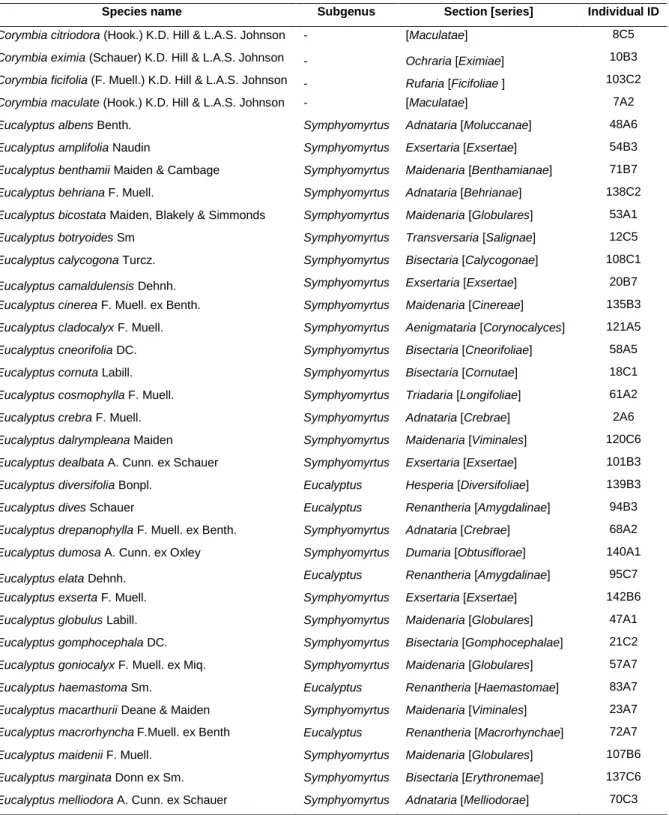
The plant material used in this study was collected in Eucalyptus Arboretum at Escaroupim National Forest (Escaroupim, Portugal) in October 9 and 11 and November 11, 2013. Leaves were sampled on individual trees from single species collection plots [45]. The sampling resulted in a total of 62 species (Table S1). All plant material was lyophilized using a freeze dryer and properly stored until further use. Exceptionally, E. grandis young leaves of clonally in vitro propagated plants were sampled.
The DNA extraction was performed according to the protocol adapted from Gemas [46]. Approximately 50-100mg of lyophilized leaf tissue discs, from a single tree of each of 62 species were used for DNA extraction. DNA integrity was checked by running the DNA samples in a 0.8% (w/v) agarose gel, in 0.5X Tris-Borate-EDTA buffer (TBE), and stained SYBR Safe (Invitrogen®, Carlsbad, CA, USA), along to the molecular marker λ phage DNA (Invitrogen®, Carlsbad, CA, USA). Bands were visualized in a Gel Doc-1000 UV (Bio-Rad® Laboratories, Inc.) image acquisition system. Quantification and quality (A260/280 and A260/230 ratios) of nucleic acids was determined using the NanoDrop ND-1000 Spectrophotometer (Thermo ScientificTM, Wilmington, Delaware, USA).
3.2 Selection of promoter region
Eucalyptus lignification genes promoter region sequences:
The 1000bp upstream the first start codon (ATG) of each gene from the Eucalyptus core lignin toolbox [13] (Table S4) were chosen to represent promoter region. A sequence containing the 1000bp promoter regions and the 200-300bp after the first start codon were extracted from the current annotation set version 1.1 of the E. grandis genome stored in JGI/CIG-Phytozome v9.1 using the PhytoExtract [47].
Arabiopsis, Populus and Vitis lignification genes promoter region sequences:
Orthologous promoter sequences, of the gene members belonging to the Eucalyptus core lignin toolbox, of A. thaliana, P. trichocarpa and V. vinifera, three angiosperm genera were retrieved from the available versions of the genomes stored in Phytozome v.10 [63]. For orthologs selection the tool Keyword search was used, using E. grandis genes as target. Then the respective protein homologs of each of the three species with higher score and percentage of similarity were selected (Table S4). The
7 1000bp upstream flanking-coding region (Transcript) sequence from each orthologous gene was retrieved using the sequence retrieval tool from BioMart [48]. The promoter datasets were compiled resulting in a total of 75 sequences representing the members of the Eucalyptus core lignin toolbox and their orthologous promoter regions in the other three genera.
3.3 Primer design
Primer 3 Plus (http://primer3plus.com/) was used to design new primer pairs that targeted the maximum of the promoter region sequences, with the following options: i) annealing temperature of 60ºC and G/C content 40-60%; ii) primer size between 18 to 22bp, and expected product size range of 851-1000bp; iii) Max Self Complementarity and Max Pair Complementarity of 0 whenever possible. The forward primers were designed to match the 5’ promoter region sequence end and the reverse primers to match the first nucleotides of the transcript sequence. For all genes but EgrHCT5 was possible to design specific set of primers (Table S2). For gene EgrHCT5 it was no possible design a set of primes due to the high percentage of N bases in the promoter sequence.
3.4 DNA Amplification
The PCR amplification was performed using the 50 ng DNA of each species sample (Table S1) and the primersdescribed in Table S2. Water was used as negative control. All amplifications were held in Thermal Cycler C-1000 (Bio-Rad® Laboratories, Inc.), in a total volume of 20μL using 10ng of DNA, 5X Colorless GoTaq® buffer, 1.5mM MgCl2, 0.2mM of each dNTPs, 0.4μL of primer forward (10μM), 0.4μL of primer reverse (10μM), and 1U of GoTaq® DNA polymerase (Promega, Madison, WI, USA). Conditions of the PCR amplification were as follows: denaturation cycle at 94ºC for 3 min, then 40 cycles at 94ºC for 15 seconds, annealing at 60ºC or 65°C for 30 seconds, extension for 72ºC for 1 min, and a final extension at 72ºC for 10 min. The evaluation of the bands of the PCR products was performed using the 2% (w/v) agarose 0.5X TBE gel and the molecular marker 1 Kb Plus DNA Ladder (Invitrogen®, Carlsbad, CA, USA). The bands were visualized in a Gel Doc-1000 UV image acquisition system (Bio-Rad® Laboratories, Inc.).
8 3.5 Sequencing of promoter regions
In order to prevent unincorporated components and undesired by-products, which interfere with direct DNA sequencing, PCR products were purified with NZYGelpure kit (NZYTech), according to the manufacturer’s instructions. All the purified products were eluted in 20µl or 30µl of ultrapure water and quantified before sequencing. The PCR products were sequenced at STAB Vida (STAB Vida, Lisboa, Portugal) using reverse primers in order to maximize the promoter region sequence.
For those genes/samples combinations in which the sequences presented multiple overlapping sequence peaks, the sequence was discarded, the corresponding PCR reactions repeated, and the PCR products were cloned using the TOPO® TA Cloning® Kit (Invitrogen®, Carlsbad, CA, USA). The transformed colonies were identified, handpicked and cultured overnight in LB containing 50μg/mL ampicillin. Cloned fragments were checked by colony PCR screening using universal primers: M13-20
forward (5´-GTAAAACGACGGCCAG-3´) and M13 reverse
(5´-CAGGAAACAGCTATGAC-3´). The correct size PCR products were then purified and the amplified product corresponding to one colony was random selected and sent for sequencing, using one of the universal primers: M13-20 forward and M13.
3.6 DNA sequence analysis
Chromatograms and quality chart of each sequence were analyzed to check sequence quality (minimum phred 20). Cloned fragment sequences were scanned with Vecscreen [49] to identify and remove any segments of vector origin. When present in the sequences, the downstream ATG sequences were removed for further analysis. Sequences were aligned using ClustalW Multiple alignment function [50]of the BioEdit Sequence Alignment Editor version 7.2.5 [51] and alignments were corrected by manual inspection.
DnaSP (DNA Sequence Polymorphism) version 5.10.01 software [52] was used to calculate several measures of genetic polymorphism including the nucleotide diversity, Pi (π;[53]). For all nucleotide diversity calculations were used the associated algorithm Nucleotide diversity (gaps/missing data). This option is used in the events that there are gaps in the sequence data. Otherwise the indels present in the sequences would be ignored. Nucleotide diversity distributions along each promoter region sequence were graphically represented using the sliding window method, calculating π on a moving window of 50bp with a step size of 10bp.
9 3.7 Putative cis-regulatory elements in silico prediction and selection
Two strategies were used to select putative cis-regulatory elements (CREs) to be mapped into the Eucalyptus sequences: i) identification of known CREs and ii) identification of novel putative CREs.
First, CREs were chosen by searching known motifs in the sequences of promoter region data set (3.2 Material and Methods). Each of the promoter regions were individually scanned using the plant-specific database PLACE [37]. Cis-elements with motif lengths greater than five base pairs were selected if they were present in promoters of genes of all the 11 multigene families composing the Eucalyptus lignin toolbox and present in at least 50% of the scanned sequences. In addition, five secondary cell wall-associated elements previously reported in literature were also retrieved for subsequent cis-elements mapping, as follows: CRPE31, CRPE28, CRPE26, CRPE25 [17] and PALBOXPPC [54].
A second group of putative CREs motifs were predicted based on their overrepresentation in the sequences data set of promoter regions (3.2 Material and Methods). Three software programs were used for motifs discovery: a) MotifSampler [35, 55]; b) RSA tool oligo-analysis [21, 56]; c) MEME [34, 57]. An element was
considered overrepresented when their frequency in the 75 examined promoters was above the average level of the Arabidopsis genome, the background model available and selected in the three software programs. For the purposes of this work the default settings of the programs were used, with exception of those specified or below:
a) MotifSampler [35]:
The output parameter - r (number of times the motif detection algorithm must be repeated) was set to 50. Was used the Arabidopsis background model of order 4 provided by the software package, giving more reliability to high LL scores obtained.
b) RSA tool oligo-analysis [21]:
The oligomer lengths selected were of size 7 and 8, excluding the ones of size 6. The conversion of assembled patterns to matrices was defined to a maximum of 10 matrices.
c) MEME (Multiple Em for Motif Elicitation) [34]:
The width of the motif was defined with a minimum of 6bp and a maximum of 8bp. The maximum number of motifs to find was defined as 4 motifs (rather than the default 3). Taking into account the distribution of motif occurrences among the sequences it was performed a run with the option - Zero or one occurrence of a single motif per sequence and a second run with the option - Any number of repetitions per sequence.
10 STAMP [58, 59] was used to compare and to hierarchically cluster, by motif similarity and redundancy, the outputs of the three programs. Motifs were inputted into the software as position-specific scoring matrix (PSSM) allowing a more reliable comparison taking into account the “background” probability of different letters. The clustering resulted from a joint analysis of the proximity of the motifs in the UPGMA tree (output of STAMP) and of the observation of the correspondent most similar CREs in the PLACE database for each motif. The motifs of each defined group were aligned and a consensus sequence was generated. The motifs were entitled lignin-related promoter elements (LRPE) and numbered sequentially.
3.8 Cis-element mapping
RSA tool Pattern Matching [21, 56] was used to map and count occurrences of the selected CREs in the promoter sequences of each of the selected Eucalyptus species. Default settings were used. The RSA tool ‘Random Sequence Generator’ was used to generate a random data set calibrated on non-coding upstream sequences of Arabidopsis. An Arabidopsis-specific Markov model was used to generate 10 random sequences. All random and Eucalyptus species sequences containing the mapped CREs were divided into 100-bp intervals and the CREs occurrences in each one were counted. For each 100-bp intervals of each promoter gene, a two-tailed t-test (assuming equal variance) was performed to identify those intervals, showing significant differences in the number of CREs relatively to random data set (for both, α= 0.01 and α= 0.001).
3.9 Cis-element conservation analysis
Cis-element conservation was assessed by manually counting the number and type of nucleotide changes that occurred within each cis-element occurrence considered. The cis-elements occurrences were classified as conserved, if no polymorphism occurred in any of the Eucalyptus species analyzed; putative cis-element occurrences that had a single nucleotide polymorphism or that had two or more nucleotide changes causing the loss of the respective cis-element in one or more species were also scored separately. All the occurrences absent in only one of the nine Eucalyptus species or absent in two or more species due to the same type of changes were annotated. The cis-element counts and the respective calculations of averages and percentages of the polymorphisms affecting cis-element occurrences were carried out using Excel (Microsoft Office 2007).
11 4 RESULTS
4.1 Extraction Integrity and Quantification of Eucalyptus species DNA
DNA was successful extracted from lyophilized leaves. A visible sharp band at the level of the λ-phage DNA band confirmed the presence of DNA. The average of overall DNA extracted from 62 samples was 5.072µg/µL, ranging from 0.196µg/µL (E. amplifolia, sample 54B3) to 1.030µg/µL (E. globulus, sample 47A1). The quantification using NanoDrop ND-1000 Spectrophotometer, confirm the purity of DNA, showing a 260/280 ratio of ~ 2.1. The 260/230 ratio had values of approximately 1.9, which are slightly lower than the desired values (2.00-2.20). However, the quantity and quality of the DNA obtained revealed viable for the present study.
4.2 Primer Testing for PCR Amplification
Twenty-three out of 30 (77%) primers sets yielded successful (a single band per locus) amplification for at least one of the species used in primer testing, according to the established PCR conditions (3.4 Material and Methods) and optimization. Only ProC3H3_PP primer set showed lack of amplification. The remaining six primer sets (20%) showed multiband amplification. The results of this prior test for PCR amplification were used to help establish the criteria for selection of the primer sets to further study. Therefore, a total of 11 primer sets (Table 1) were selected for amplification of the promoter regions over the 62 species (Table S1). The successful amplification over the eleven primer sets was very substantial (73%), showing a considerable degree of conservation of the promoter region in the related species under analysis (Table 1). Only Pro4CL1_PP showed a total percentage of successful amplification below 50% (42.6%). By contrast, ProCSE_PP (100%) led to a successful amplification in all the species analyzed.
Observing the results, it is possible to recognize that the species with greater failure in amplification, considering the results of the 11 primer sets, were the four species from the genus Corymbia. The species of the subgenus Eucalyptus showed successfully amplification values substantially lower than the observed in the subgenus Symphyomyrtus. Within the genus Eucalyptus, the species with lower successful amplification (less than 50%) were the ones belonging to the subgenus Eucalyptus, E. elata, E. pilularis, E. piperita and E. stricta (Table 1).
12 4.3 Isolation and analysis of promoter regions of the five lignin genes in nine
Eucalyptus species and one Corymbia (C. citriodora).
Five primer sets were selected for amplification and further analysis of promoter regions: EgrPAL9, EgrC4H2, EgrF5H2, EgrCAD3 and EgrCSE. The selection of these genes was done taking into account the position of the enzymes in the lignin biosynthetic pathway (Fig. 1). EgrCAD3 gene (Eucgr.H03208) was removed from the current E. grandis v1.1 annotation but RNAseq and RT-qPCR expression data support that it is being actively transcribed in developing xylem tissues [13]. The gene can still be found in the low confidence transcripts in the current v1.1 annotation. Furthermore, these genes were selected because they could become of interest for future studies enlightening the integration of information obtained from different types of expressional regulation. CSE is a newly identified gene, recently described in Arabidopsis and not yet reported in any other species [16]. This gene was found to contribute for the lignification of plant vascular tissues, and also found to be highly and preferentially expressed in forming xylem in Eucalyptus [13].
Emphasis was given to the subgenus Symphyomyrtus, the largest and most diverse Eucalyptus subgenera [1], for species selection. Given their representativeness in terms of phylogenetic distribution, commercial importance and availability of plant samples, the following species were selected: E. globulus and E. viminalis (section Maidenaria), E. grandis, E. urophylla, E. botryoides (section Transversaria), E. camaldulensis and E. tereticornis (section Exsertaria) [4, 15, 60]. Furthermore, two distantly related species E. regnans and E. elata, from subgenus Eucalyptus (section Renantheria), were also selected for the analysis [4, 61]. Additionally, C. citriodora was
also selected as an out group. Despite some disagreements [4], there is a general acceptance to consider Corymbia as different genus of eucalypts [3, 6], and several molecular studies support this classification [5, 62].
The 1000bp upstream ATG region of the five genes were amplified from one individual of each species and used to study patterns of sequence, spatial conservation and occurrence of CREs among Eucalyptus species, using PCR conditions described in Table 1. Even after several attempts of primer optimization and design it was not possible to isolate the upstream regions of the PAL9, C4H2, F5H2 and CAD3 from E. elata and C. citriodora may be due to high sequence divergence in the upstream priming sites. As a result, promoter data set relative to these four genes only contained sequences from eight Eucalyptus species.
13 Table 1: PCR conditions for amplification of 1000bp upstream ATG region of eleven lignin and success of amplification results by genera (Corymbia vs Eucalyptus) and Eucalyptus subgenera (Eucalyptus vs Symphyomyrtus)
Multi-gene family Gene short
name Primer ID Ta (°C) [MgCl2] mM
Phylogenetic divisions of species analyzed genus Corymbia (four species) genus Eucalyptus subgenus Eucalyptus (13 species) genus Eucalyptus subgenus Symphyomyrtus (43 species) Total of species (62 species) Amplification Featuresa Amplification
Features Amplification Features Amplification Features
A MA NA A MA NA A MA NA A MA NA
Phenylalanine ammonia lyase
(PAL) EgrPAL9 ProPAL9_PP 60 1.5
25% 0% 75% 69.2% 61.5% 46.2% 81.8% 2.3% 2.3% 83.9% 1.6% 14.5% Cinnamate 4- hydroxylase (C4H) EgrC4H1 ProC4H1_PP 60 2.5 0% 25% 75% 0.0% 30.8% 38.5% 95.3% 4.7% 0.0% 82.0% 14.8% 3.3% Cinnamate 4- hydroxylase (C4H) EgrC4H2 ProC4H2_PP 65 1.5 0% 100% 0% 30.8% 7.7% 7.7% 72.1% 30.2% 0.0% 59.7% 38.7% 1.6%
Coumarate CoA ligase (4CL) Egr4CL1 Pro4CL1_PP 65 1.5 0% 25% 75% 69.2% 61.5% 46.2% 51.2% 46.5% 2.3% 42.6% 47.6% 9.8%
Shikimate O-hydroxycinnamoyltransferase (HCT) EgrHCT4 ProHCT4_PP 60 2.5 25% 50% 25% 0.0% 30.8% 38.5% 58.1% 41.9% 0.0% 60.7% 37.7% 1.6% p-coumarate 3-hydroxylase (C3H) EgrC3H4 ProC3H4_PP 60 2.5 75% 25% 0% 30.8% 7.7% 7.7% 72.1% 27.9% 0.0% 78.7% 21.3% 0.0%
Caffeoyl Shikimate Esterase
(CSE) EgrCSE ProCSE_PP 60 2.5
100% 0% 0% 69.2% 61.5% 46.2% 100.0% 0.0% 0.0% 100.0% 0.0% 0.0%
Ferulate 5-hydroxylases (F5H) EgrF5H2 ProF5H2_PP 60 2.5 0% 25% 75% 0.0% 30.8% 38.5% 95.5% 4.5% 0.0% 88.7% 4.8% 6.5%
Caffeic acid
O-methyltransferase (COMT) EgrCOMT35 ProCOMT35_PP 60 2.5
0% 0% 100% 30.8% 7.7% 7.7% 83.7% 7.0% 9.3% 70.5% 4.9% 24.6%
Cinnamyl CoA reductase
(CCR) EgrCCR1 ProCCR1_PP 60 2.5
0% 25% 75% 69.2% 61.5% 46.2% 93.0% 4.7% 2.3% 80.3% 6.6% 13.1%
Cynnamyl-alcohool
dehydrogenase (CAD) EgrCAD3 ProCCR3_PP 65 1.5
0% 0% 100% 0.0% 30.8% 38.5% 68.2% 22.7% 9.1% 56.5% 19.4% 24.2%
Average 20% 25% 55% 34% 36% 33% 79% 17% 2% 73% 18% 9%
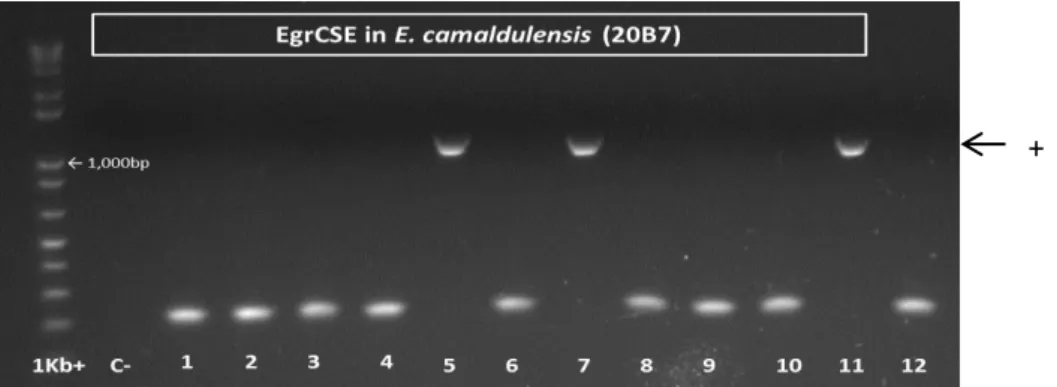
14 All the PCR products were initially, directly sequenced. Products that its sequences presented multiple overlapping sequence peaks (CSE - 95C7, 66B3, 6C4, 20B7, 8C5, 12C5 and 28A2; F5H2 - 20B7 and 22B1) were discarded. For these cases corresponding PCR products were cloned before sequencing. In general, the efficiencies of cloning and transformation were found low (with few number of colonies and high number of false positives detected by PCR colony screening) (Fig. 2). Several attempts were carried out in order to increase the transformation efficiencies: volumes of PCR product, cloning reaction conditions, different competent E.coli cells strains and transformation reaction conditions.
Fig. 2: Example of the results of PCR colony screening to EgrCSE in E. camaldulensis. The bands 5, 7 and 11 correspond to positively transformed clones with expected size – expected product size (951bp) and fragment of the vector amplified using universal (M13) vector primers (201bp).
For three of the species, the PCR products of EgrC4H2 presented a non-specific band. Furthermore, PCR products successfully purified and sequenced always presented multiple overlapping peaks and poor quality along all promoter regions, and it would require the cloning of all PCR products for all species. Thus, for the purpose of this work and by time constraints it was decided to leave the study of the promoter region of this gene for further analysis.
To validate the correct sequence of all promoter sequences analyzed in this study, they were blasted against E. grandis genome [63]. The sequences matched a single region directly upstream of the corresponding gene, with high homology (> 88% nucleotide identity) (Table S3). This supports the inference that no paralogous promoters were isolated. After sequence treatment and trimming, promoter regions obtained varied in length from 421bp for CAD3 in E. urophylla (6C4) to 992bp for the PAL9 promoter in E. botryoides (Table S4). Some of the sequences obtained displayed significantly smaller size than the remaining placed in the same alignment. And in such cases their 3 'end aligned some base pairs upstream the ATG in the reference sequence.
15 4.4 Species-level DNA sequence variation and diversity in the promoter regions of
Eucalyptus lignin genes.
Nucleotide diversity (π, [53]) and other measures of genetic polymorphism and sequence conservation were calculated using DnaSP version 5.10.01 software [52]. The distribution of nucleotide diversity along the promoter sequences of each gene was calculated using different subsets of sequences, due to the small size of some of the consensus sequences, except for F5H2 promoter set (Table 2).
The mean G/C content was 43%, with a minimum of 33% in the F5H2 promoter sequences. The highest G/C content was found in the promoter sequences of PAL9, with 53% (average of GC content values among the A, B and C subsets).
The average species-level nucleotide diversity (π) of the four Eucalyptus lignin genes promoter regions varied from π=0.026 for PAL9 (average of A, B and C nucleotide diversity calculations) to π=0.078 for CAD3 (average of A, B, C and D).
Table 2: Species-level nucleotide diversity in the promoter regions of four lignin genes from 9 Eucalyptus tree species
Promoter region ID PAL9 PAL9 PAL9 CSE CSE CSE F5H2 CAD3 CAD3 CAD3 CAD3
Species subsetsa A B C A B C A A B C D Number of species analyzed 8 7 6 9 8 10 8 8 7 7 5 Length of aligned sequence (including gaps/missing data) (bp) 920 920 920 886 886 924 795 904 904 904 904 G+C content (%) 55 50 54 46 45 46 33 31 37 34 38
Total number of sites
(excluding gaps) (bp) 209 495 455 556 694 468 581 298 596 412 797
Number of polymorphic
sites 57 56 54 112 99 190 86 155 150 148 112
Nucleotide diversity (π) 0.02428 0.02572 0.02664 0.03775 0.03603 0.05809 0.03172 0.07812 0.07770 0.07859 0.06971 Total number of
insertions and deletions (indels) events analyzed
5 7 10 4 6 15 12 8 15 8 13
a A (in the four promoter regions) - all the Eucalyptus sequences available; B (PAL9) - without E.
botryoides (12C5) sequence; B (CSE and CAD3) - without E. urophylla (6C4) sequence; C (PAL9) - without E. urophylla (6C4) and E. regnans (28A2) sequences; C (CSE) – including C. citriodora (8C5) sequence; C (CAD3) - without E. camaldulensis (20B7) sequence; D (CAD3) - without E. urophylla (6C4), E. camaldulensis (20B7) and E. regnans (28A2) sequences.
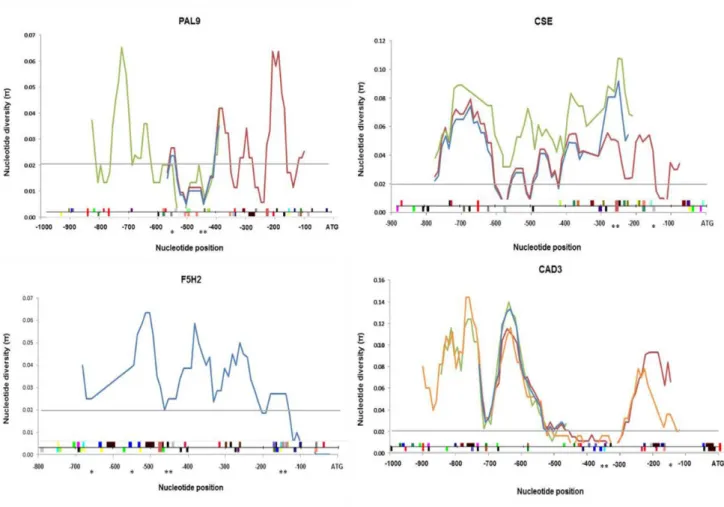
The graphs of nucleotide diversity distribution for each subset were overlapped to evaluate the distribution throughout the entire promoter region in analysis (Fig. 3). The profiles of the distribution of nucleotide diversity were coincident for all subsets of sequences, with the exception of CSE-C subset (green line - including C. citriodora sequence).
16 The levels of nucleotide diversity observed in promoter regions at the species-level are, in general, superior to 0.02. Nevertheless, there were regions in all promoters where species-level diversity was below 0.02 that is the threshold of nucleotide diversity expected for conserved coding regions [64]. This relative sequence conservation could indicate functional restrictions within those regions and may contain clusters of cis-regulatory elements.
Fig. 3: Species-level nucleotide diversity profiles of the promoter regions from four Eucalyptus phenylpropanoid metabolism and lignin pathway genes in nine Eucalyptus and one Corymbia tree species. Nucleotide position is indicated relative to the start of translation (ATG position 0). Nucleotide diversity at 0.02 is marked by a grey line. The line and color blocks at the bottom of each graph show the position in the sense (upper) and anti-sense (down) strands of the mapped cis-element occurrences in the E. grandis reference sequence. A cis-element key is in Fig. 4 (See section 4.6) The different color lines correspond to the subsets of species listed in Table 2 as follows: blue – A; red – B; green – C and orange – D. Single asterisk and double asterisks at the bottom of each graph are positioned at the 100-bp intervals that showed higher number of cis-elements occurrences with significant differences from the random dataset. (p=0.01 and 0.001, respectively; two-tailed t-test assuming equal variance) (See section 4.6 and Fig.S2).
17 Indels and microsatellite regions were found in promoter regions of all the four genes. The E. tereticornis PAL9 promoter region presented two 5bp indel (-488bp to -492bp and -635bp to -639bp) not observed in any of the other Eucalyptus species. In the F5H2 promoter region a 103bp indel (-547bp to -650bp) was detected also for E. tereticornis. The CSE multiple alignment showed a 34bp conserved indel in the species E. globulus, E. viminalis, E. camaldulensis, E. tereticornis and E. elata, not being presented in the remaining species. It is interesting to point out to a microsatellite region (CT rich motif) between -145bp and -176bp in the promoter region of the CSE gene showing different polymorphisms in some of the species. In the CAD3 promoter is also possible to observe a 17bp indel (-89bp to -105bp) in E. grandis and E. globulus.
4.5 In silico identification of putative CREs 4.5.1 Identification of known CREs
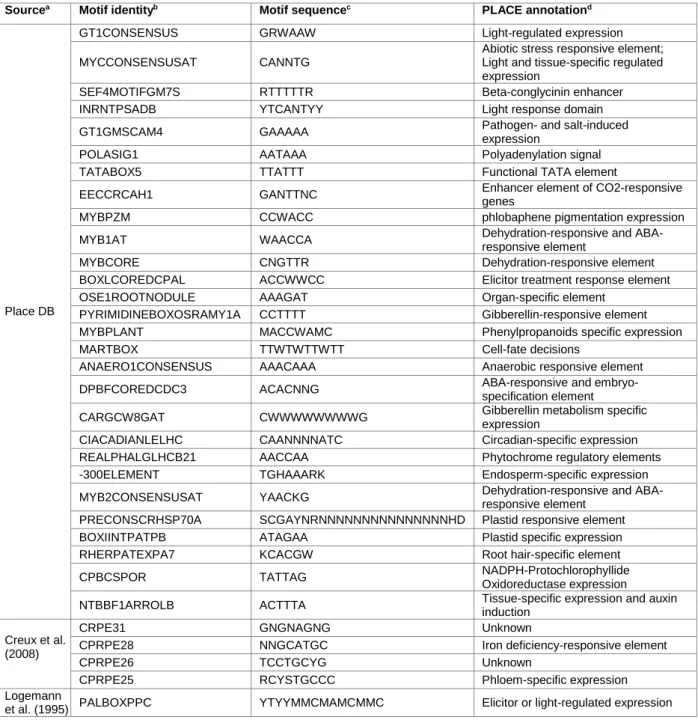
Cis-regulatory elements in the promoter sequences of genes members of the Eucalyptus core lignin toolbox and their orthologous in the other three genera were detected by homology in the plant-specific database PLACE. Excluding from the outset the motifs with five or less base pairs, a total of 219 different cis-elements were identified within the 75 promoter region sequences. These results were further refined to find CREs present in sequences belonging to the eleven lignin multigene families in Eucalyptus, which were identified in more than 50% of the sequences analyzed. Within this subset for the identified polyadenylation signals and functional TATA elements only the elements that appeared in the greater number of sequences were considered: TATABOX5 (89% of the sequences) and POLASIG1 (91% of the sequences). Table 3 contains detailed information of the selected 28 CREs from PLACE database who fulfilled those requirements. Those CREs are most likely involved in lignin gene regulation. Therefore, they were subsequently used to map the promoter regions of Eucalyptus species under study.
GT1CONSENSUS CRE was found in all the 75 gene promoters and MYCCONSENSUSAT and SEF4MOTIFGM7S occurred in 73. Twenty five percent of the CREs detected in those promoter regions were AC elements (MYB binding sites) (Table 3). The consensus sequence of some of those motifs could, potentially, lead to the recognition of the same sequence motif, resulting in the identification of more than one cis-element in the same position. For instance, BOXLCOREDCPAL (5’- ACCWWCC-3’) could be identified in the same position than MYBPLANT (5’- MACCWAMC-3’). However, as there is no prior knowledge of which factors actually
18 bind to specific regions of the sequences in analysis, all the elements referred in Table 3 were used for cis-elements mapping. The five cis-regulatory elements retrieved from literature reports used to map the promoter regions of Eucalyptus species under study (3.7 Material and Methods)were also included in Table 3.
Table 3: Details of 33 cis-regulatory elements selected from PLACE database scans and literature and used for DNA pattern matching
Sourcea Motif identityb Motif sequencec PLACE annotationd
Place DB
GT1CONSENSUS GRWAAW Light-regulated expression
MYCCONSENSUSAT CANNTG
Abiotic stress responsive element; Light and tissue-specific regulated expression
SEF4MOTIFGM7S RTTTTTR Beta-conglycinin enhancer
INRNTPSADB YTCANTYY Light response domain
GT1GMSCAM4 GAAAAA Pathogen- and salt-induced
expression
POLASIG1 AATAAA Polyadenylation signal
TATABOX5 TTATTT Functional TATA element
EECCRCAH1 GANTTNC Enhancer element of CO2-responsive
genes
MYBPZM CCWACC phlobaphene pigmentation expression
MYB1AT WAACCA Dehydration-responsive and
ABA-responsive element
MYBCORE CNGTTR Dehydration-responsive element
BOXLCOREDCPAL ACCWWCC Elicitor treatment response element
OSE1ROOTNODULE AAAGAT Organ-specific element
PYRIMIDINEBOXOSRAMY1A CCTTTT Gibberellin-responsive element
MYBPLANT MACCWAMC Phenylpropanoids specific expression
MARTBOX TTWTWTTWTT Cell-fate decisions
ANAERO1CONSENSUS AAACAAA Anaerobic responsive element
DPBFCOREDCDC3 ACACNNG ABA-responsive and
embryo-specification element
CARGCW8GAT CWWWWWWWWG Gibberellin metabolism specific
expression
CIACADIANLELHC CAANNNNATC Circadian-specific expression
REALPHALGLHCB21 AACCAA Phytochrome regulatory elements
-300ELEMENT TGHAAARK Endosperm-specific expression
MYB2CONSENSUSAT YAACKG Dehydration-responsive and ABA-responsive element
PRECONSCRHSP70A SCGAYNRNNNNNNNNNNNNNNNHD Plastid responsive element
BOXIINTPATPB ATAGAA Plastid specific expression
RHERPATEXPA7 KCACGW Root hair-specific element
CPBCSPOR TATTAG NADPH-Protochlorophyllide
Oxidoreductase expression
NTBBF1ARROLB ACTTTA Tissue-specific expression and auxin
induction Creux et al.
(2008)
CRPE31 GNGNAGNG Unknown
CPRPE28 NNGCATGC Iron deficiency-responsive element
CPRPE26 TCCTGCYG Unknown
CPRPE25 RCYSTGCCC Phloem-specific expression
Logemann
et al. (1995) PALBOXPPC YTYYMMCMAMCMMC Elicitor or light-regulated expression
aOriginal source of the cis-element; bPublished name or identity of the cis-element; cPublished
consensus sequences for the cis-elements motifs with ambiguous bases represented as IUPAC codes where W=A/T, M=A/C, R=A/G, K=T/G, S=G/C, Y=C/T and N represent any of the four bases;
19 4.5.2 Identification of unknown CREs using three software programs
Prediction of putative CREs was carried out by detection of over-represented motifs in 1 kb upstream promoter sequences of a set of genes highly or preferentially expressed in differentiating secondary xylem using three software programs (3.2 Material and Methods).
MotifSampler prediction allowed the identification of 50 motifs with Log-likelihood (LL) scores varying between 762 and 997. Some of the return motifs represented exactly the same consensus sequences. In the Oligo-analysis search, all the motifs displayed a number of occurrences considerably higher than the random expectation value, according to the background model. The significance values (sig= - log10 (e-value)),
indicating the number of false-positives that would be expected by chance, varied between 0.4 and 31.72 (a significance higher than 0 would be expected, by chance alone, once per sequence set) [21]. The RSA tool pattern assembly automatically assembled the significant words, discovered by Oligo-analysis search. Clusters of aligned oligonucleotides were generated and the resultant best 20 consensus sequences (with greater lengths) were displayed. Since there was no information about the distribution of the motifs occurrences among the input sequences, MEME search were carried out in two different runs. The selection of the correct type of the motif distribution improves the sensitivity and quality of the motif search. The two runs differed in the distribution options, one considering zero or one occurrence of a single motif per sequence and the other considering any number of repetitions per sequence. The obtained motifs from MEME search are shown inTable S5.
Based on the outputs of the three software programs a total of 77 motif sequences were identified as overrepresented in the Eucalyptus and respective A. thaliana, P. trichocarpa and V. vinifera orthologous promoter regions. However, the output of those three programs included redundant and strong mutually overlapping motifs. The 77 motifs were introduced in STAMP software in order to detect motif similarity and redundancy within the outputs of motif-finders. The motifs of each defined group were manually aligned and a consensus sequence was generated. This allowed obtain a nonredundant set of 10 putative motifs (Table 4; Fig. S1). Five out of ten motifs were not annotated and not considered in further analysis: three of them consist in repeat motifs, being very likely microsatellite regions (AGGAGGAGGAGG; AGAAGAAGA and ATATATATATATAT), and the two other were extremely ambiguous (GGKNGKKGGN and GSCGGKBG).