A Work Project presented as part of the requirements for the Award of a Masters Degree in Finance from NOVA School of Business and Economics.
Directed Research Internship
Dynamic Delta Hedging of Autocallables under a Discrete
Rebalancing Context
Tiago Vieira Lopes Student Number: 729
Abstract
This work tests different delta hedging strategies for two products issued by Banco de Investimento Global in 2012. The work studies the behaviour of the delta and gamma of autocallables and their impact on the results when delta hedging with different rebalancing periods. Given its discontinuous payoff and path dependency, it is suggested the hedging portfolio is rebalanced on a daily basis to better follow market changes. Moreover, a mixed strategy is analysed where time to maturity is used as a criterion to change the rebalancing frequency.
Keywords: Autocallable; Delta Hedging; Discrete Rebalancing
A Project carried out under the supervision of Professor Afonso Eça.
2 Table of Contents
Abstract ... 1
I. Introduction ... 3
II. Literature Review ... 5
III. Data and Methodology ... 7
1. Methodology ... 7
1.1. The Model ... 8
2. Data ... 9
IV. Results ... 12
1. Basket TOP América ... 12
1.1. Hedging Results ... 13
2. Basket Acções Recursos Naturais ... 15
2.1. Hedging Results ... 15
3. Discretionary Hedging ... 18
V. Conclusion ... 21
References ... 22
3 I. Introduction
In an economic landscape of low yields, financial institutions struggle to find new ways to increase the returns they can offer to investors. Autocallable Notes are very popular financial products to fight this problem given their above average yield andwell defined payoffs. In simple terms, an Autocallable Note (which from now on will be denominated as “Autocallable”) is a structured product that pays a coupon on autocallable dates if the underlying asset (or basket of assets) is above a pre-determined strike price. If that condition holds true in any of the autocallable dates, the product is automatically called and ceases to exist; if not, it carries on until maturity where either the investor is exposed to the depreciation of the underlying asset (or the depreciation of the worst performer of a basket of assets) or the total notional is retrieved to him. Autocallables can have a lot of variations but, even though the investors’ capital is usually at risk when the underlying performs negatively, I will only cover the case where the investors’ capital is fully guaranteed, as this is the most common autocallable structure issued by Banco de Investimento Global (BiG).
For illustrative purposes, let’s assume an investor is really interested in investing in Apple and Microsoft but does not want to worry about the constant changes in their market prices, nor wants his investment at risk. He can invest in a 1-year capital guaranteed autocallable which pays a 5% coupon if both assets are above their initial prices in the first semester, or 10% if both are over the strike price at maturity. If, for instance, Microsoft fails to cross its strike price in any of the two semesters, the investor will not receive the coupon but neither will he lose the money invested, as the full amount will be reimbursed to him. The payoff described is represented in figure 1.
4 Although attractive to investors given its low risk and higher yields, the autocallable is not easily replicated. It is a discontinuous and path dependent instrument which does not have any closed form solution available, thus being priced using the Monte Carlo simulation. This approach can often lead to an option mispricing, hence leading to a mishedge.
This work will focus on the hedging of this type of instruments, i.e., how a financial institution manages the risks of issuing this type of products. It outlines the challenges that arise from the need to dynamically hedge an option position, through the so called Delta Hedging. Through dynamic delta hedging, an underwriter can replicate an option and protect itself against any loss incurred by the written option and, this way, a trader will be indifferent to the payoff of the instrument that he previously sold, since he is, theoretically, perfectly hedged. Even though Black-Scholes (1973) refers to continuous delta hedging to perfectly correct for undesired changes in stock prices, this is not accurate as some simplifying assumptions are not observed in a real market environment. Among those is the inability to hedge continuously as there is no such thing as continuous trading, or continuous prices.
Figure 1: Autocallable payoff
0.00% 2.50% 5.00% 7.50% 10.00% 12.50% -20% -16% -12% -8% -4% 0% 4% 8% 12% 16% 20% Co up o n Moneyness 6 Months Maturity
5 In this paper, the focus goes towards dynamic delta hedging given different rebalancing periods. It tests what would be the hedging results if the revision period of the replicating portfolio was one, two or up to five days of difference. Two different products issued by BiG in 2012 serve as a starting point to study the hedging outcome of different hedging strategies. Henceforth, it studies if the time to maturity has an impact on the optimal hedging frequency and how the delta behaves for different strikes and maturities.
Section II highlights the secular work on dynamic hedging, where the state of the art stands and what this paper intends to add to the literature. Section III outlines the methodology used for this study, along with the data that was used for the different tests. The results and discussions are presented in section IV, followed by conclusions in section V.
II. Literature Review
Black-Scholes (1973) first introduced an option’s valuation framework where all parameters were known and a perfect hedge position was possible with a replication portfolio. This breakthrough achievement was the basis for pricing derivatives and since then a lot of variations arose. However, for options where one cannot derive a closed-form solution, and whose payoff is heavily path dependent, Boyle (1977) introduced the Monte Carlo method for pricing. This method requires the simulation of n different paths for the underlying asset’s price and then, the option’s value is computed by averaging the payoffs of all simulations. Usually, it is used when discontinuities, uncertain time to maturity and path dependence is observed, such as in the autocallables.
6 In order to be indifferent to the outcome of a product, the issuer of an option needs to hedge his position. The underwriter is exposed to a variety of risks, also known as Greeks, that might affect the option’s expected value, and which account for the exposure of an option, or portfolio of options, to each specific risk, assuming all the other variables remain constant. Among those are the Delta, Gamma, Vega, Theta, and Rho. Hull (1988) offers in his book a comprehensive description of the Greeks, which are summarized in appendix 1. Albeit the existence of all those risks, the underwriter cannot always fully hedge himself as that would be too costly and impractical. The issuer usually takes closer attention to the market risk of its position, hedging mostly its delta (Δ). Since the main objective of this work is to study the best dynamic delta hedging frequency I will, henceforth, concentrate on this Greek.
Hedging strategies might change from static hedging to dynamic hedging. The former, discussed in Carr et al. (1998), supports the fixing of the hedging position in the beginning of the issue and not changing it until maturity. The later, dynamic hedging, defends a constant rebalancing of the hedging portfolio in accordance to changes in market conditions. In this work, the later strategy is used, as it is common practice among financial institutions when hedging instruments that are not easily replicated in the market and whose payoff depends on different factors. In practice, the derivatives trader will make its positions delta neutral at the end of the day, while monitoring gamma and vega, which will not be managed every day, unless their levels are not acceptable for the risk manager.
Black-Scholes (1973) also defended that if the hedge was continuously maintained, the approximation between the hedge and the option’s value would be exact and certain. However, assumptions like continuity, no transaction costs and constant variance are
7 not realistic. Boyle and Emanuel (1980) tackled the problem of the impossibility of continuous trading and tested what would be the results when the hedge portfolio was rebalanced discretely. As expected, the hedging returns improved the higher the rebalancing frequency, with the results presenting a significant negative skew. Recently Ku et al (2012) reached the same conclusion, but they included the existence of transaction and liquidity costs. Their work followed the framework of Leland (1985) for the inclusion of transaction costs, and also accounted for the impact of the timing and size of a transaction in the hedging strategy.
My work presents a practical study on discrete hedging, while replicating as closely as possible the market environment at the time of the study. By relying on financial products issued in the past, I intend to add some insights about the behaviour of different delta hedging strategies of an autocallable.
III. Data and Methodology
1. Methodology
A financial institution who underwrites financial derivatives to its clients faces the challenge of hedging its products on a daily basis, so its position is neutral whatever the final payoff of the product. In this project, I intend to take into account implicit transaction costs and, in the case of autocallables, time constraints, to answer the question of how often should the bank rebalance its position, to better protect itself against undesired changes in the products' value. The “time constraint” mentioned arises from the autocallables’ pricing method - Monte Carlo – whose simulations are very time consuming and require more computing power.
8 As previously stated, there is no closed formula available to evaluate an autocallable, due to the fact that autocallables have a discontinuous payoff and an uncertain time to maturity. Hence, the Monte Carlo simulation approach will be used to price and hedge the products issued by the bank. I will backtest two autocallables issued by Banco de Investimento Global in 2012 and test how a given rebalancing strategy would impact the hedging results of the bank. It is presented a comparison between the results achieved while using a rebalancing period of 1, 2, 3, 4 and 5 days, which is the most realistic time frame, given that it is not reliable to perform the delta hedge more frequently, and that the bank will not leave its position unhedged longer than a week. Additionally, it is tested what would happen to the hedging P&L if the bank would only rebalance each 10, 15 and 20 days, so one can better understand how the hedging portfolio behaves if kept unhedged for an extended period of time.
1.1. The Model
In order to perform the backtest of the dynamic delta hedging strategy of the products under study, one would need to find out what the historical deltas were during the time the option was active. For example, for a standard autocallable on a basket of assets, with no risk, starting in 01-Jan-2012, with an autocallable date 6 months in (01-Jun-2012) and maturing in 01-Jan-2013, one would:
1. Observe what the stock prices, volatilities and correlations were at 01-Jan-2012, and calculate 25,000 different paths for the underlying assets’ price, until maturity.
2. Based on the 25,000 different paths, the delta of each underlying was computed and saved as the delta of 01-Jan-2012.
9 3. Then, the same analysis would be made but for 02-Jan-2012 (one workday after). Historical prices, volatilities and correlations were again observed, and the deltas computed and saved.
4. The same process is replicated until 01-Jun-2012 (autocallable date) and, if all the assets are above the strike price, the coupon would be paid and the analysis would stop. If not, the process would continue until the next autocallable date, which in this case is the maturity.
In the end, we would have a list of all the daily deltas of each underlying asset, for the period the autocallable was active. With the list of deltas, it was calculated how many shares the underwriter would need to buy to delta hedge its position, and what the P&L of the hedging strategy was, based on bid-ask prices.
The higher the number of simulations, the greater would be the accuracy of results but, even though one would rather perform 1,000,000 simulations, it was chosen to do 25,000, in order to limit the time each simulation would take and still provide a close approximation to the delta verified historically. Moreover, that is the common practice among market practitioners.
2. Data
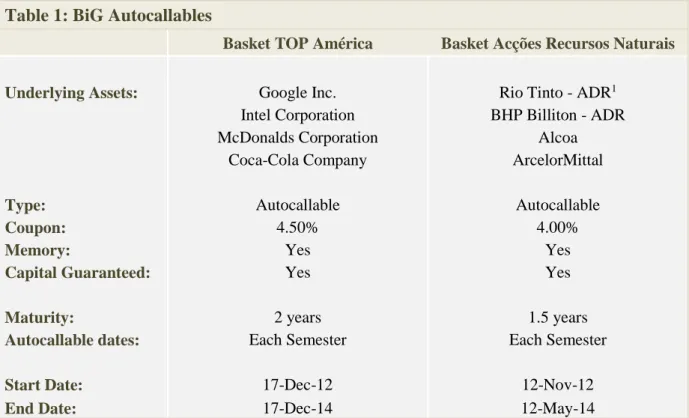
Two products issued by BiG will serve as the basis for this study. The first, Basket TOP América is an autocallable whose underlying assets were Google, Intel, McDonalds and Coca-Cola. This product was successful from the investor's point of view since it paid in the first semester a 4.5% coupon.
10 The other, Basket Acções Recursos Naturais, was not so successful from the investor's corner since it failed to pay a coupon in its 18 months of maturity. The underlying assets were Rio Tinto, BHP Billiton, Alcoa and ArcelorMittal.
The characteristics of the products are presented in table 1.
Table 1: BiG Autocallables
Basket TOP América Basket Acções Recursos Naturais
Underlying Assets: Google Inc. Rio Tinto - ADR1
Intel Corporation BHP Billiton - ADR
McDonalds Corporation Alcoa
Coca-Cola Company ArcelorMittal
Type: Autocallable Autocallable
Coupon: 4.50% 4.00%
Memory: Yes Yes
Capital Guaranteed: Yes Yes
Maturity: 2 years 1.5 years
Autocallable dates: Each Semester Each Semester
Start Date: 17-Dec-12 12-Nov-12
End Date: 17-Dec-14 12-May-14
To properly backtest these products, the historical prices of each underlying asset with non-adjusted dividends were used. These reflect the actual prices the issuer would observe when hedging its products.
In terms of volatility, the 180 days historical volatility is going to be used. Even though on a daily basis the underwriter uses the implied volatility taken from option market prices, it is not feasible to use the correct historical implied volatilities, given the limited data access. To overcome that impossibility it was added a 2.5% spread to the historical volatility to account for the fact that implied volatility is usually higher than historical
11 volatility, due to the risk premium demanded by the option seller to be exposed to the option’s volatility.
Correlations between the assets were also calculated based on their 180 days historical values, given the impossibility to get an implied correlation quote from the market, as it is very illiquid.
The risk-free interest rate was fixed at 0.5% which was close to the value of the Euribor at the release date. It was assumed a flat interest rate given the low yield environment and its low impact on the overall results.
To calculate the hedging P&L, I took into account the bid/ask spread as it accounts for most of the transaction costs. Nowadays, explicit costs, such as commissions, are about 0.02% to 0.03%, which contrasts with the 0.20% bid/ask spread Jones (2002) estimated for Dow Jones stocks. Given the marginal impact of fees and commissions, I will just take into account the bid/ask in the overall hedging cost.
Finally, I assume both products had a notional amount of $1,000,000, the hedging was performed at closing prices and that all values are in USD.
12 IV. Results
“Most money is made or lost because of market movement, not because of mispricing. Often the cause of mishedging.” – N. N. Taleb
1. Basket TOP América
The autocallable Basket TOP América was issued in December 2012 and paid a coupon of 4.5% in the first semester. All four stocks – Google, Intel, McDonalds and Coca-Cola – appreciated during that period, leading to an early redemption of the coupon and the notional.
The evolution of the prices of the four underlying stocks is presented below.
At inception, the option was worth approximately 4.32%, or $43,179 when accounting for the $1,000,000 notional. The calculations are detailed in appendix 2.
It is important to notice that all calculations are in the underwriter’s perspective, i.e., when an option is worth 4%, it reflects the margin the bank requires to issue this specific product.
Figure 2: TOP América underlying’s performance
95 100 105 110 115 120 125 130
17-Dec-12 17-Jan-13 17-Feb-13 17-Mar-13 17-Apr-13 17-May-13 17-Jun-13
13 1.1. Hedging Results
Regarding the hedging of this product, the results did not vary significantly between different rebalancing periods because all the underlying assets behaved closely to the distribution chosen, evolving positively in a smooth manner and leading to a final payoff to investors of 4.5%, in six months.
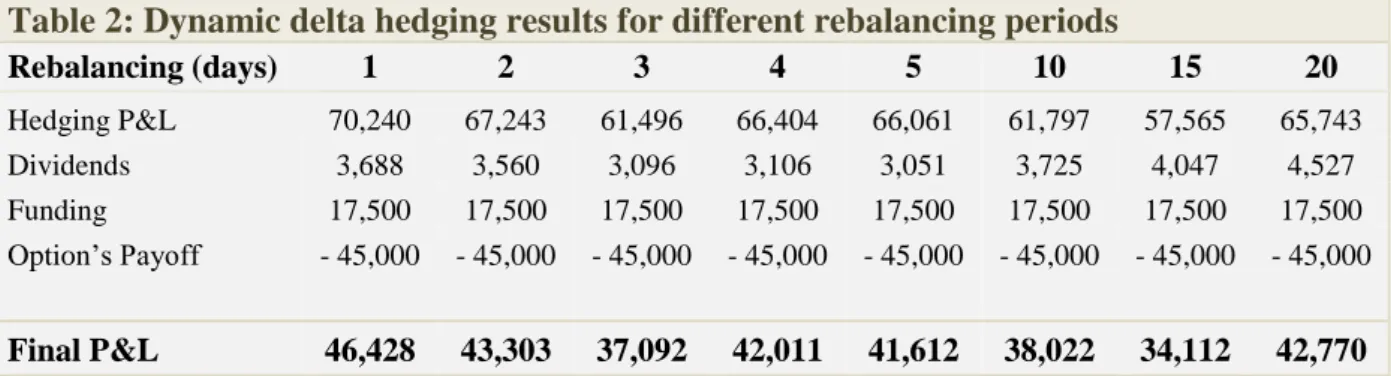
In table 2 is exhibited the P&L of each individual strategy. In practice, what happens is that the bank collects the $1,000,000 from the investor(s), deposits it at the current funding rate and then replicates its option position through dynamic delta hedging. In the end, the overall P&L is segregated into the capital gains/losses from the hedging position; the dividends received from holding a certain amount of shares at the ex-dividend date; the funding2; and, at last, the option’s payoff.
Overall, the results were very positive, with the hedging P&L tracking closer the value of the option, providing a close approximation between the hedging and the option’s value. In absolute terms, the results were better when rebalancing the portfolio on a daily basis. Nevertheless, the purpose of hedging is not making the most money but to closely replicate the option’s value. As will be further discussed, the highest gross return does not represent necessarily the best hedging strategy.
2 Amount earned in the deposit. It is the notional times the funding rate.
Table 2: Dynamic delta hedging results for different rebalancing periods
Rebalancing (days) 1 2 3 4 5 10 15 20 Hedging P&L 70,240 67,243 61,496 66,404 66,061 61,797 57,565 65,743 Dividends 3,688 3,560 3,096 3,106 3,051 3,725 4,047 4,527 Funding 17,500 17,500 17,500 17,500 17,500 17,500 17,500 17,500 Option’s Payoff - 45,000 - 45,000 - 45,000 - 45,000 - 45,000 - 45,000 - 45,000 - 45,000 Final P&L 46,428 43,303 37,092 42,011 41,612 38,022 34,112 42,770
14 When the hedge was performed with 10, 15 and 20 days of distance the results did not reveal significant changes, but allowed us to get some insights regarding the behaviour of the delta of the autocallables. Unlike the plain vanilla call option, the delta of this product does not approach 1 when the underlying is deep In-The-Money (ITM). Instead, the autocallable shows a bell shaped curve, with the delta approaching 0 when deep In and Out-of-The-Money (OTM). The delta behaviour of a plain vanilla option and an autocallable is represented in appendix 4.
In the particular case of the Basket TOP América, when it started to become more likely that the product was going to get called on the first semester, the delta started to decrease, likewise the number of shares we would need to hold to be delta hedged. If the hedging was performed less frequently – 10, 15 or 20 days apart – dividends received would be higher due to the fact that the adjusted portfolio did not immediately reflect the decreasing delta. We would hold a higher number of shares at the ex-dividend date than we were supposed to because we took longer to adjust our delta.
Figures 3 and 4 show the hedging P&L and the dividends received given different rebalancing periods, respectively.
Figure 3 and 4: Hedging P&L and Dividends per rebalancing period
3,000 3,200 3,400 3,600 3,800 4,000 4,200 4,400 4,600 4,800 0 5 10 15 20 5,000 10,000 15,000 20,000 25,000 30,000 35,000 40,000 45,000 50,000 1 2 3 4 5 10 15 20
15 2. Basket Acções Recursos Naturais
The autocallable Basket Acções Recursos Naturais was issued in November 2012 and did not pay a coupon in any of the observation dates (shaded areas in figure 5), although it was close to paying 8% in the second semester. At maturity, BHP Billiton and ArcelorMittal were not over their strike price, affecting negatively the performance of the product. The underlying’s price evolution is shown below.
The value of this autocallable at inception was 2.53%, or $25,278 when accounting for the $1,000,000 notional. This value represents the margin of the bank, given the 3.75% funding and the probability of payment. The detailed calculations are presented in appendix 3.
2.1. Hedging Results
An identical analysis to the TOP América’s product was performed for Recursos Naturais, leading to significantly different results. Table 3 summarizes the results of the hedging strategy for different rebalancing periods of this autocallable.
Figure 5: Recursos Naturais underlying’s performance
60 80 100 120 140 160 180
16
Table 3: Dynamic delta hedging results for different rebalancing periods
Rebalancing (days) 1 2 3 4 5 10 15 20 Hedging P&L 11,603 14,836 7,896 29,820 33,365 - 24,740 2,683 - 56,656 Dividends 5,968 6,021 5,619 5,166 4,994 4,667 6,154 4,705 Funding 56,250 56,250 56,250 56,250 56,250 56,250 56,250 56,250 Option’s Payoff - - - - Final P&L 73,821 77,108 69,765 91,236 94,609 36,177 65,087 4,299
If we only look at the absolute end results, one would suggest that the hedging should have been performed every 5 days, i.e., once a week, as this was the rebalancing period that yielded the best results. However, as can be noticed in the table above, the “Hedging P&L” varies significantly depending on the rebalancing period, suggesting heavy path dependence on the results. What can be said for sure is that a position should not be left unhedged for a long period of time. Although in the case of TOP América the results did not suffer much from hedging once and every 10, 15 and 20 days, Recursos Naturais’ results were affected as its underlying prices were more volatile and correlations changed significantly. Ignoring the delta for too long, expecting it to recover to normal values, would be the same as taking a directional position on a stock and has nothing to do with hedging.
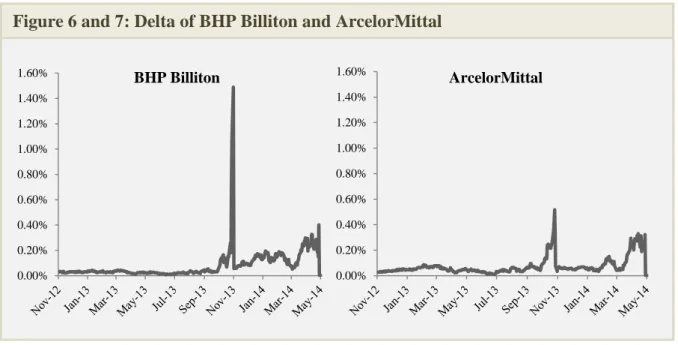
To better understand this discrepancy of results, it is presented in figure 6 and 7 the behaviour of the delta of the two stocks that ended OTM – BHP Billiton and ArcelorMittal. As shown, the deltas peak near an observation date. For instance, the delta of BHP Billiton on 11-Nov-2013 (one day left to an observation date) totalled $1,489,165, about 1.5 times the notional of this product. In the event of BHP’s price decreasing 1% the next day, the hedger would lose about $15,000 (60% of the products’ value at inception), if he had to sell his delta immediately. This demonstrates the case where the delta concentrates on only one underlying asset, the worst performer, which is the only one that probabilistically can affect the value of the option. This situation
17 usually happens when all assets, except one, appreciate, but there is one that is out but close to the money that can influence drastically the value of the product. Overall, this case shows how path dependent an autocallable is and how timing plays a relevant roll when delta hedging discretely.
This erratic behaviour of the delta has a direct implication on the hedging P&L of each stock. On table 4, it is possible to observe how the performance of BHP and ArcelorMittal change significantly for different rebalancing periods.
Table 4: P&L of each underlying asset without dividends
1 2 3 4 5 10 15 20 BHP Billiton - 18,145 - 6,501 - 4,167 14,199 5,671 - 38,000 - 6,165 - 67,204 Rio Tinto - 417 - 135 - 216 - 888 - 1,254 - 724 - 513 - 768 Alcoa 18,946 15,542 17,728 13,173 22,188 14,074 12,773 9,324 ArcelorMittal 11,220 5,931 - 5,449 3,336 6,759 - 90 - 3,412 1,991 Total 11,603 14,836 7,896 29,820 33,365 -24,740 2,683 -56,656
The overall results for different hedging rebalancing periods change significantly depending on the path taken by the underlying asset and the frequency of the hedging. Since there is no clear evidence that stock prices are predictable, if the hedger decides to hold/sell a delta based on his expectation of how the stock price might change in the
Figure 6 and 7: Delta of BHP Billiton and ArcelorMittal
0.00% 0.20% 0.40% 0.60% 0.80% 1.00% 1.20% 1.40% 1.60% BHP Billiton 0.00% 0.20% 0.40% 0.60% 0.80% 1.00% 1.20% 1.40% 1.60% ArcelorMittal
18 future, he is speculating instead of hedging. Thus, I would suggest to delta hedge on a daily basis because the results of this strategy were positive for both products, and the risk of exposure to sudden market changes is mitigated. Additionally, we would eliminate any bias and speculative position while hedging.
3. Discretionary Hedging
Until this point, it was only tested a hedging strategy with constant rebalancing periods, whatever the time to maturity. From now on, a mixed strategy will be tested, based on the time to maturity of the autocallable.
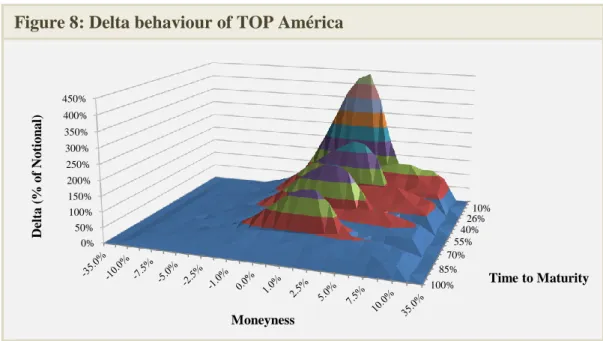
Figures 8 and 9 show the behaviour of the delta of both products under study, for different strike prices and time to maturity, and suggests that delta is more sensitive when the underlying assets are At-The-Money (ATM) and close to an autocallable date, or maturity.
Figure 8: Delta behaviour of TOP América
100% 85% 70% 55% 40% 26% 10% 0% 50% 100% 150% 200% 250% 300% 350% 400% 450% Time to Maturity De lta (% o f No tio n a l) Moneyness
19 The delta sensitivity to changes in the underlying’s price is also known as Gamma, which is one of the Greeks that shows an extreme behaviour (see appendix 6) when an option is close to maturity and near, but not exactly, ATM. This characteristic of the autocallable is well represented in Recursos Naturais, when BHP was not ITM, but really close to it, few days before the second autocallable date, leading to hefty delta changes (review figure 6).
Henceforth, it is tested a different strategy where the dynamic delta hedging is performed less frequently at the inception date – 5, 4, 3 and 2 days apart – and daily when there is 2 months left to maturity. On appendix 7 and 8 is represented the results if, instead of 2 months, we used 1 month as the criterion to start hedging daily. The rationale of this strategy comes from the fact that when an autocallable is away from maturity its delta behaves in a stable manner and there are not significant changes; and, on the other hand, when maturity is approaching, the delta starts to become more sensitive to changes. This strategy will not necessarily yield better results, however, it is expected that those results do not deviate much from when one is delta hedging on a daily basis.
Figure 9: Delta behaviour of Recursos Naturais
0 -10.0% -6.0% -2.5% -0.5% 1.0% 3.5% 7.5%25.0% 0.00% 20.00% 40.00% 60.00% 80.00% 100.00% 120.00% 140.00% 160.00% 100 % 90% 85% 80% 75% 70% 67% 60% 55% 50% 45% 40% 34% 30% 25% 20% 15% 10% 5% 1% 0% Moneyness De lta (% o f N o ti o n a l) Time to Maturity
20 The tables of results for both products are presented below. On the first column, it is represented the P&L when the hedging portfolio is rebalanced each and every 2 days until is reached a point where the time to an autocallable date is 2 months. From that point on, the hedge would be done daily. The strategy is the same for the remaining columns of both tables, with the exception of the initial frequency of rebalancing.
Table 5: TOP América Discretionary Delta hedging results
Rebalancing (days) 2 - 1 3 - 1 4 - 1 5 - 1 Hedging P&L 67,709 66,607 67,399 68,452 Dividends 3,688 3,441 3,541 3,294 Funding 17,500 17,500 17,500 17,500 Option’s Payoff - 45,000 - 45,000 - 45,000 - 45,000 Final P&L 43,897 42,548 43,439 44,246
Table 6: Recursos Naturais Discretionary Delta hedging results
Rebalancing (days) 2 - 1 3 - 1 4 - 1 5 - 1 Hedging P&L 10,824 6,244 10,513 11,430 Dividends 5,486 5,463 5,192 5,298 Funding 56,250 56,250 56,250 56,250 Option’s Payoff - - - - Final P&L 72,559 67,957 71,955 72,977
The results do not deviate much from the ones achieved when the hedge is performed daily, no matter what the time to maturity, which suggests that the overall P&L is made near the autocallable dates. This discretionary hedging looks like a good approach because it avoids the time and costs associated with delta hedging on a daily basis, when delta changes are not significant. Though, one should start hedging daily when maturity is approaching to account for market changes that have a higher impact on the payoff of the option, hence on our position as a hedger.
21 V. Conclusion
This study proved to be useful to understand the different dynamics of the delta and gamma of an autocallable, and how different rebalancing periods might affect the overall result of a hedging strategy.
First, the autocallable TOP América was analysed and, even though the hedging results did not vary significantly between rebalancing periods, it was possible to link the delta behaviour to the hedging results. For instance, in this particular case, the dividends received increased when hedging more infrequently, because of the decreasing nature of the autocallable’s delta when deep ITM. Next, Recursos Naturais revealed the dangers of keeping an unhedged position for a long period of time, i.e. more than a week. Hedging each and every 10 and 20 days led to a hedging P&L of $24,740 and -$56,656, respectively. In the end, a mixed strategy was applied where the rebalancing was adjusted according to the time to maturity of the option. This suggested that cost and time savings could be achieved when hedging infrequently in the beginning and daily when time to maturity approaches, without loss of value. This approach can be improved in further studies where one could define a different criterion for changing the periodicity of the rebalancing period. As Broadie and Glasserman (1996) put it: “The gamma (…) is related to the optimal time interval required for rebalancing a hedge under transaction costs.”, thus, it would be interesting to create a model in which the rebalancing period would change based on the gamma of the autocallable.
The path taken by the underlying and its influence on the P&L of a hedging strategy proved to be the most relevant issue in this type of products and the one it is not feasible to predict. My suggestion would be to hedge on a daily basis because such discipline avoids the issue of taking a directional view on the evolution of a particular underlying and ignore the delta altogether.
22 References
Black, F., & Scholes, M. (1973). The Pricing of Options and Corporate Liabilities. The Journal of Political Economy, Vol. 81, No. 3, 637-654.
Boyle, P. (1977). Options: A Monte Carlo Approach, Vol. 4, No 3. Journal of Financial Economics, 323-338.
Boyle, P. P., & Emanuel, D. (1980). Discretely Adjusted Option Hedges. Journal of Financial Economics 8, 259-282.
Broadie, M., & Glasserman, P. (1996). Estimating Security Price Derivatives Using Simulation. Management Science, Vol. 42, No. 2, 269-285.
Carr, P., Ellis, K., & Gupta, V. (1998). Static Hedging of Exotic Options. The Journal of Finance, Volume 53, Issue 3, 1165-1190.
Fowler, G., & Outgenza, L. (2004). Auto-Callables: Understanding the products, the issuer hedging and the risks. Citigroup.
Hull, J. C. (2011). Options, Futures, And Other Derivatives. Pearson Education Limited, 8th edition.
Jones, C. (2002). A Century Of Stock Market Liquidity and Trading Costs. Working Paper, Columbia University.
Ku, H., Lee, K., & Zhu, H. (2012). Discrete Time Hedging with Liquidity Risk. Finance Research Letters, 9, 135-143.
Leland, H. E. (1985). Option Pricing and Replication with Transaction Costs. The Journal of Finance, Vol. 40, No. 5, 1283-1301.
Samuelson, P. (1965). Rational Theory of Warrant Pricing. Industrial Management Review, 6, 13-39.
Taleb, N. (1996). Dynamic Hedging: Managing Vanilla and Exotic Options. New York: John Wiley & Sons, Inc.
23
Greeks Formula Description
Delta
∆ =𝜕𝑉 𝜕𝑆
Rate of change of the option’s value, or portfolio of options, due to a change in the price of the underlying asset(s).
Gamma
𝛤 =𝜕
2𝑉
𝜕𝑆2
Sensitivity of the portfolio’s delta to a change in the underlying asset’s price.
Vega
𝜈 =𝜕𝑉 𝜕𝜎
Rate of change of the option’s value, with respect to a change in the volatility of the underlying.
Theta
𝛩 = 𝜕𝑉 𝜕𝑇
Sensitivity of the option’s value to the passage of time, i.e., to changes in time to maturity.
Rho
𝛲 =𝜕𝑉 𝜕𝑟
Rate of change of the option’s value, with respect to the change in interest rates.
Appendix 1: Greeks Appendix
Appendix 2: TOP América's Value at inception
Semester Payoff Option Funding Total Payoff PF Act. Probability
1 4.50% 1.75% -2.75% -2.74% 11.49% 2 9.00% 3.50% -5.50% -5.47% 5.13% 3 13.50% 5.25% -8.25% -8.19% 3.22% 4 18.00% 7.00% -11.00% -10.89% 2.12% Doesn’t Pay 0.00% 7.00% 7.00% 6.93% 78.04% Total 43,179
Appendix 3: Recursos Naturais's Value at inception
Semester Payoff Option Funding Total Payoff PF Act. Probability
1 4.00% 1.88% -2.13% -2.12% 22.77% 2 8.00% 3.75% -4.25% -4.24% 8.09% 3 12.00% 5.63% -6.38% -6.35% 4.36% Doesn’t Pay 0.00% 5.63% 5.63% 5.60% 64.78% Total 25,278
24 Appendix 4: Delta behaviour of a plain vanilla option and an autocallable
0.0000 0.1000 0.2000 0.3000 0.4000 0.5000 0.6000 0.7000 0.8000 0.9000 1.0000 4 0 % 4 7 % 5 4 % 6 1 % 6 8 % 7 5 % 8 2 % 8 9 % 9 6 % 1 0 3 % 1 1 0 % 1 1 7 % 1 2 4 % 1 3 1 % 1 3 8 % 1 4 5 % 1 5 2 % 1 5 9 %
Plain Vanilla's Delta
4 0 % 4 6 % 5 2 % 5 8 % 6 4 % 7 0 % 7 6 % 8 2 % 8 8 % 9 4 % 1 0 0 % 1 0 6 % 1 1 2 % 1 1 8 % 1 2 4 % 1 3 0 % 1 3 6 % 1 4 2 % 1 4 8 % 1 5 4 % 1 6 0 % Autocallable's Delta
Appendix 5: Recursos Naturais hedging P&L and Dividends per rebalancing period
10,000 20,000 30,000 40,000 50,000 60,000 70,000 80,000 90,000 100,000 1 2 3 4 5 10 15 20 4,000 4,500 5,000 5,500 6,000 6,500 0 5 10 15 20
Appendix 6: Delta and Gamma behaviour for different maturities Delta andf 4 0 % 4 6 % 5 2 % 5 8 % 6 4 % 7 0 % 7 6 % 8 2 % 8 8 % 9 4 % 1 0 0 % 1 0 6 % 1 1 2 % 1 1 8 % 1 2 4 % 1 3 0 % 1 3 6 % 1 4 2 % 1 4 8 % 1 5 4 % 1 6 0 % Delta T=1 T=0.5 T=0.25 4 0 % 4 6 % 5 2 % 5 8 % 6 4 % 7 0 % 7 6 % 8 2 % 8 8 % 9 4 % 1 0 0 % 1 0 6 % 1 1 2 % 1 1 8 % 1 2 4 % 1 3 0 % 1 3 6 % 1 4 2 % 1 4 8 % 1 5 4 % 1 6 0 % Gamma T=1 T=0.5 T=0.25
25 Appendix 7: TOP América Discretionary Delta hedging results (1 Month)
Rebalancing (days) 2 - 1 3 - 1 4 - 1 5 - 1 Hedging P&L 68,754 65,083 68,679 69,145 Dividends 3,562 3,441 3,515 3,433 Funding 17,500 17,500 17,500 17,500 Payoff Option - 45,000 - 45,000 - 45,000 - 45,000 Final P&L 44,816 41,024 44,694 45,077
Appendix 8: Recursos Naturais Discretionary Delta hedging results (1 Month)
Rebalancing (days) 2 - 1 3 - 1 4 - 1 5 - 1 Hedging P&L 6,983 2,527 6,723 4,465 Dividends 5,486 5,463 5,192 5,298 Funding 56,250 56,250 56,250 56,250 Payoff Option - - - - Final P&L 68,718 64,240 68,165 66,012