Review
Protein-
and
Peptide-Based
Biosensors
in
Arti
fi
cial
Olfaction
Arménio
J.M.
Barbosa,
1Ana
Rita
Oliveira,
1and
Ana
C.A.
Roque
1,*
,@Animals’ olfactory systems rely on proteins, olfactory receptors (ORs) and
odorant-bindingproteins(OBPs),astheirnativesensingunitstodetectodours.
Recentadvances demonstrate that theseproteins canalso be employedas
molecularrecognitionunitsingas-phasebiosensors.Inaddition, the
interac-tionsbetweenodorantmoleculesandORsorOBPsareasourceofinspiration
for designing peptides with tunable odorant selectivity. We review recent
progressingasbiosensorsemployingbiologicalunits(ORs,OBPs,and
pep-tides)inlightoffuturedevelopmentsinartificialolfaction,emphasizing
exam-pleswherebiologicalcomponentshavebeenemployed todetectgas-phase
analytes.
BiosensorsinArtificialOlfaction
Thepossibilityofmimickingnature,buildingartificialintelligentsystemstoperformcomplex tasks,anddealingwithlargesetsofdataisgainingincreasingrelevanceinallareas,including biologicalsciences[1].Themysteriesofolfaction,inparticularhumanolfaction, stillintrigue scientistsand, notsurprisingly, it is considered the least understoodsense [2,3].Artificial olfactionsystemsaimtomimicthesenseofsmellandtypicallyconsistofelectronicnose
devices(e-noses)(seeGlossary)thatincludeanarrayofgassensorsassociatedwith
signal-processingtools[4–6].Classically,inane-nose,asampleentersthesystemthroughaninlet thatguides thegasmolecules toachamber where thesensing materialisdeposited. The interactionofthevolatileorganiccompounds(VOCs)withthesensingmaterialgeneratesa signal(forexample,electric,optical,orgravimetric)thatistransducedandfurtherprocessedby asignal-processingcomputer.
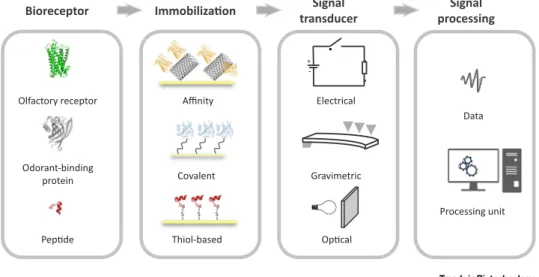
Odors are typicallycomposed of aset of VOCs.The detection ofVOCs is of significant interest, not only to understand biological processes, but also in several scientific and technologicalareas.Forinstance,VOCsensorshold greatpromise inthe early diagnosis ofdiseases[7–12],foodqualitycontrol[13–15],security[16],agriculture[17],environmental monitoring[18],andinsectsupervision[19,20].Thebroadrangeofapplicationareasfor e-noseshasbeenacceleratingtheprogressofgas-sensingtechnologies,withan extensive researchandmarketspacefordevelopingnewsensingmaterialsanddevices[2].Current gas-sensingmaterials,including thosecommerciallyavailable, includemostlymetal oxide semiconductorsandconductivepolymers.Themaindrawbacksofthesesystemsarethe lowstabilityand highpromiscuitytowardsVOCmolecules,resultinginlow selectivity.As such,incorporatingthesensingcomponentsofbiologicalolfactionsystemsintogas-sensing materialscanincreasethe VOCselectivityoftheresultantgassensorsandbio-electronic noses (Figure 1) [4,6,19–22]. Still, most published works report biosensing using VOC analytesinsolutions[23–27],incontrasttothereal-lifeimplementationofe-nosestoanalyse gaseoussamples. Therefore, thisreview focuses onlyon recent research trends in gas-phasebiosensing.
Highlights
Artificialolfactionisbeingimplemented inkeysocietalareaslikeearlydisease diagnostics,food safetyhazards,air quality,andsecurity.
Protein-andpeptide-basedVOC bio-sensors, coupled with cutting-edge transducers, increase the selectivity andsensitivityindetectingkeyVOCs withlimitsofdetectionintheorderof ppb.
Gas-phasetesting,ratherthanVOC solutions, is becoming the state of theartinbiosensorvalidation.
Combinatorial techniques such as phage display and virtual screening areadvancing thediscoveryofnew VOC-bindingpeptides.
Progressesinbiomolecule immobiliza-tionaresteadilyincreasingthe reusa-bilityandshelf-lifeofbiosensors,while maintainingthedesiredselectivity.
1UCIBIO,DepartamentodeQuímica,
FaculdadedeCiênciaseTecnologia, UniversidadeNovadeLisboa, 2829-516Caparica,Portugal
@Twitter:@Biomeng_lab
*Correspondence:
(AnaC.A.Roque).
1244 TrendsinBiotechnology,December2018,Vol.36,No.12 https://doi.org/10.1016/j.tibtech.2018.07.004
Glossary
Biophotonicsensor:asensorthat detectstheinteractionofphotons andbiomaterials.
Carbonnanotubes(CNTs):carbon atomsarrangedinatube-shaped nanostructure.
Electrochemicalimpedance spectroscopy(EIS):a spectroscopictechniquethat measurestheimpedanceofan electrochemicalsystemtoanapplied potential.
Electronicnosedevices (e-noses):electronicdeviceswiththe purposeofdetectingodorants.
Filmbulkacousticresonator (FBAR):adevicecomprisinga piezoelectricmaterialinserted betweentwoelectrodes,acoustically isolatedfromthecontiguous medium.
Field-effecttransistor(FET):a semiconductorchannelwith electrodesatbothends,denotedas drainandsource.Theconductivity betweenthedrainandsource terminalsiscontrolledbyanelectric
fieldinthedevice.
Homologymodeling:modelinga protein3Dstructurebymeansofa knownexperimentalstructureofa homologousproteinsequence.
Limitofdetection(LoD):the lowestanalyteconcentrationthatcan bereliablydistinguishedfroma blank.
Lipocalin:proteinsthattransport hydrophobicmolecules.
Microcantilever:arigidmicroscale plateanchoredatoneendandfree attheotherendtoallowstructural
fluctuations.Itmeasuresmechanical propertiesofmaterials,suchas resonancefrequency,amplitudeof vibration,andbending.
Moleculardocking:amethodfor predictingtherightorientationofa moleculewhenboundtoareceptor.
Nanodisc:solublenanoscale phospholipidbilayersabletohost membraneproteins.
Odorant-bindingprotein(OBP):
solubleproteinssecretedinthenasal mucusofvertebratesandinthe lymphofinsectchemosensory sensilla.
Olfactoryreceptor(OR):a membraneproteinchannel expressedinolfactoryneurons, triggeredbyodorantbinding. OlfactoryReceptorGas Biosensors
Olfactoryreceptors(ORs)arebelievedtorecognizedifferentodorants,soodorant
recogni-tiondependsontheORbeingactivatedandontheextentofitsactivation[28,29](Box1). IdentifyingwhichodorantsspecificallybindtoacertainORiscalleddeorphanization[30,31]. ThedeorphanizationofORsisacrucialstepto understandseveralaspectsofthesmelling sensoryprocess, includingthe completeknowledge ofanOR’s activity, theimpact ofthe physicochemicalpropertiesofodorantmoleculesinanOR’sselectivity,andthewayinwhich
Pep de Signal transducer Signal processing Olfactory receptor Odorant-binding protein Bioreceptor Electrical Op cal Gravimetric Processing unit Data
ImmobilizaƟon
Covalent
Thiol-based Affinity
S S S
-+
.
.
.
Figure1.SchemeofMainConstituentsofProteinandPeptide-BasedBiosensorsforArtificialOlfaction.A bioreceptorknowntobindtovolatileorganiccompounds(VOCs)–olfactoryreceptors,odorantbindingproteinsorVOC affinitypeptides–isselectedforimmobilization.Surfaceimmobilizationcanbemadethroughdifferentmethodsincluding affinity,covalentspacers,andthiol-basedchemistry.Thebiosensoristhenappliedinasignaltransducingsystemwhich maybe,forexample,electrical,gravimetric,oroptical.Thecollecteddataisfinallyprocessedtoyieldqualitativeor quantitativeinformationabouttargetVOCs.
Box1.DifferencesbetweenProteinsandPeptidesCurrentlyUsedinVOCBiosensing
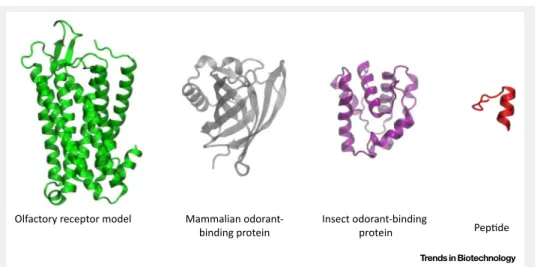
ThebiomoleculesappliedsofaringasbiosensingincludeORs,OBPs,andpeptides,withremarkablestructural differenceshighlightedinFigureI.
ORsaremembersoftheGprotein-coupledreceptorfamily:theyarestructurallydefinedbyseventrans-membrane
a-helices,about320aminoacidresiduesinlength[29].Theseproteins,uponvolatilebinding,generateasignalthatis transmittedfromtheolfactorysensoryneurons,whereORsarelocated,tothebraininarecognizedpatternthat culminatesinolfactoryperception.
MammalianOBPsbelongtothelipocalinsuperfamilyofproteins,transportproteins[38,41,42]thatare150–160 residuesinlength[43]andhavetypicallipocalin-foldofeightanti-parallelb-sheetsandashorta-helixclosetotheC terminal.Theb-sheetsformanantiparallelb-barrelshapingacentralpocketforligandbinding[44].InsectOBPspresent well-conservedfoldingwithproteinchainsof130–150aminoacids[40].Thetertiaryproteinstructurecomprisesa compactsetofsixa-heliceswithahydrophobiccavity.Additionally,thefoldingisstabilizedbythepresenceofthree disulfidebonds[39,40].ThesedisulfidebondsareconsideredthefingerprintofinsectOBPs.Notwithstandingamino acidvariability,theoverallstructureofinsectOBPsishighlyconserved,evenamongmembersofdifferentordersof insects[39,40,78].
Peptidesrepresentasimpleandlow-costoptionforbiosensors.Rangingfromapproximately5to15proteinresidues, theycanbesyntheticallyorbiologicallyproduced.TheirselectivitytowardstargetVOCsiseasiertotuneduetotheir smallsize[20,56].VOC-sensingpeptideshavebeendevelopedbydifferentapproaches(Box2,Figure2),andappliedin severalsubstratesandsensingdevices,assummarizedinTable2.
informationisaccuratelyprocessedtogeneratetherecognizedpatternthatculminatesinthe finalolfactoryperception[31].Thesestudiesmusttakeintoaccounttheabilityofanodorantto berecognizedbymultipleORs,andthefactthataspecificORcanrecognizeseveralodorants. SomeORshavealreadybeenisolatedandappliedtogas-sensingbiosensors(Table1).
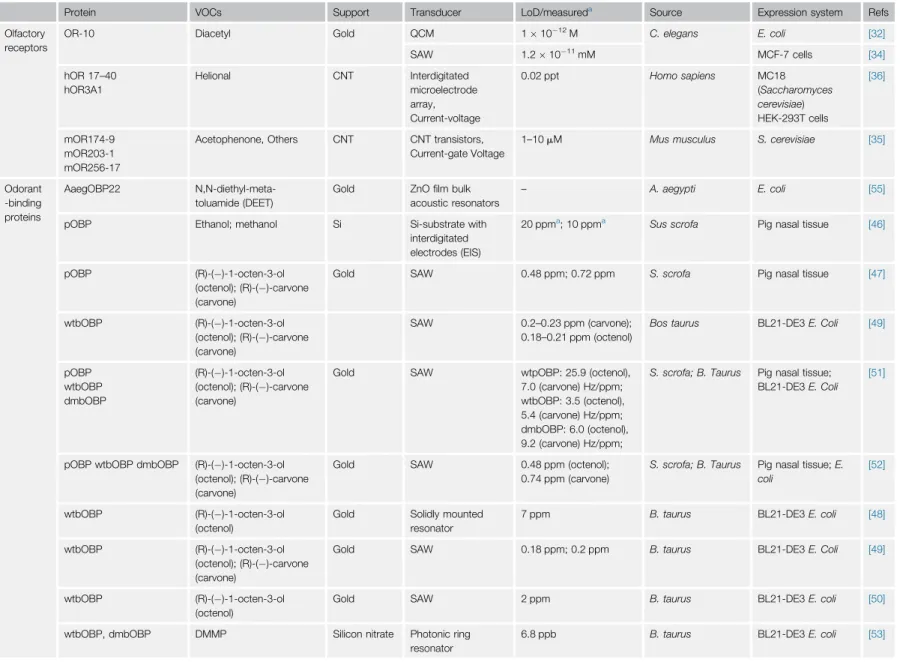
Thefirstdevelopmentofgas-phasebiosensorsforVOCdetectionusedthereceptorOR-10
fromCaenorhabditiselegans.ThisproteinwasexpressedinEscherichiacoli,anditsmembrane
fractioncontainingOR-10coatedonaquartzcrystalforquartzcrystalmicrobalance(QCM)
measurements.Thebiosensorrespondedtodiacetylwithadetectableconcentrationaslowas 10 12M[32].However,usingacrude membraneextractonthe sensorsurfacemay have distortedtheresponseofOR-10toVOCsduetothe presenceofthelipidicfractionofthe membrane,asphospholipidsarealsoknowntobindodorant-likemolecules[33].Still,these reportshighlightedthepotentialofORsingassensingandthehurdlesofdealingwithcellular membranesforORstabilizationandimmobilization.Asimilarapproach,expressingOR-10in humanbreastcancerMCF-7cells,assessedtheinfluenceofVOCsbindingtophospholipids, usingcontrolsensorsanalysedinparallel[34].Thecontrolsproducedverylow-frequencyshifts
inasurfaceacousticwave(SAW)asaresponsetothetestedVOCs(diacetyl,butanone,and
2,3-pentanedione).Moreover,theresponsetodiacetylwasthemostsignificantwithalimitof
detection(LoD) of 1.210 14M [32]. The use of a control sensor elucidated that the
contribution ofthe affinityof VOCsto phospholipid molecules isnegligible compared with theiraffinitytoORs,consolidatinganewstrategyforVOCsbiosensordevelopment.
AdifferentmethodologyforincorporatingORsinagassensorwasexploredusingmouseORs (mOR)innanodiscs[35].NanodiscswithmORswerecoupledtocarbonnanotubes(CNTs) viaHis-taginteraction.IncontrastwithotherexampleswheretheORswereinthemembrane fraction[32–34],inthiscasethenanodiscsweredepositedonthesensorsurface.Tocertifythe efficiencyofthenanodiscsensors,thesamemORswereincorporatedindigitoninmicelles, depositedinCNTs,andtestedforVOCsensing(Table1).ThemORs–CNTbiosensorsrevealed broadagreementofresultsforthemicelleandnanodiscsystems.Thedifferenceobserved betweenmORnanodiscandmicellessensorswasintheirstabilityovertime.Micellesensors remainedactivefor5daysincontrastwithnanodiscsensors,whichwerestablefor10weeks afteraninitialdecreaseinresponse.Thelongerintegritymaybeduetothehigherstabilityofthe nanodiscstructureincontrasttothemicelles[35].
Phagedisplay:acombinatorial proteinexpressiontechniquewith bacteriophageslinkingproteinsto theirrespectiveDNA.
Piezoelectric:theabilityofa materialtogenerateelectricityupon mechanicalstress.
Quartzcrystalmicrobalance (QCM):atechniquethatmeasures massvariationperunitareaby measuringthechangeinfrequency ofaquartzcrystalresonator.
Resonator:asystemthatnaturally oscillatesatsomefrequencies,called resonantfrequencies,withgreater amplitudethanatothers.
Self-assembledmonolayer(SAM):
onemoleculelayerofmaterialbound toasurfaceinanorderedway resultingfromitsphysico-chemical characteristics.
Siliconnanowire(SiNW):a nanowireformedfromasilicon precursorbyetchingofasolidor throughcatalyzedgrowthfroma vapororliquidphase.SiNWsensors transduceelectricalsignals.
Surfaceacousticwave(SAW):a soundwavethattravelsparallelto thesurfaceofanelasticmaterial, withitsdisplacementamplitude decayingintothematerial.SAW sensorsaremicroelectromechanical systemsthattransduceaninput electricalsignalintoamechanical wave.Thismechanicalwaveis influencedbyphysicalphenomena, andthewaveistransducedback intoanelectricalsignal.
Volatileorganiccompounds (VOCs):organiccompoundswith highvaporpressureatroom temperature,likeodors, pheromones,andaromas. Olfactory receptor model Mammalian
odorant-binding protein Pep de
Insect odorant-binding protein
FigureI.StructuralFeaturesofOdor-SensingProteinsandPeptides.
Table 1. Protein Biosensors in Gas Sensing
Protein VOCs Support Transducer LoD/measureda Source Expression system Refs
Olfactory receptors
OR-10 Diacetyl Gold QCM 11012M C. elegans E. coli [32]
SAW 1.210 11mM MCF-7 cells [34]
hOR 17–40 hOR3A1
Helional CNT Interdigitated
microelectrode array, Current-voltage
0.02 ppt Homo sapiens MC18
(Saccharomyces
cerevisiae) HEK-293T cells
[36]
mOR174-9 mOR203-1 mOR256-17
Acetophenone, Others CNT CNT transistors,
Current-gate Voltage
1–10mM Mus musculus S. cerevisiae [35]
Odorant -binding proteins
AaegOBP22
N,N-diethyl-meta-toluamide (DEET)
Gold ZnOfilm bulk
acoustic resonators
– A. aegypti E. coli [55]
pOBP Ethanol; methanol Si Si-substrate with
interdigitated electrodes (EIS)
20 ppma; 10 ppma Sus scrofa Pig nasal tissue [46]
pOBP (R)-( )-1-octen-3-ol
(octenol); (R)-( )-carvone (carvone)
Gold SAW 0.48 ppm; 0.72 ppm S. scrofa Pig nasal tissue [47]
wtbOBP (R)-( )-1-octen-3-ol
(octenol); (R)-( )-carvone (carvone)
SAW 0.2–0.23 ppm (carvone);
0.18–0.21 ppm (octenol)
Bos taurus BL21-DE3E. Coli [49]
pOBP wtbOBP dmbOBP
(R)-( )-1-octen-3-ol (octenol); (R)-( )-carvone (carvone)
Gold SAW wtpOBP: 25.9 (octenol),
7.0 (carvone) Hz/ppm; wtbOBP: 3.5 (octenol), 5.4 (carvone) Hz/ppm; dmbOBP: 6.0 (octenol), 9.2 (carvone) Hz/ppm;
S. scrofa; B. Taurus Pig nasal tissue;
BL21-DE3E. Coli
[51]
pOBP wtbOBP dmbOBP (R)-( )-1-octen-3-ol (octenol); (R)-( )-carvone (carvone)
Gold SAW 0.48 ppm (octenol);
0.74 ppm (carvone)
S. scrofa; B. Taurus Pig nasal tissue;E.
coli
[52]
wtbOBP (R)-( )-1-octen-3-ol
(octenol)
Gold Solidly mounted
resonator
7 ppm B. taurus BL21-DE3E. coli [48]
wtbOBP (R)-( )-1-octen-3-ol
(octenol); (R)-( )-carvone (carvone)
Gold SAW 0.18 ppm; 0.2 ppm B. taurus BL21-DE3E. Coli [49]
wtbOBP (R)-( )-1-octen-3-ol
(octenol)
Gold SAW 2 ppm B. taurus BL21-DE3E. coli [50]
wtbOBP, dmbOBP DMMP Silicon nitrate Photonic ring
resonator
6.8 ppb B. taurus BL21-DE3E. coli [53]
aIndicates when the detected concentration was not the LoD, but the“measured”in that paper.
Trends
in
Biotechnology,
December
2018,
Vol.
36,
No.
12
A human OR(hOR)-based biosensorfor VOC sensing has beencoupled to carboxylated polypyrrolenanotubes[36].Conductivitymeasurementsrevealedaveryhighsensitivityofthis biosensortowardshelional(0.02ppt).Moreover,itpresentedselectivitytowardshelionalwhen comparedwithanalogVOCslike3,4-methylenedioxydihydrocinnamicacid,piperonal,safrole, andphenylpropanol.Theseanalogshadatleast2/3lowerelectricalresistancechangeupon bindingtothehORthanhelionalinthereportedbiosensormeasurements[36].
Thedifficult,expensive,andtime-consuminghandlingofmembraneproteinsmayhaveledto thepursuitofsimplerandmorerobustbiomoleculesasrecognitionagents[37].Therefore, gas-sensing biosensors based on the soluble odorant-binding proteins (OBPs) and small peptideshavegainedtraction[20,38,39].
OBPGas Biosensors
OBPsareanessentialcomponentoftheolfactorysystem.Theyareinthefirstlineofolfaction, locatedinthenasalepitheliumofmammals(nose)andinthesensillarlymphofinsects(e.g., antennae)[39,40].LesssolubleVOCsarebelievedtofirstbindtoOBPsthatcarrythemtothe ORsintheolfactorysensoryneurons.MorehydrophilicVOCsareabletocrossthemucosaor lymphto binddirectlytoORs.Furthermore,OBPsarebelievedtoactasscavengerswhen VOCsarepresentinhighamounts.VertebrateandinsectclassesofOBPsdifferintheir3D structure(Box1).TheOBPsfromvertebratesbelongtothelipocalinsuperfamilyofproteins, whichare essentiallytransport proteins [38,41,42]. InsectOBPs arealso stabilized bythe presenceof three disulfidebonds [39,40]. OBPscan withstand high temperatures before experiencing denaturation, and after unfolding they frequently refold, restoring their initial structure[42].Interestingly,whenbindinghigh-affinityligands,thestabilityofpigOBP(pOBP) increasesat highertemperatures [45]. InsectOBPs are even more resistant,as the three interlockeddisulfidebondspreventproteolyticdegradationandthermaldenaturation[40,42].
DevelopmentsinOBP-basedbiosensorsforgassensingstartedtoflourishinthelastdecade (Table 1). Initially, OBP biosensors were tested against volatiles and odor solutions, with measurementsof analytes in gas phase only reported by the end ofthe 2000s. The first describedOBPbiosensortodetectethanolandmethanolingasphaseinvolvedpOBP[46]. Theproteinimmobilizedonasiliconsubstrateforelectrochemicalimpedance
spectros-copy(EIS)measurements,andwasabletodetectethanolandmethanolvapors(Table1).
FurtherresearchrevealedthatpOBPcanalsobindoctenolandcarvone[47].Octenolisan importantVOCforfoodqualitycontrol,asitiscorrelatedwiththepresenceoffungiandmolds. pOBPwasimmobilized ontothegoldcoatingofaresonator,andthe sensorwas ableto detectR-carvone (aspearmint-likeflavorandodorant),butwithalower sensitivitythanfor octenol.ThesetwoVOCshavealsobeenthoroughlytestedwithbovineOBP(bOBP)[48–50], andinsensorarraysofpOBP,bOBPbothwildtype(wt)anddouble-mutant(dm)withhigher affinitytocarvone[51,52].Theabove-mentionedreportshaveshownthattheLoDsforoctenol andcarvoneofpOBPwere0.48and0.72ppm[47],andofbOBPwere0.18and0.2ppm, respectively[49].Foradifferentapplication,abiophotonicsensorusingthesamewtbOBP anddmbOBP as sensingelements was developed to detectdimethyl methylphosphonate (DMMP),a precursorof saringas [53].ThebOBPswere depositedonto thesiliconnitride surfaceofabiophotonicresonatorchip,resultinginastablesensorthatwasresponsiveforover 3monthsandcoulddetect6.8ppbofDMMPin15minutes.Furthermore,apOBP
micro-cantileverbiosensorwasrecentlyreported;althoughthesystemisinearlydevelopment,the
sensor successfully detected 2-isobutyl-3-methoxypyrazinein a gas chamber [54]. Taken together, these examples reveal some plasticity of OBP structures in identifying different chemical structures. It is in fact important to merge structural information on OBP–VOC
interactionforproteindesignandengineeringtowardstargetVOCsofinterest,whichcurrently stillremainsachallengeduetothelimitedstructuralinformationavailableforawidevarietyof VOCstructures(Boxes1and2;Figure2,KeyFigure).
TheonlyreportedbiosensorbasedonaninsectOBPforVOCdetectioninthegasphaseused anOBPfromthemosquitoAedesaegypti(AaegOBP22)[55].ThepurifiedOBPwasdeposited
inaZnOthinfilmbulkacousticresonator(FBAR),andavaporflowof
N,N-diethyl-meta-toluamide (DEET), the main component of mosquito repellents, was used for detection measurements.TheAaegOBP22biosensordetectedthepresenceofDEETthroughadrop inthe responsefrequencyoftheFBARsensor,dependingonahigherorloweramountof loadedOBP[55].
Peptide-BasedGasBiosensors
PeptidesarepromisingalternativestoORsandOBPsasmolecularrecognitionunitsinVOC sensing. Due to their smaller size, peptides represent a simple and low-cost option for biosensors (Box 1). Additionally, the selectivity towards target VOCs is easier to tune [20,56].VOC-sensingpeptideshavebeendevelopedbydifferentapproaches(Box2,Figure2), andappliedinseveralsubstratesandsensingdevices,assummarizedinTable2.
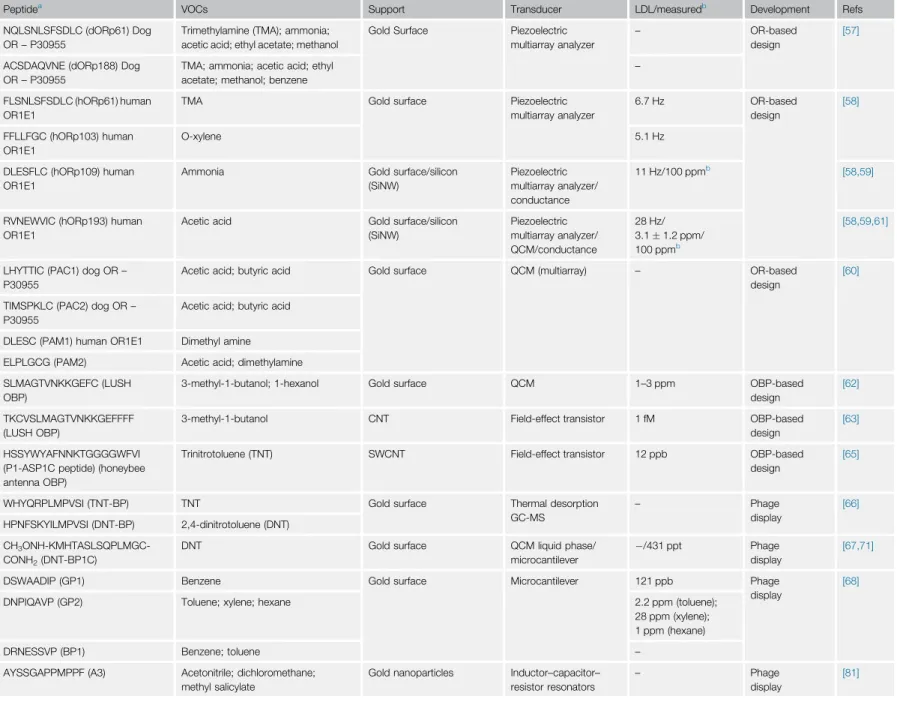
PeptidesequencesforVOCsensingweredevelopedintheearly2000sbasedondogand hORs. Thefirst OR-basedpeptide sequences were designed bymaintaining the dog OR regionsresponsibleforVOCbinding.Theselectedpeptidechains,rangingfrom9to14amino acidresidues,weredepositedonagoldsurfaceofapiezoelectricmultiarrayanalyzer.Two immobilizedpeptidesequences,orp61(12-mer)andorp188(9-mer),successfullydetected trimethylamine(TMA)andammonia,openinganewpathforthedevelopmentofpeptide-based volatilebiosensors[57].Inanotherwork, aseriesofpeptideswere designedinspiredbya
homologymodelofthehumanOR1E1.SeveralVOCsweredockedtoeachtransmembrane
Box2.ProteinandPeptideEngineeringinVOCSensing
TotailorproteinsandpeptidesforbindingtargetVOCs,severalproteinengineeringtechniquesmaybe applied
(Figure2).Predominanttechniquesinvolvesite-specificproteinmutations(Figure2A),thedesignofpeptidesinspired
bytheVOCrecognitionsitesofolfactoryreceptorsandodorant-bindingproteins(Figure2B),andscreeningofpeptide librariesbyphagedisplayandvirtualscreeningapproaches(Figure2C,D).
AdetailedanalysisoftheVOC-bindingpocketfromOBPsrevealsaclosesimilarityamongthebindingsiteofOBPsfrom differentorganisms,suchaspigandbovineOBPs(Figure2A),eventhoughthetargetVOCisdifferent.Theseproperties ledtothedevelopmentofsensorarraysincludingOBPsfromdifferentorganismsandmutatedOBPs,inordertobetter discriminatedetectedVOCs[51,52].Anexamplemutationisthebovinedoublemutantdescribedtoincreasethe sensitivityofbOBPtooctenolandcarvone[51].
AnotherapproachconsistsofapeptidethatwasrationallydesignedbyextractingthesequencesresponsibleforVOC recognitioninORsandOBPs.Duetotheirsmallersizes,peptidesareusuallyeasiertoimmobilizeinanorientedand predefinedwayontosensorsurfaces.PeptidesarealsosomewhatmorestablethanORsandmoreresilientto reusabilityandshelf-life.SuccessfulexampleshavebeenreportedforpeptidesderivedfromhumanOR1E1[58,61,79]
anddogOR-P30955[57,60].ThreedifferentpeptidesderivedfrominsectOBPsweresuccessfullyproducedand implementedingassensorstodetect3-methyl-butanol[63,80],1-hexanol[63],andtrinitrotoluene[65](Figure2B).
Combinatorialscreeningtechniques,suchasphagedisplayandvirtualscreening,canbroadenpeptidesequence variabilityandfindsequencesforspecificVOCs.PhagedisplayisimplementedwhenaVOCanalogisimmobilizedonto asurfaceora VOC-analogsurfaceisusedtoscreenrandomized peptidesforbinding[66–68,71](Figure2C). Computational virtual screening of peptide libraries is also used in the discovery of VOC-binding peptides
[69,72,75](Figure2D).Thetop-performingpeptidesareusuallysynthetizedandexperimentallytestedingassensing,
withsatisfactorycorrelationbetweeninsilicoandexperimentaldata[69,75].
KeyFigure
Protein
and
Peptide
Discovery
and
Engineering
for
Gas
Sensing
Phage library Panning graphene
Hit pep des sequencing:
1- 2- 3-4- …
Affinity pep des
Pep de library
VOC library
Docking virtual screening
Docking score ranking:
1- 2- 3-4- …
Computa onal affinity pep des
Bovine OBP Binding site Porcine OBP
VOC recogni on sequence
Insect OBP VOC recogni on
pep de
Protein engineering
PepƟde raƟonal design
Phage display
ComputaƟonal screening
1- 2- 3- 4-5- …
(B) (A)
(D) (C)
(Seefigurelegendonthebottomofthenextpage.)
sequenceofhOR1E1usingmoleculardockingandthefourmostpromisingpeptideswere synthesized.The lead peptides, horp61 (12-mer),horp103 (7-mer), horp109 (8-mer), and horp193(8-mer),wereimmobilizedonsiliconnanowires(SiNWs),andusedtodetectTMA, o-xylene,ammonia,andaceticacid[58,59].OtherQCMsensorarrayswithpeptidesfromdog OR(LHYTTIC,TIMSPKLC)andhumanOR1E1(DLESC,ELPLGCG)havealsobeenassembled. Thissystemcould discriminatemore VOCsthan previousexamples,including aceticacid, butyricacid,ammonia,dimethylamine,chlorobenzene,andbenzene[60].Theaffinityofthe peptidehorp193towardsaceticacidwasfurtherconfirmedbyQCMstudies,revealingaLoDof 3.8–2ppm.Thisworkalsoreportedthataloweramountofpeptideinthesensingfilmoriginates betterreproducibilityandshelf-life,asopposedtohigherpeptidedensities[61].
WhenutilizingOBPsasscaffoldstoextractputativeVOC-sensingpeptidesequences,someof theproblems associatedwithOR-inspired peptidedesignare solved.Theexistenceof3D structuresofseveralOBPsmeansthattheirbindingsitesaregenerallywelldefinedandthe needtopredicthomologymodelsbecomesobsolete.Withtheaimofdetectingfood contami-nationbySalmonella,two peptideswereextractedfromthe sequenceofDrosophila
mela-nogasterLUSH-OBP(Table2)[62,63].KnowingthatthemainVOCreleasedfromSalmonella
-contaminated meatis 3-methyl-1-butanol,the LUSH-OBPwas selected dueto its known sensitivityandselectivitytowardsalcohols[62].Hence,bothselectedsequencescontained alcohol-bindingresiduesandalso differentC terminalends fortheirimmobilizationongold surfacesforQCManalysis[62]andCNTsforfield-effecttransistor(FET)studies[63].QCM measurementsrevealedthattheimmobilizedpeptidecouldbindto3-methyl-1-butanoland 1-hexanol,withaLoDof10ppm,whereasthepeptideimmobilizedonCNTdemonstratedavery selectiveresponsefor3-methyl-1-butanol,withaLoDof1fM.ThedifferentreportedLoDsarea consequence of not only the differentsubstrates for peptide immobilization and resultant transducingsystems,butalsotheexperimentsetup,whichwasperformedwithgasesforthe QCMmeasurementsandinsolution forthe CNTassays. In theCNT assays, thediffusion effectsoftheVOCsinthesensingchamberwerediscarded,althoughthiseffectisknowntobe oneofthemaindifficultiesinVOCsbiosensors[62,63].
AnotherinterestingOBP-basedpeptidewasdevelopedtodetecttheexplosivetrinitrotoluene (TNT).Inthiscase,ahybridpeptidewasassembled,withanaminoacidsequencepresenting affinitytowardstheCNTsurface(HSSYWYAFNNKT)[64],andaTNTrecognitionsitebasedon thebindingsiteofASP1(GGGGWFVI),anOBPfromtheantennaeofApismellifera[65].The CNT-hybridpeptidewasthenexposedtoTNTinasaturatedvaporchamberforFETanalysis. ThepositiveresultforTNTbindingrevealsthatthemethodologyofdevelopinghybridpeptides withaspecificgroupforimmobilizationonthesubstrate’ssurfacecanbesuccessful,asthe VOCbindingmoietyofthepeptideiscompletelyavailableforVOCdetectionandnotanchored tothesurface[65].
Figure2.ForaFigure360authorpresentationofFigure2,seethefigurelegendathttps://doi.org/10.1016/j.tibtech.2018.
07.004.
ForaFigure360authorpresentationofFigure2,seethefigurelegendathttps://doi.org/10.1016/j.tibtech.2018.07.004. (A)Superimpositionofthebindingpocketsofbovineandporcineodorant-bindingproteins(OBPs)revealshowsmall differencesinresiduecompositionleadtodifferentvolatileorganiccompound(VOC)affinities[51].(B)Theextractionof volatilebindingsequencefromthefruitflyOBPLUSH,asawaytorationallydeveloppeptidesforVOCdetection[62,63].(C) Phage-displaypanningscreensamultitudeofpeptidesequencesagainstagraphiticsurfacemimickingbenzene[68].(D) Computationaltechniquespredictthebestpeptide–VOCpairstobeexperimentallytested[70].
Table 2. Peptide Biosensors in Gas Sensing
Peptidea VOCs Support Transducer LDL/measuredb Development Refs
NQLSNLSFSDLC (dORp61) Dog OR–P30955
Trimethylamine (TMA); ammonia; acetic acid; ethyl acetate; methanol
Gold Surface Piezoelectric
multiarray analyzer
– OR-based
design
[57]
ACSDAQVNE (dORp188) Dog OR–P30955
TMA; ammonia; acetic acid; ethyl acetate; methanol; benzene
–
FLSNLSFSDLC (hORp61) human OR1E1
TMA Gold surface Piezoelectric
multiarray analyzer
6.7 Hz OR-based
design
[58]
FFLLFGC (hORp103) human OR1E1
O-xylene 5.1 Hz
DLESFLC (hORp109) human OR1E1
Ammonia Gold surface/silicon
(SiNW)
Piezoelectric multiarray analyzer/ conductance
11 Hz/100 ppmb [58,59]
RVNEWVIC (hORp193) human OR1E1
Acetic acid Gold surface/silicon
(SiNW)
Piezoelectric multiarray analyzer/ QCM/conductance
28 Hz/ 3.11.2 ppm/ 100 ppmb
[58,59,61]
LHYTTIC (PAC1) dog OR– P30955
Acetic acid; butyric acid Gold surface QCM (multiarray) – OR-based
design
[60]
TIMSPKLC (PAC2) dog OR– P30955
Acetic acid; butyric acid
DLESC (PAM1) human OR1E1 Dimethyl amine
ELPLGCG (PAM2) Acetic acid; dimethylamine
SLMAGTVNKKGEFC (LUSH OBP)
3-methyl-1-butanol; 1-hexanol Gold surface QCM 1–3 ppm OBP-based
design
[62]
TKCVSLMAGTVNKKGEFFFF (LUSH OBP)
3-methyl-1-butanol CNT Field-effect transistor 1 fM OBP-based
design
[63]
HSSYWYAFNNKTGGGGWFVI (P1-ASP1C peptide) (honeybee antenna OBP)
Trinitrotoluene (TNT) SWCNT Field-effect transistor 12 ppb OBP-based
design
[65]
WHYQRPLMPVSI (TNT-BP) TNT Gold surface Thermal desorption
GC-MS
– Phage
display
[66]
HPNFSKYILMPVSI (DNT-BP) 2,4-dinitrotoluene (DNT)
CH3
ONH-KMHTASLSQPLMGC-CONH2(DNT-BP1C)
DNT Gold surface QCM liquid phase/
microcantilever
/431 ppt Phage
display
[67,71]
DSWAADIP (GP1) Benzene Gold surface Microcantilever 121 ppb Phage
display
[68]
DNPIQAVP (GP2) Toluene; xylene; hexane 2.2 ppm (toluene);
28 ppm (xylene); 1 ppm (hexane)
DRNESSVP (BP1) Benzene; toluene –
AYSSGAPPMPPF (A3) Acetonitrile; dichloromethane;
methyl salicylate
Gold nanoparticles Inductor–capacitor– resistor resonators
– Phage
display
[81]
1252
Trends
in
Biotechnology,
December
2018,
Vol.
36,
No.
Table 2. (continued)
Peptidea VOCs Support Transducer LDL/measuredb Development Refs
NFQGI 2,3.7,8-TCDD
(2,3,7,8-tetrachlorinated dibenzo-p-dioxin
Gold Surfaces QCM 10–20 ppbb Rational
design (virtual screening)
[72]
NFGGQ
NFQGF
CG 2-propanol; acetone; acetonitrile;
butane-2,3-dione; ethanol; ethyl acetate; ethyl butanoate; ethyl octanoate; hex-3-en-1-ol; hexane; isopentylacetate; nonanal; octanal; terpin-4-ol
Gold nanoparticles QCM Sensor array
(discriminates all tested VOCs)
Rational design (virtual screening)
[69]/[75]
ECG (glutathione)
CIHNP
CIQPV
CRQVF
IHRIC
Terpinen-4-ol>hexane>octanal>nonanal
Gold nanoparticles QCM Sensor array
(discriminates all tested VOCs)
Rational design (virtual screening)
[70]
KSDSC Small alcohols (2-propanol;
ethanol)
LGFDC Ethanol, 2-propanol; acetone;
butane-2,3-dione; ethyl acetate
TGKFC Alcohols (hex-3-en-1-ol;
terpinen-4-ol) and aldehydes (nonanal; octanal)
WHVSC Esters (ethyl acetate; ethyl
butanoate; ethyl octanoate; isopentyl acetate) and hexane
IHRIC Alcohols (1-butanol; 1-hexanol;
2-methyl-1-propanol; ethanol; hexen-3-en-1-ol) and esters (ethyl acetate; ethyl-methyl-2-butyrate; isopentyl acetate)
Zinc oxide nanoparticles QCM Sensor array
(discriminates all tested VOCs)
Rational design (Virtual screening)
[76]
LAWHC
TGKFC
WHVSC
aPeptide sequences provided as one-letter codes. b
Indicates when the detected concentration was not the LoD, but the“measured”in that paper.
Trends
in
Biotechnology,
December
2018,
Vol.
36,
No.
12
TheuseofOBPsandORstodeveloppeptidesequencesforgassensingissomehowlimitedto thediversity ofVOCsknown to bindtheseproteins. Therefore,methodologies like phage
display[66–68],virtualscreening[69],andcombinatorialpeptidelibraries[70]broadenthe
rangeofpeptidesequenceswithdistinctphysico-chemicalproperties,improvingaffinityand selectivitytowardstargetVOCsorVOCclasses.
The application of phage display has been very fruitful in unveiling new specific peptide sequenceswithanaffinitytowardscertaintargetmolecules(Figure2).Inthismethod,aphage libraryispannedagainstasolidsurfaceresemblingtheVOCstructureoragainstanimmobilized target,whichcanbethetargetVOCitselforananaloghandledinsolutionorincrystalphases. Thechoice ofthe targetfor screeningin phage displayis ofutmost importance, as it will determinetheaffinityandselectivityoftheselectedpeptidesequences.Thefirstattemptto translatephagedisplaypanningmethodstogasphasesensingwasperformedtosearchfor peptideswithanaffinityforTNTand2,4-dinitrotoluene(DNT)[66].Twopeptides,TNT-BPand DNT-BP,werediscoveredtoselectivelybindtoTNTandDNTinliquidphase,whenpanning twocommercialphagedisplaylibraries(linear12-merandconstrained7-mer)againstcrystal formsofTNTandDNT.However,aftertranslatingthesystemtothegasphase,thelowvapor pressureof TNTdid notallowgas-phase affinity testingforTNT-BP.DNT-BPsuccessfully demonstratedaffinityinbindingDNTthroughthermaldesorptiongaschromatography-mass spectrometry(GC-MS)analysis[66].Later,alinear12-mercommercialphagedisplaylibrary waspannedagainstagold-immobilizedDNTanalog[4-(2,4-dinitrophenyl)butan-1-amine][67]. ADNTaffinitypeptidewasreported(DNT-BP1C)andgasphasemeasurementsina micro-cantileversystem,revealedahighsensitivityofthepeptidetoDNT[71].Inarecentexample,an 8-mer proprietary phage display peptidelibrary was screened againsta self-assembled
monolayer(SAM)ofbenzeneongold,andagainstagraphitesurface(consistingofhexagonal
aromaticringstructures,hereusedasbenzenemimetics),withtheaimofselectingbenzene bindersabletodiscriminatesinglecarbonanalogsofbenzene,namelytolueneandxylene[68]. Threepeptideswereselected,onepresentingaffinitytothebenzeneSAMandtwotowardsthe graphitesurface(Table2).Uponpeptideimmobilizationonsurfaceswithdifferentfunctional groups,amicrocantileversetupforgastestingshowedthepotentialtodifferentiatetheVOCs benzene,toluene,andxylene.
OneofthemajorchallengesinemployingphagedisplaytechnologytosearchforVOCbinders isadaptingthepanningmethodologiesandtranslatingthepanningresultsfromtheliquidphase togas-sensingdevices.AcriticalfactorishowtoimmobilizesuchsmalltargetsasVOCsonto thesurfacesemployedduringpanning,andhowtoreducenonspecificinteractions,asallthese methodsweredevelopedmainlytolookforbindersinaqueousconditionsagainstlargetargets, mainlyproteins.
Computationalvirtualscreeningallows‘insilico’testingofVOC–peptidebindingwithfastand low-costroutines.Thisapproachhasbeenappliedtothediscoveryofgas-sensingpeptides (Figure2)[69,72].Thefirstreportedeffortusingacomputationalscreeningmethodfocusedon findingpeptidestodetectdioxins.Alibraryof11pentapeptideswasconstructedbasedona bindingsitemodelfordioxins(-NFQGR-)[73].Aftercalculatingthetheoreticalbindingenergy, thethreemostpromisingpentapeptideswereemployedinaQCM-basedgasbiosensor.The threepeptides(NFQGI,NFGGQ,NFQGF)identifiedthepresenceof2,3,7,8-tetrachlorinated dibenzo-p-dioxin(2,3,7,8-TCDD)withinadioxinmixturecontaining17compounds[72].
Anotherstudyinvolvedthevirtualdockingscreeningof5peptides(cysteinylglycine, glutathi-one,CIHNP,CIQPV,CRQVF)(Table2),towards14distinctVOCs[69].Theresultsshoweda
100%positivecorrespondencebetweencomputationalandexperimentaldataforethyl ace-tate,ethylbutanoate,andhexane,andanoverallmatchingtrendof60%.Thesamesetof computationallydiscoveredpeptides[69,74](Table2),wasusedinthe‘Ten2009’electronic nose (Tor Vergata Sensors Group, Rome, Italy), equipped with an 8-QCM sensor array. Contemporaneously,anothersetupforthee-nosewasassembledusingonly metallo-tetra-phenylporphyrin-coated chips. The peptide-based e-nose arrangement was able to discriminate between artificially contaminated and regularwhite, milk,and dark chocolate sampleswithahigheraccuracythantheporphyrinsensorarray[75].
Anotherstudyusedasemi-combinatorialvirtualscreeningapproachtoevaluateapeptidelibrary of 8000tripeptidesforaffinity towards58 compounds fromfive distinctchemical classes(alcohols, aldehydes,esters,hydrocarbons,andketones)[70].Afteranautomateddockingprocedure,a subsetof120tripeptideswasselectedbasedontheirabilitytodifferentiatechemicalclasses. Then,anewtetrapeptidelibrarywasdesignedbased onthese120tripeptides anddockedagainst the58volatiles.Fivetetrapeptides(IHRI,KSDS,LGFD,TGKF,andWHVS)withdifferentaffinityto alcohols,aldehydes,esters,hydrocarbons,andketoneswereselectedforgassensing(Table2). UsingagassensorQCMarray,thepeptideswereimmobilizedongoldnanoparticlesandtested forbindingthetargetvolatiles.Inthiswork,theexperimentalresultsforfourofthefivepeptides confirmedthepredictionsobtainedbythecomputationalcalculations[70].Although peptide-basedsensorsare able tosuccessfully detectdifferentVOCs,water producesashiftinthesignalin QCMmeasurements.Arecentworkovercamethisobstaclebyimmobilizingfourpeptides(IHRIC, LAWHC,TGKFC,WHVSC)onzincoxidenanoparticles.Thesefourbiosensorstogetherwereable todiscriminatealcoholsandesters(Table2)andwerefurthertestedinjuicesamples.Thedifferent juicesampleswerediscriminated,supportingtheusageofzincoxideasasupportforpeptidesin VOCdetectionforhighwatercontentsamples[76].
ConcludingRemarksandFuturePerspectives
Usingbiological recognitionunitsinsensingdevicesimprovestheirselectivityandsensitivity towardsdefinedtargets,withprovenpronouncedexpressioninsamplesanalyzedinliquidstates. DespitetheextremelyvaluableknowledgederivedfromtestingVOCbiosensorsinsolution,an essentialfeatureissometimesoverlooked:thebehaviorofthesebiosensorsintestinganalytesin thegasphase.Althoughseveralobstaclesarecurrentlybeinginvestigated,therearestill chal-lengestoinspirefuturedevelopments.Theseinclude,forexample,assessinghumidity interfer-enceduringVOCdetection,reproducinggas-phasemeasurementsobtainedfromprotein-based biosensors,enhancingthestabilityofproteinsandpeptidesuponimmobilizationontosurfaces andensuringtheircompatibilitywithnanofabricationapproaches,andimprovingtheselectivityof VOCbiosensorswhenanalyzingextremelycomplexsamplesclosertoreal-lifesettings.
Sometrendsareevidentforgas-phaseproteinbiosensors.Overthelast5years,therehas beenadecreased interest inOR-basedand an increasein OBP-and peptide-based bio-sensors.Certainly,usingmembraneproteinreceptorsasORsismorechallenging,expensive, and time consuming, when compared with soluble and robust proteins such as OBPs. AlthoughOBPs areeasierto express andtohandlethan ORs,they stilllackthe simplicity andeasetogeneratediversitywhencomparedwithpeptides.Thisshortcomingjustifiesthe burgeoninginterestinpeptide-basedbiosensors.Theyareeasytoassemblethroughchemical andbiologicalmeans,andtheirengineeringprofitsfromavarietyoftechniques(phagedisplay, rationaldesign,virtualscreening).Overall,allthreesystemsreportedinthisreviewshouldstillbe consideredinthefuture,asthesensitivityandselectivityderivedfromORsandOBPsmaybe translatedtopeptideandproteindesignandperhapsdirectlycorrelateaminoacidsequences withVOCselectivityandsensitivity.
OutstandingQuestions
How can VOC-identifying analytical toolshelptodefineVOCmarkersfor relevantsocietalproblems?
Willvolatolomics,togetherwith gas-sensing advances, contribute to advanceddiagnostictools?
Whatshouldbeincludedina‘control VOCset’forproteinandpeptide gas-sensingbenchmarks?
Coulddenovocomputationalprotein designbeausefultooltopredictnew VOC-bindingproteinsandpeptides?
Will advances in VOC-biomolecular recognitionpromotesmell implemen-tationinartificiallifesystems?
Inartificialolfaction,though,thecombinationofbiologicalrecognitionunitshasnotyetreached itsfullpotential,insomecasesduetothedifficultyinestablishingVOCmarkersfromcomplex mixtures[77].However,adaptingproteinengineering,phagedisplay,andcomputationaltools toaddressthemolecularrecognitionbetweenbiologicalbindersandanalytesingasphases hasmadetremendousprogressandhasmaturedoverthelast15years.Assuch,thetoolsto developVOCbindersareinplace,aswellasthemethodologiestointerfacethebioreceptors withgas-sensingdevices(seeOutstandingQuestions)[2].
Aninvestmentinthe expansion oftested VOCsfor the developmentofgas biosensorsis required, as recent examples reporta verylimited numberand chemical diversityof VOC targets.InalmostallareasofVOCsensing,gassamplesarerichinthevarietyofchemical entities,anditisessentialtoaddressmoleculardiscriminationincurrentandfutureresearch. Theincreasingimprovementsinproteinandpeptideengineeringmaybeveryusefultoincrease thestabilityof biomolecules(for example,throughthe useofnanodiscs) orto expandthe variabilityingeneratingbindersagainstlesscommonVOCs(forexample,throughthemolecular modelingandinvitroevolutiontechniques).
Withthedevelopmentsinvolatolomics,weexpectthattheimplementationofgas-phase bio-sensorstoaddressbiologicalquestionswillbecomearealityinthenearfuture.High-impactsocial andeconomic areaswill bethecentral applicationof this technology.Earlydiseasediagnosticsand healthmonitoring,pollutantandfirehazardsintheenvironment,spoilageandqualitymonitoringin foodandagriculture,explosiveandchemical/biologicalweaponrydetectioninsafety,andodor identificationinprostheticsarejustsomepotential examplesforgasbiosensing.Overall, the developmentofprotein andpeptideVOC biosensorswillbeimportant to attainthe desired sensitivityandselectivityinVOCdetection,eitherinsingle-gassensorsforadefinedanalyteor inarraysofgas-sensingmaterialscoupledtoartificialintelligencetoolsforsignalprocessing.
Acknowledgements
ThisworkwassupportedbytheEuropeanResearchCouncilthroughthegrantreference
SCENT-ERC-2014-STG-639123(2015-2020),andbytheUnidadedeCiênciasBiomolecularesAplicadas-UCIBIO,whichisfinancedbynational fundsfromFCT/MEC(UID/Multi/04378/2013)andco-financedbytheERDFunderthePT2020PartnershipAgreement (POCI-01-0145-FEDER-007728).A.J.M.BarbosaandA.R. OliveirathankfellowshipsSFRH/BPD/112543/2015and SFRH/BD/128687/2017fromFCT/MCTES,Portugal.
SupplementalInformation
Supplementalinformation associatedwiththis articlecanbefoundonlineathttps://doi.org/10.1016/j.tibtech.
2018.07.004.
References
1. Castelvecchi,D.(2016)CanweopentheblackboxofAI?Nature 538,20–23
2. Wang,P.etal.(2015)BioinspiredSmellandTasteSensors, Springer
3. McGann,J.P.(2017)Poorhumanolfactionisa19th-century myth.Science356,eaam7263
4. Fitzgerald,J.E.etal.(2017)Artificialnosetechnology:statusand prospectsindiagnostics.TrendsBiotechnol.35,33–42
5. Zhang,X.etal.(2018)Anoverviewofanartificialnosesystem. Talanta184,93–102
6. Persaud, K.C.(2017) Towards bionicnoses.Sens. Rev.37, 165–171
7. Broza,Y.Y.etal.(2015)Hybridvolatolomicsanddisease detec-tion.Angew.Chem.Int.Ed.Engl.54,11036–11048
8. Krilaviciute,A.etal.(2015)Detectionofcancerthroughexhaled breath:asystematicreview.Oncotarget6,38643–38657
9. Vishinkin,R.andHaick,H.(2015)Nanoscalesensortechnologies fordiseasedetectionviavolatolomics.Small11,6142–6164
10. Fitzgerald,J.andFenniri,H.(2017)Cuttingedgemethodsfor non-invasivediseasediagnosisusinge-tongueande-nose devi-ces.Biosensors7,59
11. Cruz,H.etal.(2017)Developmentofe-nosebiosensorsbasedon organicsemiconductorstowardslow-costhealthcarediagnosisin gynecologicaldiseases.Mater.TodayProc.4,11544–11553
12. Rocco,G.(2018)Everybreathyoutake:thevalueofthe elec-tronicnose(e-nose)technologyintheearlydetectionoflung cancer.J.Thorac.Cardiovasc.Surg.155,2622–2625
13. Srivastava,A.K.etal.(2018)Nanosensorsandnanobiosensorsin foodandagriculture.Environ.Chem.Lett.16,161–182
14.Loutfi,A.etal.(2015)Electronicnosesforfoodquality:areview.J. FoodEng.144,103–111
15. Zanardi,E.etal.(2018)Newinsightstodetectirradiatedfood:an overview.FoodAnal.Methods11,224–235
16. Giannoukos,S.etal.(2016)Chemicalsniffinginstrumentationfor securityapplications.Chem.Rev.116,8146–8172
17. Cui,S.etal.(2018)Plantpestdetectionusinganartificialnose system:areview.Sensors18,378
18. Szulczynski,B.etal.(2017)Differentwaystoapplya measure-mentinstrumentofe-nosetypetoevaluateambientairquality withrespecttoodournuisanceinavicinityofmunicipal process-ingplants.Sensors(Switzerland)17,E2671
19. Dung,T.etal.(2018)Applicationsandadvancesinbioelectronic nosesforodoursensing.Sensors18,103
20.Wasilewski,T.etal.(2017)Bioelectronicnose:currentstatusand perspectives.Biosens.Bioelectron.87,480–494
21.Wasilewski,T.etal.(2018)Advancesinolfaction-inspired bio-materialsappliedtobioelectronicnoses.Sens.Actuators B Chem.257,511–537
22.Son,M.etal.(2017)Bioelectronicnose:anemergingtoolforodor standardization.TrendsBiotechnol.35,301–307
23. Sanmartí-espinal,M.etal.(2017)Quantificationofinteracting cognateodorantswitholfactoryreceptorsinnanovesicles.Sci. Rep.7,1–11
24. Mitsuno,H.etal.(2015)Novelcell-basedodorantsensor ele-mentsbasedoninsectodorantreceptors.Biosens.Bioelectron. 65,287–294
25. Mulla, M.Y. et al. (2015) Capacitance-modulated transistor detectsodorantbindingproteinchiralinteractions.Nat. Com-mun.6,1–9
26. Kotlowski,C.etal.(2018)Finediscriminationofvolatile com-pounds by graphene-immobilized odorant-binding proteins. Sens.ActuatorsBChem.256,564–572
27. Larisika,M.etal.(2015)ElectronicolfactorysensorbasedonA. melliferaodorant-bindingprotein14onareducedgraphene oxidefield-effecttransistor.Angew.Chem.Int.Ed.Engl.54, 13245–13248
28.Antunes,G.andSimoesdeSouza,F.M.(2016)Olfactoryreceptor signaling.MethodsCellBiol.132,127–145
29.Behrens,M.etal.(2018)Structure–functionrelationshipsof olfactoryandtastereceptors.Chem.Senses43,81–87
30. deFouchier,A.etal.(2017)FunctionalevolutionofLepidoptera olfactoryreceptorsrevealedbydeorphanizationofamoth reper-toire.Nat.Commun.8,15709
31. SilvaTeixeira,C.S.etal.(2016)Unravellingtheolfactorysense: fromthegenetoodorperception.Chem.Senses41,105–121
32. Sung,J.H.etal.(2006)Piezoelectricbiosensorusingolfactory receptorproteinexpressedinEscherichiacoli.Biosens. Bioelec-tron.21,1981–1986
33. Wu, T.Z. (1999) Apiezoelectric biosensor as an olfactory receptor for odourdetection:electronicnose.Biosens.Bioelectron.14,9–18
34. Wu,C.etal.(2012)Abiomimeticolfactory-basedbiosensorwith highefficiencyimmobilizationofmoleculardetectors.Biosens. Bioelectron.31,44–48
35. Goldsmith,B.R.etal.(2011)Biomimeticchemicalsensorsusing nanoelectronicreadoutofolfactoryreceptorproteins.ACSNano 5,5408–5416
36.Lee,S.H.etal.(2012)Mimickingthehumansmellsensing mech-anismwithanartificialnoseplatform.Biomaterials33,1722–
1729
37.Wu,C.etal.(2017)Biomimeticsensorsforthesenses:towards betterunderstanding of tasteand odorsensation. Sensors (Basel)17,E2881
38. Persaud,K.C.andTuccori,E.(2014)Biosensorsbasedon odor-antbindingproteins.InBioelectronicNose(Park,T.H.,ed.),pp. 171–190,Springer
39. Pelosi,P.etal.(2018)Beyondchemoreception:diversetasksof solubleolfactoryproteinsininsects.Biol.Rev.93,184–200
40. Brito,N.F.etal.(2016)Alookinsideodorant-bindingproteinsin insectchemoreception.J.InsectPhysiol.95,51–65
41. Northey,T.etal.(2016)Crystalstructuresandbindingdynamics ofodorant-bindingprotein3fromtwoaphidspeciesMegoura viciaeandNasonoviaribisnigri.Sci.Rep.6,24739
42. Pelosi,P.etal.(2014)Structureandbiotechnologicalapplications ofodorant-bindingproteins.Appl.Microbiol.Biotechnol.98,61–
70
43. Mastrogiacomo,R.etal.(2014)Anodorant-bindingproteinis abundantlyexpressedinthenoseandintheseminalfluidofthe rabbit.PLoSOne9,45–48
44. Schiefner,A.etal.(2015)Crystalstructureofthehumanodorant bindingprotein,OBPIIa.Proteins83,1180–1184
45. Paolini,S.etal.(1999)Porcineodorant-bindingprotein:structural stabilityandligandaffinitiesmeasuredbyfourier-transform infra-redspectroscopyandfluorescencespectroscopy.Biochim. Bio-phys.Acta1431,179–188
46.Capone,S.etal.(2009)Electricalcharacterizationofapig odor-antbindingproteinbyimpedancespectroscopy.Proc.IEEE Sens.2009,1758–1762
47.DiPietrantonio,F.etal.(2013)Surfaceacousticwavebiosensor basedonodorantbindingproteinsdepositedbylaserinduced forwardtransfer.IEEEInt.Ultrason.Symp.2013,2144–2147
48. Cannata,D.etal.(2012)Odorantdetectionviasolidlymounted resonatorbiosensor.IEEEInt.Ultrason.Symp.2012,1537–1540
49. DiPietrantonio,F.etal.(2014)Tailoringodorant-bindingprotein coatingscharacteristicsforsurfaceacoustic wavebiosensor development.Appl.Surf.Sci.302,250–255
50. Palla-Papavlu,A.etal.(2014)Preparationofsurfaceacoustic waveodorsensorsbylaser-inducedforwardtransfer.Sens. ActuatorsBChem.192,369–377
51. DiPietrantonio,F.etal.(2013)Detectionofodorantmoleculesvia surfaceacousticwavebiosensorarraybasedonodorant-binding proteins.Biosens.Bioelectron.41,328–334
52. DiPietrantonio,F.etal.(2015)Asurfaceacousticwave bio-electronicnosefordetectionofvolatileodorantmolecules. Bio-sens.Bioelectron.67,516–523
53.Bonnot,K.etal.(2014)Biophotonicringresonatorfor ultrasensi-tivedetectionofDMMPasasimulantfororganophosphorus agents.Anal.Chem.86,5125–5130
54.Possas-Abreu,M.etal.(2017)BiomimeticdiamondMEMS
sen-sors based onodorant-binding proteins:sensors validation
throughan autonomous electronic system.ISOCS/IEEEInt.
Symp.OlfactionElectron.Nose PublishedonlineMay2017.
http://dx.doi.org/10.1109/ISOEN.2017.7968909
55. Zhao,X.etal.(2012)ProteinfunctionalizedZnOthinfilmbulk acousticresonatorasanodorantbiosensor.Sens.ActuatorsB Chem.163,242–246
56. Sankaran,S.etal.(2012)Biologyandapplicationsofolfactory sensingsystem:areview.Sens.ActuatorsBChem.171–172,1–
17
57. Wu,T.Z.andLo,Y.R.(2000)Syntheticpeptidemimickingof bindingsitesonolfactoryreceptorproteinforusein“electronic nose”.J.Biotechnol.80,63–73
58. Wu,T.Z.et al.(2001)Exploringtherecognizedbio-mimicry materialsforgassensing.Biosens.Bioelectron.16,945–953
59. McAlpine,M.C.etal.(2008)Peptide-nanowirehybridmaterials forselectivesensingofsmallmolecules.J.Am.Chem.Soc.130, 9583–9589
60.Lu,H.H.etal.(2009)Directcharacterizationandquantificationof volatileorganiccompoundsbypiezoelectricmodulechips sen-sor.Sens.ActuatorsBChem.137,741–746
61. Panigrahi,S.etal.(2012)Olfactoryreceptor-basedpolypeptide sensorforaceticacidVOCdetection.Mater.Sci.Eng.CMater. Biol.Appl.32,1307–1313
62. Sankaran,S.etal.(2011)Odorantbindingproteinbased biomi-meticsensorsfordetectionofalcoholsassociatedwith Salmo-nellacontaminationinpackagedbeef.Biosens.Bioelectron.26, 3103–3109
63. Son,M.etal.(2016)Bioelectronicnoseusingodorantbinding protein-derived peptide and carbon nanotube field-effect
transistorfortheassessmentofSalmonellacontaminationin food.Anal.Chem.88,11283–11287
64. Pender,M.J.etal.(2006)Peptide-mediatedformationof single-wallcarbonnanotubecomposites.NanoLett.6,40–44
65. Kuang,Z.etal.(2009)Biomimeticchemosensor:designing pep-tiderecognitionelementsforsurfacefunctionalizationofcarbon nanotubefieldeffecttransistors.ACSNano4,452–458
66. Jaworski,J.W.etal.(2008)Evolutionaryscreeningofbiomimetic coatingsforselective detectionofexplosives. Langmuir24, 4938–4943
67. Jang,H.-J.etal.(2010)Identificationofdinitrotolueneselective peptidesbyphagedisplaycloning.Bull.KoreanChem.Soc.31, 3703–3706
68.Ju,S.etal.(2015)Single-carbondiscriminationbyselected peptidesforindividualdetectionofvolatileorganiccompounds. Sci.Rep.5,9196
69.Pizzoni,D.etal.(2014)Selectionofpeptideligandsfor piezo-electricpeptidebasedgassensorsarraysusingavirtual screen-ingapproach.Biosens.Bioelectron.52,247–254
70. Mascini,M.etal.(2017)Tailoringgassensorarraysviathedesign ofshortpeptidessequencesasbindingelements.Biosens. Bio-electron.93,161–169
71. Hwang,K.S.etal.(2011)Peptidereceptor-basedselective dini-trotoluenedetectionusingamicrocantileversensor.Biosens. Bioelectron.30,249–254
72. Mascini,M.etal.(2004)Piezoelectricsensorsfordioxins:a biomimeticapproach.Biosens.Bioelectron.20,1203–1210
73. Kobayashi,S.etal.(1999)Atheoreticalinvestigationofthe conformationchangingofdioxinsinthebindingsiteofdioxin receptormodel;roleofabsolutehardness–electronegativity activ-itydiagramsforbiologicalactivity.J.Mol.Struct.475,203–217
74. Compagnone,D.etal.(2013)Goldnanoparticles-peptidebased gassensorarraysforthedetectionoffoodaromas.Biosens. Bioelectron.42,618–625
75. Compagnone,D.etal.(2015)SensorsandactuatorsB:chemical quartzcrystalmicrobalancegassensorarraysforthequality controlofchocolate.Sens.ActuatorsBChem.207,1114–1120
76. Mascini,M.etal.(2018)PeptidemodifiedZnOnanoparticlesas gassensorsarrayforvolatileorganiccompounds(VOCs).Front. Chem.6,105
77.Palma,S.I.C.J.etal.(2018)Machinelearningforthe meta-anal-ysesofmicrobialpathogens’volatilesignatures.Sci.Rep.8,3360
78.Carraher,C.et al.(2015)Towardsanunderstandingofthe structuralbasisforinsectolfactionbyodorantreceptors.Insect Biochem.Mol.Biol.66,31–41
79.Cui,Y.etal.(2012)Biomimeticpeptidenanosensors.Acc.Chem. Res.45,696–704
80. Sankaran,S.etal.(2011)Olfactoryreceptorbasedpiezoelectric biosensorsfordetectionofalcoholsrelatedtofoodsafety appli-cations.Sens.ActuatorsBChem.155,8–18
81. Nagraj,N.etal.(2013)Selectivesensingofvaporsofsimilar dielectricconstantsusingpeptide-cappedgoldnanoparticles onindividualmultivariabletransducers.Analyst138,4334–4339