Brewing practices to maximise levels of catechins and other
compounds with functional properties in Azorean green tea
infusions: comparison with composition of canned green
tea drinks
fri_140 241..249Catarina Petisca,* Armindo Melo,†Isabel M. P. L. V. O. Ferreira† and Olívia Pinho*† *Faculdade de Ciências da Nutrição e Alimentação da Universidade do Porto, Rua Dr. Roberto Frias, 4200-465 Porto, Portugal;†REQUIMTE, Serviço de Bromatologia, Faculdade de Farmácia da
Universidade do Porto, Rua Anibal Cunha 164, 4099-030 Porto, Portugal
Correspondence:
Isabel Ferreira, Faculdade de Farmácia, Universidade do Porto, R Anibal Cunha 164, 4050-047 Porto, Portugal. Tel: +351 2220 78929; Fax: +351 2220 03977; E-mail: [email protected] Keywords:
caffeine, catechins, gallic acid, green tea, HPLC/ DAD, theophylline
Abstract
The influence of infusion time, temperature and water characteristics on catechins, gallic acid, theophylline and caffeine levels of Azorean green tea infusions was evaluated in two samples of green tea presenting different compositions to optimise brewing practices and maximise levels of com-pounds with functional properties in infusions. Additionally, the comcom-pounds under study were quantified in commercial canned green tea drinks and levels compared with composition of home-made infusions. An enhancement of epigallocatechin gallate, epigallocatechin and epicatechin gallate levels, the catechins with higher antioxidant activity, was observed as water pH decreased and infusion time increased. No correlations were found between the levels of gallic acid, theophylline and caffeine of tea infusions, and water pH. The industry of canned green tea drinks produces beverages with a composition of catechins and other bioactive compounds similar to that of home-made acidified green tea with 10-min infusion.
Introduction
Green tea is rich in possibilities as a functional food and is a popular beverage among the new health-conscious generation. Research has started to remove the veil concealing some of its true power as a functional food as attention is being paid to the role of green tea in bioregulating func-tions (McKay & Blumberg 2002; Erba et al. 2005; Williamson & Manach 2005; Cabrera
et al. 2006); namely, biodefense function by
pre-venting cancer (McKay & Blumberg 2002; Wu & Wei 2002; Higdon & Frei 2003; Lambert & Yang 2003; Horie et al. 2005; Shimizu et al. 2005; Arts 2008; Ashihara et al. 2008; Wang et al.
2008), disease-preventing function by preventing high blood pressure or diabetes, disease-recovery function by inhibiting the rise of cholesterol and inflammatory activity (Wang & Helliwell 2000; McKay & Blumberg 2002; Ashihara et al. 2008), physical rhythm-controlling function by stimulat-ing the central nervous system with caffeine and ageing-suppressing function by providing the body with antioxidants (McKay & Blumberg 2002; Jeong & Kong 2004; Bunkova et al. 2005; Kuzuhara et al. 2006; Kotani et al. 2007; Raza & John 2007).
Tea is an infusion of Camellia sinensis (L.) leaves. The tea plant, originally from south-east China, gradually expanded to India, Sri Lanka and 20th Anniversary Volume
further into many tropical and subtropical countries. Since the last decade of the 19th century, tea is also produced in one unique place in Europe – S. Miguel – Azores Islands (Baptista et al. 1999).
Green tea, black tea and oolong tea are the three major forms of tea. Black tea constitutes 78% of tea produced worldwide, whereas green tea and oolong tea constitute about 20 and 2%, respectively. Among the three main types of com-mercial teas, green tea is a type of unfermented tea that preserves a higher quantity of com-pounds with physiological activity than oolong (semi-fermented) and black (fermented) teas. Green tea has received much attention owing to its health properties. The pharmacological prop-erties are mainly because of the presence of cat-echins, which constitute up to 30% on a dry weight basis, are water soluble and can be easily extracted in infusions. The ratio and quantity of catechins determine the taste and quality of the teas. The eight catechins present in green tea and known to possess biological properties are catechin (C), epicatechin (EC), (-)-gallocatechin (GC), (-)-epi(-)-gallocatechin (EGC), (-)-gallocatechin gallate (GCG), epigallocatechin gallate (EGCG), catechin gallate (CG) and (-)-epicatechin gallate (ECG) (Sigma Chemical Co., St. Louis, MO, USA). EGCG is regarded as the most important of the tea catechins because of its high content in tea and the fact that its activity is mirrored by green tea extracts. In green tea infusions, catechins undergo many chemical changes such as oxidation and epimerisation, the predominant change appears to be epimerisation from the epistructure to the nonepistructure and water composition can influence these changes (Wang & Helliwell 2000). Other bioactive com-pounds from tea include gallic acid and the meth-ylxanthines theophylline and caffeine (Sigma Chemical Co.). Gallic acid is one of the most important phenolic acids present in tea, and it exhibits antioxidant property, anticarcinogenic effect and antifungal activity.
The amount of catechins, gallic acid, theophyl-line and caffeine extracted depends upon the genetic characters, season, age of the leaves, agro-nomic condition, the manufacture style, type of water used to prepare the tea and the temperature and duration of infusion.
If tea catechins were epimerised or changed during brewing, then the real profiles of catechin compositions of samples would not be reflected and the healthy functions of the tea extracts would differ from those of the tea itself (Horie
et al. 1997). Thus, domestic preparation of ‘a cup
of tea’ may significantly affect the composition and expected health benefits of the drink. It is important, therefore, to understand the fate of catechins, gallic acid, theophylline and caffeine in tea infusions prepared under controlled domestic conditions using different types of water and different temperatures to find an appropriate method for extraction of tea catechins and other bioactive compounds from tea to improve its functional properties.
For several years, manufacturers have been trying to package green tea extract in cans or glass bottles that can be sold as functional drinks. However, it was noted that the production of green tea extract in cans was more problematic than that of black or oolong tea extracts (Watanabe et al. 1998). Functional canned green tea products are relatively new, and there has been only limited information available on processed green tea extracts (Liang et al. 2001).
The objectives of the present study are the fol-lowing: (i) study the influence of infusion time, temperature and water characteristics on catechins and other bioactive compounds of Azorean green tea infusion to optimize brewing practices and maximise levels of catechins and other compounds with functional properties in green tea infusions, and, (ii) additionally, levels of catechins, gallic acid, theophylline and caffeine in commercial canned green tea drinks were compared with com-position of homemade green tea infusions.
Materials and methods
Chemicals
Catechins, including C (>98%), EC (>98%), GC (>98%), EGC, CG (>98%), GCG (>98%), ECG (>98%) and EGCG (>98%), gallic acid, theophyl-line (>99%) and caffeine for High Performance Liquid Chromatography (HPLC) references were provided by Sigma Chemical Co.
External calibration was used for quantifica-tion. Calibration curves were performed in the
range of 0.5–5 mg/mL for caffeine, gallic acid and theophylline; 1–10 mg/mL for EC; 2.5–20 mg/mL for C, ECG and CG; and 15–60 mg/mL for GCG, GC, EGC and EGCG. Other reagents and HPLC grade solvents were from Merck (Darmstadt, Germany). HPLC solvents were filtered through 0.22-mm NL Nylon Membrane Filters (Whatman, Maidstone, UK).
Sampling
Green tea infusions
First experiments were performed with six samples of green tea from Azores Islands (Gorreana) from different lots commercially available. The leaf size was 5–7 mm. The ranges of concentration of cat-echins, theophylline, caffeine and gallic acid were evaluated, aiming to select the two samples (A and B) presenting maximum and minimum levels of the compounds under study. The assays were per-formed in 18 infusions: 2 g of green tea leaves was brewed in 250 mL of deionised water (pH 6.90) at 100°C for 3, 5 and 10 min.
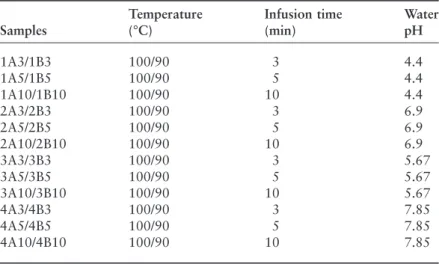
Further experiments were carried out to evalu-ate the influence of infusion conditions on cat-echins, theophylline, caffeine and gallic acid extraction: 2 g of green tea leaves (named as A and B samples) was brewed in 250 mL of deion-ised water (pH 6.90), tap water (pH 7.85), mineral water (pH 5.67) and mineral water acidi-fied (pH 4.4) with seven drops of lemon juice at 100°C and 90°C for 3, 5 and 10 min. Samples were codified as follows: 1A3, 1A5, 1A10, 1B3,
1B5 and 1B10 correspond to 3-, 5- and 10-min infusions in acidified mineral water of samples A and B respectively. 2A3, 2A5, 2A10, 2B3, 2B5 and 2B10 correspond to 3-, 5- and 10-min infu-sions in deionised water of samples A and B respectively. 3A3, 3A5, 3A10, 3B3, 3B5 and 3B10 correspond to 3-, 5- and 10-min infusions in mineral water of samples A and B respectively. 4A3, 4A5, 4A10, 4B3, 4B5 and 4B10 correspond to 3-, 5- and 10-min infusions in tap water of samples A and B respectively (Table 1). The samples were then filtered through a 0.45-mm polyester filter and analysed directly by HPLC.
Canned soft drinks with green tea
Six canned green tea drinks from four different brands (named C to F) commercially available were studied. C1 was a soft drink with green tea and citrus [ingredients: water, green tea extract (8.4%), lemon juice (0.2%), aromas, fructose, caf-feine, acidifier and sweeteners]. C2 was a soft drink with green tea [ingredients: water and green tea extract (5.3%), sugar, fructose, aromas, acidi-fier and ascorbic acid]. D1 was a soft drink with green tea and lemon [ingredients: water, sugar, lemon juice (0.5%), green tea extract (0.1%), acidifier and preservatives, and sweeteners]. D2 was a nectar of orange, kiwi and green tea [ingre-dients: water, juice and pulp of orange (29%) and kiwi (11%), green tea extract (0.12%), ascorbic acid and sweeteners]. E was a soft drink of green tea and pear [ingredients: mineral water (98.5%), fibre (1.0%), dextrin (0.1%), natural aromas,
Table 1 Presents study design for optimization of brewing practices to maximise levels of green tea bioactive compounds Samples Temperature (°C) Infusion time (min) Water pH 1A3/1B3 100/90 3 4.4 1A5/1B5 100/90 5 4.4 1A10/1B10 100/90 10 4.4 2A3/2B3 100/90 3 6.9 2A5/2B5 100/90 5 6.9 2A10/2B10 100/90 10 6.9 3A3/3B3 100/90 3 5.67 3A5/3B5 100/90 5 5.67 3A10/3B10 100/90 10 5.67 4A3/4B3 100/90 3 7.85 4A5/4B5 100/90 5 7.85 4A10/4B10 100/90 10 7.85
acidifier and sweeteners]. F was a carbonated soft drink of lemon and green tea [ingredients: mineral carbonated water, apple concentrate and lemon juice (2.3%), acidifier, lemon aroma and green tea extract].
HPLC analysis
The chromatographic analysis was carried out in an analytical HPLC unit (Jasco, Tokyo, Japan) equipped with two Jasco PU-2080 HPLC pumps, a Column Heater (Model 7981; Jones Chromatog-raphy, Hengoed, UK), an MD-2010 Plus multi-wavelength detector and a Jasco As-950 intelligent sampler. The column was a reversed-phase Waters Spherisorb® C18 (5 mm, 250 mm ¥ 4.6 mm)
ODS2 (Waters, Milford, MA, USA). The Borwin PDA Controller Software (JMBS Developments, Le Fontanil, France) was also used. The HPLC was carried out according to Liang et al. (2001, 2007). Gradient elution was carried out with a mixture of two solvents and a flow of 1 mL/min. Solvent A consisted of acetonitrile/acetic acid/water (6:1:193, v : v : v) and solvent B consisted of acetonitrile/acetic acid/water (60:1:139, v : v : v), changing from 100% (v) solvent A to 100% (v) solvent B by linear gradient during the first 40 min, returning to initial conditions. Detection was per-formed at 280 nm.
Data analysis
The tests were carried out in duplicate for each sample. SPSS for Windows, v. 16 (SPSS Inc.,
Chi-cago IL, USA) was used for statistical treatment of results. Quantitative data from the HPLC analysis were compared using analysis of variance. For variables for which significant F values (P< 0.05) were found, Tukey test was used for comparison means. The calculations of the correlation coeffi-cients between the levels of catechins, gallic acid, theophylline and caffeine of different tea samples and the infusion time were those of Pearson. Princi-pal components analysis (PCA) was performed using catechins concentrations as variables, in order to reduce the dimensionality of the data, and pinpoint the most important effects of influence of water type on green infusion composition.
Results and discussion
Evaluation of ranges of concentration of
catechins, theophylline, caffeine and gallic acid
in Azorean green tea
First studies were performed using tea infusions prepared with 2 g of green tea leaves brewed in 250 mL of deionised water at 100°C for 3, 5 and 10 min, a usual practice in Western countries. A typical chromatogram is shown in Fig. 1. The content of catechins, theophylline, caffeine and gallic acid varied significantly (P< 0.05) in the samples analysed. Table 2 presents the ranges of concentration for each compound according to the conditions used. The Azorean tea is processed between April and September, and the amount of catechins is higher in Summer than in Spring,
Figure 1 Chromatogram of the analysed compounds. 1-Gallic acid; 2-Gallocatechin; 3-Theophylline; 4-Epigallocatechin; 5-Catechin; 6-Caffeine; 7-Epicatechin; 8-Epigallocatechin gallate; 9-Gallocatechin gallate; 10-Epicatechin gallate; 11-Catechin.
presumably because of the higher growth rate and metabolic activities of the young leaves during that season (Baptista et al. 1999), which explains the high variability of catechins and other bioactive compounds found in samples from the market. Additionally, catechins are used by plants to protect them against ultraviolet visible light. Sea-sonal effects were also reported in Australian tea (Yao et al. 2005) and in northeastern Indian tea (Singh et al. 1999; Reto et al. 2007) in which the EGCG, EGC and ECG contents rose during the warm season and fell during the cold season. Variations in the caffeine content according to the origin of the leaf, type of soil and manufacturing conditions are usual (Chen et al. 1998).
Levels of catechins, gallic acid, theophylline and caffeine of different tea samples were posi-tively correlated with the infusion time (Pearson correlation) and significant at 0.05 level for C, EC, EGC, GCG, EGCG, CG, ECG, gallic acid, theophylline and caffeine. Only GC correlations were significant at 0.01 level (P = 0.290). Thus, increasing infusion time results in an increasing of concentration of the compounds under study.
Influence of infusion conditions on catechins,
theophylline, caffeine and gallic acid extraction
Two samples of green tea presenting very differ-ent compositions were selected from those
analysed previously (named as A and B, as can be observed in Fig. 2) and used for further studies of influence of infusion conditions on catechins, theophylline, caffeine and gallic acid extraction. Sample A presented significantly higher levels of all the compounds under study when compared with sample B. The most abun-dant catechin in sample A is EGCG, followed by EGC, whereas in sample B the most abundant catechin is EGC, followed by EGCG. The third most abundant catechin in both samples was ECG.
Different types of water were tested, including deionised water, mineral water, mineral water acidified with lemon juice and tap water at three different infusion times (3, 5 and 10 min) at 100°C. The assays were repeated at 90°C as these are the usual conditions for tea brewing in Western countries. PCA was performed using catechin levels at 100°C as variables in order to reduce the dimensionality of the data and pin-point the most important effects of water type and infusion time on the catechin extraction and changes as a result of epimerisation and oxida-tion. Another PCA was performed using catechin levels at 90°C as variables.
As shown in Table 3, communalities among the variables were high, ranging from 0.528 to 0.983 for experiments performed at 100°C, and from 0.773 to 0.987 for experiments performed
Table 2 Ranges of concentration for catechins, theophylline (TP), caffeine (CAF) and gallic acid (GA) in tea infu-sions prepared with 2 g of tea brewed in 250 mL of deionised water at 100°C for three different infusion times
Compounds (mg/g)
Infusion time (min)
3 (n= 6) 5 (n= 6) 10 (n= 6) Pearson correlation* (P) C 0.48–0.88 0.72–2.15 1.07–2.96 0.695 EC 1.57–2.55 1.93–3.42 2.35–4.31 0.641 GC 0.22–0.58 0.27–0.69 0.49–0.71 0.290 EGC 8.78–11.34 10.32–19.50 13.66–27.31 0.636 GCG 0.49–1.15 0.72–2.68 1.09–3.78 0.528 EGCG 5.64–13.23 7.07–24.88 9.90–31.35 0.539 CG 0.74–1.51 0.89–2.03 1.15–2.10 0.529 ECG 2.44–5.72 2.93–7.86 4.01–9.64 0.578 GA 0.36–0.73 0.41–1.08 0.52–1.25 0.573 TP 0.12–0.27 0.14–0.40 0.20–0.50 0.638 CAF 4.40–11.76 4.68–13.52 4.81–14.37 0.584
*Pearson correlation between levels of the compounds under study and the infusion time.
GC, (-)-gallocatechin; EGC, (-)-epigallocatechin; C, (-)-catechin; EC, (-)-epicatechin; EGCG, (-)-epigallocatechin gallate; GCG, (-)-gallocatechin gallate; ECG, (-)-epicatechin gallate; CG, (-)-catechin gallate.
at 90°C. Similar catechin performance was observed for experiments conducted at 100°C and at 90°C as shown in Table 3.
The results of PCA at 100°C are depicted on a two-dimensional plot (Fig. 3) that is able to explain 87.9% of the total variance. Component 1 explains 45.6% of the variance in the data; the positive segment of the plot for this compo-nent is closely related to the levels of GC, EGC, EC, EGCG and ECG as can be concluded from analysis in Table 3. Component 2 explains 42.2% of the variance in the data; this dimen-sion is positively related to levels of C, GCG and CG. In this figure, the catechins needed for the definition of these components are shown on the axis edges, indicating the direction in which their levels increase. Infusions with the same type of water clustered together. Three clusters were obtained, one for tap water infusions (including 3-, 5- and 10-min infusion times of
samples A and B), another for mineral water and deionised water infusions (also for 3-, 5-and 10-min infusions for the two samples) 5-and the third for acidified mineral water infusions. Thus, water pH influenced catechins’ extraction and changes in their composition. Figure 3 shows that, by using boiling tap water, the content of the non-epistructured catechins, such as C, GCG and CG, increased, except GC, while the content of the epistructured catechins, namely EGC, EC, EGCG and ECG, decreased when compared with using boiling deionised water or boiling mineral water. When compared with acidified mineral water infusion, this effect was even more notorious. This indicates that, during the tea-infusion process, the epimerisa-tion of the catechins occurs more readily when using boiling tap water. Samples A and B pre-sented different catechin contents, however; they showed similar ‘behaviour’ in the four types of
Figure 2 Catechins, theophylline (TP), caffeine (CAF) and gallic acid (GA) contents of two samples (A and B) of Azorean green tea brewed in deionised water at 100°C during 5 min.
GC, gallocatechin; EGC, (-)-epigallocatechin; C, (-)-catechin; EC, epicatechin; EGCG, (-)-epigallocatechin gallate; GCG, (-)-gallocatechin gallate; ECG, (-)-epicatechin gallate; CG, (-)-catechin gallate.
Table 3 Principal components loadings for catechin levels in two sets of experiments, one at 100°C and another at 90°C Catechins Experiments at 100°C Experiments at 90°C PC1 PC2 Communalities PC1 PC2 Communalities C 0.650 0.738 0.968 0.521 0.842 0.987 EC 0.949 0.259 0.969 0.790 0.544 0.773 GC 0.721 0.090 0.528 0.816 -0.065 0.695 EGC 0.961 0.166 0.952 0.938 0.032 0.860 GCG 0.173 0.979 0.989 0.021 0.994 0.969 EGCG 0.897 0.246 0.866 0.939 0.135 0.864 CG 0.174 0.976 0.983 0.005 0.992 0.957 ECG 0.840 0.447 0.904 0.843 0.482 0.924
GC, (-)-gallocatechin; EGC, (-)-epigallocatechin; C, (-)-catechin; EC, (-)-epicatechin; EGCG, (-)-epigallocatechin gallate; GCG, (-)-gallocatechin gallate; ECG, (-)-epicatechin gallate; CG, (-)-catechin gallate.
water at different infusion times. This is consis-tent with the results given by other authors (Wang and Helliwell 2000), who observed that epimerisation takes place more easily in tap water than in purified water. The different pH values between tap (7.85), deionised (6.90) and acidified mineral (4.4) waters are thought to be the main reasons for the different conversion rates for individual catechins (Toschi et al. 2000). Chen et al. (1998) described that, for the pH ranging from 4 to 7, the stability of green tea catechins was inversely associated with the pH value of the infusions.
Toschi et al. (2000) had observed that the anti-oxidant activity of the green tea is higher in the teas that contain higher levels of EGCG, EGC and ECG. These epimers are major tea components with functional properties. Tea infusions prepared with lemon acidified mineral water during higher infusion times (1A10 and 1B10) presented higher levels of these compounds indicating that infu-sions of high antioxidant activity were produced.
Levels of gallic acid, theophylline and caffeine of tea infusions obtained in different types of water were positively correlated with the infusion time (Pearson correlation) and significant at 0.05 level, with P-values of 0.659, 0.690 and 0.759, respectively. No correlations were found between the levels of these compounds and water pH.
Analysis of commercial canned green tea drinks
Individual eight catechins, gallic acid, theophyl-line and caffeine in commercial canned green tea soft drinks were analysed as shown in Fig. 4. All the catechins under study, gallic acid, theophylline and caffeine were detected in samples C1, C2, D1 and D2 as expected in samples containing green tea extracts. The concentrations of EGC and EGCG were, respectively, the highest quan-tity contained in these samples. Sample C1 was enriched in EGC, EGCG, ECG and caffeine when compared with 1A10 and 1B10 samples (infu-sions in acidified mineral water 10 min). C2
Figure 3 Two-dimensional plot representing the principal components analysis of data from catechins at 100°C infusions. 1A3, 1A5, 1A10, 1B3, 1B5 and 1B10 correspond to 3-, 5- and 10-min infusions in acidified mineral water of samples A and B, respectively. 2A3, 2A5, 2A10, 2B3, 2B5 and 2B10 correspond to 3-, 5- and 10-min infusions in deionised water of samples A and B respectively. 3A3, 3A5, 3A10, 3B3, 3B5 and 3B10 correspond to 3-, 5- and 10-min infusions in mineral water of samples A and B respectively. 4A3, 4A5, 4A10, 4B3, 4B5 and 4B10 correspond to 3-, 5- and 10-min infusions in tap water of samples A and B respectively.
GC, (-)-gallocatechin; EGC, (-)-epigallocatechin; C, (-)-catechin; EC, (-)-epicatechin; EGCG, (-)-epigallocatechin gallate; GCG, (-)-gallocatechin gallate; ECG, (-)-epicatechin gallate; CG, (-)-catechin gallate.
samples were similar to 1A10 samples, and D1 and D2 samples were similar to 1B10 sample. It was found that catechin content of some canned drinks was similar when compared with that of tea usually prepared in a tea cup, traditionally prepared by pouring hot water (250 mL, 90–100°C) onto 2 g of dry tea leaves in a tea cup during 5- to 10-min infusion. The industry uses the stabilising effect of ascorbic acid and other acidifying agents on catechin stabilisation.
Concerning E and F samples of soft drinks with mineral and carbonated water and mentioning the addition of green tea extracts, only three cat-echins were detected. Sample E contained EGCG and traces of GCG and ECG. Sample F contained GC, EGC and EGCG. Gallic acid, theophylline and caffeine were not detected in those samples. The chromatographic profile of these two samples was not characteristic of the presence of green tea extracts; hence this evaluation can be used as an authenticity parameter to guarantee the confor-mity with labelling.
Conclusions
The type of water used to prepare green tea infu-sion is of critical importance. As expected, there are other factors to consider such as the tempera-ture and the time of infusion. An enhancement of EGCG, EGC and ECG levels, the catechins with higher antioxidant activity, is observed as water pH decreases and infusion time increases. Thus, the use of mineral water with pH lower than 7 is advised. Additionally, the levels of EGCG, EGC
and ECG can be increased by the addition of a lemon juice or a lemon slice before tea brewing. Temperatures between 90°C and 100°C are appropriate for tea brewing during 10 min, to enable extraction of great amounts of bioactive compounds.
The canned green tea drinks industry produces beverages with compositions of catechins similar to that of home-made acidified green tea infusion and uses the stabilising effect of ascorbic acid and other acidifying agents for that purpose.
Quantification of catechins, gallic acid, theo-phylline and caffeine in canned drinks labelled as containing green tea can be used as an authentic-ity parameter to guarantee the conformauthentic-ity with labelling.
In conclusion, this work indicated tea brewing practices to obtain an infusion rich in bioactive compounds, conveying health messages to con-sumers and food service professionals. Addition-ally, comparison of canned green tea drink and home-made green tea infusions provide useful information for the tea industry, legal regulators of food authenticity and consumers.
References
Arts IC (2008). A review of the epidemiological evi-dence on tea, flavonoids, and lung cancer. The
Journal of Nutrition 138:1561S–6S.
Ashihara H, Sano H, Crozier A (2008). Caffeine and related purine alkaloids: biosynthesis, catabolism, function and genetic engineering. Phytochemistry 69:841–56.
Baptista JAB, Tavares JFP, Carvalho RCB (1999). Comparative study and partial characterization of
Figure 4 Catechins, gallic acid (GA), theophylline (TP) and caffeine (CAF) contents of tea infusion (1A10 and 1B10) and commercial canned green tea drinks (C1, C2, D1, D2, E and F samples).
GC, gallocatechin; EGC, (-)-epigallocatechin; C, (-)-catechin; EC, epicatechin; EGCG, (-)-epigallocatechin gallate; GCG, (-)-gallocatechin gallate; ECG, (-)-epicatechin gallate; CG, (-)-catechin gallate.
Azorean green tea polyphenols. Journal of Food
Composition and Analysis 12:273–87.
Bunkova R, Marova I, Nemec M (2005). Antimu-tagenic properties of green tea. Plant Foods for
Human Nutrition 60:25–9.
Cabrera C, Artacho R, Giménez R (2006). Beneficial effects of green tea – a review. Journal of the
Ameri-can College of Nutrition 25:79–99.
Chen ZY, Zhu QY, Wong YF, Zhang Z, Chung HY (1998). Stabilizing effect of ascorbic acid on green tea catechins. Journal of Agriculture and Food
Chemistry 46:2512–6.
Erba D et al. (2005). Effectiveness of moderate green tea consumption on antioxidative status and plasma lipid profile in humans. The Journal of Nutritional
Biochemistry 16:144–9.
Higdon JV, Frei B (2003). Tea catechins and polyphe-nols: health effects, metabolism, and antioxidant functions. Critical Reviews in Food Science and
Nutrition 43:89–143.
Horie H, Mukai T, Kohata K (1997). Simultaneous determination of qualitatively important compo-nents in green tea infusions using capillary electrophoresis. Journal of Chromatography A 758: 332–5.
Horie N et al. (2005). Synergistic effect of green tea catechins on cell growth and apoptosis induction in gastric carcinoma cells. Biological & Pharmaceutical
Bulletin 28:574–9.
Jeong WS, Kong ANT (2004). Biological properties of monomeric and polymeric catechins: green tea cat-echins and procyanidins. Pharmaceutical Biology 42 (suppl.):84–93.
Kotani A, Takahashi K, Hakamata H, Kojima S, Kusu F (2007). Attomole catechins determination by capillary liquid chromatography with electro-chemical detection. Analytical Sciences 23:157–63. Kuzuhara T, Sei Y, Yamaguchi K, Suganuma M, Fujiki
H (2006). DNA and RNA as new binding targets of green tea catechins. The Journal of Biological
Chem-istry 281:17446–56.
Lambert JD, Yang CS (2003). Mechanisms of cancer prevention by tea constituents. The Journal of
Nutri-tion 133:3262S–7S.
Liang H, Liang Y, Dong J, Lu J (2007). Tea extraction methods in relation to control of epimerization of tea catechins. Journal of the Science of Food and
Agri-culture 87:1748–52.
Liang YR, Ma WY, Lu JL, Wu Y (2001). Comparison of chemical compositions of Ilex latifolia Thumb and Camellia sinensis L. Food Chemistry 75:339–43.
McKay DL, Blumberg JB (2002). The role of tea in human health: an update. Journal of the American
College of Nutrition 21:1–13.
Raza H, John A (2007). In vitro protection of reactive oxygen species-induced degradation of lipids, pro-teins and 2-deoxyribose by tea catechins. Food and
Chemical Toxicology 45:1814–20.
Reto M, Figueira ME, Filipe HM, Almeida CMM (2007). Chemical composition of green tea (Camellia sinensis) infusions commercialized in Portugal. Plant
Foods for Human Nutrition 62:139–44.
Shimizu M et al. (2005). Epigallocatechin gallate and polyphenon E inhibit growth and activation of the epidermal growth factor receptor and human epider-mal growth factor receptor-2 signaling pathways in human colon cancer cells. Clinical Cancer Research 11:2735–46.
Singh HP, Ravindranath SD, Singh C (1999). Analysis of tea shoot catechins: spectrophotometric quantita-tion and selective visualizaquantita-tion on two-dimensional paper chromatograms using diazotized sulfanil-amide. Journal of Agriculture and Food Chemistry 47:1041–5.
Toschi TG et al. (2000). The protective role of different green tea extracts after oxidative damage is related to their catechin composition. Journal of Agriculture
and Food Chemistry 48:3973–8.
Wang H, Helliwell K (2000). Epimerisation of catechins in green tea infusions. Food Chemistry 70:337– 44.
Wang R, Zhou W, Jiang X (2008). Reaction kinetics of degradation and epimerization of epigallocatechin gallate (EGCG) in aqueous system over a wide tem-perature range. Journal of Agriculture and Food
Chemistry 56:2694–701.
Watanabe T, Nishiyama R, Yamamoto A, Nagai S, Terabe S (1998). Simultaneous analysis of individual catechins, caffeine, and ascorbic acid in commercial canned green and black teas by micellar electroki-netic chromatography. Analytical Sciences 14:435– 8.
Williamson G, Manach C (2005). Bioavailability and bioefficacy of polyphenols in humans. II. Review of 93 intervention studies. The American Journal of
Clinical Nutrition 81:243S–55S.
Wu CD, Wei GX (2002). Tea as a functional food for oral health. Nutrition 18:443–4.
Yao L et al. (2005). Seasonal variations of phenolic compounds in Australia-grown tea (Camellia
sinen-sis). Journal of Agriculture and Food Chemistry