ESSAYS ON DEBT MATURITY
Luis Miguel da Silva Laureano
Thesis submitted as partial requirement for the conferral of
PhD in Management Specialization in Finance
Supervisor:
Prof. Doutor Miguel Luís Sousa Almeida Ferreira, Universidade Nova de Lisboa Faculdade de Economia
Co-Supervisor:
Prof. Doutor José Dias Curto, ISCTE-IUL Business School Departamento de Métodos Quantitativos
i
Abstract
This dissertation consists of three major empirical studies about debt maturity following two introductory chapters describing the data used and also the most relevant theoretical and empirical work in the existent literature.
In the first empirical study we examine the debt maturity trend from 1980 to 2004 for US firms and identify if the changes in the debt maturity determinants over time help to explain that same trend. We find evidence of a statistically significant downtrend. Unconstrained firms have significantly higher average debt maturity than constrained ones. We model the average debt maturity using the major determinants found in the most relevant literature. The results give mixed support to most of the existing theories. Opposite to the agency costs theory, we find that firms with higher growth options have higher average debt maturity ratios. Being a regulated firm yields more long term debt and larger firms have higher debt maturity in their capital structures. The signaling hypothesis finds weak support in the results. We provide evidence that our model significantly overestimates the average debt maturity and that the changes occurred over time in the firm characteristics used in the model do not explain the overall trend observed in the debt maturity ratio.
In the second empirical study we investigate the relation between debt maturity and macroeconomic conditions for US industrial firms from 1974 to 2004. We find some evidence that firms hold more short-term debt during economic recessions. However, the results obtained in the financially constrained and unconstrained subsamples are statistically weakly significant. At the firm specific level we find no support for the agency costs hypothesis. In contrast, our results show a positive relation between long-term debt and growth options with a stronger economic impact in unconstrained firms. We find a statistically significant positive relation between size and debt maturity and no evidence that being a regulated firm has any influence on debt maturity choice. We also find no evidence that supports the signaling mechanism in which firms use their debt maturity choice to signal their quality to the market. The matching principle receives good support in our study, particularly from constrained firms. We find that firms with higher effective tax rates borrow more long-term.
ii
The third empirical study focuses on using different approaches to provide support to previous results and to find additional evidence in explaining the choice of the debt maturity level. Through logistic regression we find that larger firms with more growing opportunities and asset maturity and that are subject to higher tax rates are more likely to have higher average debt maturity in their capital structure. Using cluster analysis we are able to clearly identify two distinct groups. We examine the debt maturity in each group and find good support to the previous findings. Using classification trees we find similar results to those obtained using logistic regression while using regression trees yields the indication that the largest firms and those with highest asset maturity are expected to have, on average, the highest debt maturity ratios.
JEL Classification: G30, G32
iii
Resumo
Esta dissertação é constituída por três estudos empíricos sobre a maturidade da dívida antecedidos por dois capítulos introdutórios onde são descritas as bases de dados e as variáveis utilizadas, assim como as principais teorias e estudos empíricos já existentes na literatura.
No primeiro estudo analisa-se a tendência na maturidade da dívida, desde 1980 até 2004, para empresas norte-americanas e identifica-se se as alterações nos determinantes da maturidade da dívida ao longo do tempo permitem explicar essa tendência. Observa-se que a tendência de descida é estatisticamente significativa e que as empresas sem constrangimento financeiro possuem, em média, maturidade da dívida mais elevada que as empresas com constrangimento financeiro. Cria-se um modelo para explicar a maturidade da dívida utilizando os principais determinantes encontrados na literatura mais relevante. Os resultados são mistos quanto ao suporte das teorias existentes. Ao contrário da teoria dos custos de agência, verifica-se que empresas com maiores oportunidades de crescimento possuem, em média, rácios superiores de maturidade da dívida. Empresas regulamentadas têm mais dívida de longo prazo e empresas de maior dimensão possuem dívida de maior maturidade na sua estrutura de capital. Empresas sujeitas a taxas de imposto superiores possuem dívida de maior maturidade, assim como empresas com maior maturidade nos seus activos. Os resultados não suportam a teoria de sinalização ao mercado. Apresenta-se também evidência empírica que o modelo utilizado sobrestima significativamente a média da maturidade da dívida e que as alterações ocorridas ao longo do tempo nas características das empresas utilizadas no modelo não são suficientes para explicar a tendência observada no rácio de maturidade da dívida.
No segundo estudo empírico investiga-se a relação entre a maturidade da dívida e as condições macroeconómicas para empresas industriais norte-americanas desde 1974 a 2004. Apresenta-se evidência empírica que as empresas utilizam mais dívida de curto-prazo durante recessões económicas. No entanto, os resultados obtidos para empresas com constrangimento financeiro são fracos. Ao nível da empresa não se encontra suporte para a hipótese dos custos de agência. Por outro lado, os resultados identificam uma relação positiva entre dívida de longo-prazo e oportunidades de crescimento, existindo maior impacte económico nas empresas sem constrangimento financeiro. Observa-se uma relação positiva entre a dimensão da empresa e
iv
a maturidade da dívida mas não detecta-se nenhuma evidência empírica de que uma empresa regulamentada tenha alguma influência significativa na escolha da maturidade da dívida. Também não se encontra suporte para a teoria de sinalização em que as empresas utilizam a escolha da maturidade da dívida para dar indicações ao mercado sobre a sua qualidade. O princípio de que as empresas tentam acompanhar a maturidade dos seus activos com semelhante maturidade no financiamento dos mesmos é fortemente suportada pelos resultados. Verifica-se ainda que empresas sujeitas a maiores taxas de imposto financiam-se mais no longo-prazo.
No terceiro estudo empírico utilizam-se diferentes técnicas estatísticas e de data mining de forma a dar suporte aos resultados obtidos anteriormente e ainda a procurar novas evidências que permitam compreender melhor a escolha do nível da maturidade da dívida. Através da regressão logística foi possível detectar que empresas de maior dimensão, com maiores oportunidades de crescimento e maior maturidade dos activos e sujeitas a taxas de imposto superiores, têm maior probabilidade de possuírem maturidade da dívida superior à média. Recorrendo à análise de clusters identifica-se de forma distinta dois grupos homogéneos de empresas. Examina-se a maturidade da dívida em ambos e encontra-se um bom suporte nos resultados obtidos previamente. Através de árvores de classificação obtém-se resultados similares aos obtidos através da regressão logística, enquanto através de árvores de regressão verifica-se que as empresas de maior dimensão e com maior maturidade dos seus activos tenderão a ter, em média, rácios de maturidade da dívida mais elevados.
Classificação JEL: G30, G32
Palavras-chave: Maturidade da dívida, estrutura de capital, constrangimento financeiro,
v
Acknowledgements
I would like to thank to both my supervisors and colleagues Miguel Ferreira and José Dias Curto, for all their guidance throughout the development of my PhD program. Their comments, suggestions and availability were always welcomed and appreciated.
I would also like to thank my brother Raul Laureano, for his helpful contribution on Chapter 6, and for all the ideas and comments received throughout this work.
The utmost thanks go to my wife Nídia and to my daughter Diana. Their continuous presence and the good and bad times we have shared together through the years have made it all possible. A special thanks to my mother for her daily caring and concern and to the rest of my family for creating an environment of which I am lucky to be a part of.
Special acknowledgments go to António Gomes Mota and Clementina Silva Barroso for all the support and confidence they have always demonstrated, and for letting me be part of a special team. A final word of appreciation to my friend Rui Costa Pinto for always being there when I needed him.
vi
Contents
Abstract ... i Resumo ... iii Acknowledgements ... v Contents ... vi List of Tables ... ixList of Figures ... xiv
Chapter 1 Introduction ... 1
Chapter 2 Reference theoretical and empirical work ... 7
2.1 Reference theoretical studies ... 7
2.1.1 The irrelevance hypothesis ... 7
2.1.2 “Matching” between debt maturity and asset maturity ... 8
2.1.3 Agency costs ... 8
2.1.4 Credit and liquidity risk ... 10
2.1.5 Asymmetric information and signaling ... 11
2.1.6 Taxes ... 12
2.1.7 Other theories ... 13
2.2 Empirical Studies ... 14
Chapter 3 Data samples and variables description ... 19
3.1 Sample and subsamples ... 19
3.2 Dependent variable ... 20
3.3 Independent firm-specific variables ... 21
vii
3.5 Summary descriptive statistics ... 22
Chapter 4 Debt maturity trend analysis ... 29
4.1 Introduction ... 29
4.2 Data and samples ... 30
4.3 Methodology ... 31
4.4 Empirical Results ... 33
4.4.1 Debt maturity trend Analysis ... 33
4.4.2 Financially constrained and unconstrained debt maturity trend comparison ... 36
4.4.3 Debt maturity determinants ... 37
4.4.4 Predicted versus actual debt maturity ... 41
4.4.5 Changes in firm characteristics and their impact on the debt maturity ratio over time . 43 4.5 Summary ... 46
Chapter 5 Corporate debt maturity and macroeconomic conditions ... 73
5.1 Introduction ... 73
5.2 Data and samples ... 75
5.3 Hypotheses... 77
5.4 Methodology ... 79
5.5 Descriptive statistics and empirical results ... 81
5.5.1 Descriptive statistics ... 81
5.5.2 Debt maturity determinants for the full sample ... 82
5.5.3 Financially constrained and unconstrained debt maturity determinants ... 84
5.6 Robustness checks ... 86
5.7 Summary ... 88
Chapter 6 Debt maturity estimation and classification using logistic regression, cluster analysis and decision trees ... 97
viii
6.1 Introduction ... 97
6.2 Data and sample ... 98
6.3 Methodology ... 99
6.3.1 High debt maturity probability estimation ... 99
6.3.2 Debt maturity in homogeneous groups ... 101
6.3.3 Debt maturity estimation and classification using decision trees ... 102
6.4 Empirical Results ... 104
6.4.1 High debt maturity probability estimation ... 104
6.4.2 Debt maturity in homogeneous groups ... 109
6.4.3 Debt maturity estimation and classification using decision trees ... 114
6.5 Summary ... 119
Chapter 7 Conclusions ... 144
ix
List of Tables
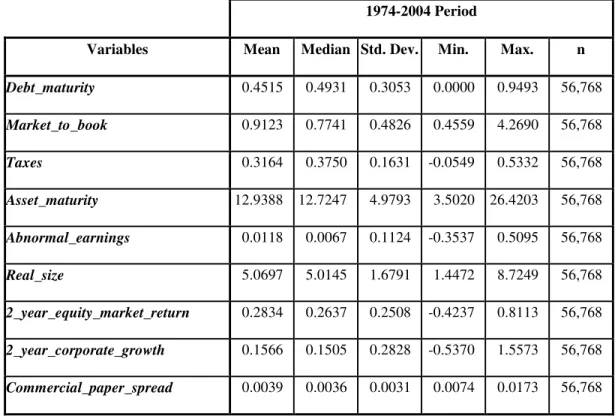
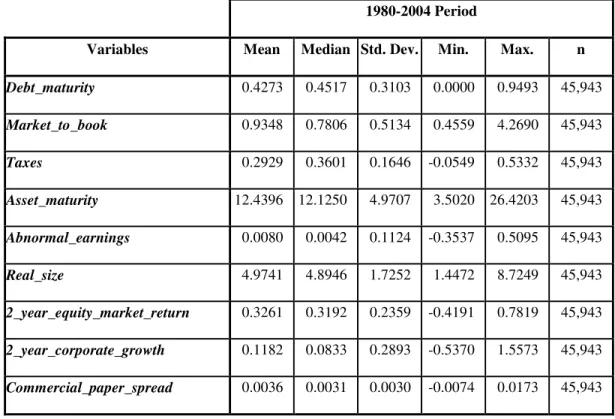
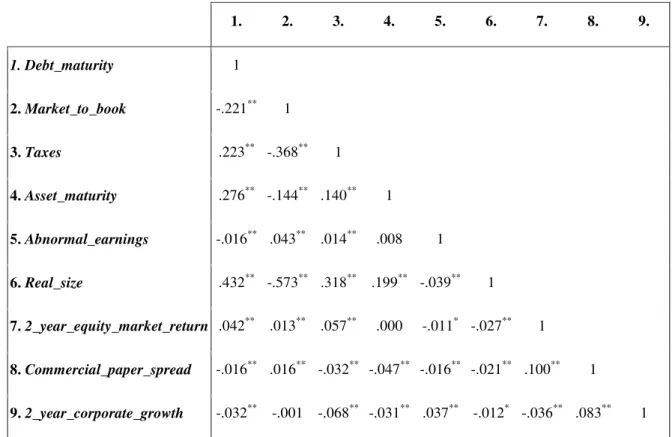
Table 3-1 – Descriptive statistics of firm-specific variables and macroeconomic variables for the sample period of 1974-2004. ... 25 Table 3-2 – Descriptive statistics of firm-specific variables and macroeconomic variables for the sample period of 1980-2004. ... 26 Table 3-3 - Correlation matrix of firm-specific variables and macroeconomic variables for the full sample: 1974-2004 COMPUSTAT firms. ... 27 Table 3-4 - Correlation matrix of firm-specific variables and macroeconomic variables for the full sample: 1980-2004 COMPUSTAT firms. ... 28 Table 4-1 - Expected determinants’ impact on debt maturity ... 38 Table 4-2 - Descriptive statistics for Debt_maturity for the 1980-2004 sample period. ... 49 Table 4-3 - Average and median debt maturity for constrained and unconstrained firms by size for the 1980-2004 sample period. ... 51 Table 4-4 - Average and median debt maturity for constrained and unconstrained firms by constrain dummy for the 1980-2004 sample period. ... 53 Table 4-5 - Average and median debt maturity for constrained and unconstrained firms by Tobin’s Q for the 1980-2004 sample period. ... 55 Table 4-6 - Trend analysis for the average and median debt maturity ratio for the whole sample and subsamples from 1980 to 2004. ... 57 Table 4-7 - Average and median comparison between constrained and unconstrained subsamples by criteria. ... 58 Table 4-8 - Regressions estimating the debt maturity determinants for the whole sample from 1980 to 2004. ... 59 Table 4-9 – Fixed effects coefficients (1980 a 1989). ... 60 Table 4-10 - Predicted debt maturity ratio versus actual debt maturity for the whole sample, from 1990 to 2004, using fixed effects coefficients. ... 60 Table 4-11 - Predicted debt maturity versus actual debt maturity for the constrained subsamples, from 1990 to 2004, using fixed effects coefficients. ... 61
x
Table 4-12 - Predicted debt maturity versus actual debt maturity for the unconstrained subsamples, from 1990 to 2004, using fixed effects coefficients. ... 62 Table 4-13 - Fama-MacBeth Coefficients (from 1980 to 1989) ... 63 Table 4-14 - Predicted debt maturity ratio versus actual debt maturity for the whole sample, from 1990 to 2004, using Fama-Macbeth coefficients. ... 63 Table 4-15 - Predicted debt maturity versus actual debt maturity for the constrained subsamples, from 1990 to 2004, using Fama-Macbeth coefficients. ... 64 Table 4-16 - Predicted debt maturity versus actual debt maturity for the unconstrained subsamples, from 1990 to 2004, using Fama-Macbeth coefficients. ... 65 Table 4-17 - Fixed Effects Coefficients (from 1990 to 2004) ... 66 Table 4-18 - Changes in the determinants of debt maturity from the 1980-1989 period to the 1990-2004 period for the whole sample, using fixed effects coefficients. ... 66 Table 4-19 - Changes in the determinants of debt maturity from the 1980-1989 period to the 1990-2004 period for the constrained firms’ subsamples, using fixed effects coefficients. ... 67 Table 4-20 - Changes in the determinants of debt maturity from the 1980-1989 period to the 1990-2004 period for the unconstrained firms’ subsamples, using fixed effects coefficients. ... 68
Table 4-21 - Fama-Macbeth Coefficients (from 1990 to 2004) ... 69
Table 4-22 - Changes in the determinants of debt maturity from the 1980-1989 period to the 1990-2004 period for the whole sample, using Fama-Macbeth coefficients. ... 69 Table 4-23 - Changes in the determinants of debt maturity from the 1980-1989 period to the 1990-2004 period for the constrained firms’ subsamples, using Fama-Macbeth coefficients... 70 Table 4-24 - Changes in the determinants of debt maturity from the 1980-1989 period to the 1990-2004 period for the unconstrained firms’ subsamples, using FM coefficients. ... 71 Table 4-25 - Summary table of the changes in the determinants of debt maturity from the 1980-1989 period to the 1990-2004 period for the whole sample and subsamples, using fixed effects coefficients. ... 72 Table 5-1 - Description of firm-specific variables and macroeconomic variables for the full sample: 1974-2004 COMPUSTAT firms. ... 90 Table 5-2 - Descriptive statistics for debt maturity by groups of firms. ... 91
xi
Table 5-3 - Fixed effects regressions predicting debt maturity levels for the full sample from 1974
to 2004. ... 93
Table 5-4 - Fixed effects regressions predicting debt maturity levels for constrained and unconstrained firms from 1974 to 2004. ... 94
Table 5-5 - Modified fixed effects regressions predicting debt maturity levels. ... 95
Table 5-6 - Fixed effects regression predicting debt maturity levels with new macro variables, for the full sample from 1794 to 2004. ... 96
Table 6-1- ROC Discriminating Power ... 105
Table 6-2 - Independent variables' impact on odds ratio ... 107
Table 6-3 - Summary results for cluster 1 ... 109
Table 6-4 - Summary results for cluster 2 ... 110
Table 6-5 - Case processing summary ... 122
Table 6-6 - Classification table ... 122
Table 6-7 - Variables in the equation ... 123
Table 6-8 - Omnibus tests of model coefficients ... 123
Table 6-9 - Model summary ... 123
Table 6-10 - Hosmer and Lemeshow test ... 123
Table 6-11 - Classification table ... 123
Table 6-12 - Variables in the equation ... 124
Table 6-13 - Case processing summary ... 124
Table 6-14 - Area under the curve ... 124
Table 6-15 - Omnibus tests of model coefficients ... 125
Table 6-16 - Model summary ... 125
Table 6-17 - Hosmer and Lemeshow test ... 126
Table 6-18 - Classification table ... 126
xii
Table 6-20 - Variables not in the equation ... 127
Table 6-21 – Auto-clustering ... 128
Table 6-22 - Regulation_dummy frequencies ... 128
Table 6-23 - Descriptive statistics for continuous variables and Debt_maturity, per cluster ... 130
Table 6-24 - Cluster x Debt_maturity quartiles (DM_Quartiles) crosstabulation ... 131
Table 6-25 - Cluster x Market_to_book quartiles (MB_Quartiles) crosstabulation ... 131
Table 6-26 - Cluster x Taxes quartiles (TX_Quartiles) crosstabulation ... 131
Table 6-27 - Cluster x Asset_maturity quartiles (AM_quartiles) crosstabulation ... 132
Table 6-28 - Cluster x Abnormal_earnings quartiles (AE_Quartiles) crosstabulation ... 132
Table 6-29 - Cluster x Real_size quartiles (RS_Quartiles) crosstabulation ... 132
Table 6-30 – Regression tree risk estimate ... 133
Table 6-31 – Regression tree independent variable importance ... 133
Table 6-32 - Regression tree root node ... 134
Table 6-33 - First two levels of the regression tree ... 134
Table 6-34 - Regression tree left branch nodes ... 135
Table 6-35 - Regression tree right branch nodes ... 136
Table 6-36 - Classification tree risk estimate ... 137
Table 6-37 - Classification ... 137
Table 6-38 - Logistic regression (predicted group) x Classification tree (predicted value) crosstabulation ... 138
Table 6-39 - Classification tree independent variable importance ... 138
Table 6-40 - Classification tree root node ... 139
Table 6-41 - Classification tree first two levels ... 139
Table 6-42 - Classification tree outside left branch nodes ... 140
xiii
Table 6-44 - Classification tree inside right branch nodes ... 142 Table 6-45 - Classification tree outside right branch nodes ... 143
xiv
List of Figures
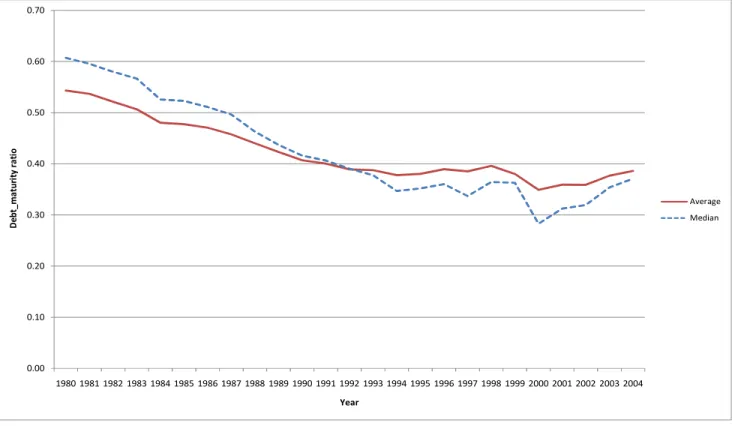
Figure 4-1 - Average and median debt maturity ratio for the whole sample from 1980 to 2004. . 50
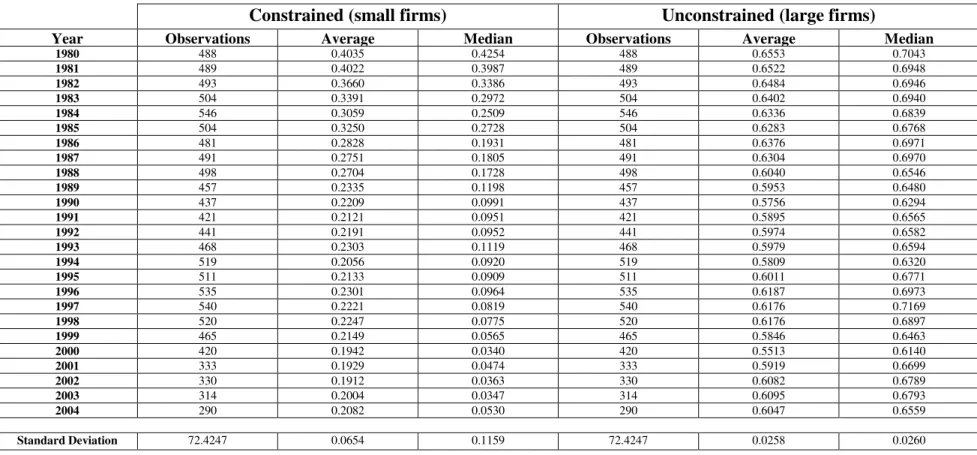
Figure 4-2 - Average and median debt maturity for constrained and unconstrained firms by size from 1980 to 2004. ... 52
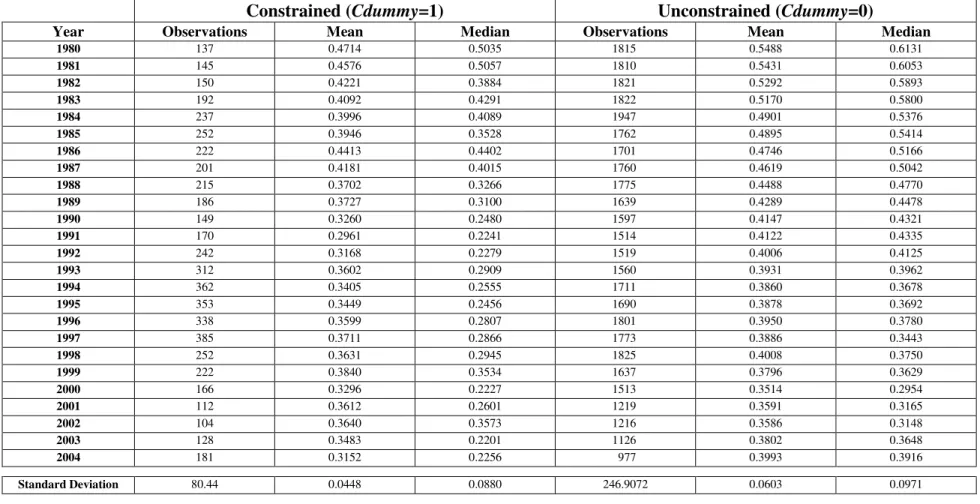
Figure 4-3 - Average and median debt maturity for constrained and unconstrained firms by constrain dummy from 1980 to 2004. ... 54
Figure 4-4 - Average and median debt maturity for constrained and unconstrained firms by Tobin’s Q from 1980 to 2004. ... 56
Figure 5-1 - Average of the debt maturity ratio from 1974-2004. ... 92
Figure 6-1 - Regression tree diagram ... 114
Figure 6-2 - Classification tree diagram ... 117
Figure 6-3 - ROC curve ... 124
Figure 6-4 - Regulation_dummy importance, by cluster ... 129
Figure 6-5 - Continuous variables importance in cluster 1 ... 129
1
Chapter 1 Introduction
In order to finance their activities or future investments, firms need to decide where to obtain the necessary funds. When borrowing debt, whether bank or market debt, the maturity choice is a must. Priority has been given to the study of capital structure and to the factors that influence managements’ decisions in having more or less debt in their firm’s capital structure. The choice between equity and debt in financing new projects and in maximizing the company’s value has been studied since the early work of Modigliani and Miller (1958, 1963). Some of the most relevant studies were mainly presented during the seventies: (Donaldson, 1961), (Kraus and Litzenberger, 1973), (Stiglitz, 1974), (Jensen and Meckling, 1976), (Miller, 1977), (Ross, 1977) and (Myers, 1977). More recently, the contributions of Titman and Wessels (1988), Fischer et al. (1989), Shyam-Sunder and Myers (1999) and Hovakimian et al. (2001) have significantly improved the knowledge about capital structure choice.
The first theoretical work with references to the debt maturity choice appeared in the late fifties, early sixties and seventies (Modigliani and Miller, 1958, 1963) and (Stiglitz, 1974)). In the late eighties and during the nineties, academics presented the first empirical studies regarding debt maturity ((Titman and Wessels, 1988), (Mitchell, 1991), (Barclay and Smith, 1995), (Stohs and Mauer, 1996) and (Guedes and Opler, 1996)). However, most of the existing work focus only on firm-specific variables in trying to explain the debt maturity choice. There are few studies on the impact of macroeconomic conditions on the choice of debt maturity as the main subject. Some research work focus on the relation between debt maturity and specific time events or specific country development stages, but to the best of our knowledge, none in the US: accessing the 1997 Asian crisis ((Wiwattanakantang et al., 2003), (Charumilind et al., 2006), (Guerrero and Parker, 2006) and (Deesomsak et al., 2009)); focusing on developing or emerging countries and on the financial globalization ((Bussiere et al., 2006), (Guerrero, 2007) and (Schmukler and Vesperoni, 2001)).
Several theories have been presented through the years to help determine the choice of debt maturity: the irrelevant hypothesis, the “matching” between debt maturity and asset maturity proposition, the agency costs model, the credit and liquidity risk model, the asymmetric
2
information and signaling model and the tax based model. Next we succinctly describe these theories and present the results from some relevant empirical studies.
The irrelevant hypothesis was first introduced by Modigliani and Miller (1958) and later developed by Stiglitz (1974). The authors argue that in the presence of perfect capital markets, both the capital structure and the maturity of debt are irrelevant to the firm’s value. Stiglitz, however, recognized that market imperfections would interfere with his theorem.
The “matching” between debt maturity and assets maturity was first studied by Grove (1974), Morris (1976) and Myers (1977). The authors argue that firms try to match their assets maturity with their debt maturity in order to minimize the risk of owning assets which generate return in different periods than those from the debt obligations. Stohs and Mauer (1996) also defend this idea. Other authors also suggest that firms synchronize their assets and debt maturities, although for different reasons: to reduce agency costs ((Myers, 1977), (Stove et al., 1980) and (Van Auken and Holman, 1995)) or to reduce liquidity risk (Diamond, 1991a). This theory has been strongly supported throughout several empirical work (i.e. (Guedes and Opler, 1996), (Stohs and Mauer, 1996), (Ozkan, 2000)1 and (Danisevská, 2002)).
Myers (1977) argues that the underinvestment problem and the agency costs associated may be mitigated by shortening the debt maturity. Increasing growing options in a firm’s investment opportunities set increases the agency costs (Myers and Majluf, 1984) and (Mauer and Ott, 2000)). Several other solutions to this problem have been presented by Myers (1977), Barnea et al. (1980), Ho and Singer (1982), Stulz and Johnson (1985). The conflict between stockholders and creditors have higher probability of occurring in small firms (Smith and Warner, 1979) and are also more relevant in this riskier firms ((Petit and Singer, 1985) and Whited, 1992)). Empirical research has found mix results. Barclay and Smith (1995) find that, in average, firms with more growth options have more short-term debt. Guedes and Opler (1996) and Ozkan (2000) show consistent results with the theory. However, Stohs and Mauer (1996) and Danisevská (2002) find no support for the prediction that more growth options in the firm’s investment opportunity set leads to a relative increase in short-term debt. Johnson (2003) finds strong support for Myers (1977) prediction and suggests that firms trade-off the costs of the
1
3
underinvestment problems against the costs of illiquidity risk when choosing short-term debt. Antoniou et al. (2006) find no support for the theory and even find contradictory results2.
In the credit and liquidity risk model firms face the risk of not being able to refinance their debt. Diamond (1991a) presents a model relating liquidity risk with debt maturity. In this model, high quality firms choose to issue short-term debt while low quality firms also borrow short-term because they have no other choice. Only medium-risk firms tend to issue long-term debt. Sharpe (1991) and Titman (1992) follow the ideas presented by Diamond. Rizzi (1994) also suggests that firms with inferior ratings are often kept away from issuing long-term debt. Houston and Venkatarman (1994) argue that firms use multiple debt issues with different maturities and not simply short or long-term debt. They show that the debt financing costs can be mitigated by issuing the proper mix of short and long-term debt. Stohs and Mauer (1996) and Scherr and Hulburt (2001)3 find strong support for Diamond’s (1991a) prediction of a nonmonotonic relation between debt maturity and bond rating. To a lesser degree a similar result is presented by Barclay and Smith (1995). Guedes and Opler (1996) find that large firms with investment grade credit rating typically issue debt on the short or long end of the maturity spectrum while firms with speculative grade credit ratings borrow on the middle of the spectrum. Elyasiani et al. (2002) find inconsistent results for the expected effect of liquidation risk and debt maturity while Berger
et al. (2005)4 find consistent results for low-risk firms but conflicting results for high-risk firms. In the asymmetric information and signaling framework, the first relevant paper was presented by Flannery (1986). The author concludes that firms with favorable private information signal their projects quality issuing short-term debt. This idea is reinforced in O’Hara (1992). Firms with unfavorable information issue long-term debt while firms facing the absence of information asymmetries are likely to be indifferent in choosing debt maturity. Kale and Noe (1990) and Titman (1992) extend Flannery’s work. The former validating Flannery’s model in the absence of transaction costs and the latter adding interest rate uncertainty. Goswani et al.
2
Their cross-country study comprises French, German and UK firms.
3
Their sample focus only on small US firms taken from the National Survey of Small Business Finances (NSSBF) database.
4
4
(1995) study the maturity structure as a function of the temporal distribution of asymmetric information. They conclude that firms issue long term debt when the asymmetry is related to long-term cash-flows uncertainty. When the distribution of informational asymmetry is randomly spread between the short and long-term, firms issue short-term debt. Barclay and Smith (1995) find evidence that firms with larger information asymmetries issue more short-term debt. Little evidence is found for the prediction that firms use their debt structure for signaling purposes. Wittenberg-Moerman (2007)5 finds similar results to Barclay and Smith (1995). Cuñat (1999)6 finds no evidence for the signaling usage of debt maturity structure. Berger et al. (2005) find that a reduction in informational asymmetries in low-risk firms increases their average maturity. Danisevská’s (2002) work on asymmetric information finds no support to Goswani et al. (1995) model. The author finds no relation between long-term asymmetric information and debt maturity. However, firms with both high short-term asymmetric information and good news use significantly more short-term debt.
When studying the relation between taxes and debt maturity, Kane et al. (1985) develop a continuous time model and conclude that debt maturity increases as the effective tax rate decreases. In the same year, Brick and Ravid (1985) argue that firms employ more long-term debt in order to maximize firm value, when the term structure of interest rates has a positive slope. However, Lewis (1990) contradicts this argument stating that taxes have no impact in the firm’s value when optimal leverage and debt maturity structure are determined simultaneously. Brick and Ravid (1991) extend their previous work and demonstrate that firms tend to issue long-term debt when interest rates are uncertain, despite having a positive, flat or a negative slope. Barclay and Smith (1995) find no support for Brick and Ravid’s (1985) tax hypothesis, however they argue that the results are broadly consistent with Lewis’s (1990). Stohs and Mauer (1996) find an inverse relation between the effective tax rate and debt maturity, thus supporting Kane et al.
5
The author observes syndicated loans and uses the bid-ask spread in the secondary market as a measure for informational asymmetries.
6
5
(1985) model. Guedes and Opler (1996) and Cai et al. (2008)7 find no significant impact of taxes on debt maturity.
This dissertation is devoted to the analysis of the debt maturity choice. We contribute to the existing literature in three major ways: we analyze the existence of a time trend in the debt maturity held by firms and identify the factors that generate that trend; we introduce macroeconomic determinants to explain the debt maturity choice and analyze its behavior during expansions and recessions periods; we apply econometric techniques different from those usually applied in the recent empirical studies to generate new information and to provide robustness to the existing results.
In the first empirical study, presented in Chapter 4, our main motivation is to investigate how the debt maturity structure of US firms has evolved from 1980 to 2004. After identifying the existent trend in the debt maturity ratio for the full sample, we proceed with the same analysis for several subsamples of financially constrained and unconstrained firms. Next, using the most relevant determinants found in the literature, we build a model to explain the debt maturity of firms during the sample period. Finally, using the 1980s as a reference period, we investigate if the firm-specific determinants of the debt maturity have changed over time and if they are responsible for the observed trend. Some of the methodologies used follow the work of Bates et
al. (2009).
In the second study (Chapter 5) we use a sample of 10,159 non-financial US firms over the period from 1974 to 2004. We focus on how macroeconomic conditions impact on debt maturity decisions. The main contribution of this work relies in the fact that we focus not only at the firm-specific level but also at the macroeconomic level in determining the maturity structure of debt held by firms. Furthermore, we test whether there are differences in the debt maturity structure of financially constrained and unconstrained firms with emphasis on the macroeconomic conditions. We expect that during economic recessions firms shorten their debt maturity structure, particularly financially constrained firms. We also expect strong support to the maturity matching hypothesis between debt and assets, with a stronger economic impact on financially constrained firms. We classify firms as financially constrained and unconstrained
7
6
according to five criteria: growth potential, size, a constrain dummy variable, bond rating and commercial paper rating. To proxy for macroeconomic cycles and business conditions we use proven variables, namely, the two year equity market return, the two year corporate growth and the commercial paper spread. The work by Korajczyk and Levy (2003) constituted an additional motivation to our analysis.
Chapter 6 documents the last empirical study. Our main motivation is to give robustness to our previous findings and to the existing literature using different econometric techniques than those previously applied. We also aim at obtaining additional information regarding the debt maturity choice by firms. We use the same data sample as in Chapter 5. Using firm-specific and macroeconomic determinants and applying logistic regression and classification trees, we classify firms into high or low debt maturity firms, according to the debt maturity level being above or below average. Using cluster analysis and the debt maturity firm-specific determinants as discriminating factors, we identify homogeneous groups in our data. We identify the type of firms and analyze the debt maturity in each group. Finally, we perform a regression tree and identify the most relevant determinants that influence the debt maturity level held by firms. The results obtained from the cluster analysis and from the regression tree are then compared with those obtained in the previous two studies and also with the existing literature.
The remaining chapters of this dissertation are organized as follows. Chapter 2 succinctly describes the most relevant theoretical studies and empirical work. In Chapter 3 we offer a description of the main data samples and variables used throughout our empirical studies. Chapter 4 analyses the debt maturity trend in the last decades and investigates if the changes occurred in the debt maturity determinants during that period are responsible for the observed trend. In Chapter 5 we study the impact of macroeconomic conditions on the debt maturity choice with emphasis on financially constrained and unconstrained firms. In Chapter 6 we take a different approach in the study of the debt maturity of firms using logistic regression, cluster analysis and decision trees techniques. The final Chapter summarizes the conclusions.
7
Chapter 2 Reference theoretical and empirical work
In this chapter we provide some of the most relevant theoretical and empirical work on debt maturity. We present a synthetic description of each theory followed by several empirical studies and the major results reported. Overall, this chapter serves the purpose of identifying the background on debt maturity studies and help us define the framework of our investigation.
2.1 Reference theoretical studies
2.1.1 The irrelevance hypothesis
The irrelevance in financing decisions, where the debt maturity choice is included, had its origins in the work of Modigliani and Miller (1958). The authors implicit demonstrate that, in the presence of perfect markets, the maturity of debt is irrelevant to the companies’ value. The perfect markets hypothesis assume absence of taxes, absence of transaction costs, absence of agency costs, individuals have homogeneous expectancies relative to future investments and information is freely accessible and it is equally available to all market intervenients.
In one of the propositions presented, the authors argue that the market value of a company is independent of its capital structure and that the decision concerning the maturity of debt never leads to changes in the company’s value, becoming irrelevant.
The initial work of Modigliani and Miller was later developed by Stiglitz (1974). Stiglitz explicitly demonstrates the irrelevance of debt maturity. Once again, some of markets’ imperfections are eliminated. In his first theorem, he makes four assumptions: there are no bankruptcies; existence of a perfect market for bonds with all maturities; all real decisions have been made by companies and the existence of a general equilibrium.
Under these assumptions, Stiglitz proves the existence of another general equilibrium in which a company may change one or several financing policies but the firm value and the value of all bonds with different maturities remain the same. In this new equilibrium investors change their bond and stock portfolio in order to balance the changes made by firms of which they own securities. If, for example, a firm decides to issue more five year bonds than three year bonds, then investors have the ability to adjust their portfolios to counterbalance that decision.
8
Theoretical studies about the determinants of debt maturity structure evolved with the introduction of market imperfections. The theories developed embrace different issues like adverse selection, market signaling, taxes, moral hazard and others. These theories are explained next.
2.1.2 “Matching” between debt maturity and asset maturity
Grove (1974), Morris (1976) and Myers (1977) were the first to study the impact of assets maturity on debt maturity. Morris argues that firms try to match their assets maturity with their debt maturity. This way they can reduce the risk of upcoming cash-flows fall short to pay interests and the debt itself. This idea is also defended by Stohs and Mauer (1996). Owning debt with maturity inferior to assets maturity may be risky because the latter may not generate enough return to face debt obligations. On the other hand, owning debt with maturity greater than the maturity of assets may also be risky, because debt obligations must be fulfilled when the assets in place no longer generate return, leading to the need of new investments. To reduce the risk mentioned, firms try to match both maturities.
Myers (1977) argues that firms synchronize their debt payments with the declining value of their assets, reducing agency costs. This way, firms with medium and long term assets can have more long-term debt in their capital structure. Maturity matching allows firms to lengthen their debt maturity without increasing agency costs. This idea can also be found in Stowe et al. (1980) and in Van Auken and Holman (1995).
Diamond (1991a) argues that liquidity risk can be reduced by financing long-term assets with long-term capital. Other explanations for matching the maturity of assets and debt can be found in the work of Goswami et al. (1995) and in Hart and Moore (1994).
2.1.3 Agency costs
Agency costs result from any costs deriving from conflict of interest between two parties (Jensen and Meckling, 1976). The agency costs of debt may influence its maturity. According to Myers (1977), agency costs may occur in what the author named the under-investment problem. When projects are financed with debt, it is possible that managers will not take on projects with positive NPV. When firms have large debt, the residual claims may be low and the investment
9
return may benefit almost exclusively the creditors. Stockholders, knowing they may not get a fair return are reluctant to embrace in future investments which reduce the firms’ growing opportunities.
The value of a company comes from the value of assets and from the present value of its growing opportunities, which can be looked at like options to follow future investments. If these options are not exercised, they expire, and the value of the firm diminishes. In an attempt to solve this problem the author suggests that the maturity of debt should be reduced in order to end before the maturity of investment options. Long-term debt can then be obtained through the continuous renewing of short-term debt. The growing options of a firm affect the choice of debt maturity due to this underinvestment problem ((Myers and Majluf, 1984), (Mauer and Ott, 2000) and (Childs et al., 2005)).
Other solutions to this problem can arise from using call and sinking funds provisions ((Barnea et al., 1980) and (Ho and Singer, 1982)), by reducing the level of debt in the capital structure or by including covenants in debt contracts (Myers, 1977). Stulz and Johnson (1985) suggest that by issuing high priority fixed claims, firms can limit the transfer of value from stockholders to bondholders.
Barnea et al. (1980) point out the agency costs that result from the replacement of assets where mangers invest in riskier assets than those that were initially agreed. Short-term debt can reduce the costs because it is less sensitive to variations in projects’ cash-flows when compared to long-term debt. To Smith and Warner (1979) the probability of conflict between stockholders and creditors in small firms is higher. Petit and Singer (1985) argue that agency issues are directly related to debt financing and are more relevant in smaller firms. Whited (1992) shows that small firms are usually set aside from long-term debt markets because the proportion of their assets as collateral to future investment opportunities are low.
Hart and Moore (1995) show that is possible that firms choose an optimal amount of debt, senior and junior, in a way that counterbalances managers incentive to invest in less profitable projects. The authors agree that the choice of debt maturity can reduce the agency conflict between managers and stockholders. Berlin and Loeys (1988) on the other hand conclude that
10
banks do better monitoring firms than other creditors, thus reducing agency problems and the need for shorter debt maturity.
Leland and Toft (1996) examine the optimum level of capital structure when it is possible to determine the amount of debt and its maturity. In their model the optimal amount of debt depends on the maturity of debt and it is lower when firms finance in the short-term. The maturity of debt suggests a trade-off between tax benefits and financing costs, including agency costs. In the presence of agency costs, riskier firms should issue more short-term debt and additionally reduce the amount of debt.
2.1.4 Credit and liquidity risk
Every firm with debt faces the risk of not being able to refinance that debt. The risk of bankruptcy may influence the debt maturity choice (Sarkar, 1999). This way, financing with debt of longer maturities may prove beneficial under this reality. Stiglitz and Weiss (1981), like Diamond (1991a), argue that although liquidity risk may influence firms to give priority to long-term debt, some may be unable to get it because the return demanded by investors for the long-term risk may lead to the acceptance of riskier and low quality projects.
Diamond (1991a) presents a model relating liquidity risk with short-term financing. Like Diamond, Sharpe (1991) and Titman (1992) agree that bad news may occur prior to the refinancing date regarding the debt holder, which could lead to the deterioration of financing conditions or even to the end of the contract. Diamond defines liquidity risk as the risk of the debt holder having to inefficiently liquidate his assets, once access to new debt has been denied.
Firms with favorable inside information about their future earnings will prefer short-term debt because this will lead to better refinancing conditions. Short-term financing means higher liquidity risk. According to Diamond, firms with higher ratings prefer short-term debt for the liquidity risk is low. Firms with inferior ratings prefer long-term debt reducing the refinancing risk. Firms with very low ratings use short-term debt because the chances of generating sufficient cash-flows to face long-term debt are weak.
11
According to Rizzi (1994), firms with inferior ratings are often incapable of issuing long-term debt. Those who can, usually face unfavorable credit conditions and access it trough financial intermediaries.
2.1.5 Asymmetric information and signaling
Every time both parties in a contract have different information we are under asymmetric information. Managers often have more information about future financial conditions then future or current creditors. Flannery (1986), after analyzing asymmetric information relation with projects quality suggests that a firm with favorable private information signals its quality issuing short-term debt. According to the author, this happens because high quality projects are less undervalued in the short-term than in the long-term.
There is a separating equilibrium when firms with low quality projects cannot mimic the behavior of firms with good projects, because the short-term refinancing costs may exceed the overvaluation of short-term debt of the lesser firm. Firms with unfavorable private information issue long-term debt. Firms with no asymmetric information problems are likely to be indifferent in the choice of debt maturity. O’Hara (1992) reinforces the idea that in the presence of asymmetric information about the quality of assets in place, a firm may signal the assets quality by issuing short-term debt.
Kale and Noe (1990) show that the separating equilibrium presented by Flannery (1986) remains valid with the inexistence of transaction costs. Similar results are obtained if the nature of the released information is correlated through time. Titman (1992) verifies that it is possible to obtain a long-term pooling equilibrium if we consider financial distress costs and if the interest rates are uncertain.
Goswani et al. (1995) introduce the temporal distribution of asymmetric information. Their model suggests that differences in the degree of asymmetric information in the short or long-term cash-flows influence the choice of debt maturity. When we have a high degree of uncertainty in the long-term cash-flows firms issue long-term debt with limited coupons and dividend payouts. In the presence of more asymmetric information in the short-term cash-flows and of refinancing risk, firms then issue long-term debt without limited coupons and payout dividends. When there is asymmetric information in the short and long-term cash-flows then firms issue short-term debt.
12
Other studies about asymmetric information and debt maturity can also be found in (Diamond, 1991b, 1993), (Robbins and Schatzberg, 1986), (Goswami, 2000), (Kanatas and Qi, 2001) and (Lensink and Pham, 2006).
2.1.6 Taxes
Since the early work of Modigliani and Miller (1963) that the influence of taxes in the capital structure choice has been taken into account. In fact, financing through debt and not with capital has a clear advantage: the financial costs of debt are tax deductible while dividend payouts are not. Despite this advantage in the usage of debt, authors like Baxter (1967), Kraus and Litzenberger (1973) and Scott (1976) show that a higher degree of debt financing may lead to a higher probability of bankruptcy, while the costs of bankruptcy may exceed the tax advantage of debt.
Miller (1977) introduced personal taxes in the study of debt but Kane et al. (1985) were the first to develop a model in continuous time that allowed the endogenous determination of optimal debt maturity including taxes, corporate and personal. They conclude that the optimal debt maturity rises as the debt fiscal advantages decline. This inverse relation exists as a way to assure that the remaining debt fiscal benefit deducting the bankruptcy costs is not lower than the amortization of the flotation costs.
Brick and Ravid (1985) establish a generic platform relating taxes and debt maturity. Since firms may enter into default on debt payments, the expected value of the tax benefits depends on the debt maturity structure when the interest rates are not flat. The authors demonstrate that the firm market value rises with long-term debt when the interest rate curve is upward sloping.
Long-term debt is also ideal in stochastic interest rate environment (Brick and Ravid, 1991). The reason for this relation comes from the fact that the debt fiscal benefits are higher with a higher proportion of debt payments allocated to the long-term. When the interest rate is downward sloping the conclusion is symmetric and the higher the marginal tax rate the more relevant are the impacts mentioned.
Brick and Ravid (1985) make the assumption that the debt level is established before the debt maturity. Meanwhile, Lewis (1990) argues that taxes have no relevance in the choice of debt
13
maturity if we are to assume that the optimal level of leverage and its maturity are simultaneously defined. Lewis points out that the choice of debt maturity is irrelevant when the presence of taxes is the only market imperfection.
The choice of debt maturity may also be influenced by taxes because the choice of long-term debt instead of short-term debt represents a tax-timing option, resulting from the possibility of the firm to re-acquire and issue new debt ((Mauer and Lewellen, 1987), (Emery et
al., 1988) and Brick and Palmon, 1992)).
2.1.7 Other theories
Kane et al. (1985) argue that the optimal debt maturity is negatively related with volatility in the firm value. The maturity rises as the volatility declines. Wiggins (1990) shows that higher volatility in the firm value may lead to longer debt maturities. Leland (1994) and Ravid (1996) confront these two different perspectives. Ravid states that the opposite implications derive from different tax related assumptions. Ju and Ou-Yang (2006) develop a model to jointly determine the optimal capital structure and debt maturity under stochastic interest rates. They find that the long run mean of the interest rate is key in determining the optimal capital structure and debt maturity. They also find that the interest rate volatility and the correlation between the interest rate and a firm assets’ value are important factors in the debt maturity determination.
Harford et al. (2007) examine the impact of weaker or stronger boards in the debt maturity choice. They find that stronger boards force the firm to hold more short-term debt and that the impact of the board in the short-term debt usage is likely to be stronger in low-growth firms. Datta et al. (2005) find that managerial stock ownership plays an important role in determining debt maturity. They find a significant and robust inverse relation between the two. They also argue that managerial stock ownership influences the relation between credit quality and debt maturity and between growth opportunities and debt maturity. Emery (2001) develops a model in which debt maturity depends on the demand for a firm’s product. The author finds that firms use short-term debt to match their assets’ and liabilities’ maturities and to increase the amplitudes of the firms’ investment, production, and sales cycles. Aarstol (2000) finds an inverse relation between private debt maturity and inflation.
14
2.2 Empirical Studies
The first studies with results regarding debt maturity came as a byproduct of studies about capital structure. Titman and Wessels (1988) focus their study in the usage of short-term or long-term debt in capital structure decisions. The study uses data from US companies, from 1974 to 1982. The authors conclude that smaller firms have a higher proportion of short-term debt in their capital structures. The reason presented is that firms could minimize the costs associated with the issuing of long-term debt.
Mitchell (1987) tries to explain why the short-term debt over long-term debt ratio had an increase in the economy between 1952 and 1982. Mitchell finds out the existence of a positive correlation between the increase in the ratio and the increase in interest rates uncertainty.
Mitchell (1991) analyses the time to maturity of public corporate bonds. The author finds that a firm has more probability to became indebted in the short-term (less than 20 years) if it is not part of the NYSE or the S&P400 index. According to the author, this conclusion is consistent with the theory that when firms have a high degree of asymmetric information they tend to choose short-term debt in order to minimize the costs of adverse selection. Firms of lesser size and with convertible debt have more probability of issuing short-term debt (less than 10 years). Mitchell finds no support for the matching theory.
Despite the fact that the three empirical works presented already give some pointers about debt maturity choosing, the main subject of these studies was never the debt maturity. Next we present the most relevant empirical work with debt maturity as the main theme.
Barclay and Smith (1995) use a sample of US firms taken from COMPUSTAT and CRSP. They have a total of 39,949 firm-year observations, between 1974 and 1992. The authors conclude that smaller firms have most of their debt with maturities less than three years. This conclusion supports the theory that firms with higher growing opportunities issue short-term debt. The result is consistent with Myers (1977), where firms use debt maturity as a way to control the conflicts of interest between bondholders and stockholders. Other results give strong support to the contracting costs hypotheses: firms with little growing opportunities, large or regulated, have more long term capital in their capital structure. Little evidence is found about the usage of debt maturity as a signaling tool. No support is found for the influence of taxes in debt maturity.
15
Stohs and Mauer (1996) use information from 328 large firms, from several industries and publicly traded. The sample period is from 1980 to 1989. The results show that large firms with lesser risk and long duration assets use long-term debt. The authors also conclude that the maturity of debt is inversely related to unexpected news about firms’ results and with the effective tax rate. As to the inverse relation between growing opportunities and debt maturity they find mixed evidence. The authors find a strong support to the relation between debt maturity and the bond rating level. Firms with bond ratings very high or very low, use short-term debt.
Guedes and Opler (1996) examine the determinants of the term to maturity for new debt issues and not for existing debt, like the two previous studies. The bond and notes issues occurred between 1983 and 1992, with a total of 7,369 observations. The main finding of the study is that large firms with investment grade credit ratings borrow at the extremes of the maturity spectrum, either short-term (less than 10 years) or long-term (more than 30 years). Firms with speculative grade credit ratings issue debt in the middle of the maturity spectrum. The authors find that firms with above average growing expectations tend to issue short-term debt. They also find support for Myers (1977) matching theory where firms have a tendency to match the maturity of assets with debt maturity. The results obtained also give support for the theory in Diamond (1991a), where firms with higher ratings are mostly present in the short-term debt market and that riskier firms try to avoid issuing short-term debt due to the non refinancing risk.
As reference, the empirical work of Elyasiani et al. (2002) and Jun and Jen (2003) also study the main determinants of the debt maturity structure of US firms.
Ozkan (2000) studies 429 non financial British firms. The sample period goes from 1983 to 1996. The results support the theory that firms with higher growing opportunities have more short-term debt and that there is a negative impact between firm size and debt maturity structure. The matching theory is also supported by the results. In the study little support is found for the signaling theory and the inverse relation between taxes and debt maturity is not confirmed. The author points out that the results indicate that firms have long-term debt target ratios and that the adjustment to those values is made relatively quickly, what may suggest that the default costs are significant. Similar results are found in Ozkan (2002).
16
Like Ozkan (2000, 2002), some recent studies have focused on explaining the debt maturity choice in other European countries and in the Asian region. European countries include Spain ((Cuñat, 1999) and (García-Teruel and Martínez-Solano, 2009)), Italy (Magri, 2006), Turkey (Arslan and Karan, 2006) and Ukraine ((Antonenko et al., 2006) and (Stephan et al., 2007)). Asian countries include Thailand (Guerrero and Parker, 2006), South-Korea (Guerrero, 2007)), China (Cai et al., 2008) and Japan (Cai et al., 1999).
Demirgüç-Kunt and Maksimovic (1999) argue that the debt maturity choice is not only determined by firm-specific factors but also by country-specific factors such as economic conditions and institutional environment. They examine the debt maturity in 30 countries from 1980-1991. They find significant differences between developed and developing countries and also between firms of different sizes. They conclude that inflation is negatively related to the use of long-term debt. Several other cross-country studies have been conducted in recent years. Some focus on emerging economies, in particular in the Asian/Pacific region and in South America, such as (Schmukler and Vesperoni, 2001), (Schmukler and Vesperoni, 2006) and (Deesomsak et
al., 2009); Others on the confrontation between developed and developing countries, like (Sorge and Zhang, 2007) and (Fan et al., 2006), or on SME European firms (Hernández-Cánovas and Koëter-Kant, 2006). Antoniou et al. (2006) examine the determinants of debt maturity structure in French, German and British firms. Their results suggest that the debt maturity structure of firms is determined not only by firm-specific factors but also by the countries’ financial and institutional system. Their results support the major debt maturity theories for the British firms. However, they find mixed results for the German and French firms.
Scherr and Hulburt (2001), unlike the previous studies, focused their study in small firms. The sample was taken from the National Survey of Small Business Finances (NSSBF) for the years 1987 and 1993. The total number of observations was 3,404 and 4,637 respectively for each year. Each firm could not have more than 500 employees. Despite the differences between small and large firms, the authors found that some of the determinants of debt maturity were the same. Strong evidence was reported that the default risk, asset maturity and capital structure influence the debt maturity choice. Firms with high or low default risk have more short-term debt than firms with intermediate risk. The authors did not find the influence of fiscal regimes or the firm’s level of asymmetric information on the determination of debt maturity. Although theoretical
17
smaller companies have more growing opportunities, in this study no evidence was found on the relation between the firms growing potential and debt maturity. According to the authors, the reason for this relation may be in the sample itself. Heyman et al. (2003) study debt maturity in small Belgium firms while Pindado et al. (2006) focus their study on small Portuguese firms. Ortiz-Molina and Penas (2008) investigate the determinants of the maturity of lines of credit to US small businesses.
In addition to the previous presented work, some recent research has focused on specific factors that contribute to determine the debt maturity structure of firms. Danisevská (2002) analyses the effect of asymmetric information between managers and investors in debt maturity while Berger et al. (2005) test the implications of Flannery’s (1986) and Diamond’s (1991a) models concerning the effects of risk and asymmetric information in determining debt maturity. Lately, new directions have been taken by researchers: the study of the debt maturity from the lender’s perspective has been followed in the recent work of Sorge and Zhang (2007), Magri (2006) and Trà and Lensink (2006); Harford et al. (2007) focus their attention on the role of the boards in making financing decisions that discipline managers and find that stronger boards will force the firm to hold more debt and more short-term debt, and that the effect of the board on the use of short-term debt is likely to be stronger among low-growth firms than among high-growth firms; Datta et al. (2005) study the role of managerial stock ownership in determining corporate debt maturity and find a significant inverse relation between the two, also suggesting that the relation between credit quality and debt maturity and growth opportunities and debt maturity are influenced by managerial stock ownership.
The development of empirical studies on the impact of macroeconomic conditions in corporate decisions has been small. In recent years though, some studies were developed. The most relevant for our work is Korajczyk and Levy (2003). The authors study the impact of macroeconomic conditions and financial constraints in the choice of capital structure. The model defines the capital structure target as a function of macroeconomic conditions and firm-specific variables. The main results lead to the conclusion that target leverage is counter-cyclical for the financially unconstrained firms but pro-cyclical for the constrained ones. The authors also conclude that macroeconomic conditions have a negative significant impact on the choice of debt issuing in financially unconstrained firms but less in constrained firms. The conclusions about
18
macroeconomic conditions are consistent with the pecking order theory, in particular in the financially unconstrained group of firms. The firm-specific variables are consistent not only with the pecking order theory but also with the tradeoff theory.
19
Chapter 3 Data samples and variables description
In this chapter we provide a full description of the most relevant samples and variables used throughout our empirical studies (presented in the next three chapters). A synthetic description is also given in each empirical work for reference.
3.1 Sample and subsamples
For our empirical work we use a large sample of US firms, taken from COMPUSTAT Industrial Annual database. Like Opler et al. (1999) or Korajczyk and Levy (2003), we exclude from the sample financial firms (SIC8 one digit code 6) and utilities (SIC two digits code 49). Financial and utilities firms are excluded because they tend to have significant different capital structures, due to regulation factors, than the other firms included in the sample. American Depositary Receipts (ADRs) and firms designated as pre-FASB9 are also excluded. Firms may enter or leave the panel during the sample period. Our dependent and independent variables were cleaned by eliminating all outliers at the top and bottom 5% level.
We use two main sample periods: from 1980-2004 in our first empirical study and from 1974-2004 in the other two. From 1980-2004 we have 9,367 different firms with a total of 45,943 firms-year observations while from 1974-2004 we find 10,159 firms with a total of 56,768 firm-year observations.
In Chapter 4 and in Chapter 5 we split our sample in six subsamples. The subsamples are divided in financially constrained and unconstrained firms according to three criteria:
• In the first criterion, a firm is considered to be financially constrained (unconstrained) if it has a Tobin’s Q ratio higher (lower) than one (Korajczyk and Levy, 2003). Tobins_Q is defined as the sum of the market value of equity (Data# 25×Data#19910) and the book
value of debt (Data# 9 + Data# 34), divided by the book value of assets (Data# 6). The
8
SIC stands for Standard Industrial Classification. A complete codes list can be consulted at http://www.sec.gov/info/edgar/siccodes.htm.
9
FASB stands for Financial Accounting Standards Board. Their website link is http://www.fasb.org/home.
10
20
authors argument for using this criterion is that firms with more investment opportunities are usually riskier and younger, leading to greater exposure to market conditions;
• In the second criterion a financially constrained (unconstrained) firm is the one which has an assets’ book value (Data# 6) in the first quartile (last quartile), by year. The argument presented is that small firms are usually more vulnerable to market imperfections due to being typically younger and less known (Almeida et al, 2004);
• In the third criterion we use a constrain dummy (Cdummy) that is set to one if: (1) the firm does not have a net repurchase of debt ( Data# 9t − Data# 9t−1 ≥ 0 ) or equity
(Data#115 ≤ 0) and does not pay dividends within the year (Data# 21 ≤ 0), and (2) the
firm’s Tobin’s Q is greater than one. The constrain dummy is set to zero and the firm is labeled as financially unconstrained if it does not meet these two conditions (Korajczyk and Levy, 2003).
In Chapter 5 we introduce two new criteria to split our sample in four additional subsamples of financially constrained and unconstrained firms:
• In the first criterion a firm is considered to be financially constrained (unconstrained) if it has leverage and no (has) bond rating associated with it (Almeida et al., 2004). Using this criterion, the firm’s credit quality is in line with the market’s opinion;
• The last criterion is similar to the fourth, but now we use the commercial paper rating instead of the bond rating (Almeida et al., 2004).
3.2 Dependent variable
The dependent variable is the debt maturity. Previous empirical studies consider different approaches to measure debt maturity. The incremental approach, which uses the maturity of the issued bonds as a proxy for debt maturity, has been followed, for example, by Guedes and Opler (1986). The balance sheet approach uses the debt percentage that matures after a certain period ((Barclay and Smith, 1995) and (Titman and Wessels, 1988)) or the weighted averaged of all debt obligations ((Stohs and Mauer, 1996) and (Scherr and Hulburt, 2001)) as proxy for debt maturity. Our approach is similar to the one followed by Barclay and Smith (1995). We measure debt maturity (Debt_maturity) as the proportion of the firm’s total debt (Data# 9 + Data# 34) that has a maturity of more than three years (Data# 9 − Data# 91− Data# 92).
21
3.3 Independent firm-specific variables
At the firm-specific level we use proven variables applied in relevant empirical work: the market-to-book ratio, the firm size, a regulation dummy, abnormal earnings, the asset maturity and the effective tax rate.
As suggested by Smith and Watts (1992) and Gaver and Gaver (1993), we use the market-to-book ratio (Market_to_book) as a measure of growth options. Firms with market values greater than their book values are expected to have profitable investment opportunities. The ratio is computed as market value of assets, divided by the book value of assets (Data# 6). The market value of assets is determined by the book value of assets, less the book value of equity, plus the market value of equity (Data# 6 − Data# 60 + Data# 25×Data#199). We use the
market value of equity at the end of each calendar year.
The firm size (Real_size) is calculated as the natural logarithm of the book value of assets (Data# 6) inflated into 2004 dollars using the Consumer Price Index (CPI)11.
We use a dummy variable for industries that have been subject to entry and price regulation during a given period (Regulation_dummy). This variable is similar to that employed by Barclay and Smith (1995) and Opler et al. (1999). Regulated industries include railroads (SIC code 4011) through 1980, trucking (SIC codes 4210, 4213) through 1980, airlines (SIC code 4512) through 1978 and telecommunications (SIC codes 4812, 4813) through 1982.
Similar to previous empirical studies ((Barclay and Smith, 1995) and (Stohs and Mauer, 1996) among others) we use future abnormal earnings (Abnormal_earnings) as a proxy for firm quality. Abnormal earnings in time t is measured as the difference in earnings per share (Data# 58) between time t and t-1, divided by time t-1 share price (Data#199).
11
Data obtained from the United States Department of Labor – Bureau of Labor Statistics website: http://stats.bls.gov/cpi/home.htm.