Matter Diusion in Hexagonal Columnar Phases
M.Daoud
, K.Ra
ios,M. Gharbia,A. Gharbi
Groupe des Cristaux Liquides-Ecole Superieure des Sciences et Techniques de Tunis-5, Avenue Taha Hussein-BP 56-Tunis 1008-Tunisie.
Laboratoire des Cristaux Liquides et des Polymeres
Faculte des Sciences de Tunis-Campus Universitaire-1002 Tunis-Tunisie.
H.T. Nguyen
Centre de Recherche Paul Pascal-Avenue A. Schweitzer-33600 Pessac-France.
Received 08 September, 1998
Matter diusion experiments are carried out in hexagonal columnar phases of mesogenic disk-like and polycatenar compounds. The diusion characteristics of two dyes of dierent sizes diused into these mesophases are determined by measuring the diusion coecients along the columns and perpendicularly to them. The nature of diusion versus the structure of these mesophases is discussed in comparison with previous results obtained in nematic and smectic systems.
PACS numbers: 61.30.v; 62.20.Fe; 66.30.J.
I Introduction
It is well-established that the hexagonal columnar phases can be exhibited by thermotropic and lyotropic mesogenic compounds which consist of disk-like, rod-like or amphiphilic molecules.
In recent years, several experimental and theoret-ical studies have been carried out on thermotropic hexagonal columnar phases such as: X-ray investiga-tion, Rayleigh scattering from column ondulations, col-umn buckling instability, point defects, surface tension and elasticity [1-12] etc.... These studies have shown that the columnar behaviour depends on the nature, the shape and the stacking mode of the mesogenic molecules in columns. In addition, some typical coef-cients have been measured, such as the elastic curva-ture, compressibility modulus, penetration length, elas-tic shear modulus etc. However, the diusion coe-cients have not been determined, except for an indirect estimation [3], although the rst investigation of diu-sion in mesophases was realized by T. Svedberg since 1918 [13] and this phenomenon had been widely stud-ied in nematic and smectic mesophases during the last
thirty years [14]. Thus, several techniques have been used. Among them are direct measurements of Mass Transport [15-17], Nuclear Magnetic Resonance meth-ods [18-20], Quasi-Elastic Neutron Scattering [21,22] etc....
More recently, we have studied the diusion phenomenon in thermotropic hexagonal columnar mesophases. We have reported the rst measurements of diusion coecients and anisotropic ratios of some discotic and phasmidic mesogens [23-26]. Experimen-tally, we have used an optical absorption technique which consists in dissolving appropriate probes through the mesophases. The diusion is proved by direct mea-surements of the absorbed light by the sample or by taking pictures of the sample, versus diusion time. A mirage eect technique is also used. In both cases the diusion coecients are measured in two geometries, along the columns (D
k) and perpendicularly to them (D
?). Then, anisotropic ratios D
k =D
? are deduced. All experimental values are discussed. A compar-ison between the diusion coecients and anisotropic ratios to the results obtained in nematic and smectic
mesophases [14] may lead to a better understanding of the relationship between the mesomorphic properties and the molecular structure of these mesophases.
II Description of
thermotro-pic hexagonal
columnar
mesophases
lt is well-known that beyond the classical liquid crys-tals, i.e. nematic, cholesteric and dierent lamellar phases such asS
A ; S
C ; S
B ; S
F etc.... which con-sist of rod-like molecules [27], thermotropic columnar mesophases have been observed by S. Chandrasekhar et al since 1977 [28] with a discotic mesogen, the hexa-n-alcanoate of benzene. Later, several discotic mesogenic compounds possessing alkoxy, alkanoyloxy chains with dierent nature of the core and exhibit-ing these new types of mesophases have been syn-thesized [29,34] such the hexa-n-alkoxytriphenylenes (HET), the hexa-n- alkanoyloxytriphenylenes (HAT), the alkanoyloxybenzenes (HAB), the alkoxybenzoates of triphenylene (HBT), the hexa-n-alkanoyloxytruxenes (HATX) etc.... Structural studies by X-ray diraction, realized by A.M. Levelut [4] have shown that these mesophases consist of a regular pack-ing of parallel and independent columns of molecules. In the columns, the disk-like molecules which pile up are staked and arranged in a two-dimensional network (Fig. 1). In addition, the rigid cores of the disk-like molecules are normal or tilted with respect to the columnar axis. According to the symmetries of these mesophases, the lattices are called D
h (hexagonal), D
ob (oblique), D
r (rectangular)) etc....
The columnar structure of these mesophases have been characterizated by other techniques such NMR spectroscopy, Mass Transport etc.... Also, using op-tical texture observations [31], one can nd large homeotropic domains revealing the uniaxial nature of these mesophases. Furthermore, little homeotropic hexagons which reveal an hexagonal lattice were ob-served.
Soon afterwards, other homologous series of meso-genic compounds which also exhibit thermotropic hexagonal columnar mesophases have been synthesized. Among them we can remind some compounds:
(i) Chiral molecules, i.e. propellar-like molecules which rotate in dierent directions within their columns without destroying the columnar structure. The
nor-mals to disk-like molecules are constrained to lie par-allel to columnar axes [35-37]. Several experimental studies and theoretical models describing the columnar mesophases exhibited by these molecules are realized [38-40].
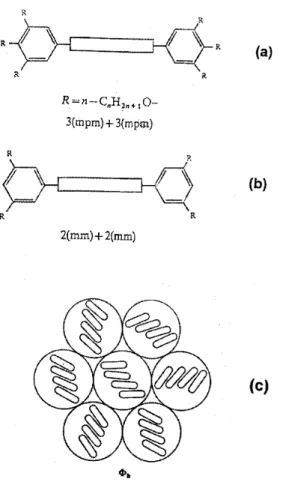
(ii) Polycatenar mesogens, i.e. molecules with a long rod-like rigid core ending in two half disk moities and three, four, ve or six aliphatic chains in ortho, para and meta positions are grafted at each end (Fig. 2a,b) [41-46]. The hexagonal columnar mesophases observed in this case have the same symmetry as the disc-like molecules. Furthermore, the columns are shaped with slices containing three, four or ve molecules (Fig. 2c). Some types of these compounds will be studied in the following sections.
Figure 1. Schematic representation of the structure of the columnar discotic liquid crystal.
(iii) Heteroatomic salts in which the central core part consists of a polarisable heteroatomic cation. These salts exhibit, particularly, an ordered columnar mesophase from room temperature to 200
C : Further-more, the columnar slice dier from the discotic and polycatenar ones. Several studies have shown that the number, the position, the length of the exible chains and the nature of the anions are at the origin of the polymorphism properties [47-49].
in presence of water. These molecules are able to build up structures exhibiting a long range crystalline order, although they are locally disordered in a liquid-like along the columnar axis [50,51]. The rst lyotropic columnar mesophases were observed by A. Skoulios et al [52]. As for example, we note the liquid crystalline phtalocyanines which are prepared for the rst time about fteen years ago [53]. These amphiphilic com-pounds with alkyl chains at their peripheral positions (Fig. 3a) display lyotropic mesophases in which the crown ether rings form large columnar aggregates in solution. Two types of lyotropic columnar mesophases are identied. The rst one corresponds to cylinders with a paranic core surrounded by matter, whereas in the second type, the core of each cylinder contains water surrounded by the amphiphilic molecules (Fig. 3b, c).
Figure 2. Schematic representation of two types of poly-catenar molecules (a) an hexapoly-catenar, called \phasmidic" molecule (b) a tetracatenar, called \biforked" molecule. (c) schematic representation of a slice of the polycatenar colum-nar phase (from Ref. 44,55).
Figure 3. Schematic representation of lyotropic columnar phases: (a) chemical formulas of phtalocyanine molecule; (b) direct columnar phase; (c) inverse columnar phase (from Ref 49).
III Bulk and surface diusion
in thermotropic hexagonal
columnar mesophases
III.1 Material
a) Disk-like compounds
The disk-like molecules are formed by a rigid aro-matic core surrounded by six aliphatic chains which are necessary to exhibit columnar mesophases [29-34]. Ex-periments are performed with the four following meso-genic disk-like compounds:
* Three hexa-n-alkoxytriphenylenes (C n
HET): the hexa-n-pentyloxytriphenylene (C
5
HET); the hexa-n-hexyloxytriphenylene (C
6
HET) and the hexa-n-octyloxytriphenylene (C
8
chains (R = 0,C
nH2n+1): We present in gure (4a) the chemical formulas of these compounds. All these compounds exhibit a thermotropic hexagonal columnar mesophase (Dh) as follow,
(C5HET) K 69
C ,! D
h 122
C ,! I (C6HET) K
68
C ,! D
h 97
C ,! I (C8HET) K
66:8
C
,! D
h 85:6
C ,! I
* One hexa-n-alkanoyloxytriphenylene (CnHAT): this type of molecule has the same core that the last ones but with six alkanoyl lateral chains (R = ,OCO,C
nH2n+1): The compound used is the hexa-n-dodecanoate of triphenylene (C11HAT) (Fig. 4b). lt exhibits three stable mesophases between 80C and 122C:
(C11HAT)K 80
C ,! D
ho 93
C ,! D
r 111
C ,! D
hd 122:3
C ,! I
Dh;Dr and Dhd correspond, respectively, to the or-dered hexagonal, rectangular and disoror-dered hexagonal phases. The choice of these samples allows us to study the eects of the length, the shape of the chains bound to the triphenylene disks and the stacking order of disks in columns.
Figure 4. Chemical formulas of triphenylene compounds, (a) the hexa-n-alkoxytriphenylenes (C
n
HET): (b) the hexa-n-alkanoyloxytriphenylene (CnHAT):
b) Polycatenar compounds
The polycatenar compounds present a clear rod-like core which is composed of an elongated polyaromatic part containing, in general, ve rings connected in the para position and normal aliphatic chains grafted only on two terminal benzene rings, in the para and meta positions. Furthermore, unlike the discotic mesogens where the disks are staked one on top the other to form liquid-like columns, in the polycatenar mesogens the slice of a column is made by a cluster of rigid cores ar-ranged side by side and surrounded by aliphatic chains. Each slice is formed by three molecules for the hexa-catenar and four ones for the tetrahexa-catenar mesogens. Taking into account the number of aliphatic chains and the possible combination of their enchoring points into meta and para positions with regard to the linking group of the central core, a nomenclature is proposed. So, the compounds with six, ve, four or three chains are named respectively the hexa, penta, tetra and three catenars [42-46]. Some studies have shown that the molecular structure of polycatenar compounds holds an intermediate position between mesogenic disks and mesogenic rods. Furthermore, the polymesomorphism is very similar to that of lyotropic systems [50].
Experiments are performed with three polycatenar compounds with ve and six-benzene-ring cores. They dier also by the length, number, nature and the po-sition of aliphatic chains bound on the core. In these materials, only these columnar mesophases having the same symmetry as the disk-like mesogens are consid-ered.
* One hexacatenar mesogen (called "Phasmid" from the name of six legged stick-like insects). This type of polycatenar mesogen has three alkyloxy chains R = ,0,C
nH2n+1;(n = 12) in the meta, para and meta position at each end [3(mpm)+3(mpm)] (gure 5a). lt undergoes the following phase transitions:
K 70 C ,! ob 81:5 C ,! h 92 C ,! I
Figure 5. Chemical formulas of polycatenar molecules: (a) an hexacatenar (n = 12); (b) a tetracatenar (n = 10); (c) a tetracatenar (n = 14).
* Two tetracatenar mesogens (called "biforked" mesogens). This type of molecule has two dierent alkyloxy chains R = ,0,C
nH2n+1 (we have used
n= 10 andn= 14) connected in the meta, meta posi-tion at each end [2(mm) +2(mm)] (gure 5b,c). They, respectively, exhibit the following mesophases:
K 76
C
,!
h 110
C ,! I
K 66
C
,!
h 118
C ,! I
The choice of these compounds has been made because they all present thermotropic hexagonal mesophases. This allows to compare the results to the discotic liquid crystal ones. In addition, the dierent number, position and length of the aliphatic chains allow to examine the inuence of these parameters on the anisotropic diu-sion ratiosDk=D?:
c) lmpurities
The impurities diused in these mesophases are ap-propriate biological dyes with dierent molecule sizes. Two have been chosen from several dyes: a red dye, called Red Oil O, the 1-[4(xylylazo)xylylazo]-2-Naphtol with a molecular diameter 0:75 nm and a yellow one, the 4-Phenylazophenol with a molecular diameter 0:45 nm. These dyes present melting points beyond the temperature domain of the studied liquid crystals
(mpred dye = 120C
and mpyellow dye = 156C):. ln addition, experimentally, we do not observe a transition of the liquid crystal-dye mixture to the isotropic phase at temperatures<90Cfor the red dye and at tempera-tures<115Cfor the yellow one. This allows to detect the dye concentration diused into the mesophase ver-sus the time and the position. The chemical formulas of these dyes are presented in gure (6a, b).
Figure 6. Chemical formulas of impurity molecules: (a) the 1-[(xylylazo)xylylazo]-2-Naphtol (red dye); (b) the 4-phenylazophenol (yellow dye).
III.2 Theory
It is well-known that the main property of mesophases, which distinguish them from both, isotropic liquids and cristalline solids, is the order pa-rameter S which is described by the following equation:
S= 12 <3cos2 ,1>
Where is the angle between the long molecular axis and the directorn:
on the order parameter and hence its components can be written by [14]:
D?=< D >(1
,S) +SD 0 ?
Dk=< D >(1
,S) +SD 0 k
where< D >, often called average diusion coecient, is given by:
< D >=< D0>
= 13(2D0 ?+D
0
k) = 13(2D ?+D
k)
D0 is the diusion coecient tensor of a perfectly or-dered phase,Dk andD
?;are the diusion coecients, respectively, parallel to the directornand perpendicu-lar to it.
As in the uid systems, the relationship between the diusion coecient and the impurity concentration which diuses in the mesophases can be described by the Fick equation.
For 1 D treatment,C(x;t) is related to the diusion coecientD by:
@C(x;t)
@t =D@
2C(x;t)
@x2
,<,
0> C(x;t) (1)
<,0 > C(x;t) represents the transverse diusion and ,0is the jump frequency. Equation (1) agrees with the following solution,
C(x;t) =C(0;t)exp , x2 4Dt (2) Furthermore, the concentration at the origin C(0,t) is given by:
C(0;t) = pQ
Dtexp(,<,
0> t) (3) WhereQrepresents the amount of impurity diused by unit of area such as:
Q= Z
1 0
C(x;t)dx (4) Equations (2) and (3) predict that C(x,t) is described by half a gaussian curve centered on C(O;t) which de-creases asp
twith an attenuation factor exp(,<, 0>
t):
From the gaussian curve, one can measure the gaps
A / p
Dkt (along the columns) and B /
p
D?t (per-pendicularly to them). Indeed, in planar orientation, we deduce that the diusion in the two perpendicular directions can be described by ellipsoid axes such as:
X2
A2 +
Y2
B2 = 1
From these equations, we can derive the ellipticity for many times: A B = s Dk D?
Then, we can deduce the anisotropic ratioDk=D ?from the densitometry of pictures.
III.3 Experiments
a) Bulk diusion
For the bulk diusion in disk-like mesogens, the ex-perimental set-up is composed of a spectral lamp, a sys-tem of lens, a sample holder placed in a thermostated cell, a detector and a recorder. The sample is placed between two glass plates treated with mellitic acid as a surfactant. The thickness of the sample can be ad-justed with mica spacers from 5 to 80 m: Then, it is oriented in two geometries: columns perpendicular to the plates (homeotropic orientation) and parallel to them (planar orientation). For the lower thickness, we can observe a good homeotropic orientation when the sample is cooled very slowly (0:05Cper min) from the isotropic to the liquid crystal phase. Thus, we obtain a sample with grains of about 1 mm of size. The pla-nar orientation is obtained from homeotropic oriented sample to which we apply on the upper plate shearings which amplitude is about 10m. The sample is kept at rest between successive shearings during 10 mn for annealing.
For the dye diusion experiments, a thin lm of the impurity is carefully placed on the edge of the lower glass plate, in contact with the liquid crystal. Some time later, a concentration gradient of the diused im-purity molecules can be directly visualized with an op-tical polarizing microscope.
light intensity (la) absorbed by impurity. The trans-mitted light (It) is detected by a photodetector. The intensity (I) in the pure sample allows to deduce the ab-sorbed onela =I
,I
twhich is proportionnel to the con-centration of impurity diusing inside the liquid crys-tal. Quantitatively, to determine this concentration, we measured the diusion prole versus the position x and versus the column orientation, for many times.
For the polycatenar compounds, the dye concentra-tion diused into the mesophase is followed by taking pictures of the mesophase after dierent times. The sample is placed between two glass platesL1, L2 with a thicknesse= 20m. The upper glass contains in the center a circular hole which is about 1 mm, aimed to place the diusing dyes in contact with the liquid crystal. Thus, we take several pictures from which we measure the diusion prole versus the dye position, the diusion time and versus the column orientations. The study of these pictures shows that the diusion symmetry is circular for the homeotropic orientation (Fig. 7a) and elliptical for the planar one (Fig. 7b). The mean ellipse axes correspond to a dye diusion into the mesophase along the columns and perpendicu-larly to them. The measurements of the lengths of the ellipse axes allow to deduce the ratio of the diusion coecients.
b) Surface diusion
The surface diusion is made in discotic liquid crys-tal threads which are prepared with the same proce-dure used by V. Winckle and N.A. Clark [54,55]. The used compound is the hexa-n-pentyloxytriphenylene (C5HET): The sample is melted between two glass plates of thickness 100m. Then, the temperature is lowered to a xed value in the hexagonal phase. When the plates are slowly taken away from each other, a dis-cotic drop is formed which will give rise to a thread. The motion of the plates is frequently interrupted with a 10 min annealing between each displacement. We obtain quasi-cylindrical threads attached to the glass plates by larger parts, called "bases" (Fig. 8). Sev-eral threads are prepared with dierent diameters in the range of 10mto 20mand lengths in the range of 100m to 2 mm. We can verify that for the used thickest threads d (10m < d < 20m), the optical
axis is oriented along the thread axis; this corresponds to the direction of columns. Before experimenting, the thread is subjected to a two-hour annealing at the same temperature.
Figure 7. Pictures of red dye concentration proles of hex-acatenar columnar phases: (a) in homeotropic orientation; (b) in planar orientation.
The surface diusion experiments are performed as follow:
the 4-phenylazophenol, diused in the thread, we use the optical absorption technique described in section III-3-a. Actually, from the light intensity transmitted by the sample for dierent positions of the photocell along the transmitted rectangular beam we deduce the values of concentrationC(x;t) versus x:However, this technique helps to keep the oven with the sample inside in a xed position, we only move the photocell over an image, ve times the size of the transmitted beam.
III.4 Resultsand discussion
a) Diusioncoecients
In order to measure the diusion coecientsD kand D
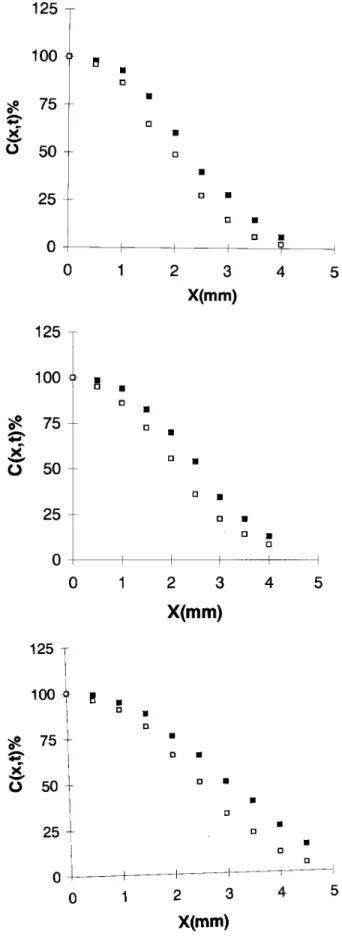
? of dyes in all studied mesophases, we plot the vari-ation of the concentrvari-ation C(x;t) versus the position x for many times. For the bulk diusion, we report in gure (9 a,b,c), for example, the case ofC
6
HET at 85
C for two times and two dyes. We note that half of the gaussian curves are in agreement with Equation (2). They lead to a predictible result i.e. the matter diu-sion in the hexagonal columnar phases can be decribed by the Fick Law.
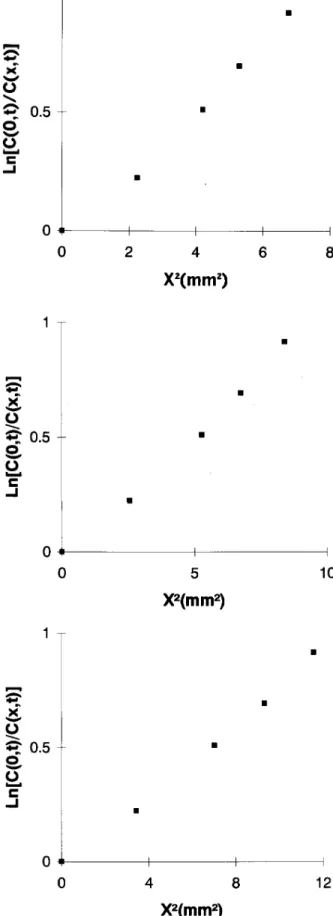
Furthermore, the plot of ln(C(0;t)=C(x;t)) versus x
2 for a given time (
t = 72hours) shows a linear be-haviour (Fig. 10 a,b,c). From the slopes, one can deduce the diusion coecients D
k, D
? and, conse-quently, the anisotropic ratiosD
k =D
?
:All experimen-tal results are presented in table 1.
Figure 8. Microscopic view of a thread.
Figure 9. Plot of the dye concentration C(x,t) versus posi-tion x of (C6HET) at 85
Figure 10. Plot of ln(C(0;t)=C(x;t)) versus x2 of (C6HET) at 85 C (n t2 = 72 h). (a) in homeotropic orientation (red dye); (b) in planar orientation (red dye); (c) in planar ori-entation (yellow dye).
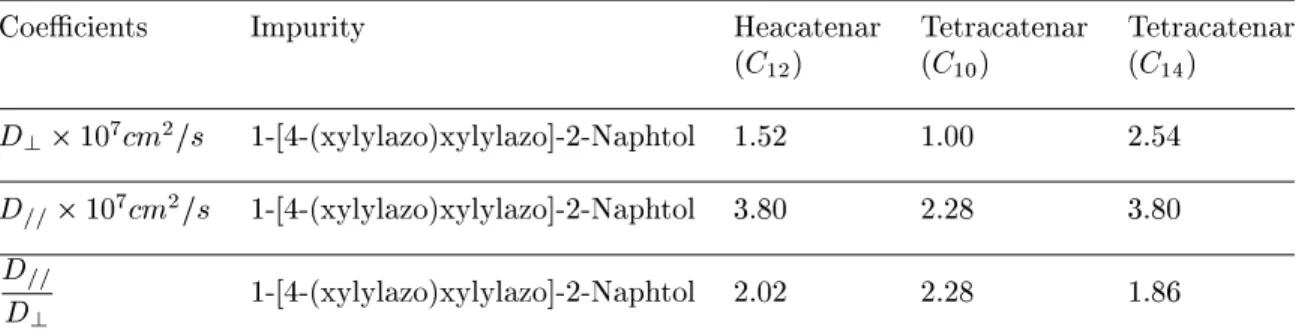
On the other hand, the diusion coecients and the anisotropic ratios of polycatenar compounds are deduced from the pictures. First, we consider the homeotropic orientation of mesophases, we have ob-tained a circular geometry (Fig. 7a). As expected, the anisotropy seems insignicant. Let us consider now the planar orientation, we obtain an elliptical geometry (Fig. 7b). The measurement of the ellipse axe lengths allows to the anisotropic ratios. We conclude that the orientation quality is true. ln fact, the symmetry of the elliptical diusion (planar orientation) or the circular one (homeotropic orientation) is an evidence of the ori-entation quality in both directions. We present in table 2 the results for the used polycatenar compounds.
For the surface diusion, we plot C(x;t) versus x for three times (3 hours, 5 hours, and 9 hours) for the case of C
5
HET (Fig. 11a,b,c). We note that the concentration at the origin C(O;t) decreases with the time t: Measuring the ratio C(0;t
i) =C(O;t
j)
; we ob-serve a good agreement between the experimental val-ues with those predicted by the pre-exponential fac-tor C(0;t
i) =C(O;t
j) = p
t j
=t
i. We conclude that exp < ,
0 > (t
j ,t
i)
1; then < , 0
>= 0: This means that the transverse diusion can be neglected. The measurements of experimental and theoretical ra-tios are reported in table 3.
Table 1: Variation of the diusion coecients (D?), (Dk) and the ratio in hexagonal columnar phases exhibited by some discotic compounds, versus: (a) the dye molecule size; (b) the temperature; (c) the length of aliphatic chains; (d) the nature of aliphatic chains.
(a)
Coecients Impurities T(C) = 75 T(C) = 85
D? 10
7cm2=s 1-[4-(xylylazo)xylylazo]-2-Naphtol 0.95 1.50
4-Phenylazophenol 1.32 2.10
D== 10
7cm2=s 1-[4-(xylylazo)xylylazo]-2-Naphtol 1.48 1.90
4-Phenylazophenol 1.84 2.71
D==
D?
1-[4-(xylylazo)xylylazo]-2-Naphtol 1.56 1.39
4-Phenylazophenol 1.39 1.29
(b)
Coecients Impurities T(C) = 75 T(C) = 85 T(C) = 105
D? 10
7cm2=s 4-Phenylazophenol 0.66 0.94 1.64
D== 10
7cm2=s 4-Phenylazophenol 1.20 1.49 2.55
D==
D?
4-Phenylazophenol 1.88 1.58 1.50
(c)
Coecients Impurity C5HET C6HET C8HET
D? 10
7cm2=s 4-Phenylazophenol 0.66 1.32 1.75
D== 10
7cm2=s 4-Phenylazophenol 1.20 1.84 1.93
D==
D?
(d)
Coecients Impurity C8HET C11HET
D? 10
7cm2=s 1-[4-(xylylazo)xylylazo]-2-Naphtol 1.24 4.61
D== 10
7cm2=s 1-[4-(xylylazo)xylylazo]-2-Naphtol 1.61 10.96
D==
D?
1-[4-(xylylazo)xylylazo]-2-Naphtol 1.30 2.40
Table 2: Measurements of the diusion coecients (D?)., (D
k) and the ratio in hexagonal columnar phases exhibited by some polycatenar mesogens.
Coecients Impurity Heacatenar Tetracatenar Tetracatenar
(C12) (C10) (C14)
D? 10
7cm2=s 1-[4-(xylylazo)xylylazo]-2-Naphtol 1.52 1.00 2.54
D== 10
7cm2=s 1-[4-(xylylazo)xylylazo]-2-Naphtol 3.80 2.28 3.80
D==
D?
1-[4-(xylylazo)xylylazo]-2-Naphtol 2.02 2.28 1.86
Table 3: Measurements of the experimental and theoretical ratioDk,D?.
Ratio t=3hours t=5hours t=9hours
C(0;ti)
C(0;tj)(
exp) 1.26 1.30 1.60
C(0;ti)
C(0;tj)(
the) 1.29 1.34 1.73
Table 4: (a) Measurements of the surface diusion coecient (b) Comparison of surface diusion coecients with the bulk ones in the (C5HET).
(a)
Coecients Impurity T(C) = 75 T(C) = 85 T(C) = 105
Ds 10
(b)
T(C) D s
10
7cm2=s D v==
10
7cm2=s D v?
10
7cm2=s D s
Db
75 1.75 1.20 0.66 1.46
85 2.30 1.49 0.94 1.54
105 3.20 2.55 1.64 1.41
Furthermore, we have measured the Ds values for the following temperatures T1 = 75
C; T 2 = 85
C and T3= 105
C (Table 4a). We note that the D s val-ues are nearer than the bulk one in planar orientation (Table 4b).
From the measured values, we can make the follow-ing remarks:
(i) The matter diusion in hexagonal columnar mesophases exhibited by discotic and polycatenar com-pounds is anisotropic whatever the dye size or the na-ture of the sample. The ratio r = Dk=D
? is always superior to 1. This means that the diusion is quicker along the columns than perpendicularly to them. This result seems in good agreement with previous experi-mental and theoretical studies [4,11] which allows to de-termine the structure of columnar discotic liquid crys-tals, liquid-like order along the column direction and solid-like order perpendicularly to it. The anisotropy
decreases when the temperature increases. Indeed, when the temperature comes up to liquid phase, the uidity of mesophase increases and the system tends toward an isotropic state.
It is interesting to compare the polycatenar results to the discotic ones. Table 5 gives the anisotropic ratios and shows that for the columnar polycatenars, we ob-tain 1:86 D
k=D?
2:28 whereas this ratio varies as 1:10 D
k=D?
1:88 in the columnar discotic phases. We notice that the polycatenar anisotropic ratios are larger than the corresponding ones in dis-cotic mesophases. This is probably due to the colum-nar structure in both cases. lndeed, in the discotic com-pounds, the disk-like molecules which pile up are staked one after one and arranged in a two dimensional net-work, whereas in the polycatenar compounds, the av-erage number of molecules in a slice of column is three for phasmids and four for biforked mesogens.
Table 5: Comparison ofDk=D?:ratios measured in discotic compounds with polycatenar ones.
ratio Hexa-n-alkoxytriphenylenes Polycatenars
C5HET C6HET C8HET Tetra(C10) Hexa(C12) Tetra(C14)
D==
D?
1.88 1.39 1.10 2.28 2.02 1.86
In addition, the diusion anisotropic ratio is larger for theC11HAT compound (r= 2;4) than theC8HET one (r= 1;3):This is probably due to the dierence in length and type of the aliphatic chains bound to the
triphenylene cores (ether chain: ,0,C
8H17 and ester one:,OCO,C
11H23):In fact, the inter-columnar dis-tances for the two mesophases increase from 2,22 nm
un-like ether, the ester chains of the C 11
HAT are not in the plane of disk, but the oxygen atoms of carboxylic group are lying on both sides of the disk plane.
(ii) A comparison of the surface diusion results with to bulk ones in planar orientation leads a ratio D
s =D
b
1:5 (Table 4b). This result can be explained on the basis of point defects, i.e. the existence of the column extremities, taking into account of the existence of fault lines. The corresponding structure is perturbed only in a plane where the columns jump from one site to the next. The columnar sample is perfect immediately above and below this plane. These lines can taper into point defects which are column extremities [11]. Using the atomic theory, the diusion coecient D is given by [56]:
D= 1 n
, 2
Wheren;, andrepresent respectively the number of sites, the jump frequency from one site to the next and the mean free path.
Given that the impurity diusion takes place into the mesh of aliphatic chains surrounding the columns, we acknowledge that the impurity can jump to four sites in surface diusion (Fig. 12a) and to six sites in the bulk one (Fig. 12b). Then, D
s = ,
2 =4 and D
b = ,
2
=6 . This allows D S
=D b = 1
:5: We observe a good agreement between the experimental and the theoretical values.
Figure 12. Schematic representation of the impurity jump in sites: (a) in surface diusion (four sites); (b) in bulk diusion (six sites).
(iii) For all the studied discotic (C 5
;C 6
;C 8) and polycatenar (C
10 ;C
12 ;C
14) compounds, the diusion coecientsD
k =D
?increase with the length of aliphatic chains. Assuming that the diusion impurity molecules take place in the volume occupied by these chains, we can explain this result by the width of paranic crown
surrounding the core. From the parameter a of the hexagonal lattice [4] for instance, we have estimated this crown width for the discotic compounds as about 1.2 nm (C
5
HET) and 1.6 nm (C 8
HET):A comparison of the D
k =D
? ratio in discotic and polycatenar com-pounds (Table 5) shows that this ratio decreases with the length of aliphatic chains in both cases. This is due to the increasing of the crown width. Furthermore, this ratio is greater for the polycatenar compounds. This eect can be explained by the stacking disorder of molecules in columns.
For a comparison between the diusion along the columns and perpendicularly to them, in discotic and polycatenar compounds, we calculate the average ratio
P D Polycatenars P D Discotics and nd: P D ?Polycatenars P D ?Discotics 1; P D kPolycatenars P D kDiscotics 2; The rst ratio (1) shows that the diusion per-pendicularly to columns is comparable in both colum-nar mesophases. If we assume that the molecules are aligned along the radius of a circular column we obtain a very dense paranic zone [56]. As in the discotic case, the matter diusion in polycatenar mesogens by-passes the central part of columns and takes place in the paranic crown.
The second ratio ( 2) shows that the diu-sion along the columns is quicker in the polycatenar mesophases. This eect can be explained by the in-creasing of the lateral chain lengths (n = 5, 6, 8 for the discotics and n = 10, 12, 14 for the polycatenars). Fur-thermore, using a chemical anity, we can still justify this eect by the impurity polarity (presence of phenol function in Red Oil 0) which is more soluble in polycatenar compounds containing a polar group (-CH=N- ). This eect may be explained too, as a more relative disordered disposition of the molecules along a column in comparison with the long range order ob-served in discotic columns.
For theC 6
HET;for instance, at the same temperature (T = 85
C) these ratios are estimated as follow:
P D
?reddye P
D ?reddye
P
D
kyellowdye P
D
kyellowdye 0:7
This result seems in agreement with a theoretical ra-tio which takes account of the diameterlof self diused molecules. lndeed, using at the same temperature, a re-lationship for the smectic, nematic and isotropic phases [58],D/1=lwe obtain:
P D
?reddye P
D ?reddye
P
D
kyellowdye P
D
kyellowdye 0:8
Then, the experimental ratio is comparable to the theoretical one. This means that the size eect of the diused dye has the same behaviour in the mesophases and in the isotropic phases.
b) Activationenergy
It is established that the relationship between the activation energy E and the diusion coecient D is given by the Arrhenius equation:
D=D 0
exp
, E R T
where E is the activation energy and R, the gas con-stant.
In the solid state, E is interpreted as the potential barrier over which the diusing particle has to jump from one lattice position to the next. In the liquid state, it is assumed that a diusing particle is an ac-tivated state during the jump. This concept leads to a temperature dependence of the coecient D
0 : This eect, however, is so weak that the Arrhenius law is still a very good approximation even in a liquid state. For liquid crystals which are in an intermediate state between solid and liquid, the argument is still true and the Arrhenius law may be used for the diusion data.
Figure 13. Plot of LnD? and LnDk / versus T-1 in the (C5HET) (a) in homeotropic orientation (b) in planar ori-entation.
To determine the activation energy in the two ge-ometries of the sample orientation, for theC
5
HET for instance, we plot the logarithms of diusion coecients lnD
? and ln D
k versus reciprocal temperature 1 T (Fig. 13a,b). We observe a linear dependence as expected from the Arrhenius equation. From the slope we can deduce:
E ?= 34
:5kJ. mol ,1 E
k = 30
:3kJ. mol ,1 E5kJ. mol
,1
We note that these values are similar i.e., unlike the diusion coecients which present an anisotropic ra-tio, the activation energiesE
kand E
independent from the diusion geometry. lndeed, see-ing that the dye diusion takes place into the volume occupied by aliphatic chains, whatever the orientation geometry, the matter diusion throught the mesophase requires approximately the same avtivation energy.
IV Comparison with nematic
and smectic mesophases
A comparison of the dyes diusion in thermotropic columnar mesophases exhibited by disk-like and poly-catenar compounds to some nematic ones shows a sim-ilar ratio D
k =D
?
: For exemple, the diusion at room temperature of some impurities such the tetramethyl-silane (TMS), the methyl-red (MR) or the nitroso-dimethylaniline (NMA) into nematic mesophases ex-hibited by the p-metoxybenzylidene-p'-n-butylaniline (MBBA) or by the Licristal (LC
4) gives anisotropic ra-tios D
k =D
? which vary from 1.03 to 1.70 (Table 6). In addition, the activation energy in nematic phases shows, as the columnar ones, an insignicant anisotropy (0:98<E
k =E
?
<1:06): This means that the diusion features in columnar and nematic mesophases are
com-parable. This result seems to be in agreement with a re-cent study of diusivity by Light Beating Spectroscopy in thermotropic nematic mesophases exhibited by disk-like mesogens [59]. lt was shown that the nematic order can be manifest in the packing of a few molecules (15 to 25) to form relatively short columns of a diameter of an individual disk. Each column would be equivalent to an individuel rod in classical nematic liquid crystals. Furthermore, the ratioE
k =E
? is often used to charac-terize the anisotropy of diusion in smectic mesophases. Previous studies [14] have shown that in the smectic mesophases this ratio is1:These results are in qual-itative agreement with the structural features of theses mesophases which consist of liquid layer. Thus, inside the layers the diusion is liquid-like with a lower activa-tion energy as in the solid-like jump process from layer to layer. Unlike the columnar mesophases where the impurity diusion takes place into the volume occupied by aliphatic chains whatever the orientation geometries (diusion parallel to the columns or perpendicularly to them), the matter diusion requires approximately the same activation energy. So, we ndE
k =E
? 1:
Table 6: Comparison of impurity diusion coecients in columnar phases to nematic and smectic ones.
Phase Mesogenic Compounds Impurities T(
C)
D == D
? E
== E
?
References
Nematic MBAA 4% TMS 22 1.03 1.04 [14]
MBBA 8% TMS 22 1.00 1.04 [14]
MBBA NMR 22 1.70 - [17]
MBBA MR 22 1.60 - [17]
LC4 2% TMS - 1.26 0.98 [14]
LC4 10% TMS - 1.09 1.04 [14]
Hexagonal Columnar C 5
HET Yellow dye 75 1.88 1 [23]
C 6
HET Yellow dye 75 1.39 - [23]
Red Oil O 75 1.56 - [23]
C 8
HET Red Oil O 75 1.30 - [24]
Yellow dye 75 1.10 - [24]
C 11
HAT Red Oil O 90 2.40 - [24]
Yellow dye 115 2.20 - [24]
Hexagonal phasmidic Tetracatenar(C
10) Red Oil O 75 2.28 - [26]
Hexacatenar(C
12) Red Oil O 75 2.02 - [26]
Tetracatenar(C
V Conclusion
We have shown that optical absorption and densito-metry techniques can be used to determine the dif-fusion behaviour of dyes in thermotropic hexagonal columnar mesophases exhibited by discotic and poly-catenar compounds. Whatever the orientation geome-tries (homeotropic and planar), the nature of the sam-ple (bulk and thread), the molecular form (disk-like and rod-like), we have measured the diusion coecients D
k and D
? (along the columns or perpendicularly to them) and the ratiosD
k =D
?
:The experimental values show an anisotropic diusion in both cases.
The anisotropic behaviour becomes less pronounced when the temperature increases. In addition, what-ever the dye size, the diusion of impurities into the mesophases takes place in the volume occupied by the aliphatic chains. Furthermore, a comparison of re-sults shows that the diusion along the columns is quicker in phasmidic compounds than in discotic ones. This is probably due to a relative disordered arrange-ment of the molecules along the columns of phasmidic mesophases in comparison with the short order ob-served in discotic columns. We conclude that the molec-ular structure of polycatenar compounds holds in an intermediate position between the mesogenic disks and mesogenic rods.
The anisotropic behaviour of matter diusion in columnar discotic mesophases, studied also by mirage eect techniques conrms the obtained eects of impu-rity size, length and type of branched alphatic chains.
In addition, the symmetry of diusion pictures of the concentration proles (circular for the homeotropic orientation and elliptic for the planar one) proves the average macroscopic orientation.
The temperature dependence ofD k and
D
? can be described by the Arrhenius Law. The activation ener-gies E
kand E
? are about equal to each other.
A comparison of our results to some others shows that, as in nematics and smectics, the diusion in ther-motropic columnar liquid crystals (discotics and poly-catenars) is anisotropic. However, the activation en-ergy ratio E
k =E
? is insignicant as in the nematic
phase. So, unlike in smectic mesophases, this ratio can not be used to characterize the columnar mesophase anisotropy.
References
[1] F.C. Franck, S. Chandrasekhar, J. Phys. 40, 1285 (1980).
[2] P. Oswald, M. Kleman, J. Phys.42, 1461 (1981). [3] P. Oswald, M. Kleman, J. Phys.49, 1083 (1988). [4] A. M. Levelut, J. Chem. Phys.80, 149 (1983). [5] M. Cagnon, M. Gharbia and G. Durand, Phys. Rev.
Lett.53, 938 (1984).
[6] P. Oswald, J. Malth^eute, P. Pelce, J. Phys. (France), 50, 2121 (1989).
[7] S. Chandrasekhar, G.S. Ranganath, Rep. Prog. Phys. 53, 37 (1990).
[8] M. Gharbia , A. Gharbi, M. Cagnon and G. Durand; J. Phys. (France),51, 1355 (1990).
[9] J. Prost, Liq. Cryst.,8, 1285 (1990).
[10] M. Gharbia, T. Othman, A. Gharbi, C. Destrade, G. Durand, Phys. Rev. Lett.68, 13 (1992).
[11] P.G. de Gennes, J. Prost,ThePhysicsofLiquid Crys-tals, Oxford Univ. Press (1993).
[12] L. Sallen, P. Oswald, J.C. Guminard and J. Malth^ete, J. Phys.II (France),5, 937 (1995).
[13] T. Svedberg, Kolloidzeitschrift,22, 68 (1918). [14] G.J. Kruger, Phys. Rep.82, N. 4 229 (1982).
[15] C.K. Yan, A.G. Fredrickson, Mol. Cryst. and Liq. Cryst.12, 13 (1970).
[16] E. Rondalez, Sol. State Commun.14, 815 (1974). [17] H. Hakemi, M.M. Labes, J. Chem. Phys. 63, 3708
(1975).
[18] C.G. Wade, Ann. Rev. Chem.2847 (1977).
[19] I. Zupancic, J. Pirs, M. Luzar, R. Blinc and J.W. Doane, Sol. State Commun.15, 227 (1974).
[20] G.J. Kruger, H. Spiesecke, R. Van Stenwinkel and F. Noack, Mol. Cryst. and Liq. Cryst.40, 103 (1977). [21] J. Topler, B. Alfred and T. Springer, Mol. Cryst. and
Liq. Cryst.26, 297 (1974).
[22] F. Volino, A.J. Dianoux and A. Heidermann, J. Phys. Lett.40, L-583 (1979).
[23] M. Daoud, M. Gharbia and A. Gharbi; J. Phys. Il (France),4, 989 (1994).
[24] M. Daoud, G. Louis, X. Quulin, M. Gharbia, A. Gharbi and P. Peretti, Liq. Cryst.19, 833 (1995).
[26] M. Daoud, K. Rais, M. Gharbia, A. Gharbi and H.T. Nguyen, submitted to Liq. Cryst. (1998).
[27] P. G. de Gennes, The Physics of Liquid Crystals, Ox-ford Univ. Press (1994).
[28] S. Chandrasekhar, B.K. Sadashiva and K.A. Sureh, Pranama,9, 471 (1977).
[29] J.C. Dubois, Ann. Phys. N.Y.3, 13 (1978).
[30] C. Destrade, M.C. Bernaud, H. Gasparoux, A.M. Leve-lut and H.T. Nguyen, Proc. lnt. Conf Liq. Cryst. (Ban-galore), 1980a (1979).
[31] C. Destrade, H.T. Nguyen, H. Gasparoux, J. Malth^ete and A.M. Levelut, Mol. Cryst. and Liq. Cryst.71, 111 (1981).
[32] M. Dvolaitzzky, J. Billard, Mol. Cryst. and Liq. Cryst. 64, 247 (1981).
[33] C. Destrade, H. Gasparoux, P. Foucher, H.T. Nguyen, J. Malth^ete and J. Jacques, J. Chem. Phys. 80, 137 (1983).
[34] P. Foucher, C. Destrade, H.T. Nguyen, J. Malth^ete and A.M. Levelut, Mol. Cryst. and Liq. Cryst. 108, 219 (1984).
[35] J. Malth^ete, C. Destrade, H.T. Nguyen and J. Jacques, Mol. Cryst. and Liq. Cryst.66, 115 (1981).
[36] J. Malth^ete, J. Jacques, H.T. Nguyen and C. Destrade, Nature298, 46 (1982).
[37] E. Fontes, P.A. Heiney, W.H. de Jeu, Phys. Rev. Lett. 61, 1202 (1988).
[38] K.D. Kamien, D.R. Nelson, Phys. Rev. Lett.74, 2499 (1995).
[39] K.D. Kamien, D.R. Nelson, Phys. Rev. E53, 650 (1996).
[40] M. Hebert, A. Caillu, Phys. Rev.E53, 1714 (1996). [41] J. Malth^ete, A.M. Levelut, H.T. Nguyen, J. Phys. Lett.
46, L 875 (1985).
[42] H.T. Nguyen, C. Destrade, A.M. Levelut, J. Malth^ete, J. Phys.47, 553 (1986).
[43] C. Destrade, H.T. Nguyen, A. Roubineau and A.M. Levelut, Mol. Cryst. and Liq. Cryst.159, 163 (1988). [44] J. Malth^ete, H.T. Nguyen and C. Destrade, Liq. Cryst.
13, 171 (1993).
[45] J. Malth^ete, A. Collet and A.M. Levelut, Liq. Cryst.5 , 129 (1989).
[46] H.T. Nguyen, C. Destrade and J. Malth^ete, Adv. Mater.9, 375 (1997).
[47] H. Strzelecka, C. Jallabert, M. Veber, P. Davidson and A. M. Levelut, Liq. Cryst.161, 395 (1988).
[48] M.Veber, P. Sotta, P. Davidson, A.M. Levelut, C. Jal-labert and H. Strzelecka, J. Phys. (France), 51, 1283 (1990).
[49] A. Zinsou, M. Veber, H. Strzelecka, C. Jallabert and A.M. Levelut, Liq. Cryst.17, 513 (1994).
[50] V. Luzzari, Biological Membranes, Ed. Chapman (Acad. Press, London) 1968.
[51] P. Ekwall, Adv. Liq. Cryst.1, 1 (1975).
[52] A.E. Soulios, A. Luzarti, Acta Cryst.14, 278 (1961). [53] C. Piechocki, J. Simon, A. Skoulios, D. Guillon and P.
Weber, J. Am. Chem. Soc.104, 5245 (1982).
[54] D.M. Van Winkle, N.A. Clark, J. Phys. Lett.48, 1407 (1982).
[55] C.R. Sanya, K.S. Liang, W.A. Varady N.A. Clark and G. Anderson, J. Phys. Lett.53, 1172 (1984).
[56] J. Phillibert,Diusion et transport de matiere dans les solides, Ed. de Phys. (1985).
[57] O. Prodi, J. Phys. Lett.37, L143 (1976).
[58] A.M. Levelut, J. Malth^ete, C. Destrade and H.T. Nguyen, Liq. Cryst.2, 877 (1987).

![Figure 6. Chemical formulas of impurity molecules: (a) the 1-[(xylylazo)xylylazo]-2-Naphtol (red dye); (b) the 4-phenylazophenol (yellow dye).](https://thumb-eu.123doks.com/thumbv2/123dok_br/18978318.456103/6.918.507.850.210.663/chemical-formulas-impurity-molecules-xylylazo-xylylazo-naphtol-phenylazophenol.webp)