Article
0103 - 5053 $6.00+0.00
*e-mail: [email protected]
Quantiication of Selenium Species in Petroleum Reinery Wastewaters using Ion
Chromatography Coupled to Post-Column Isotope Dilution Analysis ICP-MS
H. Laura Reyes,a Silvia García-Ruiz,a B. Gisele Tonietto,b J. MarcusGodoy,*,b
J. Ignacio García Alonsoa and Alfredo Sanz-Medela
aDepartment of Physical and Analytical Chemistry, University of Oviedo, Julián Clavería 8,
33006, Oviedo, Spain
bDepartamento de Química, Pontifícia Universidade Católica do Rio de Janeiro,
22453-900 Rio de Janeiro-RJ, Brazil
A metodologia analítica de diluição isotópica (IDA) pós-coluna foi empregada para realizar ensaios de especiação quantitativa de selênio (Se) em amostras de eluentes industriais através do acoplamento da cromatograia de íons ao ICP-MS, contendo um sistema composto por uma célula de reação (ORS). As interferências ocasionadas pelos dímeros de argônio nos isótopos
78Se e 80Se foram suprimidas pressurizando-se a câmara do octapolo com 4 mL min-1 de
hidrogênio. Selenito [Se (IV)], selenato [Se (VI)] e selenocianato [SeCN−
] foram separados por cromatograia de íons (IC) utilizando eluição isocrática com 20 mmol L-1 Na
2CO3/2 mmol L -1
NaHCO3. Após a separação, os íons carbonato presentes no eluente foram convertidos a CO2 em linha por uma membrana supressora auto-regenerante, a im de evitar a obstrução do nebulizador ou dos cones de interface do ICP-MS. Limites de detecção (3σ da lutuação da linha de base) de 0,18, 0,13 e 1,0 ng g-1 foram atingidos para Se (IV), Se (VI) e SeCN−
, respectivamente. A quantiicação do selênio, separadamente em cada espécie, foi executada empregando a análise de diluição isotópica (IDA) pós-coluna, adicionando de modo contínuo uma solução enriquecida com 77Se ao eluente da coluna supressora. Finalmente, as razões entre os isótopos 78Se/77Se ou 80Se/77Se foram monitoradas e a concentração da espécie correspondente de selênio avaliada.
A metodologia proposta foi aplicada com sucesso para o estudo de especiação quantitativa do selênio em eluentes de reinarias de petróleo.
A post-column Isotope Dilution Analysis (IDA) methodology has been used to carry out the quantitative speciation of selenium (Se) in industrial wastewaters by ion chromatography coupled to ICP-MS with an octapole reaction system (ORS). The interfering argon dimers on the 78Se and 80Se isotopes were suppressed by pressurizing the octapole chamber with 4 mL min-1 of hydrogen.
The inorganic Se species selenite [Se (IV)], selenate [Se (VI)] and selenocyanate [SeCN−] were
separated by ion chromatography (IC) using isocratic elution with 20 mmol L-1 Na
2CO3 / 2 mmol L -1
NaHCO3 as eluent. After the separation, the eluent carbonates were converted to CO2 on-line by a membrane self-regenerating suppressor, in order to avoid clogging problems in the nebulizer or in the cones of the ICP-MS interface. Detection limits (as 3σ of the baseline noise) of 0.18, 0.13 and 1.0 ng g-1 were achieved for Se (IV), Se (VI) and SeCN− respectively. Quantiication of selenium in
each separated species was performed using post-column isotope dilution analysis by continuous mixing of an enriched 77Se spike solution with the efluent from the suppressor column. Finally,
the 78Se/77Se or 80Se/77Se isotope ratios were monitored and the concentration of the corresponding
selenium species was evaluated. The proposed methodology has been successfully applied to study the quantitative speciation of selenium in petroleum reinery wastewaters.
Introduction
Sour crude oils produced from geological formations containing seleniferous marine shale often contain high levels of selenium.1 Due to its chemical similarity with
sulfur, selenium follows the whole oil reining process being concentrated into the wastewater.2 Inorganic selenium
is most commonly found in refinery wastewaters as selenate, Se (VI), and selenite, Se (IV), both highly soluble in water. Also, a signiicant concentration of selenocyanate (SeCN−
), formed in the reducing environment, may be present.3 As inorganic forms of Se are potentially toxic at
high concentrations in aqueous samples,4 the removal of
selenium in industrial wastewaters is mandatory before discharging them into the environment. Most of such treatments for selenium removal depend on the selenium species, e.g. adsorption methods are effective to remove selenite anions but not so effective for SeCN−
, in such a way that this compound has to be oxidized before the adsorption step. Of course, the determination of such Se species, owing to the different effects of the various Se species which may be essential or toxic, depending on its oxidation state and concentration,5 is today of great interest. Therefore the
development of analytical methods able to provide reliable, fast and accurate determinations of the different selenium species is required. Ion chromatography (IC) is probably the most commonly used separation method for selenium anionic species in waters.6-9 Since selenium concentrations
in some waters may be extremely low and the concentration of potential interferents may be orders of magnitude higher, a sensitive and selective detector should be used. On-line coupling of a chromatographic system with ICP-MS enables the determination of very low levels of elemental species due to the low detection limits of the detector, its high elemental speciicity, multi-element capabilities and possibility of performing isotopic measurements.10-14
Unfortunately, the measurement of the most abundant Se isotopes (80Se+ and 78Se+) by ICP-MS with quadrupole
analyzers (ICP-QMS) is seriously affected by polyatomic interferences (e.g. 40Ar
2
+ at m/z = 80 or 40Ar38Ar+ at
m/z = 78). The use of high resolution ICP-MS instruments for this purpose is limited due to the high resolving powers necessary (R=10000) which lead to a signiicant loss of sensitivity. An interesting alternative to overcome those selenium interferences is the use of ICP-MS instruments equipped with collision/reaction cell, as they are able to remove some spectral interferences by pressurizing the cell chamber with gases such as He, H2, O2, NH3 and CH4.15
Nevertheless, ion chromatography eluents cause some problems for on-line ICP-MS detection because they usually contain high concentration of dissolved
salts, used either as buffers or as the eluent itself. This high salt content may alter the plasma properties and thereby affect its analytical performance or may cause gradual clogging of the nebulizer and the cones in the plasma interface (so affecting the long-term stability and robustness of the analytical method). Those problems could be circumvented modifying the eluent after the separation without affecting the separated analytes. This may be carried out by using an anion self-regenerating suppressor column (ASRS) that consists of a continuously operating cation-exchange membrane device where protons are generated electrolytically. Thus, the cations from the eluent (usually Na+) are replaced continuously by hydronium ions
by diffusion from outside of the membrane. In this way eluent anions as carbonate or hydroxide are neutralized and converted to CO2 or H2O which do not affect the nebulizer, the plasma or the extraction interface.16
In spite of the development of hyphenated techniques for elemental speciation studies in environmental samples, the reliable quantiication of the separated species is still a dificult task. An attractive approach to get reliable determinations of the selenium bound to the different species is the application of isotope dilution analysis (IDA) online with HPLC-ICP-MS.17 Heumann et al.17proposed
two different modes of operation for this purpose: species-speciic and species-unspecies-speciic spiking modes, the former can be used only when isotopically enriched species are available. The species-unspeciic spiking mode would allow accurate quantiication even with unknown composition and structure of the compounds if enriched species-speciic standards are not available.19-21 Here an isotope enriched
solution is mixed on-line with the column eluent after the chromatographic separation and, as a consequence, isotopic equilibration between the separated element species and the Se enriched isotope spike is only obtained in the plasma of the ICP-MS. Previous works in our laboratory have shown the applicability of this IDA technique to the precise and accurate determination of selenium species in different biological materials including human serum,19 yeast and
wheat lour enzymatic extracts20 and cod muscle.21
However, ICP-MS sensitivity has to be species independent to correctly apply this methodology. Thus, a post column isotope dilution methodology has been investigated here for the reliable quantiication of selenium species in wastewaters from a petroleum reinery. The separation of Se (IV), Se (VI) and SeCN−
species was carried out by ion chromatography using a membrane suppressor for the elimination of interferences.
The quantiication was carried out by 78Se/77Se and 80Se/77Se isotope ratios measurements using a H
2 low for
dimers on the 78Se and 80Se isotopes.22 A selenium speciation
report in such kind of samples by HPLC-ICP-MS is found in the literature.23 However, conventional quadrupole mass
analyzer and methodologies have been used. The particular combination of techniques here reported, aiming at a robust and an accurate determination of selenium species in waste water, has not been reported so far.
Experimental
Instrumentation
The separation was performed using a Dionex model DX-120 ion chromatography system (Sunnyvale, CA, USA), equipped with a 75 μL sample loop. A carbonate selective anion-exchange column (Dionex AS9-HC) and guard column (Dionex AG9-HC) were used. The eluent consisted of 20 mmol L-1 Na
2CO3 plus 2 mmol L
-1 NaHCO 3
(1 mL min-1). After separation, the column efluent is passed
through the Anion Self Regenerating Suppressor (ASRS-ULTRA, 4 mm, Dionex) operated at a suppression current of 100 mA in the external water source mode.
Selenium determination was carried out on an inductively coupled plasma mass spectrometer (ICP-MS) Agilent 7500c with an octapole ion guide operated in RF-only mode (Agilent Technologies, Tokyo, Japan). Hydrogen, 4 mL min-1, was introduced into the octapole
cell as reaction gas. The column efluent was connected using PEEK tubing (Dionex) to a Meinhard nebulizer with a Scott double-pass quartz spray chamber cooled down to 2 oC. The torch position and ion lens voltage settings were
optimized daily for optimum sensitivity with a 10 ng g-1
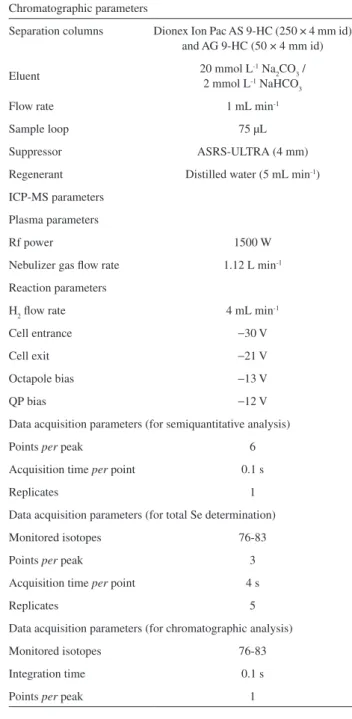
Li, Co, Y, Tl and Ce mixture in 1% (m/m) HNO3 solution. A solution of 1% (m/m) HNO3 was also used to check the background level caused by polyatomic argon interferences. The integration time chosen for each mass was 0.1 s and the masses selected were 76, 77, 78, 79, 80, 81, 82 and 83. Integration of the ICP-MS chromatographic peaks was performed using the Origin 5.0 software (Microcal Software Inc. Northampton, MA, USA). Instrumental operating conditions are summarized in Table 1 and a schematic diagram of the setup system is shown in Figure 1. The continuous addition of the spike (0.1 mL min-1) was
performed by a peristaltic pump model HP4 from Scharlau Science (Barcelona, Spain).
Reagents and materials
Ultra-pure water with a resistivity of 18.2 MΩ cm-1
obtained from Milli-Q water puriication system (Millipore Co., Bedford, MA, USA) and analytical grade reagents
Table 1. Instrumental operating conditions and data acquisition parameters
Chromatographic parameters
Separation columns Dionex Ion Pac AS 9-HC (250 × 4 mm id) and AG 9-HC (50 × 4 mm id)
Eluent 20 mmol L
-1 Na 2CO3 / 2 mmol L-1 NaHCO
3
Flow rate 1 mL min-1
Sample loop 75 μL
Suppressor ASRS-ULTRA (4 mm)
Regenerant Distilled water (5 mL min-1)
ICP-MS parameters
Plasma parameters
Rf power 1500 W
Nebulizer gas low rate 1.12 L min-1
Reaction parameters
H2 low rate 4 mL min-1
Cell entrance −30 V
Cell exit −21 V
Octapole bias −13 V
QP bias −12 V
Data acquisition parameters (for semiquantitative analysis)
Points per peak 6
Acquisition time per point 0.1 s
Replicates 1
Data acquisition parameters (for total Se determination)
Monitored isotopes 76-83
Points per peak 3
Acquisition time per point 4 s
Replicates 5
Data acquisition parameters (for chromatographic analysis)
Monitored isotopes 76-83
Integration time 0.1 s
Points per peak 1
were used to prepare all eluents, standard stock solutions and dilutions.
Enriched 77Se (91.1 ± 0.7%) was supplied from
Cambridge Isotope Laboratories (Andover, MA, USA) as elemental powder and it was dissolved in the minimum volume of sub-boiled nitric acid and diluted to volume with ultra-pure water. The concentration of this standard solution, (5.31±0.03) μg g-1, was established by reverse
isotope dilution analysis as is discussed in detail elsewhere.22 A standard solution of 1000 mg L-1 of Se
as SeO2 stabilized in 2-3% (v/v) nitric acid Suprapur® was purchased from Merck (Darmstadt, Germany). Sodium selenite Na2SeO3 from Sigma (St. Louis, MO, USA), sodium selenate Na2SeO4 from Merck (Darmstadt, Germany), and potassium selenocyanate KSeCN from Aldrich (Milwaukee, WI, USA) were used to prepare 1000 mg L-1 stock solutions. The purity of these Se
standards was > 99%. All solutions were prepared in high density polyethylene bottles on a weight basis and stored at 4 oC in the dark. Individual species standard solutions
were analyzed by IC-ICP-MS to assess any change in elemental speciation. No change in the elemental species of the standard solutions was observed over the duration of the experiments. Daily working standards were prepared by dilution of the stock solutions. For the mobile phase, sodium hydrogen carbonate NaHCO3 and sodium carbonate Na2CO3 from Merck (Darmstadt, Germany) were used. HPLC eluent was freshly prepared and degassed with helium prior to use. Nylon 0.45 μm × 13 mm syringe ilters from Waters (Millipore Co., Bedford, MA, USA) were used for iltration of samples.
Procedures
Sample collection and pre-treatment
Industrial wastewater samples were collected from a Brazilian petroleum reinery. They are related to internal stream waters (CAO and CAC samples) and treated efluents (BA sample). The pHs of the samples were 8.3, 8.9 and 7.3 for CAO, CAC and BA, respectively. No acid was added to prevent species transformation. After collection, the samples were stored at 4 oC in dark borosilicate glass
flasks. Prior to injection, water samples were filtered through nylon 0.45 μm syringe ilters.
Semi-quantitative analysis
The samples to be analyzed were diluted 20-fold with HNO3 1% (m/m) and spiked with the internal standard elements: Be, Sc, Ga, Y, Rh, In, Tb, Re and Th at ca. 10 ng mL-1 levels in order to compare the
measured intensities for these elements with a previously
established response table of the instrument. The estimated concentrations of the analytes were obtained using the Agilent software. Data acquisition parameters for selected isotopes of every element are shown in Table 1.
Total Se determination by IDA-ICP-MS
The total selenium concentration in the wastewaters was determined by IDA-ICP-MS after ive-fold dilution of the samples with ultra pure water. The samples were spiked with the appropriate amount of 77Se enriched
standard solution, calculated in previous work.22 Plastic
polypropylene containers were used to prepare all solutions on a weight basis. The ICP-MS and data acquisition parameters are given in Table 1.
All isotope ratio measurements were corrected using a dead time of 47 ns. For accurate isotope ratio measurements, the Se intensity signals were corrected for SeH+ and BrH+ interferences using mathematical equations
previously described.22 A natural standard of selenium was
also measured between the samples to calculate the mass bias correction factor using an exponential model.24
Finally, the isotope dilution equation25 was applied to
determine the total selenium concentration by IDA-ICP-MS using the 78Se/77Se and 80Se/77Se isotope ratios.
Post-column isotope dilution analysis
The quantification of each separated selenium species was performed by post-column isotope dilution analysis. A 77Se-enriched standard solution of appropriate
concentration to obtain the optimum spike to sample ratio25
was continuously introduced (at 0.1 mL min-1) using a
peristaltic pump through a T piece. The data acquisition parameters are shown in Table 1.
The obtained intensity chromatograms (counts s-1)
were converted to mass low chromatograms (ng min-1) for
quantiication of the selenium species. For this purpose, the time resolved intensity counts were irst corrected taking into account the detector dead time (47 ns). After smoothing of the data using moving average (n = 15) in order to reduce the noise level and to guarantee optimum peak deinition, mathematical corrections were applied to correct for BrH+ and SeH+ interferences22 with the factors
obtained using natural Se and Br standards introduced post-column instead of the enriched spike and using the chromatographic mobile phase as matrix between each triplicate sample determination. Then, the 78Se/77Se or 80Se/77Se isotope ratios were calculated and corrected for
mass bias using an exponential model.24 The mass bias
factor was calculated using the same standard solution as for SeH+ correction. Finally the on-line isotope dilution
obtaining a mass low chromatogram. The amount of selenium in each chromatographic peak was calculated by integration of the chromatographic peaks and the concentration of selenium was calculated by dividing the Se amount found by the injection volume (75 μL).
Results and Discussion
Semiquantitative analysis
Analysis of industrial wastewaters by IC-ICP-MS is not easy because competition between matrix and analyte anions in the chromatographic separation and also spectroscopic interferences during the detection by ICP-MS are common place. In order to investigate the extent of such interferences in the wastewater samples, a semi-quantitative analysis was irst performed for every sample. The waste water samples from the petroleum reinery contained appreciable amounts of chloride, sulfur and bromide (ca. 2 μg g-1) and also high amounts of sodium,
magnesium, calcium, and potassium (ca. 200, 14, 10 and 4 μg g-1 respectively). The high saline content of this
complex matrix may affect the analytical performance of the chromatographic separation. Moreover, some major matrix anions (e.g. chloride, sulfate) also cause chromatographic interferences, as will be discussed later. Also, spectroscopic interferences due mainly to the high amount of bromide in the matrix may occur. As previously published,16 alkaline and alkaline-earth elements are
selectively removed from the chromatographic eluent by the use of a suppressor column (so we do not expect signiicant spectral or matrix interferences in the plasma derived from the high saline content of the sample).
Total Se determination by IDA-ICP-MS
For an accurate isotope dilution analysis (total Se determination and quantification of the different Se species after separation by IC), all the chosen Se isotopes should be free of spectral interferences. In previous work22 no detectable interferences at 77Se by chlorine
up to concentration of 400 μg g-1 was observed in the
determination of total selenium in biological samples by IDA-ICP-MS. However, the interference of 79BrH+on 80Se
was important at these bromide levels even with the employ of the octapole reaction system (ORS) pressurized with H2. This interference was corrected by monitoring also 79Br
and 81Br, at the same time as the analyte isotopes, and then
using mathematical corrections.
The total Se amount in the petroleum reinery wastewater samples was determined using IDA-ICP-MS after 5-fold
dilution of the sample with ultra pure water using 77Se
standard as spike. The total Se concentrations obtained using 78Se/77Se and 80Se/77Se isotope ratios respectively
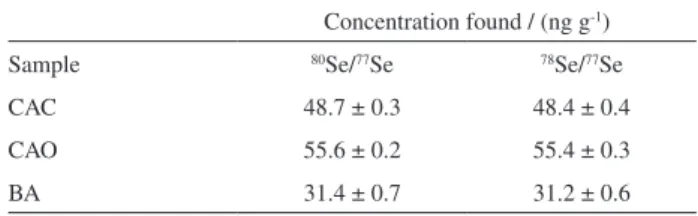
are listed in Table 2. Three replicates of each sample were analyzed. As can be seen from the table, the results found by measuring both isotope ratios after adequate correction of SeH+ and BrH+ interferences were in good agreement.
This demonstrates that the spectral interferences (due mainly to the high amounts of bromine in this type of environmental matrix) are satisfactorily corrected using the mathematical corrections, as previously reported for biological materials22 It is worth mentioning that Se
level found in the BA sample complies with the ranges given in the Brazilian regulation for efluents discharge to freshwaters (< 50 μg L-1 of total Se).27
Analytical performance characteristics for Se speciation in wastewaters
Prior to the quantification of inorganic selenium species in wastewaters by IDA-ICPMS, the on-line ion chromatographic separation was investigated. The selected chromatographic conditions are listed in Table 1. To achieve a high resolution for inorganic selenium species, an isocratic elution with 20 mmol L-1 Na
2CO3 / 2 mmol L
-1 NaHCO
3
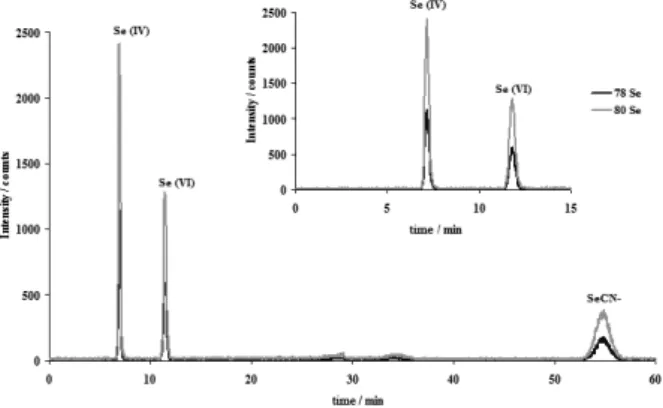
was applied. With this mobile phase, a complete separation of the Se (IV), Se (VI) and SeCN−
is achieved (60 min are necessary due to the high retention of the SeCN−
). In spite of the long elution time for SeCN−
, the long-term stability of this method is not affected for clogging problems caused by the highly saline eluent thanks to the use of a membrane salt suppressor. The chromatogram of the three species in aqueous standard solution (10 ng g-1per species) is shown
in Figure 2. The observed detection limits of 80Se (calculated
as 3σ of the baseline noise, based on peak height) were (0.18 ± 0.01), (0.13 ± 0.01) and (1.0 ± 0.08) ng g-1 for Se
(IV), Se (VI) and SeCN−
respectively. The detection limits obtained are comparable with those previously reported with sample volumes commonly used in IC-ICP-MS for Se (IV) and Se (VI), which eluted at shorter retention times.11,12,28 The
observed higher detection limit for SeCN−
could be described Table 2. Analysis of total selenium in wastewater samples from petroleum reinery by IDA-ICP-MS (uncertainty expressed as std. dev., n = 3)
Concentration found / (ng g-1)
Sample 80Se/77Se 78Se/77Se
CAC 48.7 ± 0.3 48.4 ± 0.4
CAO 55.6 ± 0.2 55.4 ± 0.3
to the broad peak obtained for SeCN−
due to its comparatively long retention time under the selected chromatographic conditions. Detections limits of ca. 0.2 ng L-1 for these
three species by IC-ICP-MS have been recently reported by Wallschläger and London14 but using an additional hydride
generation step in order to increase the analyte introduction eficiency. Of course, such additional step increases the complexity of the setup and can be recommended only for the analysis of uncontaminated waters at ng L-1 levels. The
detection limits obtained in our work are adequate for the precise and accurate quantiication of Se species in petroleum reinery wastewater. Reproducibility of replicate analyses of standard solutions was evaluated at 10 ng g-1 and RSD
between 3.4% and 7.6% (n = 3) were obtained.
Besides the spectroscopic interferences previously discussed, major matrix anions could also cause chromatographic interferences in the analysis of petroleum reinery wastewaters by IC-ICP-MS. In fact, Wallschläger and Roehl13reported chromatographic interferences by
chloride and sulfate in estuarine waters. This problem was avoided by diluting 20-fold the estuarine waters and using large sample volume injected (1-11 mL sample loop) that resulted in higher matrix tolerance than using smaller volume of the undiluted sample.13 Unfortunately, for
reinery wastewater samples (with an extremely complex matrix and low concentration of Se species) the use of large volumes of diluted samples turned out to be inadequate to obtain suitable chromatographic peaks for on-line accurate quantiication of Se species by IDA IC-ICPMS. Tirez et al.12found optimal separation of inorganic Se
species in industrial wastewaters by combining low sample volume injection with high low rates. In the analysis of such petroleum reinery wastewaters, chromatographic interferences by chloride, bromide and sulfate on the Se (IV) peak were observed under the selected chromatographic
conditions, due to retention times overlapping. In our work, a sample loop volume of 75 μL (undiluted samples) with a low rate of 1 mL min-1 of the mobile phase offered a
compromise between matrix tolerance and good resolution of the Se chromatographic peaks allowing the accurate quantiication of Se (IV) in wastewaters by IDA IC-ICP-MS as discussed in next section.
Determination of Se species by post-column IDA
Accurate Se concentration results by post-column isotope dilution analysis are obtained provided that the elemental response in the ICP is independent of the nature of the Se chemical species entering the ion source. Thus, nebulization, atomization and ionization eficiencies should be species independent. However, for certain sample introduction systems, such as ultrasonic nebulizer with membrane desolvator, signiicant differences have been observed.29 In our case, using a standard nebulization
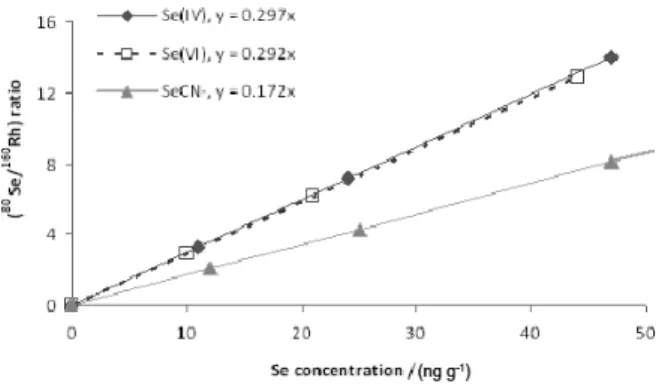
system (Meinhard nebulizer coupled to a double path spray chamber). Figure 3 shows typical calibration graphs obtained by direct nebulization of standard solutions of Se (IV), Se (VI) and SeCN−
. The anomalous behavior for SeCN−
could be reproduced on different days directly in the ICP-MS and also after separation of the species by ion chromatography. As the total Se concentration in SeCN−
standard solutions was also conirmed by IDA-ICP-MS (after microwave-assisted digestion with HNO3/H2O2) it appears to be an analyte transport problem to the plasma.
As the post-column spike 77Se used is in the form of Se
(VI) a systematic error in the determination of SeCN−
would be expected if this difference in ICP-MS response is not taken into account. Hence, for the calculations by post-column isotope dilution analysis the intensities obtained for SeCN−
, after the chromatographic separation, were corrected by an adequate factor, corresponding to the ratio of the slopes of the calibration graphs obtained for Se (VI) and SeCN−
respectively (0.291/0.172). Of course, this correction procedure increases the uncertainty of the results for SeCN−
and creates some concerns about the advantages of post-column isotope dilution analysis for the determination of the selenium species SeCN−
.
Analysis of the reinery wastewater
Wastewater samples (three replicates) were injected undiluted in the chromatographic system and ion chromatography (IC) was used for the Se species separation. The instrumental setup is shown in Figure 1 using optimised parameters, listed in Table 1. Then, the IC-IDA-ICP-MS approach was applied to the determination Figure 2. IC-ICP-MS chromatogram of Se (IV), Se (VI) and SeCN− in
of inorganic Se species in 3 petroleum reinery wastewater samples, including internal stream waters (CAC and CAO samples) and treated efluents (BA sample) from the oil reinery. The analytical results are summarized in Table 3 for the 78Se/77Se isotope ratio. Again, the concentrations
found by measuring the 78Se/77Se and 80Se/77Se isotope
ratios were in good agreement, demonstrating that the spectral interferences were satisfactorily corrected using the mathematical equations used here.
In the internal stream waters from the petroleum reinery (CAC and CAO samples), which are essentially an aqueous extract of the crude oil, SeCN−
was the only Se species detected. The SeCN−
concentrations in those two samples (Table 3) were (46 ± 2) and (56 ± 1) ng g-1, respectively after
the correction for the SeCN−
differential response. As can be seen in Table 3, there is a good agreement between the speciated content of Se found by IC-IDA-ICP-MS and total Se found directly by IDA-ICP-MS. The average recoveries were (95 ± 6)% (n = 3) for CAC sample and (101 ± 5)% (n = 3) for CAO sample.
As an example, intensity chromatograms by IC-IDA-ICP-MS obtained at masses 77, 78 and 80 and the corrected inal mass low chromatograms at the 78Se/77Se and 80Se/77Se
isotope ratios respectively (shifted for clarity) for the CAO sample are shown in Figure 4.
The integration of the corresponding mass flow chromatograms for 78Se/77Se and 80Se/77Se isotope ratios
showed in the Figure 4 provided virtually the same results (within the reported standard deviation of the measurements).
Along the water treatment process, the SeCN−
was effectively removed and the total Se concentration decreased as can be observed in Table 3 for BA sample. The corrected inal mass low chromatograms for the BA sample are given in Figure 5.
Although the detector response is speciic for Se, the retention times of chloride, bromide and sulfate peaks are very close to Se (IV) affecting the peak shape and thereby the precision of the integration of this peak.
Spectroscopic interferences of 79BrH+ (on 80Se isotope)
also affected the precision of the quantiication of Se (IV) Figure 3. Calibration curves of selenium species using conventional
nebulisation ICP-MS.
Table 3. Determination of inorganic selenium species in petroleum reinery wastewater by IC-IDA-ICP-MS and of total selenium concentration, determined by direct ICP-MS (uncertainty expressed as std. dev., n = 3)
Sample
Se concentration / (ng g-1) (78Se/77Se isotope ratio)
aSe(IV) aSe(VI) aSeCN− Total
CAC bn.d. n.d. 46 ± 2 48.4 ± 0.4
CAO n.d. n.d. 56 ± 1 55.4 ± 0.3
BA 12 ± 1 n.d. n.d. 31.2 ± 0.6
aNormalized to injection sample volume. bNot detected.
Figure 4. (a) Intensity chromatograms for 77Se, 78Se and 80Se isotopes and (b) corresponding mass low chromatograms obtained for 78Se /77Se and 80Se /77Se isotope ratios during separation in the internal stream water (CAO sample) from the petroleum reinery by IC-ICP-IDA-MS.
(to a lesser extent than for SeCN−
), which is relected in the values showed in Table 3 obtained by IDA-IC-ICP-MS. However, precise quantiication for Se (IV) could be achieved using both isotope ratios.
As can be seen in Table 3, in the analysis of BA sample low overall recoveries of Se (IV) related to total Se were observed (40 ± 8)%, n=3), indicating that other unknown selenium species seem to be present in this sample but they are either removed by the suppressor column (cationic species) or not eluted from the column, as already pointed out by Miekeley et al.23
Conclusions
The development of robust methods for reliable quantiication of Se species in waters is most important today due to the lack of suitable certified reference materials. Of course, using IDA techniques is a powerful tool for validation of quantitative speciation results.17 The
potential of the coupling of ion chromatography with a suppressor system and on-line isotope dilution ICP-MS for the quantiication of selenium species in wastewater samples has been demonstrated here.
The use of an ORS pressurized with H2 allows the quantiication of the main isotope 80Se and the elimination
of polyatomic interferences. The detection limits obtained by the coupling IC-ICP-MS for Se (IV), Se (VI) and SeCN−
in the ICP-MS are adequate for Se speciation determinations in industrial or contaminated waters. Moreover, the concentrations found by measuring the
78Se/77Se or the 80Se/77Se isotope ratios were in good
agreement.
The difference in analytical response observed for Se (IV) and Se (VI) with respect to SeCN−
in the ICP-MS is a cause of concern for an accurate determination of SeCN−
using post-column isotope dilution analysis. The correction factor applied seems to be adequate in the particular cases studied (admittedly it might causes general uncertainties in other cases were unknown selenium species should be determined).
Finally, although the aim of this work was not the study of the wastewater treatment process to eliminate SeCN−
, the proposed methodology has proved the effectiveness of the industrial oxidation process of SeCN−
(the only species found in untreated waters) to Se (IV) after the industrial efluent treatment.
Acknowledgments
The authors are grateful to the Ministry of Education and Science, Madrid, Spain, for inancial support (BQU2000-0221 and BQU2003-03438 projects) and for awarding a
doctoral grant to S. García-Ruiz. L. Hinojosa Reyes gratefully acknowledges her doctoral grant from the National Council for Science and Technology of Mexico (CONACyT).
References
1. Meng, X.; Bang, S.; Koriatis, G. P.; Water Res.2002, 36, 3867. 2. Gerhardt, M. B.; Stern, P. C.; Maroney, P. M.; Mitchell, S. C.; Removal of Selenium from Petroleum Reinery Wastewaters.
Unocal Corporation Brief Report, El Segundo, California, USA, 1992.
3. WSPA; Selenium Removal Technology Study: Project Final Report, Western States Petroleum Association, Sacramento, California, USA, 1995.
4. Muñoz Olivas, R.; Donard, O. F. X.; Cámara, C.; Quevauviller, P.; Anal. Chim. Acta1994, 286, 357.
5. Moreno, M. E.; Pérez-Conde, C.; Cámara, C.; J. Anal. At. Spectrom.2000, 15, 681.
6. Wallschlänger, D.; Bloom, N. S.; J. Anal. At. Spectrom.2001, 16,1322.
7. Roehl, R.; Slingsby, R.; Avdalovic, N.; Jackson, P. E.; J. Chromatogr., A 2002, 956, 245.
8. Gómez-Ariza, J. L.; Sánchez-Rodas, D.; Caro de la Torre, M. A.; Giráldez, I.; Morales, E. J.; J. Chromatogr., A 2000, 889, 33.
9. Pitts, L.; Fisher, A.; Wosfold, P.; Hill, S. J.; J. Anal. At. Spectrom.
1995, 10, 519.
10. Jackson, B. P.; Miller, W. P.; Environ. Sci. Technol.1999, 33, 270.
11. Gammelgaard, B.; Jøns, O.; J. Anal. At. Spectrom. 2000, 15, 499.
12. Tirez, K.; Brusten, W.; Van Roy, S.; De Brucker, N.; Diels, L.; J. Anal. At. Spectrom. 2000, 15, 1087.
13. Wallschläger, D.; Roehl, R. J.; J. Anal. At. Spectrom.2001, 16, 922.
14. Wallschläger, D.; London, J.; J. Anal. At. Spectrom.2004, 19, 1119.
15. Tanner, S. D.; Baranov, V. I.; Bandura, D. R.; Spectrochim. Acta, Part B2002,57, 1361.
16. García Fernandez, R.; García Alonso, J. I.; Sanz-Medel, A.; J. Anal. At. Spectrom.2001,1, 1035.
17. Heumann, K. G.; Rottmann, L.; Volg, J.; J. Anal. At. Spectrom.
1994,9, 1351.
18. Hinojosa Reyes, L.; Moreno Sanz, F.; Herrero Espílez, P.; Marchante-Gayón, J. M.; García Alonso, J. I.; Sanz-Medel, A.; J. Anal. At. Spectrom.2004, 19, 1230.
19. Hinojosa Reyes, L.; Marchante-Gayón, J. M.; García Alonso, J. I.; Sanz-Medel, A.; J. Anal. At. Spectrom.2003, 18, 1210. 20. Díaz Huerta, V.; Hinojosa Reyes, L.; Marchante-Gayón, J.
21. Díaz Huerta, V.; Fernández Sánchez, M. L.; Sanz-Medel, A.; J. Anal. At. Spectrom. 2004, 19, 644.
22. Hinojosa Reyes, L.; Marchante Gayón, J. M.; García Alonso, J. I.; Sanz-Medel, A.; J. Anal. At. Spectrom. 2003, 18, 11. 23. Miekeley, N.; Pereira, R. C.; Casartelli, E. A.; Almeida, A. C.;
Carvalho, M. F. B.; Spectrochim. Acta, Part B 2005,60, 633. 24. Ruiz Encinar, J.; García Alonso, J. I.; Sanz-Medel, A.; Main,
S.; Turner, P. J.; J. Anal. At. Spectrom. 2001, 16, 315. 25. García Alonso, J. I.; Anal. Chim. Acta 1995,312, 57.
26. Sariego Muñiz, C.; Marchante Gayón, J. M.; García Alonso, J. I.; Sanz-Medel, A.; J. Anal. At. Spectrom. 2001, 16, 587. 27. CONAMA, Ministério do Meio Ambiente, Brasília Brasil,
Resolution1986, 20.
28. Vassileva, E.; Becker, A.; Broekaert, J. A. C.; Anal. Chim. Acta
2001,441, 135.
29. Heumann, K. G.; Anal. Bioanal. Chem. 2004,378, 318.
Received: December 23, 2008