940 Brazilian Journal of Physics, vol. 36, no. 3B, September, 2006
Two Electrons in Vertically Coupled One-Dimensional Rings
Jairo H. Marin1, Francisco Garc´ıa2, and Ilia D. Mikhailov2
1Escuela de F´ısica, Universidad Nacional de Colombia, A. A. 3840 Medell´ın 2Escuela de F´ısica, Universidad Industrial de Santander, A. A. 678 Bucaramanga
Received on 8 December, 2005
A problem of two electrons spatially separated in vertically coupled one-dimensional rings is solved exactly by using the numerical trigonometric sweep method. The change of the level-ordering and the crossover of the curves of the energy levels as a functions of the rings radii, the separation between rings and the magnetic field, applied along the axis, are found and discussed. As the distance between rings tends to zero our results are in an excellent agreement with those obtained previously for the single two-electron one-dimensional ring.
Keywords: Quantum rings; Two-electron energies; Trigonometric sweep method
I. INTRODUCTION
The rapid progress in crystal growth and fabrication meth-ods have made possible to generate a new kind of nanometer-size semiconductor heterostructures with controlled thickness and relatively sharp interfaces. In the last several years, there has been a considerable interest in quasi-zero dimen-sional self-assembled quantum dots (QDs), formed through the Stranki-Krastanow growth mode by deposition a material on the substrate with different lattice parameter [1]. This in-terest is related to potential technological application of QDs in optoelectronic devices [1-2], as well as to their character of novel quantum systems in which new physics and analogies with atomic clusters, atoms, molecules, may be found. The QDs shapes are not well known yet, nevertheless, structural studies suggest that commonly the quantum dots look like lenses, pyramids or disks [3]. Recently, Lorke and co-workers have reported the fabrication of InGaAs QDs with a ring-like geometry [4]. This finding has stimulated some theoretical investigations about one- and two-particle spectra in quantum rings (QRs) which have been done in order to establish the pe-culiarities related to this morphology [5]. The realistic geome-try of two-electron InGaAs QR is a structure with larger outer radius (∼400-500nm), narrower width (∼20-40nm) and very small height (∼2-4nm). Due to strong confinement in vertical direction a two-dimensional model is commonly considered in order to analyze the QRs electronic properties. Nevertheless, one-dimensional model may also be consider as appropriated in framework of the adiabatic approximation [5] which allows one to decouple the rapid radial motion from the slow angular motion.
Exact energy levels of two-electron systems in 1D QRs have been obtained and the size effect on the interaction ener-gies in the limit of a narrow-width nanoring has been studied in reference [6]. A few two-particle exactly solvable prob-lems are known and therefore the exact solution found out in reference [6] is interesting not only from a physical point of view but also from a mathematical point of view. In this work we propose an other exactly solvable model in which two vertically coupled concentric 1D rings contain each one only one electron. The fabrication of similar stacked arrays of InAs self-assembled QDs with vertical alignment have been reported recently [7]. These systems are technologically
im-portant, because they allow us to improve the performance of the optical devices taking advantage provided by the coupling effect between QRs. In this context, we consider relevant to use the exactly solvable model to explore the new physics bound up with the coupled QRs in order to understand effects related to coupling between rings on the two-electron energy spectrum.
II. THEORY
We consider a model of two coaxial, identical and paral-lel one-dimensional rings, every each with only one electron. Besides, we suppose that the external homogeneous magnetic fieldB=Bˆzis applied along the rings axis. BeingRthe rings radius anddthe spatial separation between them along the Z-direction, we introduce dimensionless parameterβ=d/R. In order to compare our results with those from Ref. 6 in the limit caseβ→0, as rings merge and form only one ring, we use both the same notations and the units that have been used in this reference. The units used below for the length, the energy and the magnetic field strength are the effective Bohr radius, a0∗=~2ε±
m∗e2, the effective RydbergRy∗=m∗e4± 2~2ε2
and the first Landau level energyγ=eB~±2m∗cRy∗, respec-tively.
The normalized dimensionless two-electron Hamiltonian ( ˜H=HR2):
˜ H=
2
∑
i=1 ·
− ∂ 2
∂ϕ2 i
−iγR2 ∂ ∂ϕi
¸ +γ
2R4
2 +U(ϕ1−ϕ2) (1)
U(ϕ1−ϕ2) =2R
,r
4sen2(ϕ1−ϕ2 2 ) +β
2 (2)
Eigenvalues of the Hamiltonian (1) corresponding to the normalized two-electron energies, ˜E (energies E multiplied by the squared radius of ring, ˜E =ER2) can be found ex-actly by using center-of-mass,θ= (ϕ1+ϕ2)±
Jairo H. Marin et al. 941
˜
H=H˜c+H˜r+γ2R4±2; H˜c=−12 d 2
dθ2−iγR2ddθ;
˜
Hr=−2d2
dϕ2+U(ϕ)
(3)
This separability allows us to write two-particle normal-ized energy in the form ˜E=E˜c+E˜r+γ2R4±2, where ˜Ecand
˜
Er are eigenvalues of the operators ˜Hcand ˜Hr, respectively. The eigenvalues of the operator ˜Hc are given by: ˜Ec(M) = 0.5M2+γMR2with center-of-mass angular momentumM= 0,±1,±2, . . ., whereas the eigenvalues of the operator ˜Hr should be found by solving the one–dimensional wave equa-tion:
−2d 2f
ms(ϕ)
dϕ2 +U(ϕ)fms(ϕ) =E˜r(m,s)fms(ϕ) (4) in the region of [−2π,2π] with periodic boundary condi-tions fms(0) = (−1)mfms(2π). The quantum number m= 0,±1,±2, . . . defines the two-electron relative angular mo-mentum and s=±the eigenfunction parity. The even so-lutions(s= +)correspond to singlet states and the odd solu-tions(s=−)correspond to triplet states. The electronic spec-trum of the two-electron system will then be given by energies
˜
E(M,m,s)labelled by three quantum numbersM,m,s. In our numerical work we use the trigonometric sweep method [8] in order to solve the eigenvalue problem (4) with the periodic boundary condition asserted above.
III. RESULTS
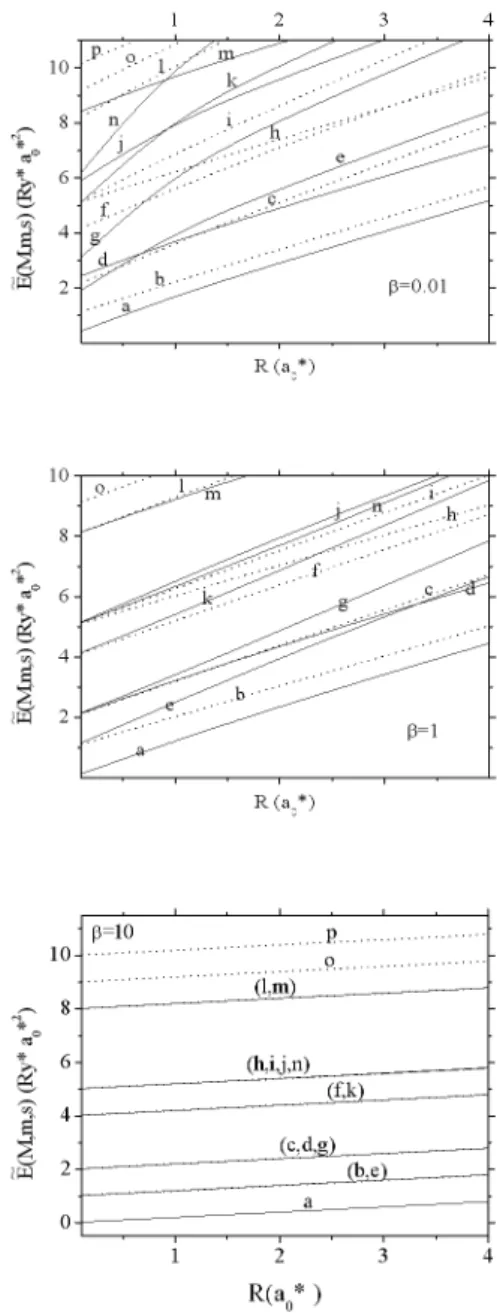
We have performed numerical calculations of two-electron energies ˜E(M,m,±)as a function of the rings radiusRfor dif-ferent values ofβ. The results are presented in Fig.1 and Table I. Here and below we use the short notation about quantum number and spin, i.e.a,b,c,etc. in the order of increasing en-ergy value under very strong confinement condition(R→0)as the rings merge(β→0).
Complete correspondence between short notation and set of the quantum numbers(M,m,s)is given in Table I. In the same place we compare our results for very small ratioβ=0.001 with those obtained previously for two electrons in a single ring in Ref. 6. One can observe an excellent concordance between results obtained for two different rings radii.
One can observe in Fig.1 a remarkable evolution of the energies dependencies on the ring radius with increasing of the separation between rings, as the ratioβvaries from small value 0,001 (upper curves) to large one 10 (lower curves). To understand this evolution one should compare the contri-butions which give the kinetic and Coulomb energies in the Hamiltonian (1). There is a strong competition between these two terms. As the ring radius is very small or the distance between rings is very large the contribution of the Coulomb energy becomes depreciable and the exact eigenvalues of the Hamiltonian (1) correspond to normalized energies of two un-coupled rigid rotors given by the formula:
FIG. 1: Normalized total energies ˜E(M,m,s)of two electrons ver-sus radiusRin vertically coupled QRs with different ratios of the distance between rings-to-radius,β0.001, 1 and 10. Solid lines are singlet states and dotted lines are triplet states.
˜
depen-942 Brazilian Journal of Physics, vol. 36, no. 3B, September, 2006
TABLE I: Exact energy levels ˜E(M,m,s)of two electrons in verti-cally coupled rings withβ=0.001 (our results) and in single ring (from Ref. 6).
Energy notation R=1a0∗ R=4a0∗
Short no-tation
Full
nota-tion
Our results
Ref. 6 Our
results
Ref.6
a E˜(0,0,0) 1.72 1.73 5.18 5.18
b E˜(1,1,1) 2.23 2.23 5.68 5.68
c E˜(0,2,1) 3.61 3.62 7.92 7.92
d E˜(2,0,0) 3.72 3.73 7.18 7.18
e E˜(1,1,0) 4.06 4.12 8.41 8.42
f E˜(2,2,1) 5.62 5.62 9.92 9.92
g E˜(0,2,0) 6.22 6.23 11.40 11.40
h E˜(3,1,1) 6.33 6.38 9.68 9.68
i E˜(1,3,1) 6.88 6.88 11.90 11.90
j E˜(3,1,0) 8.06 8.11 12.41 12.41
k E˜(2,2,0) 8.22 8.38 13.40 13.40
l E˜(0,4,1) 10.08 10.08 15.71 15.71
m E˜(4,0,0) 9.72 9.73 13.18 13.18
n E˜(1,3,0) 10.24 10.57 16.19 16.21
o E˜(3,3,1) 10.88 10.88 15.90 15.90
p E˜(4,2,1) 11.62 11.62 15.92 15.92
dencies on the ring radius become almost horizontal and the levels turn into degenerated with respect to spin orientations.
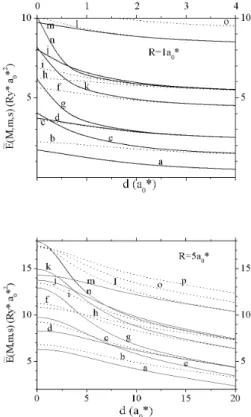
Similar dependencies of the two electron energies on the distance between vertically coupled one-dimensional rings are presented in Fig. 2 for ring radii 1a0∗and 5a0∗. One can ob-serve that the spectrum of the system substantially transforms to one, typical for a pair of uncoupled rigid rotors described by the relation (5). Transformation of the energy spectrum from one common for a system with a strong Coulomb inter-action (as the distance between rings is small) to another usual for a system of the independent rigid rotors (as the distance between rings is large) provides the intersections between dif-ferent curves observed in Fig.2.
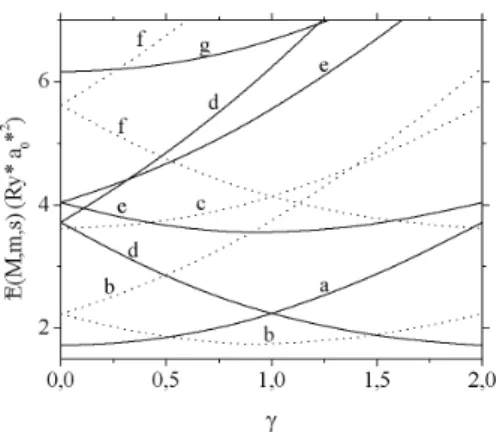
The dependence of some normalize energies ˜E(±M,m,s) with|M| ≤2 on the magnetic field strength for the ring radii R=1a0∗, and separation between rings,d=0.1a0∗, is shown in Fig. 3. One can see that the presence of the magnetic field provides the splitting of the energy levels whose angular mo-mentumMhas different signs. Larger magnetic field strength more significant is the splitting induced by the paramagnetic term in the Hamiltonian (3).
The behaviour of these curves is controlled by the strong competition between the paramagnetic and diamagnetic terms in the Hamiltonian (3). The contribution of the paramagnetic term depends on the magnetic field strength is linear whereas this dependence of the diamagnetic term is quadratic. There-fore, as the magnetic field strength is small the contribution of the paramagnetic term is predominant and for large magnetic field the diamagnetic term becomes more significant. For this reason, at the beginning of the curves they look like quasi-linear with a positive slope (M≥0)or negative slope (M<0)
FIG. 2: Normalized total energies ˜E(M,m,s)of two electrons versus distancedbetween vertically coupled rings with two different radii, R=1a0∗(upper curves) andR=5a0∗(lower curves).
adopting parabolic-like shape for large magnetic fields. Addi-tionally, we can note that the lowest level energy dependence on the magnetic field strength display an oscillatory behaviour with periodγ=1.0. For magnetic field strength less than 0.5 the ground state energy corresponds to the ˜E(0,0,0)singlet level. As the magnetic field strength becomes greater than 0.5 the ground state is transformed in ˜E(−1,1,1)triplet level. Within the interval of the magnetic field(1<γ<1.5) this level is remained as the ground state. Further, as the magnetic field exceeds the value 1.5 the ground state is transformed in
˜
E(−2,0,0) singlet level, etc. This oscillatory behaviour is remained for different values of the rings radius and the sep-aration between them. It is evident that the quantum number Mof the ground state level raises with increasing of the mag-netic field strength and the positions of minima in the curves of the magnetic oscillation corresponds toγ=M±
R2and the oscillation period is equal to 1±R2. Magnetic oscillations not suffer any changes as the ring radii are modified. It is due to the fact that the Coulomb interaction between two electrons in 1D rings is responsible of the quantum size effects.
Jairo H. Marin et al. 943
FIG. 3: Normalized energies ˜E(±M,m,s) versus magnetic field strengthγfor two electrons in vertically coupled rings of the radii R=1a0∗and separation between themd=0.1a0∗.
axis are analyzed. It is shown that in the limit case, when the separation between rings tends to zero, our results are in an excellent concordance with those obtained previously for one-dimensional ring by using a different method.
Acknowledgements
This work was financed by the Industrial University of Santander (UIS) through the Direcci´on General de Investi-gaciones (DIF Ciencias, Cod. Cod. 5124) and the Excel-lence Center of Novel Materials ECNM, under Contract No. 043-2005 and the Cod. No. 1102-05-16923 subscribed with COLCIENCIAS. J. H. Mar´ın wishes to thank the Universi-dad Nacional-Sede Medell´ın for the permission to study at the UIS.
[1] L. Jacak, P. Hawrylak, and A. W´ojs,Quantum Dots (Springer,
Berlin, 1997).
[2] G. Timp,Nanotechnology(Springer-Verlag, New York, 1999).
[3] S. Fafard, Appl. Phys. Lett.76, 2707 (2000).
[4] A. Lorke, R. J. Luyken, A. O. Govorov, J. P. Kotthaus, J. M. Garcia, and P. M. Petroff, Phys. Rev. Lett.84, 2223 (2000). [5] H. Hu, J. L. Zhu, and J. J. Xiong, Phys. Rev. B62, 16777 (2000);
L. Wendler, V. M. Fomin, A. V. Chaplik, and A. O. Govorov,
Phys. Rev. B54, 4794 (1996).
[6] J.-L. Zhu, Z. Dai, and X. Hu, Phys. Rev. B68, 045324 (2003). [7] J. J Palacios and P. Hawrylak, Phys. Rev. B51, 1769 (1995); G.
S. Solomon, J. A. Trezza, A. F. Marshall, and J. S. Harris, Jr., Phys. Rev. Lett.76, 952 (1996).