Analysis of Time-Resolved Laser Plasma Ablation using an Imaging Spectra Technique
H. Luna#, J. Dardis‡, D. Doria†, and J.T. Costello‡
#Centro Brasileiro de Pesquisas F´ısicas, Rua Xavier Sigaud 150, Urca, Rio de Janeiro, Brazil.
†Queens University Belfast, Belfast, UK. and
‡NCPST and School of Physical Science, Dublin City University, Glasnevin, Dublin 9, Republic of Ireland.
Received on 10 October, 2007
Pulsed laser deposition (PLD) is extensively employed for the growth of thin films. The laser-material in-teraction involves complex processes of heating, melting, vaporization, ejection of atoms, ions and molecules, shock waves, plasma initiation, expansion and deposition onto a substrate. The understanding of the spatial and temporal distribution of a plasma parameters in a laser-produced plasma is important to the control of thin film growth process. In this work we have studied the dynamics of laser ablated graphitic carbon plasma ex-panding into vacuum using a spectroscopic imaging suitable as an in situ& automated diagnostic sampling technique for PLD. Time-resolved spectra, that were also spatially resolved in one dimension along the axis of plasma expansion, were obtained using a time-gated intensified charge-coupled device (ICCD) coupled to a stigmatic Czerny-Turner spectrograph. Plasma parameters such as electron density, temperature and plume velocity expansion were extracted directly from the analysis of the C II (2s23d-2s24f) transition.
Keywords: Spectroscopy; Laser produced plasma; Time-resolved imaging; Plasma density; Plasma temperature
I. INTRODUCTION
Diamond-like carbon (DLC) materials are assuming a growing interest in a number of fields ranging from electrical and optical applications to biomedical engineering. For exam-ple, the possibility to coat large surfaces with a diamond-like carbon films makes them ideal for radiation detection, X-ray windows, biocompatible membranes, wave sensors and high voltage (HV) switching devices [1, 2].
Pulsed Laser Deposition (PLD) is one of the techniques used to produce films with structures varing from a-C films (amorphous carbon films) to nanophase diamond, where the film characteristics output such as hardness, density and fric-tion coeficient are dependent on the deposifric-tion condifric-tions [3]. Its main advantage over other techniques is the possibility to control properties of the deposited film by changing the laser irradiation conditions such as laser beam wavelength, pulse duration, energy and focusing spot size. The carbon plasma is formed when a laser pulse with intensity of the order of 109−11 W/cm2is focused onto a graphitic carbon target. The plasma then expands freely into vacuum or in an inert gas atmosphere. The particles ejected from plasma are subsequently deposited on different substrates to form the films.
The monitor and control of the PLD-generated plasma can be done by several diagnostic sampling techniques. Diagnos-tic sampling techniques may be divided into three categories: (1) those involving sample extraction andex situanalysis, e.g. mass spectrometry; (2) those which require placing a physical probe (e.g. Langmuir probe) in the region of interest [4]; and (3)in situoptical probes, e.g. optical emission spectroscopy (OES), Thomson scattering and Raman spectroscopy.
The aim of this work is to develop a tool forin situPLD characterization based on OES technique. For this propose we apply a space and time resolved, spectral imaging technique [5] where plasma parameters can be extracted directly from line emission in the VIS/NIR (range of interest for a table top apparatus). We have found the C II (2s23d-2s24f) transition,
to be the best choice of line emission for a rapid and ready op-tical characterization of the plasma during film deposition. A MATLABTM[6] code was used for plasma parameter extrac-tion from the image spectrum and can be adapted for on-line monitoring deposition conditions.
II. EXPERIMENTAL APPARATUS
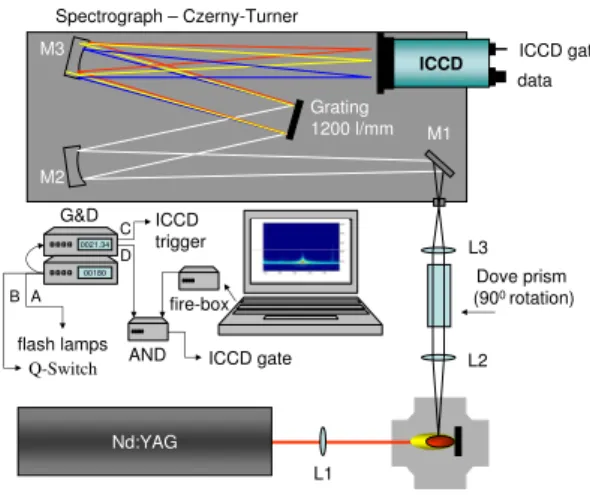
The experimental apparatus is shown schematically in Fig. 1. A Q-switched Nd:YAG laser (E = 150 mJ,λ= 1064 nm, pulse duration of 15 ns FWHM and 10 Hz repetition rate) is focused onto a graphitic carbon target surface placed in-side a vacuum chamber (5×10⁻⁵mbar) generating a plasma
that expands normal to the target surface. A typical laser ir-radiance can be estimated from the crater diameter shown in Fig. 2, obtained with a SEM. In this case the shape of the spot is approximately an ellipsoid ofa=59µmandb=78.6µm), resulting in a laser irradiance of≈7×10¹⁰W/cm2.
The target holder was mounted on aXY Zstage in order to allow us to move to a fresh surface after exposure. The op-tical system used to focus the plasma onto the entrance slit of the spectrograph comprises a Dove prism located between two achromatic lenses, L2 and L3, with focal lengths of 250 mm, respectively. The Dove prism is used to rotate the image of the plasma plume by 90◦, projecting the direction of the
plasma expansion (z-axis) along the entrance slit (y-axis) of a 0.5 m focal length Czerny-Turner spectrograph. The spectro-graph was equipped with a grating of groove density of 1200 lines/mm and a blaze wavelength of 400 nm. The optimum resolution was obtained at a slit width of 60µmsince no im-provement in resolution was obtained at narrower slit widths while the resolution was degraded at larger slit widths. The dispersion of the grating was found to be 0.04 nm/pixel forλ
= 426.7 nm and instrument function of the system to be 0.16 nm, measured independently.
intensi-Spectrograph – Czerny-Turner
B
ICCD
M1 M2
M3
Grating 1200 l/mm
L1
L3
0021.34
L2 Dove prism (900rotation)
Q-Switch
00180
flash lamps
fire-box
AND
ICCD gate data
ICCD trigger G&D
A C D
ICCD gate
Nd:YAG
FIG. 1: Experimental set-up for the colliding plasma experiment. C target, lenses (l1,l2andl3), wedge prism (WP), Dove prism, spec-trograph and ICCD camera.
FIG. 2: Image of the target after being exposed to the laser shot. Typical spot profile obtained after laser exposure.
fied two-dimensional (2D) charge-coupled device (AndorTM ICCD). The ICCD consisted of an 18 mm diameter micro channel plate (MCP) image intensifier coupled to a 512 ×
512 pixels charge-coupled device by a high quality relay lens system. Since the spectrometer is stigmatic, the overall ICCD/spectrometer system provides 1D (spatial) by 1D (spec-tral) images of the plasma plume. The ICCD camera used in the experiment can be operated with a gate width as low as 2 ns FWHM. By varying the delay between plasma initiation and the opening of the ICCDs gate, we were able to track the temporal evolution of the plasma. Two Stanford DG535TM delay generators were used to achieve this synchronization. A 16 ns gate width was used to record the spectra used during this work.
III. PLASMA PARAMETERS ANALYSIS
A set of raw images (background subtracted) obtained from the plasma imaging system comprising the spectrograph (with ICCD readout) are shown in Fig. 3 for the C II (2s23d-2s24f) transition at three different times during the plume expansion, respectively, 60, 100 and 180 ns. The x-axis corresponds to the direction of wavelength dispersion (spectrometer setting centred at the 426.7 nm transition wavelength) and the z-axis corresponds to spatial distribution of the corresponding ex-cited state species distribution along the plasma plume expan-sion direction. The analyses of the spectral images are de-scribed in reference [5]. In brief, a set of cells or grid can be superimposed onto the image and the image segment en-closed within each cell binned vertically. The binned lineouts (or spectra) are then projected along the expansion direction (z-axis) and a Voigt function is used to fit each spectrum for each spatialcellor box. Therefore, spectrally resolved para-meters such as relative line intensity, Gaussian and Lorentzian widths can then be extracted for each position, from the time-resolved images.
125
250
375
500 0
1000
125
250
375
500
180 nsec
0 8000
100 nsec
0 100 200 300 400 500
125
250
375
500 0
3.000E4
60 nsec
8000
0 30000
0
1000
0
wavelength (pixels)
d
is
ta
n
ce
(
p
ix
el
s)
A. Plume expansion velocity
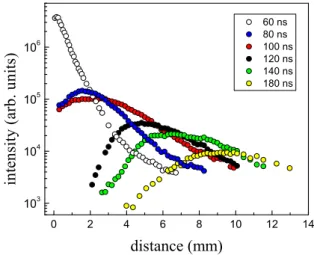
The first parameter is the plume velocity and can be ex-tracted from the spatial line intensity distribution. By tracking the maximum brightness displacement, shown in Fig. 4 for the CII (2s23d-2s24f) transition, a velocity expansion of 0.75
×107cm/sec was obtained, towards the longitudinal direction,
for the singly ionized component of the plume. This is in good agreement with the value measured by Harilal and co-workers (107cm/sec), using a 2-D fast photography technique for a car-bon plasma expanding in vacuum [7].
0 2 4 6 8 10 12 14
10
3
10
4
10
5
10
6
60 ns 80 ns 100 ns 120 ns 140 ns 180 ns
i
n
t
e
n
s
i
t
y
(
a
r
b
.
u
n
i
t
s
)
distance (mm)
FIG. 4: Longitudinal line intensity distribution for the CII 426.7 nm transition.
Concerning the theoretical treatment of the plume expasion, two models are often used for comparison with the experi-mental results. Special solutions of gas dynamics equations can be obtained from an arbitrary initial temperature profile and laser irradiance conditions. The simplest case assume an isothermal solution of the gas-dinamical equations with gaussian pressure and density profiles [8]. However spatially and time resolved experiements [5] have shown that the spa-tial distributions of the electron temperature are not isothermal and disregarding spatial temperature gradients is physically inadequate. A more realistic model is presented by Anisimov and co-workes [9, 10]. In their work a model for the plume expansion is obtained from the analitical solution of the gas-dinamical equations considering a non-isothermal adiabatic expansion of the plume in vacuum or a gas atmosphere. A gas dynamics expansion code based on this model is currently under development by us and results from it will be presented later.
B. Electron density
The second parameter to be extracted is the electron density. Under the assumption of LTE (local thermodynamics equi-librium), the electron density can be calculated by analysing
the profile of the C II (2s23d-2s24f) transition centered atλ0 = 426.7 nm. A Voigt function is used to fit a profile to the transition that takes into account the various processes that contribute to the line broadening. Several broadening mecha-nism can be attributed to the Lorentzian and Gaussian compo-nent. The Stark contribution to the broadening is described by the Lorentzian component and all other contributions are ac-counted for the Gaussian components. Two broadening mech-anism are often important for laser produced plasma [11, 12]. The broadeing component due to Doppler effect, can be calcu-lated from:λ1/2(FHWM) = 3.8×10⁻⁵λ0(kT/M)1/2, where kTis the plasma temperature in eV,Mis the atomic mass num-ber andλ0is the line wavelength in nm, and the instrument function of the apparatus which is a function of the optics, spectrograph and ICCD configuration. For the transition stud-ied in this work we have found the Doppler contribution to be
≈0.005-0.015 nm, for T = 1-10 eV. The second contribution
comes from the instrument function which was measured in-dependently using the scattered light from a HeNe laser and is well approximated by a Gaussian profile with a full width at half maximum of 0.16 nm.
Therefore, having obtained the pure Stark component, the electron density can be obtained by solving the equations be-low:
∆λwidth=2W(Ne/1016) +3.5A(Ne/1016)1/4
×[1−1.2ND−1/3]W(Ne/1016) (1)
where the electron impact parameterW, and the ionic-impact parameterAare taken from tabulated values [12, 17] andND is the number of particles in the Debye sphere, given by:
ND=1.72×10⁹(T3/Ne)1/2 (2)
The first term in equation 1 describes the broadening caused by electron-emitter collisions. The second term, or quasi-static component describes the broadening due to ion-emitter interactions. Stark broadening in lowly ionised species is dominated by electron collisions, thereby allowing us neglect the ion broadening term and to use only the first term in the equation 1. The FHWM (∆λwidth) will then scale linearly with the electron densityNe.
0 2 4 6 8 10 12 14 0,00 1,75 3,50 5,25 7,00 8,75 0,00 0,50 1,00 1,50 2,00 2,50
0,0 0,5 1,0
0,0 0,5 1,0 1,5 2,0 80 ns 100 ns 60 ns N e ( 1 0 1 8 c m -3 ) ( n m ) distance (mm) 60 ns 100 ns 180 ns (a) N e ( 1 0 1 8 c m -3 ) distance (mm) (b)
FIG. 5: (a) Spatial distribution of the electron density for 60, 100 and 180 ns. On (b) Insert- expanded view of the region near the target surface showing the sharp decay in the magnitude ofNe.
C. Electron temperature
Finally, the third parameter of interest to PLD, is the plasma temperature. Also, under the assumption of LTE, the electron temperatureTecan be assumed equal to the excitation temper-atureTexc, and the plasma temperatureT can be determined from optical emission by three methods, namely, the relative to-continuum intensity ratio the relative, the relative line-to-line intensity ratio for transitions from the same element and same ionization stage (Boltzmann plot), or by two subse-quent ionization stages of the same element (Saha equation) [11, 12]. Once the main goal of this work, is to present an in−situ& automated plasma characterization procedure for PLD, any temperature calculation based on line-to-line ratio becomes only achievable if two or more line transitions lie within the spectral window of the spectrograph. For a Czerny-Turner specrograph, the choice of the diffraction grating will determine the spectral range and resolution. For example, a grating with density of 300 lines/mm can provide a larger spectral range (typically 300-700 nm or 500-1100 nm depend-ing on the blaze angle), allowdepend-ing simultaneous measurement of several lines and the use of Boltzmann plot method. Larger spectral range comes with the expense of losing spectral res-olution (typically 0.5 to 1 nm) and consequently the impos-sibility of measuring densities via Stark broadening. Higher density gratings (1200 to 3600 lines/mm) are suitable for Stark measuremnts but the spectral range window will not be wide enough to allocate two or more emission line transition from the same element. In this work, as only one line is avail-able within the spectral window of the spectrometer plus CCD spectral window, we set on the relative line-to-continuum in-tensity ratio method to to measure the electron temperature.
The background continuum from a plasma arises from the interactions of free electrons with ions yielding recombinative radiation (free-bound transitions) and Bremsstrahlung emis-sion due to freefree transitions, and can be described by the following equation [13, 14],
0,0 0,5 1,0 1,5 2,0 2,5 3,0 3,5 4,0 20
25 30 35
0,0 0,5 1,0 1,5 2,0 25 26 27 28 29 30 31 60ns t e m p e r a t u r e ( 1 0 3 K ) distance (mm) 100ns t e m p e r a t u r e ( 1 0 3 K ) distance (mm)
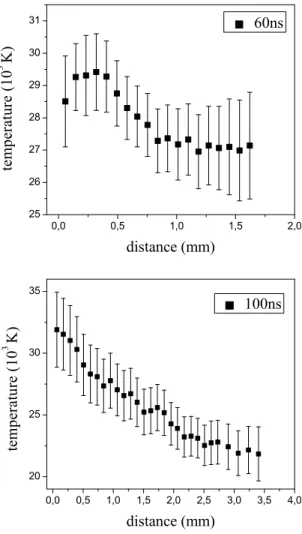
FIG. 6: Typical electron temperatures obtained using the line-to-continuum ratio method.
εc=C
Ne2
λ2T1/2 e
½
ξ
· 1 -exp
µ
−hc
λkTe ¶¸ +G · exp µ −hc
λkTe ¶¸¾
(3) where C = 1.632×10−43[Jm4K1/2sec−1sr−1] andλ,N
e, and
Te are, respectively, wavelength, electron density and tem-perature. The constantsh,candkare the Plancks constant, the speed of light and Boltzmanns constant. The free-bound and free-free factors are denoted byξ and G, respectively. From the Saha equation, the equation for the relative line-to-continuum intensity ratio is given by:
εi
εc
=CrAkigk
Zi
λ
Te
exp(∆E/kTe) ½
ξ
· 1 -exp
µ
−hc
λkTe ¶¸ +G · exp µ −hc
λkTe ¶¸¾
(4) where,Cr= 2×10⁻⁵[sK], andAkigkis the Einstein transition probability weighted by the upper energy level degeneracy.
and the upper level energy, respectively. For carbon we have usedξ= 1.4 obtained for Si in references [15, 16] andG= 1.
It is important to note that, equation 4 is only applicable for early stages of the plume expansion, since after 100 nsec the continuum emission has disappeared. Secondly, it is not ideal for predicting spatial temperature profiles, because it fails to give an accurate line-to-continuum ratio at the edges of the plume, where the continuum signal is weak. In the early phase of the plume expansion (and near the target surface) the plasma emission tends to be continuum dominated and the measurement of the transition emission becomes imprecise. At the end of the plume life, the opposite scenario takes over, and the continuum emission becomes much lower than dis-crete line emission. Equation 4 can be solved numerically or graphically. The results are shown in Fig. 6, for two times in the plume expansion, where the continuum emission was still measurable.
IV. CONCLUSION
In this work we have presented an optical imaging method capable to provide space and time resolved spectra of a plasma
plume during pulsed laser deposition. From a single line emission, plasma parameters such as plume expasion veloc-ity, electron temperature and densveloc-ity, can be obtainedin-situ and simultaneously with the film deposition. These time re-solved spectra and the parameters obtained from them can be used as a fingerprint of the film deposited and as a historical record of the conditions in which the films were growth.
Acknowledgments
We thank Dr. D.F. Franceschini for helpful comments and suggestions. This work was supported by Science Foundation Ireland under the Frontiers Programme. DD acknowledges suport from EU FP6 Marie Curie Training Site Scheme. HL acknowledges support from the EU FP6 Marie Curie IIF and HEA North-South programmes.
[1] C.E. Nebel, D. Shin, B. Rezek, N. Tokuda, H. Uetsuka, and H. Watanabe J. R. Soc. Interface,4, 439 (2007).
[2] M. Nesladek Semiconductor Science and Technology,20, R19 (2005).
[3] A.A. Voevodin, M.S. Donley Surface and Coatings Technol-ogy,82, 199 (1996).
[4] James G. Lunney, Brendan Doggett, and Yitzhak Kaufman, J. Phys.: Conf. Ser.59, 470 (2007).
[5] D. Doria. K.D. Kavanagh, J.T. Costello, and H. Luna Meas. Sci. Technol.17, 670 (2006).
[6] K.D. Kavanagh, PhD Thesis, Dublin City University (2006). [7] S.S. Harilal, B. O’Shay, M.S. Tillack, C.V. Bindhu, and F.
Na-jmabadi Ieee Transactions on Plasma Science,33, (2005). [8] R.K. Singh and J. Narayan Phys. Rev. B41, 8843 (1990). [9] S.I. Anisimov, D. Bauerle, and B.S. Lurkyanchuk Phys. Rev. B
48, 12076 (1993).
[10] S.I. Anisimov, B.S. Luk’yanchuk, and A. Luches Applied
Sur-face Science96-98, 24 (1996).
[11] H. R. Griem 1964Plasma Spectroscopy(McGraw-Hill, New York).
[12] H. R. Griem 1974Spectral Line Broadening by Plasmas (Aca-demic Press, New York).
[13] G.J. Bastiaans and R.A. Mangold Spectrochimica Acta Part B
40B, 885 (1985).
[14] G.C.Y. Chan and W-T Chan Spectrochimica Acta Part B57, 1771 (2002).
[15] H.C. Liu, X.L. Mao, J.H. Yoo, and R.E. Russo Spectrochimica Acta Part B54, 1607 (1999).
[16] X. Zeng, S.S. Mao, H.C. Liu, X.L. Mao, R. Greif, and R.E. Russo Spectrochimica Acta Part B58, 867 (2003).