Study of Co
2
+
in Different Crystal Field Environments
M. E. Foglio and G. E. Barberis
Instituto de F´ısica “Gleb Wataghin”, UNICAMP, 13083-970, Campinas, S ˜ao Paulo, Brazil
Received on 14 June, 2005; accepted on 28 November, 2005
We consider the ESR of Co2+in different environments: in an regular octahedron (Co2+in a MgO crystal), in a deformed octahedron (Co2+in single crystals and powder samples of NH4NiPO4.6H2O) or in a trigonal bipyramid (Co2+in powders of Co2(OH)PO4and Co2(OH)AsO4). We study the effect of the non-cubic crystal fields in the ESR of Co2+ in the deformed octahedron, by employing the normal modes of this structure to simplify the systematic study of the effect of these fields. A similar study was done for the deformed trigonal bipiramid, and it was necessary to derive the normal modes of this complex that are relevant to our problem.
Keywords: ESR; Crystal field
I. INTRODUCTION
In the study of solid state systems, it is sometimes interest-ing to focus on the local states of the ions placed at the differ-ent sites of the crystal, either because they can be considered as the building blocks of the system, like in the tight binding method, or else because one is interested in the properties of a particular ion immersed in the solid, like in the study of the Electron Spin Resonance (ESR), or of the Raman scattering of impurities. We shall consider in particular the case of a ion Co2+in different environments: in an regular octahedron (Co2+in a MgO crystal[1]), in a deformed octahedron (Co2+ in single crystal and powder samples of NH4NiPO4.6H2O[2]) or in a trigonal bipyramid (Co2+in powders of Co2(OH)PO4 and Co2(OH)AsO4[3]).
The Co2+ in octahedral symmetry would be naively ex-pected to suffer a static Jahn-Teller deformation, because the ground term4F has a rather large orbital degeneracy, but in-stead it retains its cubic symmetry [1]. We shall briefly dis-cuss the origin of this effect, and point out how the Jahn-Teller crystal fields affect the properties of the system. In a different symmetry, we shall use the normal modes of the octahedron formed by the nearest neighbors of Co2+ in NH4NiPO4.6H2O to study how the crystal fields affect the ESR of a single crys-tal of this compound. The Co2+ in a trigonal bipyramid sur-roundings appear in Co2(OH)PO4and Co2(OH)AsO4, and we have developed a study of the effect of crystal fields on its ESR that is similar to the one we employed for the deformation of the octahedron in NH4NiPO4.6H2O.
II. THECo2+IN A PERFECT OCTAHEDRAL SYMMETRY
In this section we shall consider a Co2+ ion in a perfect octahedral symmetry, as found when it is a substitutional im-purity in crystalline MgO. This crystal has the NaCl struc-ture, and the Co impurity is coordinated by six O ions in a regular octahedra. From any displacement of the six O with respect to the vertices of this regular octahedron we can find [4, 5] the corresponding normal coordinatesQj of the seven ion complex, formed by the Co and the six nearest O, that are invariant against inversion. These are separated in the three
4F
T1g T2g A2g
Γ 8 Γ
8 Γ
7
Γ 6
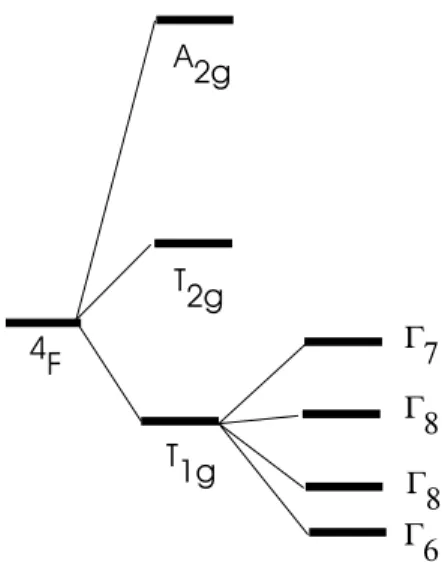
FIG. 1: Energy levels of the ground4F term of a Co2+split by a cubic field and by the spin orbit interaction. The levels are labelled by their symmetry properties.
sets{Q1},{Q2,Q3}and{Q4,Q5,Q6}, and the corresponding Qjtransform respectively like the basis of the irreducible rep-resentationsA1,EandT2of the cubic group, as given in Table II of reference 6.
The4F ground state of isolated Co2+(3d7) in a purely oc-tahedral crystal field splits into two orbital triplets4T1,4T2and one orbital singlet4A2, and from Jahn-Teller’s theorem [7, 8] one would expect that the normal coordinatesQj would take non-zero values to minimize the octahedron energy. This de-formation does not occur, because the spin-orbit interaction stabilizes the average octahedral symmetry, by partially lift-ing the degeneracy of the4T1triplet into oneΓ
6, twoΓ8and oneΓ7subspaces, as shown in figure 1.
[10].
In the lowest order one obtains g from the matrix elements of the Zeeman term in the Γ6 subspace of the 4T1 ground triplet. The matrix elements of the orbital angular momentum
Lwithin aT1subspace are proportional to those of aPterm, but one should note that the excited term4Pis also of the4T1 symmetry, and is mixed by the cubic field with the4T1of the ground4F term. If we indicate two states of4Fand4Pwith
φi andφ′i respectively, such that they transform in the same way under the cubic group, the states of the ground4T1will be of the formaφi+bφ′i. The values of the constantsaand bcan be obtained [1, 11] from the Racah parameterBand the crystal field parameterDq, that take the values 815cm−1and 905cm−1respectively for Co : MgO. With these values one obtainsa=0.9811 andb=−0.1933, and the proportionality constant of the angular momentum is
α=−1.5a2+b2=−1.4063 . (1) Two further effects should be considered in the calculation of the isotropic g tensor. One is the second order contribution of the4T2states, that are separated by∆′from the ground4T1 states, and the other is the covalency between the Co and the neighboring O, described by several factors [1, 10], that re-duce the matrix elements of the orbital angular momentum and of the spin orbit interaction. Using a singlek0for all these factors one obtains the expression for the g factor in a cubic field:
g=5
3ge− 2
3αk0+2
Ã√
15 2 a+b
!2
(k0)2|λ| ∆′ (2)
whereλ=−180cm−1is the Co2+spin-orbit interaction. The expression given in reference [2] for∆′is not correct, and should be calculated as the difference between the level E(4T2)and the ground levelE(4T1). The groundE(4T1)level is the lowest eigenvalue of the matrix
¯ ¯ ¯ ¯
−15B−6Dq 4Dq
4Dq 0
¯ ¯ ¯ ¯
(3) and the coefficients of the corresponding eigenvector give the aandb employed above to calculate the coefficientαof the angular momentum.
The level4T2is given by
E(4T2) =−15B+2Dq, (4) and in the present case, the choice of Dq=905 cm−1 and B=815cm−1givesE(4T2)−E(4T1) =∆′=7953cm−1. To adjust Eq. 2 to the experimental value it is then necessary to usek0=0.86. In summary, the values for Co : MgO are a=0.9811,b=−0.1933,α=−1.4063,∆′=7953cm−1and k0=0.86. This last value seems too small, and one has to consider the dynamic Jahn-Teller effect [12, 13] to obtain a more reasonable value closer to 1.
To simplify the study we present a model that describes all the crystal fields acting on the Co as originating in the crystal field of the six nearest O located at the vertices of a deformed
octahedron, obtained by displacement of the vertices of the regular octahedron introduced at the beginning of this sec-tion. If one neglects the mixing of other configurations into the ground configuration (3d)7, it is sufficient to keep only the part of the crystal fieldV that is even against inversion. We could then writeV =∑7
i=1V(ri), whereV(r)would be the sum of products of only two or four components of the electronic coordinatesr. Within our model, one could then write [4]
V(r) =
∑
j
QjVj(r) (5)
where theQj andVj(r)transform like the same partners of irreducible representations of the octahedral group [6]. As theVj(r)must be even against inversion, theQjmust have the same property, an only the sixQj with j=1,6 discussed at the beginning of this section would appear in Eq. (5). In the following we shall not consider the identical representationA1 because it does not modify the g tensor. The usefulVj(r)are then:
V2(r) =A¡
x2−y2¢
+B¡
x4−y4¢
√
3V3(r) =A¡3z2−r2¢+B¡2z4−x4−y4¢ (6) and
V4(r) =C z y+E¡
z3y−y3z¢
V5(r) =C x z+E¡
x3z−z3x¢
V6(r) =C x y+E¡x3y−y3x¢ . (7) For a point charge model [4], the constants are given by
A=1
4 e ee f f
³
18R−4−75R−6r2´, B=175e ee f f/8R6 C= e ee f f³−6R−4+15R−6r2´, E=−35e ee f f/2R6 (8) whereee f fis an effective charge associated to the O.
The total Hamiltonian of the Co : MgO system can be writ-ten as
HS=H0+HJT=HS0+Hv+HJT (9) whereHv describes the vibrational states of MgO and HJT the Jahn-Teller (JT) interaction, that we shall describe with Eq. (5). The eigenfunctions of the zeroth-order Hamiltonian H0 are products of the electronic functionsΓ6, Γ7, Γ8, and Γ′
! "# $% &
’
())* +
,-./01 2 3 45 67 8 *))9
F E D
$
E
V
R
U
S
W
LR
Q
G
H
U
LY
D
W
LY
H
D
X
0 D J Q H W L F I L H O G P 7
FIG. 2: Three Co+2ESR spectra selected for directions of the mag-netic field that show their properties as described in the text.
of covalency one obtains for the interaction constantsVj in Eq. (5) the valuesVE≡V2=V3=2.04 10−11 cm−1/cmand VT ≡V4=V5=V6=0.34 10−11 cm−1/cm. Without enter-ing into the details of the calculation [1] we can say that the experimental g factorg=4.278 [14] is explained by a JT co-efficientVE =2.40 10−11 cm−1/cmwithin the experimental error of 20% and a covalency factork0=0.96, much closer to one than the k0=0.86 derived in the absence of JT in-teraction. Employing an approximate phonon distribution [1], closer to the experimental one [15] than the single frequencies employed before [12, 13] to treat the JT interaction, it was also possible to describe the experimentally observed [16] Raman spectra of Co : MgO as the electronic Raman spectra of Co2+. We conclude that the JT effect is essential to understand the Co2+ion in a perfect octahedral symmetry.
III. THECo2+IN A DEFORMED OCTAHEDRAL SYMMETRY
Figure 2 shows the ESR spectra of the single crystal sam-ple measured at 4.2 K, for three selected directions of the magnetic field. The local symmetry of the nickel (II) ions is near cubic, and the Electron Spin Resonance (ESR) of im-purity ions substituting Ni in the lattice is a powerful tech-nique to analyze the environment of this ion. The ESR exper-iments make evident the difference between the two magnet-ically non-equivalent Ni sites that are present in the structure of NH4NiPO4.6H2O.
5
H
V
R
Q
D
Q
F
H
I
LH
OG
P
7
FIG. 3: Angular variation of spectra of Co+2in NH4NiPO4.6H2O, in the three experimental planes. The principal directions in these planes are indicated in the figure. The solid lines are the best fit to the Eq. [10], and the fitting parameters are given in Table [I].
The spectra consist of two octets of resonance lines; those octets are due to the allowed transitions for∆Sz =±1,∆Iz =0 corresponding to the hyperfine interaction between the effec-tive spin~S=1/2 of the cobalt and the real nuclear spin (I= 7/2) of59Co (100% abundant).
Figure 3 shows the angular variation of the resonance field of the ESR lines in the (100), (010) and (001) planes. Both the angular variation and its symmetry clearly show two magnet-ically nonequivalent sites related by a C2operation about the c crystal axis, which is the point operation that relates the two centers. The actual spectra show eight well resolved hyperfine lines along some directions for each site; but the reduction of the hyperfine interaction causes the collapse of them in other directions (see Figure 2). The point group symmetry for the Ni2+ion (and the Co2+substituting them) is Cs, and the ap-propriate spin-Hamiltonian for~S= 1/2 and~I= 7/2 is therefore [9]:
ˆ
H=µBH·g1·S1+µBH·g2·S2+S1·A1·I1+S2·A2·I2, (10) whereg1andg2are the gyromagnetic tensors andA1andA2 the hyperfine tensors for each site.His the applied magnetic field, andµBis the Bohr magneton.
As a first approximation, the ESR data were used to cal-culate theg andAtensors by Schonland’s method [17], and the obtained parameters were used as preliminary informa-tion for the subsequent calculainforma-tion.The resonant field for each transition was obtained exactly, within the machine error, by diagonalizing numerically the 16×16 matrix corresponding to each of the sites in Eq. (10), and obtaining the field self con-sistently. These fields were the input to a least squares fitting program, treating theg′sandA′svalues as adjusting parame-ters. All the experimental data of the three planes were fed in the program, and the solid lines in Figure 3 are the best fitting of the data using Eq. (10), and Table I gives the spin-Hamiltonian parameters obtained by this procedure.
cos(θ1) cos(θ2) cos(θ3) g1 4.9091 -0.26072 -0.55762 0.78809 g2 5.1389 0.96461 -0.11704 0.23630 g3 2.6680 -0.03953 0.82180 0.56840
x 10−4cm−1 cos(θ1) cos(θ2) cos(θ3) A1 160.17 -0.20229 -0.58951 0.78202 A2 178.76 0.97741 -0.07163 0.19884 A3 44.37 -0.06120 0.80458 0.59068
TABLE I: Spin-Hamiltonian parameters for Co2+ in NH4NiPO4.6H2O at 4.2 K. The direction cosines are referred to the orthorhombic axesa,b,cof the crystal
Axes a b c
j=x 0.7328 - 0.3099 - 0.6058 j=y -0.00048 0.8900 - 0.4559 j=z 0.6804 0.3344 0.6521
TABLE II: The cosines between the orthorhombic axesa,b,cof the crystal and the new axes j=x,y,z fixed to the octahedron, as discussed in the text.
the Nickel compound [18], and taking the average of their po-sitions as the center of the octahedron, we choose two of the O and use them to determine an orthogonal system of axis. In the new system thexaxis goes through the position of one of those two O, and thezaxis is perpendicular to the plane de-termined by the two O and the center of the octahedron. The direction cosines of these axes with respect to the orthorhom-bic axis of the crystal are given in Table II. The average dis-tance of the six O with respect to the origin of the new axes is R=2.0531 ¯A, and we can define a regular octahedron with the six vertices placed along the axes at a distance±Rfrom the origin.
To analyze further the experimental g tensor, one could try and find crystal field values that would reproduce the measured results, and a study of this type was presented by Abragam and Pryce for the Cobalt Tutton salts [19]. To sim-plify the study we present a model that describes all the crystal fields acting on the Co as originating in the crystal field of the six nearest O located at the vertices of a deformed octahedron, obtained by displacement of the vertices of the regular octahe-dron introduced at the beginning of this section. To organize the study, we employ Eq. (5) to express the crystal field as a function of the normal coordinatesQjof the octahedron.
We shall use second order perturbation theory, using both V(r)and the Zeeman termHZ= (geS+L).Has perturbation. The change in the g tensor is then obtained from
S.δg.H=2
3 (ge+α) µB
∆ −CE
h√
3Q2(SxHx−SyHy) +
Q3(3SzHz−S•H)] +CT[Q4(SzHy+SyHz) +
Q5(SxHz+SzHx) +Q6(SxHy+SyHx)], (11) whereµBis the Bohr magneton and∆is the splitting between theΓ6doublet and the lowestΓ8quadruplet in the octahedral
symmetry, given by[20]
∆=1.5¡
−1.5a2+b2¢
k0λ−33 20
Ã√
15 2 a+b
!2
k20 λ 2
∆′ . (12) The constantsCE andCT can be obtained by calculating a single matrix element in each case:
CE=−1 2
*
T1z
¯ ¯ ¯ ¯ ¯
∑
jV3(rj)
¯ ¯ ¯ ¯ ¯
T1z
+
(13)
and
CT=
*
T1x
¯ ¯ ¯ ¯ ¯
∑
jV3(rj)
¯ ¯ ¯ ¯ ¯
T1y
+
, (14)
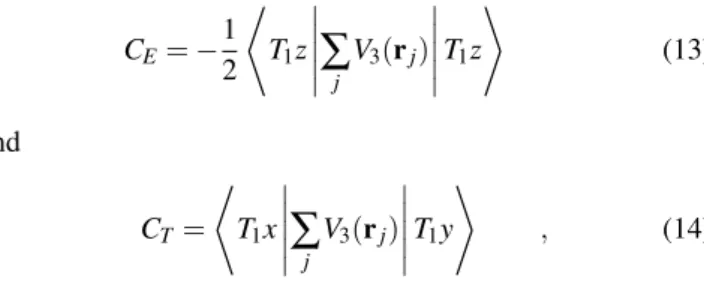
where the{|T1xi,|T1yi,|T1zi}are a basis of the ground 4T1 that transforms like the coordinates{x,y,z}under the octahe-dral group.
The expression in Eq. (11) corresponds to deformations from a cubic environment, and one should then compare this formula with the experimental g tensor in the axis of the regu-lar octahedron defined in Table II, which is given in Table IV, but it is first necessary to determineCEandCT. One obtains with Eqs. (5-8)
CE=e ee f f
R2
¡
1.4846−1.7815a2+1.7815a b
−0.4454b2¢<r 2>
R2 +
¡
−0.1718+0.6873 a2−
¡
0.6873 a b+0.1718b2¢<r 4>
R4
¾
(15)
and CT=e ee f f
R2
½ ¡
0.0857 a2−1.3714 a b+1.2 b2¢<r
2>
R2 +
¡
−0.7143a2−0.2381 a b¢<r
4>
R4
¾
. (16)
The averages <r2>=1.251 and <r4>=3.655 (atomic units) have been calculated with Hartree Fock functions [11], but we can obtainee f f<r4>from the cubic field parameter Dqemploying the relation
Dq=−1 6
e ee f f R
<r4>
R4 (17)
Q2 Q3 Q4 Q5 Q6 1−0.03840 0.02497 0.01417 0.06542 −0.01275 2 0.01092 0.00305 0.16028 −0.22616 −0.14710 3 1.60 845. 2.04 1.77 1.99
TABLE III: The symmetrical normal coordinates of the complex formed by the Co and the six O with respect to the regular octahe-dron defined in the text. Row 1 gives the values calculated from the O positions determined crystallographically. Row 2 gives the values that would reproduce the experimental g tensor for the point charge model. Row 3 gives a number proportional to the ratio of the normal coordinates obtained from the g tensor divided into those obtained from the A tensor.
Axes gj,x gj,y gj,z
j=x -0.1306 0.6354 0.9769 j=y 0.6354 0.1809 -0.6923 j=z 0.9769 -0.6923 -0.0503
TABLE IV: The components of the experimental g tensor, referred to the octahedron axes j=x,y,z, after substraction of the isotropic tensor g=4.2387.
CT =−3932cm−1/A˚. The difference is not critical, and we shall use the Ni values in the remaining of the discussion.
It is now possible to compare Eq. (11) with Table IV, and one immediately obtains values of the normal coordinates that would reproduce the experimental g tensor when substituted in that equation. These values are given in the second line of Table III, and it is clear that they are rather different from the values calculated from the crystallographic position of the O in the Ni compound. There are two alternative explanations for this result: either the O around the Co impurity are in dif-ferent positions than in the Ni compound, or the model is not adequate. In the absence of experimental evidence to check the first alternative, we shall discuss possible modification to the model employed above. Instead of the point charge model we could use a model with dipoles, all “directed away from the central ion”[4]. This model gives the same potential of Eqs. (5-7) but with different expression for the constantsA,B,C,E. Within each irreducible representationsEandT2, the normal coordinates necessary to reproduce the g tensor would then be proportional to those obtained with the point charge model, as only the values ofCEandCT would change in this model, so that both the charge and dipole models would give essentially the same results. A more complicated model, either involving the change in the direction of the dipoles, or even consider-ing the extended charges of the ligands, would increase very much the difficulty of the calculation. We should then remain with the point charge model, but only as a means to obtain a fairly simple crystal field that would be sufficient to explain the experimental g tensor. This crystal field is theV(r)of Eq. (5) given in the axes of the regular octahedron defined in Table II with theQj given in the second row of Table III. The agreement is perfect because there are as many free nor-mal coordinates asδgcomponents, but the point charge model employed should not be taken too seriously.
Although we have not analyzed the hyperfine tensor in de-tail, we can extract some information from its experimental
Axes Aj,x Aj,y Aj,z
j=x - 970. 3200. 5510. j=y 3200. 970. - 3390. j=z 5510. - 3390. 0.
TABLE V: The components of the experimental A tensor (given in cm−1), referred to the octahedron axes j=x,y,z, after substraction of the isotropic tensorA=12780cm−1.
value. As seen from Table I, the principal axes of the two tensors g and A do not exactly coincide, but are fairly close together. As with the g tensor, we have expressed theδA ten-sor in the axes of the regular octahedron discussed above, and the corresponding values are given in Table V. One can show [21] that theδAis described by an expression similar to that of theδg(cf. Eq. (11)) with the component ofItaking the place of the components ofH, but we have not explicitly calculated the coefficients equivalent to theCE andCT. Nevertheless, by the same method employed with the g tensor one can ob-tain quantitiesQ′j proportional theQj, and then calculate the ratio of theQjgiven in the second row of Table III to the cor-respondingQ′j obtained from the A tensor. These ratios are given in the third row of Table III, and those corresponding to Qj of the same irreducible representation should be equal if the theory were strictly true. The enormous value of the ratio corresponding toQ3is not significant, because the value de-rived from the A tensor is zero within the experimental error, and one can therefore not draw any conclusions from the pair {Q2,Q3}. On the other hand, the three ratios corresponding to {Q4,Q5,Q6}are fairly close to the same value, and they show that the crystal fields that result from the present treatment are fairly consistent with the available experimental results.
In the present calculation we have neglected the effect of the4T2triplet, that contributes to δgin third order perturba-tion (our calculaperturba-tion would be of the second order).This effect was calculated by Tucker[11] who obtained contributions that are about 6% of the second order contribution for theT2 de-formation and about 13% for theE deformation, and would therefore not alter substantially our conclusions.
A similar treatment of the Co2+ in sites with deformed octahedral symmetry of Co2(OH)PO4or Co2(OH)AsO4has been considered in [3], but it is less interesting because only the powder samples of these compounds have been measured. The treatment of this problem shall not be further discussed in the present work.
We conclude that employing the normal modes of the seven ion complex to adjust the values of the g-factor tensor, it is possible to estimate the crystal fields of the whole crystal act-ing on the Co2+impurity ion.
IV. THECo2+IN A DEFORMED TRIGONAL BIPYRAMID
dif-ferent magnetic properties could be expected when magnetic cations are employed. The recently synthesized compounds Zn2(OH)PO4 [24], Co2(OH)PO4 [24], Mg2(OH)AsO4 [25, 26], as well as the natural Co2(OH)AsO4[27], present these two type of sites. We have then found interesting to study the properties of the Co2+ions as impurities in the two non-magnetic compounds, as a first step in the understanding of the properties of the concentrated compounds.
To analyze the ESR measurements it is necessary to have information about the splitting of the energy levels with both the crystal field and the electronic Coulomb repulsion, and we obtained this information from optical diffuse reflectance measurements [28].
The experimental ESR powder spectra of Co2+impurities in both Zn2(OH)PO4and Mg2(OH)AsO4present two differ-ent sets of lines, one very intense, and the other just observ-able. The average of the g factors of the intense spectra is 4.15 in the two compounds, a value close to the 4.33 expected for Co2+in moderately distorted octahedral symmetry [29], and it seems reasonable to assign these spectra to that environment and apply the same approach employed in the previous section in the study of the ESR of Co2+in NH4NiPO4.6H2O (see also [2]). The remaining lines are very weak and we assign them to the penta-coordinated symmetry (the possible reason for their small intensity has been discussed in [3]).
Here we shall only briefly consider the deformed octahe-dral symmetry, and give more details of the theory describing the ESR of Co2+ in the penta-coordinated environment, that was partially discussed in [3]. This last complex is a distorted trigonal bipyramid, and we first calculated the crystal fields of the perfect trigonal bipyramid following the existing liter-ature [30, 31]. To analyze the distorted complex we derived the normal modes of the trigonal bipyramid with respect to the reference complex, and then obtained the Jahn-Teller con-tributions [7, 8] to the crystal field acting on the Co2+, that is generated by these modes.
In this calculation we have introduced a procedure that uniquely defines the orientation and size of the two reference complexes, so that the normal modes that describe their defor-mation are free from irrelevant rotations and expansions.
These results were then employed to analise the theoreti-cal ESR spectra. We found that for the system parameters obtained from the optical spectra we should expect that the ground doublet beMJ=±1/2, corresponding to an allowed spectrum. The rather small intensity, of this type of spectra seems to indicate a preference of Co2+for the octahedral sites in the crystal structure, a conjecture that was advanced in a preliminary report [32] on the ESR of impurities of this ion in Mg2(OH)AsO4, and was confirmed in [3]. Employing a molecular calculation we have verified in the last reference that the formation energies of the two type of complexes, with both Co and Zn as the central ions, are compatible with this hypothesis.
4T
1g→ 4T2g 4A2g 4T1g(P) B Dq
PO4 a) 8450 15450 18350
b) 7819 16013 18324 767.6 819.4 AsO4
a) 7700 15500 18020
b) 7616 15585 18011 758.9 796.9
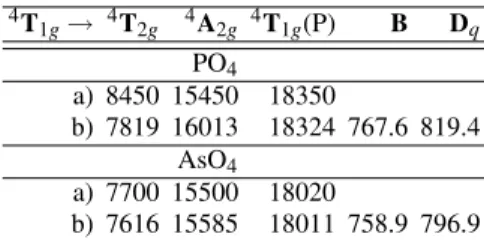
TABLE VI: a) The transitions between the ground4T1g level and
the levels shown at the top of each column, in cm−1 and as-signed from the experimental spectra of the octahedral complexes of Co2(OH)PO4and Co2(OH)AsO4; the level4T1g(P)corresponds
to the highest of the same symmetry. b) The best fit, obtained with theBandDqshown in the last two columns.
4A′
2→ 4A′′1,4A′′2 4E′′ 4E′ 4A′2(P) 4E′′(P) PO4
a) 6400 7000 11100 15800 19600 b) 3233 4835 12868 17386 17947 c) 1511 3603 11106 15801 19604
AsO4
a) 5000 6250 10870 16000 19800 b) 2707 4440 12210 17188 18595 c) 1437 3535 10876 15999 19805
TABLE VII: a) The transitions between the ground level4A′′1and the levels shown at the top of each column, given in cm−1and assigned from the experimental spectra of the penta-coordinated complexes of Co2(OH)PO4and Co2(OH)AsO4. b) The best possible fit to the five transitions. c) The best fit obtained by adjusting only the three transitions of higher energy. The corresponding values ofB,Ds,Dt
are given in rows b) and c) of table XV.
A. Optical studies.
The necessary optical data was obtained from diffuse re-flectance experiments in the 5000 – 50000 cm−1wavenumber region [3, 28, 33]. The whole of the optical data used in this work was recorded at room temperatures, and all the relevant data that was necessary in the present work is in the tables VI and VII. The system parameters of the octahedral complexes are slightly different from those already published [28, 33], because they were obtained from the optical spectra after in-cluding a spin orbit correction in the ground orbital level [34].
B. Electron Spin Resonance (ESR).
200 220 240 260
0 100 200 300 400 500
(c)
2.0 3.2
8.0
g = 2.03 4.55
5.89
(b)
(a)
B(mT)
d
χ
"/
d
H
(a
rb
.
u
n
it
s
)
Zn2(OH)PO4:Co (0.1%)
FIG. 4: ESR spectra of Co2+ in Zn2(OH)PO4. a) Experimental spectrum. b) Sum of the simulated spectrum for both the hexa-coordinated and penta-hexa-coordinated complexes. c) Simulated spec-trum for the hexa-coordinated complex. The g-values of both the octahedral and of the pencoordinated complexes are given in ta-ble VIII. The arrows in c) show the g-values and their positions for the octahedral complex, while those in a) correspond to the penta-coordinated complex. The insert gives the detail of the experimental hyperfine structure and of the simulated one (aroundg2), attributed to the Co2+in the triangular bipyramid.
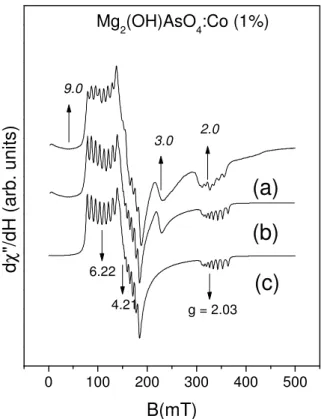
defined hyperfine structure that identifies the Co2+ion. There are also some extra lines, rather weak in the phosphate but more intense in the arsenate, that preclude an automatic fitting of the spectra, and the powder spectra of the hexa-coordinated Co2+were simulated with a more flexible program. The best results, plotted in the curves (c) of Figs. 4 and 5, correspond to the g-values shown in rows a) of table VIII Their values and positions are also shown by arrows below the simulated curves (c). The extra lines near 200 mT in the phosphate show an hyperfine structure typical of the Co2+, and are given in more detail in the inset of Fig. 4. The remaining lines in the two compounds are rather broad and show a collapsed hyperfine structure. The curves (b) in the Figs. 4 and 5 show the sum of the simulated spectra of the hexa-coordinated Co2+in (c), plus a simulation of the penta-coordinated Co2+that employs theg- values given in rows b) of table VIII and is adequately renormalized to account for the smaller relative concentration of the last compound. Thesegvalues have rather large errors, and their positions are shown by arrows above the measured spectra (a) of Figs. 4 and 5. In the inset of Fig. 4 it is also shown the detail of the hyperfine structure near 200 mT both in the experimental and in the simulated spectrum.
0 100 200 300 400 500
(c)
9.0
3.0 2.0
6.22
4.21 g = 2.03
Mg
2(OH)AsO
4:Co (1%)
(b)
(a)
d
χ
"/
d
H
(
a
rb
.
u
n
it
s
)
B(mT)
FIG. 5: ESR spectra of Co2+inMg2(OH)AsO4. Curves a), b), and c), and the meaning of the arrows and values in curves a) and c) are the same as in figure 4.
g1 g2 g3 A1 A2 A3
PO4
a 5.89±0.02 4.55±0.05 2.02±0.02 240±5 155±8 85±3 b 8.±0.5 3.2±0.3 2.0±0.2
AsO4
a 6.22±0.02 4.21±0.05 2.05±0.02 140±5 120±7 55±5 b 9.±1.5 3.±0.5 2.0±0.2
TABLE VIII: Values of the principal g and A parameters, obtained from the spectra in Figs. 4 and 5. The values of the A parameters are in 10−4cm−1units. a) Octahedral complex: thegandAvalues were obtained from a program simulating powder spectra, as described in the text. b) The parameters for the penta-coordinated Co2+, also estimated by simulation.
C. Hexa-coordinated Co
We shall briefly discuss the hexa-coordinated Co2+ions in Zn2(OH)PO4 and Mg2(OH)AsO4 following the same treat-ment employed in Section III. The Co2+is surrounded by six oxygens in a fairly regular octahedron with positions given in table IX, and only powder spectra were available. The three principal valuesgi of theg tensor could be measured, but without all the details obtained for the NH4NiPO4.6H2O compound (see table VIII).
n a( ˚A) b( ˚A) c( ˚A) a( ˚A) b( ˚A) c( ˚A)
PO4 AsO4
1 4.7150−1.2420 0.0000 0.9197 −1.0794 0.0000 2 4.9627−1.0327 2.9700 0.6438 −1.2633 3.0255 3 2.1592−1.2713 1.7274 −1.9091 −1.1662 1.3476 4 3.0793 1.0327 2.9700 −0.6438 1.2633 3.0255 5 3.3270 1.2420 0.0000 −0.9197 1.0794 0.0000 6 5.8827 1.2713 1.7274 1.9091 1.1662 1.3476 7 4.0210 0.0000 1.5135 0.0000 0.0000 1.4910
TABLE IX: The columnsa,b,cgive the position of the six oxygens (n=1,...,6) and Cobalt (n=7) in the hexa-coordinated complexes of Co2(OH)PO4and Co2(OH)AsO4with respect to the three unit cell axes.The X,Y,Z axes roughly correspond to n=1,2,3 respectively, tak-ing n=7 as the origin.
Q2/R Q3/R Q4/R Q5/R Q6/R PO4
a) 0 −0.04407 0.03478 0.03478 0.11425 b) 0 −0.11683 −0.01717−0.01717 −0.05641
AsO4
a) 0 −0.0441 0.04032 0.04032 0.09989 b) 0 −0.09328 −0.02818−0.02818 −0.06982 TABLE X: Normal modes of the octahedral Co divided by the Co-O distanceRin Co:Zn2(OH)PO4 and Co:Mg2(OH)AsO4. a) Values that adjust the experimental values of the g tensor. b) Values ob-tained from the crystallographic positions corresponding to the pure compounds.
gyromagnetic tensorg. This method systematizes the proce-dure, and in table X we give the normal modes that reproduce the experimental values of the threegi. We shall then choose a reference perfect octahedron centered in the Co2+, calcu-late the normal modes corresponding to the crystallographic positions of the O, and compare them in table X with those obtained from the experimental spectra.
The average values of g are 4.1537 for Co:Zn2(OH)PO4 and 4.153 for Co:Mg2(OH)AsO4, and to analise these results it is sufficient to consider the Co2+in pure octahedral sym-metry, because the crystal fields of lower symmetry do not change this value in our approximation. The calculation fol-lows the same lines given in reference[2] and shall not be re-peated here.
The values of the constantsa andb that give the mixture of the ground4F with the lowest4Pcan be obtained as be-fore from the Racah parameterB and the crystal field para-meter Dq, that were estimated [34] from the spectroscopic
X Y Z X Y Z
PO4 AsO4
a 0.4054 −0.5794 −0.7071 0.3800 −0.5963 −0.7071 b 0.4054 −0.5794 0.7071 0.3800 −0.5963 0.7071 c −0.8194 −0.5733 0.0000 −0.8434−0.5373 0.0000 TABLE XI: Direction cosines of the three axisX,Y,Zof the reference perfect octahedron of Co2(OH)PO4and Co2(OH)AsO4with respect to the three crystallographic axisa, b, c
data and are given in table VI. With these values one ob-tainsa=−0.9820 andb=0.1886 for the phosphate, and the proportionality constant of the angular momentum is then
α=−1.5a2+b2=−1.4110. (18) As discussed in Section III we use Eq. (11) to relate the changeδg in the g tensor with the normal modesQj of the complex of Co2+with the six neighboring O, employing
∆=283 cm−1 as the splitting between the Γ6 doublet and the lowestΓ8quadruplet in the octahedral symmetry in the P compound.
The values ofCE andCT are obtained by the same pro-cedure employed in Section III. For the Co-O distance R we used R=2.11176 ˚A, corresponding to the reference octahedron defined below, and we found the values CE =
6436 cm−1/A and˚ CT =−3666 cm−1/A. We can now cal-˚ culate the crystal fields that would describe the experimen-tal values ofgor, what is equivalent, the corresponding nor-mal modes within the approximations just discussed. As there are more normal modes than data, we fix the relations Q4=Q3=0.3044Q6, which correspond to the normal modes calculated below from the crystallographic positions, and we obtain a perfect fit to the experimental values employing the normal modes given table X.
From table VI we obtain the coefficients a =−0.9824, b=0.1867, andα=−1.4128 for Co2(OH)AsO4. The ESR data was then adjusted with the normal modes coordinates given in table X, where we usedR=2.1224 ˚A,Q4=Q3=
0.4037Q6,CE =6287 cm−1/A,˚ CT =−3558 cm−1/A and˚ ∆=282 cm−1, for this compound.
particular, although the crystal field theory of point charges gives the right symmetry properties, it is only a very rough description of the physics of the problem, but the crystal field V(r)obtained give a much better description of the system than the model employed.
Although we have not analyzed the hyperfine tensor in de-tail, we have verified that its components are compatible with the normal modes necessary to describe theδgtensor.
In the present calculation we have neglected the effect of the4T2triplet, that contributes toδgin third order perturbation (our calculation is of the second order). This effect was calcu-lated by Tucker[11] who obtained contributions that are about 6% of the second order contribution for the T2 deformation and about 13% for the E deformation, and would therefore not alter substantially our conclusions.
D. Penta-coordinated Co
1. The crystal field of the trigonal bipyramid.
The structure of the penta-coordinated complex of Co2+is very close to a trigonal bipyramid, and the positions of the Co and of the five O are given with respect to the crystal axes in table XII. Following a method similar to that employed in the octahedral case we chose an orthogonal system of axes X,Y,Z, such that the normal modes obtained from the crystallographic positions would not have contributions of irrelevant rotations and expansions. The direction cosines of the axes of this sys-tem with respect to the crystal axesa,bandcare given in table XIII, and the coordinates of the six atoms in the reference per-fect trigonal bipyramid are given in table XIV. There are two different Co-O distances in the reference complex: Ra corre-sponds to the three ligands in the XY plane (equatorial O) and Rc to the two along the Z axis (axial O); their values for the phosphate and arsenate are given in the caption of table XIV. Two crystal field parametersDs andDt are necessary in the trigonal bipyramid, and are given in the point charge model [30, 35] by:
Ds= e
14
·
4qc R3 c
−3qa R3
a
¸
hr2i,
Dt= e
168
·
16qc R5
c
+9qa
R5 a
¸
hr4i, (19)
where we shall useqa=qc=−2e. The crystal field potential Vc fcan be expressed by the usual formula
Vc f(r) =
∑
kq
r
4π 2k+1
∑
ℓ qℓrk
ℓ<
rk+1ℓ> Y
∗
kq(θℓ,ϕℓ)C(k)q (θ,ϕ), (20)
whereYkq(θℓ,ϕℓ)are the spherical harmonics at the position
of theℓ-th ligand and theCq(k)(θ,ϕ) =p4π/(2k+1)Ykq(θ,ϕ) are usually called the Racah’s rationalized spherical harmon-ics. In our actual calculation we have employed the real combinations Clm(θ,ϕ) and Slm(θ,ϕ) that are proportional
n a( ˚A) b( ˚A) c( ˚A) a( ˚A) b( ˚A) c( ˚A)
PO4 AsO4
1 4.9008 3.2438 2.9700 4.9744 0.9132 3.0180 2 1.8617 2.9132 1.2426 1.9003 1.1604 1.3442 3 1.8617 2.9132 4.6974 1.9003 1.1604 4.6676 4 3.1412 5.1252 2.9700 3.2085 3.2015 3.0180 5 3.0793 1.0327 2.9700 3.2736 -0.9132 3.0180 6 2.9102 3.0621 2.9700 3.0056 1.1561 3.0180
TABLE XII: The columnsa,b,cgive the position of the five oxygens (n=1,...,5) and Cobalt (n=6) in the penta-coordinated complexes of Co2(OH)PO4and Co2(OH)AsO4with respect to the three unit cell axes.
X Y Z X Y Z
PO4 AsO4
a 0. 0. 1. -0.00203 0. 0.999998 b 0.99931 0.03720 0. 0.999698 −0.02449 0.00203 c −0.03720 0.99931 0. 0.02449 0.9997 0.00005 TABLE XIII: Direction cosines of the three axisX,Y,Zemployed to define the reference perfect trigonal bipyramid of Co2(OH)PO4and Co2(OH)AsO4with respect to the three crystallographic axisa, b, c
to cos(m,ϕ) and sen(m,ϕ) respectively [36]. In the ab-sence of the spin-orbit interactions one employs the irre-ducible representations Γof the trigonal bipyramid to clas-sify the eigenstates|α,S,L,Γ,γ,aiof the Hamiltonian, which are simply related to the states |α,S,L,MLi (the index α identifies the particular states with the same S,L). In ta-ble I of reference 30 we find that the irreducita-ble representa-tionsA′2, A′′1,A′′2, E′ andE′′ are contained in the two terms 4F and4P, and that the|α,S,L,MListates that generate the corresponding subspaces are {|3,3/2,3,0i,|3,3/2,1,0i}→ A′2, {|3,3/2,3,±3i}→ (A′′1, A′′2), {|3,3/2,3,±2i}→E′ and {|3,3/2,3,±1i,|3,3/2,1,±1i}→ E′′. The Hamiltonian without spin orbit interaction is diagonal in the partners γ of each irreducible representation Γ and in the spin com-ponent MS, so it is not necessary to write them explicitly here. The onlyC(k)q (θ,ϕ) that contribute to Eq.(20) in the perfect trigonal bipyramid havek=0,2,4 andq=0. To cal-culate the matrix elements of the Hamiltonian that contains VCF=∑i=1,7Vc f(ri),we have used the standard tensorial op-erator techniques [37] as well as the unitary opop-erators obtained form Nielsen and Koster’s tables [37, 38], and we have veri-fied that our matrix coincides with that given in table II or reference 30.
n X Y Z
1 0 Ra 0
2 −√3
2 Ra −12Ra 0 3
√ 3
2 Ra 12Ra 0
4 0 0 Rc
5 0 0 −Rc
6 0 0 0
TABLE XIV: The columns X,Y,Z give the position of the five oxy-gens (n=1,...,5) and Cobalt (n=6) in the reference perfect penta-coordinated complexes of Co2(OH)PO4[Ra=2.01622 ˚A andRc=
2.04365 ˚A],and Co2(OH)AsO4[Ra=1.98578 ˚A andRc=2.05596
˚
A] with respect to the axes defined in table XIII
B Ds Dt B Ds Dt
PO4 AsO4
b 728. 165. 947. 785. 313 919. c 852. 745. 885. 875. 749. 869.
TABLE XV: The values ofB,Ds,Dtin cm−1that fit the optical
tran-sitions, given in table VII, of the two penta-coordinated complexes. The best fit to the five transitions is given in row b), and the best fit to the three highest transitions in row c). The spin orbit parameter ζ=580 cm−1was used in all these fittings
ofB,DsandDtthat minimize the mean square deviationχfor the two systems, and we give them in row b) of table XV. The transitions calculated with these two sets of values are given in the two rows of table VII that are labelled b). The fitting is rather poor, and in particular the transitions to the levels4A′′
1, 4A′′
2and4E′′fall below the range of the measuring equipment. As an alternative we have fitted only the three highest transi-tions, obtaining the values given in row c) of table XV, and the corresponding values calculated with these two sets of para-meters are given in the two rows of table VII that are labelled c). In the following section we shall consider these two sets of values to estimate the gyromagnetic factors for each of the two compounds.
2. The spin-orbit interaction in the trigonal bipyramid.
It is now essential to include the spin orbit interaction into the calculation. The basis of the irreducible represen-tationsΓ7, Γ8andΓ9, of the double group D∗3hhave a sim-ple expression in our system (cf. reference [31]): they are given by ¯¯d7αSLJMJ
®
, and in particular we have Γ7(a)≡
©¯
¯d7αSLJ±1/2 ®ª
, Γ7(b)≡©¯¯d7αSLJ±11/2 ®ª
, Γ8(a)≡
©¯
¯d7αSLJ±5/2 ®ª
, Γ8(b) ≡ ©¯¯d7αSLJ±7/2 ®ª
, Γ9(a) ≡
©¯
¯d7αSLJ±3/2 ®ª
andΓ9(b)≡©¯¯d7αSLJ±9/2 ®ª
. These states are easily obtained from the ¯¯d7,α,S,MS,L,ML
®
cal-culated above by employing the 3-j or the Clebsch Gordan coefficients. In the absence of magnetic fields the two states of each Kramer’s doublet have the same energy, and to cal-culate the energies of the system it is enough to consider only the states with positiveMJ. As only the mixture of the 4F and4P states is important in our problem we shall
con-sider only that subspace, and the corresponding matrix of the total Hamiltonian splits into five boxes of the following di-mensions: (MJ=1/2)→Γ7(a)→(7×7), (MJ =3/2)→ Γ9(a)→(6×6), (MJ =5/2)→Γ8(a)→(4×4), (MJ = 7/2)→Γ8(b)→(2×2),(MJ=9/2)→Γ9(b)→(1×1), and there are no matrix elements ofMJ=11/2, i.e.Γ7(b), within the subspace{4F,4P}ofd7that corresponds toS=3/2. The matrices we have obtained coincide with those given in table II of reference 31, and their eigenvalues have been calculated for the different sets of B, Ds andDt values that were ob-tained above, employing the one-electron spin-orbit parame-terζ=580 cm−1. For all the set of parameters in table XV the lowest doublet is aΓ7(a)(MJ=±1/2), separated by at least 75 cm−1from the followingΓ9(a)(MJ=3/2) doublet, and by more than 2377 cm−1 from the remaining doublets. This situation is not altered by making fairly large changes in the three basic parametersB, Ds andDt, and shows that even for moderate increases in the temperature only the low-est doublet (MJ=±1/2) would be occupied. This doublet has allowed ESR transitions, and should be observed within the approximation employed. If the position of the two low-est doublets were exchanged, the ESR transitions of the lowlow-est doublet would be forbidden and the spectra should not be then observed.
The fact that the two lowest doublets haveMJ=±1/2 and MJ=±3/2 and are separated by a large energy from the re-maining doublets is easily understood when we notice that the lowest level in the absence of spin-orbit interaction is4A′
2. The orbital partA′2is a singlet with no orbital angular momentum, and the totalJwould then correspond to theS=3/2. These four states would be rather far apart from the remaining ones, and would split in the way calculated above through the higher order spin orbit mixing with those excited states.
The present calculation was for a perfect trigonal bipyra-mid withD3hsymmetry, and one wonders whether the defor-mations with respect to this structure could alter the relative position of the two lowest doublets, thus changing from an allowed to a forbidden ESR transition. We shall then study the effect of these deformations, both on the relative position of the two lowest doublets and on the value of the gyromag-netic tensor. In this study we shall follow a treatment similar to that employed in the octahedral case, by considering the effect of the normal modes of the trigonal bipyramid on the Hamiltonian of the penta-coordinated Co2+.
3. The normal modes of the trigonal bipyramid
As in the octahedral case we are interested in a contribution to the Hamiltonian of the same type of Eq. (5), but here the normal modesQj andVj(r)transform like the same partners of irreducible representations of the trigonal bipyramid. As the undistorted complex does not have a center of symmetry, both the even an odd modes against reflection in the equatorial plane may have non-zero matrix elements inside the configu-rationd7 of Co2+, and therefore we shall need to consider both types of normal modes in our discussion.
re-Qj x1 y1 z1 x2 y2 z2 x3 y3 z3 x4 y4 z4 x5 y5 z5
2√3Q1 -2 0 0 1 √
3 0 1 -√3 0 0 0 0 0 0 0 2√3Q2 0 2 0
√
3 -1 0 -√3 -1 0 0 0 0 0 0 0 √
2Q3 0 0 0 0 0 0 0 0 0 1 0 0 1 0 0 √
2Q4 0 0 0 0 0 0 0 0 0 0 1 0 0 1 0 √
3Q5 1 0 0 1 0 0 1 0 0 0 0 0 0 0 0 √
3Q6 0 1 0 0 1 0 0 1 0 0 0 0 0 0 0 √
3Q7 0 0 1 0 0 1 0 0 1 0 0 0 0 0 0 √
2Q8 0 0 0 0 0 0 0 0 0 0 0 1 0 0 1 √
2Q9 0 0 0 0 0 0 0 0 0 0 -1 0 0 1 0 √
2Q10 0 0 0 0 0 0 0 0 0 1 0 0 -1 0 0
TABLE XVI: The six even (1-6) and four odd (7-10) normal modes E′that are relevant to our problem. The numbers are the coefficients of the departuresuj={xj,yj,zj}of the j=th ion from their
equilib-rium position.
ducible representationΓof theD3hgroup, that can be reduced as follows:Γ=2A′1+A′2+4E′+3A′′2+2E′′(see e.g. the Eq. (9.19) in reference [39]). Of these irreducible representations, theA′2corresponds to an axial rotation, oneE′′to two equato-rial rotations, oneA′′2to an axial translation and oneE′to two equatorial translations. After eliminating these three trans-lations and rotations we are left with three even irreducible representationsE′, as well as twoA′′2 and oneE′′ odd repre-sentations. The six even normal modes (Q1, ...,Q6) transform in pairs like the partners ofE′; they have been obtained em-ploying standard techniques[39, 40] and are defined in table XVI. In the same way the two modesA′′2(Q7,Q8) and the two partners ofE′′((Q9,Q10) have been obtained, and are defined in the same table.
The modesQ3,Q4, andQ8are translations of only the two axial oxygens, and theQ5,Q6, andQ7are translations of only the three equatorial oxygens whileQ9andQ10 are rotations along the x andyaxis of the two axial oxygens. As these modes are only partial rotations or translations they are capa-ble of changing the crystal field. Thexandyrotations of the three equatorial oxygens can be combined withQ9andQ10 to give full rotations of the trigonal bipyramid, and thez rota-tion of the three equatorial oxygens is already a full rotarota-tion, so these three sets of displacements would not appear in our calculation.
From tables XII, XIII, and XIV we can calculate the dis-placementsujof the five O with respect to their positions in the reference trigonal bipyramid (cf. section IV D 1) and cal-culate the corresponding normal modesQj defined in table XVI. Employing theseQj we calculate in the next two sec-tions the g values of the distorted complex.
4. The effect of the normal modes on the crystal field
We can now try and find an expression similar to Eq. (5) for the trigonal bipyramid. To this purpose we have employed a relation equivalent to Eq. (20) to calculate, for each of the ten normal modesQj given in table XVI, the change in the crystal fieldVc f(r)when all the ligands are displaced from their equilibrium position in the reference complex by a small
ML ML′ h4F,MS,ML|VCF′ |4F,MS,ML′ >i
−3 −2 −(3c2+10c4)Q∗e/
¡
7√3¢
−3 −1 (6c2Qa−15c4Qb)/(56
√ 5)
-3 0 √15c4Qd/4
-3 1 -√5c4Q∗c/16
-2 −1 -(9c2−40c4)Q∗e/
³
21√5´ -2 0 (12c2Qa+5c4Qb)/(56
√ 10)
-2 1 √5c4Qd/
³
2√6´ -2 2 -5c4Q∗c/(16
√ 3)
-1 0 -√2(3c2−25c4)Q∗e/
¡
35√3¢
-1 1 (18c2Qa+25c4Qb)/(140
√ 3)
-1 2 -√5c4Qd/
³
2√6´ -1 3 -√5c4Q∗c/16
0 1 √2(3c2−25c4)Q∗e/¡
35√3¢
0 2 (12c2Qa+5c4Qb)/(56
√ 10)
0 3 -√15c4Qd/4
1 2 (9c2−40c4)Q∗e/³21√5´ 1 3 (6c2Qa−15c4Qb)/(56
√ 5)
2 3 (3c2+10c4)Q∗e/¡
7√3¢
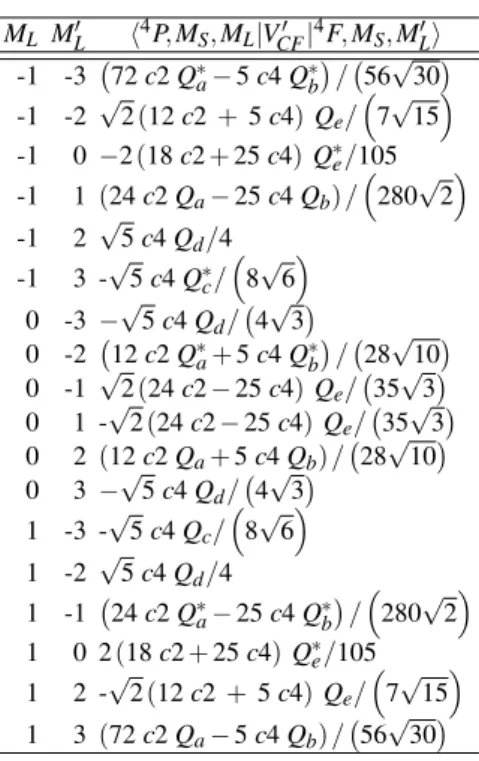
TABLE XVII: The non-zero matrix elements of the crystal field VCF′ =∑jQjVj(r)generated by the normal modesQ1, ...,Q10 be-tween states|α,S,MS,L,MLi=
¯
¯4FMSML
®
in the subspace4Fx4F. Only the elements corresponding to the upper triangle of the matrix are given, and the remaining ones are obtained by Hermitian con-jugation. The matrix is independent of, and diagonal in, the spin componentsMS. To compress the table we have used the
follow-ing abbreviations: Qa= (Q2+iQ1) +5(Q6+iQ5), Qb=3(Q2+ iQ1) +7(Q6+iQ5),Qc=9(Q2+iQ1) + (Q6+iQ5), (even modes) andQd=iQ7,Qe= (iQ9+Q10)(odd modes), as well as their com-plex conjugatesQ∗a,Q∗b,Q∗c,Q∗dandQ∗e
ML ML′ h4P,MS,ML|VCF′ |4P,MS,ML′ >i
-1 0 3c2Q∗e/5 -1 1 -3√3c2Qa/20
0 1 -3c2Q∗e/5
TABLE XVIII: Same as in table XVII but for the sub-matrix4Px 4P. The same abbreviations are used here.
fractionεof that particular normal modeQj. Expanding this change ofVc f(r)in a power series of the coefficientεand tak-ing the linear terms inεgives the correspondingVj(r)from Eq. (5). As we are only interested in the subspace{4F,4P} withS=3/2 of the configurationd7, and theVj(r)are inde-pendent of the spin componentMS, we need a 10x10 matrix h4L,MS,ML|V′
CF|4L′,MS,M′Lifor eachQj, with fixedMSand L,L′=3,1. There are regularities between the matrix ele-ments associated to differentQj, and we shall employ the fol-lowing abbreviations:Qa= (Q2+iQ1) +5(Q6+iQ5),Qb=
ML ML′ h4P,MS,ML|VCF′ |4F,MS,ML′i
-1 -3 ¡
72c2Q∗a−5c4Q∗b
¢
/¡
56√30¢
-1 -2 √2(12c2+ 5c4)Qe/
³
7√15´ -1 0 −2(18c2+25c4)Q∗e/105
-1 1 (24c2Qa−25c4Qb)/
³
280√2´ -1 2 √5c4Qd/4
-1 3 -√5c4Q∗c/
³
8√6´ 0 -3 −√5c4Qd/
¡
4√3¢
0 -2 ¡
12c2Q∗a+5c4Q∗b
¢
/¡
28√10¢
0 -1 √2(24c2−25c4)Qe/¡35
√ 3¢
0 1 -√2(24c2−25c4)Qe/¡35
√ 3¢
0 2 (12c2Qa+5c4Qb)/
¡
28√10¢
0 3 −√5c4Qd/
¡
4√3¢
1 -3 -√5c4Qc/
³
8√6´ 1 -2 √5c4Qd/4
1 -1 ¡
24c2Q∗a−25c4Q∗b¢
/³280√2´ 1 0 2(18c2+25c4)Q∗e/105 1 2 -√2(12c2+5c4)Qe/
³
7√15´ 1 3 (72c2Qa−5c4Qb)/
¡
56√30¢
TABLE XIX: Same as in table XVII but for the sub-matrix4Px4F. All the non zero matrix elements are given here, and those corre-sponding to the sub-matrix4Fx4Pare obtained by Hermitian con-jugation. The same abbreviations are used here.
non-zero elements are obtained by Hermitian conjugation. It is interesting to note that the matrix elements associated to Q3,Q4, andQ8are all zero: these modes involve only the two axial ions, and the corresponding two atom partial complex is not only invariant against the operations of D3h, but also against a twofold axis along thezdirection. This extra sym-metry forces all the one-electron matrix elements betweend states of the crystal field associated toQ3,Q4, andQ8to be zero.
As in the crystal field of the reference complex, theVCF′ has coefficients containing the Co-O distancesRaandRc, as well as the atomic averages hr2i andhr4i, and they appear as c2 andc4in the tables XVII, XVIII and XIX. As theRa andRc are nearly the same, it is possible from Eq. (19) to relate the crystal field parametersDs andDt to these two co-efficients. Assuming thatRa=Rcwe obtainc2=14Dsand c4= (168/25)Dt, but we have derived slightly better relations considering the difference betweenRaandRc:
c2= 7
−(3/2) +2(Ra/Rc)3Ds,
c4= 21
(9/8) +2(Ra/Rc)5Dt. (21) As with the reference complex, we employ the 3-j coeffi-cients to calculate the matrix elements of the crystal fieldVCF′ in the representation that diagonalizes the totalJandJz, be-cause the doublets¯
¯d7αSLJMJ ®
are basis for the irreducible representations of the reference trigonal bipyramid, and the eigenstates of the reference complex would then belong to subspaces with fixedMJ. In section IV D 2 we have shown
g1 g2 g3 gav
PO4
b0 4.8027 4.8027 1.9904 3.8653 b1 5.0477 4.5577 2.2998 3.9684 b2 5.0477 4.5577 1.9904 3.8653 c0 5.0435 5.0435 1.9829 4.0233 c1 5.7379 4.3492 2.1171 4.0680 c2 5.7379 4.3492 1.9829 4.0233
AsO4
b0 4.8723 4.8723 1.9885 3.9110 b1 5.7637 4.2279 2.2364 4.0760 b2 5.7637 4.2279 1.9885 3.9934 b3 5.6402 4.1044 1.9885 3.9110 c0 5.0667 5.0667 1.9818 4.0384 c1 7.1232 3.5385 1.9854 4.2157 c2 7.1232 3.5385 1.9818 4.2145 c3 6.8591 3.2744 1.9818 4.0384
TABLE XX: The principal components of the calculated g ten-sor for the penta-coordinated Co2+ and their average gav in
Co:Zn2(OH)PO4 and Co:Mg2(OH)AsO4. The rowsb0andc0 are for the reference trigonal bipyramid, whileb1,b2,b3,c1,c2, andc3 include the effect of deformations produced by the crystallographi-cally calculated normal modes. Rowsb1andc1include all the nor-mal modes, whileb2andc2only include the even modes, and in rows b3 andcewe have also putQ1=Q2=0. The values ofB,Ds,Dt
andζemployed here for rowsbj (j=0−3) are given in row b of
table XV, and those corresponding to rowscjare given in row c of
that table.
that, with the two sets of parametersB,DsandDtobtained in that section, the two lowest doublets belong to theMJ=1/2 andMJ=3/2 subspaces and that they are separated by more than 75 cm−1, while the remaining doublets are more than 2300 cm−1 above them. A good approximation to calculate the effect ofVCF′ on these levels is then to consider the total Hamiltonian inside the two subspacesMJ=1/2,3/2, and one has then to consider a matrix of 26 x 26 elements, correspond-ing to values ofJequal to 9/2, ...,1/2. The eigenstates of this matrix show that there is no change in the relative position of the two lowest doublets, so that the ground state remains MJ=1/2.
5. The g-factors of the penta-coordinated Co2+.
and j=1,2,3 for the arsenate) have been calculated employ-ing the normal modes Qj derived from the crystallographic positions (cf. table XII) as discussed in section IV D 3. One verifies in table XX that the average of the principal values of
gis not very different from 4.33, but that it changes withBand the crystal field parameters more than in the octahedral case. The rows b1 andc1 include the effect of all normal modes, while inb2andc2only the even modes are considered. In the phosphate case, the crystallographicQ1=Q5=0, and for the arsenate we have also imposed this condition in rowsb3and c3. From table XX we conclude that
• With only even modes andQ1=Q5=0 (compare rows b2andc2in phosphate andb3andc3in arsenate with rowsb1andc1) the averagegis not altered by the lower symmetry crystal fields generated by the remaining nor-mal modes, and these fields affect the equatorial compo-nents ofg, but leave their sum and the axial component unaffected.
• Only the axialg-factor is altered by the inclusion of the odd modes, while the two equatorialg-factors are not altered (compare rowsb1withb2andc1withc2). This result is true both withQ1=Q5=0 (in the phosphate) or otherwise (in the arsenate).
• The fields associated to the modesQ1andQ5change the sum of the two equatorial g-factors but leave the axial value unaffected (compare rowsb2withb3andc2 withc3in the arsenate).
From the calculations in the present section, it follows that one should observe an allowed ESR line of Co2+ from the penta-coordinated complex when that site is occupied. We have seen in Section IV B that besides the lines associated to the octahedral spectra, there are some weak extra lines that could be interpreted as belonging to that complex: their esti-matedg-factors are given in rows b) of table VIII, and should be compared with the values given in table XX, that were calculated for different sets of parameters derived from the optical spectra and with normal modes calculated from the crystallographic positions. It is clear that the arsenate val-ues in row c3 of table XX are fairly close to the estimated values in row b from table VIII. It is well known that the g(i)obtained from the crystallographically calculated normal modes are generally different from those experimentally ob-served, as discussed for the octahedral compounds (cf. sec-tion IV C ), and we could expect that a good fitting could be obtained by making small changes in the crystallographic normal modes. To verify this assumption it is sufficient to change only Q2 and Q6, keeping all the remaining modes at their crystallographic values. EmployingQ2/Ra=−0.03 andQ6/Ra=−0.07 for the phosphate we findg(1) =7.05, g(2) =3.03, andg(3) =2.12, while for the arsenate we obtain g(1) =7.62,g(2) =3.04, andg(3) =1.99 withQ2/Ra=0.01 andQ6/Ra=−0.07. These fittings are fairly good, and show that the ESR spectra of Co2+in the two compounds can be de-scribed perfectly well within our theory, but the crystal fields obtained can not be taken too seriously because of the very large errors in the experimentalgtensor.
We notice that the relative intensities of the extra lines in Fig. 4 are rather smaller than those in Fig. 5. This can be understood because the concentration of Co2+in the arsenate is ten times larger than in the phosphate, and this should also alter their relative occupations.
The rather small intensity of the lines that could be at-tributed to the penta-coordinated complex indicates a very small occupation of Co2+in the penta-coordinated sites. This conjecture has been verified [3], from the heat of formation of these compounds, estimated by a molecular orbital calculation of the heats of formation of the clusters [M(OP(OH)3)n]2+,n = 5,6 and M = Co and Zn.
V. CONCLUSIONS
We have discussed the ESR of the ion Co2+in different sys-tems: Co2+in a MgO crystal [1], Co2+in single crystal and powder samples of NH4NiPO4.6H2O [2] and Co2+ in pow-ders of Co2(OH)PO4and Co2(OH)AsO4[3].
The Co2+ in a MgO crystal is in an octahedral symmetry, and we discuss why it retains its cubic symmetry although it would be naively expected to suffer a static Jahn-Teller defor-mation, because the ground term4Fhas a rather large orbital degeneracy. We then briefly discuss the origin of this effect, and point out how the Jahn-Teller crystal fields affect the prop-erties of the system, like the ESR and the electronic Raman scattering from Co2+.
When Co2+ substitutes Ni2+ in single crystals of NH4NiPO4.6H2O its nearest O form a deformed octahedron, and we study the effect of the non-cubic crystal fields em-ploying the normal modes of the octahedron to simplify the systematic study of the effect of these fields.
There are two type of sites of Co2+ in the compounds Co2(OH)PO4and Co2(OH)AsO4of the adamite type: a de-formed octahedron and a dede-formed trigonal bipyramid, and we have analyzed the ESR of impurities of Co2+in synthetic crystals of Zn2(OH)PO4, Mg2(OH)AsO4 in powder form. Crystal field theory has been employed to try and understand the experimental ESR results for the two Co2+ complexes with coordination five and six that are present in the adamite structure. The Racah parameterBas well as the crystal fields Dq for the octahedral complex and bothDs and Dt for the trigonal bipyramid one have been estimated from the assign-ments that were made of the diffuse reflectance spectrum of these two complexes. Two alternative sets of parameters were proposed for the penta-coordinated complex.
From the crystallographic structure, a reference octahedron centered in the Co2+was defined, such that the normal modes of the complex corresponding to rotations and expansions would be zero and the remaining normal modes would not have any contribution of these irrelevant deformations, and following the same method employed to study the ESR of Co2+in NH4NiPO4.6H2O, the crystal fields that would repro-duce the experimentalg tensor of the octahedral complex in both Zn2(OH)PO4and Mg2(OH)AsO4have been obtained..

![TABLE XIV: The columns X,Y,Z give the position of the five oxy- oxy-gens (n=1,...,5) and Cobalt (n=6) in the reference perfect penta-coordinated complexes of Co 2 (OH)PO 4 [R a = 2.01622 ˚ A and R c = 2.04365 ˚ A],and Co 2 (OH)AsO 4 [R a = 1.98578 ˚ A and](https://thumb-eu.123doks.com/thumbv2/123dok_br/18982204.457451/10.892.194.332.76.202/table-columns-position-cobalt-reference-perfect-coordinated-complexes.webp)