Crop Breeding and Applied Biotechnology 9: 210-218, 2009 Brazilian Society of Plant Breeding. Printed in Brazil
Received 25 March 2009
Accepted 15 June 2009
Genetic dissimilarity of ‘yellow’ and ‘sleep’ passion fruit
accessions based on the fruits physical-chemical
characteristics
Carlos Bernard Moreno Cerqueira-Silva1, Claudio Benicio Cardoso-Silva2, Juliana Vieira A Nonato2, Ronan Xavier Corrêa3, and Antonio Carlos de Oliveira2*
ABSTRACT -The intra- and inter-specific genetic dissimilarity between 14 ‘yellow’ passion fruit plants and eight ‘sleep’ passion fruit plants were evaluated through nine physical-chemical descriptors, whose measured values were submitted to descriptive (average, standard deviation and variation coefficient) and inferential [univariated (ANOVA, averages and correlations tests) and multivariated (Mahalanobis distance, hierarchical clustering, Singh coefficient and Mantel test)] statistics.Intra- and, especially, inter-specific variability were found among the passion fruit plants (p < 0.001). The total soluble solid, equatorial diameter, total titratable acidity, and fruit weight descriptors presented the highest percentage of relative contribution, totaling 85.2% of the observed divergence. Preferential crossings among genotypes with physical-chemical characteristics of desirable fruits and useful genetic dissimilarity in divergent and convergent crossings were identified.
Key words: Diversity,multivariated analysis, Passiflora edulis Sims, Passiflora setacea DC, variability.
1 Departamento de Estudos Básicos e Instrumentais, Universidade Estadual do Sudoeste da Bahia, 45700-000, Itapetinga, BA, Brazil
2 Departamento de Ciências Naturais, Universidade Estadual do Sudoeste da Bahia, 45083-900, Vitória da Conquista, BA, Brazil. *E-mail: [email protected] 3 Departamento de Ciências Biológicas, Universidade Estadual de Santa Cruz, 45662000, Ilhéus, BA, Brazil
INTRODUCTION
The Passifloraceae family originated from tropical America and is comprised of about 530 species, of which approximately 150 are distributed in Brazilian territory (Bernacci et al. 2005). Among these species, the ‘yellow’ passion fruit (Passiflora edulis Sims) is highlighted for being cultivated in a great majority of the Brazilian fields used for the production of passion fruit (Meletti et al. 2005), significantly contributing to Brazil´s position as the world’s largest passion fruit producer and exporter (Ferreira et al. 2005). However, the average productivity of the passion fruit plants in Brazil is considered low (Pimentel et al. 2008).
Among the factors that contribute to the low productivity are: occurrence of pests and pathogens, inadequate techniques of cultivation, heterogeneity of the orchards and the reduced number of improved genotypes available to the producers (Meletti et al. 2000, Pimentel et al. 2008). Several wild species of the
Passiflora genus present potential characteristics for
Crop Breeding and Applied Biotechnology 9: 210-218, 2009 211
which presents both a resistance to pathogens and the physical-chemical characteristics of desirable fruits for genetic breeding (Cardoso-Silva et al. 2007).
However, even though Brazil has the largest center of geographical distribution of the Passiflora species
(Meletti et al. 2000) the effective use of this inter-specific variability in genetic breeding programs of the culture is still considered an open field (Nascimento et al. 2003), having few available results. In this sense, a growth in the number of works, including recent characterizations of genetic diversity of Passiflora through molecular
markers (Bellon et al. 2007, Junqueira et al. 2008) and agronomic descriptors (Araújo et al. 2008, Negreiros et al. 2008) are observed. There are few publications, such as the ones by Cardoso-Silva et al. (2007) and Godoy et al. (2007), whose evaluation of genetic dissimilarity is based on physical-chemical descriptors which are intimately associated with the quality of the fruit, a major objective in the genetic breeding of fruit plants.
For species unrelated to the Passiflora genus, for
example, the umbu-caja fruit (Spondias sp) and cassava
(Manihot esculenta), diversity characterizations
through morphologic and physical-chemical descriptors were already carried out in order to expand the selection of genotypes for hybridization (Ritzinger et al. 2008, Fonseca et al. 2008, Nick et al. 2008).
In order to guarantee and increase the productivity and quality of the ‘yellow’ passion fruit from hybridizations with wild species which present resistance to diseases, accompanied with the high organoleptic potential of fruits, the present work aimed (i) to quantify the intra- and inter-specific genetic
dissimilarities among genotypes of ‘yellow’ passion fruit plants and ‘sleep’ passion fruit plants through the evaluation of physical-chemical descriptors of fruits; (ii) to estimate, under multivariated analysis, the relative
contribution of each of the measured descriptors, and (iii) to identify preferential crosses which can contribute
to the genetic breeding of physical-chemical attributes of these species.
MATERIAL AND METHODS
An amount of the 22 genotypes of passion fruit plants, originating from natural pollination and belonging to the Active Collection of Passiflora Work
Germplasm from the Universidade Estadual do Sudoeste da Bahia (CAGT-Passiflora/UESB), Vitória daConquista
campus, Bahia (14º 53’ 20'’ S and 40º 47’ 54'’W, alt. 900 m asl; average annual precipitation 700-800 mm, concentrated between November and March, average annual temperature 20-22ºC) (Instituto Nacional de Metereologia/Ministério da Agricultura e Abastecimento) were used. Of these genotypes, 14 are ‘yellow’ passion fruit (UESB-Pef-G1 a -G14), originating
from the germination of seeds of fruits collected in Vitória da Conquista street markets and characterized for the reaction to the Cowpea aphid-borne mosaic virus (Cerqueira-Silva et al. 2008), as well as possessing
genotypes previously identified for the high
(UESB-Pef-G11 and -G13) and low (UESB-Pef-G3 and -G5)
prolificity, e.g., production of fruits. The other eight genotypes are ‘sleep’ passion fruit (UESB-PsG1 to
-G8), prospected in native areas of Vitória da Conquista, presenting no pests or diseases.
The passion fruit were randomly collected during the months of October and November of 2008, only those that were ripe and had fallen on the ground with a yellowish peel were harvested, solely in the case of the ‘yellow’ passion fruit. Soil differences and climate variability possibly existing in the area were not considered. After harvest, the fruits, from 4 to 13 for genotype/species, were evaluated in the Laboratory of Molecular Biology of UESB - Vitória da Conquista, for nine physical-chemical descriptors: fruit weight (FW), equatorial diameter (ED), longitudinal diameter (LD), pulp weight with seeds (PWS), peel weight (PW), peel thickness (PT), pH, total soluble solids (TSS) expressed in ºBrix and total titratable acidity (TTA). The fruit conformity index [CI=ED/LD] and pulp yield (PY) [PY (%) = (FW-PW/FW) x 100] were also calculated. For physical characterizations, the fruits and the pulp were weighed with a 0.01g precision. The diameter measurements and peel thickness were obtained with a digital pachymeter Starrett 727, with 0.01 mm precision.
LD was determined measuring the distance taken between the poles of the fruit, while ED was calculated from the larger equatorial dimension area of the fruit. For chemical characterizations, the pH was calculated employing Quimis benchtop pHmeter. TSS contents
The statistical analyses used were (i) descriptive
type (average, standard deviation and variation coefficient of each descriptor); (ii) univariated
[analysis of variance (ANOVA), followed by a mean comparison test (Tukey)] and (iii) multivariated
analyses [(iii.a) estimates of dissimilarity among the
genotypes through Mahalanobis generalized distance; (iii.b) clustering of the genotypes through hierarchical methods (Ward, Gower, More Distant Neighbor, Closer Neighbor, and the unweighted pair-group method using arithmetic averages); iii.c) clustering selection
for two-dimensional representation (dendogram) based on the values of cophenetic correlation coefficient, distortion and stress; (iii.d) estimates of the relative
contribution of each one of the descriptors, adopting the Singh criterion (1981), and (iii.e) determination of
the correlation values among the descriptors which more or less contribute to the divergence of the
genotypes, obtained by Spearman test]. Data normality was verified through the Lilliefors test.
For the analyses ‘i ’, ´i i’, ‘i i i.e’ and the
normality test, BioEstat 5.0 software was used (Ayres et al. 2005), and Genes software was adopted for analyses ‘iii.a-d’ (Cruz 2001).
RESULTS AND DISCUSSION
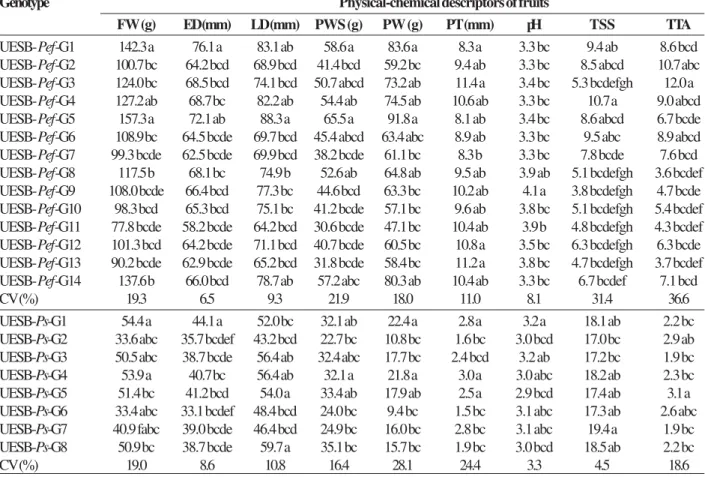
The average results of the physical-chemical characteristics of fruits presented statistical differences both between the ‘yellow’ passion fruit plants and between ‘sleep’ passion fruit plants (p < 0.001) (Table
1), which certifies the existence of intra-specific genetic variability. Another indication regarding the intra-specific variability of these species is the percentage of the variation coefficient (VC) checked among the genotypes for each one of the physical-chemical
Genotype Physical-chemical descriptors of fruits
FW (g) ED (mm) LD (mm) PWS (g) PW (g) PT (mm) pH TSS TTA
UESB- Pef -G1 142.3 a 76.1 a 83.1 ab 58.6 a 83.6 a 8.3 a 3.3 bc 9.4 ab 8.6 bcd
UESB- Pef -G2 100.7 bc 64.2 bcd 68.9 bcd 41.4 bcd 59.2 bc 9.4 ab 3.3 bc 8.5 abcd 10.7 abc
UESB- Pef -G3 124.0 bc 68.5 bcd 74.1 bcd 50.7 abcd 73.2 ab 11.4 a 3.4 bc 5.3 bcdefgh 12.0 a
UESB- Pef -G4 127.2 ab 68.7 bc 82.2 ab 54.4 ab 74.5 ab 10.6 ab 3.3 bc 10.7 a 9.0 abcd
UESB- Pef -G5 157.3 a 72.1 ab 88.3 a 65.5 a 91.8 a 8.1 ab 3.4 bc 8.6 abcd 6.7 bcde
UESB- Pef -G6 108.9 bc 64.5 bcde 69.7 bcd 45.4 abcd 63.4 abc 8.9 ab 3.3 bc 9.5 abc 8.9 abcd
UESB- Pef -G7 99.3 bcde 62.5 bcde 69.9 bcd 38.2 bcde 61.1 bc 8.3 b 3.3 bc 7.8 bcde 7.6 bcd
UESB- Pef -G8 117.5 b 68.1 bc 74.9 b 52.6 ab 64.8 ab 9.5 ab 3.9 ab 5.1 bcdefgh 3.6 bcdef
UESB- Pef -G9 108.0 bcde 66.4 bcd 77.3 bc 44.6 bcd 63.3 bc 10.2 ab 4.1 a 3.8 bcdefgh 4.7 bcde
UESB- Pef -G10 98.3 bcd 65.3 bcd 75.1 bc 41.2 bcde 57.1 bc 9.6 ab 3.8 bc 5.1 bcdefgh 5.4 bcdef
UESB- Pef -G11 77.8 bcde 58.2 bcde 64.2 bcd 30.6 bcde 47.1 bc 10.4 ab 3.9 b 4.8 bcdefgh 4.3 bcdef
UESB- Pef -G12 101.3 bcd 64.2 bcde 71.1 bcd 40.7 bcde 60.5 bc 10.8 a 3.5 bc 6.3 bcdefgh 6.3 bcde
UESB- Pef -G13 90.2 bcde 62.9 bcde 65.2 bcd 31.8 bcde 58.4 bc 11.2 a 3.8 bc 4.7 bcdefgh 3.7 bcdef
UESB- Pef -G14 137.6 b 66.0 bcd 78.7 ab 57.2 abc 80.3 ab 10.4 ab 3.3 bc 6.7 bcdef 7.1 bcd
CV (%) 19.3 6.5 9.3 21.9 18.0 11.0 8.1 31.4 36.6
UESB-Ps-G1 54.4 a 44.1 a 52.0 bc 32.1 ab 22.4 a 2.8 a 3.2 a 18.1 ab 2.2 bc
UESB-Ps-G2 33.6 abc 35.7 bcdef 43.2 bcd 22.7 bc 10.8 bc 1.6 bc 3.0 bcd 17.0 bc 2.9 ab
UESB-Ps-G3 50.5 abc 38.7 bcde 56.4 ab 32.4 abc 17.7 bc 2.4 bcd 3.2 ab 17.2 bc 1.9 bc
UESB-Ps-G4 53.9 a 40.7 bc 56.4 ab 32.1 a 21.8 a 3.0 a 3.0 abc 18.2 ab 2.3 bc
UESB-Ps-G5 51.4 bc 41.2 bcd 54.0 a 33.4 ab 17.9 ab 2.5 a 2.9 bcd 17.4 ab 3.1 a
UESB-Ps-G6 33.4 abc 33.1 bcdef 48.4 bcd 24.0 bc 9.4 bc 1.5 bc 3.1 abc 17.3 ab 2.6 abc
UESB-Ps-G7 40.9 fabc 39.0 bcde 46.4 bcd 24.9 bc 16.0 bc 2.8 bc 3.1 abc 19.4 a 1.9 bc
UESB-Ps-G8 50.9 bc 38.7 bcde 59.7 a 35.1 bc 15.7 bc 1.9 bc 3.0 bcd 18.5 ab 2.2 bc
CV (%) 19.0 8.6 10.8 16.4 28.1 24.4 3.3 4.5 18.6
Table 1. Averages, variation coefficients (VC) and results of the Tukey test (α = 0.05) regarding nine physical-chemical descriptors [fruit
Crop Breeding and Applied Biotechnology 9: 210-218, 2009 213
descriptors evaluated (Table 1). Except for the percentage of VC checked for TSS and TTA descriptors, the other VCs checked for ‘yellow’ passion fruit plants (between 6.5 and 21.9 %) and ‘sleep’ passion fruit plants (between 3.3 and 28.1%) are similar to the ones described by Nascimento et al. (2003) when characterizing ‘yellow’ passion fruit progenies. When considering the 22 genotypes of passion fruit plants jointly, the VC percentiles (19% to 57%) are quite superior to those observed inside each one of the two species (between 6.5 and 36.6% and 3.3 and 28.1% for ‘yellow’ passion fruit and ‘sleep’ passion fruit plants, respectively), attesting that the inter-specific dissimilarity is higher than the intra-specific ones.
The magnitude of the average physical-chemical characteristics (Table 1) and the relative importance of them is the aggregate value on the commercialization of ‘yellow’ passion fruit plants and ‘sleep’ passion fruit plants which makes it able to foresee the useful genotypes to be used in intra-and inter-specific hybridizations, since the observed values in this work are, as discussed below, similar or higher than those observed in the literature.
Higher levels of TSS superior to ºBrix 13 are desired by the juice industry (Meletti et al. 2000, Fortaleza et al. 2005). We observed an average result for ‘sleep’ passion fruit (TSS = 17.9) superior to the average found in ‘yellow’ passion fruit for Meletti et al. (2000), Nascimento et al. (2003), Godoy et al. (2007) and Negreiros et al. (2008) (TSS = 16, 16.2, 13.1, and 15.7; respectively). In this work the UESB-Ps-G7 genotype stands out and was prominent with a TSS ºBrix of 19.4. Average percentages of PY used by the industry (PY around or superior to 45%) were partly detected in the ‘yellow’ passion fruit and ‘sleep’ passion fruit (PY of 41 and 61%, respectively) evaluated. These percentages observed were superior to those reported by Ruggiero et al. (1996) of 19.00 to 38.00% and by Ritzinger et al. (1989) of 34.67% to 35.74% and around the average value observed by Godoy et al. (2007) (52.8%) for ‘yellow’ passion fruit. Attention was drawn to the average results checked in the fruits of the UESB-Pef-G8 (45%) and UESB-Ps-G6 (72%) genotypes.
In relation, it was possible to observe at the CI 1.1 for ‘yellow’ passion fruit and 1.3 for ‘sleep’ passion fruit. Similar values were found by Fortaleza et al. (2005) for ‘yellow’ passion fruit (between 1.05 and 1.22). In this work the results checked for UESB-Pef-G5 (1.2) and UESB-Ps-G1, -G2 and -G7 (1.2) genotypes stand out.
These values are desirable for the juice industry, considering that the oblong fruits present a superior yield, in up to 10%, in relation to those found in round fruits (Fortaleza et al. 2005).
Although a screening of genotypes in pre-breeding and preliminary characterizations of natural populations is of great importance, the differences observed between the values obtained for the different physical-chemical descriptors of fruits may vary, in part, due to the influence of uncontrolled soil and climatic factors (Nascimento et al. 2003, Vianna-Silva et al. 2008). Genetic dissimilarity among the genotypes was estimated from the 484 pairs of passion fruit plants, and revealed considerable genetic variability among the genotypes of passion fruit (Table 2). The average genetic distances (D2) were of 24.5 (3.4 ≤ D2≤ 72.8) and 7.2 (2.4 ≤ D2≤ 16.6) for the 196 pairs and 64 pairs of
‘yellow’ passion fruit and ‘sleep’ passion fruit genotypes, respectively. Inter-specific genotypes pairs with higher and lower distances [UESB-Pef-G3 vs.
UESB-Ps-G8 (D2 = 369.9) and UESB-Pef-G4 vs. UESB-Ps-G5 (D2 = 150.1), respectively] were identified in the
dissimilarity matrix (Table 2). These pairs of genotypes can be explored in divergent (with higher dissimilarity) and convergent (with lower dissimilarity) crossings. Inter-specific characterizations have not been reported so far, being that this is the first work evaluating inter-specific genetic diversity through physical-chemical descriptors of fruits among species of passion fruit plants.
The highest diversity values observed among the genotypes of ‘yellow’ passion fruit plants in relation to the ‘sleep’ passion fruit plants can be explained as the consequence of coming from different places, considering that the seeds that resulted from the ‘yellow’ passion fruit plants have were obtained from fruits bought in different production fields, when compared with the origin of a duplicate area of the ‘sleep’ passion fruit seeds. Regarding high intra-specific variability, Junqueira et al. (2005), in studies carried out on ‘suspiro’ passion fruit (P. nitida) accesses, it was
observed that accesses of different origins present a variability superior to those from the same origin.
plied Biotechnology 9: 210-218, 2009
Genótipos Pef1 Pef2 Pef3 Pef4 Pef5 Pef6 Pef7 Pef8 Pef9 Pef10 Pef11 Pef12 Pef13 Pef14 Ps1 Ps2 Ps3 Ps4 Ps5 Ps6 Ps7 Ps8 UESB- Pef -G1 0
UESB- Pef -G2 11.5 0 UESB- Pef -G3 37.8 14.6 0 UESB- Pef -G4 19.4 30.8 66.6 0 UESB- Pef -G5 10.5 24.2 50.4 22.7 0 UESB- Pef -G6 7.2 4.3 31.3 22.9 13.9 0 UESB- Pef -G7 11.1 6.7 27.6 30.8 12.9 3.6 0 UESB- Pef -G8 36.0 37.0 49.3 60.3 25.1 31.7 21.9 0 UESB- Pef -G9 46.6 37.9 40.7 68.7 38.1 40.5 27.1 6.1 0 UESB- Pef -G10 27.7 23.3 32.0 49.7 24.6 23.9 12.4 6.5 4.7 0 UESB- Pef -G11 43.6 29.9 41.4 62.3 34.8 28.4 16.7 8.1 5.9 5.3 0 UESB- Pef -G12 21.0 13.1 24.9 38.5 18.7 12.3 6.0 9.4 10.9 3.9 5.5 0 UESB- Pef -G13 49.7 38.7 47.9 72.8 41.5 35.6 22.9 9.2 10.1 9.2 3.4 8.6 0 UESB- Pef -G14 16.2 12.8 26.7 30.7 7.7 9.3 5.0 17.3 23.5 12.7 16.5 5.3 22.0 0 UESB-Ps-G1 180.2 211.4 329.5 162.3 164.2 160.2 178.5 219.0 265.5 234.6 220.5 211.6 234.8 195.3 0 UESB-Ps-G2 190.0 209.8 322.5 176.9 170.5 160.9 174.8 224.0 268.6 236.1 217.0 211.9 233.3 192.9 7.2 0 UESB-Ps-G3 192.9 221.5 336.7 167.5 165.7 170.4 183.5 224.4 267.3 236.9 222.1 216.5 241.5 195.5 6.8 7.5 0 UESB-Ps-G4 196.1 230.4 350.5 167.4 172.5 177.3 194.7 239.0 285.1 252.0 239.7 228.9 257.3 206.8 4.6 11.4 2.4 0 UESB-Ps-G5 169.9 198.2 310.2 150.1 151.7 149.6 165.6 212.6 257.5 223.2 211.8 200.6 228.7 180.1 3.9 5.3 3.2 3.1 0 UESB-Ps-G6 211.5 233.9 350.8 188.1 184.1 182.6 195.8 244.3 287.7 256.1 236.8 232.8 257.3 210.3 10.0 3.7 2.5 6.9 5.6 0 UESB-Ps-G7 237.5 268.4 399.3 212.9 219.0 211.2 232.4 283.4 334.6 299.6 280.2 271.3 295.7 251.6 4.9 8.9 10.5 7.2 9.3 9.5 0 UESB-Ps-G8 213.7 248.8 369.9 182.0 186.1 195.3 210.1 256.8 302.0 267.0 256.7 247.0 279.1 221.8 13.7 16.6 3.2 3.5 6.9 7.4 15.4 0
Table 2. Measurements of intra and interspecific dissimilarity of the Mahalanobis generalized distance (D²) between pairs of genotypes of Passiflora [‘yellow’ passion fruit
Crop Breeding and Applied Biotechnology 9: 210-218, 2009 215
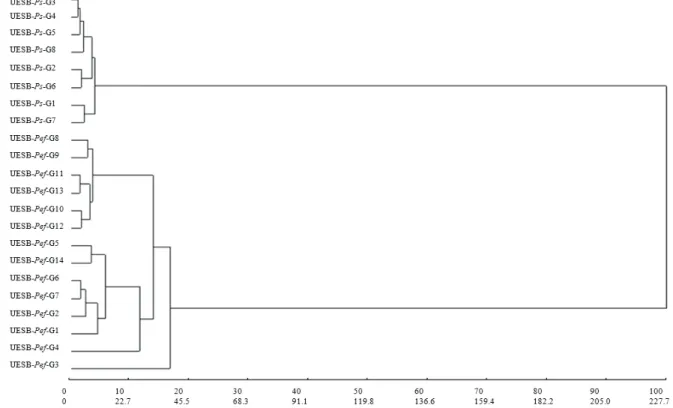
From the clustering analysis carried out through the data of the Mahalanobis generalized distance, clear inter-specific separations were detected between the ‘yellow’ passion fruit and the ‘sleep’ passion fruit plants (Figure 1). This clustering was obtained from the unweighted pair-group method using arithmetic averages (UPGMA) that exhibited the best projection coefficients (cophenetic correlation, distortion and stress of 0.94, 4.8, 21.9, respectively), in relation to the other tested methods. Similar results were also obtained by Cerqueira-Silva et al. (2009) to the evaluate different statistical methods to characterize the genetic diversity of Passiflora.
The separation of the species into different groups in the dendrogram (Figure 1), is derived from the fact that the largest D² observed was found in inter-specific pairs that presented a D² average of 197.2 and corroborates the intra- and inter-specific VC values previously discussed (Table 1). A higher inter-specific variability was also found when characterizing the access variability of ‘yellow’ passion fruit plants and
related species of Passiflora (Viana et al. 2003). In the
present work, the genotypes that differentiated both to a lesser and greater degree were “UESB-Ps-G7 with
UESB-Pef-G3” (D² =399.3) and “UESB-Ps-G5 with UESB-Pef-G4 and UESB-Pef-G6” (D²=150), respectively.
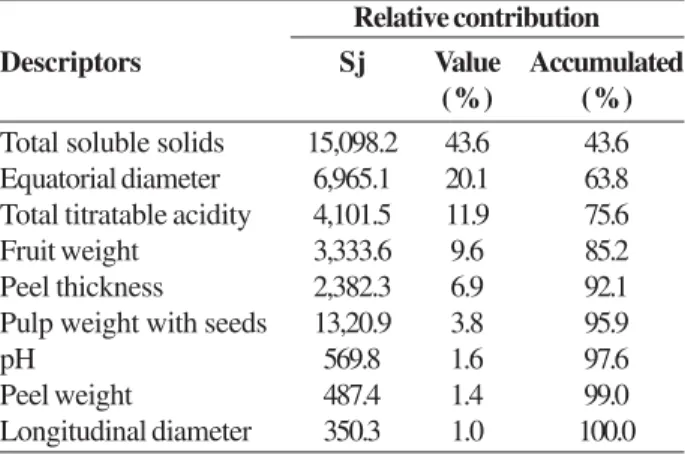
The relative contributions, individual and accumulative, of the analyzed descriptors for the genetic divergence were identified (Table 3). The characteristics that contributed significantly more to genetic diversity were TSS (43.6%), ED (20.1%), TTA (11.9%), and FW (9.6%) which, together, represented 85.2% of the variability that is existent among the genotypes. These results reinforce the existent relationship for the differences in VC values among the passion fruit plants concerning these physical-chemical characteristics (Table 1). It is noteworthy that those descriptors with a greater contribution for divergence of the genotypes are considered decisive in the characterization of the fruits as being appropriate for consumption in natura or for the production of
industrialized juices (Fortaleza et al. 2005).
The correlation values existent among the descriptors that contribute to a greater and lesser degree to genetic divergence were high and significant (r≥ 0.78; p < 0.01) (Table 4). This high correlation among
descriptors, associated with their values of relative contribution (Table 3), indicate that the descriptors of lower relative contribution for divergence (LD, PWS, PW, PT, and pH) highlight the same variation in descriptors of higher importance (TSS, ED, TTA, and FW). From these results, considering the Singh (1981) criterion, the descriptors with a lower contribution can be considered redundant and disregarded for the purpose of evaluation of new populations of plants, at least in the evaluated species. In studies of the genetic characterization of ‘scrub’ passion fruit (P. cincinnata)
the variables LD, PWS, PW, PT, and pH also presented a lower relative contribution (Araújo et al. 2008).
All the physical-chemical descriptors present statistical differences among the ‘passion’ fruit plants and contribute to genetic divergence, standing out due to the elevated values of VC and percentages of relative
Relative contribution
Descriptors Sj Value Accumulated
(%) (%)
Total soluble solids 15,098.2 43.6 43.6
Equatorial diameter 6,965.1 20.1 63.8
Total titratable acidity 4,101.5 11.9 75.6
Fruit weight 3,333.6 9.6 85.2
Peel thickness 2,382.3 6.9 92.1
Pulp weight with seeds 13,20.9 3.8 95.9
pH 569.8 1.6 97.6
Peel weight 487.4 1.4 99.0
Longitudinal diameter 350.3 1.0 100.0
Table 3. Estimates of the relative contribution (S.j) of each physical-chemical descriptor of fruits for the genetic divergence between ‘yellow’ passion fruit and ‘sleep’ passion fruit plants. based on the Mahalanobis generalized distance (D²)
contribution in the descriptors TSS, ED, TTA, and FW. The observed variability can be explored in divergent (UESB-Pef-G3 vs. UESB-Ps-G7) and convergent (UESB-Pef-G4 vs. UESB-Ps-G5) inter-specific crossings, as well
as in crossings aimed at the growth in TSS (UESB-Pef
-G4 vs. UESB-Pef-G7), pulp yield (UESB-Pef-G8 vs. UESB-Ps-G6) and conformity index (UESB-Pef-G5 vs. UESB-Ps-G7) content. In addition to the genetic improvement of the physical-chemical characteristics, the execution of inter-specific hybridizations between these species may allow the selection of hybrid genotypes of backcrossings between ‘yellow’ passion fruit and ‘sleep’ passion fruit plants, endowed with resistance genes from the ‘sleep’ passion fruit. Since the resistance this species is known for is for diseases that attack the passion fruit culture (Cardoso-Silva et al. 2007, Meletti et al. 2005).
Descritor** FW (g) ED (mm) TSS TTA
LD (mm) 0.969 0.937 -0.767 0.691
PWS (g) 0.948 0.837 -0.568 0.663
PW (g) 0.991 0.979 -0.827 0.772
PT (mm) 0.824 0.920 -0.952 0.708
pH 0.503 0.653 -0.855 0.183
**The correlations presented values of p < 0.01; The acronyms are as presented in Table 1
Table 4. Correlation coefficients between the descriptors of higher
importance (in the horizontal) and those of less importance (in the vertical). for the nine physical-chemical descriptors of the analyzed fruits
ACKNOWLEDGEMENTS
To CNPq (Conselho Nacional de Desenvolvimento Científico e Tecnológico) and FAPESB (Fundação de Amparo à Pesquisa do Estado da Bahia) for the Master’s
degree and Scientific Initiation scholarships granted to the first two authors, respectively.
Dissimilaridade genética de acessos de maracujazeiros
‘amarelo’ e ‘do-sono’ com base em características
físico-químicas de frutos
Crop Breeding and Applied Biotechnology 9: 210-218, 2009 217 e multivariada (distância de Mahalanobis, agrupamentos hierárquicos, coeficiente de Singh e teste de Mantel)]. Foi encontrada variabilidade intra e, especialmente, interespecífica entre os maracujazeiros (p < 0,001). Os descritores sólidos solúveis totais, diâmetro equatorial, acidez titulável total e peso dos frutos apresentaram os maiores percentuais de contribuição relativa, totalizando 85,2% da divergência observada. Cruzamentos preferenciais entre genótipos com características físico-químicas de frutos desejáveis e dissimilaridade genética útil em cruzamentos divergentes e convergentes foram identificados.
Palavras-chave: Análise multivariada, diversidade, variabilidade, Passiflora edulis Sims, Passiflora setacea DC.
g e r m o p l a s m a e m e l h o r a m e n t o g e n é t i c o. Embrapa Cerrados, Planaltina, p. 41-50.
Fonseca RM, Lopes R, Barros WS, Lopes MTG and Ferreira FM (2008) Morphologic characterization and genetic diversity of Capsicum chinense Jacq. accessions along the upper Rio Negro – Amazonas. C ro p B r e e d i n g a n d A p p l i e d Biotechnology 8: 187-194.
Fortaleza JM, Peixoto JC, Junqueira NTV, Oliveira AT and Rangel LEP (2005) Características físicas e químicas em nove genótipos de maracujá-azedo cultivado sob três níveis de adubação potássica. Revista Brasileira de Fruticultura 27: 124-127.
Godoy RCB, Ledo CAS, Santos AP, Matos ELS, Lima AA and Waszczynskyj N (2007) Diversidade genética entre acessos de maracujazeiro amarelo avaliada pelas características físico-químicas dos frutos. Revista Ceres 54: 541-547.
Junqueira KP, Faleiro FG, Ramos JD, Bellon G, Paula MS, Junqueira NTV and Braga MF (2005) Variabilidade genética de acessos de maracujá-suspiro (Passiflora nitida Kunth.) com base nos marcadores moleculares. In: IV Reunião t é c n i c a d e p e s q u i s a s e m M a r a c u j a z e i ro . IV RTPM, Planaltina, p. 122-127.
Junqueira KP, Faleiro FG, Junqueira NTV, Bellon G, Ramos JD, Braga MF and Souza LS (2008) Confirmação de híbridos interespecíficos artificiais no gênero Passiflora por meio de marcadores RAPD. Revista Brasileira de Fruticultura 30: 191-196.
Meletti LMM, Santos RR and Minami K (2000) Melhoramento do maracujazeiro-amarelo: obtenção do cultivar ‘composto iac-27’1,2. Scientia Agricola 57: 491-498.
Meletti LMM, Soares-Scott MD, Bernacci LC and Passos IRS (2005) Melhoramento genético do maracujá: passado e futuro. In: Faleiro FG, Junqueira NTV, Braga MF (eds)
M a r a c u j á : g e r m o p l a s m a e m e l h o r a m e n t o g e n é t i c o. Embrapa Cerrados, Planaltina, p. 55-78.
Nascimento WMO, Tomé AT, Oliveira MSP, Müller CH and Carvalho JEU (2003) Seleção de progênies de maracujazeiro-amarelo (Passiflora edulis f. flavicarpa) quanto à qualidade de frutos. Revista Brasileira de Fruticultura 25:
186-188.
Negreiros JRS, Alexandre RS, Álvares VS, Bruckner CH a n d C r u z C D ( 2 0 0 8 ) C a r a c t e r i z a ç ã o d e f r u t o s d e
REFERENCES
Araújo FP, Silva NS and Queiroz MA (2008) Divergência genética entre acessos de Passiflora cincinnata Mast com base em descritores morfoagronômicos. Revista Brasileira de Fruticultura 30: 723-730.
Ayres M, Ayres Junior M, Ayres DL and Santos AAS (2005)
P ro g r a m a B i o E s t a t 4 . 0 . A p l i c a ç õ e s e s t a t í s t i c a s n a s áreas das ciências biológicas e médicas. Sociedade Civil Mamirauá, Manaus, 324p.
Bellon G, Faleiro FG, Junqueira KP, Junqueira NTV, Santos EC, Braga MF and Guimarães CT (2007) Variabilidade genética de acessos silvestres e comerciais de Passiflora edulis Sims. com base em marcadores RAPD. Revista Brasileira de Fruticultura 29: 124-127.
Bernacci LC, Meletti LMM, Soares-Scott MD and Passos IRS (2005) Espécies de maracujá: caracterização e conservação da biodiversidade. In: Faleiro FG, Junqueira NTV and Braga MF (eds) M a r a c u j á : g e r m o p l a s m a e m e l h o r a m e n t o genético. Embrapa Cerrados, Planaltina, p. 559-586.
Cardoso-Silva CB, Melo JRF, Pereira AS, Cerqueira-Silva CBM and Oliveira AC (2007) Estudo da diversidade genética mediante caracterização físico química de frutos de maracujazeiros-do-sono nativos. Magistra 19: 352-358.
Carvalho CRL, Mantovani DMB, Carvalho PRN and Moraes RM (1990) Análise química de alimentos. ITAL, São Paulo,
121p.
Cerqueira-Silva CBM, Moreira CN, Figueira AR, Corrêa RX and Oliveira AC (2008) Detection of a resistance gradient to Passion fruit woodiness virus and selection of ‘yellow’ passion fruit plants under field conditions. Genetics and Molecular Research 7: 1209-1216.
Cerqueira-Silva CBM, Cardoso-Silva CB, Conceição JVA, Nonato JVA, Oliveira AC and Corrêa RX (2009) Comparison of coefficients and distance measurements in passion fruit plants based on molecular markers and physicochemical descriptors.
Genetics and Molecular Research 8: 870-879.
Cruz CD (2001) Programa Genes: aplicativo computacional em genética e estatística. Editora UFV, Viçosa, 648p.
progênies de meios-irmãos de maracujazeiro-amarelo em R i o B r a n c o - A c r e . R e v i s t a B r a s i l e i r a d e F r u t i c u l t u r a 3 0 : 4 3 1 - 4 3 7 .
Nick C, Carvalho M, Assis LHB and Carvalho SP (2008) Genetic dissimilarity in cassava clones determined by multivariate techniques. Crop Breeding and Applied Biotechnology 8: 104-110.
Pimentel LD, Stenzel MNC, Cruz CD and Bruckner CH (2008) Seleção precoce de maracujazeiro pelo uso da correlação entre dados de produção mensal e anual. P e s q u i s a Agropecuária Brasileira 43: 1303-1309.
Ritzinger R, Manica I and Riboldi J (1989) Efeito do espaçamento e da época de colheita sobre a qualidade do maracujá amarelo. Pesquisa Agropecuária Brasileira 24:
241-245.
Ritzinger R, Soares Filho WS and Carvalho PCL (2008) Evaluation of umbu-caja germplasm in the state of Bahia, Brazil. C rop Breeding and Applied Biotechnology 8:
181-186.
Ruggiero C, São José AR, Volpe CA, Oliveira JC, Durigan JF, Baumgartner JG, Silva JR, Nakamura K, Ferreira ME, Kavati R and Pereira VP (1996) M a r a c u j á p a r a e x p o r t a ç ã o: aspectos técnicos da produção. EMBRAPA-SPI, FRUPEX, Brasília, 64p. (Publicações Técnicas 19)
Singh D (1981) The relative importance of characters affecting genetic divergence. The Indian Journal of Genetics and Plant Breeding 41: 237-245.
Sousa JSI and Meletti LMM (1997) M a r a c u j á : e s p é c i e s , variedades, cultivo. FEALQ, Piracicaba, SP, 179p.
Vianna-Silva T, Resende ED, Viana AP, Pereira SMF, Carlos LA and Vitoria L (2008) Qualidade do suco de maracujá-amarelo em diferentes épocas de colheita. Ciência Tecnologia de Alimentos 28: 545-550.
![Table 2. Measurements of intra and interspecific dissimilarity of the Mahalanobis generalized distance (D²) between pairs of genotypes of Passiflora [‘yellow’ passion fruit (UESB-Pef-G1 a -G14) and ‘sleep’ passion fruit (UESB-Ps-G1 a G8)] through physical](https://thumb-eu.123doks.com/thumbv2/123dok_br/18415377.360275/5.1105.101.1001.116.724/measurements-interspecific-dissimilarity-mahalanobis-generalized-distance-genotypes-passiflora.webp)