78 PHYSICAL
EDUCATION OF STUDENTS
THE PREVENTION PROGRAMS OF PHYSICAL REHABILITATION FOR CHERNOBYL DISASTER SURVIVORS Korobeynikov G.V., Drojjin V.U.*
National University of Physical Education and Sport of Ukraine * Luhansk Taras Shevchenko National University
Abstract. The purpose of the study: approbation of the prevention program of physical rehabilitation for Chernobyl disaster survivors in lifestyle aspects. Sixty persons who were disaster survivors and workers of Chernobyl Nuclear Power Plant aged 32-60 have rehabilitation during 21 days. The complex of training prevention programs of physical and psycho-emotional rehabilitation methods was elaborated. The study of efficacy of training prevention programs among Chernobyl disaster survivors. The results showed the improvement of psycho-emotional status and normalization of cardiovascular vegetative regulation after training prevention programs in Chernobyl disasters survivors. The studies show that the preventive programs for Chernobyl disaster survivors in lifestyle aspects had the high effect. This displays the decrease of tempo of aging and the improving of physical and psychological health status of Chernobyl disaster survivors during preventive course.
Key words: preventive programs, physical rehabilitation, Chernobyl disaster survivors, lifestyle, health.
Introduction1
There are many medical consequences obtained twenty seven years before accident on Chernobyl Nuclear Power Plant. This is more important problem for Ukraine and people of the world. The studies of Ukrainian scientists showed the decrease of cardiovascular disease of people who live in Chernobyl region (more then 30 km around) after accident [1, 2, 3, 4]. Apart from, the long stay in ecological disaster region is resulted is evolution of the psycho-emotional disorders and psychosomatic pathologies [5, 6, 7, 8].
The use of pharmacological rehabilitation may accompany with “drug's disease”. Still the lifestyle change intervention with diet, aerobic exercise and stress management as prevention rehabilitation methods was more effective.
Purpose, tasks of the paper, material and methods
The aim of the study: approbation of the prevention programs of physical rehabilitation for Chernobyl disaster survivors in lifestyle aspects.
Methods
Sixty persons, disaster survivors and workers of Chernobyl Nuclear Power Plant aged 32-60 have rehabilitation during 21 days.
The complex of physical rehabilitation programs as lifestyle change intervention included: low-fat diet with finishing of smoking and alcohol using: vegetable low-meet foods; physical aerobic exercises use complex of physical rehabilitation;
stress management includes psychotherapy and training course of psycho-emotional rehabilitation. The rules for complex of physical rehabilitation for Chernobyl disaster survivors:
1. The training lessons of physical rehabilitation must be held on the sporting hall or open ground.
2. The training lessons of physical rehabilitation must be held among patients of II or III Chernobyl disaster categories. 3. The training lessons of physical rehabilitation must include morning exercises and healthy exercises.
4. The morning exercises must be hold 10 minutes after awakening and 30 minutes before breakfast. Duration of morning exercises - 20-30 minutes.
5. The healthy exercises must be hold 1-2 an hour before and 2 an hour after meal, in the second part of the day. Duration of healthy exercises - 1 an hour.
The study of the effect of preventive program for Chernobyl disaster survivors. The functional age and tempo of aging as criterion of health status were studied.
The tempo of aging (TA) was determined [9]:
ТA = (BPSr/BPSt + BPDr/BPDt + HRr/ HRt + HRw r/ HRw t + + VCt/VCr + HBIt/HBIr + HBEt/HBEr + SBt/SBr) / n, (1)
were: ТA - tempo of aging (secret unit); BPS - blood pressure systolic (mm ); BPD - blood pressure diastolic (mm ); VC - vital capacity of the lungs (l); HBI - hold the breath in inhale (s); HBE - hold the breath in exhale (s); SB - static balance (s); HR - heart rate in rest (min-1); HRw - heart rate after 20 squats (min-1); r - real estimation of parameter; t - table estimation of parameter; n - number of parameters.
Functional age was determined:
FA = ТA * КA, (2) were: KA - calendar age (years).
Table 1
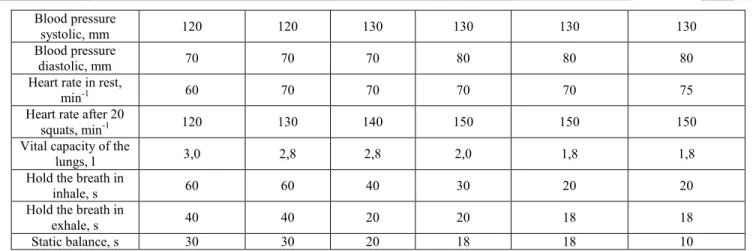
Average population parameters for women, which include the tempo of aging formula
Parameters 20-29 30-39 40-49 Age groups, years 50-59 60-69 70 and over
79 Вlood pressure
systolic, mm 120 120 130 130 130 130
Вlood pressure
diastolic, mm 70 70 70 80 80 80
Heart rate in rest,
min-1 60 70 70 70 70 75
Heart rate after 20
squats, min-1 120 130 140 150 150 150
Vital capacity of the
lungs, l 3,0 2,8 2,8 2,0 1,8 1,8
Hold the breath in
inhale, s 60 60 40 30 20 20
Hold the breath in
exhale, s 40 40 20 20 18 18
Static balance, s 30 30 20 18 18 10
The average parameters, which include formula (1), are presented in the tab.1 (for women) and tab.2 (for men). These meanings were the results of the analysis of investigations in aging researches areas and our investigations.
Psycho-emotional status of patients was studied by subjective estimation of self-sense, activity and mood, before and after one rehabilitation course.
Table 2
Average population parameters for men, which include the tempo of aging formula
Parameters 20-29 30-39 40-49 Age groups, years 50-59 60-69 70 and over
Вlood pressure
systolic, mm 120 120 130 130 130 130
Вlood pressure
diastolic, mm 70 70 70 80 80 80
Heart rate in rest,
min-1 60 70 70 70 70 75
Heart rate after 20
squats, min-1 120 130 140 150 150 150
Vital capacity of the
lungs, l 3,5 3,4 3,0 2,9 2,6 2,0
Hold the breath in
inhale, s 90 90 80 60 40 30
Hold the breath in
exhale, s 60 60 40 30 20 20
Static balance, s 60 60 40 30 20 10
Results of the research.
The average parameters of functional age and tempo of aging in patients before and after preventive course are presented in tab.3.
Table 3
Average data of functional age and tempo of aging in Chernobyl disaster survivors before and after preventive course
State Age, years Functional age, years Теmpo of aging
Before preventive
course 48,81+1,91 71,75+5,62 1,58+0,09
After preventive
course 48,81+1,91 66,76+4,31 1,36+0,06
The results showed the increasing of the functional age (71,7+5,62) for comparative of calendar age (48,81+1,91) before the prevention course. This is associated with the acceleration type of aging and decline of health in Chernobyl disaster survivors.
The average parameters, which include formula of determination of tempo of aging before and after preventive course of Chernobyl disaster survivors, are presented in tab.4.
Table 4
Average parameters, which include the tempo of aging formula in Chernobyl disaster survivors before and after preventive course
Parameters Before preventive course After preventive course
Вlood pressure systolic, mm 130,13+3,13 127,21+2,60*
Вlood pressure diastolic, mm 82,37+2,22 79,08+1,58*
80 PHYSICAL
EDUCATION OF STUDENTS
Hold the breath in inhale, s 40,31+3,14 41,82+3,09*
Hold the breath in exhale, s 21,62+1,43 24,17+1,61*
Static balance, s 8,03+1,98 9,52+1,93
Heart rate in rest, min-1 77,28+2,06 75,11+1,33*
Heart rate after 20 squats, min-1 117,66+4,06 115,17+4,10*
* - p < 0,05
The analysis of this data shows the increase of arterial blood pressure for concerning health norm. This fact demonstrates the significant role of heart health for people who Chernobyl disaster survivors.
At the same time, the decrease of static balance for concerning average population meanings may be related with internal brain vascular disturbance.
The decline of respiratory functions displays the decrease of hold the breath in inhales and exhales parameters.
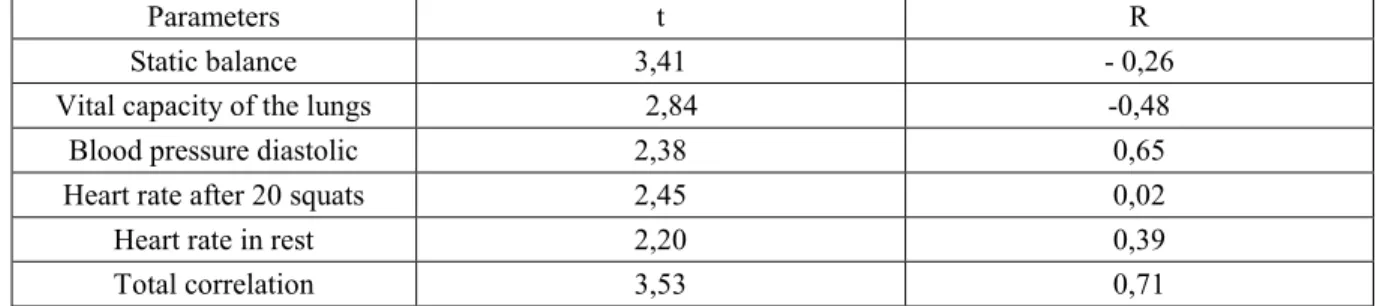
The tempo of aging structure before preventive course was studied for multiple correlation between functional age and parameters, which include formula of determination of tempo of aging (tab. 5).
Table 5
Results of multiple correlation analysis between functional age and parameters, which include the tempo of aging formula before preventive course in Chernobyl disaster survivors
Parameters t R
Static balance 3,41 - 0,26
Vital capacity of the lungs 2,84 -0,48
Вlood pressure diastolic 2,38 0,65
Heart rate after 20 squats 2,45 0,02
Heart rate in rest 2,20 0,39
Total correlation 3,53 0,71
According to correlation analysis the functional age in Chernobyl disaster survivors before preventive course was the determination of heart parameters and static balance parameters.
After preventive course program, the average parameters of functional age in Chernobyl disaster survivors decrease. This demonstrates the improving of general health status in Chernobyl disaster survivors (tab. 3). But, the tempo of aging after preventive course remains accelerating (tab. 3).
The decrease of arterial blood pressure, heart rate in rest and after physical load, increase of vital capacity of lungs and static balance showed the improvement of health promotion in Chernobyl disaster survivors during the preventive course (tab.4).
The results of multiple correlation analysis between functional age and parameters, which include formula of determination of tempo of aging in Chernobyl disaster survivors after preventive course, are presented in tab. 6.
Table 6
Results of multiple correlation analysis between functional age and parameters, which include the tempo of aging formula after preventive course in Chernobyl disaster survivors
Parameters T R
Вlood pressure systolic 5,60 0,83
Вlood pressure diastolic 2,01 0,56
Heart rate in rest 1,79 0,19
Static balance 1,36 -0,31
Heart rate after 20 squats 2,23 0,09
Total correlation 3,62 0,78
As it is seen on tab. 6, the general structure of aging in Chernobyl disaster survivors after preventive course does not change. But, there are changes of internal structure of aging among studied parameters.
According to this data the main factor, which determined of aging structure in Chernobyl disaster survivors after preventive course is arterial blood pressure.
Thus, one of the ways for possibility of the health improving in Chernobyl disaster survivors is related with the regulation of arterial blood pressure.
The average parameters of psycho-emotional status of patients before and after preventive course are presented in tab. 7. Table 7
Average parameters of psycho-emotional status in Chernobyl disaster survivors before and after preventive course
Parameters Before preventive course After preventive course
Self-sense, secret unit 5,33+0,18* 6,18+0,17*
81
Mood, secret unit 5,67+0,20* 6,49+0,22*
* - p < 0,05
According to data from tab. 7 the subjective estimation of self-sense, activity and mood in Chernobyl disaster survivors improve during preventive course. This fact indicated the promotion of psychological health of Chernobyl disaster survivors during lifestyle change intervention.
The relations between psychological and physical health were studied. The correlation analysis between psycho-emotional status parameters and arterial blood pressure as criterion of physical health are presented on tab. 8.
According to this analysis close correlation is showed between arterial blood pressure and mood. At the same time the correlation between arterial blood pressure and parameters of psycho-emotional status before preventive course is closer for concerning after preventive course. This demonstrates the decrease of psycho-physiological tension of regulatory systems of human organism during preventive course of Chernobyl disaster survivors [10].
Table 8
Results of correlation analysis between parameters of psycho-emotional status and BPS in patients before and after preventive course.
Parameters Before preventive course After preventive course
Self-sense - 0,27 - 0,17
Activity - 0,35 - 0,05
Mood - 0,39 - 0,05
This corresponds with correlation analysis data between mood and functional age: before preventive course correlation coefficient makes up r = - 0,33 (p < 0,06).
Thus, the improving of physical health after preventive course influence the promotion of the psychological health of Chernobyl disaster survivors.
Summary.
The studies show that the preventive programs for Chernobyl disaster survivors in lifestyle aspects had the high effect. This displays the decrease of tempo of aging and the improving of physical and psychological health status of Chernobyl disaster survivors during preventive course.
However, the solution of problem of health promotion must have Government and International support of lifestyle changes preventive programs, especially for people who survivors Chernobyl accident.
Reference:
1. Zotov V.N., Korkushko O.V. Medico-biological aspects of healthy rehabilitation system’s in people who Chernobyl disaster survivors. Kiev, Medecol "Medicine-ecology", 1996, 196 p.
2. Bebeshko V.G. Bazika D.A., Romanenko U.A., Loganovskiy K.M. Radiological and Medical Consequences of Chernobyl Catastrophe. Journal National Academy of Medical Sciences of Ukraine, 2011, pp. 132-138.
3. Kоvalenko А. N. Kоvalenko V. V. Systemic radiation syndromes,. Nikolaev, NGU Petra Mogily named, 2008, 248 p.
4. Bennett B., Repacholi Z., Carr M. Health Effects of the Chernobyl Accident and Special Health Care Programmes. Report of the UN Chernobyl Forum Expert Group "Health", Geneva,WHO, 2006, 160 p.
5. Lukianova O.N., Poliakov A.A., Korobeynikov G.V. Non-medical psychophysiological rehabilitation of neuro-emotional status. Medical informational technology, 1994, pp. 82-87.
6. Jiakovenko S.I. Principles, organizational forms and methods of psychological assistance to victims of the Chernobyl disaster.
Practical Psychology and Social Work. 2005, vol.2, pp. 13–21.
7. Fava G.A., Sonino N., Wise T.N. The Psychosomatic Assessment. Strategies to Improve Clinical Practice. Advances in Psychosomatic Medicine. 2012, vol 32, pp. 1–18.
8. Richard L. Kradin. Psychosomatic disorders: the canalization of mind into matter. Journal of Analytical Psychology, 2011, vol.56, pp. 37–55.
9. Reshetiuk A.L., Poliakov A.A., Korobeynikov G.V. Determination of functional age and tempo of aging. Methodical recommendation. Кiev, Public Health Ministry of Ukraine, 1996, 10 p.
10. McGee E. J., Synnott H. J., Johanson K. J. Chernobyl fallout in a Swedish spruce forest ecosystem, Journal of Environmental Radioactivity, 2000, vol.48(1), pp. 59–78.
Information about the authors:
_____________________________________________________________________________________________________
Korobeynikov G.V.: [email protected]; National University of Physical Education and Sport of Ukraine; Fizkultury str. 1, Kiev, 03680, Ukraine.
Drojjin V.U.: [email protected]; Luhansk Taras Shevchenko National University; Defense str. 2, Lugansk, 91011, Ukraine.
_____________________________________________________________________________________________________
Cite this article as: Usakovsky Y.O., Bova N.I. Comparative analysis of motive activity with a ball and without in training of different playing lines
of young footballers aged 11-15 years. Physical Education of Students, 2013, vol.1, pp. 74-77. doi:10.6084/m9.figshare.156363
The electronic version of this article is the complete one and can be found online at: http://www.sportedu.org.ua/html/arhive-e.html
This is an Open Access article distributed under the terms of the Creative Commons Attribution License, which permits unrestricted use, distribution, and reproduction in any medium, provided the original work is properly cited (http://creativecommons.org/licenses/by/3.0/deed.en).
_____________________________________________________________________________________________________ Received: 28.01.2013