Abstract—Removal and recovery of heavy metals from wastewater has been a priority in recent years due to environmental and economic reasons. The scarcity of fresh water resources, pollution of water sources and the dwindling mineral reserves are some of the issues that has led to an increased interest in heavy metal removal and recovery. The use of hydrazine as a reducing agent to remove and recover aluminum and manganese metal was investigated. A 5 L batch reactor was used to conduct experiments where 100 mg/l of Al and Mn metal solutions were reduced using 1M hydrazine as a reducing agent. It was found that the metals were reduced to their elemental form. Hydrazine proved to be an effective reducing agent for Mn with average removal efficiencies of 99.8 and 99.5% in the single metal (Mn-only) and mixed metal systems (Mn and Al) respectively. However, the removal efficiency for Al was low with average removal efficiencies of 17 and 19% in the single and mixed metal system.
Index Terms— electroless plating, heavy metal removal reduction crystallization, wastewater treatment
I. INTRODUCTION
HE toxicity of heavy metals had received much concern, which had triggered numerous studies focusing on their removal. Techniques, such as precipitation, adsorption, biosorption, ion exchange, and membrane technology, exist for metal removal from waste streams. Selection of these techniques is based on factors such as metal concentration, pH and operational efficacy. However, these methods only allow removal of metals which are ultimately discarded as sludge and do not permit the reuse of the metals, resulting in a waste of raw materials. This is especially serious for the metallurgical and electroplating industry [1]. Industrial waste water frequently contains toxic heavy metals such as silver, aluminum, manganese and mercury to name a few. Discharge of industrial wastewater results in degraded water quality and has a negative impact on health and recreation
As the mineral reserves for metals are dwindling, it is becoming more economical to recover heavy metals if possible to their metallic state and reuse these metals Manuscript received March 1, 2012; revised March 29, 2012. This work was supported in part by the University of Johannesburg and Impala Platinum Refineries.
T. P. Malematja was with the University of Johannesburg, Department of Chemical Engineering (e-mail: [email protected]).
F. Ntuli is with Chemical Engineering Department, University of Johannesburg, Doornfontein 2028, Johannesburg, South Africa. (corresponding author- phone: +27-11-5596003; fax: +27-11-5596430; e-mail: fntuli@ uj.ac.za).
M. Belaid is with the Chemical Engineering Department, University of Johannesburg, South Africa (e-mail: [email protected]).
obtained. The use of reducing agents such as sodium borohydride, hydrazine and formaldehyde for metal recovery is a relatively simple method, which is similar to chemical precipitation except that the different soluble metal cations are recovered (by chemical reduction) as useful insoluble elemental metal instead of metal hydroxide sludge [2]. The metal solids can then be separated from the solution by filtration, sedimentation and centrifuge. Previous studies using nickel powder as seeding material have demonstrated that hydrazine is an effective reducing agent for Ni, Cu, Co and Fe with removal efficiencies of over 97% [3]. Based on these findings the feasibility of using the same technique for the removal of manganese and aluminum was explored. These metals are normally form part of the toxic elements found in metal refining liquid effluents and acid mine drainage.
A. Hydrazine as a reducing agent
Hydrazine (N2H4) is a powerful reducing agent in alkaline
aqueous solutions and is widely used in various chemical operations.
An important half reaction involving hydrazine is: 4OH- + N2H4 = N2 + 4H2O + 4e- E0= 1.17 V (1)
It can effectively be employed in reduction of various metal cations (Mn+) to the elemental state (M0) according to the following reaction [4]:
Mm++ N2H4 =M0 + N2 + H+ (2)
II. MATERIALS AND METHODS
A. Materials
1 M hydrazine in tetra-hydrofuran was employed as a reducing agent and nickel powder supplied by Impala Platinum Refineries was used as seeding material. Synthetic metal solutions of manganese and aluminium were prepared by dissolving their respective sulphate salts in water. Sodium hydroxide (2 M) was used to adjust the pH. The experiments were conducted using a 5 L stainless steel batch reactor fitted with a 4 pitched blade axial impeller (diameter 50 mm), heating element and a thermostat for temperature control. The reagents were weighed on an analytical balance (model Radweg PS 6000/c/l). A pH meter (model Mettler Toledo, InLab 74X Series) was used to measure the pH and also the temperature during the reduction process.
Reduction Crystallization of Manganese and
Aluminum from Waste Water using Hydrazine
Thapelo Promise Malematja, Freeman Ntuli, Member, IAENG, and Mohamed Belaid
T
Proceedings of the World Congress on Engineering 2012 Vol III WCE 2012, July 4 - 6, 2012, London, U.K.
ISBN: 978-988-19252-2-0
ISSN: 2078-0958 (Print); ISSN: 2078-0966 (Online)
Inductively coupled plasma optical emission spectroscopy (ICP-OES; model Spectro Arcos FSH12) was used to measure the concentrations of Al and Mn in solution after reduction. X-Ray fluorescence (XRF; model Magix Pro Phillips) was used to determine the elemental composition of the powder product. The particle size of the powder was measured using the laser diffraction technique (Malvern Particle analyser; model Mastersizer 2000). The powder morphology was captured using a Scanning Electron Microscopy (SEM, model Joel JSM 5600).
B. Experimental Procedure
100 g/l Al solution was prepared and fed into a 5 L stainless steel batch reactor and 30 g of nickel seed was weighed and added to the solution as seeding material on which electroless deposition occurred. The mixture was agitated at a constant speed of 460 rpm and the heating element was switched on to heat the solution to a temperature of 50-70oC. 3 ml of 1M hydrazine was then added into the reactor as the reducing agent when the temperature was above 50oC. The pH of the solution was adjusted to 11 using 2M sodium hydroxide solution. The reaction was allowed to proceed for 3 min. After the reaction was complete, the agitation as well as the heating process was stopped and the nickel powder was allowed to settle. A 5 ml sample of the reduced solution was sampled and analysed for the residual aluminium concentration using ICP-OES. The reduced solution was then discharged and the nickel seed left in the reactor to act as seeding material for the next batch reduction (termed a densification). A fresh aluminium solution was introduced into the batch reactor with the seed from the previous densification. A similar procedure was followed as for the first densification. A total of three densifications were conducted in each experimental run. After the third densification, the reduced solution and the nickel powder were discharged from the reactor. The powder was then separated from the liquor by filtration using a vacuum pump and dried overnight in an oven at 90oC. A repeat experimental run was conducted for each metal solution to check for reproducibility of the results.
A similar experimental procedure was followed for the manganese solution. To investigate the reduction of both Al and Mn under mixed metal conditions, 100 mg/l of both reagents were prepared and fed into a 5 L reactor and the amount of the reducing agent was increased to 7 ml. The procedure for conducting the experiments was similar to the one outlined above.
III. RESULTS AND DISCUSSION
A. Residual Concentration
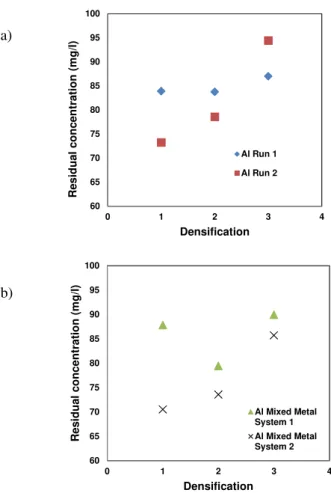
The residual Al concentration after reduction in the single metal system (Al-only) and mixed metal system (Al and Mn) is shown in Fig 1.
(a)
(b)
Fig. 1. Residual Al concentration (a) Al solution (b) Al-Mn solution
There was an overall increase in residual Al concentration with increasing number of densifications in both the single and mixed metal system. On average, approximately 17% Al was removed in the single metal system, whereas 19% Al was removed under the mixed metal system.
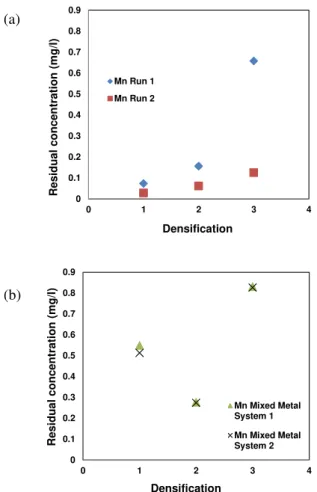
The residual Mn concentration after reduction in the single metal system (Mn-only) and mixed metal system (Mn and Al) is shown in Fig 2. An increase in residual Mn concentration was observed with an increase in the number of densifications for the single metal system. However, there was a drop in residual Mn concentration in the second densification followed by a sharp increase in residual concentration thereafter.
Hydrazine proved to be an effective reducing agent for Mn as compared to Al as there was an average of 99.8% Mn removal in the single metal system and 99.5% in the mixed metal system. The removal efficiency decreased by approximately 0.3% when Al was introduced into the solution. Previous studies on other transitional metals such as copper, iron and nickel have shown removal rates of above 99% when they were reduced using hydrazine [3].
60 65 70 75 80 85 90 95 100
0 1 2 3 4
R
e
s
id
u
al
co
n
c
e
n
tr
at
io
n
(
m
g
/l)
Densification Al Run 1
Al Run 2
60 65 70 75 80 85 90 95 100
0 1 2 3 4
R
e
s
idua
l c
oncentr
ati
on
(mg/
l)
Densification
Al Mixed Metal System 1 Al Mixed Metal System 2
Proceedings of the World Congress on Engineering 2012 Vol III WCE 2012, July 4 - 6, 2012, London, U.K.
ISBN: 978-988-19252-2-0
ISSN: 2078-0958 (Print); ISSN: 2078-0966 (Online)
(a)
(b)
Fig. 2. Residual manganese concentration in solution (a) Mn solution (b) Mn-Al solution
B. Reduction Rate
The reduction rates of Al and Mn from solution in the single and mixed metal systems were investigated and are shown in Fig. 3 and 4 respectively.
1.4 2.4 3.4 4.4 5.4 6.4 7.4 8.4 9.4
0 1 2 3 4
Re
ducti
on Ra
te
(mg/l
.m
in
)
Densification
Al Run 1 Al Run 2
Al Mixed Metal System 1 Al Mixed Metal System 2
Fig.3. Reduction rate of Al
33.00 33.05 33.10 33.15 33.20 33.25 33.30 33.35
0 1 2 3 4
Reducti
on
R
a
te
(mg/
l.
mi
n)
Densification Mn Run 1
Mn Run 2
Mn Mixed Metal System 1 Mn Mixed Metal System 2
Fig.4. Reduction rate of Mn
The rate of reduction of Al ranged from 1.8 to 8.9 mg/l·min in the single metal system and from 3.5 to 9.8 mg/l·min in the mixed metal system. For Mn the reduction rate was approximately 33mg/ l·min. in the both the single and mixed metal systems. Overall, the reduction rate of Mn was higher in the absence of Al. The lower reduction rate of Al was attributed to its inability to act as a reduction catalyst. Most reduction catalyst are characterized by empty
d-orbitals e.g. transition metals, which are absent in Al. While the seeding material (Ni) can act as a reduction catalyst, the electroless deposition of Al on its surface reduces its surface activity. Thus, as the surface of the Ni seed is covered with Al the rate of reduction decreases.
From a thermodynamic viewpoint, to obtain reduction of the metal from aqueous solution the potential of the reducing system must be more negative than the potential of the metal metal undergoing reduction. The reduction potentials of the species considered in this study are given below:
Mn2+ + 2e = Mn E0= -1.182 V (3) Al3+ + 3e = Al E0= -1.68 V (4) From equation (1), it can be seen that the reduction potential of hydrazine is less negative than that of both metals, thus reduction of both metals is thermodynamically less feasible. However, reduction does occur due to the catalytic effect of Ni used as the seeding material. To enhance the removal of Al it is proposed that Ni should be introduced into solution to ensure the deposition surface remains catalytically active. Previous studies have demonstrated that nickel can accelerate the catalytic decomposition of hydrazine because of its peculiar catalytic activity [5].
C. Elemental Composition of Powder
The elemental composition of the powder obtained after three densifications was determined using XRF and is shown in Table 1.
0 0.1 0.2 0.3 0.4 0.5 0.6 0.7 0.8 0.9
0 1 2 3 4
Resid
u
al
co
ncen
tr
at
io
n
(
m
g
/l
)
Densification Mn Run 1
Mn Run 2
0 0.1 0.2 0.3 0.4 0.5 0.6 0.7 0.8 0.9
0 1 2 3 4
Re
s
idu
al
co
nc
en
tr
a
tion
(mg
/l)
Densification
Mn Mixed Metal System 1
Mn Mixed Metal System 2
Proceedings of the World Congress on Engineering 2012 Vol III WCE 2012, July 4 - 6, 2012, London, U.K.
ISBN: 978-988-19252-2-0
ISSN: 2078-0958 (Print); ISSN: 2078-0966 (Online)
TABLEI
ELEMENTAL COMPOSITION OF POWDER
Composition (%)
Element Al Mn Ni Other
elements
Al-only run 1 0.90 0.00 95 4.10 Al-only run 2 0.67 0.00 95 4.33 Mn-only run1 0.00 1.40 95 3.60 Mn-only run 2 0.00 2.20 93 4.80
With the exclusion of Ni metal which was used as seeding; it was found that on average 18% and 13% of the powder samples consisted of Al metal for run 1 and 2 respectively in the single metal system. Mn was found to constitute 28% and 31% of the powder sample for run 1 and 2 respectively in the single metal system. This proves that both metals were reduced to their elemental state.
D. Evolution of the PSD (Particle Size Distribution)
The evolution of the PSD in terms of the number distribution for both the single and mixed metal systems is shown in Fig. 5.
Fig. 5 (a) and (c) shows that there was a shift in the modal size to the right and a decrease in the area under the curve (equivalent to total number of particles). This is evidence of size enlargement by aggregation. For the single metal system with only Mn there was a shift in modal size to the left and an increase in the area under the curve (Fig. 5(b)). This phenomenon can either be a result of particle breakage or nucleation. However, there was no evidence of breakage in the other systems studied, thus it more likely that nucleation was the dominant process.
IV. CONCLUSION
Hydrazine was found to be an effective reducing agent for Mn with average removal efficiencies of 99.8 and 99.5% in the single metal (Mn-only) and mixed metal systems (Mn and Al) respectively. However, the removal efficiency for Al was low with average removal efficiencies of 17 and 19% in the single and mixed metal system. The low removal efficiency for Al was attributed to its inability to act as a reduction catalyst. It was recommended that Ni should be introduced into the reduction solution to maintain the surface activity of the powder in the presence Al. Aggregation was identified as the dominant size enlargement mechanism in the single metal system (Al-only) and mixed metal system (Al-Mn). However, nucleation was found to be the dominant mechanism in the solution with Mn only.
(a)
(b)
(c)
Fig. 5. Evolution of the PSD (a) Al-only (b) Mn only (c) Mixed metal (Mn and Al)
ACKNOWLEDGMENT
The authors will like to thank the University of Johannesburg (URC) for their financial assistance and Impala Platinum Refineries for providing the materials used in the project.
REFERENCES
[1] Horikawa, K. and Hirasawa, I. “Removal and Recovery of Nickel Ion from Wastewater of Electroless Plating by Reduction crystallization,” Korean J. Chem. Eng, vol. 17, no. 6, pp. 629-632, 2000.
[2] Chen, J .P. and Lim, L.L. “Key factors in reduction by hydrazine for recovery of precious metals,” Chemosphere, vol 49, pp. 363-370, 2002.
[3] Phetla, T.P., Ntuli, F and Muzenda, E. “Reduction crystallization of Ni, Cu, Fe and Co from a mixed metal effluent (Accepted for publication),” Journal of Industrial and Engineering Chemistry, to be published.
[4] Simpsons, D.K. “Hydrazine, a powerful metal reductant,” Met. Finish., vol 83, pp. 57-60, 1985.
[5] Li, Y.D., Li, L.Q., Liao, H.W. and Wing, H.R., “Preparation of pure nickel, cobalt, nickel–cobalt and nickel–copper alloys by hydrothermal reduction,” J. Mater. Chem., vol 9, pp. 2675-2677, 1999.
0 20 40 60 80 100 120
0.01 0.1 1 10 100 1000 10000
Ln(L
) x
1
0
9(m -3)
Size (micron)
Seed
Al run 1 Al run 2
0 50 100 150 200 250 300 350
0.01 0.1 1 10 100 1000 10000
Ln(L
) x1
0
9(m -3)
Size (micron)
Seed
Mn run 1 Mn run 2
0 20 40 60 80 100 120
0.01 0.1 1 10 100 1000 10000
Ln(L
) x
1
0
9(m -3)
Size (micron)
Seed
Mn‐Al run 1 Mn‐Al run 2
Proceedings of the World Congress on Engineering 2012 Vol III WCE 2012, July 4 - 6, 2012, London, U.K.
ISBN: 978-988-19252-2-0
ISSN: 2078-0958 (Print); ISSN: 2078-0966 (Online)