www.ache.org.rs/CICEQ
Chemical Industry & Chemical Engineering Quarterly 18 (2) 245−254 (2012) CI&CEQ
BILJANA ANGJUSHEVA EMILIJA FIDANCEVSKA VOJO JOVANOV
Faculty of Technology and Metal-lurgy, University “Ss. Cyril and
Methodius”, Skopje, Republic of Macedonia
SCIENTIFIC PAPER
UDC 666.3/.7(497.17):666.3–187 DOI 10.2298/CICEQ110607001A
PRODUCTION OF CERAMICS FROM
COAL FLY ASH
Dense ceramics are produced from fly ash from REK Bitola, Republic of Ma-cedonia. Four types of fly ash from electrofilters and one from the collected zone with particles <0.063 mm were the subject of this research. Consolidation was achieved by pressing (p = 133 MPa) and sintering (950, 1000, 1050 and 1100 °C and heating rates of 3 and 10 °C/min). Densification was realized by liquid phase sintering and solid state reaction where diopside [Ca(Mg,Al)(Si,Al)2O6] was formed. Ceramics with optimal properties (porosity 2.96±0.5%, bending strength 47±2 MPa, compressive strength 170±5 MPa) was produced at 1100
°C using a heating rate of 10 °C/min.
Keywords: fly ash, ceramics, sintering, bending strength, compressive strength.
In the last decade there has been a growing interest for solving problems related to environmental pollution with industrial wastes. One such example is industrial waste from the coal combustion process in thermal power plants. The total quantity of coal com-bustion by-products in Europe for 2008 is 56 million tons [1]. The highest percent (around 66.6%) belongs to fly ash but the quantity that is utilized exceeds no more than 17 million tons. The highest utilization of coal fly ash is in the construction industry as a con-crete addition or a replacement for part of the cement [2-5], then road base construction [6,7], landfill liners [8-10], and agriculture [11,12]. However, new applica-tions and possibilities for utilization of coal fly ash are needed. Fly ash is a by-product of the burning of coal between the temperature range of 1100 and 1450 °C, and contains valuable oxides, such as SiO2, Al2O3, CaO, Fe2O3 and other oxides provided as powder with fine particles [13]. There has been considerable research on the production of ceramics from coal fly ash with the addition of the natural raw materials or waste materials [14-16].
Fukumoto et al. [17] explored the suitability of using fly ash and clay in order to produce composite material with satisfactory mechanical properties.
Correspondening author: B. Angjusheva, Faculty of Technology and Metallurgy, University “Ss. Cyril and Methodius”, Rudjer Bošković 16, Skopje, Republic of Macedonia.
E-mail: [email protected] Paper received: 7 June, 2011 Paper revised: 17 November, 2011 Paper accepted: 3 January, 2012
searchers have investigated the influence of the sin-tering procedure on the mixture of fly ash, with a changing ratio of clay 0-10% on the mechanical pro-perties of the composite materials. They have empha-sized the reinforcement role of coal ash particles to clay base material during the electric furnace burning. For spark plasma sintering, clay plays the role of a binder effect due to liquid phase sintering by clay melting.
There are a several reports for producing a po-rous structure from fly ashes and different additives [18-20]. Zimmer et al. [21] utilized in their studies tra-ditional raw materials, such clay, limestone, feldspar and fly ash, in order to produce ceramic materials with satisfactory technological properties, allowing the production of ceramic tiles.
There are fewer works that deal with the topic of receiving the ceramics from pure fly ash. Pimraksa et al. [22] used pure fly ash for the production of bricks. They studied the influence of treatments such as siev-ing and groundsiev-ing on the properties of the sintered ceramics.
MATERIALS AND METHODS
Characterization of the fly ash
Fly ash from the thermal power plant REK Bi-tola, Republic of Macedonia, was used as raw mate-rial for producing ceramics. Four fly ash samples with lignite origin from different zones of electrofilter, coded as FA1, FA2, FA3 and FA4 and from the collected zone coded as CZ, were the subject of this study.
The morphology of the received fly ashes was followed by scanning electron microscope (Leica S 440I) and the particle size distribution was determined by sieving analyses (Retsch AS200). Further investi-gation was conducted on the fly ashes with a fraction lower than 0.063 mm.
Chemical analysis of the fly ashes was carried out by X-ray fluorescence (ARL 990XP). Unburnt car-bon content was determined from the loss of ignition (LOI) on a dried sample heated at 900 °C for 2 h at maximum temperature. The phase composition of the fly ashes was performed by using X-ray diffraction (Philips, model PV 105-1) operating at CuKα radiation
at an accelerating voltage of 40 kV and a current of 40 mA. The Pycnometer method was applied for the purpose of determining the specific gravity. In order to determine the specific surface area of the fly ashes, the BET method (Micromerits, Gemini) was applied. The thermal properties of the fly ashes were deter-mined using a heating microscope (Leitz Wetzlar) in the temperature interval from room temperature (RT) to 1400 °C, in air atmosphere with a heating rate of 10
°C/min.
Consolidation of the fly ash samples
The fly ash particles with dimensions lower than 0.063 mm were granulated using a certain amount of water from 17 to 20 wt.%, gradually drop-wise into fly ash. The moistened fly ash was granulated through a 0.6 mm sieve. Pressing of the granulated fly ash was performed by uniaxial press (Weber Pressen KIP 100) at p = 133 MPa. Green density was calculated from the weight to volume ratio of unfired samples.
Fly ash samples were sintered in the chamber furnace in air atmosphere at temperatures of 950, 1000, 1050 and 1100 °C with a holding time at a ma-ximum temperature of 60 min. The applied heating rates for sintering were 3 and 10 °C/min, while the cooling of the samples was not controlled.
Characterization of the sintered samples
Bulk density was calculated from the weight to volume ratio of the sintered samples. Sample shrink-age (%) was measured from the differences in the
the sintered samples was determined from the diffe-rence between dry mass, mdry, and surface dry mass, msur.dry, after immersion in cold water. Porosity of the samples was calculated from the relative density.
The microstructure of the sintered fly ash samp-les was examined by means of scanning electron microscopy (Leica S440I). The samples were coated with gold prior to examination.
The bending strength was measured on the sin-tered samples (with the dimensions of 50 mm×5 mm×
×5 mm), which were subjected to a 3-point bending strength tester (Netzsch 401/3) with a 30 mm span and a 0.5 mm/min loading rate. The compressive strength tests were carried out using an Instron test-ing machine (model 1126) with a crosshead speed of 0.5 mm/min. For these mechanical tests at least five samples were used per each mentioned type, and the results were averaged.
Linear thermal expansion of the dense com-pacts was determined using the dilatometer (Netzsch 402E) in the air atmosphere and temperature interval RT-650 °C-RT, with a heating rate of 2 °C/min.
RESULTS AND DISCUSSION
Morphology of the received fly ashes
The morphology of the received fly ashes (CZ and FA1-FA4) are presented in Figure 1.
The typical morphology of fly ash powders can be seen from the SEM micrographs in Figure 1. Sphe-rical particles with a broad particle size distribution, the porous sphere and particles with irregular geo-metry and dimensions are evident. The particles in CZ have the most heterogenic distribution and the dimensions varied from 10 to 200 µm, as seen in Fi-gure 1a. A more uniform geometry and more spheri-cal particles are present in the ashes starting from FA1 up to FA4. Namely, the dimensions of the parti-cles varied for FA1 from 5 to 100 µm, in Figure 1b, for FA2 from 2 to 50 µm, in Figure 1c, for FA3 from 2 to 20 µm, in Figure 1d, and for FA4 from 1 to10 µm, in Figure 1e. In addition, the size of agglomerates differs in fly ash powders and the degree of agglomeration is related to the particles’ size. The highest agglome-ration is present in FA4, Figure 1e, due to the pre-sence of the smallest particle.
Particle size distribution of received fly ashes
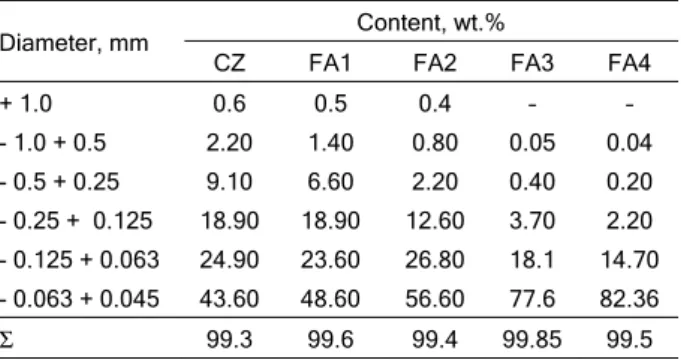
The particle size distribution of the fly ashes is given in Table 1.
(82.36 wt.%), so the FA4 is the finest fly ash. The low content of the coarse fractions (larger then 0.250 mm) is evident in all fly ashes. The content of the coarse fraction for the CZ is 11.9 wt.% and subsequently de-creases for the rest of the fly ashes reaching the va-lue of 0.24 wt.% for FA4. The medium fraction (0.250- –0.125 mm) in CZ is 43.80 wt.% and it is almost the same as the content of the fine fraction. The content of the medium fraction for the fly ashes FA1 to FA4 decreases and the lowest content is evident in FA4 (16.9 wt.%).
Table 1. Particle size analysis of the fly ash
Diameter, mm Content, wt.%
CZ FA1 FA2 FA3 FA4
+ 1.0 0.6 0.5 0.4 – –
- 1.0 + 0.5 2.20 1.40 0.80 0.05 0.04 - 0.5 + 0.25 9.10 6.60 2.20 0.40 0.20 - 0.25 + 0.125 18.90 18.90 12.60 3.70 2.20 - 0.125 + 0.063 24.90 23.60 26.80 18.1 14.70 - 0.063 + 0.045 43.60 48.60 56.60 77.6 82.36
Σ 99.3 99.6 99.4 99.85 99.5
As the fraction less than 0.063 mm is the most reactive part of fly ashes, it was used as a starting point material for the next investigations for all types of the received fly ashes.
Chemical and physical properties of the fly ashes
Chemical composition and loss of ignition
The chemical composition of the investigated fly ashes (a fraction less than 0.063 mm) is given in Table 2.
Table 2. Chemical composition of the fly ashes
Oxide Content, wt.%
CZ FA1 FA2 FA3 FA4 SiO2 50.33 53.31 49.20 48.81 49.51
Al2O3 18.59 19.92 18.78 17.81 17.62
Fe2O3 7.71 7.68 7.72 7.80 7.91
CaO 13.76 10.74 13.23 14.31 13.77 MgO 3.05 2.70 3.04 3.39 3.36 Na2O 1.07 0.84 0.78 0.70 0.69
K2O 1.41 1.51 1.45 1.38 1.46
SO3 1.44 1.03 1.78 2.76 3.52
LOI 2.60 2.20 2.03 1.78 1.57
Σ 99.96 99.93 98.01 98.74 99.41
It is evident from Table 2 that the major che-mical components in the fly ashes are: SiO2, Al2O3 and CaO. In all the fly ashes, the content of CaO is higher than 10% and can be characterized as Class C fly ashes. According to ASTM C618 [23] fly ashes from lignite coals have a relatively large content of CaO and they are classified as Class C ashes.
(a) (b) (c)
(d) (e)
Free CaO was not detected in the investigated fly ashes. According to Kiattikomol et al. [24] the pozzolanic activity of the fly ash is influenced by cal-cium in the glass, and not by the free calcal-cium oxide nor crystalline CaO.
The content of LOI slightly decreased, starting from CZ (2.60 wt.%) towards FA4 (1.57 wt.%). The values of LOI are related to the existence of the un-burnt coal particles, and according to Itskos et al. [25] it is also a result of the thermal disruption of some of its components.
Phase composition
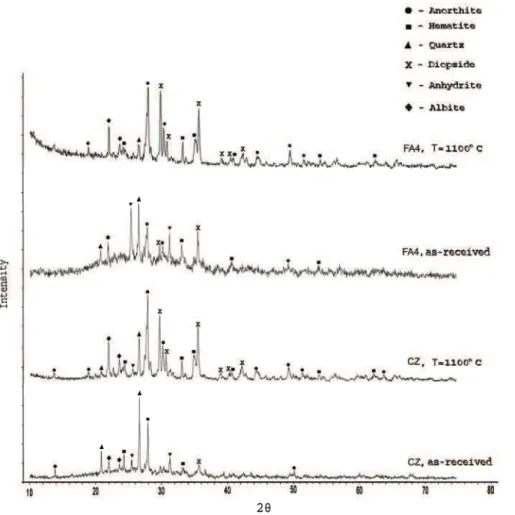
From the XRD patterns of the CZ and FA4 pre-sented in Figure 2, the presence of the principal crys-talline phases is obvious: SiO2 - quartz, CaAl2Si2O8 - anorthite, Fe2O3 - hematite, NaAlSi3O8 - albite, CaSO4 - anhydrite and an amorphous phase. In addition, the presence of quartz and anorthite are more empha-sized in the CZ compared to FA4. The detected an-hydrite is a characteristic phase in class C fly ashes. Gikunoo [26] reports that for most of the ashes, only about half of the SO3 occurred as anhydrite while the rest play a role in the formation of alkali sulphates.
From the intensity of the peaks it is obvious that an-hydrite is more present in FA4. This is in relation to the SO3 content detected from the chemical analysis in Table 2. Namely, the SO3 content in CZ is 1.44 wt.%, but the amount of SO3 in FA4 is more than double (3.52 wt.%). The existence of anhydrite in the finer fractions of the ashes is confirmed in the lite-rature as well [25]. From the XRD patterns it is as well obvious that there is a significant difference in the amorphous phase present in the FA4 compared to CZ, which is reflected in the high reactivity of FA4 compared to CZ. According to [27] the glass fraction in fly ashes usually varies between 70 and 89% de-pending on the type and coal source, degree of pulve-risation, combustion conditions in the furnace, and the cooling rate of the combustion residue.
Specific surface area and specific gravity of the fly ashes and green density of the compacts
Table 3 presents the specific gravity, surface area of the fly ashes and green density of the com-pacts.
the specific gravity of fly ash generally varies from 1.3 to 4.8 g/cm3 and it is closely related to the shape and chemical composition of fly ash particles.
Table 3. Specific gravity, specific surface area of the fly ashes and green densities of the compacts
Property CZ FA1 FA2 FA3 FA4 Specific gravity, g/cm3 2.28 2.27 2.32 2.38 2.42 Specific surface area, m2/g 3.09 3.68 4.99 6.10 11.31 Green density, g/cm3 1.524 1.519 1.520 1.524 1.556
The specific surface area increased from FA1 to FA4 reaching the value of 11.31 m2/g and it is almost 3.5 times higher than the value of the CZ. The diffe-rences are due to the different size, form and relief of the particles.
Concerning the green density, FA4 showed the highest density which is a result of the better packing of the particles during the pressing as a consequence of the high amount of fine particles present in FA4. Higher green density promotes a greater density of the sintered compacts [29].
Thermal properties of the fly ashes
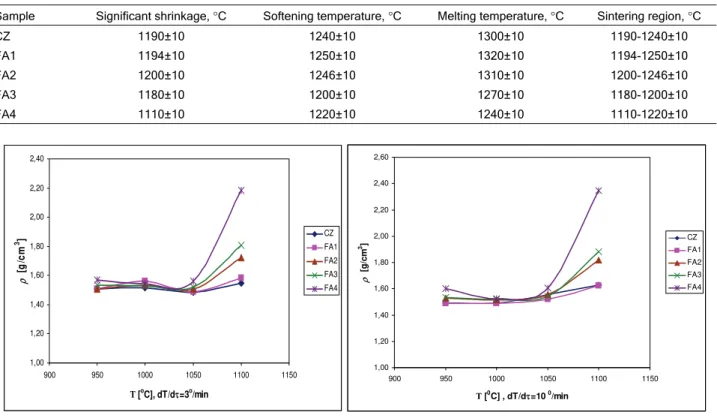
The thermal properties of the fly ashes are given in Table 4.
According to the data presented in Table 4, it is evident that all types of fly ashes have a narrow re-gion of sintering (1190-1250)±10 °C, except for FA4 (1110-1220)±10 °C. The melting temperature for CZ is 1300±10 °C, while for the rest of the fly ashes, they are in the interval from (1270-1320)±10 °C, and for FA4, it is 1240±10 °C.
Physical and thermal properties of sintered samples
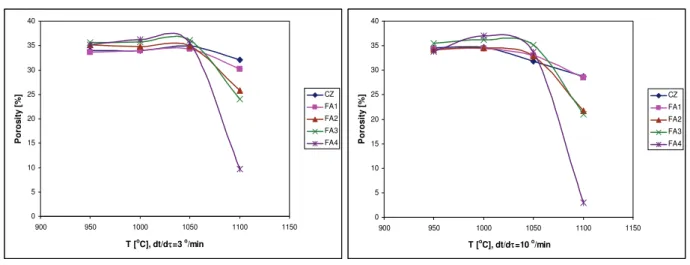
The variation of density, porosity, water absorp-tion and linear shrinkage with a temperature at a heating rate of 3 and 10 °C/min are presented in Fi-gures 3-6.
The densities of the all FA compacts in the sin-tering region from 950 to 1050 °C for both heating rates are close, i.e., in the ranges from 1.50±0.02 to 1.61±0.02 g/cm3 (Figures 3a and 3b). For all the fly ash compacts, the density at a temperature of 1100 °C in-creased for both the applied heating rates, particularly for FA4. One of the reasons for the highest density of FA4 (2.35±0.02 g/cm3) is a lower content of residual coal and as a consequence during the sintering the lower porosity has been produced. The particle with no defined geometry influenced the package of the powders. Thus, the smaller the particle size, the smaller the space (pores) among the particles that is generated during the package of the powders, and in
Table 4. Thermal properties of the investigated fly ashes
Sample Significant shrinkage, °C Softening temperature, °C Melting temperature, °C Sintering region, °C
CZ 1190±10 1240±10 1300±10 1190-1240±10
FA1 1194±10 1250±10 1320±10 1194-1250±10
FA2 1200±10 1246±10 1310±10 1200-1246±10
FA3 1180±10 1200±10 1270±10 1180-1200±10
FA4 1110±10 1220±10 1240±10 1110-1220±10
1,00 1,20 1,40 1,60 1,80 2,00 2,20 2,40
900 950 1000 1050 1100 1150
T [oC], dT/d
τ=3o/min
ρ
[
g
/c
m
3]
CZ
FA1
FA2
FA3 FA4
1,00 1,20 1,40 1,60 1,80 2,00 2,20 2,40 2,60
900 950 1000 1050 1100 1150
T [0C] , dT/d
τ=10 0/min
ρ
[g
/c
m
3]
CZ FA1
FA2 FA3
FA4
(a) (b)
0 5 10 15 20 25 30 35 40
900 950 1000 1050 1100 1150
T [oC], dt/d
τ=3 o/min
P o ro s ity [% ] CZ FA1 FA2 FA3 FA4 0 5 10 15 20 25 30 35 40
900 950 1000 1050 1100 1150
T [oC], dt/d
τ=10 o/min
Po ro s it y [ % ] CZ FA1 FA2 FA3 FA4
(a) (b)
Figure 4. Porosity of the sintered fly ash compacts using heating rate: a - 3 and b - 10°C/min.
0 5 10 15 20 25
900 950 1000 1050 1100 1150
T [0C], dt/dτ=30/min
W a te r ab so rp ti o n [ % ] CZ FA1 FA2 FA3 FA4 0 5 10 15 20 25
900 950 1000 1050 1100 1150
T [0C], dt/d
τ=10 0/min
W a te r a b s o rp ti o n [%] CZ FA1 FA2 FA3 FA4
(a) (b)
Figure 5. Water absorption of the sintered fly ash compacts using heating rate: a - 3 and b - 10°C/min.
-14 -12 -10 -8 -6 -4 -2 0
900 950 1000 1050 1100 1150
T [oC], dT/dτ=3o/min
Δ L/ L, [ % ] CZ FA1 FA2 FA3 FA4 -16 -14 -12 -10 -8 -6 -4 -2 0
950 1000 1050 1100
T [0C], dT/dτ=10 0/min
Δ L/ L [ % ] CZ FA1 FA2 FA3 FA4
(a) (b)
Figure 6. Shrinkage of sintered fly ash compacts using heating rate: a - 3 and b - 10°C/min.
the course of sintering the smaller pores are easily eliminated and the compacts with lower porosity are produced [29].
the density of 2.35±0.02 g/cm3 was achieved, which is in accordance with the literature [30].
From Figure 4 it is evident that the porosity of the all fly ash samples decrease at a temperature of 1100 °C, and it is the most expressed for FA4. Thus, the porosity for CZ, sintered at 1100 °C using a heat-ing rate of 10 °C/min, was 28.5±2%, while the poro-sity for FA4 samples, sintered under the same condi-tions, was 2.96±0.5%.
The data for water absorption presented in Fi-gure 5 shows that the FA4 has the lowest value (2.39 wt.%) at a temperature of 1100 °C, using a heating rate of 10 °C/min. The values for density, water ab-sorption and porosity are better than the values re-ported by Ilic et al. [31] and Pimraksa et al. [22].
The maximal shrinkage has the sample FA4 (13 wt.%) and according to [32] it is a result of the high reactivity, i.e., the higher factor of geometrical activity.
The characteristic of thermal expansion deter-mined in the interval of RT-650 °C-RT showed ab-sence of hysteresis, which proves that the obtained ceramic compacts are in thermal equilibrium [19]. The technical coefficient for CZ and FA4, sintered at 1100
°C using the heating rate of 10 ºC/min, is 8.30 and 8.58×10⁻⁶/°C, respectively, and corresponds to the va-lue reported in literature [33].
Mechanical properties of the sintered samples
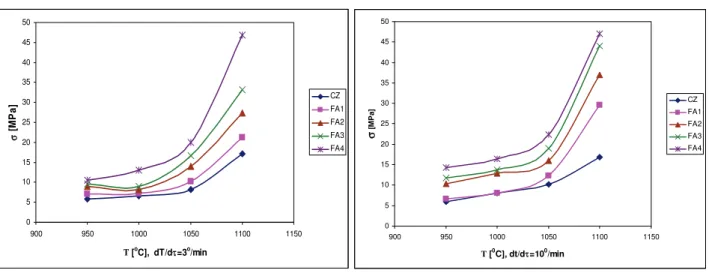
In Figure 7, the bending strength of the fly ash compacts versus the sintering temperature for both the heating rates are presented.
Generally, for all FA compacts, by increasing the temperature up to 1050 °C the bending strength is also increased and there are no significant differen-ces in bending strengths, no matter if the heating rate was 3 or 10 °C/min. The significant difference of
bending strength is evident at higher sintering tempe-ratures. The FA4 compacts showed the highest va-lues of bending strength for the investigated sintering region. Namely, the bending strength for FA4 at 950 °C was 14.26±1 MPa, but at the final temperature of 1100 °C the maximum bending strength of 47.01±2 MPa was reached. The highest values of the bending strength of FA4 compacts is directly related to the lower residual coal content, narrow particle size distri-bution and the morphology of the fly ash particles. As a consequence the compacts with high density/lower porosity and high mechanical properties were ob-tained. The bending strength for CZ compacts was the lowest for the whole investigated temperature re-gion, starting from 6±1 MPa at 950 °C up to 16.5±1 MPa at 1100 °C.
Further research was conducted only to the FA4 and CZ compacts, as the most favorable investigated systems due to the highest physical and mechanical properties - FA4, and the integral quantity of CZ pro-duced during the combustion of coal.
Figure 8 presents the variation of the compres-sive strength of CZ and FA4 compacts with the sin-tering temperature for both the heating rates.
It is evident that for the FA4 the compressive strength increased from 70±3 to 170±5 MPa by in-creasing the sintering temperature from 950 to 1100
°C using the heating rate of 10 °C/min. The bending and compressive strength for the sintered FA4 com-pacts are higher than those reported by Pimraksa et al. [22] for the investigated temperature region.
It is obvious that the mechanical properties of the investigated fly ash compacts have generally higher values when the heating rate of 10 °C/min was used during the sintering. It can be explained that one of the reasons is limiting the oxygen access to the
0 5 10 15 20 25 30 35 40 45 50
900 950 1000 1050 1100 1150
T [oC], dT/d
τ=3o/min
σ
[M
P
a
] CZFA1
FA2
FA3
FA4
0 5 10 15 20 25 30 35 40 45 50
900 950 1000 1050 1100 1150
T [0C], dt/dτ=100/min
σ
[M
P
a
]
CZ FA1 FA2 FA3
FA4
(a) (b)
carbon in the compact interior described in [34]. Ap-plying the higher heating rate during the sintering, the surface of the compact is sintered and becomes vir-tually impervious to air. As a result, the carbon parti-cles encapsulated inside the specimen were not oxi-dized and did not generate any pores.
0 20 40 60 80 100 120 140 160 180
900 950 1000 1050 1100 1150
Sintering temperature [0 C],
σ
[MP
a
]
CZ, dt/dt=3 C/min
FA4, dt/dt=3 C/min
CZ, dt/dt=10 C/min
FA4, dt/dt=10 C/min
Figure 8. Plot of compressive strength of the samples in relation to sintering temperature.
XRD Studies of the sintered samples
The XRD patterns for received CZ and FA4 and sintered compacts of CZ and FA4 at a temperature of 1100 °C with a heating rate of 10 °C/min, are shown in Figure 2.
The crystalline phases in received CZ and FA4 are: quartz, anorthite, hematite and albite, and they remain (the same) in the sintered samples of CZ and FA4. Sintering the samples of CZ and FA4 at 1100 °C reduce the peaks of quartz (SiO2) and anhydrite (CaSO4) and are in accordance with [25]. On the other hand, sintering promotes the anorthite peaks (CaAl2Si2O8). The relatively high content of CaO pre-sent in the received fly ashes is the reason for the formation of anorthite. As reported by Erol et al. [35], the substitution of the Ca ion into the SiO2–Al2O3 couple lead to the occurrence of anorthite at high temperatu-res. In addition, the new crystalline phase of diopside [Ca(Mg,Al)(Si,Al)2O6] was detected and the formation of diopside should be forced [36], because it generally displayed better physical properties due to the inter-locking microstructure of its crystals.
The amorphous phase especially present in FA4 has been reduced during the sintering of the compacts.
Microstructural analysis
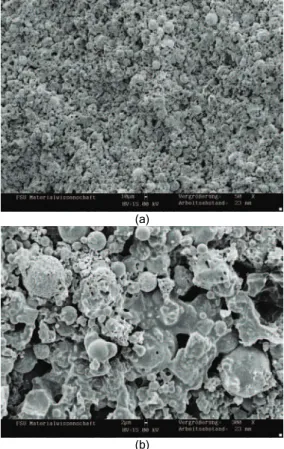
The microstructures of the fractured surface of the compacts CZ and FA4 sintered at 1100 °C with a heating rate of 10 °C/min are presented in Figures 9 and 10, respectively.
(a)
(b)
Figure 9. SEM Images for CZ, T = 1100 °C/1h,
dT/dτ = 10 °C/min; bars: a)10 and b) 2 µm.
(a)
(b)
The microstructure of CZ compacts, Figures 9a and 9b, is heterogeneous with evident presence of liquid bridges among the grains. The dimension of the grains varied in a wide interval (from 5 to 70 µm). The biggest part of the spherical grains has kept their individuality and their dimensions are in the interval from 8 to 15 µm. The presences of the porous grains (10-20 µm) are also evident. The dimensions of inter-granular pores are 2±1 µm.
Figures 10a and 10b show the microstructure of the FA4 which is more homogeneous and smoother compared to the microstructure of CZ sintered at the same temperature. A significant presence of the liquid phase is evident through the whole surface of the sintered compact. There are also closed pores with dimensions no larger than 10 µm. One of the basic reasons for better densification of the FA4 compacts is the morphology of the particles. The different form of the particles and their smaller dimensions are the reasons for more frequent contacts among the parti-cles. The narrow particle size distribution of FA4 is also the reason for interparticle neck formation and appearance of liquid phase at lower sintering tempe-ratures, as reported in literature [29].
CONCLUSIONS
- Fly ash from the thermal power plant REK Bi-tola, Republic of Macedonia, was used for production of dense ceramics.
– The process variables of the sintering were: temperature in the interval between 950 and 1100 °C, and a heating rate of 3 and 10 °C/min. Four different fly ashes from different zones of electro filter (FA1 and FA4) and one from the collected zone (CZ) with a granulation of <0.063 mm were the subject of this research.
- Ceramics with a porosity of 2.96±0.5%, density (2.35±0.02 g/cm3), bending strength 47.01±2 MPa and compressive strength 170±5 MPa, were
pro-duced at p = 133 MPa and T = 1100 °C, using a
heating rate of 10 °C/min.
– Sintering in the presence of the liquid phase was evident at a temperature of 1100 °C, but also the re-action of sintering among the CaO, SiO2 and Al2O3 has resulted in the formation of diopside [Ca(Mg,Al) (Si,Al)2O6].
- The produced dense ceramics are the potential materials in the construction industry.
REFERENCES
[1] European Coal Combustion Products Association e.V., http://www.ecoba.com (accessed 25 February 2011)
[2] O.E. Manz, Fuel 76(8) (1997) 691-696
[3] L.K.A. Sear, International ash Symposium, Center for applied Energy Research, University of Kentucky, Paper 36 (2001)
[4] J. Monzo, J. Paya, E. Peris-Mora, Cem. Con. Res. 24 (1994) 791-796
[5] K.S. Wang, K.L. Lin, Z.Q. Huang, Cem. Con. Res. 31 (2001) 97-103
[6] B.M. Galloway, Proceedings of the Fly Ash Applications in 1980 Conference, College Station, Texas (1980) [7] A. Mistra, S. Upadhyaya, D. Biswas, International Ash
Utilization Symposium, Center for applied Energy Re-search, University of Kentucky, Paper 118 (2003) [8] J. Zerbe, J. Siepak, H. Elbanowska, Pol. J. Environ. Stud.
10(2) (2001) 113-117
[9] E. Çokça, J. Geotec. Geoenviron. Eng. 27(7) (2001) 568- –573
[10] S.R. Kaniraj, V. Gayathri, J. Ener. Eng. 30(1) (2004) 18-43 [11] C.Heidrich, International Ash Utilization Symposium,
Center for applied Energy Research, University of Ken-tucky, 2005
[12] V. Kumar, K.A. Zacharia, G. Goswami, Fly Ash in Agricul-ture: Issues & Concerns, http://www.tiffac.org.in/ /news/flyagr.htm (accessed 25 February 2011)
[13] R.D. Rawlings, J.P. Wu, A.R. Boccaccini, J. Mater. Sci. 41 (2006) 733-761
[14] M.R. Little, V. Adell, A.R. Boccaccini, C.R. Cheeseman, Res. Con. Rec. 52(11) (2008) 1329-1335
[15] R. Rekecki, J. Ranogajec, Proc. App. Ceram. 2(2) (2008) 89-95.
[16] C.Y. Park, S.D. Yoon,Y.H. Yun, J. Ceram. Proc. Res. 8(6) (2007) 435-439
[17] I. Fukumoto, Y. Kanda, J. Sol. Mech. Mat. Eng. 3(5) (2009) 739-747
[18] J.P. Wu, A.R. Boccaccini, P.D. Lee, M.J. Kershaw, R.D. Rawlings, Adv. App. Ceram. 105(1) (2006) 32-39 [19] J. Bossert , E. Fidancevska, B. Mangutova, B. Panova, D.
Milosevski, M. Milosevski, Sci. Sin. 36 (2004) 87-92 [20] B. Mangutova, E. Fidancevska, M. Milosevski, J. Bossert,
APTEFF 35 (2004) 103-110
[21] A. Zimmer, C.P. Bergman, Was. Manag. 27(1) (2007) 59- –68
[22] K. Pimraksa, M. Wilhelm, M. Kochberger, W. Wruss, In-ternational ash Symposium, Center for applied Energy Research, University of Kentucky, Paper 84 (2001). [23] Annual Book of ASTM Standards, B618-03, pp.459-467 [24] K. Kiattikomol, C. Jataurpitakkul, S. Songpiriyakij, S.
Chu-tubtim, Cem. Con. Comp. 23 (2001) 335-343
[25] G. Itskos, S. Itskos, N. Koukouzas, Fuel Proc. Tech. 91 (2010) 1558-1563
[26] E. Gikunoo, Master thesis, University of Saskatchewan, Canada, 2004
[28] A. Medina, P. Camero, X. Querol, N. Moreno, B. de Leon, M. Almanza, G. Vargas, M. Izquierdo, O. Font, J. Haz. Mater. 181 (2010) 82-90
[29] E. Benavidez, C. Grasselli, N. Quaranta, Ceram. Inter. 29 (2003) 61-68
[30] A. Karamanov, M. Aloisi, M. Pelino, J. Eur. Ceram. Soc. 25 (2005) 1531-1540
[31] M. Ilic, C. Cheeseman, C. Sollars, J. Knight, Fuel 82 (2003) 331-336
[32] V. Adell, C.R. Cheeseman, M. Ferraris, M. Salvo, F. Smeacetto, A.R. Boccaccini, Mater. Charact. 58 (2007) 980-988
[33] A. Karamanov, M. Pelino, M. Salvo, I. Metekovits, J. Eur. Ceram. Soc. 23 (2003) 1609-1615
[34] A. Mishulovich, J.L. Evanko, Ceramic International ash Symposium, Center for applied Energy Research, Uni-versity of Kentucky, Paper 18 (2003)
[35] M. Erol, S. Kűçűkbayrak, A. Ersoy Meriçboyu, Fuel 87 (2008) 1334-1340
[36] Y.J. Park, S.O. Moon, J. Heo, Ceram. Inter. 29 (2003) 223-227.
BILJANA ANGJUSHEVA EMILIJA FIDANCEVSKA VOJO JOVANOV
Faculty of Technology and Metallurgy, University “Ss. Cyril and Methodius”, Skopje, Republic of Macedonia
NAUČNI RAD
PROIZVODNJA KERAMIKE OD PEPELA UGLJA
Gusta keramika se dobija iz pepela iz REK Bitola u Republici Makedoniji. Predmet ovog
istraživanja su četiri tipa pepela iz elektro filtera i jedan tip sa deponija sa česticma
manjim od 0,063 mm. Konsolidacija se postiže pod pritiskom (p = 133 MPa) i
sinterova-njem (na temperaturama 950, 1000, 1050 ili 1100 °C ibrzinom zagrevanja od 3 ili 10
°C/min). Zgušnjavanje se postiže sinterovanjem tečnom fazom i reakcijom u čvrstom
stanju, pri čemu se formira diopsid (Ca(Mg,Al)(Si,Al)2O6). Keramika optimalnih
karakte-ristika (poroznosti 2,96±0,5%, jačine savijanja 47±2 MPa, čvrstoće 170±5 MPa) je
do-bijena na1100 °C brzinom zagrevanja od 10 °C/min.