www.earth-syst-sci-data.net/8/105/2016/ doi:10.5194/essd-8-105-2016
© Author(s) 2016. CC Attribution 3.0 License.
A database of multi-year (2004–2010) quality-assured
surface solar hourly irradiation measurements for the
Egyptian territory
Mohamed Korany1, Mohamed Boraiy2, Yehia Eissa3,4, Youva Aoun4, Magdy M. Abdel Wahab5, Stéphane C. Alfaro6, Philippe Blanc4, Mossad El-Metwally7, Hosni Ghedira3, Katja Hungershoefer8,
and Lucien Wald4
1Egyptian Meteorological Authority, Cairo, Egypt 2Physics and Mathematical Engineering Department, Faculty of Engineering,
Port Said University, Port Said, Egypt
3Masdar Institute, Research Center for Renewable Energy Mapping and Assessment,
P.O. Box 54224, Abu Dhabi, UAE
4MINES ParisTech, PSL Research University, O.I.E. – Centre Observation, Impacts, Energy,
CS 10207 – 06904 Sophia Antipolis CEDEX, France
5Astronomy and Meteorology Department, Faculty of Science, Cairo University, Cairo, Egypt 6Laboratoire Inter-universitaire des Systèmes Atmosphériques, Universités de Paris-Est Créteil et
Paris-Diderot, France
7Physics Department, Faculty of Science, Port Said University, Port Said, Egypt 8Deutscher Wetterdienst, Offenbach, Germany
Correspondence to:Stéphane Alfaro ([email protected])
Received: 6 July 2015 – Published in Earth Syst. Sci. Data Discuss.: 9 September 2015 Revised: 18 February 2016 – Accepted: 21 February 2016 – Published: 1 March 2016
106 M. Korany et al.: Quality-assured surface solar hourly irradiation measurements
1 Introduction
With the development of solar-based renewable energy tech-nologies, national meteorological services must face increas-ing demands for reliable data on solar resource. Complete and accurate solar radiation data for specific regions are also indispensable for a large variety of solar-energy-related stud-ies. The surface solar irradiation (SSI), i.e. the downwelling broadband solar irradiation received at ground level on a hor-izontal plane, and its diffuse and direct components are mea-sured by means of pyranometers and pyrheliometers (WMO, 2008). Pyranometers are hemispherical sensors measuring the global irradiation on a horizontal plane, denoted by the variable G. Shaded pyranometers measure the diffuse irra-diation on a horizontal plane,D. Pyrheliometers, comprised of thermopile sensors and a Sun-tracking mechanism, mea-sure the direct (or beam) irradiation incident from the Sun on a normal plane,Bn. The varying aperture (or opening)
half-angles of the different pyrheliometeric systems, normally be-tween 2.5◦
and 5◦
, means they are also measuring the radia-tion surrounding the solar disc, i.e. the circumsolar radiaradia-tion (Blanc et al., 2014).
Measuring the SSI and its components is more difficult than other meteorological variables. Systematic errors due to the instruments themselves exist (e.g. Muneer and Fairooz, 2002; Younes et al., 2005), but the most important ones are usually random and due to operational causes such as main-tenance and instrument reading. Therefore, one of the major concerns of operational radiometric networks is to perform a rigorous quality control (QC) on the measurements (e.g. Journée and Bertrand, 2011; Moradi, 2009; Roesch et al., 2011). This is an indispensable step before further processing of the data.
In order to provide the large community of potential users with high quality SSI data, the Egyptian Meteorological Au-thority (EMA) started establishing in the 1960s a network of stations measuring the global SSI and its diffuse and di-rect components, as well as more common surface meteoro-logical variables. Currently, this network includes more than 10 sites.
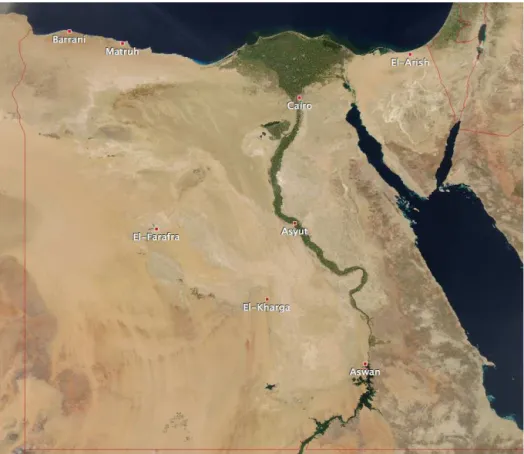
The aim of this paper is to describe the SUSIE (SUrface Solar Irradiance in Egypt for energy production) database elaborated in the framework of the eponymous Egyp-tian/French project. The database covers the period 2004– 2010 and includes the quality-checked hourly measurements of the SSI components performed at eight EMA stations (Fig. 1). These stations were selected for being representa-tive of the different types of Egyptian climates (Diabaté et al., 2004), namely “coastal” (Matruh, Barrani), arid Sinai Peninsula (El-Arish), “urban” (Cairo), “Nile valley and up-per Egypt” (Asyut and Aswan) and “desert” (El-Kharga and El-Farafra). For all sites, meteorological variables such as air temperature, pressure, wind direction/speed and humidity are also included in the database.
Measurements are currently going on at the EMA stations and SUSIE was an opportunity to make measurements avail-able to a wide audience. Note that for the moment no SSI data are proposed after 2010 because EMA was unable to attend the World Meteorological Organization (WMO) In-ternational Pyrheliometer Comparison (IPC-XI) held at the World Radiation Center (WRC) in Davos in September– October 2010 and calibrate its absolute reference pyrhe-liometer, namely the self-calibrating Absolute Cavity Pyrhe-liometer Model HF No. 31103. Therefore, the EMA can-not consider its post-2010 measurements reliable before this reference instrument is calibrated again in the frame of the 12th International Pyrheliometer Comparison (IPC-XII) in September–October 2015 at the WRC and a correction is de-signed for the data from 2011 to 2015.
This paper is organized as follows: the study area and the available ground measuring instruments are described in Sect. 2, the QC procedures applied to the SSI measure-ments are detailed in Sect. 3, their results and the structure of SUSIE database are given in Sect. 4. Finally, Sect. 5 is dedi-cated to the summary and perspectives. The quality-checked database is available in PANGAEA under Creative Com-mons Attribution 3.0 Unported International Public License (CC-BY 3.0).
2 Ground stations and measurements
2.1 Location of the measurement sites
Table 1 contains the names, WMO number and geographical characteristics (latitude, longitude, altitude, type of climate) of the eight sites reported in Fig. 1 and whose measurements in the period 2004–2010 were considered to build the SUSIE database. These sites and their surroundings are briefly de-scribed below.
Sidi Barrani (hereinafter referred to more simply as Bar-rani): situated in Lower Egypt along the north coast, the site is 500 m away from the Mediterranean coast. The instru-ments are located on a small hill outside the village of Sidi Barrani and in an open area. The soil around the measure-ment site is spread with numerous calcareous rocks the size of a fist.
Mersa Matruh (Matruh, hereinafter): also situated in Lower Egypt along the north coast and∼3000 m away from the Mediterranean coast. The instruments are located on the roof of a two-story building at the local airport. The sur-roundings are low residential buildings. No appreciable in-terception of the sky exists.
El-Arish: the station lies in the northeastern part of the arid Sinai Peninsula. The instruments are set up on the roof of the meteorological office, away from the town centre. The station is in the middle of olive farms and close to the El-Arish airport. The site has an open sky dome.
Figure 1.Location of the eight surface stations of the Egyptian Meteorological Authority (EMA) whose data are included in the SUSIE database.
Table 1. Name, WMO#, Location (Lat–Long), altitude (m), SSI components measured (Bn: direct at normal incidence;D: diffuse; G: global), and type of climate for the eight sites.
Site WMO# Lat◦ Long◦ Alt (m) SSI components Station type
Barrani 62303 31.60 26.00 23.7 G,D Mediterranean climate Matruh 62306 31.33 27.22 25 G,D Mediterranean climate El-Arish 62337 31.08 33.82 27.2 G,D Mediterranean climate Cairo 62371 30.08 31.28 34.4 G,D,Bn Urban-influenced climate El-Kharga 62435 25.45 30.53 77.8 G,D Western desert climate El-Farafra 62423 27.06 27.99 82.2 G,D,Bn Western desert climate Asyut 62393 27.2 31.17 52 G,D Desert Nile climate Aswan 62414 23.97 32.78 192.5 G,D,Bn Desert Nile climate
type, surrounded by high buildings and a heavy traffic load. In addition, two large industrial areas, Shubra El-Kheima and Helwan, are located north and south, respectively, of the mea-surement site.
El-Kharga: the oasis is inside the Western Desert. The sta-tion itself is located at the limit of the oasis in an agricultural research centre around which bare sandy surfaces with scat-tered shrubs can be observed. No appreciable interception of the sky exists within the field of view of the measuring in-struments.
El-Farafra: this small oasis is located approximately 450 km to the southwest of Cairo and 480 km south of the
Mediterranean Sea in a part of the western Egyptian desert known as the “White Desert”. The instruments are located on the roof of the two-story building of EMA station. The site is located east of the village of El-Farafra, in an extremely flat, open area deprived of any obstacles. According to the classi-fication of Diabaté et al. (2004), the area is characterized by a dry desert climate.
108 M. Korany et al.: Quality-assured surface solar hourly irradiation measurements
Aswan is also situated in Upper Egypt and it exhibits a dry desert climate. The instruments are installed over a two-story building inside the premises of the Aswan military airport. The site is surrounded by sandy surfaces with sparse rocks of varying sizes.
2.2 Irradiation measurements 2.2.1 Instruments and data storage
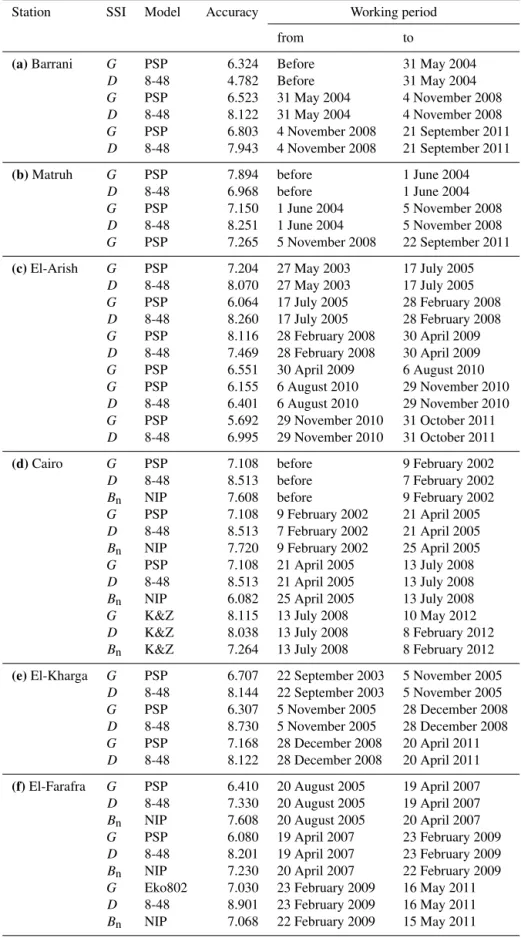
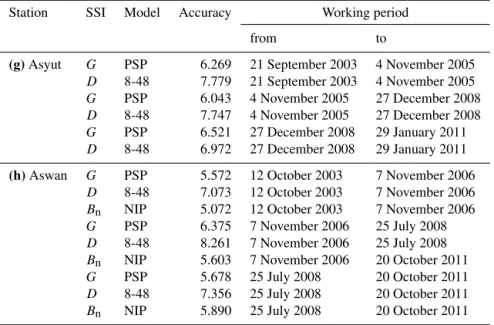
SSI measurements are not performed with the same types of pyranometers and pyrheliometers at the eight sites. Table 2a– h contains the period of measurements – note that the mea-surements at Barrani and El-Farafra did not start before Jan-uary and August 2005, respectively – and the details of the instruments. Data-loggers scan the signals from the radiation sensors at least every minute. However, in order to increase their storage capacity, these initial data are stored as hourly averages.
2.2.2 Instrument maintenance, calibration and performance
Measurements of the global SSI are made with pyranome-ters. The properties of concern when evaluating the accu-racy and quality of the radiation measurements are the sen-sitivity, stability, response time, cosine response, azimuth re-sponse, linearity, temperature response and spectral response (Wald et al., 2000; ISO-9060, 1990). Deviations are caused primarily by the directional sensitivity of the individual re-ceiver surfaces and by effects of the glass dome covering the upward-facing sensor (Geiger et al., 2002). This dome must be cleaned regularly to avoid soiling of its surface, especially at the desert stations where deposition of wind-blown dust is an acute problem. Other errors may result from inaccurate horizontal adjustment of the receiver surface, moisture inside the dome, etc. Though smaller relative uncertainties can be achieved for daily irradiation (WMO, 2008), in the case of hourly irradiation the relative uncertainties at the 66 % con-fidence level are about 3, 5 and 20 % for operational pyra-nometers of high, good and moderate quality, respectively. T PSP and NIP instruments (see Table 2) are of the high-quality types and the relative uncertainty on the hourly G andBnis less than 3 %. The 8-48 instrument is of the
good-quality type, and the relative uncertainty onDis in the range 3 to 5 %.
The shading–unshading method (WMO, 1981; McArthur, 2004) is used to calibrate the pyranometers every year by comparison against the EMA reference Pyrheliometer HF 31103, itself being calibrated every 5 years at the World Radiometric Reference (WRR), at Davos in Switzer-land (WMO/TD No. 1320, 2006). In order to minimize the uncertainties further, the measurements performed by the pyranometers are corrected to account for: (1) thermal offsets, (2) cosine response, and (3) temperature sensitiv-ity of the calibration constant. These corrections follow the
WRC (1985, 1995) guidelines. The pyrheliometers and pyra-nometers used at the EMA stations are traceable to the World Radiometric Reference (WRR) standards.
2.3 Meteorological variables
Basic meteorological variables, namely the relative humidity, mean sea level pressure, dry-bulb temperature, wet-bulb tem-perature, wind direction, wind speed and cloud amount are also measured at the EMA sites. Except for cloud amount, measurements are performed at the frequency of 1 Hz for the 10 min preceding each hour and their averages are stored by the data-loggers.
All measurements are performed in agreement with the WMO requirements. Mercury thermometers manufactured by R. Fuess and Theodor Friedrichs, which count among the most accurate meteorological thermometers (WMO, 2008), are used for routine observations of the air, wet-bulb and dry-bulb temperatures. Based on the recommendation of the Commission for Instruments and Methods of Observation, several regional associations of WMO have set up regional instrument centres (RICs) to maintain standards and provide advice (WMO/CIMO, 1985). Cairo (Egypt) is one of those RICs for RA I (Africa). Their terms of reference and loca-tions are given in WMO (2008, Annex 1.A).
The operational instruments for measuring atmospheric pressure are mercury (R. Fuess, type 11a-9) barometers, and Short and Mason barographs are used for continu-ous pressure recording. Surface wind characteristics (speed and direction) are monitored with Munro cup or propeller anemometers. Finally, the measurements of the cloud amount are made by visual observation according to the Code ta-ble 2700 in WMO (2010).
3 Details of the quality control applied to the data
The EMA is particularly aware of the importance of the qual-ity assurance and management of its observing systems. In spite of the quality of the instruments used and of the dedi-cation of the personnel who calibrate, maintain and operate them, measurement errors are still possible. Therefore, qual-ity control (QC) procedures aiming at flagging suspicious values are applied to the measurements of solar radiation and other meteorological variables.
3.1 Meteorological variables
Table 2. Details of the set of instruments implemented at the eight experimental sites. Their accuracy (in mV cal−1cm−2min−1) and working periods are also reported.
Station SSI Model Accuracy Working period
from to
(a)Barrani G PSP 6.324 Before 31 May 2004
D 8-48 4.782 Before 31 May 2004
G PSP 6.523 31 May 2004 4 November 2008 D 8-48 8.122 31 May 2004 4 November 2008 G PSP 6.803 4 November 2008 21 September 2011 D 8-48 7.943 4 November 2008 21 September 2011
(b)Matruh G PSP 7.894 before 1 June 2004 D 8-48 6.968 before 1 June 2004 G PSP 7.150 1 June 2004 5 November 2008 D 8-48 8.251 1 June 2004 5 November 2008 G PSP 7.265 5 November 2008 22 September 2011
(c)El-Arish G PSP 7.204 27 May 2003 17 July 2005 D 8-48 8.070 27 May 2003 17 July 2005 G PSP 6.064 17 July 2005 28 February 2008 D 8-48 8.260 17 July 2005 28 February 2008 G PSP 8.116 28 February 2008 30 April 2009 D 8-48 7.469 28 February 2008 30 April 2009 G PSP 6.551 30 April 2009 6 August 2010 G PSP 6.155 6 August 2010 29 November 2010 D 8-48 6.401 6 August 2010 29 November 2010 G PSP 5.692 29 November 2010 31 October 2011 D 8-48 6.995 29 November 2010 31 October 2011
(d)Cairo G PSP 7.108 before 9 February 2002 D 8-48 8.513 before 7 February 2002 Bn NIP 7.608 before 9 February 2002 G PSP 7.108 9 February 2002 21 April 2005 D 8-48 8.513 7 February 2002 21 April 2005 Bn NIP 7.720 9 February 2002 25 April 2005 G PSP 7.108 21 April 2005 13 July 2008 D 8-48 8.513 21 April 2005 13 July 2008 Bn NIP 6.082 25 April 2005 13 July 2008 G K&Z 8.115 13 July 2008 10 May 2012 D K&Z 8.038 13 July 2008 8 February 2012 Bn K&Z 7.264 13 July 2008 8 February 2012
(e)El-Kharga G PSP 6.707 22 September 2003 5 November 2005 D 8-48 8.144 22 September 2003 5 November 2005 G PSP 6.307 5 November 2005 28 December 2008 D 8-48 8.730 5 November 2005 28 December 2008 G PSP 7.168 28 December 2008 20 April 2011 D 8-48 8.122 28 December 2008 20 April 2011
110 M. Korany et al.: Quality-assured surface solar hourly irradiation measurements
Table 2.Continued.
Station SSI Model Accuracy Working period
from to
(g)Asyut G PSP 6.269 21 September 2003 4 November 2005 D 8-48 7.779 21 September 2003 4 November 2005 G PSP 6.043 4 November 2005 27 December 2008 D 8-48 7.747 4 November 2005 27 December 2008 G PSP 6.521 27 December 2008 29 January 2011 D 8-48 6.972 27 December 2008 29 January 2011
(h)Aswan G PSP 5.572 12 October 2003 7 November 2006 D 8-48 7.073 12 October 2003 7 November 2006 Bn NIP 5.072 12 October 2003 7 November 2006 G PSP 6.375 7 November 2006 25 July 2008 D 8-48 8.261 7 November 2006 25 July 2008 Bn NIP 5.603 7 November 2006 20 October 2011 G PSP 5.678 25 July 2008 20 October 2011 D 8-48 7.356 25 July 2008 20 October 2011 Bn NIP 5.890 25 July 2008 20 October 2011
– Highly experienced observers screen the records of hourly data. If they detect any logical error, they correct them.
– The reviewed records are sent to the central mainframe for the data entry.
– Computer programs test the internal self-consistency of the data sets and print a list of the suspicious data.
– The data entry errors detected in the previous phase of the checking procedure are corrected.
Note that some rare outliers or suspicious data (for instance null values of Tdry recorded at Barrani in the first half of
2009) might still be present in the meteorological data sets after these corrections.
3.2 SSI components
After a visual observation of the data sets of the SSI com-ponents to detect and remove periods of obviously erroneous measurements, the data sets are submitted to the QC. This QC is a succession of tests which result in flagging data as “successfully passed” (flag=0) or “failed” (flag=1) de-pending on the result of the test. In essence, the QC of the ra-diometric observations includes limits within which data are expected to lie for being acceptable. These tests are guided either by physical reasoning – detecting physically impossi-ble events – or by criteria based on the expected statistical variability of the data – detecting very rare and thus ques-tionable events. Furthermore, they either treat the various so-lar radiation parameters separately or compare them to each other. De Miguel et al. (2001), Geiger et al. (2002), Long and Dutton (2002), Muneer and Fairooz (2002), and Younes et
al. (2005) have proposed such tests, which have been adopted here for hourly irradiation. The measurements have units of MJ m−2. Denotingθ
Sthe solar zenith angle,E0andE0,nthe
hourly irradiation at top of atmosphere received on a horizon-tal surface, respectively at normal incidence, the conditions to pass are:
G>max
0.03E0,0.0036 MJ m−2
(1)
G<min
1.2E0,n,1.5E0cos(θS)0.2+0.36 MJ m−2,
1.2E0cos(θS)0.2+0.18 MJ m−2
(2)
D>max0.03E0,0.0036 MJ m−2
(3)
D<min0.8E0,n,0.95E0cos(θS)0.2+0.18 MJ m−2,
0.75E0cos(θS)0.2+0.108 MJ m−2
(4)
Bn>0.0036 MJ m−2 (5)
Bn<min
E0,n,0.95E0,ncos(θS)0.2+0.036 MJ m−2
. (6)
ForG,DandBnmeasured at Aswan, Cairo and El-Farafra,
and satisfying the aforementioned QC procedures, an addi-tional “consistency check” is performed. This test flags out any measurement for which the measured and computedG do not agree with each other within specified limits (Roesch et al., 2011):
0.92≤(Bncos(θS)+D)/G≤1.08 ifθS>75◦ (7)
0.85≤(Bncos(θS)+D)/G≤1.15 otherwise. (8)
Practically,E0,E0,nandθSwere obtained from the McClear
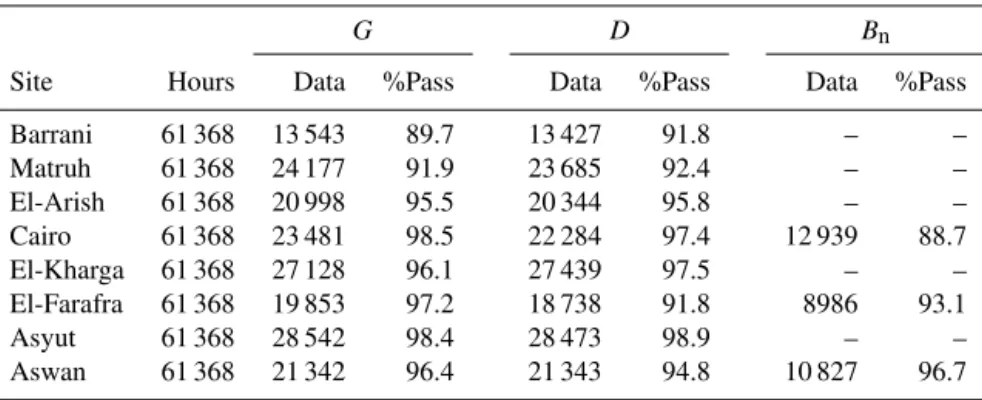
Table 3.Duration of the period 2004–2010 (in hours), numbers of available (non-missing, non-night, non-suspicious) data forG,DandBn. The proportion of available measurements having passed the quality check is also reported.
G D Bn
Site Hours Data %Pass Data %Pass Data %Pass
Barrani 61 368 13 543 89.7 13 427 91.8 – – Matruh 61 368 24 177 91.9 23 685 92.4 – – El-Arish 61 368 20 998 95.5 20 344 95.8 – – Cairo 61 368 23 481 98.5 22 284 97.4 12 939 88.7 El-Kharga 61 368 27 128 96.1 27 439 97.5 – – El-Farafra 61 368 19 853 97.2 18 738 91.8 8986 93.1
Asyut 61 368 28 542 98.4 28 473 98.9 – –
Aswan 61 368 21 342 96.4 21 343 94.8 10 827 96.7
Gschwind et al., 2006). Within a few clicks, the McClear ser-vice delivers time series of the SSI components that should be observed if the sky were clear for the site of interest (Lefèvre et al., 2013). It also provides precise values of E0
using an accurate algorithm for computing θS (Blanc and
Wald, 2012). Estimates of SSI in McClear are performed with a 1 min step; estimates may be then aggregated for var-ious durations. Here, hourly values forE0and the SSI
com-ponents for clear-sky Gclear,Dclear,Bclear andBclear,n were
requested, whereBcleardenotes the direct SSI on a horizontal
surface. Unfortunately, the McClear service does not provide estimates ofθS for each hour. AsθSvaries greatly within an
hour, an effectiveθSwas computed for each hour (Blanc and
Wald, 2016):
cos(θS)=Bclear/Bclear,n (9) E0,n=E0/cos(θS). (10)
4 Results
4.1 Results of the quality check
Theoretically, the maximal number of data that can be ac-quired between 1 January 2004 and 31 December 2010 is equal to the number of hours (61 368) in this period. Among these, approximately half are nighttime hours during which measurements are performed but give a null result that do not meet the minimum value requirement (see Eqs. 1, 3 and 5 above) of the QC. They are flagged accordingly. In addi-tion, several daytime values are missing in the sets of original data because of instrumental problems or maintenance opera-tions. In the case of El-Farafra and Barrani, the measurement period did not start in 2004 but in 2005, which contributes to increase significantly the number of missing data. In El-Arish, the data of 2010 were also discarded from the start after a visual screening because there was obviously a prob-lem with them. Table 3 reports for each station and for each irradiation component (G,DandBn) the total duration (in
hours) of the measurement period, the number of available
(non-night and non-missing) data before QC, and the pro-portion of this available data that passed the QC.
Even though the number of missing data is significantly larger at Barrani than elsewhere, the proportion of existing data validated by the QC (between 88.7 and 98.8 %) is re-markably large at all sites, which emphasizes the excellent quality of the measurements performed at the EMA stations. Therefore, at seven of the eight stations, from about 18 000 to 28 000GandDhourly values passed the QC successfully and are included in the final SUSIE database. Note that these figures correspond approximately to between 60 and 93 % of the total number of daytime hours and therefore to the the-oretical maximum of possible data in this 7-year period. In the case ofBn, the number of valid data is smaller but still
> 10 000 at Aswan and Cairo, and a little less (8360) at El-Farafra because the measurement period is shorter.
4.2 The SUSIE database: description and where to access it
For each of the eight surface stations, one file containing the hourly meteorological observations and another contain-ing the hourly components of the surface irradiation per-formed in parallel between 2004 and 2010 can be down-loaded from the Pangaea website (http://www.pangaea.de/) using a unique identifier (doi:10.1594/PANGAEA.848804). Note that to avoid any risk of confusion, two time stamps are given in UT: one at the beginning, and the other at the end, of the measuring hour. The meteorological files are self-explanatory and contain 11 columns in which one can find the average, start and end times of the measurements, the rel-ative humidity (in %), the surface pressure (in hPa), the dry-and wet-bulb temperatures (in◦
C), the wind direction (in◦ , and increasing clockwise with 0◦
denoting the wind blow-ing from the north), the wind speed (in m s−1) and the cloud
fraction (in okta).
112 M. Korany et al.: Quality-assured surface solar hourly irradiation measurements
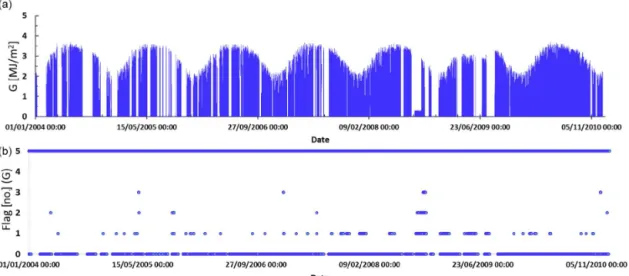
Figure 2.Temporal variation of the hourly global horizontal irradiation (G, in MJ m−2) measured from 1 January 2004 to 31 December 2010 at the Cairo station(a), and corresponding values of the flags allotted after the different tests of the quality tests(b).
stations where it is measured, the direct normal (Bn)
irra-diations. Missing values are left blank. Each available mea-surement is flagged “0” if it has successfully passed the QC and the visual screening. Otherwise, a flag is allotted whose value indicates the reason why the data were not considered as valid. More precisely, “1” means that the measurement is outside the range of expected extreme values, “2” that the measurement is greater than rarely observed values, “3” that the measurement is greater than rarely observed values and outside the range of expected extreme values. Flag “4” in-dicates that though having passed the QC successfully, the measurement is suspicious because further visual screening casts doubts on its validity. Flag “5” corresponds to night values. Finally, whenG,DandBnare available
simultane-ously, which is only possible at the Cairo, Aswan and El-Farafra stations, a last consistency flag of “0” if passed, or “1” otherwise is attributed. For illustrating the quality of the measurements, the variation with time ofGmeasured at the Cairo station and the associated values of the different flags are plotted in Fig. 2a and b, respectively. As already reported in Table 3, only a very small fraction (1.5 %) of the available data does not pass the quality check.
5 Summary and perspectives
A homogeneous database of hourly meteorological variables and surface solar irradiation components has been assem-bled. The data cover the period January 2004 to Decem-ber 2010 and originate from eight surface stations representa-tive of the variety of geographical (coastal, urban and desert) conditions in the Egyptian territory. These quality-checked data are available online at doi:10.1594/PANGAEA.848804. The data provide an insight to the spatial and temporal vari-ability of the global, diffuse and direct components of the
solar irradiation and thus constitute a precious tool for the estimation of the potential of solar energy in Egypt. Because of their high temporal resolution, the data are also adapted to atmospheric studies such as the study of the impact of aerosols on atmospheric radiative transfer. In the near future, it is planned to complete regularly the present 2004–2010 database, starting with the data of the period 2011–2015, as soon as the reference radiometer is recalibrated. Thanks to this continued acquisition, longer and more adapted to cli-mate studies time series will eventually become available in this part of the world where they are currently very scarce.
Acknowledgements. This work took place within the frame-works of the SUSIE (SUrface Solar Irradiance in Egypt for energy production) project (no. 5404) co-funded by the Science and Tech-nology Development Fund (STDF) of Egypt and the French AIRD, and of the MISRA (MIsr Solar Radiation Atlas) project funded by the French Ministry of Foreign Affairs and the UAE government. The authors thank all personnel of the Egyptian Meteorological Authority who installed and maintained the stations in Egypt. The background image of Fig. 1 was taken from the NASA Worldview (https://earthdata.nasa.gov/labs/worldview/) website.
Edited by: D. Carlson
References
Blanc, P. and Wald, L.: The SG2 algorithm for a fast and accurate computation of the position of the Sun for multi-decadal time period, Sol. Energy, 86, 3072–3083, doi:10.1016/j.solener.2012.07.018, 2012.
Blanc, P., Espinar, B., Geuder, N., Gueymard, C., Meyer, R., Pitz-Paal, R., Reinhardt, B., Renné, D., Sengupta, M., Wald, L., and Wilbert, S.: Direct normal irradiance related definitions and ap-plications: The circumsolar issue, Sol. Energy, 110, 561–577, doi:10.1016/j.solener.2014.10.001, 2014.
De Miguel, A., Bilbao, J., Aguiar, R., Kambezidis, H., and Ne-gro, E.: Diffuse solar irradiation model evaluation in the North Mediterranean Belt area, Sol. Energy, 70, 143–153, 2001. Diabaté, L., Blanc, P., and Wald, L.: Solar
radia-tion climate in Africa, Sol. Energy, 76, 733–744, doi:10.1016/j.solener.2004.01.002, 2004.
Geiger, M., Diabaté, L., Ménard, L., and Wald, L.: A web service for controlling the quality of measurements of global solar irra-diation, Sol. Energy, 73, 475–480, 2002.
Gschwind, B., Ménard, L., Albuisson, M., and Wald, L.: Convert-ing a successful research project into a sustainable service: the case of the SoDa Web service, Environ. Model. Softw., 21, 1555– 1561, doi:10.1016/j.envsoft.2006.05.002, 2006.
ISO 9060: Solar energy – Specification and classification of instru-ments for measuring hemispherical solar and direct solar radia-tion, Instrumental Standard ISO 9060, International Organisation for Standardization (ISO), Geneva, Switzerland, 1990.
Journée, M. and Bertrand, C.: Quality control of solar radiation data within the RMIB solar measurements network, Sol. Energy, 85, 72–86, 2011.
Lefèvre, M., Oumbe, A., Blanc, P., Espinar, B., Gschwind, B., Qu, Z., Wald, L., Schroedter-Homscheidt, M., Hoyer-Klick, C., Arola, A., Benedetti, A., Kaiser, J. W., and Morcrette, J.-J.: Mc-Clear: a new model estimating downwelling solar radiation at ground level in clear-sky conditions, Atmos. Meas. Tech., 6, 2403–2418, doi:10.5194/amt-6-2403-2013, 2013.
Long, C. and Dutton, E. G.: BSRN Global Network recom-mended QC tests, V2.0., BSRN Technical Report, avail-able at: http://bsrn.awi.de/fileadmin/user_upload/redakteur/ Publications/BSRN_recommended_QC_tests_V2.pdf (last access: 29 February 2016), 2002.
McArthur, L. J. B.: Baseline Surface Radiation Network (BSRN), Operations Manual, WMO/TD-No. 879, WCRP/WMO, Geneva, Switzerland, 2004.
Moradi, I.: Quality control of global solar radiation using sunshine duration hours, Energy, 34, 1–6, doi:10.1016/j.energy.2009.09.006, 2009.
Muneer, T. and Fairooz, F.: Quality control of solar radiation and sunshine measurements – lessons learnt from processing world-wide databases, Build. Serv. Eng. Res. T., 23, 151–166, 2002. Roesch, A., Wild, M., Ohmura, A., Dutton, E. G., Long, C. N.,
and Zhang, T.: Corrigendum to “Assessment of BSRN radia-tion records for the computaradia-tion of monthly means” published in Atmos. Meas. Tech., 4, 339–354, 2011, Atmos. Meas. Tech., 4, 973–973, doi:10.5194/amt-4-973-2011, 2011.
Wald, L., Albuisson, M., Czeplak, G., Bourges, B., Aguiar, R., Lund, H., Joukoff, A., Terzenbach, U., Beyer, H. G., and Borisenko, E. P.: ESRA: European Solar Radiation Atlas, edited by: Scharmer, K. and Greif, J., fourth edition, includ. CD-ROM, published for the Commission of the European Communities by Presses de l’Ecole, Ecole des Mines de Paris, Paris, France, 2000. WMO: Manual on the Global Observing System. WMO-No. 544. World Meteorological Organization, Geneva, Switzerland, 1981. WMO: Guide to Meteorological Instruments and Methods of Ob-servation, World Meteorological Organization, WMO-No 8, 7th Edn., Geneva, Switzerland, 2008.
WMO: Manual on Codes, WMO-No. 306, World Meteorological Organization, Geneva, Switzerland, 2010.
WMO/CIMO: International Organizing Committee for the WMO Solid Precipitation Measurement Intercomparison, Final Re-port of the First Session, Norrkoping, Sweden, WMO Geneva, Switzerland, 1985.
WMO/TD No. 1320/IMOP Report No. 91: WMO International Pyrheliometer Comparison, IPC-X, 26.9-14.10.2005, WMO, Geneva, Switzerland, 2006.
WRC: Sixth international pyrheliometer comparison (IPC VI), Working Report No. 137, 1–18 October 1985, Davos, Switzer-land, 1985.
WRC: International pyrheliometer comparison (IPC VII), Work-ing Report No. 188, 25 September–13 October 1995, Davos, Switzerland, 1995.