Original Article
Artigo Original
Adriana de Souza Batista Kida1 Clara Regina Brandão de Ávila2 Simone Aparecida Capellini1
Descritores
Avaliação Leitura Aprendizagem Dislexia
Keywords
Evaluation Reading Learning Dyslexia
Correspondence address: Adriana de Souza Batista Kida Avenida Hygino Muzzi Filho, 737, Mirante, Marilia (SP), Brazil, CEP: 17525-000. E-mail: [email protected] Received: 04/16/2015
Accepted: 05/11/2015
Study conducted at the Learning Disorders Research Laboratory of the Department of Speech–Language Pathology and Audiology of the Universidade Estadual Paulista “Julio de Mesquita Filho” – UNESP – Marilia (SP), Brazil.
(1) Department of Speech–Language Pathologyand Audiology, Universidade Estadual Paulista “Julio de Mesquita Filho” – UNESP – Marilia (SP), Brazil.
(2) Department of Speech–Language Pathology and Audiology, Universidade Federal de São Paulo – USP – São Paulo (SP), Brazil.
Financial support: Conselho Nacional de Desenvolvimento Cientíico e Tecnológico – CNPq. Conlict of interests: nothing to declare.
Syntactic markers in the
oral retelling of dyslexic students
Marcadores sintáticos no reconto oral de escolares disléxicos
ABSTRACT
Purposes: To investigate, in the oral retelling after reading process, the syntactic markers capable of characterizing different clinical groups of developmental reading disabilities. Methods: Thirty-two Brazilian students were evaluated: dyslexic group (DG) — 16 individuals were diagnosed with developmental dyslexia; control group (CG) — 16 individuals did not present reading dificulties when compared with the DG by age, gender, and educational level. They all read one narrative and one expository text and orally retold what was read. The retellings were recorded, transcribed, and analyzed via Coh-Metrix-Port. The performances were statistically analyzed using productivity indexes, lexical diversity, grammar skills, and complexity. Results: DG showed a lower average of correct sentences in the narrative and expository retellings, fewer words per sentence, and a lower incidence of content words in the expository retelling. Conclusion: The analysis of the microstructure of retellings differentiated the groups’ performances. Dyslexic students presented lower grammar skills for narrative and expository text retellings. Fewer words per sentence and a lower incidence of content words characterized the retellings of expository texts by dyslexic students, possibly a consequence of a higher cognitive demand to the reading comprehension of this type of text.
RESUMO
INTRODUCTION
Several evidences of phonological and meta-phonological deicits in dyslexia support and reinforce the importance of the investigation of this language subsystem and its processors for the clinical diagnosis of reading disorder. However, the inves-tigation of alterations in other language areas, such as syntax-morphology interface (morphosyntax) is incipient, although there is evidence of alterations in dyslexic individuals. Among them are the low performance in syntax as evidenced by a greater number of grammatical mistakes and incomplete sentences(1), errors in noun and verb agreements(2), and dificulties in tasks involving morphological awareness(3). The presence of delays in morphosyntactic language development of children consid-ered at risk for dyslexia, so even before learning to read, has pointed out an evidence that poor morphosyntactic skills are not purely a result of insuficient exposure to reading(4).
The relation between the learning of reading and the devel-opment of spoken language is consensus in the literature and, therefore, the investigations of the alterations in processors and subsystems of language, as probable causes and/or predictors of reading demonstrations, are not rare(5,6). This evidence only reinforces the importance of investigating the morphosyntax in the search for potential clinical markers that can assist the characterization and diagnosis of dyslexia.
The morphosyntactic research has beneited from the analy-sis of the microstructure of the speech, in which characteriza-tion of the retelling through objective measures of syntactic structures(7) proves to be an effective assessment for both pre-dicting academic performance(7) and differentiating the per-formance in syntax of the students with and without reading disability(7-9). Among the many variables related to the analy-sis of the narrative microstructure there are the productivity, which relates to the quantiication of the speech(10,11); lexical diversity, which means the variety of words used in a narra-tive situation(12); and the grammatical complexity(13) and the grammatical competence, involving the precision in the use of the grammar(9-11,14).
In order to accurately obtain the syntactic measures, com-putational tools have been successfully used in the analysis of the speech. In this context, we highlight the Coh-Metrix pro-gram, which produces widely studied and validated measure-ments(15). This program is used to measure the syntactic structure of written texts(16) and transcripts of narratives or oral retell-ing of the texts read(17,18). There is a version adapted for analy-sis of Brazilian Portuguese, the Coh-Metrix-Port.
The Coh-Metrix-Port(19) is an adaptation of the metrics of Coh-Metrix 1.0 for the Brazilian Portuguese and has 34 of the 60 metrics available in the original program. Still restricted to the computer analysis in oral or written tasks in Portuguese, Coh-Metrix-Port has not yet been applied to investigate the nar-rative microstructure in the schoolchildren. A study employing computational tools adapted to Brazilian Portuguese to investi-gate the language microstructure of dyslexic individuals may be promising in the search for evidence of alterations in the linguis-tic domains(10). It should contribute to the functional diagnosis of human communication disorders, in addition to promoting
comprehension of the indings in a language of Latin origin, especially if compared with the results obtained in English.
This study aims at characterizing the linguistic productivity of the oral retelling in the Brazilian children diagnosed with developmental dyslexia, in order to identify the possible syn-tactic markers capable of differentiating their linguistic perfor-mances from that expected for proicient readers.
It is assumed that the retelling task after reading is an activ-ity performed in two phases. The irst phase, involving the com-prehension, depends on receptive language and encompasses the abilities to identify and memorize the main ideas of the text, to understand and establish the relationships between the main ideas, and to organize them, mentally, in a structured and coherent system that allows the comprehensive understanding of the reading(21). The second phase, involving the expression, requires the expressive language domain in order to convey the ideas inferred from the text(14). The oral retelling of a text, by its nature, may prove a potentially important tool, because it refers to a speciic content, presented and delimited by the text itself. The analysis of the retelling allows the clinician to obtain important information on the reading comprehension of the person evaluated and their ability to communicate orally.
The speciic research questions aim at investigating the pos-sible differences in the oral expression of a clinical group and its control in retelling tasks after reading, under the assumption that dyslexic students must present poorer performance in the syntactic domains in situations of spoken language construc-tion. The questions also consisted of the following objectives: 1. to increase the number and variety of measures investiga-ted, considering for this purpose the following indicators pointed out by research conducted in the English language: productivity, lexical diversity, grammatical complexity, and grammatical competence;
2. to study the inluence of the type of text on the retelling, and analyzing the behavior of the variables related to the performance of the oral retelling depending on the nature of the recounted texts (narrative versus expository).
METHODS
This study was approved by the Research Ethics Committee of the Universidade Estadual Paulista “Júlio de Mesquita Filho” – UNESP - Marília (No. 0928/2014). The assessments started after the following: 1) authorization to collect data at the Clinic of Learning Disabilities at the Clinical Hospital of Faculdade de Medicina de Botucatu – Universidade Estadual Paulista “Júlio de Mesquita Filho” – UNESP - Botucatu and the Laboratory for Investigation of Learning Disabilities at the School of Philosophy and Sciences, Universidade Estadual Paulista “Júlio de Mesquita Filho” – CEES/FFC/UNESP - Marília (SP).
Participants
students without complaints of reading dificulties, paired with the DG by age, gender, educational level, and type of school. We adopted the absence of complaints or indicators of hear-ing loss, visual, neurological, behavioral, or cognitive disor-ders as the inclusion criteria. All the students were Brazilian Portuguese native speakers.
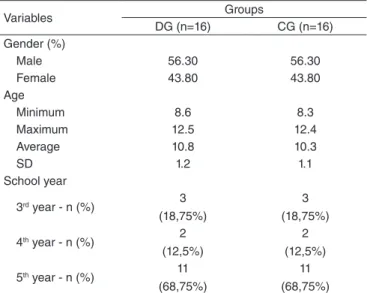
Table 1 summarizes the distribution of the participants by gender, age, and educational level.
The DG participants were selected by the diagnosis conducted by an interdisciplinary team (child neurologist, neuropsycholo-gist, educational psycholoneuropsycholo-gist, and speech–language pathologist), held at the Laboratory for Investigation of Learning Disabilities at the School of Philosophy and Sciences, Universidade Estadual Paulista “Júlio de Mesquita Filho” – CEES/FFC/UNESP - Marília (SP) and Clinic of Learning Disabilities at the Clinical Hospital of School of Medicine – Universidade Estadual Paulista “Júlio de Mesquita Filho” – UNESP - Botucatu.
The students of DG showed a discrepancy between the verbal IQ and the execution in the psychological assessment WISC-III; alterations in relation to the phonological memory, reading, and writing in the neuropsychological tests(22); phone-mic and syllabic alterations, rhyme, and alliteration in phono-logical awareness tests(23); and oral reading rate and accuracy lower than expected for the age and educational level, mea-sured by oral reading of words and separate pseudowords(24). The participants in the control group (CG) were recruited in primary education in public schools. In addition to the inclu-sion criteria determined for all the participants in the sample, they showed no history of speech and language disorders and academic or reading dificulties.
The study of the matching between the clinic and control groups in terms of gender and age showed that the groups were properly paired (gender: χ2 (2)=2.775, p=0.438, (likelihood ratio) indicates no differences between the expected frequencies in gender between the two groups investigated; Age: ANOVA test - F (3.54)=1.405, p=0.251, η2=0.072). The comparison of the
variables of decoding, rate and accuracy of reading, showed that the clinical group (DG) presented lower values when compared with the control group (rate: DG, mean=28.2, CG, mean=58.4, t=-7.382, p=0.000, d=-2.62; accuracy: DG, mean=13.4, CG, mean=50.1, t=-7.622, p=0.000, d=-2.707).
Procedures
Retelling task after reading
The children were assessed after reading a narrative and an expository text. In this study, we used three narrative texts selected from didactic books and three expository texts were elaborated(1) with appropriate syntactic complexities for each of the investigated school years (Flesch indexI and frequency of occurrence of wordsII, number of words and sentences in the text, sentences per paragraph, type/tokenIII, incidence of content wordsIV, incidence of pronouns, number of pronouns by phraseV, and number of connectivesVI). In addition, all narrative texts respond to the grammar of the stories containing settings and episodes divided in: initiating event, internal response, plan-ning, execution, consequence, and reaction(25). The expository texts were elaborated containing themes related to the educa-tional content of school years ahead of those of the children evaluated, with the intention to restrict the inluence of their prior knowledge on the reading comprehension.
The students were instructed to read two texts, one at a time, in the same way they usually follow to understand the text (aloud or silently). After reading, the participants recounted what they understood, and the retelling was recorded and sub-mitted to transcript for further analysis.
The retelling transcripts were adapted for the analysis of computational parameters of linguistics productivity. For this procedure, the following criteria were established:
1. suppression of the marking of short and long silent pauses; 2. Sentences interrupted with a period were marked;
3. suppression of transcription of the incomplete words; (d) insertion of the score based on the language rules; (e) suppres-sion of transcription of the repeated words; (f) suppressuppres-sion of the syntactic errors promptly self-corrected, keeping only the corrected transcript of the speech; (g) correction of errors of phonological type and; (h) suppression of mar-king of illed pauses.
I The Flesch Readability Index seeks a correlation between average length
of words and sentences and readability. Four reading dificulties ranges are identiied for the Portuguese language. However, in this project, we used only the following: (a) very easy texts (index from 75 to 100), suitable for readers from the //1st to 3rd grades; (b) easy texts (index from 50 to 75), suitable for readers from the //4th to 9th grades.
II Average of all frequencies of content words found in the text (nouns, verbs,
adverbs, and adjectives). The value of the frequency of words adopted comes from the corpus Banco de Português (BP), compiled by Tony Sardinha at PUC-SP.
III Number of different words divided by the number of tokens of these words.
Each different word is a type. Each repetition of this word in the speech is a token.
IV Incidence of content words in a text: nouns, verbs, adjectives, and adverbs. V Average number of pronouns that appear in a text divided by the number
of phrases.
VI Incidence of all connectives appearing in a text.
Table 1. Participant’s distribution by gender, age, and educational level
Variables Groups
DG (n=16) CG (n=16) Gender (%)
Male 56.30 56.30
Female 43.80 43.80
Age
Minimum 8.6 8.3
Maximum 12.5 12.4
Average 10.8 10.3
SD 1.2 1.1
School year
3rd year - n (%) 3
(18,75%)
3 (18,75%)
4th year - n (%) 2
(12,5%)
2 (12,5%)
5th year - n (%) 11
(68,75%)
11 (68,75%)
The same speech–language pathologist performed all of these modiications.
A researcher reviewed the changes made in the recount, and the discrepancies found were corrected through the consistent application of the criteria.
Verbal productivity measures
The following variables were adopted for this study, subject to analysis by computerized tool Coh-Metrix-Port(19):
1. Productivity index: number of words and number of spo-ken sentences;
2. Lexical diversity indexes:
• Frequency of content words: calculated based on the aver-age frequency of all content words found in the speech (nouns, verbs, adverbs, and adjectives).
• Minimum frequency of content words: equal to the aver-age of all minimum frequencies of the content words obtained in each of the sentences of the speech. • Type/token ratio: Number of different words divided by
the number of tokens of these words. Each different word is a type. Each word is a token. For example, if the word “dog” appears 7 times in a text, its type is 1, and its token is 7. The program calculates this metric only for content words (nouns, verbs, adverbs, and adjectives).
3. Grammatical complexity indexes: • Number of words per sentence;
• Incidence of content words (nouns, verbs, adverbs, and adjectives);
• Incidence of function words (articles, prepositions, pro-nouns, conjunctions, and interjections);
• Total number of logical operators: the program considers the following logical operators: and, or, if, negations (no, neither, none, nothing, never, and ever) and a number of conditions (in case, since, provided that, once, unless, without, except that, that is, and why). Total number of logical operators in the speech is quantiied and then divided by the total words spoken;
• Total number of connectives: the program has con-nective lists classiied into two dimensions: positive and negative connectives (positive connective extends events, while negative connective stops events); con-nectives are also classiied by the type of cohesion: additives, temporal, causal, and logical. The program quantiies the total number of connectives found in the discourse and divides them by the total words spoken.
Variables related to the grammatical competence were then added to this analysis(26):
• Total grammatically correct sentences;
• Percentage of grammatically correct sentences, calcu-lated by dividing the number of correct sentences by the total sentences produced by the subject.
To this purpose, the following were considered grammati-cal errors: disrespect to the rules of verbal and noun agree-ments; errors in use of the verbs (inadequacies in conjugation, verb tenses, and modes); verbal regency errors (inadequacies
in the use of multiword, phrasal, and prepositional verbs); inappropriate use of pronouns; phrase construction errors in relation to the word order and focus; and errors in morphol-ogy derivation.
The total score of grammatically correct sentences of all transcripts was performed by two speech–language pathologists, whose interrater agreement (Cohen’s Kappa coeficient) was 0.87.
The adoption of these measures aimed at keeping the great-est number of variables available to analyze: the dimensions that relect the use of syntax in the case of productivity variables and grammatical complexity; and competence in the use of syntax, in the case of grammatical competence variables and vocabulary (lexical diversity). Thus, the analysis by means of statistical pro-cedures could reveal, which are the best indexes to differentiating the performance in the spoken language of the studied groups.
RESULTS
The tests were performed to investigate the presence or absence of a normal distribution (Kolmogorov–Smirnov (KS) test for one sample), whose results showed normal distribution in most part of the variables investigated. The following speci-ied variables presented nonnormal distribution:
• the dyslexia group (DG) analysis: minimum frequency for retel-ling of narrative texts (mean=6345.7; SD=18963.1; p=0.004) and expository texts (mean=1059.1; SD=2441.1; p=0.028); • the control group (CG) analysis: percentage of correct
sen-tences for retelling of narrative texts (mean=104.5; SD=31.4; p=0.001) and expository texts (mean=92.3; SD=12.2; p=0.03), and minimum frequency for the retelling of expository texts (mean=552.4; SD=79.9; p=0.031).
In order to compare the performance between clinical groups and their controls, t-tests were conducted for the parametric
variables under investigation, using independent samples. We considered as signiicant the results of p<0.05. The degrees of freedom (df) showed a value of 30 for DG in these comparisons.
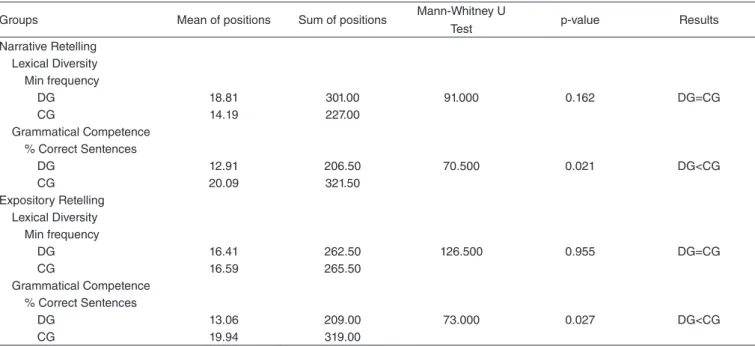
Analyses comparing the variables classiied as nonnormal were performed using the Mann-Whitney test.
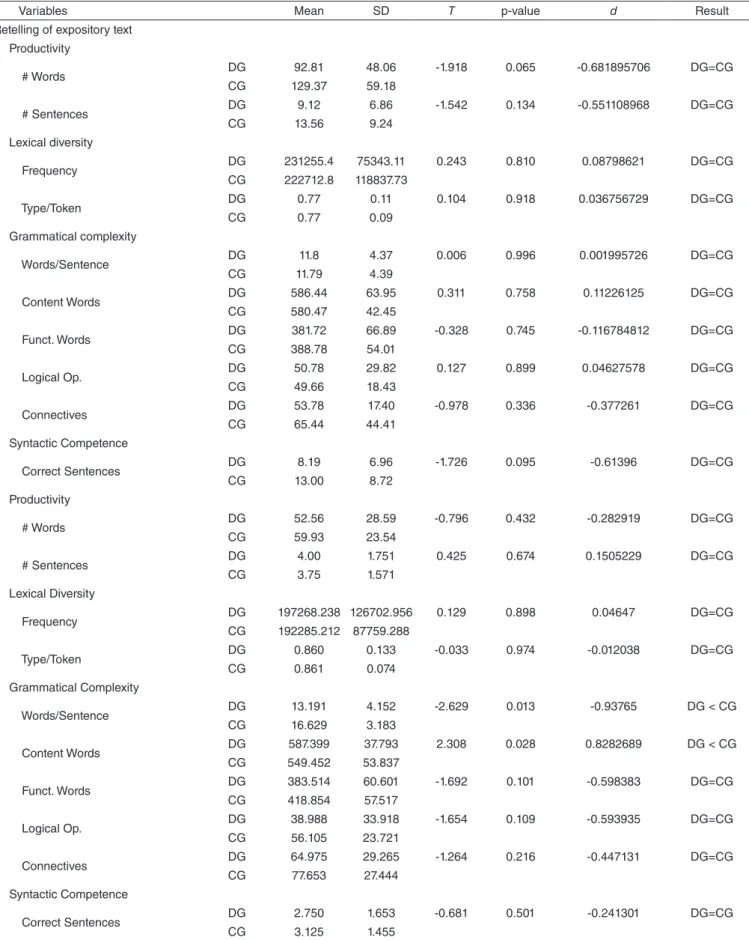
Tables 2 and 3 summarize the results for comparisons between DG and CG.
When we analyzed the retelling of expository texts, the results indicated that the DG distinguished from the typical group of children in relation to the performance in the gram-matical complexity variables. The performance of dyslexic students revealed fewer words per sentence, meaning the use of more concise sentences (DG: mean=13.19; SD=4.15; CG: mean=16.63; SD=3.18; p=0.013) and, therefore, grammati-cally simpler and presenting lesser use of content words (DG: mean=587.4; SD=37.8; CG: mean=587.4; SD=53.8.18; p=0.028).
Table 2. Results of parametric statistics for variables with normal distribution (DG versus CG)
Variables Mean SD T p-value d Result
Retelling of expository text
Productivity
# Words DG 92.81 48.06 -1.918 0.065 -0.681895706 DG=CG
CG 129.37 59.18
# Sentences DG 9.12 6.86 -1.542 0.134 -0.551108968 DG=CG
CG 13.56 9.24
Lexical diversity
Frequency DG 231255.4 75343.11 0.243 0.810 0.08798621 DG=CG
CG 222712.8 118837.73
Type/Token DG 0.77 0.11 0.104 0.918 0.036756729 DG=CG
CG 0.77 0.09
Grammatical complexity
Words/Sentence DG 11.8 4.37 0.006 0.996 0.001995726 DG=CG
CG 11.79 4.39
Content Words DG 586.44 63.95 0.311 0.758 0.11226125 DG=CG
CG 580.47 42.45
Funct. Words DG 381.72 66.89 -0.328 0.745 -0.116784812 DG=CG
CG 388.78 54.01
Logical Op. DG 50.78 29.82 0.127 0.899 0.04627578 DG=CG
CG 49.66 18.43
Connectives DG 53.78 17.40 -0.978 0.336 -0.377261 DG=CG
CG 65.44 44.41
Syntactic Competence
Correct Sentences DG 8.19 6.96 -1.726 0.095 -0.61396 DG=CG
CG 13.00 8.72
Productivity
# Words DG 52.56 28.59 -0.796 0.432 -0.282919 DG=CG
CG 59.93 23.54
# Sentences DG 4.00 1.751 0.425 0.674 0.1505229 DG=CG
CG 3.75 1.571
Lexical Diversity
Frequency DG 197268.238 126702.956 0.129 0.898 0.04647 DG=CG
CG 192285.212 87759.288
Type/Token DG 0.860 0.133 -0.033 0.974 -0.012038 DG=CG
CG 0.861 0.074
Grammatical Complexity
Words/Sentence DG 13.191 4.152 -2.629 0.013 -0.93765 DG < CG
CG 16.629 3.183
Content Words DG 587.399 37.793 2.308 0.028 0.8282689 DG < CG
CG 549.452 53.837
Funct. Words DG 383.514 60.601 -1.692 0.101 -0.598383 DG=CG
CG 418.854 57.517
Logical Op. DG 38.988 33.918 -1.654 0.109 -0.593935 DG=CG
CG 56.105 23.721
Connectives DG 64.975 29.265 -1.264 0.216 -0.447131 DG=CG
CG 77.653 27.444
Syntactic Competence
Correct Sentences DG 2.750 1.653 -0.681 0.501 -0.241301 DG=CG
CG 3.125 1.455
CG: mean=104.5, SD=31.4, mean of positions=20.09; u=70.50, p=0.021; expository retelling of DG: mean of positions=13.06; CG: average of positions=19.94; u=73.00; p=0.027).
DISCUSSION
Some of the linguistic variables in this study differentiated the performance of the clinical group from their respective con-trol, showing a poorer performance of the dyslexic students.
In this regard, the results of DG showed that regardless of the retold text, narrative or expository, and, therefore, the cognitive demands imposed by the text comprehension, oral production was characterized by a worse performance on the grammati-cal competence. The DG executions were characterized by a lower percentage of correct sentences when compared with their peers. Thus, the dyslexic students included in this sample presented lower skills in applying the rules of verbal and noun agreement, lower assertiveness in verbal conjugations, tenses and regency, lower proiciency in the use of pronouns, in the word order and focus, and in the use of morphology derivation.
With regard to the eficiency in the use of grammatical rules, previous studies in English supported the hypothesis that dys-lexic individuals show less proiciency in the use of grammar rules when compared with typical readers(1,2,14,27), similar to the indings of this study. However, these same results do not appear in the syntactic performance of Russian schoolchildren on the retelling tasks(15).
Among the scientiic evidence, worse performance of dys-lexic individuals have been observed when measuring their luency skills, completeness, and grammatical accuracy in the elaboration of sentences(1,27). When evaluated lengthwise, the dificulties regarding the grammatical accuracy were resolved during adolescence, suggesting that the grammatical develop-ment in children with dyslexia may be delayed(1).
One explanation would be that the irst representations of words require its mapping and association between the pho-nological representations and their semantic representations. However, in children with dyslexia, phonological representations are unstable or inaccurate, which slows down the development of reliable representations of the word(1,4,28) and knowledge of morphological units, which, in general, also carry important syntactic information of the language(3,28).
In this regard, considering the data presented on the analy-sis of the dyslexic group, an aspect that should be emphasized is that, in the syntactic structure of the Portuguese, the verbal inlection morphemes are always positioned at the end of the word. Therefore, considering that dyslexic individuals may fail to read the stimulus, in initial or medial syllables, or even use the semantic access to guess the stimulus without ever reading the end of the word, the mistakes can contribute to the absence of accurate orthographic representations of the word, and the inadequate experience with grammatical morphemes can harm the learning of verbal inlection rules.
With regard to the retelling of the expository texts only, dys-lexic individuals showed the worst performances in the vari-ables of grammatical complexity, characterized by a speech with shorter sentences and lesser use of content words. These indings support the hypothesis that, in tasks of higher cogni-tive demand, such as in the retelling of expository texts, both productivity and eficiency in syntax may be impaired when expressing the content read(29).
In fact, the task of understanding the expository texts is more demanding when compared with the narrative texts, given the amount of information that the former provides(29). The expository texts can perform the role of instructing on a given subject, because a lot of new information can be found on the text. Thus, the lack of familiarity with the subject, which is the case of the expository texts used in this study, because
Table 3. Results of nonparametric statistics for nonnormally distributed variables (DG versus CG)
Groups Mean of positions Sum of positions Mann-Whitney U
Test p-value Results
Narrative Retelling Lexical Diversity Min frequency
DG 18.81 301.00 91.000 0.162 DG=CG
CG 14.19 227.00
Grammatical Competence % Correct Sentences
DG 12.91 206.50 70.500 0.021 DG<CG
CG 20.09 321.50
Expository Retelling Lexical Diversity
Min frequency
DG 16.41 262.50 126.500 0.955 DG=CG
CG 16.59 265.50
Grammatical Competence % Correct Sentences
DG 13.06 209.00 73.000 0.027 DG<CG
CG 19.94 319.00
the themes they addressed are applicable to higher grades in order to ensure the absence of interference from previous knowledge, may have resulted in lower availability of knowl-edge to facilitate the processing of information. The most com-mon approach in such situations is that the reader strategically seeks to record the ideas read in his memory, without neces-sarily understanding them or their relations with other ideas in the text. The dificulty in predicting which of these ideas would be the most relevant information and the best option for stor-ing a large number of text ideas would result in a greater bur-den on the working memory, which would make processing of expository texts more demanding than the narrative texts(29). Thus, the greater attention paid and the cognitive effort may result in dificulties in establishing relationships between facts conveyed in the text, grammatically characterized by the use of conjunctions and complex sentences. In this circumstance, the retelling can be characterized by the more frequent use of sentences grammatically simple (simple periods) and, there-fore, with fewer words.
Added to this condition is the evidence that dyslexic indi-viduals made less use of content words (nouns, verbs, adjec-tives, and adverbs) when compared with nondyslexic students. This type of information contained in the text, often expressed by this category of words, can be frequently misunderstood and thus removed from the oral recount. These assumptions of the interaction between the performance in the syntactic com-plexity variables and the task of reading comprehension can be conirmed, as new studies are conducted, in order to add to its observations the statement of retold text ideas, which is a limitation of this study.
Another explanation for the use of a smaller number of words per sentence and the lower incidence of content words in the retelling of expository texts would be admitting that these situations may be owing to poorer reading accuracy observ-able for dyslexic students, more frequent in situations of lesser familiarity with a given topic addressed by the text and with the vocabulary presented. Frequent errors in text decoding interfere in the construction of basic text, resulting in the loss of key ideas for the text comprehension and more dificulties in establishing the relationship between the transmitted infor-mation(30). This hypothesis considers the evidence that dyslexic students exhibit a higher error rate for text connecting issues when compared with students with proicient reading(30).
In short, the lower eficiency in the use of grammar rules by dyslexic individuals, a inding similar to others described in the literature in English-speaking schoolchildren, may relect both: deicits in syntactic development which, according to some authors, could be owing to laws in the phonological representation of the word by instability and inaccuracy, dam-aging the construction of the syntactic knowledge necessary to the recognition of essential grammatical morphemes for the grammatically correct expression; and inadequate experience with morphemes in reading situations, which seems indepen-dent of the spoken language.
The different proile revealed when comparing the perfor-mances of clinical and control groups indicates that the anal-ysis of the microstructure of the discourse can assist in the
characterization of dyslexia, contributing to a more speciic diagnosis. Therefore, the task of retelling a text read proves to be a promising clinical assessment tool not only for the per-formance in the reading comprehension but also in the linguis-tic expression.
CONCLUSION
Students with dyslexia differed from the proicient readers by revealing poorer grammatical competence, characterized by a lower percentage of correct sentences, expressed on the retelling of both narrative and expository texts.
The performance difference was more comprehensive in the retelling of the expository texts not only by the lower percent-age of grammatically correct sentences but also by the num-ber of words per sentence and the incidence of content words that also differentiated the performance of dyslexic from the typical children. This result is owing to a possible effect of higher cognitive demands imposed by expository texts that make it dificult to retain and establish relationships between the information read.
*ASBK prepared the project and the evaluation tool, collected and analyzed the statistics of the survey data, identiied the literature, and wrote the article; CRBA collaborated in drawing up the assessment tool, in the discussion of survey data, and the preparation of the article; SAC supervised the study, participated in the discussion of the data, and the preparation of the article.
REFERENCES
1. Altmann LJP, Lombardino, LJ, Puranik C. Sentence Production in students with dyslexia. Int J Lang Commun Disord. 2008;43(1):545-61. 2. Rispens J, Roeleven S, Koster C. Sensivity to subject-verb agreement
in spoken language in children with developmental dyslexia. J Neurolinguistics. 2004;17(5):333-47.
3. Cantiani C, Lorusso ML, Perego P, Molteni M, Guasti T. Event-related potentials reveal anomalous morphosyntactic processing in developmental dyslexia. Appl Psycholinguistic. 2013;34(6):35-1162.
4. Cantiane C, Lorusso ML, Guasti MT, Sabisch B, Männel C. Characterizing the morphosyntactic processing deicit and its relationship to phonology in developmental dyslexia. Neuropsychologia. 2013;51(8):1595-607. 5. Tunmer WE, Chapman JW. The simple view of reading redux: vocabulary
knowledge and the independent components hypothesis. J Learn Disabil. 2012;45(5):453-66.
6. Elwér A, Gustafson S, Byrne B, Olson RK, Keenan JM, Samuelsson S. A retrospective longitudinal study of cognitive and language skills in poor reading comprehension. Scand J Psychol. 2015;56(2):157-66.
7. Feagans L, Appelbaum MI. Validation of language subtypes in learning disabled children. J Educ Psychol. 1986;78(5):358-64.
8. Westerveld MF, Gillon GT. Oral narrative context effects on poor readers´s spoken language performance: Story retelling, story generation and personal narratives. Int J Speech Lang Pathol. 2010;12(2):132-41.
9. Klop D. The relationship between narrative skills and reading comprehension: when mainstream learners show signs of speciic language impairment. [PhD Thesis], Stellenbosch: University of Stellenbosch, Africa; 2011.
10. Justice LM, Bowles RP, Kaderavek JN, Ukrainetz TA, Eisenberg SL. The Index of Narrative Microstructure: A Clinical Tool for Analyzing School-Age Children’s Narrative Performances. Am J Speech Lang Pathol. 2006;15(2):177-91.
12. Fergadiotis G, Wright HH, Green SB. Psychometric Evaluation of lexical diversity indices: assessing length effects. J Speech Lang Hear Res. 2015, 58(3):840-52.
13. Puranik C, Lombardino LJ, Altmann LJ. Writing through retellings: an exploratory study of language-impaired and dyslexic populations. Read Writ. 2006,20(3):251-72.
14. Kornev AN, Balciuniene, I. [Internet]. Story (re-)telling and reading in children with dyslexia: language or cognitive resource deicit? Academia. Edu Website, [cited 2014, August 9]. Available form: http://www.academia. edu/6796467/Story_re_telling_and_reading_in_children_with_dyslexia_ language_or_cognitive_resource_deicit
15. McNamara DS, Louwerse MM, McCarthy PM, Graesser AC. Coh-Metrix: Capturing linguistic featyres of cohesion. Discourse Processes. 2010;47(4):292-330.
16. McNamara DS, Crossley SA, McCarthy PM. Linguistic features of writing quality. Writ Commun. 2010;27(1):57-86.
17. Bedwell JS, Gallagher S, Whitten SN, Fiore SM. Linguistic correlates of self in deceptive oral of autobiographical narratives. Consciousness and Cognition. 2011;20(3):547-55.
18. Rabaglia CD, Salthouse TA. Natural and constrained language production as function of age and cognitive abilities. J Learn Disabil. 2011;26(10):1505-31. 19. Scarton CE, Aluísio SM. Análise da Inteligibilidade de textos via ferramentas
de Processamento de Língua Natural: adaptando as métricas do Coh-Metrix para o Português. Linguamática. 2010;2(1):45-61.
20. Toledo CM, Cunha A, Scarton C, Aluísio S. Automatic classiication of written descriptions by healthy adults. Dement Neuropsychol. 2014;8(3):227-35.
21. Reed DK, Vaughn S. Retell as an Indicator of Reading Comprehension. Sci Stud Read. 2012;16(3):187-217.
22. Tabaquim MLM. Validação do Exame Neuropsicológico e análise das funções corticais superiores em crianças do ensino fundamental [Tese]. Campinas: Universidade de Campinas; 2008.
23. Moojen S, Lamprecht R, Santos RM, Freitas GM, Brodacz R, Siqueira M et al. Consciência fonológica: instrumento de avaliação sequencial. São Paulo: Casa do Psicólogo; 2003.
24. Arduini R, Capellini SA, Ciasca SM. Comparative study neuropsychological and neuroimaging evaluations in children with dyslexia. Arq Neuropsiquiatr. 2006;64(2b):369-75.
25. Katalayi GB, Sivasubramaniam S. The construct validity of a reading test based on narrative text. Lang Teach Res. 2015;6(1):21-9.
26. Westerveld MF, Gillon GT, Boyd L. Evaluating the clinical utility of the proile of oral narrative ability for 4-year-old children. Int J Speech Pathol. 2012;14(2):130-40.
27. Leikin M, Bouskila OA. Expression of syntactic complexity in sentence comprehension: A comparison between dyslexic and regular readers. Read Writ. 2004;17(7):801-22.
28. Joanisse MF, Manis FR, Keating P, Seidenberg MS. Language deicits in dyslexic children: speech perception, phonology and morphology. J Exp Child Psychol. 2000;77(1):30-60.
29. Kucer SB. Going beyond the author: what retellings tell us about comprehending narrative and expository texts. Literacy. 2011;45(2):62-9. 30. Carvalho CAF. Função pragmática da linguagem e compreensão leitora