Original Article
Artigo Original
Cardiorespiratory parameters and their
relation with gestational age and level of
oral feeding skills in preterm infants
Parâmetros cardiorrespiratórios e sua relação
com a idade gestacional e nível de habilidade
de alimentação oral de recém-nascido
pré-termo
Raquel Coube de Carvalho Yamamoto1 Leila Sauer Prade1 Luana Cristina Berwig1 Angela Regina Maciel Weinmann1 Márcia Keske-Soares1
Keywords
Sucking Behavior Preterm Infant Feeding Heart Rate Respiratory Rate
Descritores
Comportamento de Sucção Recém-nascido Pré-termo Alimentação Frequência Cardíaca Frequência Respiratória
Correspondence address:
Raquel Coube de Carvalho Yamamoto Av. Roraima, 1000, Prédio 26, Sala 1418, Camobi, Km 9, Santa Maria (RS), Brazil, CEP: 97105-900. E-mail: [email protected]
Received: December 06, 2014 Study carried out at Programa de Pós-graduação em Distúrbios da Comunicação Humana, Universidade Federal
de Santa Maria – UFSM - Santa Maria (RS), Brazil.
1Universidade Federal de Santa Maria – UFSM - Santa Maria (RS), Brazil.
Financial support: nothing to declare.
Conlict of interests: nothing to declare.
ABSTRACT
Purpose: To correlate cardiorespiratory parameters with gestational age and level of oral feeding skills in the irst oral feeding in preterm infants. Methods: Study participants were 37 clinically stable preterm infants. Cardiorespiratory rate was assessed before and after introduction of oral feeding. The newborns were divided into three strata according to gestational age at birth. Oral skill was classiied into four levels: I - low oral skill and low resistance to feeding; II - low oral skill and high resistance to feeding; III - high oral skill and low resistance to feeding; IV - high oral skill and high resistance to feeding. Results: No difference was observed in heart and respiratory rate between the strata of gestational age at birth and between the levels of oral skill. Comparison between pre- and post-cardiorespiratory rates within each level of oral skill and stratum of gestational age showed difference between heart rate in the strata of gestational ages of 30 to 33 weeks and of 34 to 36 weeks, as well as between oral skill of levels I, II, and IV. With regard to the comparison between pre- and post- respiratory rates, difference was found in the oral skill of level I. Conclusion: Differences were observed between pre- and post-prandial cardiorespiratory rates regarding the irst oral feeding, as well as between strata of gestational age at birth and levels of oral feeding skills.
RESUMO
INTRODUCTION
At birth, the preterm newborn (PTN) presents urgency with respect to nutritional needs similar to or even greater than that expected for a fetus with the same gestational age (GA). However, the nutritional needs of this infant are not fully established and change according to gestational age and clinical
condition. Considering these dificulties, the effort to reach growth development, as it occurs in the uterus, is a dificult
task to accomplish(1).
The intercurrences that the PTN may present during the neonatal period are responsible for prolonged periods of hospitalization and sequelae that may compromise clinical evolution, including that related to the feeding process(2,3). Neurological immaturity, modiied muscle tone, minimized oral relexes, general weakness, and dificulties in self-regulation
may interfere with the quality of oral motor skills of PTNs(2,4) and may also be suficiently justiiable factors to provoke
irregularity in their cardiorespiratory pattern(5).
Oral feeding (OF) can be initiated when the PTN presents corrected gestational age (CGA) of approximately 34 weeks,
a time when the infant begins to acquire eficient coordination
between the functions of sucking, swallowing, and breathing (S/S/B)(6-8), although more recent studies report that it is already
possible to observe coordination between these functions as of the 32nd week of CGA(9). Although CGA is important in the
decision for oral feeding readiness(10), it should not be considered
a determining factor(11).
Heart (HR) and respiratory (RR) rates may change during OF(12), being essential to control them before, during, or after
feeding. In a clinically stable PTN, HR should range from 120 to 160 beats per minute (bpm) and RR should not exceed 60 respirations per minute (rpm), with the latter being fundamental in the decision for oral feeding readiness(13).
It is imperative that the speech-language pathologist have access to and knowledge regarding the procedures for monitoring the PTN and use the cardiorespiratory parameters observed at rest, in motion, and during the assessment(13) as important
tools indicative of possible adverse occurrence during feeding. Clinical evaluation is important in cardiorespiratory conditions and professionals should not consider the values indicated on the equipment screen as an only reference, and should compare them with data from behavioral observation(14).
Being able to be fed orally is deined as readiness for OF
introduction, as well as having interest in feeding(15). For hospital
discharge, in addition to being clinically stable, the PTN should be able to be fed exclusively through OF(16,17).
Based on these considerations, the objective of the present
study was to verify the cardiorespiratory parameters, through heart and respiratory rate, before and after introduction of oral feeding, correlated with gestational age at birth and with level of oral feeding skills, in preterm infants.
METHODS
This study of cross-sectional, quantitative design was approved by the Research Ethics Committee of the aforementioned institution under protocol no. 11155312.7.0000.5346. All parents/guardians
of the participating preterm infants signed an Informed Consent Form (ICF) prior to study commencement.
The study sample was composed of 37 preterm newborns (PTN) hospitalized in the Neonatal Intensive Care Unit (NICU) of a university hospital. Inclusion criteria comprised healthy, clinically stable premature neonates, whereas exclusion criteria included PTNs with neurogenic alterations, genetic syndromes, head and/or neck malformations, neonatal asphyxia (5-minute
Apgar score ≤ 5), hyperbilirubinic encephalopathy, intraventricular
hemorrhage grades III and IV, and infants who had received prior speech-language pathology stimulation.
All participants were evaluated after release by the medical team to initiate OF. During assessment, the PTNs were in air-heated incubators.
Pre- and post-prandial HR and RR of PTNs were measured, that is, before the speech-language pathology assessment and
after completion of the irst OF. HR was assessed for one minute
using a stethoscope available at the NICU. RR was evaluated for one minute from the observation of the thoracoabdominal excursions of the infants.
The preterm neonates were stratiied into groups according to
gestational age at birth: Group A - between 26 and 29 weeks and 6 days; Group B - between 30 weeks and 33 weeks and 6 days; and Group C - between 34 weeks and 36 weeks and 6 days.
The level of oral skill, evaluated during the irst OF, was obtained from a combination of the parameters proiciency (PRO)
and rate of milk transfer (RT), as proposed in the literature(18).
As for PRO, which represents the percentage of the volume
ingested in relation to the volume prescribed in the irst ive minutes, these irst ive minutes of the feeding are monitored,
believing that during this period the fatigue factor is minimal and thus represents the actual OF capacity or ability of the PTN. Rate of milk transfer, which is the volume of milk accepted per
minute during the entire feeding session, relects a resistance
index. Based on these data, the level of oral feeding skills (OFS)
of the preterm infants was classiied as follows: Level I = PRO
< 30% and RT < 1.5 ml/min (low OFS and low resistance - high
fatigue); Level 2 = PRO < 30% and RT > 1.5 ml/min (low OFS and high resistance - low fatigue); Level 3 = PRO > 30% and
RT < 1.5 ml/min (high OFS and low resistance - high fatigue);
and Level 4 = PRO > 30% and RT > 1.5 ml/min (high OFS and
high resistance - low fatigue).
The results were classiied and analyzed using the STATA
10.0 statistical software. Analysis of variance (ANOVA) and the paired Student’s t test were used for comparison between the means, whereas the Chi-square test was used for comparison
between the variables. A level of statistical signiicance of 5%
(p<0.05) was applied to all analyses.
RESULTS
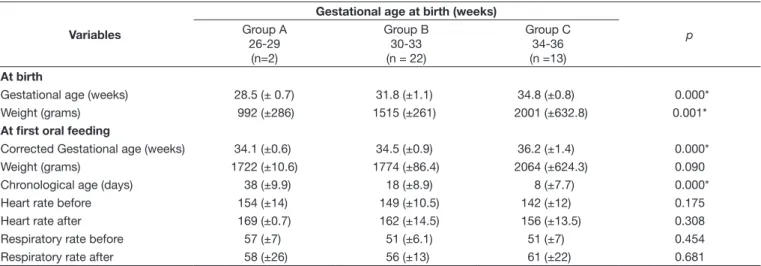
Table 2 shows the variables weight and GA, as well as HR
and RR for pre- and post-irst OF, according to the strata of GA at birth. As expected, signiicant difference was observed
regarding weight (p=0.001) and GA at birth (p=0.000), according
to the three strata assessed. The preterm infants were released for OF with approximately 34 weeks, except those born with GA between 34 and 36 weeks (p<0.001). Also as expected,
signiicant difference was observed with regard to chronological age at irst OF (p<0.001). As for both pre- and post-HR and
RR, no statistically signiicant difference was found between
the groups, with the mean value within the normality range.
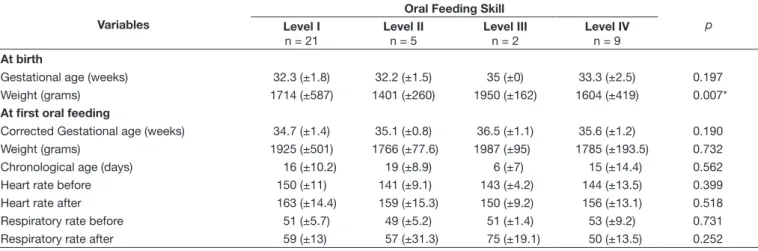
The variables weight and GA at birth and at irst OF, as well as pre- and post-irst oral feeding HR and RR, according to the level of OFS observed (Lau and Smith, 2011), are shown in
Table 3. Of the 37 PTNs analyzed, 21 (56.7%) were classiied
as level I; ive (13.5%) as level II; two (5.4%) as level III; and
nine (24.4%) as level IV. No difference was found according
to level for the variables weight and CGA at irst OF, as well as for pre- and post- HR and RR. Although no signiicant
difference was observed, the preterm neonates with high OFS and resistance (level IV) presented greater stability in relation
to the RR parameters. The two PTNs classiied as level III,
with low resistance to feeding, showed the higher increase in RR (51 ±1.4 vs. 75 ± 19.1 for pre- and post-RR, respectively).
As for the comparison of vital signs (HR and RR) before and
after the irst OF, HR presented signiicant increase (although
within the normality range) for infants in the strata of GA at birth between 30 and 33 weeks (p=0.001) and 34 and 36 weeks
(p=0.007) and in infants classiied as level I (p=0.001), level II
(p=0.027), and level IV (p=0.041) of oral feeding skill. Signiicant
increase was observed for the RR (although within the normality
range) for infants classiied as level I of OFS (p=0.006) (Table 4).
DISCUSSION
Studies investigating the heart (HR) and respiratory (RR)
rates before and after the irst oral feeding (OF) in groups of
preterm newborns (PTN) of different gestational ages (GA) and levels of oral feeding skills (OFS) have not yet been described in
the speciic literature. In the current speech-language pathology
clinical practice, more importance is given to the observation of oxygen saturation during OF, with measures of RR and HR being left in the background of assessment parameters.
Corrected gestational age (CGA) and weight have been used as decision-making criteria for introduction of OF in PTNs,
although they are often not suficient for adequate performance
during OF. In the present study, it was possible to observe the
following CGAs of PTNs at irst OF: 34.1 (±0.6), 34.5 9±0.9),
and 36.2 (±14) weeks for infants with GAs at birth between 26-29, 30-33, and 34-36 weeks, respectively. This result meets one of the criteria used in the neonatal unit evaluated, that is, the presence of CGA of approximately 34 weeks. This criterion has been adopted because this is the time when coordination
Table 1. General characteristics of the 37 preterm newborns at birth and at first oral feeding
Variables Gender (%)
Male (n=16) 43.2
Female (n=21) 56.8
At birth
Gestational age (weeks)* 32.7 (±2)
Weight (grams)* 1658 (±505)
At first oral feeding
Corrected Gestational age (weeks)* 35.1 (±1.3) Chronological age (days)* 15.6 (±11)
Weight (grams)* 1873 (±393)
Heart rate before (bpm)* 147 (±11.4) Heart rate after (bpm)* 160 (±14) Respiratory rate before (rpm)* 51 (±6.4) Respiratory rate after (rpm)* 57 (±16.9)
*Values expressed in mean and standard deviation
Table 2. Comparison between the variables “at birth” and “at first oral feeding” expressed in mean and standard deviation (M±SD) and the strata of gestational age of the preterm newborns
Variables
Gestational age at birth (weeks)
p
Group A 26-29
(n=2)
Group B 30-33 (n = 22)
Group C 34-36 (n =13)
At birth
Gestational age (weeks) 28.5 (± 0.7) 31.8 (±1.1) 34.8 (±0.8) 0.000*
Weight (grams) 992 (±286) 1515 (±261) 2001 (±632.8) 0.001*
At first oral feeding
Corrected Gestational age (weeks) 34.1 (±0.6) 34.5 (±0.9) 36.2 (±1.4) 0.000*
Weight (grams) 1722 (±10.6) 1774 (±86.4) 2064 (±624.3) 0.090
Chronological age (days) 38 (±9.9) 18 (±8.9) 8 (±7.7) 0.000*
Heart rate before 154 (±14) 149 (±10.5) 142 (±12) 0.175
Heart rate after 169 (±0.7) 162 (±14.5) 156 (±13.5) 0.308
Respiratory rate before 57 (±7) 51 (±6.1) 51 (±7) 0.454
Respiratory rate after 58 (±26) 56 (±13) 61 (±22) 0.681
between the sucking, swallowing, and breathing (S/S/B) functions begin(6,7,8).
The means of chronological age are in compliance with GA at birth; the lower the GA, the longer it takes the PTN to reach
the adequate CGA for irst OF.
For the variable HR after OF, it is possible to observe results above the maximum expected in PTNs with GA between 26 and 29 weeks, with mean of 169 bpm, and in those with GA between 30 and 33 weeks, with mean of 162 bpm, which are believed to occur due to prematurity, in function of a compromised clinical condition, or even owing to cardiac immaturity. For the variable RR after OF, it was also possible to observe results above the maximum expected (RR mean of 62 rpm) in PTNs with GA between 34 and 36 weeks. Nevertheless, the literature describes increases in HR of up to 10 bpm as common during OF, but increases above this index may indicate that OF is overburdening the neonate(19), demonstrating that the fatigue factor inluences the RR(20) and the change in behavioral status
after nutritive suction (NS)(21).
A study on HR and RR with groups of stimulated and unstimulated PTNs reports a trend of the infants of the stimulated
group to stabilize their post-irst oral feeding RR, as well as
their HR after NS in complete OF for 24 hours(12), demonstrating
that perhaps resistance training with non-nutritive sucking (NNS), along with an oral sensorimotor stimulation program may assist PTNs to regulate their vital functions in the pre- and post-prandial HR and RR. In another survey(19), no difference
was observed between HR and RR during sucking on a bottle or breastfeeding.
Preterm infants classiied as Level I(18), who present low OFS
and low resistance to feeding showed difference in the pre- and
post-prandial comparison for both HR and RR. At Level II, for
the PTNs that presented low OFS and high resistance and at
Level IV, for the PTNs that showed high OFS and high resistance, signiicant difference in the comparison was observed only for
HR. These data indicate that even with adequate CGA and weight
at irst OF, these PTNs were not eficiently prepared to fulill
the NS activity, because the monitoring of HR and RR before and after OF is important to evaluate possible physiological intercurrences in face of the effort made by the PTN during OF.
Preterm infants of Levels I, II, and IV presented means of
post-prandial HR with more than 10 bpm above the means of
Table 3. Comparison between the variables “at birth” and “at first oral feeding” expressed in mean and standard deviation (M±SD) and the levels of oral feeding skill at birth and at first oral feeding
Variables
Oral Feeding Skill
p
Level I
n = 21
Level II
n = 5
Level III
n = 2
Level IV
n = 9
At birth
Gestational age (weeks) 32.3 (±1.8) 32.2 (±1.5) 35 (±0) 33.3 (±2.5) 0.197 Weight (grams) 1714 (±587) 1401 (±260) 1950 (±162) 1604 (±419) 0.007*
At first oral feeding
Corrected Gestational age (weeks) 34.7 (±1.4) 35.1 (±0.8) 36.5 (±1.1) 35.6 (±1.2) 0.190 Weight (grams) 1925 (±501) 1766 (±77.6) 1987 (±95) 1785 (±193.5) 0.732 Chronological age (days) 16 (±10.2) 19 (±8.9) 6 (±7) 15 (±14.4) 0.562 Heart rate before 150 (±11) 141 (±9.1) 143 (±4.2) 144 (±13.5) 0.399 Heart rate after 163 (±14.4) 159 (±15.3) 150 (±9.2) 156 (±13.1) 0.518 Respiratory rate before 51 (±5.7) 49 (±5.2) 51 (±1.4) 53 (±9.2) 0.731 Respiratory rate after 59 (±13) 57 (±31.3) 75 (±19.1) 50 (±13.5) 0.252
*Statistically significant values (p≤0.05)
Table 4. Comparison between the variables “at birth” and “at first oral feeding” expressed in mean and standard deviation (M±SD) and the pre- and post-prandial vital signs
Variables Vital Signs
n HRb HRa p RRb RRa p
Gestational age
Group A 2 154 (±14.1) 169 (±0.7) 0.142 57 (±7.1) 58 (±26.2) 0.491
Group B 22 149 (±10.5) 162 (±14.5) 0.001* 51 (±6.1) 56 (±13.0) 0.073 Group C 13 142 (±12.0) 156 (±13.5) 0.007* 51 (±7.0) 61 (±21.9) 0.068
Oral feeding skill
Level I 21 150 (±11.2) 163 (±14.4) 0.001* 51 (±5.7) 59 (±12.9) 0.006* Level II 5 141 (±9.1) 159 (±15.3) 0.027* 49 (±5.2) 57 (±31.3) 0.303
Level III 2 143 (±4.2) 150 (±9.2) 0.202 51 (±1.4) 75 (±19.1) 0.106
Level IV 9 144 (±13.5) 156 (±13.1) 0.041* 53 (±9.2) 50 (±13.5) 0.294
*Statistically significant Values (p<0.05).
pre-prandial HR. In the comparison of the pre-RR, all PTNs
stratiied into the levels showed means within the normal range; however, in the post-RR, only PTNs of Level III presented
data above normality of 60 rpm, with post-RR mean of 7 rpm.
The justiication for this inding may be that Level III infants
present high OFS but low resistance to feeding(18), which could
explain the fact that fatigue has caused an increase in the respiratory movements in these infants, although the number of individuals for this skill level group, as well as for group A of
GA, does not allow statistical analysis due to sample size (n=2).
Oral feeding skill and resistance to feeding are equally important to determine the success of OF(18). The classiication of
oral skills into levels has been used by some authors considering
that the test presents an indicator that allows quantiication of
the ability of PTNs to receive OF, whose evaluation occurs in
the irst ive minutes of the feeding, and during this period, the dificulties caused by fatigue would not be observed yet(18,22-25).
In full-term newborns, during suction groups, the RR may decrease, recovering during the pauses between suction groups, maintaining the total RR at adequate levels; however, in preterm neonates with GA between 34 and 36 weeks, the RR may show a decrease during the continuous suction phase, in which discrete recovery occurs during the intermittent suction
phase. Therefore, newborns with RR > 65 rpm, on alertness or
presenting respiratory alterations, may show signs of respiratory discomfort during bottle sucking, preventing NS from occurring at this moment(19).
The monitoring of HR and RR indices allows the speech-language pathologist to detect possible changes during stimulation or OF and suspend the procedure, avoiding episodes of aspiration or clinical destabilization, ensuring the success of the transition(26).
Furthermore, the hospital discharge of PTNs requires them
to perform OF exclusively, safely and eficiently(27), which is
an important achievement in their development(17,22), because
the long periods of hospitalization, the lack of adequate oral stimulation, and the necessary medical procedures can contribute
to alimentary dificulties(2,3).
Proper analysis of the vital signs of PTNs at the moment of OF is based on the observation of the feeding situation and on whether it represents a moment in which the HR and RR indices undergo considerable changes. Therefore, it is essential that the speech-language pathologist participate in the Neonatal Team, taking conducts, and be attentive to the clinical conditions of the infants during the feeding situation, observing the HR and RR indices in order to avoid potential clinical complications. Based on the outcomes of this study, further research on the observation of the HR and RR indices is suggested, so that the
real conditions of preterm infants at irst OF can be evidenced.
CONCLUSION
No difference between the groups was observed with respect to pre- and post-heart and respiratory rates, which presented mean values within the normality range. Concerning gestational
age and levels of oral feeding skills, signiicant correlation was
found for heart rate variation. Differences were also observed between pre- and post-prandial cardiorespiratory rates regarding
the irst oral feeding, as well as between strata of gestational
age at birth and levels of oral feeding skills.
REFERENCES
1. Brasil. Ministério da Saúde. Atenção à saúde do recém-nascido: guia para os profissionais de saúde – cuidados com o recém-nascido pré-termo [Internet]. 2. ed. Brasília: Ministério da Saúde; 2012 [citado em 2014 Out 23]. Disponível em: http:/ / bvsms.saude.gov.br/ bvs/ publicacoes/ atencao_saude_recem_nascido_profissionais_v4.pdf
2. Arvedson J, Clark H, Lazarus C, Schooling T, Frymark T. Evidence-based systematic review: effects of oral motor interventions on feeding and swallowing in preterm infants. Am J Speech Lang Pathol. 2010;19(4):321-40. PMid:20622046. http://dx.doi.org/10.1044/1058-0360(2010/09-0067). 3. Ahmed AH, Sands LP. Effect of pre- and postdischarge interventions on breastfeeding outcomes and weight gain among premature infants. J Obstet Gynecol Neonatal Nurs. 2010;39(1):53-63. PMid:20409103. http://dx.doi. org/10.1111/j.1552-6909.2009.01088.x.
4. Neiva FC, Leone CR. Evolução do ritmo de sucção e influência da estimulação em prematuros. Pro Fono. 2007;19(3):241-8. PMid:17934599. http://dx.doi.org/10.1590/S0104-56872007000300002.
5. Rios IJA. Técnicas de sucção nutritiva para recém-nascido prematuro. In: Rios IJA. Conhecimentos essenciais para atender bem em: Fonoaudiologia Hospitalar. São Paulo: Pulso Editorial; 2003. p. 83-6.
6. Wolff PH. The serial organization of sicking in the young infant. Pediatrics. 1968;42(6):943-56. PMid:4235770.
7. Yamamoto RC, Keske-Soares M, Weinmann ARM. Características da sucção nutritiva na liberação da via oral em recém-nascidos pré-termo de diferentes idades gestacionais. Rev Soc Bras Fonoaudiol. 2009;14(1):98-105. http://dx.doi.org/10.1590/S1516-80342009000100016.
8. Medeiros AM, Oliveira AR, Fernandes AM, Guardachoni GA, Aquino JP, Rubinick ML, et al. Caracterização da técnica de transição da alimentação por sonda enteral para seio materno em recém-nascidos prematuros. J Soc Bras Fonoaudiol. 2011;23(1):57-65. PMid:21552734.
9. Macias MER, Meneses GJS. Physiology of nutritive sucking in newborn and infants. Bol Med Hosp Infant Mex. 2011;68(4):296-303.
10. White-Traut R, Pham T, Rankin K, Norr K, Shapiro N, Yoder J. Exploring factors related to oral feeding progression in premature infants. Adv Neonatal Care. 2013;13(4):288-94. PMid:23912022. http://dx.doi.org/10.1097/ ANC.0b013e31829d8c5a.
11. Dreckpohl D, Dudas R, Justice S, McConnell C, Macwan KS. Outcomes from na oral feeding protocol implemented in the NICU. Inf C Adol Nutr. 2009;1(1):6-10. http://dx.doi.org/10.1177/1941406408328535. 12. Costa PP, Ruedell AM, Weinmann ARM, Keske-Soares M. Influence
of sensory-motor-oral stimulation on preterm newborns. Rev. CEFAC. 2011;13(4):599-606. http://dx.doi.org/10.1590/S1516-18462010005000132. 13. Xavier C. Intervenção fonoaudiológica em bebês de risco. In: Ferreira LP, Befi-Lopes D, Limongi S. Tratado de fonoaudiologia. São Paulo: Roca; 2004. p. 415-38.
14. Wolf LS, Glass RP. Feeding and swallowing disorders in infancy. Tucson: Therapy Skill Builders; 1992.
15. Kish MZ. Oral feeding readiness in preterm infants. Adv Neonatal Care. 2013;13(4):230-7. PMid:23912014. http://dx.doi.org/10.1097/ ANC.0b013e318281e04e.
16. Barlow SM. Oral and respiratory control for preterm feeding. Curr Opin Otolaryngol Head Neck Surg. 2009;17(3):179-86. PMid:19369871. http:// dx.doi.org/10.1097/MOO.0b013e32832b36fe.
17. Briere CE, McGrath J, Cong X, Cusson R. State of the science: a contemporary review of feeding readiness in the preterm infant. J Perinat Neonatal Nurs. 2014;28(1):51-8, quiz E3-4. PMid:24476652. http://dx.doi.org/10.1097/ JPN.0000000000000011.
19. Silva RNM. Fatores que interferem na Sucção/Deglutição/Respiração do prematuro. In: Lopes SMB, Lopes JMA. Follow up do recém-nascido de alto risco. Rio de Janeiro: Medsi; 1999. p. 275-300.
20. Thoyre SM, Carlson JR. Preterm infant’s behavioral indicators of oxigen decline during bottle feeding. J Adv Nurs. 2003;43(6):631-41. PMid:12950569. http://dx.doi.org/10.1046/j.1365-2648.2003.02762.x.
21. Prade LS, Bolzan GP, Weinmann ARM. The influence of behavioral state on sucking patterns in preterm infants. Audiol Commun Res. 2014;19(3):230-5. http://dx.doi.org/10.1590/S2317-64312014000300002014;19(3):230-5.
22. Lau C, Sheena HR, Shulman RJ, Schanler RJ. Oral feeding in low birth weight infants. J Pediatr. 1997;130(4):561-9. PMid:9108854. http://dx.doi. org/10.1016/S0022-3476(97)70240-3.
23. Lau C, Smith EO. Intervention to improve the oral feeding performance of preterm infants. Acta Paediatr. 2012;101(7):269-74. PMid:22404221. http://dx.doi.org/10.1111/j.1651-2227.2012.02662.x.
24. Berwig LC. Aplicação de um instrumento para avaliação objetiva da habilidade para alimentação oral de recém-nascidos pré-termo [dissertação]. Santa Maria (RS): Universidade Federal de Santa Maria; 2013. 52 p.
25. Ribeiro FGSM. Protocolo para transição da alimentação para via oral em prematuros. In: Furkim AM, Rodrigues KA. Disfagias nas unidades de terapia intensiva. São Paulo: Roca, 2014. p. 189-99.
26. Neiva FCB, Leone CR, Leone C, Siqueira LL, Uema KA, Evangelista D, et al. Non-nutritive sucking evaluation in preterm newborns and the start of oral feeding: a multicenter study. Clinics. 2014;69(6):393-7. PMid:24964303. http://dx.doi.org/10.6061/clinics/2014(06)05. 27. Caetano LC, Fujinaga CI, Scochi CGS. Sucção não nutritiva em bebes
prematuros: estudo bibliográfico. Rev Lat Am Enfermagem. 2003;11(2):232-6. PMid:12852302. http://dx.doi.org/10.1590/S0104-11692003000200014.
Author contributions