Prevalence of and risk factors for late diagnosis
of HIV infection in Brazilian infants and children
Lígia Mara Dolce de Lemos
[1], Andrew Anglemyer
[2], Victor Santana Santos
[1],
Ricardo Queiroz Gurgel
[3]and George Williams Rutherford
[2][1]. Departamento de Enfermagem, Universidade Federal de Sergipe, Aracaju, Sergipe, Brasil. [2]. Department of Epidemiology and Biostatistics and Global Health Sciences, University of California, San Francisco, USA. [3]. Departamento de Medicina, Universidade Federal de Sergipe, Aracaju, Sergipe, Brasil.
ABSTRACT
Introduction: Late human immunodefi ciency virus (HIV) diagnosis is an important cause of HIV-related morbidity and mortality
in infants and children. Methods: This retrospective cohort study of HIV-infected children diagnosed in Sergipe, in northeastern
Brazil, between 2002 and 2011 aimed to determine the prevalence of and risk factors for late HIV diagnosis. Results: Of 55
infants and children with confi rmed infection, 42 (76.5%) were diagnosed at ≥ 12 months old. No antiretroviral prophylaxis during delivery (OR 5.48, 95% CI 1.11-32.34) was associated with late diagnosis. Conclusions: More than 75% of cases were
diagnosed late. Efforts are needed to improve early HIV diagnosis in infants.
Keywords: HIV. Infant diagnosis.Vertical transmission. Polymerase chain reaction.
Corresponding author: Dra. Ligia Mara Dolce de Lemos. Av. Cláudio Batista
s/n, 49048-010 Aracaju, Sergipe, Brasil.
Phone: 55 79 3246-6893; Fax: 55 79 2105-1813 e-mail: [email protected]
Received 22 October 2014 Accepted 20 January 2015
Late diagnosis of human immunodefi ciency virus (HIV) infection is an important cause of HIV-related morbidity and
mortality in infants and children(1) and represents a serious missed opportunity for early initiation of antiretroviral treatment
(ART), which has proven to be very effective in reducing
HIV-related morbidity and mortality in infants and children(1) (2) (3).
For example, early mortality in HIV-infected infants was 4% when ART was initiated at a median age of 7 weeks, compared with 16% when ART was initiated according to a threshold for cluster of differentiation 4 (CD4) percentage or clinical disease progression(2). Current World Health Organization (WHO)
guidelines recommend that ART be started in all infants and children diagnosed with HIV at ≤ 24 months of age regardless of CD4 percentage or WHO clinical stage(4).
The North and Northeastern regions of Brazil, which
include the poorest nine states of the country, have been
disproportionately affected by HIV, with much higher HIV-specifi c mortality rates than the rest of the country(5).In these
regions, HIV has spread primarily through heterosexual intercourse, with subsequent substantial numbers of HIV-exposed and infected infants.
Sergipe is one of the nine states in Northeastern Brazil, with a population of 2,068,017 and 34,016 births in 2010. Infant mortality was 18.2 per 1,000 live births in 2010, which
was higher than the median for Brazilian states(6). Sergipe has
a predominantly generalized HIV epidemic, and 3,131 cases of acquired immunodefi ciency syndrome (AIDS) in adults and adolescents have been reported since 1987(7). The estimated
HIV prevalence among women attending antenatal clinics is 0.42%(8). Among children < 5 years old, the incidence of AIDS
has decreased considerably in recent years from 2.75 cases per 100,000 per year in 2005 to 0.6 cases per 100,000 per year in
2011(9).
This study aimed to determine the prevalence of and risk
factors for late HIV diagnosis in infants in the State of Sergipe in Northeastern Brazil.
We conducted a retrospective cohort study of HIV-infected
infants and children diagnosed in Sergipe between January 1,
2002, and December 31, 2011, when human immunodefi ciency virus deoxyribonucleic acid (HIV DNA) was available at 6
weeks of age, as recommended by the Brazilian Ministry of
Health. We included individuals considered HIV exposed based
on their mother’s diagnosis and followed their records until their diagnosis of infection, to identify whether it was a late diagnosis.
We compiled data from the National Information System for Reportable Diseases [Sistema de Informações de Agravos
de Notifi cação (SINAN)], the National Mortality Information
System [Sistema de Informação sobre Mortalidade (SIM)], the state laboratory database (viral load tests), and ambulatory
medical records from the Federal University of Sergipe and Center of Medical Specialties [Centro de Especialidades Médicas de Aracaju(CEMAR)] for human immunodefi ciency virus/sexually transmitted diseases/acquired immunodefi ciency syndrome (HIV/STD/AIDS) in Aracaju. When information was
The primary outcome variable of late diagnosis was defi ned as a virological diagnosis (HIV DNA testing) or a clinical or
postmortem diagnosis at >12 months of age. We compared these cases to those in infants who had a serological diagnosis
or clinical or post mortem diagnosis at ≤ 12 months of age. Predictor variables included infant and maternal
sociodemographic and clinical factors. For the infants, we
recorded sex, date of delivery, breastfeeding history, date of HIV infection diagnosis, date of AIDS diagnosis, date of death, clinical stage of HIV infection, and ART history. For the
mothers, we recorded educational level, antiretroviral history
(during prenatal care and delivery), timing of HIV infection diagnosis (before pregnancy, during pregnancy, during delivery, after delivery), number of prenatal visits (< 6 visits or ≥ 6 visits), and clinical stage of HIV infection.
We collected all data on a standard form and entered them
into a database using Epi Info 3.5.2 [Centers for Disease Control (CDC), Atlanta, GA, USA]. We examined differences in proportions using Fisher’s exact test for distributions with fewer than 5 events expected per cell. We calculated unadjusted odds ratios (OR) and 95% confi dence intervals (CI) to examine
differences between infants who were and were not diagnosed virologically at >12 months of age. We conducted descriptive
analyses using Statistical Package for the Social Sciences (SPSS) version 13 (SPSS Inc., Chicago, IL, USA) and bivariate analyses using Stata 8.0 (Stata Corporation, College Station, TX, USA).
We obtained informed consent from parents for interviews. The
Ethics and Research Committee of the Federal University of Sergipe approved the study (registration number 0183.0.107.000-10).
Of the 485 infants exposed to HIV in Sergipe during the study period, 55 (11.3%) were diagnosed with HIV infection. Of these 55 infants, seven (12.7%) had died, and 42 (76.4%)
were more than 12 months old at the time of diagnosis. Of the
seven deaths, two were diagnosed virologically at ≤ 12 months old, and fi ve were diagnosed at > 12 months of age (OR 1.34, 95% CI 0.11-9.69) (Table 1). Two of the infants who died were
diagnosed on the day of death or postmortem (3.5 months old and 8.9 months old). Of the 13 (25.6%) diagnosed virologically at ≤ 12 months of age, four were diagnosed at 6-12 months of age.
No mother received ART (as opposed to antiretroviral prophylaxis) during pregnancy or in the immediate postpartum period. Of the 12 (41.8%) mothers who did not receive antiretroviral prophylaxis during pregnancy, eight infants were diagnosed at > 12 months old; however, lack of antiretroviral prophylaxis was not signifi cantly related to late diagnosis. Not receiving antiretroviral prophylaxis during delivery (OR 5.48, 95% CI 1.11-32.34, p = 0.03) was, however, associated
with late diagnosis. Lack of prenatal care and breastfeeding were not associated with late diagnosis (Table 1).
The timing of HIV diagnosis was reported for 42 (76.4%) mothers. Twenty (47.6%) were diagnosed with HIV after their babies were born, six (14.3%) during delivery, and 16 (38.1%)
before or during pregnancy. The infants of women diagnosed during delivery were more likely to have been diagnosed
virologically at ≤ 12 months of age than those of women diagnosed before or during pregnancy (5/11 vs. 1/31, p = 0.0028,
Fisher’s exact test); this was not true for those diagnosed before or during pregnancy (4/11 vs. 12/31, p = 1.00). Additionally, only seven (21.9%) infants of 32 mothers who received antiretroviral prophylaxis during pregnancy, four (14.8%) of 27 mothers who received intrapartum antiretroviral prophylaxis, and six (40%) of 15 infants who received neonatal prophylaxis were diagnosed with HIV at ≤ 12 months of age despite the availability of DNA polymerase chain reaction testing.
More than three-quarters of infants and children diagnosed with HIV infection in Sergipe in a recent 10-year period (2002-2011)
were diagnosed after one year of age. Late diagnoses might be
associated with the fact that screening for HIV occurred for only 67% of the 76% of women who received prenatal care during the antenatal period in Sergipe from 1990 to 2011(8).
This study used data beginning in 2002, when Brazil adopted
early infant diagnosis; more than half of the women had been
were diagnosed before their infants were born, and most
received antepartum or intrapartum antiretroviral prophylaxis.
The failure to employ early virological testing to diagnose and
treat these exposed infants resulted in a substantial number of
missed opportunities to improve clinical outcomes in these children(2) (10). Furthermore, the prevalence of late diagnosis
would likely be higher if stricter defi nitions of early diagnosis were used, such as using a cut-off age of ≤ 6 months or excluding
infants diagnosed at or near death(10), instead of the defi nition of
≤ 12 months of age, which was based on molecular diagnostic
tests in the present study.
Interestingly, six mothers who had not received prenatal care did receive antiretroviral prophylaxis during pregnancy,
which underscores the lack of coordination between prenatal and
HIV treatment services. It is not clear why infants and children were not tested. Our study population was predominantly low-income, was poorly educated, and had diffi cultly accessing health
services. A large proportion of women was not diagnosed until the postpartum period and would not necessarily have known to
have their infant diagnosed. Additionally, as the majority of
HIV-infected infants and children are asymptomatic after birth and during early infancy, mothers may not seek care for their children or be reticent to reveal their own infection status to pediatric
providers. Moreover, a dedicated pediatric HIV treatment service does not exist at the Reference Center in Sergipe, and children’s
and mothers’ services have not been linked.
Our study has some limitations. While the data were
collected from a universal notifi cation system, which increases the external validity, registry data suffer from incompleteness(8).
Additionally, the exposed cases and deaths might have
been underestimated, because prior to 2000, most pediatric
HIV infections in Sergipe were diagnosed in infants and
children who presented with symptomatic disease rather than
through screening; therefore, some infants might not have been diagnosed. Additionally, the exposed cases and deaths
might have been underestimated, because prior to 2000, most
pediatric HIV infections in Sergipe were diagnosed in infants
and children who presented with symptomatic disease rather
than through screening; therefore, some infants might not have
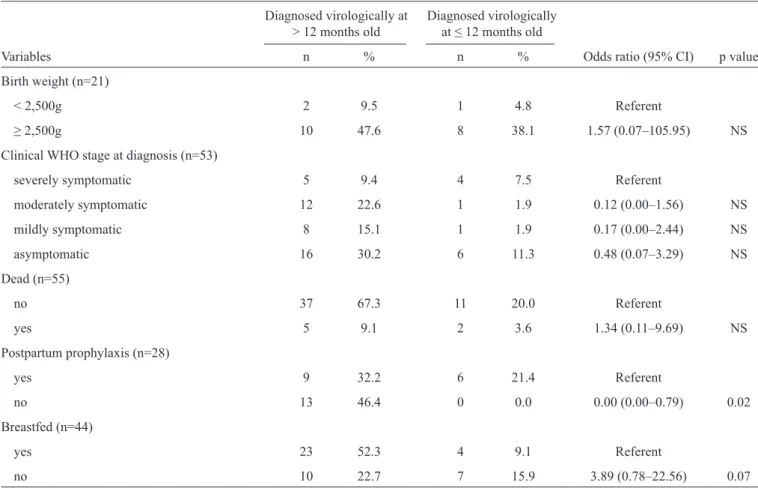
TABLE 1 - Predictors of late diagnosis in HIV-infected infants by age at diagnosis, Sergipe, Brazil, 2002-2011.
Diagnosed virologically at Diagnosed virologically
> 12 months old at ≤ 12 months old
Variables n % n % Odds ratio (95% CI) p value
Maternal variables
Area of residence (n=44)
urban (1) 34 77.3 8 18.1 Referent
rural (2) 1 2.3 1 2.3 4.07 (0.05–342.07) NS
Educational level (n=41)
illiterate 7 17.0 2 4.9 Referent
< 8 years 11 26.8 4 9.8 1.26 (0.13–17.49) NS
8 years 10 24.4 0 0.0 0.00 (0.00–4.67) NS
> 8 years 6 14.7 1 2.4 0.60 (0.01–14.46) NS
Timing of diagnosis (n=42)
before pregnancy 7 16.6 1 2.4 Referent
during pregnancy 5 11.9 3 7.1 3.84 (0.23–250.9) NS
during delivery 1 2.4 5 11.9 22.89 (1.20–1844.1) NS
after delivery 12 28.6 2 4.8 1.16 (0.1–78.5) NS
through child’s diagnosis 6 14.3 0 0.0 0.00 (0.00–52.00) NS
Antenatal care (n=43)
no 16 37.2 2 4.7 Referent
yes 16 37.2 9 20.9 4.35 (0.73–47.67) 0.09
Stage of HIV infection (n=54)
symptomatic 29 53.7 7 13.0 Referent
asymptomatic 12 22.2 6 11.1 2.04 (0.46–8.90) NS
ARV prophylaxis during antenatal care (n=44)
yes 25 56.8 7 15.9 Referent
no 8 18.2 4 9.1 1.76 (0.30–9.40) NS
Lost to follow up (n=47)
yes 32 68.1 11 23.4 Referent
no 4 8.5 0 0.0 0.00 (0.00–5.08) NS
ARV prophylaxis during delivery (n=43)
yes 23 53.5 4 9.3 Referent
no 8 18.6 8 18.6 5.48 (1.11–32.34) 0.03
Mode of delivery (n=39)
vaginal 19 48.7 4 10.3 Referent
caesarean section 9 23.1 7 17.9 3.56 (0.69–21.31) NS
Infant variables Sex (n=55)
male 19 34.5 5 9.1 Referent
female 23 41.8 8 14.6 1.31 (0.32–6.01) NS
TABLE 1 - Continuation.
Diagnosed virologically at Diagnosed virologically
> 12 months old at ≤ 12 months old
Variables n % n % Odds ratio (95% CI) p value
Birth weight (n=21)
< 2,500g 2 9.5 1 4.8 Referent
≥ 2,500g 10 47.6 8 38.1 1.57 (0.07–105.95) NS
Clinical WHO stage at diagnosis (n=53)
severely symptomatic 5 9.4 4 7.5 Referent
moderately symptomatic 12 22.6 1 1.9 0.12 (0.00–1.56) NS
mildly symptomatic 8 15.1 1 1.9 0.17 (0.00–2.44) NS
asymptomatic 16 30.2 6 11.3 0.48 (0.07–3.29) NS
Dead (n=55)
no 37 67.3 11 20.0 Referent
yes 5 9.1 2 3.6 1.34 (0.11–9.69) NS
Postpartum prophylaxis (n=28)
yes 9 32.2 6 21.4 Referent
no 13 46.4 0 0.0 0.00 (0.00–0.79) 0.02
Breastfed (n=44)
yes 23 52.3 4 9.1 Referent
no 10 22.7 7 15.9 3.89 (0.78–22.56) 0.07
HIV: human immunodefi ciency virus; CI: confi dence interval; NS: not signifi cant; ARV: antiretroviral; WHO: World Health Organization. The number of pregnant women or infants/children for each variable may not equal 55 due to missing information.
However, late diagnosis was and likely continues to be a
signifi cant problem in Sergipe, with more than three quarters of
cases diagnosed late during the study period. To facilitate early diagnosis and treatment of infected infants, we recommend that screening of infants should be routine in early pediatric care,
not only for those who are known to have been exposed to HIV but also for those whose exposure status is unknown because
their mothers have not been tested.
ACKNOWLEDGMENTS
The authors wish to thank the health services for facilitating the data collection and especially the following students who assisted us with data collection: Gabriella Souza Duarte,
Nágla Galvão Regis Martins, Thaísa Fonseca Siqueira Rocha, and Marcus Vinícius da Conceição.
The authors declare that there is no confl ict of interest.
CONFLICT OF INTEREST
FINANCIAL SUPPORT
This work was supported by the Brazilian Conselho Nacional de Desenvolvimento Científi co e Tecnológico and
grants from the U.S. National Institutes of Health and Fogarty International Center [International Clinical, Outcomes and Health Services Research Training Award Brazil Scientists Program (D43 TW05799-01) and AIDS International Training and Research Program (D43 TW000003)].
REFERENCES
1. Wamalwa D, Benki-Nugent S, Langat A, Tapia K, Ngugi E, Slyker
JA, et al. Survival benefi t of early infant antiretroviral therapy is compromised when diagnosis is delayed. Pediatr Infect Dis J 2012; 31:729-731.
2. Violari A, Cotton MF, Gibb DM, Babiker AG, Steyn J, Madhi
SA, et al. Early antiretroviral therapy and mortality among HIV-infected infants. N Engl J Med 2008; 359:2233-2244.
3. Johnson LF, Davies M-A, Moultrie H, Sherman GG, Bland RM,
treatment in infants on pediatric AIDS mortality in South Africa: a model-based analysis. Pediatr Infect Dis J 2012; 31:474-480. 4. World Health Organization (WHO). Guidelines on HIV and Infant
Feeding 2010: Principles and Recommendations for Infant Feeding in the Context of HIV and a Summary of Evidence. Geneva: WHO;
2010.
5. Matida LH, Ramos Jr AN, Heukelbach J, Sañudo A, Succi RCM,
Marques HHS, et al. Improving survival in children with AIDS in Brazil: results of the second national study, 1999-2002. Cad Saude Publica 2011; 27 (supl I):93-103.
6. Ministério da Saúde, Departamento de Informática do Sistema Único de Saúde (DATASUS). Consolidação do Sistema de Informações sobre Nascidos Vivos - 2011. Brasília: Ministério da Saúde; 2011. (Cited 2014 October 22). Available at: http://tabnet. datasus.gov.br/cgi/tabcgi.exe?sinasc/cnv/nvSE.def
7. Ministério da Saúde. Boletim epidemiológico Aids/DST. Brasília, DF: Ministério da Saúde; 2012 p. 25. (Cited 2014 October 22). Available at: http://www.aids.gov.br/sites/default/fi les/anexos/ publicacao/2012/52654/boletim_jornalistas_pdf_22172.pdf 8. Lemos LMD, Duarte GS, Martins NGR, da Silva FJCP, Ilozue
C, Gurgel RQ. Estimating the number of HIV-positive pregnant women in Sergipe, Brazil, using capture-recapture. AIDS Care 2013; 25:691-694.
9. Lemos LMD, Lippi J, Rutherford GW, Duarte GS, Martins NGR, Santos VS, et al. Maternal risk factors for HIV infection in infants in northeastern Brazil. Int J Infect Dis 2013;17:e913-e918.
10. Tejiokem MC, Faye A, Penda IC, Guemkam G, Ateba Ndongo