*e-mail: [email protected]
Production of Nanograined Intermetallics using High-pressure Torsion
Ali Alhamidia,b, Kaveh Edalatia,b, Zenji Horitaa,b*
aDepartment of Materials Science and Engineering, Faculty of Engineering,
Kyushu University, Fukuoka 819-0395, Japan
bWPI, International Institute for Carbon-Neutral Energy Research (WPI-I2CNER),
Kyushu University, Fukuoka 819-0395, Japan
Received: November 19, 2012; Revised: January 15, 2013
Formation of intermetallics is generally feasible at high temperatures when the lattice diffusion is fast enough to form the ordered phases. This study shows that nanograined intermetallics are formed at a low temperature as 573 K in Al- 25 mol% Ni, Al- 50 mol.% Ni and Al- 50 mol% Ti powder mixtures through powder consolidation using high-pressure torsion (HPT). For the three compositions, the hardness gradually increases with straining but saturates to the levels as high as 550-920 Hv. In addition to the high hardness, the TiAl material exhibits high yield strength as ~3 GPa with good ductility as ~23%, when they are examined by micropillar compression tests. X-ray diffraction analysis and high-resolution transmission electron microscopy reveal that the significant increase in hardness and strength is due to the formation of nanograined intermetallics such as Al3Ni, Al3Ni2, TiAl3, TiAl2 and TiAl with average grain sizes of 20-40 nm.
Keywords: severe plastic deformation (SPD), ordering, phase transformation, micropillar, AlNi, TiAl, aluminide
1. Introduction
High-pressure torsion (HPT) was first introduced by Bridgman in 1935 to investigate the mechanical behavior and phase transformations in materials under high pressure and concurrent torsional straining1. The principle of the HPT
processing is that a sample, in the form of disc or ring, is placed between two anvils which are rotated with respect to each other under application of compressive pressure, P, to create torsional strain, γ, in the sample2.
2 rN t
π
γ = (1)
where r is the distance from the center of disc (or ring),
N is the number of turns and t is the thickness of disc (or ring). In 1991, Valiev et al. reported the significance of grain refinement to the submicrometer and nanometer levels by HPT3. Over the last two decades, considerable
interest has developed in processing materials through the application of HPT as a severe plastic deformation method not only for grain refinement4-6, but also for several other
applications such as attainment of ultrahigh strength and high ductility7-9, attainment of high strength and high
electrical conductivity10, achievement of high strength and
high biocompatibility11-13, improvement of Tribocorrosion
resistance14, improvement of wear resistance15, improvement
of hydrogen storage capability16-18, achievement of
photoluminescence effect19, controlling the allotropic
phase transformations19-22, consolidation of machining
chips23,24, consolidation of metallic powders25-27, production
of supersaturated alloys28,29, and improvement of several
other multifunctionalities30-32. Although most of these
works are focused on HPT processing using bulk samples, consolidation of powders using HPT has recently received much attention23-30.
The HPT method was recently applied for production of nanostructured intermetallics with ultrahigh strength and high ductility from their elemental constituents33,34.
The method was applied to powder mixtures of the Al-Ni and Al-Ti systems and it was found that in addition to powders consolidation and grain refinement, nanograined intermetallics were formed. This paper reports summary from the earlier study with additional results on the production of the nanograined AlNi and TiAl intermetallics33,34 and an
extended application of the principle to an Al3Ni production from the Al and Ni elemental powders.
2. Experimental Procedures
The HPT-processed discs were first polished to a mirror-like surface and Vickers microhardness was measured with an applied load of 200 g for 15 s along the radii at 8 different radial directions. Second, X-ray diffraction (XRD) analysis was performed using the Cu Kα radiation in a scanning step of 0.01° and a scanning speed of 0.5 °/min. Third, for transmission electron microscopy (TEM), discs with 3 mm in diameter were cut from the HPT-processed discs at 3.5 mm away from the center. The 3 mm discs were ground to a thickness of 0.15 mm and further thinned for TEM with a solution of 10% H2SO4, 10% HNO3 and 80% CH3OH at 263 K under an applied voltage of 18 V for the
Al-Ni samples and using a solution of 5% HClO4, 25%
C3H3(CH2)2CH2OH and 70% CH3OH at 263 K under an applied voltage of 15 V for the Al-Ti samples. TEM was performed under a voltage of either 200 kV or 300 kV for microstructural observation and for recording selected-area electron diffraction (SAED) patterns. Fourth, the mirror-like surface of the HPT-processed samples was examined using scanning electron microscopy (SEM) under an applied voltage of 15 kV to analyze the formation of micropores during HPT. Fifth, square-shaped micropillars with a side length of ~4 µm and a height of ~12 µm were prepared from the discs at ~4 mm away from the center using focused ion beam (FIB) technique so that the side surfaces of the pillars become perpendicular to the disc surface34. Compression test
was conducted on the micropillars using a microhardness testing machine equipped with a flat diamond tip with a diameter of 20 µm at a nominal stress rate of 10 MPa/s, which corresponds to an initial strain rate of 10-4 s-1. Sixth,
the micropillars were observed by SEM under an applied voltage of 15 kV.
3. Results and Discussion
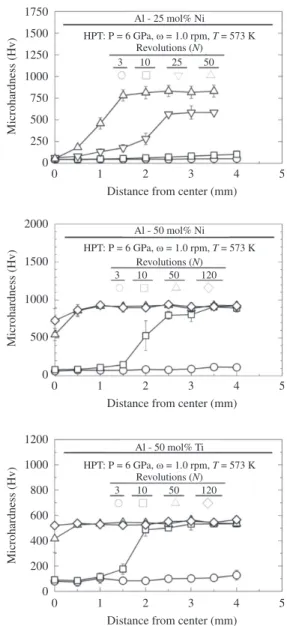
Figure 1 shows the hardness variation with the distance from the disc center after processing by HPT for various turns on the (a) Al- 25% Ni, (b) Al- 50% Ni and (c) Al-50% Ti samples. The microhardness increases with an increasing number of turns and an increasing distance from the disc center. The difference in the hardness behavior arises because the magnitude of strain created through HPT increases with increasing the turn and the distance from the disc center as given by Equation 1. The saturation of the hardness level is attained in the disc samples after 50 turns in the Al- 25% Ni and after 10 turns in the Al- 50% Ni and Al- 50% Ti, indicating that increasing the atomic fraction of the second element can accelerate the hardening during HPT. The hardness levels at the saturation, 550-920 Hv, exceeds those of most HPT-processed metals and alloys reported thus far2-7.
XRD profiles are shown in Figure 2 for the powder mixtures of (a) Al- 25% Al, (b) Al- 50% Ni and (c) Al-50% Ti and for the corresponding compositions of discs consolidated by HPT for various turns. A close examination of Figure 2 indicates the four important points. First, the Al3Ni intermetallic is formed in the Al-25% Ni after processing the powders by HPT, but a certain fraction of Al3Ni2 intermetallic are detected at large strains. The formation of intermetallics are controlled by atomic
diffusion and it is well documented that the diffusivity can strongly be enhanced during severe plastic deformation because of the presence of large fractions of high-angle grain boundaries35,36 as well as because of supersaturation
of vacancies37. Second, the Al
3Ni intermetallics are formed
at an early stage of straining in the Al- 50% Ni sample, but they transform to Al3Ni2 intermetallic at large strains. Since the diffusion of Ni in Al is faster than the diffusion of Al in Ni38, the Ni atoms diffuse to the Al matrix and form the
Al-rich Al3Ni intermetallics which then transforms to the Al3Ni2 intermetallics with further diffusion of Ni atoms. Third, large fractions of TiAl3, TiAl2 and TiAl intermetallics are formed in the Al- 50% Ti and their fraction increases with increasing strain. The TiAl3 cannot be detected at the steady state because the diffusivity of Ti in TiAl3 is rather fast38 and
it transforms to the TiAl2 and TiAl intermetallics. Fourth, the
full width at half maximum in the XRD patterns increases significantly with torsional straining using HPT, indicating the occurrence of lattice strains, dislocations generation and grain fragmentation during the HPT processing.
TEM micrographs including SAED patterns are shown in Figure 3 for the Al- 25% Ni samples after HPT, where
the bright-field images are on the left, the SAED patterns are in the inset at the center and the dark-field images taken with the diffracted beams indicated by the arrows in the SAED patterns are on the right. The micrographs and the corresponding SAED patterns were taken from four samples subjected to different numbers of turns: (a) N = 3, (b) N = 10, (c) N = 25 and (d) N = 50.
Observation shows that the microstructure corresponding to Figure 3a consists of large grains with an average grain size of ~2500 nm. Although grains containing high dislocation density are locally visible within the microstructures as marked A, few dislocations are visible within most of the grains with the grain boundaries well-defined in (a). It is noted that these microstructural features are typical of microstructures after processing by HPT at high homologous temperatures4,10. With increasing the shear stain, the grains
are refined to the submicrometer level as in Figure 3b and many Al3Ni nanograins as marked B are visible within the microstructures. In Figure 3c the grain size is reduced to the
Figure 3. TEM bright-field images (left), SAED patterns (center) and dark-field images taken with diffracted beams indicated by arrows in SAED patterns (right) for Al- 25% Ni samples processed for (a) 3, (b) 10, (c) 25 and (d) 50 turns.
nanometer level and the ill-defined grain boundaries increase the misorientation angles because the SAED analysis now exhibits a ring pattern. In Figure 3d, the grain size reaches ~40 nm and the grain boundaries appear to be better defined. The ring pattern from the SAED analysis indicates that the nanograins are separated by high angles of misorientations at the steady state.
The grain size of ~40 nm is much smaller than those of the HPT-processed pure metals4,10,16,26 and many
alloys3,5,6,9, but well comparable with those of HPT-processed
intermetallics39,40, ceramics21, lattice softened alloys8 and
semi-metals such as Si19. The formation of nanograins can
be attributed to two main reasons: first, the presence of a second phase blocks the dislocations motion and grain
boundaries movement, and second, the in-situ formed
intermetallics have strong covalent bonding. For the latter, it was reported that the grain size in materials with covalent bonding is significantly reduced to the nanometer level by HPT41. The application of HPT to intermetallics as well as
other materials with covalent bonding results in formation of a heterogeneous microstructure composed of nanograins and submicrometer grains39,40, whereas the grain size distribution
is reasonably uniform after in situ production with HPT33.
This is an important advantage of in-situ production of nanograined intermetallics by HPT.
High-resolution TEM images and corresponding diffractograms obtained by fast Fourier transform (FFT) analyses are shown in Figure 4 for the Al- 50% Ni sample processed by HPT for 50 turns. The FFT analyses show that (a), (b) and (c) correspond to Ni, Al3Ni and Al3Ni2, respectively. This characterization is well consistent with the XRD analyses. The average grain size for this sample is ~30 nm which is slightly smaller than the steady-state grain size of the HPT-processed Al- 25% Ni sample. It should be noted that this sample after annealing at 673 K transform to ~100% AlNi intermetallic with an average grain size of ~50 nm33.
Microstructures are shown in Figure 5 for the Al- 50% Ti sample processed for 50 turns, where (a) is a TEM bright-field image including the corresponding SAED pattern, (b) is a dark-field image taken with the diffracted beams indicated by the arrow in the SAED pattern, (c) is a high resolution image and the corresponding difractogram, and (d) is a reconstructed lattice images of the square region in (c) obtained by inverse FFT, which corresponds to either Al or TiAl. Note that the micrographs were taken on the sample at the steady state where the hardness remains unchanged with straining. The TEM characterization indicates several important points.
First, the bright- and dark-field images show that the nanograins form after HPT processing with an average grain size of ~20 nm. It should be noted that this sample transforms to ~100% TiAl after annealing at 873 K with an average grain size of ~100 nm with a large fraction of nanotwins34. Second, the SAED pattern exhibits a complete
form of rings, indicating that the microstructure consists of very small grains having high angles of misorientations. Third, the high-resolution image also shows the formation of nanograins. Fourth, examination of the lattice image clearly shows that there is at least one edge dislocation
in the interior of the grain. Considering the grain size of ~20 nm, an estimation of the minimum dislocation density results in 3.2 × 10¹⁵ m–2, provided that at least a single
dislocation exists in each nanograin. It turns out that such a high dislocation density within the nanograins, which is consistent with the peak broadening in the XRD patterns, is comparable to that in HPT-processed pure metals42, alloys6
and ceramics21.
4. Conclusions
• Micropowder mixtures ofAl- 25% Ni,Al- 50% Ni and Al- 50% Ti were consolidated by HPT at a temperature of 573 K;
• Large fractions of intermetallics such asAl3Ni,
Al3Ni2, TiAl3, TiAl2 and TiAl were formed because of enhanced diffusivity;
• Alongwiththeformationofintermetallics,thegrain size was reduced to 20-40 nm and the hardness was increased to 550-920 Hv;
• Thecompressionstrengthwas~1.7GPawith~2% ductility in the Al- 50% Ti samples processed by HPT, but increased to ~3 GPa with the ductility as high as ~23% after subsequent annealing.
Acknowledgements
One of the authors (AA) thanks the Indonesian Directorate of Higher Education Program (DIKTI) for a doctoral scholarship. The author (KE) acknowledges the Japan Society for Promotion of Science (JSPS) for a postdoctoral scholarship. This work was supported in part bytheLightMetalsEducationalFoundationofJapan,inpart by a Grant-in-Aid for Scientific Research from the MEXT, Japan, in Innovative Areas “Bulk Nanostructured Metals” and in part by Kyushu University Interdisciplinary Programs in Education and Projects in Research Development (P&P). compression test was used in this study because of several
reasons. First, despite many papers regarding the tensile properties of HPT-processed materials2,7,9,12,16,23,26,27, there
are limited reports regarding their compression properties34.
Second, since some fractions of micropores are formed during consolidation by HPT33,34, the micropillar was used
to minimize the effect of micropores on the mechanical properties. Third, the micropillars are appropriate to investigate the deformation mechanism43. Figure 6 shows
representative stress-strain curves of the samples. The sample after HPT processing but before annealing, which consists of certain fractions of Ti, TiAl2 and TiAl, exhibits a high yield strength as ~1.7 GPa but a limited plasticity as 2%. The sample after HPT processing and annealing, which is composed only of TiAl, exhibits a plasticity as high as ~23%. The yield strength is also significantly enhanced to the level as high as ~3 GPa and this strength is 4-10 times higher than those for micropillars of TiAl single crystals43. It should
be noted that the sample after annealing had a bimodal microstructure composed of nanograins and submicrometer grains with an average grain size of ~100 nm with a high density of nanotwins with an average twin width of ~9 nm.
Figure 7 shows the TiAl micropillars (a) before compression test and (b) after compression test. It is evident that the pillar is deformed plastically with an estimated uniform plasticity of ~19% which is well consistent with the compression test. The high uniform plasticity may be attributed to the two microstructural futures: one for bimodal microstructure formation composed of nanograins and submicrometer grains and the other for nanotwins formation as discussed earlier34.
Figure 5. TEM micrographs of Al- 50% Ti sample after HPT processing for 50 turns. (a) bright-field image and corresponding SAED pattern, (b) dark-field image taken with diffracted beams indicated by arrow in SAED patterns, (c) high resolution image and corresponding FFT analysis (d) reconstructed lattice image of square region in (c) after inverse FFT analysis, showing presence of {111}<110> edge dislocation.
Figure 6. Nominal stress versus nominal strain curves for Al- 50% Ti samples after HPT processing for 50 turns and after HPT processing and annealing at 873 K for 1 hour. Micropillar compression tests were carried out at nominal stress rate of 10 MPa/s, corresponding to initial strain rate of 10–4 s–1.
torsion. Nanotechnology. 2010; 21(48):485703. http://dx.doi. org/10.1088/0957-4484/21/48/485703
15. Wang CT, Gao N, Gee MG, Wood JK and Langdon TG. Processing of an ultrafine-grained titanium by high-pressure torsion: an evaluation of the wear properties with and without a TiN coating. Journal of the Mechanical Behaviour of Biomedical Materials. 2013; 17:166-175. http://dx.doi. org/10.1016/j.jmbbm.2012.08.018
16. Edalati K, Yamamoto A, Horita Z and Ishihara T. High-pressure torsion of pure magnesium: evolution of mechanical properties, microstructures and hydrogen storage capacity with equivalent strain. Scripta Materialia. 2011; 64(9):880-883. http://dx.doi. org/10.1016/j.scriptamat.2011.01.023
17. ReveszA, Kis-TothA,Varoa LK, Schafler E, Bakonvi I and Spassov T. Hydrogen storage of melt-spun amorphous Mg65Ni20Cu5Y10 alloy deformed by high-pressure torsion. International Journal of Hydrogen Energy. 2012; 37(7):5769-5776. http://dx.doi.org/10.1016/j.ijhydene.2011.12.160
18. Krystian M, Setman D, Mingler B, Krexner G and Zehetbauer MJ. Formation of superabundant vacancies in nano-Pd–H generated by high-pressure torsion. Scripta Materialia. 2010; 62(1):49-52. http://dx.doi.org/10.1016/j. scriptamat.2009.09.025
19. Ikoma Y, Hayano K, Edalati K, Saito K, Guo Q and Horita Z. Phase transformation and nanograin refinement of silicon by processing through high-pressure torsion. Applied Physics Letters. 2012; 101(12):121908. http://dx.doi. org/10.1063/1.4754574
20. Straumal BB, Gornakova AS, Mazilkin AA, Fabrichnaya OB, Kriegel MJ, Baretzky B et al. Phase transformations in the severely plastically deformed Zr–Nb alloys. Materials Letters. 2012; 81:225-228. http://dx.doi.org/10.1016/j. matlet.2012.04.153
21. Edalati K, Toh S, Ikoma Y and Horita Z. Plastic deformation and allotropic phase transformations in zirconia ceramics during high-pressure torsion. Scripta Materialia. 20111; 65(11):974-977.
22. Straumal BB, Gornakova AS, Fabrichnaya OB, Kriegel MJ, Mazilkin AA, Baretzky B et al. Effective temperature of high pressure torsion in Zr-Nb alloys. High Temperature Materials and Processes. 2012; 31(4-5):339-350.
23. ZhilyaevAP,GimazovAA,RaabGIandLangdonTG.Using high-pressure torsion for the cold-consolidation of copper chips produced by machining. Materials Science and Engineering A. 2008; 486(1-2):123-128. http://dx.doi.org/10.1016/j. msea.2007.08.070
24. Zhilyaev AP, Swaminathan S, Gimazov AA, McNelly TR and Langdon TG.An evaluation of microstructure and microhardness in copper subjected to ultra-high strains. Journal of Materials Science. 2008; 43(23-24):7451-7456. http:// dx.doi.org/10.1007/s10853-008-2714-y
25. Sort J, Zhilyaev A, Zielinska M, Nogues J, Surinach S, Thibault J et al. Microstructural effects and large microhardness in cobalt processed by high pressure torsion consolidation of ball milled powders. Acta Materialia. 2003; 51(20):6385-6393. http:// dx.doi.org/10.1016/j.actamat.2003.08.006
26. AlexandrovIV,ZhuYT,LoweTC,IslamgalievRKandValiev RZ. Microstructures and properties of nanocomposites obtained through SPTS consolidation of powders. Metallurgical Materials Transactions A. 1998; 29(9):2253-2260. http:// dx.doi.org/10.1007/s11661-998-0103-4
27. YoonEY,LeeDJ,AhnDH,LeeESandKimHS.Mechanical properties and thermal stability of bulk Cu cold consolidated from atomized powders by high-pressure torsion. Journal of
References
1. Bridgman PW. Effects of high shearing stress combined with high hydrostatic pressure. Physical Review. 1935; 48(10):825-847. http://dx.doi.org/10.1103/PhysRev.48.825
2. ValievRZ,EstrinY,HoritaZ,LangdonTG,ZehetbauerMJ and Zhu YT. Producing bulk ultrafine-grained materials by severe plastic deformation. Journal of the Minerals, Metals and Materials Society. 2006; 58(4):33-39. http://dx.doi. org/10.1007/s11837-006-0213-7
3. Valiev RZ, Krasilnikov NA and Tsenev NK. Plastic deformation of alloys with submicron-grained structure. Materials Science and Engineering A. 1991; 137:35-40. http:// dx.doi.org/10.1016/0921-5093(91)90316-F
4. KawasakiM,FigueiredoRBandLangdonTG.Aninvestigation of hardness homogeneity throughout disks processed by high-pressure torsion. Acta Materialia. 2011; 59(1):308-316. http://dx.doi.org/10.1016/j.actamat.2010.09.034
5. Tugcu T, Sha G, Lia XZ, Trimby P, Xia JH, Murashkin MY et al. Enhanced grain refinement of an Al–Mg–Si alloy by high-pressure torsion processing at 100 °C. Materials Science and Engineering A. 2012; 552:415-418. http://dx.doi. org/10.1016/j.msea.2012.05.063
6. YoonEY,LeeDJ,KimTS,ChaeHJ,JeneiP,GubiczaJetal. Microstructures and mechanical Properties of Mg–Zn–Y alloy consolidated from gas-atomized powders using high-pressure torsion. Journal of Materials Science. 2012; 47(20):7117-7123. http://dx.doi.org/10.1007/s10853-012-6408-0
7. ValievRZ,AlexandrovIV,ZhuYTandLoweTC. Paradox of strength and ductility in metals processed by severe plastic deformation. Journal of Materials Research. 2002; 17(1):5-8. http://dx.doi.org/10.1557/JMR.2002.0002
8. Edalati K, Toh T, Furuta T, Kuramoto S, Watanabe M and Horita Z. Development of ultrahigh strength and high ductility in nanostructured iron alloys with lattice softening and nanotwins. Scripta Materialia. 2012; 67(5):511-514. http:// dx.doi.org/10.1016/j.scriptamat.2012.06.019
9. ZhangP,AnXH,ZhangZJ,WuSD,LiSX,ZhangZFetal. Optimizing strength and ductility of Cu–Zn alloys through severe plastic deformation. Scripta Materialia. 2012; 67(11):871-874. http://dx.doi.org/10.1016/j.scriptamat.2012.07.040
10. Edalati K, Imamura K, Kiss T and Horita Z. Equal-channel angular pressing and high-pressure torsion of pure copper: evolution of electrical conductivity and hardness with strain. Materials Transactions. 2012; 53(1):123-127. http://dx.doi. org/10.2320/matertrans.MD201109
11. ValievRZ,SemenovaIP,JakushinaE,LatyshVV,RackH,Lowe TC et al. Nanostructured SPD Processed Titanium for Medical Implants. Materials Science Forum. 2008; 584-586:49-54. http://dx.doi.org/10.4028/www.scientific.net/MSF.584-586.49
12. Valiev RZ and Langdon TG.Achieving exceptional grain refinement through severe plastic deformation: New approaches for improving the processing technology. Metallurgical Materials Transactions A. 2011; 42(10):2924-2951. http:// dx.doi.org/10.1007/s11661-010-0556-0
13. Yilmazer H, Niinomi M, Nakai M, Hieda J, Todaka Y, Akahori T et al. Heterogeneous structure and mechanical hardness of biomedical β-type Ti–29Nb–13Ta–4.6Zr subjected to high-pressure torsion. Journal of the Mechanical Behaviour of Biomedical Materials. 2012; 10:234-245. http://dx.doi. org/10.1016/j.jmbbm.2012.02.022
Magazine A. 2002; 82(11):2249-2262. http://dx.doi. org/10.1080/01418610208235736
36. Divinski SV, Reglitz G, Rosner H, Estrin Y and Wilde G. Ultra-fast diffusion channels in pure Ni severely deformed by equal-channel angular pressing. Acta Materialia. 2011; 59(5):1974-1985. http://dx.doi.org/10.1016/j.actamat.2010.11.063
37. Setman D, Schafler E, Korznikova E and Zehetbauer MJ. The presence and nature of vacancy type defects in nanometals detained by severe plastic deformation. Materials Science and Engineering A. 2008; 493(1-2):116-122. http://dx.doi. org/10.1016/j.msea.2007.06.093
38. Mehrer H. Numerical Data and Functional Relationships in Science and Technology, Diffusion in Solid Metals and Alloys. Berlin: Springer-Verleg; 1990. v. 26. http://dx.doi.org/10.1007/ b37801
39. Ciuca O, Tsuchiya K, Yokoyama Y, Todaka Y and Umemoto M. Heterogeneous Process of Disordering and Structural Refinement in Ni3Al during Severe Plastic Deformation by High-Pressure Torsion. Materials Transactions 2010; 51(1):14-22. http:// dx.doi.org/10.2320/matertrans.MB200915
40. Rentenberger C, Waitz T and Karnthaler HP. Formation and structures of bulk nanocrystalline intermetallic alloys studied by transmission electron microscopy. Materials Science and Engineering A. 2007; 462(1-2):283-288. http://dx.doi. org/10.1016/j.msea.2006.03.151
41. Edalati K and Horita Z. High-pressure torsion of pure metals: Influence of atomic bond parameters and stacking fault energy on grain size and correlation with hardness. Acta Materialia. 2011; 59(17):6831-6836. http://dx.doi. org/10.1016/j.actamat.2011.07.046
42. Hegedus Z, Gubicza J, Kawasaki M, Chinh NQ, Fogarassy Z and LangdonTG.Microstructureoflowstackingfaultenergysilver processed by different routes of severe plastic deformation. Journal of Alloys and Compounds. 2012; 536S(1):S190-S193. http://dx.doi.org/10.1016/j.jallcom.2011.10.070
43. Fujimura K, Kishida K, Tanaka K and Inui H. Compression of micropillars of TiAl coexisting with Ti3Al. Materials Research Socity Symposium Proceeding. 2011; 1295:201-206. Materials Science. 2012; 47(22):7770-7776. http://dx.doi.
org/10.1007/s10853-012-6569-x
28. Sauvage X, Jessner P, Vurpillot F and Pippan R. Scripta Materialia. Nanostructure and properties of a Cu–Cr composite processed by severe plastic deformation. Scripta Materialia. 2008; 58(12):1125-1128. http://dx.doi. org/10.1016/j.scriptamat.2008.02.010
29. Pippan R, Scheriau S, Taylor A, Hafok M, Hohenwarter A and Bachmaier A. Saturation of fragmentation during severe plastic deformation. Annual Review of Materials Research. 2010; 40: 319-343. http://dx.doi.org/10.1146/ annurev-matsci-070909-104445
30. ZhilyaevAPandLangdonTG.Usinghigh-pressuretorsionfor metal processing: Fundamentals and applications. Progress in Materials Science. 2008; 53(6):893-979. http://dx.doi. org/10.1016/j.pmatsci.2008.03.002
31. Horita Z, editor. Production of mutifunctional materials using severe plastic deformation. In: Proceedings of International Symposium on Giant Straining Process for Advanced Materials (GSAM2010); 2010; Fukuoka. Fukuoka: Kyushu University Press; 2011.
32. Zehetbauer M, Grossinger R, Krenn H, Krystian M, Pippan R, Rogl P et al. Bulk Nanostructured Functional Materials By Severe Plastic Deformation. Advanced Engineering Materials. 2012; 12(8):692-700. http://dx.doi.org/10.1002/ adem.201000119
33. Edalati K, Toh S, Watanabe M and Horita Z. In-situ production of bulk intermetallic-based nanocomposites and nanostructured intermetallics by high-pressure torsion. Scripta Materialia. 2012; 66(1):386-389. http://dx.doi.org/10.1016/j. scriptamat.2011.11.039
34. Edalati K, Toh S, Iwaoka H, Watanabe M, Horita Z, Kashioka D et al. Ultrahigh strength and high plasticity in TiAl intermetallics with bimodal grain structure and nanotwins. Scripta Materialia. 2012; 67(10):814-817. http://dx.doi. org/10.1016/j.scriptamat.2012.07.030