Licenciado sob uma Licença Creative Commons DO): http://dx.doi.org. . / - . . .AO
[T]
Clinical profile of newborns undergoing physical
therapy in a neonatal intensive care unit
[)]
Peri l clínico dos recém-nascidos que realizaram
i sioterapia em uma unidade neonatal
[A]
Graziela Ferreira Biazus[a], Cidia Cristina Kupke[b, c]*
[a] Universidade Federal de Ciências da Saúde de Porto Alegre UFCSPA , Porto Alegre, RS, Brazil [b] Universidade Federal de Santa Maria UFSM , Santa Maria, RS, Brazil
[c] Centro Universitário Metodista )PA )PA , Porto Alegre, RS, Brazil
[R]
Abstract
Introduction: )n neonatal therapy units, physical therapy is directed toward integral baby care. Objective: To describe the pro ile of newborns NBs hospitalized in a Neonatal )ntensive Care Unit N)CU . Methods: Retrospective documentary study with data collection from medical records from July to July . The sample consisted of NBs who performed motor and respiratory therapy. Data were grouped into ive categories according to birth weight g, - g, - g,
-g, g . Results: total of , newborns were admitted to the N)CU within the stipulated period, . % underwent physical therapy. Of the NBs who underwent physical therapy, were born in the hospital . % and were transferred there . % ; of these babies died during the neonatal hospital stay . % . All newborns of the extremely low birth weight group g required mechanical ventilation, . % non-invasive ventilation and . % high-frequency oscillatory ventilation. The occurrence of pneumothorax in the extremely low birth weight group was . % and % in the group with birth weight - g. Conclusion: )nfants with low birth weight < g
554
constituted the pro ile of NBs who underwent physical therapy, which was directly related to higher in-cidence of death and pneumothorax, as well as increased use of mechanical and non-invasive ventilation.
Keywords: Physical Therapy. Newborn. N)CU.
Resumo
Introdução: Nas unidades de terapia neonatal, o tratamento ϔisioterapêutico visa ao cuidado integral do bebê. Objetivo: Descrever o perϔil dos recém-nascidos (RNs) internados em uma UTI Neonatal. Métodos: Estudo retrospectivo documental com coleta de dados nos prontuários no período de julho de 2011 a julho de 2013. Pertencem à amostra os RNs que realizaram ϔisioterapia motora e respiratória. Os dados foram agrupados em cinco categorias de acordo com o peso ao nascimento (κ 1.000 g, 1.001-1.500 g, 1.501-2.000 g, 2.001-2.500 g, λ 2.501 g). Resultados: De um total de 1.884 RNs internados na Unidade de Internação Neonatal do Hospital de Clínicas de Porto Alegre no período estipulado, 168 (13,9%) realizaram ϔisioterapia. Dos 168 RNs que re-alizaram ϔisioterapia, 137 nasceram neste hospital (81,5%) e 31 foram transferidos para o mesmo (18,5%); sendo que 17 desses bebês foram a óbito durante o período de internação neonatal (10,1%). Todos os RNs do grupo extremo baixo peso (κ 1.000 g) necessitaram de ventilação pulmonar mecânica, 72,7% de ventilação não invasiva e 16,6% de ventilação mecânica de alta frequência. A ocorrência de pneumotórax no grupo de extremo baixo peso foi 13,8% e no grupo com peso de nascimento entre 1.001-1.500g foi de 16%. Conclusão: Bebês com baixo peso ao nascimento (< 2.500g) constituíram o perϔil dos RNs que receberam atendimento de ϔisioterapia, sendo estes diretamente relacionados com maior incidência de óbito, pneumotórax, maior uso de ventilação pulmonar mecânica e ventilação não invasiva.
Palavras-chave: Fisioterapia. Recém-Nascido. UTI Neonatal.
Introduction
)n neonatal physical therapy care units the aim is to improve pulmonary conditions, reduce airway resistance and increase lung compliance in order to reduce the respiratory workload imposed on new-borns NBs , aiming to improve the respiratory me-chanics and neuromotor development .
Some of the indications for physical therapy in preterm and term neonates are the aspiration syn-dromes, respiratory distress syndrome, pneumonia, atelectasis and prevention of mechanical ventilation complications . Thus, through bronchial clearance and pulmonary re-expansion techniques, physical therapy can provide improved respiratory function in order to facilitate gas exchange, correct the ventila-tion-perfusion ratio and prevent or treat pulmonary complications .
The literature states that babies who are born prematurely are more likely to have neuromotor dysfunctions, as they are more susceptible to peri-ventricular hemorrhage and periperi-ventricular leuko-malacia .
Data from the Brazilian National (ealth System SUS classi ies newborns according to gestational age: preterm, less than weeks of gestational age; term, between and weeks and days of gesta-tion; post-term, more than weeks of gestational age . Regarding the criteria of risk, the Ministry of
(ealth classi ied newborns born with less than g
as underweight; those born weighing less than g
as very low birth weight and newborns with birth
weight less than g as extremely low weight .
Newborns of extreme low weight or extreme prematurity are more immature and, therefore, suffer more frequent and more serious complica-tions. They are at high risk of developing neuro-motor and sensory deviations and sequelae. The most common consequences are: developmental delays, learning disabilities, behavioral disorders
and cerebral palsy .
The aims of this study were to describe the pro-ile of newborns that underwent physical therapy and to relate the neonatal care with birth weight in a Neonatal )ntensive Care Unit N)CU in the period
Methods
This was a quantitative, descriptive and retro-spective documentary study. )t was approved by the Research Ethics Committee of the (ospital de Clinicas de Porto Alegre (CPA , under authorization number
, .
The population consisted of newborns admitted to the neonatal inpatient unit of (CPA. The sample was composed of the NBs who received respiratory and/or motor physical therapy in this institution,
from July to July .
The mean number of babies hospitalized in the neonatal unit per month was . . Of these, % un-derwent respiratory and/or motor physical therapy.
The sample size was calculated to be babies over
the period of two years, using a sampling error of % and % con idence level. The sample size calcula-tion was performedusing the SAS . program.
For the data collection, a survey was conducted in the medical records. The variables recorded were: birth weight in grams , gestational age in weeks ,
Apgar at the irst and ifth minute - , gender
male and female , mode of delivery cesarean and vaginal , use of exogenous surfactant yes or no , day of life that physical therapy began days , use of mechanical ventilation yes or no , noninvasive ventilation yes or no , high frequency ventilation yes or no , inhaled nitric oxide yes or no , length of
hospitalization in the unit in days , reason for physi-cal therapy request atelectasis, mucus retention, surgery or motor stimulation , hospital discharge condition cured or in treatment and death during hospitalization yes or no .
)nclusion criteria were newborns hospitalized in the N)CU and receiving respiratory and/or
mo-tor physical therapy from July to June .
The exclusion criterion was not having undergone respiratory and/or motor therapy during the pe-riod stipulated.
Data were grouped into ive categories according
to birth weight , g, - g, - g,
- g, g , birth weight being the best
default predictor forthe immediate and future health of the newborn . The variables were analyzed us-ing mean and standard deviation for the continuous variables and simple frequency for the categorical variables .
Results
Of the total of , newborns admitted to the
N)CU, within the stipulated period, . %
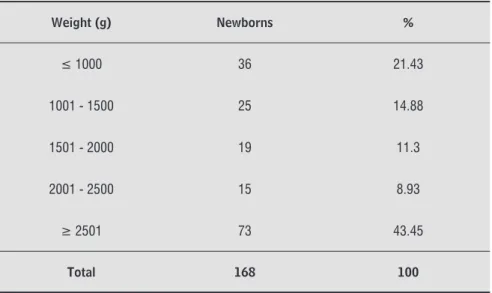
un-derwent respiratory and/or motor therapy. Table shows the relationship between the percentage of NBs and birth weight. Table shows the character-istics of the sample according to birth weight.
Table 1 - Relationship between the percentage of NBs and birth weight (g)
Weight (g) Newborns %
≤ 1000 36 21.43
1001 - 1500 25 14.88
1501 - 2000 19 11.3
2001 - 2500 15 8.93
≥ 2501 73 43.45
556
Of the infants that underwent physical
ther-apy, were born at the obstetric center of (CPA
. % and were transferred to (CPA . % ;
of these babies died during the neonatal hospital
stay . % . Table presents the reasons for the
therapy request, these being: atelectasis, mucus re-tention, surgery and motor stimulation
Table 2 - Characterization of the sample according to birth weight (g)
Caracteristics ≤ 1000g 1001 - 1500g 1501 - 2000g 2001 - 2500g ≥ 2501g
1-minute Apgar* 4.58 (± 2.4) 4.92 (±2.0) 5.58 (± 2.2) 6.25 (±2.3) 6.28 (±2.4)
5-minute Apgar* 7.36 (±1.6) 6.96 (±1.5) 7.82 (±1.4) 7.42 (±2.2) 8.12 (±1.4)
Male sex 17 (47.2%) 13 (52%) 13 (68.4%) 6 (40%) 48 (65.7%)
GA (weeks)* 26.9 (±1.3) 28.4 (±1.1) 33.2 (±1.6) 36 (±2) 38.3 (±1.6)
BW (g)* 791.5 (±85.7) 1183.4 (±121.0) 1766 (±110.16) 2244 (±137.8) 3208.9 (±430.3)
Exogenous surfactant 36 (100%) 20 (80%) 5 (26.3%) 3 (20%) 5 (6.8%)
Vaginal 14 (38.8%) 14 (56%) 6 (31.5%) 5 (33.3%) 27 (36.9%)
Days of began physiotherapy* 19.8 (±14.6) 17.2 (±10.8) 24.4 (±16.0) 11.2 (±8.7) 13.4 (±9.5)
Use of MV 36 (100%) 17 (68%) 13 (68.4%) 8 (53.3%) 48 (65.7%)
Use of NIV 26 (72.2%) 25 (100%) 9 (47.3%)
7 (46.6%)
9 (12.3%)
Use of HFOV 6 (16.6%) 2 (8%) 0 0 2 (2.7%)
Use ofi NO 4 (11.1%) 1 (4%) 1 (21%) 1 (6.6%) 10 (-13.60%)
Pneumothorax 5 (13.8%) 4 (16%) 2 (10.5%) 1 (6.6%) 2 (2.7%)
Days of hospitalization in NICU* 78.3 (±32.3) 75.7 (±20.0) 64.5 (±24.1) 31.2 (±16.5) 39.0 (±17.3)
Death 11 (30.5%) 1 (4%) 1 (5.2%) 1 (6.7%) 3 (4.2%)
Note:*Mean and standard desviation. GA: gestacional age; BW: birth weight; MV: mechanical ventilation;NIV: non-invasive ventilation; HVOF: high-frequency oscillation ventilation; iNO:inhaled nitric oxide; NICU: neonatal intensive care unit.
Table 3 - Reason for physical therapy request according to birth weight (g)
Caracteristics ≤ 1000g 1001-1500g 1501-2000g 2001-2500g ≥ 2501g
Atelectasis 9 (25%) 5 (20%) 4 (21%) 3 (20%) 20 (27.3%)
Mucusretenion 27 (75%) 20 (80%) 11 (57.8%) 7 (46.6%) 45 (61.6%)
Surgery 1 (2.7%) 0 0 1 (6.6%) 4 (5.4%)
Motor 1 (2.7%) 0 5 (26.3%) 5 (33.3%) 13 (17.8%)
Table presents the data on hospital discharge condition according to birth weight. The discharge condition was categorized as "cured", when the infant did not require oxygen therapy, physical therapy or airway aspiration in the domicile, and "in treatment",
when there was a need for care, such as oxygen ther-apy, physical therapy or airway suctioning.
Feeding route, whether oral or orogastric tube, at discharge from the neonatal unit was recorded.
Table 4 - Hospital discharge condition according to birth weight (g)
Hospital dischardecondition ≤ 1000g 1001-1500g 1501-2000g 2001-2500g ≥ 2501g
Cured 18 (72%) 21 (87.5%) 12 (66.6%) 13 (92.8%) 57 (78%) In treatment 7 (28%) 3 (12.5%) 6 (33.4%) 1 (7.2%) 13 (22%) Alimentation
Oral 15 (60%) 21 (64%) 9 (50%) 12 (85.7%) 56 (76.7%) Orogastric tube 10 (40%) 3 (36%) 9 (50%) 2 (14.3%) 14 (23.3%)
)n such cases, the proposal is not to vent aggressively
and to use for only a short period .
Several mechanical ventilation modes are avail-able for preterm infants. The choice of method and strategy should be based on knowledge of the physi-ology and pathophysiphysi-ology of the disorder presented and the prevention of lung damage. Non-invasive ventilation can be used for treating atelectasis, oxy-genation improvement, reducing the respiratory workload, preventing alveolar collapse and
improv-ing secretion removal ef iciency .
According to the study by Tsai et al. ,
mechani-cal ventilation for more than days increases the risk of cerebral palsy disorder and attention de icit/ hyperactivity disorder, even without injury to the brain. )t is known that respiratory support via me-chanical ventilation is important and necessary for
the survival of newborns, however, poses risks .
The GA was described by Favero et al. as a factor
that affectsextubation failure and reintubation, being inversely proportional to the age. This may be related to the anatomical and physiological immaturity of the
respiratory system .
When the patient is undergoing MV, there is accu-mulation of secretion leading to increased airway re-sistance and respiratory workload, changes in venti-lation perfusion and consequent atelectasis, delaying
the MV weaning process . Atelectasis is a frequent
lung condition that can increase the predisposition of the child to infectious complications and the need for increased ventilatory support oxygen, mechanical
and/or non-invasive ventilation . Respiratory
therapy,including bronchial hygiene techniques and positioning in the bed, has been shownto be an
im-portant resource in the MV weaning process .
Thoracoabdominal rebalancing is a technique that aims to encourage ventilation and promote the removal of pulmonary secretions and clearance of the upper airways, through the reorganization of respiratory muscle synergism, which is lost in lung disorders. )t is based on positioning, mobilization of costovertebral and costochondral joints, muscle stretching, manual support to increase intra-abdomi-nal pressure and myofascial maneuvers conducted to minimize the use of accessory muscles, re-educating the respiratory system that is overloaded in neonatal
pathologies .
The occurrence of pneumothorax in the extremely low birth weight group was . % and % in the
group with birth weight - g. Pneumothorax
Discussion
)n the sample strati ied by birth weight, it was observed that the death percentage was inversely proportional to gestational age GA . The group with
birth weight g had a higher incidence of death,
. % , compared to the other groups. The Apgar score less than at and minutes is considered a
risk factor for mortality . The study by Piccoli et
al. also showed a high incidence of prematurity
and low birth weight with consequent morbidity and mortality.
Silva et al. found that variables associated
with death until the th day of life were type of delivery, notusing antenatal corticosteroids,
pre-eclampsia, birth weight < g, Apgar score < at
minutes, endotracheal intubation, and notusing exogenous surfactant. For these authors, death was determined by the conditions of the pregnancy, de-livery and the newborn.
The group considered extremely low birth weight,
or birth weight g presented a mean
gesta-tional age of . weeks and the group with birth
weight - g presented a mean gestational
age of . weeks. The general immaturity can lead to dysfunction in any organ or bodily system, and the premature neonate may also suffer impairment or complications throughout their development.
All infants of the extremely low birth weight group required respiratory support, with . % re-ceiving non-invasive ventilation N)V and . % high-frequency oscillatory ventilation (FOV . Of
the group with birth weight - g, % of
the newborns required respiratory support, with % N)V and % (FOV. A multicentriccohort study
by Vendettuoli et al. in )taly, including ,
preterm infants with GA between and weeks, showed a reduction in mechanical ventilation and an increase in the use of N)V, accompanied by a decrease in mortality and bronchopulmonary dysplasia. This highlights the importance of N)V use in newborns with extremely low and low birth weight.
558
establishment of bonds, for which communication
is essential .
The physical therapy rehabilitation was designed-for the evaluation and prevention of kinetic functional
changes due to the MV and N)V intervention . An
evaluationshould be performed to determine the care priority of the NB, taking into account the in-dividual characteristics. The pregnancy history and labor conditionsshould be considered, as well as the neurological and respiratory evaluation. The overall aims of the care include the diagnosis of alterations in psychomotor development, prevention of deviations from the norm,provision of sensorimotor stimula-tion, prevention or treatment of respiratory and/or musculoskeletal complications andthe provision of information and guidance for the parents.
)ntegral care for babies and their families has be-come one of the best practices observed during
hospi-talization in N)CUs. Since , the Ministry of (ealth
has been implementing the Kangaroo Method, which is a humanized care policy for very low birth weight newborns. The method proposes the humanization of neonatal care based on four basic principles: sen-sitivity toward the baby and his/her family, respect for individualities, promoting skin to skin contact through the Kangaroo position and involving the mother in caring for her child. Babies participating in the Kangaroo method have better sensorimotor responses, lower degrees of stress, and better
spon-taneous re lex responses .
Conclusion
Babies with low birth weight < g
consti-tuted the pro ile of NBs who underwent physical therapy, which is directly related to higher incidence of death and pneumothorax and the increased use of mechanical and non-invasive ventilation. The main reasons for the physical therapy request were atel-ectasis and retention of pulmonary secretions. The physical therapist should provide humane care to the newborn, and be aware of integral baby care.
A limitation observed in this study was that the data related to some variables could not be evaluated, such as mechanical ventilation, ventilator-associated pneumonia, ventilator settings for extubation and extubation failure rate. Thus, it is suggested that further prospective studies be conducted with post-discharge follow-ups.
is more common in the irst hours of life, especially
among preterm newborns . )t can be associated
with respiratory distress syndrome, meconium aspi-ration, pulmonary hypoplasia, and even ventilatory
support .
)n the present study, the physical therapy care commencedaround the second week of life, vary-ing bya few days between groups accordvary-ing to birth weight. The main reasons for the physical therapy request were due to atelectasis and retention of pul-monary secretions. )t was also observedthat there were more requests for care in the newborns
weigh-ing up to g, compared to the group with birth
weight equal to or above g.
Among the complications associated with low birth weight and extremely low birth weight there are neonatal infections, respiratory distress syndrome, retinopathy of prematurity, perinatal anoxia, peri-intraventricular hemorrhage, periventricular leuko-malacia, metabolic disorders, necrotizing enterocoli-tisand patent ductus arteriosus,with the development of bronchopulmonary dysplasia in the long term, this being one of the most important chronic
complica-tions in preterm survivors .
)t was found that approximately % of the newborns required some assistance,such as oxygen therapy, physical therapy or airway suctioning,after discharge from the neonatal unit. For this reason it is important to inform the family about the care that will be needed after leaving the hospital. Oxygen therapy in the domicile is a growing practice for pediatric patients, especially in cases of bronchopul-monary dysplasia, cystic ibrosis and bronchiolitis
obliterans .
)t is important to monitor the psychomotor de-velopment in premature newborns after hospital discharge. The most common sequelae in the irst years of life are: cerebral palsy, mental retardation and sensorineural losses, such as visual impairment and hearing. There must be individualized support-ive care that respects the personalityof the NB and
encourages the participation of the family .
Multidisciplinary outpatient treatment,including physical therapy, speech therapy, psychology and occupational therapy, is critical in trying to prevent or minimize the presentation of motor and cognitive development de icits.
12. Silva CF, Leite AJM, Almeida NMGS, L eon ACMP,
Olofi n I, et al. Fatores associados ao óbito neonatal de
recém-nascidos de alto risco: estudo multicêntrico em Unidades Neonatais de Alto Risco no Nordeste brasileiro. Cad Saude Publica. 2014;30(2):355-68.
. Vendettuoli V, Bellù R, Zanini R, Mosca F, Gagliardi L. Changes in ventilator strategies and outcomes in preterm infants. Arch Dis Child Fetal Neonatal.
; : - .
. Nicolau CM, Andrade LB Org . PROF)S)O. Programa de Atualização em Fisioterapia Pediátrica e Neonatal: Cardiorrespiratória e Terapia )ntensiva. Ciclo . Porto Alegre Brazil : Artmed. ; . Portuguese. . Loh LE, Chan Y(, Chan ). Noninvasive in children: a
review. J Pediatr. ; : - .
. Tsai W(, (wang YS, (ung TY, Weng SF, Lin SJ, Chang WT. Association between mechanical ventilation and neurodevelopment disorders in a nationwide cohort of extremely low birth weight infants. Res Dev Disabil.
; : - .
. Fávero RA, Schuster RC, Wojahn VW, Tartari JL. )n-cidência e principais fatores associados à falha na ex-tubação em recém-nascidos prematuros. Pediatria.
; : - .
18. Costa ACO, Schettino RC, Ferreira SC. Fatores predi-tivos para falha de extubação e reintubação de recém-nascidos submetidos à ventilação pulmonar mecânica. Rev Bras Ter Intensiva. 2014;26(1):51-6.
19. Nicolau CM, Andrade LB (Org). PROFISIO. Programa de Atualização em Fisioterapia Pediátrica e Neonatal: Cardiorrespiratória e Terapia Intensiva. Ciclo 2. Porto Alegre (Brazil): Artmed. 2012; 1(2). Portuguese.
20. Johnston C, Carvalho WB. Atelectasias em pediatria: mecanismos, diagnósticos e tratamento. Rev Assoc Med Bras. 2008;54(5):455-60.
21. Pessina DC, Costa TCM, Cavenaghi OM, Goraieb L, Corrêa PR, Croti UA. Plicatura diafragmática após lesão do nervo frênico em operação de Glenn: relato de caso. Fisioter Mov. 2008;21(1):73-8.
22. Roussenq KR, Scalco JC, Rosa GJ, Honório GJS, Schivinski CIS. Reequilíbrio tóracoabdominal em recém-nascidos prematuros: efeitos em parâmetros cardiorres-piratórios, no comportamento, na dor e no desconforto respiratório. Acta Fisiatr. 2013;20(3):118-23.
References
1. Vasconcelos GAR, Almeida RCA, Bezerra AL.
Reper-cussions of physiotherapy in the Neonatal Intensive Care
Unit. Fisio e Movimento. 2011;24(1):65-73.
2. Nicolau CM, Pigo JDC, Bueno M, Falcão MC. Pain
as-sessment in premature infants during respiratory physio-therapy. Rev Bras Saude Mater Infant. 2008;8(3):285-90.
3. Abreu LC, Angheben JMM, Braz PF, Oliveira AG, Falcão
MC, Saldiva PHN. E ect of the neonatal physiotherapy in the heart rate in preterm infant with respiratory distress syndrome after replacement of exogenous surfactant. Arq Med ABC. 2006;31(1):5-11.
4. Gonçalves MCP. Prematuridade: desenvolvimento
neu-rológico e motor - avaliação e tratamento. Rio de Janeiro: Revinter; 2012. Portuguese.
5. Datasus. Defenições. 2015 [cited Apr 15]. Available
from: http://tinyurl.com/jddvkel. Portuguese.
6. Ministério da Saúde, Secretaria de Vigilância em Saúde/
Secretaria de Atenção à Saúde. Manual de vigilância do óbito infantil e fetal e do comitê de prevenção do óbito infantil e fetal. 2nd ed. Brasília: Ministério da Saúde; 2009. Portuguese.
7. Pavão SL, Arnoni JLB, Oliveira AKC, Rocha NACF.
Impact of a virtual reality-based intervention on motor performance and balance of a child with cerebral palsy: a case study. Rev Paul Pediatr. 2014;32(4):389-94.
8. Abreu LC, Souza AMB, Oliveira AG, Selestrin CC,
Guerra MSB, Ferreira C, et al. Incidência de hemorra-gia peri-intraventricular em recém-nascidos pré-termo e a relação com o peso ao nascer. Rev. bras. crescimento desenvolv. hum. 2007;17(2):24-30.
9. Callegari-Jacques SM. Bioestatística: princípios e
apli-cações (Biostatistics: principles and applications). Porto Alegre (Brazil): Artmed; 2007. Portuguese.
10. Bittencourt RM, Gaíva MAM. Mortalidade neonatal precoce relacionada a intervenções clínicas. Rev Bras Enferm. 2014;67(2):195-201.
11. Piccoli A, Soares CRS, Costa G, Silveira JL, Fiatt MP,
Cunha RS. Perfi l clínico de neonatos de muito baixo peso
internados em uma Unidade de Tratamento Intensivo
Neonatal. Rev. (CPA & Fac. Med. Univ. Fed. Rio Gd. do
560
23. Wei YH, Lee CH, Cheng HN, Tsao LT, Hsiao CC. Pigtail Catheters Versus Traditional Chest Tubes for Pneumotho-races in Premature Infants Treated in Neonatal Intensive Care Unit. Pediatr Neonatol. 2014;55(5):376-80.
. Cloherty JP, Stark AR, Eichenwald EC. Manual of Neo-natal Care. th ed. Philadelphia: Lippincott Williams & Wilkins; .
. Tapia JL, Agost D, Alegria A, Standen J, Escobar M, Grandi C, et al. Displasia broncopulmonar: incidên-cia, fatores de risco e utilização de recursos em uma população sul-americana de recém-nascidos de muito baixo peso. J Pediatr. ; : - .
. Adde FV, Alvarez AE, Barbisan BN, Guimarães BR. Recomendações para oxigenoterapia domiciliar prolongada em crianças e adolescentes. J Pediatr.
; : - .
. Neves LAT, Fronio JS, Araújo JL, Lupatini PRM. Por que prestar assistência ao prematuro? Rev Med Minas Gerais. ; : - .
. Silva LM, Tavares LAM, Gomes CF. Di iculdades na amamentação de lactentes prematuros. Rev Disturb Comun. ; : - .
. Johnston C, Zanetti NM, Comaru T, Ribeiro SNS, An-drade LB, Santos SLL. ) Recomendação brasileira de
isioterapia respiratória em Unidade de Terapia )n-tensiva Pediátrica e Neonatal. Rev Bras Ter )n)n-tensiva.
; - .
. Franco MP, Alves CP. The impact of the method Kanga-roo Mother Care in the learning process of low-birth-weight preterm infants: A literature review. Cad Ter Ocup UFSCar. ; : - .
Received in / /
Recebido em 28/07/2014
Approved in / /