Fisioter. Mov., Curitiba, v. , n. , p. - , Jul./Set.
Licenciado sob uma Licença Creative Commons
DO): http://dx.doi.org. . / - . . .AO
[T]
Effect of global postural re-education and isostretching in patients
with nonspecific chronic low back pain: a randomized clinical trial
[)]
Efeitos da reeducação postural global e do isostretching em pacientes
com lombalgia crônica não-especíi ca: ensaio clínico aleatório
[A]
Fábio Alexandre Moreschi Guastala[a], Mayara Hilda Guerini[a], Patricia Fernanda Klein[a],
Vanessa Cristina Leite[a], Renata Cappellazzo[a], Ligia Maria Facci[b]*
[a] Centro Universitário de Maringá UN)CESUMAR , Maringá, PR, Brazil [b] Universidade Estadual de Londrina UEL , Londrina, PR, Brazil
[R]
Abstract
Introduction: Low back pain is one of the most prevalent musculoskeletal disorders, but little is known
about postural methods in its treatment. Objective: Analyze changes in muscle strength, lexibility, function
and pain in patients with chronic low back pain that underwent isostretching and global posture reeduca-tion GPR . Methods: Thirty-nine patients, aged between and years, were evaluated before and after
treatment protocols regarding: lexibility for sit and reach, muscle strength, functional capacity using the Rolland-Morris Questionnaire, and intensity of pain by Visual Analog Scale. The sample was randomized into two groups -GPR; -)sostretching , all of whom were treated individually through sessions lasting minutes each, twice a week. Results: After treatment, median reduction in pain intensity of mm in
group and mm in group was observed, and a median improvement in functional capacity in group
516
of . points and points in group p < , . A mean improvement of severn repetitions in trunk exten-sor muscle strength was observed in group and in group ; by dynamometry of kg / f in group and
. kg / f in group of ten abdominal repetitions strength in group and four repetitions in group p < . .)n the Sit and Reach, Group had a total mean increase of cm, and group had . cm p < . .
Conclusion: Both groups were effective in improvement of muscle strength, lexibility, pain and functional
capacity.
Keywords: Posture. Rehabilitation. Low Back Pain. Spine. Exercise Therapy.
Resumo
Introdução: A lombalgia é uma das mais prevalentes disfunções musculoesqueléticas, porém pouco se sabe sobre os métodos posturais no seu tratamento. Objetivo: Analisar as alterações de força muscular, ϔ lexibi-lidade, função e dor em pacientes com lombalgia crônica submetidos à Reeducação Postural Global (RPG) e Isostretching. Métodos: Trinta e nove pacientes com idade entre 40 e 59 anos foram avaliados antes e após os protocolos de tratamento quanto à ϔlexibilidade pelo teste Sentar e alcançar, força muscular, capacidade fun-cional pelo Questionário Rolland-Morris e intensidade da dor pela Escala Visual Analógica. A amostra foi alea-torizada em dois grupos (1-RPG; 2-Isostretching), sendo todos tratados individualmente através de 12 sessões de 45 minutos, duas vezes por semana. Resultados: Foi observada mediana de redução na intensidade da dor de 28 mm no grupo 1 e de 32 mm no grupo 2; e melhora mediana na capacidade funcional no grupo 1 de 8,5 pontos e de 7 pontos no grupo 2 (p < 0,05). Observou-se mediana de melhora de 7 repetições na força muscular extensora de tronco no grupo 1 e no grupo 2; na Dinamometria de 10 kg/f no grupo 1 e de 12,5 kg/f no grupo 2; de 10 repetições da força abdominal no grupo 1 e 4 repetições no grupo 2 (p < 0,05). No teste Sentar e Alcançar o grupo 1 obteve aumento médio de 3 cm e o grupo 2 de 1,6 cm (p < 0,05). Conclusão: Ambos os grupos foram efetivos na melhora de força muscular, ϔlexibilidade, da dor e da capacidade funcional.
Palavras-chave: Postura. Reabilitação. Dor Lombar. Coluna Vertebral. Terapia por Exercício.
Introduction
A complaint of low back pain, with or without ra-diation to the lower limbs, is the second most common reason that leads workers to seek health care . Vitta states that low back pain affects people in different stages of life, thereby, translating into a disease that causes important socioeconomic impact .
There is signi icant evidence supporting exer-cises in the treatment of non-speci ic low back pain
. These exercises allow patients to acquire lex-ibility and stability of the lumbar spine, aiming to
prevent painful recurrences . The effectiveness
of speci ic types of exercises, however, still needs to be evaluated in further studies with an appropriate
methodology .
Despite the lack of scienti ic studies, indications of postural exercises are common in clinical practice, especially the isostretching method and global pos-tural re-education GPR for treatment of patients with chronic low back pain.
The isostretching, global postural exercise method, which emphasizes the strengthening of the deep muscles through isometric contraction, is a technique that stimulates the corporeal awareness
and the acquisition of good physical condition .
The application of this method has been studied for different purposes, such as: evaluating respiratory
consequences in healthy individuals ,
optimiza-tion of skills in athletes , improvement of gait
and balance , , , functional capacity in the
elderly , , hamstring lexibility , posterior
chain muscles , the bene its in patients with
shoulder impingement syndrome and
mastec-tomy . Still, with respect to speci ic applications
in postural re-education, studies were found with this technique in the treatment of idiopathic
sco-liosis , , , and thoracic kyphosis .
Some research was conducted to investigate the application of isostretching in patients with
low back pain – . These studies showed
517
endurance , lexibility , and reduction
in pain intensity – . (owever, in addition
to the great methodological diversity employed in these studies, when isostretching is compared with conventional kinesiotherapy, no signi icant
differ-ences were identi ied .
Global postural re-education GPR is the appli-cation of isometric exercise by maintaining static
postures . This method emphasizes that the
tension on a muscle group can re lect on changes
and compensation in the entire chain . Thus, this
technique aims to correct muscle compensation,
deal-ing with the cause to the effect . With the wide
spread adoption of this method, which was created
by Philippe Emmanuel Souchard in ,
stud-ies were stimulated that would substantiate justi i-cation of its applii-cation. Some research highlighted the bene its of the GPR in patients with spinal pain
, in postural changes – , lexibility
im-provement , , , increased range of motion
, muscle strength , functional capacity
, and reduction of the intensity of pain and
stiffness .
Some case studies using the GPR postures in pa-tients with low back pain were found. Eduardo et al.
investigated ten patients with low back pain who underwent GPR, inding signi icant improvement in quality of life and reduction in pain intensity. (eredia
and Rodrigues applied the GPR in patients
with epidural ibrosis in the postoperative period for herniated discs, observing an increase of amplitude of the coxofemoral, functional ability and reduction in pain in . % of patients. Also in patients with
lumbar disc herniation, Di Ciaccio et al. applied
GPR in patients, and found a reduction in pain intensity and improvement in functional capacity.
)n a randomized clinical trial, Bonetti et al. evaluated the ef icacy of a GPR program compared with stabilization exercises in patients with chronic low back pain in the short and medium term. This study showed that the individuals of the GPR group had signi icant improvement in pain and functional capacity in relation to the spinal stabilization group.
Considering that the GPR and isostretching meth-ods are often applied in clinical practice, despite the lack of evidence to support it, especially in the treatment of patients with low back pain, this study is justi ied.
The aim of this research was to investigate changes in the lexibility, muscle strength, functional capacity
and pain intensity in patients with chronic low back pain undergoing GPR and isostretching, and to com-pare the results obtained from these methods.
Methods
A single-blind randomized clinical trial was per-formed, after approval was received from the Research Ethics Committee CEP of Centro Universitário de
Maringá-PR UN)CESUMAR , protocols no. /
and / , according to the Resolution MS/CNS
No. / of the Ministry of (ealth MO( .
After evaluation of the referral records of people with nonspeci ic chronic low back pain at the phys-iotherapy clinic at UN)CESUMAR, patients received phone calls, were informed of the research objectives, questioned about inclusion and exclusion criteria, and were invited to participate in the study. Those who agreed to participate signed a consent form.
)n order to be included in the study, patients had to be: to years old, referred to the physiotherapy clinic at UN)CESUMAR with a medical prescription with the description of nonspeci ic low back pain. Patients with incompatible schedules for visits, lack of transportation, a disease that compromised their health during treatment and/or the study results, namely uncontrolled hypertension, ibromyalgia, spinal surgery in the previous six months, disc her-niation, spondylolisthesis, neurological disorders, and inability to perform or to understand physical exercise were excluded.
Before and after implementation of treatment protocols, all patients were evaluated by an, indepen-dent examiner, namely, one that had no knowledge about the intervention, regarding different variables. Assessment of pain intensity was performed using
the pain Visual Analogue Scale VAS ;
function-al capacity was assessed using the Roland-Morris
Questionnaire RMQ ; lexibility was assessed
using the Sit and Reach test ; Dinamometry was
used to evaluate the muscle strength of trunk
exten-sors , with the device BACK - A, TYPE - , and the
Maximum Repetition test in a minute — MR, which was also applied to assess abdominal muscle strength . Postural analysis was also applied based on
the concepts of muscle chains for choosing the
therapeutic postures.
518
ten to the maximum intensity of pain, with the
in-formation provided by the volunteer himself .
The tool for the assessment of low back pain, spe-ci ic inability, the Roland-Morris Questionnaire, al-lows for evaluation of the physical limitations result-ing from such pain on the lumbar spine and has been used to assess limitations arising from it. )t consists of questions, each statement corresponds to one point, and the inal score is determined by the sum of the obtained values. Values close to zero represent the best results, namely a lower limitation, and val-ues close to correspond to the worst results, or a
higher limitation .
The MR of trunk extensor was performed with the patient in the prone position, with hands posi-tioned in the occipital region, support in the frontal region and ixation of the pelvis by the therapist to perform the movements. Then, the therapist asked the patient to demonstrate his maximum trunk exten-sion, by analyzing the amplitude, and then the patient performed the largest number of movements of the same amplitude in one minute. The abdominal MR was performed with the patient supine with bent and stabilized legs, arms crossed in the anterior chest region, and then the therapist asked the patient to perform the largest number of trunk lexions in a
minute .
For dynamometry of trunk extensors the patient remained standing under the dynamometer, with the legs in knee extension and trunk in anterior
incli-nation of °. )n this position, the patient held the
dynamometer bar with elbow extension, and then the therapist requested that the patient perform an extension of the trunk with speci ic action of the lum-bar muscles for six seconds, by positioning the trunk
closest to an erect posture .
After being evaluated by the physiotherapist, pa-tients were randomly assigned through computer-generated numbers to both treatment groups. After generation of numbers, they were transformed into a card with the assigned treatment GPR - , isostretch-ing - and then placed in sealed, opaque envelopes numbered in sequence. This prevented the evaluator and the therapist from choosing the group to which the patient would be assigned.
All patients were monitored individually, and performed a therapeutic program of , -minute sessions twice a week. The GPR group performed three positions of the method per session, held for minutes each, in order to make for more uniform
treatment and reduce variability between sessions. The isostretching group performed nine postures, which were held for a period of nine breaths each, and the patient rested for seconds every three cycles. To perform some isostretching postures, a bat and a ball were used as auxiliary instruments.
The choice of postures in both methods was determined by prior postural analysis, which de-tected the predominance of muscle chains. Postural changes designating retraction of the previous chain were: anterior head, dorsal kyphosis, lumbar hyperlordosis, pelvic anteversion, valgus knees and ankles, and flat feet. Postural changes demonstrat-ing retraction of the posterior chain detected in the initial examination were: cervical lordosis, dor-sal rectification, lumbar hyperlordosis, pelvic tilt, varus knees and ankles and pes cavus. )f the sum of changes determined predominance of an anterior string, the postures were performed by opening the angle of the coxofemoral articulation, which are in a neutral position related to the hip joint and can be performed with the patient standing or lying down. )f the sum of changes determined prevalence of a posterior chain, the postures were performed by closing the coxofemoral angle, which is performed with the hip joint flexed and can be performed with
the patient standing, sitting or lying . Equal
changes in both chains were named mixed muscle chain retractions. The chosen treatment postures therefore were also intercalated between open and closed coxofemural.
Considering the degree of dif iculty of each pa-tient and predominance of muscle chains, different postures were performed with each patient. At the beginning, at the end, and every minutes of care, the heart rate, blood pressure and oxygen saturation were measured for general patient management.
After treatment the patients were reassessed and the information collected was statistically analyzed using the Statistical Program for the Social Sciences SPSS , version . with, the results considered sig-ni icant with p > . .
For the analysis of data distribution, the Shapiro-Wilk test was used. Because the data were not nor-mally distributed, the median Md and quartiles
519
was used; for the comparison of the variables before and after treatment within groups, the Wilcoxon test was used.
Results
One hundred and three patients with chronic low back pain, waiting for consultation in the
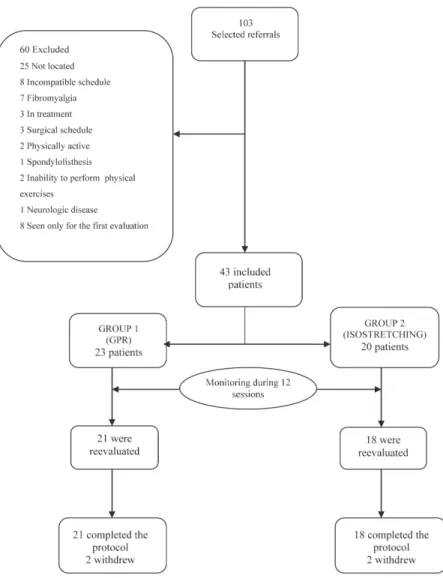
Physiotherapy Clinic of UN)CESUMAR, were select-ed. Sixty patients were excluded from the sample for different reasons, four withdrew from treatment and were not reevaluated. Among the dropouts, only one was due to change of address, not being able to be evaluated Figure . Among the thirty-nine patients with chronic back pain who completed the protocol, were randomly assigned to group GPR and to group isostretching .
Regarding the patients in group , three were male and were female; were married, two were single and one was a widower. Among the most prevalent occupations in this group were, seven housekeepers and two seamstresses. Most of the patients in group % predominantly presented retraction of the previous chain muscles. )n group , ive individuals were male and were female; were married, three were single and two were divorced; ive were
housekeepers and two were seamstresses. Regarding the prevalent muscle chain at initial assessment, % of members of group presented a predominance of retraction of the previous chain muscles.
The patients in groups and were homogeneous
p > . with respect to the complaint time, age,
pain, functional capacity, muscle strength and lex-ibility table at the beginning of the study, using the U Mann-Whitney test.
520
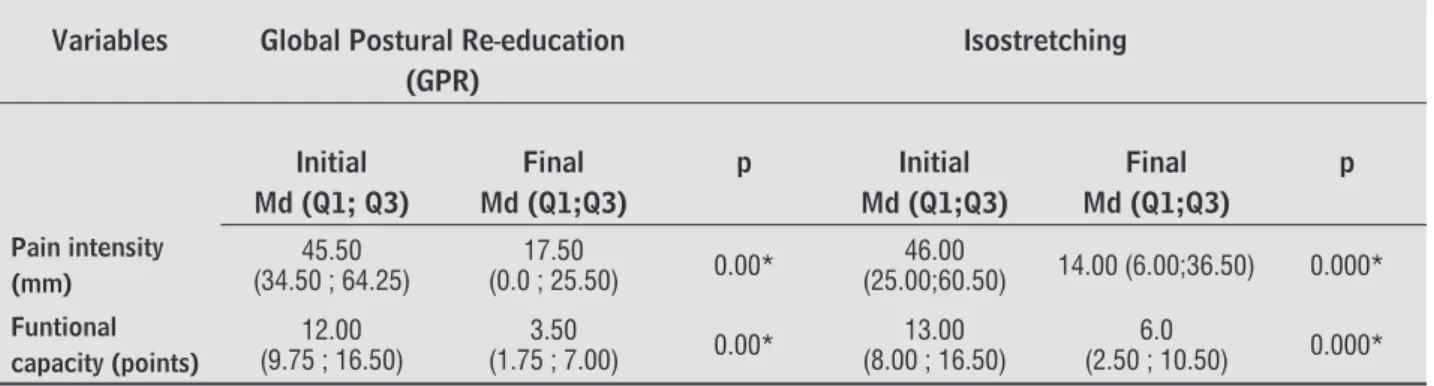
As shown in Table , when the intensity of the initial and inal pain are compared within groups, the group of patients undergoing GPR p = .
and the isostretching group p = . , presented a
statistically signi icant reduction, but without statis-tically signi icant differences between the methods
p = . .
)n the analysis of the functional capacity changes Table , a statistically signi icant improvement was
found in patients treated with GPR p = . and
)sostretching p = . . Comparing both groups,
however, a statistically signi icant difference was not
observed p = . .
Table 1 - Initial characteristics of patients included in the study
Variables
Global Postural Re education (GPR)
(n = 21)
Isostretching (n = 18)
P
Md (Q1; Q3) Md (Q1; Q3)
Age (years) 50.50 (44.00 ; 57.25) 52.00 (43.50 ; 54.50) 0.856
Complaint time (months) 102.00 (60.00 ; 246.00) 60.00 (108.00 ; 24.00) 0.133
Initial VAS (mm) 45.50 (34.50 ; 64.25) 46.00 (25.00 ; 60.50) 0.666
Initial RMQ (points) 12.00 (9.75 ; 16.50) 13.00 (8.00 ; 16.50) 0.922
Sit and Reach test (cm) 22 (17 ; 29.25) 26.4 (20.37 ; 31.47) 0.210
MR of abdominal (repetitions) 23 (16.5 ; 33) 22 (20 ; 34.25) 0.507
MR of trunk extensor (repetitions) 33 (22 ; 43.50) 30 (20.75 ; 34.25) 0.498
Dynamometry (Kg/f) 42 (34 ; 54.50) 39.5 (19.75 ; 62.25) 0.310
Note: Signifi cant difference (p < 0.05) - Test “U” Mann-Whitney; VAS: Visual Analogue Scale; RMQ: Roland-Morris Questionaire.
Table 2 - Comparison of pain intensity and functional capability (initial and final) between the two treatment groups
Variables Global Postural Re education (GPR)
Isostretching
Initial Md (Q1; Q3)
Final Md (Q1;Q3)
p Initial Md (Q1;Q3)
Final Md (Q1;Q3)
p
Pain intensity (mm)
45.50 (34.50 ; 64.25)
17.50
(0.0 ; 25.50) 0.00*
46.00
(25.00;60.50) 14.00 (6.00;36.50) 0.000*
Funtional capacity (points)
12.00 (9.75 ; 16.50)
3.50
(1.75 ; 7.00) 0.00*
13.00 (8.00 ; 16.50)
6.0
(2.50 ; 10.50) 0.000*
Note: Signifi cant difference (p < 0.05) - Wilcoxon test.
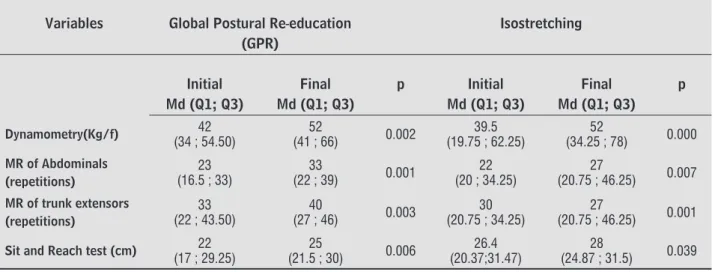
Table shows the results of muscle strength and lexibility analysis of the two groups. Regarding the muscle strength, analyzed via the MR test for abdomi-nal, MR test for trunk extensors and dynamometry of trunk extensors, both groups were effective in improv-ing in all these analyses. Likewise, in the analysis of
lexibility test, both groups effectively improved in
the Sit and Reach test when comparing ratings before and after treatment. Regarding the muscular strength changes and lexibility using the Mann-Whitney test, there were no statistically signi icant differences in any of these variables were comparing the two
521
GPR and isostretching methods in patients with chron-ic low back pain, whchron-ich makes it dif chron-icult to compare the indings.
Mann et al. compared the performance of ten
isostretching sessions in ten college students with low back pain with ten asymptomatic students in a control group. The analysis of pain intensity by VAS showed that isostretching was effective in reducing pain and improving lexibility, superior to the control group. An analgesic effect was also found in this study.
Durante & Vasconcelos also analyzed the
variations in pain intensity and functional capacity in six women with chronic low back pain, comparing the isostretching method with conventional kinesiotherapy. Treatment of patients in group , consisting of just three individuals, included ten isostretching sessions twice a week, lasting - minutes per session. Group , also consisting of three individuals, performed stretching exercises of the major muscle groups with a duration of thirty seconds for each group. Both treatment groups were effective in improving pain intensity, with no dif-ference between interventions, results that are similar to those in the present study.
Lopes et al. had patients with chronic low
back pain undergo isostretching sessions three times a week, women and nine men. The isostretching pro-tocols were similar. Statistically signi icant bene its in regard to reducing pain intensity in patients with low back pain were found, which was similar to the indings of the present study.
)n a randomized clinical trial, Macedo et al. treated nine patients with isostretching and compared them with a control group of six patients. All patients Discussion
Spinal pain, especially in the lumbar region, often has postural changes as a cause or consequence. That is because the structures that make up the spine are in a functional and physiologically inadequate position, thereby causing pain, discomfort and functional
restric-tion .
Although the literature states that most patients
have nonspeci ic low back pain , it was dif icult to
select patients in this study, considering that many of the medical referrals were not clear, thereby preventing patient selection.
The minor number losses in this study, less than %, is acceptable; however an intention-to-treat anal-ysis was not performed. )t should also be noted that one of the dif iculties of patient compliance with the sessions of the proposed methods was that, with the reduction in the intensity of low back pain, they wanted to stop treatment early.
Kinesiotherapy is one of the most frequently applied interventions in the treatment of patients with low back pain in clinical practice, through stretching programs and programs of active, resistive and proprioceptive
exercises . The postural reeducation methods are
included in this therapy.
)n the present study, the proposed objectives were achieved; statistically signi icant results were obtained regarding reduction in pain intensity, improvement in functional capacity and abdominal muscle and trunk extensor strength, and improved lexibility in the imple-mentation of the two postural re-education methods. No studies were found that compared the performance of
Table 3 - Initial and final comparison between the two treatment groups
Variables Global Postural Re education (GPR)
Isostretching
Initial Md (Q1; Q3)
Final Md (Q1; Q3)
p Initial Md (Q1; Q3)
Final Md (Q1; Q3)
p
Dynamometry(Kg/f) 42 (34 ; 54.50)
52
(41 ; 66) 0.002
39.5 (19.75 ; 62.25)
52
(34.25 ; 78) 0.000
MR of Abdominals (repetitions)
23 (16.5 ; 33)
33
(22 ; 39) 0.001
22 (20 ; 34.25)
27
(20.75 ; 46.25) 0.007
MR of trunk extensors (repetitions)
33 (22 ; 43.50)
40
(27 ; 46) 0.003
30 (20.75 ; 34.25)
27
(20.75 ; 46.25) 0.001
Sit and Reach test (cm) 22 (17 ; 29.25)
25
(21.5 ; 30) 0.006
26.4 (20.37;31.47)
28
522
daily living, and especially in reducing the painful situa-tion, as expressed in this study. (owever, it is dif icult to compare these results with the indings of the present study, because all patients in the (eredita and Rodrigues
study had a diagnosis of speci ic low back pain and
had previously undergone a surgical procedure.
Bonetti et al. evaluated patients with low
back pain regarding pain intensity by VAS and functional capacity by the Roland-Morris Questionnaire. Forty-two of these patients underwent three GPR postures, maintained for - minutes, whereas underwent conventional stretching in ten sessions, twice a week, for one hour each. The patients were evaluated again after three and six months, a procedure that was not performed in this study. The improvement in pain in-tensity and functional capacity with the GPR in Bonetti
et al.s study corroborates the indings of this study,
but it should be noted that these authors used conven-tional stretching for comparison, whereas this method was not superior to isostretching in the present study.
The follow-up time of the present study was incom-plete because it evaluated patients only before and after the interventions. Future studies are should evaluate again after three and six months to con irm the persis-tence of the effects of interventions.
)n the present study, postures were applied based on retractions found in the initial evaluation. Bonetti et al.s
GPR protocol included only the coxo-femural angle
closure, because these are the most common retractions in the population. This statement disagrees with the present study, in which changes in both chains were found, with the former chain being prevalent in . % of patients in the GPR group and % in the isostretch-ing group.
)n order to analyze the changes in electromyographic responses of the latissimus dorsi muscles, upper tra-pezius and lower tratra-pezius, Veronesi Junior & Tomaz
applied ive consecutive GPR sessions with a mean duration of minutes. At the end of treatment, these authors found that the electromyographic responses of all tested muscles improved, showing gains in muscle strength. Thus, the importance of GPR practice is high-lighted, which will favor postural correction through isometric contraction of the muscles responsible for maintaining the upright spine position.
Rosário et al. submitted women, to
years old, to eight, -minute GPR sessions and seg-mental stretching. These authors obtained improved
lexibility, as assessed by goniometry and the third inger-ground test, and muscle strength, as assessed were female, aged between and years, and had
chronic back pain and impaired functional capacity. The Rolland Morris questionnaire and the VAS were also applied, improvement in functional ability and reduc-tion of pain were found in the active group of patients, similar to the indings of the present study.
Similar to the present study, in addition to these
mentioned indings, Macedo et al. also found a
sta-tistically signi icant difference in improved abdominal strength, trunk and gluteal extension when compared to the control group. Strength gain favors stability of the spine joints, which will support the resolution of the condition and prevention of relapses.
Thomé et al. conducted a study comparing
conventional physiotherapy electrotherapy, massage therapy and lexibility exercise and combined kine-siotherapy isostretching and aquatic sensory & mo-tor training for the treatment of patients with speci ic and nonspeci ic low back pain. Despite the bene its in the combined kinesiotherapy group, which included isostretching, the respiratory strength and functional capacity and the addition of another intervention and different assessment tools make it dif icult to compare their results with the indings of this study?
Considering the previous studies that applied the isostretching method in patients with chronic low back
pain - , there is a need to improve the
method-ology by giving priority to comparative studies with larger samples.
There are few studies investigating GPR in patients with chronic low back pain. Moreira & Soares treated ive women, aged to years, with postural changes and related pain complaints with application of the GPR postures, loor frog and ballerina , over four months. There was an improvement in posture, body symmetry, in addition to a decrease in pain intensity, such as was demonstrated in the present study. A du-rability of the effects provided by the method was also found, given that all patients were satis ied with the performed treatment four months after therapeutic dis-charge. This variable was not analyzed in the present study, which emphasizes the need for further patient follow-up in future studies.
(eredita & Rodrigues applied the
523
. Vitta A. A lombalgia e suas relações com o tipo de ocupação, com a idade e o sexo. Rev Bras Fisioter.
; : - . Portuguese.
. (ayden J, van Tulder MW, Malmivaara A, Koes BW. Exercise therapy for treatment of non-speci ic low back pain. Cochrane Database of Systematic Reviews. Cochrane Database Syst Rev. ; :CD . . Greve MDG, Amatuzzi MM. Medicina de reabilitação
nas lombalgias crônicas. São Paulo: Roca; . p. - . Portuguese.
. Airaksinen O, Brox J), Cedraschi C, (ildebrandt J, Kla-ber-Moffett J, Kovacs F, et al. European Guidelines for the management of chronic nonspeci ic low back pain. Eur Spine J. ; Suppl :S - .
. Redondo BA. )sostretching: A ginástica da coluna. Rio de Janeiro: Skin Direct Store; . Portuguese. . Brandt AC, Ricieri DV, Griesbach LE. Repercussões
respiratórias da aplicação da técnica de )sostretching em indivíduos sadios. Fisioter Bras. ; :
-. Portuguese-.
. Prado ALC, Fonseca P(S, Rodrigues CO, Vanz F. O mé-todo )sostretching na otimização das aptidões para a prática do futebol de campo. Saude Santa Maria .
; - : - . Portuguese.
. Sanglard RC, Pereira JS. A in luência do )sostretching nas alterações dos parâmetros da marcha em idosos. Fisioter Bras. ; : - . Portuguese. . Sanglard RC, Pereira JS, (enriques GRP, Gonçalves
GB. A in luência do )sostretching nas alterações do equilíbrio em idosos. R. Bras. Ci. e Mov. ; :
-. Portuguese-.
. Longato MW, Castro PR, Keller KC, Ribas D)R. Efeito do )sostretching no equilíbrio de indivíduos amputados: um estudo de caso. Fisioter Mov. ; :
-. Portuguese-.
. Cepeda CC, Rodacki ALF, Persc LN, Silva PP, Buba S, Dressler VF. Efeitos do método )sostretching sobre parâmetros morfológicos e sobre um conjunto de testes motores em idosas. Rev Bras Cineantropom Desempenho (um. ; : - . Portuguese. . Carvalho AR, Assini TCKA. Aprimoramento da ca-pacidade funcional de idosos submetidos a uma intervenção por )sostretching. Rev Bras Fisioter.
; : - . Portuguese.
by hamstring dynamometry. Both techniques achieved signi icant results compared to the control group, re-inforcing the results of this study. )n the present study, however, despite the indings corroborating Rosario et
al.s , there was no statistically signi icant difference
when comparing the results of both methods.
The analysis of muscle strength of this study also showed statistically signi icant results. These results
agree with those of Macedo et al. , who
adminis-tered isostretching sessions with nine female pa-tients with low back pain, given that both showed a statistically signi icant improvement in the strength of trunk extensors. These results also agree with indings
of Rosary et al. , which showed improved muscle
strength in ten women with eight RPG sessions, where postures were administered in the coxo-femoral angle opening and closure.
One of the major differences between isostretching and GPR is the combination of manual therapy in the second method. Thus, it should be noted that profes-sional training is essential for good patient response to treatment. Yet, despite this study directing the choice of exercises to the individual analysis of patients, it is necessary to point out that standardization for research does not characterize the ideal professional reality, where the protocol can and should be modi ied accord-ing to the daily patient s response to treatment.
The need for further research is emphasized to com-pare RPG and isostretching in treating patients with nonspeci ic chronic low back pain.
Conclusions
)n this study, the global postural re-education GPR and isostretching methods were effective in reducing pain intensity, improving functional capac-ity, lexibility and muscle strength in patients with chronic low back pain. No statistically signi icant differences were found among the three methods. Therefore, further studies should be performed with bigger samples for better understanding of the ben-e its providben-ed by isostrben-etching and GPR, ben-espben-ecially in individuals with complaints of back pain.
References
524
. Durante (, Vasconcelos ECLM. Comparação do mé-todo )sostretching e cinesioterapia convencional no tratamento da lombalgia. Semina Cienc Biol Saude.
; : - . Portuguese.
. Macedo CSG, Debiagi PC, Andrade FM. Efeito do )sostretching na resistência muscular de abdominais, gl’teo máximo e extensores de tronco, incapacidade e dor em pacientes com lombalgia. Fisioter Mov.
; : - . Portuguese.
. Tomé F, Ferreira CB, Cornelli RJB, Carvalgo AR. Lom-balgia crônica: comparação entre duas intervenções na força inspiratória e capacidade funcional. Fisioter
Mov. ; : - .
. Mota YL, Barreto SL, Bin PR, Simões (G, Campbell CSG. Respostas cardiovasculares durante a postura sentada da Reeducação Postural Global RPG . Rev Bras Fisioter. ; : - . Portuguese. . Rosário JLP, Sousa A, Cabral CMN, João SMA, Marques
AP. Reeducação postural global e alongamento estático segmentar na melhora da lexibilidade, força muscular e amplitude de movimento: um estudo comparativo. Fisioter Pesqui. ; : - . Portuguese. . Souchard PE. Reeducação Postural Global:
mé-todo do campo fechado. th ed. São Paulo: Cone; . Portuguese.
. Teixeira LAN, Ribeiro DCL. Tratamento para algias da coluna e retrações posturais utilizando o método de RPG — Reeducação Postural Global. Um estudo de caso. Ter Man. ; : - . Portuguese. . Marques AP. Escoliose Tratada com reeducação
pos-tural global. Rev Fisioter Univ Sao Paulo. ; : -. Portuguese-.
. Veronesi Jr JR, Tomaz C. Efeitos da reeducação pos-tural global pelo método RPG/RFL na correção postural e no reequilíbrio muscular. Fisioter Mov.
; : - . Portuguese.
. Borges BLA. Flexibilidade de atletas de basquetebol submetidos à postura em pé com inclinação anterior do método de Reeducação Postural Global RPG . Rev Bras Ci e Mov. ; : - . Portuguese. . Silva EM, Andrade SC, Villar MJ. Evaluation of
the effects of Postural Global Reeducation in pa-tients with ankylosing spondylitis. Rheumatol )nt.
; : - .
. Macedo ACB, Gusso FR. Análise comparativa do alongamento do grupo muscular isquiotibial pelo método estático e pelo método )sostretching. Fisioter Mov. ; : - . Portuguese.
. Wilhelms F, Moreira NB, Barbosa PM, Vasconcellos PR, Nakayama GK, Bertolini GR. Análise da lexibilidade dos m’sculos da cadeia posterior mediante a aplica-ção de um protocolo especí ico de )sostretching. Arq Cienc Saude UN)PAR. ; : - .
. Barbosa EC, Peres CM, Lucca SR, Oliveira J). Melhora da qualidade de vida e da dor referida em trabalha-dores com síndrome do impacto após a aplicação do método )sostretching. Acta Fisiatr. ; :
-. Portuguese-.
. Burkle AB, Shiraish, FO, Yabiku, FN. Aplicação do mé-todo )sostretching em pacientes mastectomizadas: sé-rie de casos. Rev Saude e Pesquisa. ; : - . . Sá AF, Lima )AX. Os efeitos do método )sostretching
na lexibilidade do paciente portador de escoliose idiopática. Ter Man. ; : - .
. Oliveira AP, Souza DE. Tratamento isioterapêutico em escoliose através das técnicas de )sostretching e manipulações osteopáticas. Ter Man. ; :
-. Portuguese-.
. Borghi AS, Antonini GM, Facci LM. )sostretching no tratamento da escoliose: série de casos. Saude e Pes-quisa. ; : - . Portuguese.
. Monte-Raso VV, Ferreria PA, Carvalho MS, Ro-drigues JG, Martins CC, )unes D(. Efeito da técnica )sostretching no equilíbrio postural. Fisioter Pesqui.
; : - . Portuguese.
. . Moraes SMS, Mateus ECL. O método )sostretch-ing no tratamento da hipercifose torácica. Fisio Bras.
; : - . Portuguese.
. Lopes PM, Yau MC(, Mackert TC, Facci L M. )sostretch-ing no tratamento da lombalgia crônica. Fisio Bras.
; : - . Portuguese.
. Mann L, Kleinpaul JF, Weber P, Mota CB, Carpes FP. Efeito do treinamento de )sostretching sobre a dor lombar crônica: um estudo de caso. Motriz.
525
. Guedes DP, Guedes JERP. Manual prático para avalia-ção em educaavalia-ção ísica. São Paulo: Manole; . p.
- . Portuguese.
. Marques AP. Cadeias musculares: um programa para ensinar avaliação isioterapêutica global. st ed. São Paulo: Manole; . p. - . Portuguese.
. Detsch C, Luz AM(, Candotti CT, Oliveira DS, Laz-aron F, Guimarães LK, et al. Prevalência de alter-ações posturais em escolares do ensino médio em uma cidade no Sul do Brasil. Rev Panam Salud Publica.
; : - . Portuguese.
. Manek NJ, MacGregor AJ. Epidemiology of back dis-orders: prevalence, risk factor, and prognosis. Curr
Opin Rheumatol. ; : - .
. Moreira CMC, Soares DRL. Análise da efetividade da re-educação postural global na protusão do ombro após a alta isioterapêutica. Fisioter Mov. ; : - . Portuguese.
Received: / /
Recebido: 16/07/2013
Approved: / /
Aprovado: 18/08/2015 . (eredita EP, Rodrigues FF. O tratamento de pacientes
com ibrose epidural pela Reeducação Postural Global-RPG. Rev Bras Neurol. ; : - . Portuguese. . Eduardo ACR, Oliveira CS, Oliveria LVF, Vilaverde
AGJB. A RPG como modi icadora da qualidade de vida de indivíduos portadores de lombalgia — um estudo piloto. Ter Man. ; : - . Portuguese. . Di Ciaccio E, Polastri M, Bianchinie, Gasbarrini A.
(erniated lumbar disc treated with Global Postural Reeducation. A middle-term evaluation. Eur Rev Med Pharmacol Sci. ; : - .
. Bonetti F, Curti S, Mattioli S, Mugnai R, Vanti C, Vio-lante FS, et al. Effectiveness of a Global Postural Re-education program for persistent Low Back Pain: a non-randomized controlled trial. BMC Musculoskelet
Disord. ; : - .
. Price DD, Ra ii A, Buckingham B. The validation of visual analogue scales ratio scale measures for chronic and experimental pain. Pain. ; : - . . Nusbaum L, Natour J, Ferraz MB, Goldenberg J.
Trans-lation, adaptation and validation of the Roland-Morris questionnaire - Brazil Roland-Morris. Braz J Med Biol.
Res. ; : - .
. Tritschler K. Medidas e avaliação em educação ísica e esportes de Barrow & McGee. São Paulo: Manole;