308
Knot Formation in Ureteral Stent Case Report
International Braz J Urol Vol. 32 (3): 308-309, May - June, 2006
Repeat Knot Formation in a Patient with an Indwelling
Ureteral Stent
Brian Eisner, Howard Kim, Dianne Sacco
Department of Urology, Massachusetts General Hospital and Harvard Medical School, Boston,
Massachusetts, USA
ABSTRACT
A patient treated for nephrolithiasis formed knots in 2 occasions, in 2 separate indwelling ureteral stents. This rare complication may make stent removal difficult. To our knowledge, this is the first case report of repeat knot formation in a single patient.
Key words: ureter; stent; complications; lithiasis Int Braz J Urol. 2006; 32: 308-9
INTRODUCTION
A rare complication of indwelling ureteral stents is knot-formation within the body or coiled portion of the ureteral stent. Several techniques for removal have been described, including simple trac-tion, removal with guide wire assistance, ureteroscopy, and percutaneous removal (1-3). We report a case in which a patient formed knots in 2 separate stents.
CASE REPORT
An 82-year-old critically ill female with mul-tiple medical problems, including mulmul-tiple sclerosis requiring tracheostomy, was treated for an 11x8 mm left renal stone with a Cook Kwart Retro-Inject stent (6F x 22-32 cm) in August, 2002. She was lost to follow up until July 2003 when she developed Es-cherichia coli urosepsis. The stent was thickly en-crusted requiring 2 shock wave lithotripsies and a ureteroscopy with laser lithotripsy to facilitate
re-moval. Examination revealed a knot in the proximal coiled portion. Due to extensive manipulation during the procedure, a new Kwart stent was placed with the plan to remove it within a short period of time.
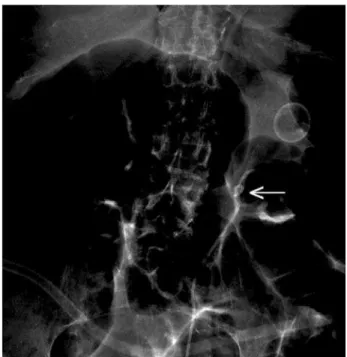
An attempt to remove the stent using an ex-ternalized string was unsuccessful in the clinic. Ra-diography revealed a knot in the proximal coiled por-tion of the stent (Figure-1). The patient was taken to the operating room for planned cystoscopy with pos-sible ureteroscopy to perform complex stent removal. During attempted induction of anesthesia, difficul-ties with the patient’s tracheostomy caused several forceful coughs, producing a Valsalva effect. Due to the difficulty of anesthesia and complexity of the pa-tient, prior to instrumentation, the stent was easily removed by simple traction. The knot was no longer present.
COMMENTS
309
Knot Formation in Ureteral Stent
formed knots in 2 indwelling stents. Previous authors have hypothesized that stent length, as well as coil configuration may be contributing factors to stent knot formation (3). We surmise that the anatomy of the patient’s renal pelvis in conjunction with the use of a Cook Kwart Retro-Inject stent with multiple proxi-mal coils increased the likelihood of knot formation. Several authors have described novel meth-ods to remove knotted stents (1-3). To our knowledge,
this is the first report of repeat stent knot formation on a single patient. In our patient, the first stent required ureteroscopic treatment of encrusted stone fragments for removal. The second knotted stent was in place for a short period without evidence of encrustations. Re-peated Valsalva (coughing) was the only interim event that could account for the knot uncoiling. We hypoth-esize that increase in intraabdominal pressure caused movements in the position of the kidney, ureter, and/or indwelling stent, causing the knot to come undone. Valsalva is an easy and relatively innocuous treatment that may aid in removal of knotted stents and avoid-ance of more invasive procedures.
CONFLICT OF INTEREST
None declared.
REFERENCES
1. Kundargi P, Bansal M, Pattnaik PK: Knotted upper end: a new complication in the use of an indwelling ureteral stent. J Urol. 1994; 151: 995-6.
2. Baldwin DD, Juriansz GJ, Stewart S, Hadley R: Knotted ureteral stent: a minimally invasive technique for removal. J Urol. 1998; 159: 2065-6.
3. Quek ML, Dunn MD: Knot formation at the mid portion of an indwelling ureteral stent. J Urol. 2002; 168: 1497.
Accepted after revision: January 25, 2006
Correspondence address: Dr. Brian Eisner
Department of Urology
Massachusetts General Hospital 55 Fruit Street
Boston, Massachusetts, 02114, USA Fax: +1 617 726-6131
E-mail: [email protected]