VALIDATION OF A
FUZZY
LINGUISTIC MODEL TO CLASSIFY
THE SEVERITY OF PHONOLOGICAL DISORDER
Validação de um modelo linguístico
fuzzy
para classiicar a gravidade do desvio fonológico
Ana Rita Brancalioni (1), Karine Faverzani Magnago (2), Márcia Keske-Soares (3)
(1) Speech Therapist, Master’s in Human Communication Disorders – Federal University of Santa Maria.
(2) Bachelor’s in Mathematics. PhD in Applied Mathematics at the State University of Campinas – UNICAMP, Campi-nas (RS), Brazil. Adjunt Professor of Mathematics and in Graduate Studies in Mathematics Education at the Federal University of Santa Maria – UFSM.
(3) Speech Therapist. PhD in Applied Linguistics at Pontifícia Universidade Católica of Rio Grande do Sul – PUC-RS, Porto Alegre (RS), Brazil; Associate Professor in the Spe-ech Therapist Course and in the Graduate Studies Program in Human Communication Disorders of the Federal Univer-sity of Santa Maria – UFSM – Santa Maria (RS), Brazil; CNPq Scholarship Holder – Brazil.
Conlict of interest: non-existent
differentiate alterations and pathologies. In this context, many proposals and Models have been created to be applied to Speech Therapy 1-5.
The concept of Model is an analytical structure which studies the relationships among a number of variables. It is composed by hypotheses which are the foundation for the extraction of implications and predictions. To be useful, the model has to present a simpliied and abstract version of the reality 6.
On a study 5, a Fuzzy Linguistic Model was developed in order to classify the severity level of the phonological disorders regarding quan-tity. The theoretical foundation was based on the Features Complexity Implicational Model (FCIM) 7,8. The mathematical models, as the one from this study 5, are built from a well-known and widely studied mathematical theory. When it is eficient, the model allows researchers to elaborate predictions, ABSTRACT
Purpose: to check if the criteria adopted from the Fuzzy Linguistic Model to classify the severity of Phonological Disorder (PD) are employed in the practice of speech and language therapists and whether they are in conformity with the purpose of such model. It is furthermore intended to analyze the acquiescence between PD severity classiied by the Model and the one deemed by speech and language therapists and check the main dificulties. Method: the study included two samples. The irst one was comprised of a representative number of deviating phonological systems (n=52) and classiied by the Model when it was proposed. The second one comprised two groups of speech and language therapists GF-I and GF-II. The speech and language therapists were asked to deem the severity of deviating in phonological systems, mapped in the Implicational Model of Feature Complexity – MICT as Severe, Moderate-Severe, Moderate-Mild, and Mild. Next, criteria and main dificulties were described in a questionnaire. Kappa statistics was used, with a signiicance level of p<0.05. Results: the criteria used in the proposal were generally used by GF-I and considered as adequate by GF-II. There was an acquiescence between classiication of severity obtained by the Model and the one deemed by the speech and language therapists. The most frequently reported dificulty was distinguishing between intermediate degrees. Conclusions: the Fuzzy Linguistic Model criteria are used to classify PD severity when based on MICT. Furthermore, the criteria are in acquiescence with the purpose of the Model. Due to the dificulties, other forms of classifying severity can be added in order to characterize PD over other major aspects.
KEYWORDS: Validation Studies; Speech Disorders; Speech; Severity of Illness Index; Classiication
INTRODUCTION
make decisions, explain and understand a real situ -ation or phenomenon studied 9.
The development of the model is as important as its validation. This step, which is an essential part to assess its acceptance, should be done in a proper way. That means that both the hypotheses and the criteria employed have to be tested by comparing the results obtained through the model with the ones obtained through a “real system” 9.
Having said that, this study aims to verify if the criteria adopted by the Fuzzy Linguistic Model 5 to classify the severity level of the phonological disor-ders are employed in the Speech Therapy practice and whether they match the Model’s objective. In addition, it also aims to analyze the agreement between the severity level of the deviation classiied by the Fuzzy Linguistic Model 5 and the judgment of two groups of Speech Therapists, as well as to verify the main dificulties pointed by them to judge the severity level of the phonological disorders.
METHOD
This study, which has a transverse character and is a quantitative one, was developed from two samples. The irst one is composed by the phono -logical evaluation made before the treatment of the individual with phonological disorders and the second is composed by the judgment of the severity level of phonological disorders, which was devel-oped by two groups of Speech Therapists.
The sample 1 was composed by a large number of deviated phonological systems, classiied by the Fuzzy Linguistic Model 5 when it was proposed. The sample’s equation resulted in 52 phonological systems out of 204 systems and mistake of 1 10. The selection of the 52 systems was made by a stratiied sampling, with the aim to assure more diversity to the cases.
The sample 2, which is composed by the judg -ment of two groups of Speech Therapists on the severity level of the phonological disorders, was divided into STG-I: Speech Therapists Group I and STG – II: Speech Therapists Group II. STG-I is composed by three Speech Therapists (A, B and C), doctors in Applied Linguistics and experienced in speech with deviations and STG – II is composed by three Speech Therapists (D, E and F) who have master degrees in Human Speech Deviations and are experienced in speech with deviations at Research Laboratories.
The 52 phonological systems were mapped on FCIM 8 and presented to both SPG-I and SPG – II Speech Therapists so that they would judge the severity level of the phonological disorders. The STG – I Speech Therapists were asked to do it
basing themselves on their clinical experience and on scientiic knowledge about FCIM and the severity level of the phonological disorders. The criteria used on the Fuzzy Linguistic Model 5 are not presented in order to prevent them from interfering on the answers. The criteria employed to each Speech Therapist were described in an open questionnaire. Yet, the STG – II Speech Therapists were asked to judge the severity level based on criteria adopted on the Fuzzy Linguistic Model5, which were:
1. The greater the phonemes acquisition, the less the phonological system is impaired and the more intelligible the child’s speech is and, consequently, the less intense the deviation is. The opposite is also true.
2. The more routs are traveled, the more marked features there are on the phonological system and, consequently, the less intense the devia-tion is. The opposite is also true.
3. The more complex the present phonemes are (acquired and/or partially acquired), the more complex the phonological system is and, consequently, the less intense the deviation is. The opposite is also true.
Furthermore, the analysis of the criteria employed on the Fuzzy Linguistic Model 5 was described to each Speech Therapist in an open questionnaire. Finally, the main dificulties found by the Speech Therapists from STG – I and STG – II in order to judge the severity level of the phonological disorders were analyzed taking quality into consideration.
The data belong to the project: “Study of phono -logical disorderss: classiications and evaluations”, approved by the Research and Ethics committee of a university, in its ethical and methodological aspects, under number 23081.006440/2009-60 and Certiicate of Presentation to Ethical Appreciation number 0093.0.243.000-09. The Term of Free and Clear Consent has been signed by all people who are responsible for or participating in the study.
Kappa Statistics was employed with signiicance level of p<0.05, in order to verify the agreement between the intensity of the phonological diver -sion classiied by the Fuzzy Linguistic Model 5 and the one by the speech therapists. This measure is based on the number of similar answers given by the evaluators, considering 1 as the highest value, which represents total agreement, and the values close to or even under 0, which represent no agree-ment or an agreeagree-ment by chance 10 . To analyze the
RESULTS
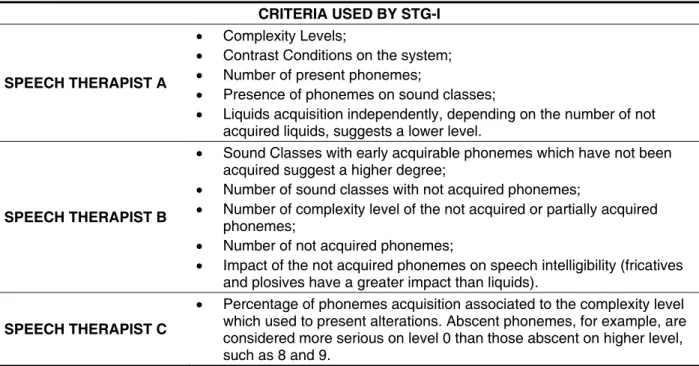
Picture 1 presents the criteria used to classify the severity level of the phonological disorders by the SPG – I Speech Therapists:
It is possible to verify that the Route’s Way, which was employed in the Fuzzy Linguistic Model 5 as one of the input variables, was not directly used by any of the Speech Therapists. Only Speech Thera-pist A refers to the routes analysis when considering the contrast conditions, since some information about the routes which were traveled is gotten by analyzing the contrasts on the phonological system.
Also, the three Speech Therapists refer to the
Phonemes Acquisition and the Complexity Degree,
which are also used on Fuzzy Linguistic Model 5 as input variables. Moreover, other criteria not employed on the Model were also used, such as sound classes and unintelligibility of speech.
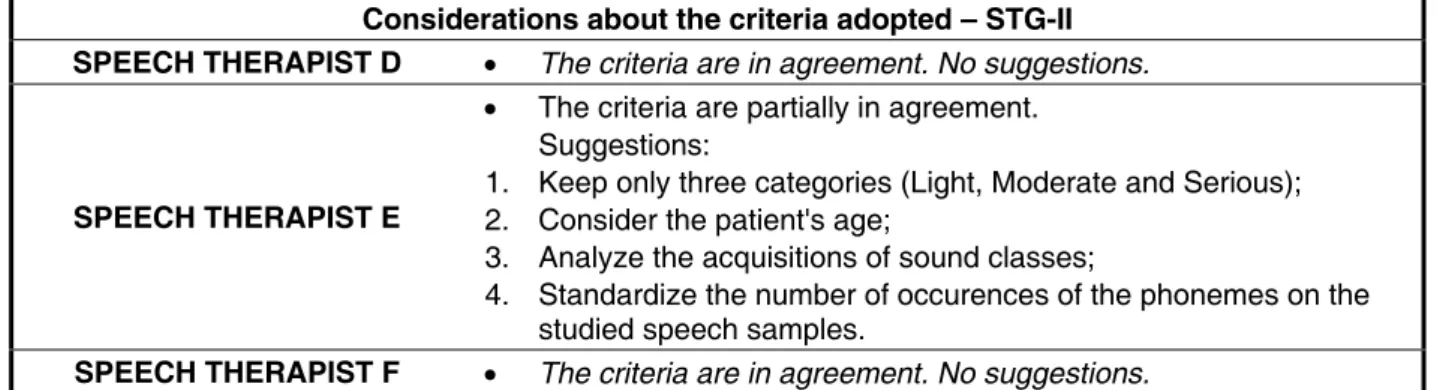
About the assessment of the criteria adopted by the Fuzzy Linguistic Model 5, Speech Therapists D and F consider them appropriate, alleging that they reach their purposes. On the other hand, the criteria adopted are only partially adequate, according to Speech Therapist E. On Picture 2, only the sugges-tions of the Speech Therapist E are presented, as Speech Therapists D and F have not given any suggestion.
Table 1 presents Kappa’s values, which indi -cate the agreement degree, in order to classify the
intensity of the phonological diversion obtained by the Fuzzy Linguistic Model 5 with the intensity considered by STG – I.
There was a lot of agreement between the degree obtained from the Fuzzy Linguistic Model 5 and the one judged by the Speech Therapists for the Serious and Light (extreme) deviations and for the gradation areas, varying from substantial to almost perfect. Yet, for the Moderate – Serious and Moderate – Light (intermediate) deviations, the agreement degree was not so representa-tive, varying from regular, moderate to substantial. Besides, the agreement from general Kappa was almost perfect to Speech Therapist A and substan -tial for Speech Therapists B and C.
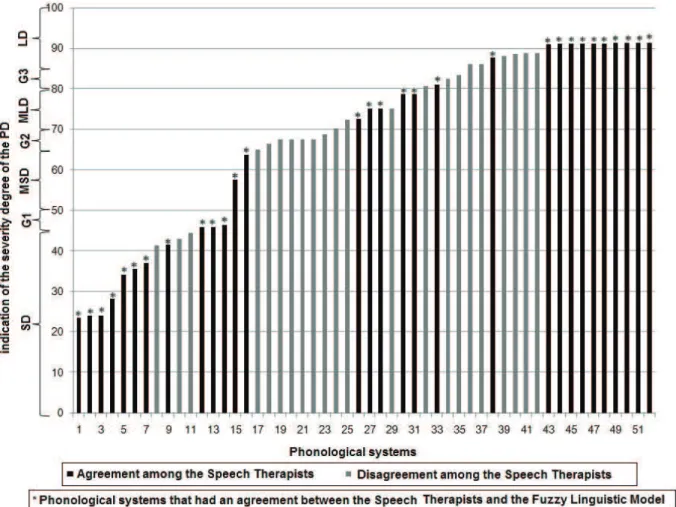
Picture 3 illustrates the agreement on the severity level of the phonological disorders between the Speech Therapists from STG – I.
It is possible to notice that there was agreement on the judgment of the severity level of the phono-logical disorders among the Speech Therapists in 30 systems (S1; S2; S3; S4; S5; S6; S7; S9; S12; S13; S14; S15; S16; S26; S27; S28; S30; S31; S33; S38; S43; S44; S45; S46; S47; S48; S49; S50; S51 e S52). In addition, the intensity of all these systems but systems S7 and S9 were classiied by the Fuzzy Linguistic Model 5 similarly to the inten-sity judged by the Speech Therapists. Therefore, in the cases in which there was agreement among the Speech Therapists, the classiication of the intensity
CRITERIA USED BY STG-I
SPEECH THERAPIST A
Complexity Levels;
Contrast Conditions on the system;
Number of present phonemes;
Presence of phonemes on sound classes;
Liquids acquisition independently, depending on the number of not
acquired liquids, suggests a lower level.
SPEECH THERAPIST B
Sound Classes with early acquirable phonemes which have not been
acquired suggest a higher degree;
Number of sound classes with not acquired phonemes;
Number of complexity level of the not acquired or partially acquired
phonemes;
Number of not acquired phonemes;
Impact of the not acquired phonemes on speech intelligibility (fricatives
and plosives have a greater impact than liquids).
SPEECH THERAPIST C
Percentage of phonemes acquisition associated to the complexity level
which used to present alterations. Abscent phonemes, for example, are considered more serious on level 0 than those abscent on higher level, such as 8 and 9.
Considerations about the criteria adopted – STG-II SPEECH THERAPIST D The criteria are in agreement. No suggestions.
SPEECH THERAPIST E
The criteria are partially in agreement.
Suggestions:
1. Keep only three categories (Light, Moderate and Serious);
2. Consider the patient's age;
3. Analyze the acquisitions of sound classes;
4. Standardize the number of occurences of the phonemes on the
studied speech samples.
SPEECH THERAPIST F The criteria are in agreement. No suggestions.
Picture 2 – Considerations about the criteria adopted – STG-II
SEVERITY LEVEL
Fono A Fono B Fono C
Kappa p Kappa p Kappa p SD 0.88 <0.001 0.65 <0.001 0.73 <0.001 MSD 0.73 <0.001 0.31 0.020 0.57 0.020
MLD 0.79 <0.001 0.46 0.001 0.59 0.001
LD 0.87 <0.001 0.82 <0.001 0.76 <0.001 G1,G2 and G3 1.00 <0.001 1.00 <0.001 1.0 <0.001 GENERAL 0.86 <0.001 0.70 <0.001 0.76 <0.001
Table 1 – Kappa values for the classiication of the severity level of the phonological disorders
obtained by the Model with the one judged by Speech Therapists A, B and C
Legend: SD: Serious Deviation; MSD: Moderate-Serious Deviation; MLD: Moderate-Light Deviation; LD: Light Deviation; G1: Grada-tion 1; G2: GradaGrada-tion 2; G3: GradaGrada-tion 3.
Note: For the phonological systems which are contained on gradation areas, it was considered an agreement when they were classiied with a degree to which they belonged.
obtained by the Fuzzy Linguistic Model 5 agreed in 93.3%.
Table 2 presents Kappa’s values for the classii -cation of the severity level of the phonological disor-ders obtained by the Fuzzy Linguistic Model 5 with the severity level judged by the STG-II.
It is noticeable that the Kappa agreement degree varied from substantial to almost perfect for all the categories judged by Speech Therapists D, E and F, except the category of Moderate-Serious deviation, judged by Speech Therapist E, in which the agree -ment degree was moderate. Moreover, the value of general Kappa for the three Speech Therapists showed an almost perfect degree of agreement.
Picture 4 illustrates the agreements on severity level of the phonological disorders among the Speech Therapists from STG-II.
It is noticeable that there was agreement in 26 phonological systems (S1; S2; S3; S4; S5; S6; S7; S8; S9; S10; S11; S16; S18; S19; S26; S28; S29; S34; S44; S45; S47; S48; S49; S50; S51 e 52). The intensity of these systems, except for S7, was simi -larly classiied by the Fuzzy Linguistic Model 5 and the Speech Therapists. Consequently, in the cases in which there was agreement on the Speech Ther-apists’ judgment, the classiication of the severity level of the phonological disorders obtained by the Model agreed in 96.1%.
Picture 5 presents the dificulties described by the Speech Therapists from STG-I when judging the severity level of the phonological disorders.
Legend: SD: Serious Deviation; G1: Gradation 1; MSD: Moderate-Serious Deviation; G2: Gradation 2; MLD: Moderate-Light Deviation; G3: Gradation 3; LD: Light Deviation. *: Phonological systems contained in a gradation area.
Note: The y axis corresponds to the severity level classiication and the index obtained from the Fuzzy Linguistic Model 5
Picture 3 – Agreement on the judgment of the severity level of the phonological disorders among the Speech Therapists from STG-I
Table 2 – Kappa values for the classiication of the severity level of the phonological disorders
obtained through the Model with the one judged by Speech Therapists D, E and F
SEVERITY LEVEL
SPEECH THERAPIST D SPEECH THERAPIST E SPEECH THERAPIST F
Kappa p Kappa p Kappa p
SD 0.92 <0.001 0.63 <0.001 0.79 <0.001
MSD 0.74 <0.001 0.44 0.001 0.74 <0.001
MLD 0.73 <0.001 0.91 <0.001 0.70 <0.001
LD 0.87 <0.001 1.00 <0.001 0.83 <0.001
G1, G2 and G3 1.00 <0.001 0.96 <0.001 1.0 <0.001 GENERAL 0.87 <0.001 0.82 <0.001 0.85 <0.001
Legend: SD: Serious Deviation; MSD: Moderate-Serious Deviation; MLD: Moderate-Light Deviation; LD: Light Deviation; G1: Grada-tion 1; G2: GradaGrada-tion 2; G3: GradaGrada-tion 3.
Legend: SD: Serious Deviation; MSD: Moderate-Serious Deviation; MLD: Moderate-Light Deviation; LD: Light Deviation; G1: Grada-tion 1; G2: GradaGrada-tion 2; G3: GradaGrada-tion 3. *: Phonological systems contained in a gradaGrada-tion area.
Note: The y axis corresponds to the severity level classiication and the index obtained from the Fuzzy Linguistic Model 5
Picture 4 – Agreement of the severity level of the phonological disorders among the Speech Therapists from STG-II
Difficulties Pointed STG-I
SPEECH THERAPIST A
The main difficulty is to tell the difference between the
Moderate-Light and Moderate-Serious deviations, because they have a hardly identifiable continuum, what suggets more arbitrary dicisions. Yet, the Light and Serious deviations can be indentied more easily.
Absence of syllabic separation, as on the clinical practice both
prosodic-syllabic and segmental evaluations are important.
SPEECH THERAPIST B
The impact of these systems depends on the syllabic structure and
on the frequency in which the sounds occur in the language.
Types of substitutions which are not described when the
phonological system is mapped on FCIM. The substitutions analysis is essential in order to classify the speech intelligibility and the severity level of the deviation.
SPEECH THERAPIST C
Absence of age of the individuals.
Absence of acquisition percentage, for a partially acquired phoneme
the percentage can vary from 40 to 79, which a very wide range of variation. An individual who presents a partially acquired sound with 79% is different from the one who presents 40%.
DISCUSSION
The fact that the analysis of the routes was not directly mentioned by any of the Speech Thera -pists asserts that the vertical analysis of FCIM is frequently not considered in the Speech Therapist’s evaluation. In spite of this fact, a study 7 assures that the number of routes traveled can help determine the severity level of the phonological disorders. Conirming that the contrast conditions provide information for the severity level of the phonological disorders, the categories classiication is described on the literature according to the consonantal contrast level to measure the severity level of the phonological disorders 11 .
Although the process of counting/analysis has not been the same for the three Speech Thera -pists, it is possible to perceive the importance of the phonemes analysis and quantiication in order to measure the severity level of the phonological disor-ders. This conirms the data of studies that present the relation between the phonemes acquisition and the severity level of the phonological disorders 12-14.
The adoption of the Complexity Level analysis as a criterion suggests that the Speech Therapists aim to distinguish the phonemes represented by more outstanding features from the phonemes repre-sented by less outstanding features. This means that both the phonemes quantity and complexity have to be analyzed 5 .
The sound class was not employed as a variable in the Fuzzy Linguistic Model 5, as it is not used to measure the severity level in the FCIM. The selection of the speech intelligibility as a criterion can be justi -ied by the fact that children with phonological disor -ders have their speech intelligibility impaired15-18.
But, in order to evaluate the speech intelligi-bility, information about prosody, voice, quality and quantity of phonological processes are required 19. These pieces of information are not described in the
phonological systems of FCIM 7,8. Then, although the speech intelligibility can be an important vari -able to measure the severity level of the phonolog -ical disorders, it cannot be analyzed and quantiied properly if it is based on FCIM.
Regarding the suggestions about the criteria employed on Fuzzy Linguistic Model 5, only three categories are described when classifying the severity level of the phonological disorders (Light, Moderate and Serious). The Percentage of Correct Consonants – PCC 20 , which is the most common classiication used to determine the severity level of the phonological disorders, presents four catego-ries (Serious, Moderate-Serious, Moderate-Light and Light), but the number of categories can vary. The categories aim to describe and differentiate the phonological systems. The adoption of few catego-ries can limit the classiication of speciic phonolog -ical systems 5.
Considering the patient’s age is another sugges-tion. To conirm that, it is possible to mention a study 1 which assures that the differences in age have to be taken into consideration to measure the severity level of the phonological disorders. The Fuzzy Linguistic Model 5 was developed under the parameter that all phonemes have already been acquired, so this Model is not proper to evaluate children under four years and two months old. As a solution to evaluate these children through the Fuzzy Linguistic Model 5, it would be necessary to use a numerical correction factor.
The last suggestion is to standardize the number of occurrences of the phonemes on the studied speech sample. This would only be possible if the speech samples were collected from repeti-tion of phonetically balanced words. Yet, there is a study 21 which raises awareness to the fact that the collection of corpus on speech through repetition is not reliable. This is due to the fact that it stimu -lates enhanced linguistic production, since the child
Difficulties Pointed GF-II
SPEECH THERAPIST D
Being used to using PCC when classifying the severity level of
the phonological disorders.
Differing similar phonological systems, as, sometimes, it gets
hard to know the limits of classification between: Serious and Moderate-Serious; Moderate-Serious and Moderate-Light. Even though, for opposite phonological systems (extremes – Light and Serious), it is easy.
SPEECH THERAPIST E Analyzing the partially acquired phonemes.
SPEECH THERAPIST F Differing intermediate degrees (Serious and
Moderate-Light).
tends to imitate the production model which was presented.
As for the agreement between the severity level of the phonological disorders classiied by the Fuzzy Linguistic Model 5 and the judgment of the severity level by the STG-II, the lower agreement veriied to Moderate-Serious degree and Moderate-Light degree agrees with other studies 17,18,22. These studies highlighted a greater dificulty in judging the intermediate categories of the severity level of the phonological disorders and the speech intelligi-bility. Such indings also bring to view the dificulty in modeling subgroups near the boundaries or in inter -mediate positions.
Considering all the categories, the agreement level was more representative for Speech Therapist A and less representative for Speech Therapist B. This can be justiied by the criteria used by them. Although all the criteria employed were not used in the Fuzzy Linguistic Model 5, there was agreement on the degree judged by these Speech Therapists with the one obtained by the Model. Therefore, the Model is valid for Speech Therapists from STG-I and acceptable for the clinical practice. In order to corroborate this idea, there is a study 9 that can be mentioned. It afirms that a model can be accepted even though it does not present all the variables that can inluence on the phenomenon studied.
On STG-II, the high values obtained for the kappa, not only on speciic categories but also in general, show that there is agreement between the severity level of the phonological disorders classi-ied by the Fuzzy Linguistic Model 5 and the one judged by the Speech Therapists. Then, it can be inferred that the Model is able to classify the severity level of the phonological disorders properly, based on the criteria on which it was grounded. Some studies conirm that by assuring that a Fuzzy Model can help on the decision making and on the selec -tion of eficient methods and procedures 2,3,23 .
The disagreements veriied on the judgment of the severity level of the phonological disorders between the Speech Therapists from both groups STG-I and STG-II may have occurred due to each Speech Therapist’s own experience. Corroborating, a study 24 assures that the Speech Therapist usually selects his/her own criteria in order to judge the severity level. Moreover, other studies 18,22 which analyzed the perceptual judgment of the severity level pointed low agreement among the judges, directing towards the necessity of using standard-ized indexes that indicate the level associated to the severity level classiication.
Regarding the dificulties described by the STG-I to judge the severity level of the phonological disor-ders, Speech Therapist A mentions the dificulty
in telling the difference between the intermediate degrees (Moderate-Light and Moderate-Serious), conirming the previous studies 18,22. Another difi -culty pointed by Speech Therapists A and B refers to the syllabic structure that is not considered in FCIM. The analysis of the syllabic structure is important in order to measure the severity level of the phonological disorders, in spite of the fact that it is not considered on FCIM, what limits the proposal. Anyway, it is essential for the Speech Therapist to analyze the productions in complex coda and onset 21 and pay attention to the age when these structures are supposed to be acquired on the phonological evaluation.
Speech Therapist B refers to the frequency of the occurrence of sounds in a language as a dificulty too. As long as the sounds frequency in a language varies, there are certain phonemes, such as /z/, that characterize a less frequent phoneme in speech productions, since they occur only in simple onset and there are only a few words with initial onset. Yet, other phonemes, such as /r/, which occurs in words with medial onset position, medial coda, ending coda and complex onset (initial and ending), are more frequent. In regard to this aspect, a study 25 afirms that the frequency of use and exposure is one of the factors that can inluence on the emer -gence of sounds in a language.
Having that posed, it is possible to infer that the frequency of sounds in a language inluences on the severity level of the phonological disor-ders. For instance, if a child does not present only the phoneme /z/ on the phonetic repertoire, there will be a lower occurrence of its incorrect produc -tion in speech, in comparison to the phoneme /r/. That happens because the phoneme /z/ happens less frequently in the language. Such statement is also acceptable when the PCC is adopted in order to classify the severity level of the phonological disorders.
Another dificulty pointed by Speech Therapist B is about the types of substitution, which are not described when the phonological system is mapped on FCIM 8. The type of substitution inluences on speech intelligibility 19 and on the severity level of the phonological disorders11. It is coherent to afirm that the substitution of a fricative for a plosive (as the following example, in Portuguese /f/ à [p] /faca/ à [paka]) makes speech less intelligible than the substitution of a non-lateral liquid for a lateral liquid (as the following example, in Portuguese /r/ à [l] /parede/ à [palede]). Furthermore, the quantity of substitutions inluences on the intelligibility 19 and on the severity level of the phonological disorders 20.
intervention. It is believed that the type and quantity of substitutions can help measure the severity level of the phonological disorders. In spite of that, the proposal has not evaluated this variable, because it was based on the FCIM system mapping 8. In order to include the substitution analysis on the proposal, the 171 possibilities should be analyzed in a quali-quantitative way.
Speech Therapist C refers to the lack of age of the individuals and the percentage of phonemes acquisition as a dificulty, as well as the use of ranges which determine whether the phonemes are acquired, partially acquired or not acquired. The use of these ranges is important to differ the phoneme acquisition, as the criterion adopted by the Fuzzy Linguistic Model 5 is used and accepted on the clin-ical practice, although it is known that the acquisition is a gradual process7,8 .
As for the dificulties described by STG-II to judge the severity level of the phonological disorders, the one which was mentioned by Speech Therapist D refers to the fact that the task making can have been harmed because she was used to employing PCC to classify the severity level of the phonological disorders. Moreover, Speech Therapist D also says that distinguishing similar phonological systems whose classiication boundaries are not well deined is also another dificulty. This dificulty is believed to happen specially to classify the systems which represent the gradation areas. This agrees with the Model, since there is uncertainty in classifying the phonological systems contained in the gradation areas.
For Speech Therapist E, the dificulty is in eval -uating the partially acquired phonemes. On the proposal, when the variable correspondent to the phonemes acquisition is analyzed, the phonemes are punctuated differently, according to whether they are acquired (1.0), partially acquired (0.5) or
not acquired (0.0). In spite of that, when the severity level of the phonological disorders is judged without the utilization of a computer resource, it is hard to quantify the variables and maintain the same way of analyzing the criteria and their interactions. Corroborating, a study 23 assures that the experts can present dificulties to use their knowledge when the model is complex. Even though, it should not be so complex about the reality.
Finally, the dificulty presented by Speech Thera -pist F is to tell the difference between intermediate degrees. The same dificulty was pointed by Speech Therapists A and D. Such inding agrees with other studies 17,18,22 that point a higher degree of dificulty in judging intermediate categories.
CONCLUSION
Having that posed, it is possible to conclude that the criteria used on the Fuzzy Linguistic Model are employed in order to classify the severity level of the phonological disorders when it is done based on FCIM. In addition, the criteria employed agree with and reach the Model’s aim, what allows us to clas-sify the severity level of the phonological disorders properly.
REFERENCES
1. Flipsen Jr P, Hummer JB, Yost KM. Measuring severity of involvement in speech delay: segmental and whole-word measures. Am. J. Speech-Lang. Path. 2005; 14:298-312.
2. Arthi K, Tamilarasi A. Prediction of autistic disorder using neuro fuzzy system by applying ANN technique. Int J Dev Neurosci. 2008; 26(7):699-704. 3. Akbarzadeh MR, Moshtagh-Khorasani M. A hierarchical fuzzy rule-based approach to aphasia diagnosis. J Biomed Inform. 2007; 40: 465-75. 4. Schipor AO, Pentiuv SG, Schipor DM. Knowledge Base of an Expert System Used for Dyslalic Children Therapy. 9th International Conference on Development and Application Systems, Suceava, Romania, p.22-4, 2008.
5. Brancalioni, AR. Proposta de Classiicação da Gravidade do Desvio Fonológico por meio da Modelagem Fuzzy segundo o Modelo Implicacional de Complexidade de Traços [dissertação] Santa Maria (RS): Universidade Federal de Santa Maria – Mestrado em Distúrbios da Comunicação Humana; 2010.
6. Hortale VA, Conill EM, Pedroza, M. Desaios na construção de um modelo para análise comparada da organização de serviços de saúde. Cad. Saúde Pública. 1999; 15(1):79-88.
7. Mota HB. Aquisição segmental do português: um Modelo Implicacional de Complexidade de Traços (Tese). Porto Alegre: Pontifícia Universidade Católica do Rio Grande do Sul – Doutorado em Letras; 1996.
8. Rangel GA. Uma análise auto-segmental da fonologia normal: estudo longitudinal de 3 crianças de 1:6 a 3:0 (Dissertação). Porto Alegre: Pontifícia Universidade Católica do Rio Grande do Sul – Mestrado em Letras; 1998.
9. Bassanezi RC. Ensino-aprendizagem com modelagem matemática. São Paulo: Contexto, 2004.
10. Siegel S, Castellan JR NJ. Estatística não-paramétrica para ciências do comportamento. 2 ed. Porto Alegre: Editora Artmed, 2006.
11. Lazzarotto-Vulcão C, Matzenauer CLB. A severidade do desvio fonológico com base em traços. Letras de Hoje. 2008;43(3):47-53.
12. Keske-Soares M, Brancalioni AR, Marini C, Pagliarin KC, Ceron MI. Eicácia da terapia para desvios fonológicos com diferentes modelos terapêuticos. Pró-Fono. 2008;20(3):153-8.
13. Pagliarin KC, Mota HB, Keske-Soares M. Análise da eicácia terapêutica em três modelos fonológicos de abordagem contrastiva. Pró-Fono. 2009;21(4):297-302.
14. Ceron MI, Keske-Soares M, Gonçalves GF. Escolha dos sons-alvo para terapia: análise com RESUMO
Objetivo: veriicar se os critérios adotados no Modelo Linguístico Fuzzy, para classiicar a gravidade
do Desvio Fonológico (DF), são empregados na prática fonoaudiológica e se estão de acordo com a inalidade do Modelo. Além disso, analisar a concordância entre a gravidade do DF classiicada pelo Modelo e a julgada por fonoaudiólogas, bem como, veriicar as principais diiculdades. Método: a pesquisa foi constituída por duas amostras. A primeira composta por um número representativo de sistemas fonológicos desviantes (n=52) classiicados pelo Modelo quando o mesmo foi proposto. A segunda por dois grupos de fonoaudiólogas GF-I e GF-II. Foi solicitado que as fonoaudiólogas julgassem a gravidade dos sistemas fonológicos desviantes, mapeados no Modelo Implicacional de Complexidade de Traços – MICT, em Grave, Moderado-Grave, Moderado-Leve e Leve. Em seguida os critérios e as principais diiculdades foram descritas em um questionário. Empregou-se a Estatística Kappa, com nível de signiicância de p<0,05. Resultados: os critérios utilizados na proposta, em geral, foram utilizados pelo GF-I e julgados adequados pelo GF-II. Veriicou-se concordância entre a classiicação da gravidade obtida pelo Modelo com a julgada pelas fonoaudiólogas. Quanto às dii -culdades, a frequentemente relatada foi diferenciar graus intermediários. Conclusões: os critérios utilizados no Modelo Linguístico Fuzzy são empregados para classiicar a gravidade do DF quando
realizada com base no MICT. Além disso, os critérios empregados estão de acordo, cumprindo com a inalidade do Modelo. Diante das diiculdades, outras formas de classiicar a gravidade podem ser agregadas a im de caracterizar o DF sobre outros aspectos importantes.
enfoque em traços distintivos. R. Soc. Bras. Fonoaudiol. 2010;15(2): 270-6.
15. Whitehead RL, Schiavetti N, Mackenzie DJ, Metz DE. Intelligibility of speech produced during simultaneous communication. J. Lang. Comm. Dis. 2004; 37(3):241-253.
16. Wertzner HF, Papp ACCS, Galea DES. Provas de nomeação e imitação como instrumentos de diagnóstico do transtorno fonológico. Pró-Fono. 2006; 18(3):303-12.
17. Donicht G, Pagliarin KC, Mota HB, Keske-Soares M. Intelligibility of phonological disorder assessed by three groups of judges. Pró-Fono. 2009;21(3):213-8.
18. Donicht G, Pagliarin KC, Mota HB, Keske-Soares M. Julgamento perceptivo da gravidade do desvio fonológico por três grupos distintos. Revista CEFAC. 2010; 12:21-6.
19. Klein ES, Flint CB. Measurement of Intelligibility in Disordered Speech. Lang Speech Hear Serv Sch. 2006; 37:191-9.
20. Shriberg LD, Kwiatkowski J. Phonological disorders I: a diagnostic classiication system. J Speech Hear Dis.1982; 47:226-41.
21. Yavas M, Hernadorena CM, Lamprecht RR. Avaliação fonológica criança: reeducação e terapia. Porto Alegre: Artes Médicas, 2ª Ed. 2001.
22. Ortega NRS. Aplicação da Teoria dos Conjuntos Fuzzy em Problemas da biomedicina. (Tese). São Paulo: Instituto de Física da Universidade de São Paulo – Doutorado em Física; 2001.
23. Yiu EML, Ng CY. Equal appearing interval and visual analogue scaling of perceptual roughness and breathiness. Clin.Linguist. Phon. 2004; 18:211-29. 24. Wertzner HF, Amaro L, Teramotto SS. Gravidade de distúrbio fonológico: julgamento perceptivo e porcentagem de consoantes corretas. Pró-Fono. 2005; 17(2):185-94.
25. Brum-de-Paula MR, Ferreira-Gonçalves G. Léxico & gramática: uma relação de causa e efeito? Letras de Hoje. 2008;43(3):69-80.
RECEIVED IN: 11/25/2010 ACCEPTED IN: 02/28/2011
Mailing Address: Ana Rita Brancalioni Rua Guerino Catapan, 342 Biraiaras – RS
CEP: 95305-000