Endodontics
Daniel Renner(a)
Renata Grazziotin-Soares(b) Giulio Gavini(c)
Fernando Branco Barletta(b)
(a)Department of Endodontics, School of
Dentistry, Santa Cruz do Sul University, Santa Cruz do Sul, RS, Brazil.
(b)Department of Restorative Dentistry, School
of Dentistry, Lutheran University of Brazil, Canoas, RS, Brazil.
(c)Department of Endodontics, School of
Dentistry, University of São Paulo, São Paulo, SP, Brazil.
Corresponding author:
Renata Grazziotin-Soares E-mail: [email protected]
Received for publication on Oct 12, 2011 Accepted for publication on Jan 10, 2012
Influence of pulp condition on the
accuracy of an electronic foramen
locator in posterior teeth: an
in vivo
study
Abstract: The aim of this study was to assess, in vivo, the accuracy of the NovApex electronic foramenlocator in determining working length
(WL) in vital and necrotic posterior teeth. The NovApexwas used in
144 canals: 35 teeth with vital pulps (68 canals) and 42 teeth with ne-crotic pulps (76 canals). WL was measured with the NovApex
loca-tor and conirmed using the radiographic method. Differences between electronic and radiographic measurements ranging between 0.0 and 0.4 millimeters were classiied as acceptable; differences equal to or greater than 0.5 millimeter were considered unacceptable. Pearson’s chi-square test was used to assess the inluence of pulp condition on the accuracy of NovApex(α = 0.05). Regardless of pulp condition, differences
be-tween electronic and radiographic WL measurements were acceptable in 73.61% of the canals. No statistically signiicant differences in accu-racy were observed when comparing vital and necrotic canals (p > 0.05). There were 38 unacceptable measurements. In none of these cases was the ile tip located beyond the radiographic apex; in 32, it was located short of the NovApex measurement. Pulp condition had no signiicant
effect on the accuracy of NovApex.
Descriptors: Endodontics; Tooth Apex; Root Canal Therapy.
Introduction
Precise working length (WL) measurement is an essential step in root canal treatment.1 The apical constriction (minor foramen) coincides with
the pulp-periodontal junction and is therefore considered to be the ide-al endpoint for root canide-al cleaning, shaping, and illing.1 In an in vitro
study designed to determine the exact location of the apical constriction, Kuttler2 found that the apical constriction was microscopically visible in
96% of the cases, located between 0.524 and 0.659 millimeters (mm) short of the apical foramen. Mean distances from the apex to the fora-men (A-F) and from the apex to the constriction (A-C) were measured by Dummer et al.3 The authors evaluated 270 extracted human teeth and
found a mean A-F distance of 0.38 mm and a mean A-C distance of 0.89 mm.
WL can be determined radiographically or electronically. The radio-graphic method, traditionally the most popular way to measure WL in
endodontics,4-13 has some advantages, e.g. the
pos-sibility to study root canal anatomy and to identify periapical lesions, as reported by ElAyouti et al.14
Conversely, one disadvantage of this method is re-lated to the dificulties involved in locating the api-cal foramen and the apiapi-cal constriction.
In addition to the well-established radiographic method, several electronic foramen locators (EFLs) have been introduced on the market with the aim of improving WL determination. Early resistance-based EFLs proved inaccurate in the presence of conducting luids.8,15 Other types of EFLs work with
alternating currents and are therefore compatible with different luids present inside the root canal.16
Recently, many authors, using different research de-signs, have attested to the accuracy of several EFL models.12,13,17-20
One of the EFLs currently available is the NovApex (Forum Engineering Technologies Ltd., Rishon Lezion, Israel) that operates based on the impedance principle, i.e., it uses alternating cur-rent of two or more frequencies while maintaining a ixed difference or ratio between the frequencies.21
In other words, based on electrical properties (e.g.
impedance), these EFLs are able to detect the point at which the ile leaves the root canal and enters the periodontal ligament (apical constriction).22,23
Impedance-based EFLs allow measuring WL, re-gardless of the type of electrolyte found in the root canal. Arora and Gulabivala,24 in an in vitro study,
showed that the Endex locator was accurate in the presence of sodium hypochlorite, unlike the RCM Mark II. Similarly, other authors have demonstrated that the presence of irrigating solutions did not in-terfere with EFL performance in extracted teeth.17,25
In addition to the inluence of luids and solu-tions, the inluence of pulp condition on the accu-racy of EFLs has been increasingly investigated. In vivo studies using teeth scheduled for extraction showed no differences in EFL measurements be-tween vital and necrotic teeth.5-7 Similar results have
been obtained in clinical studies that used radio-graphic analysis as a comparison method. Smadi,9
for example, tested the effect of preoperative pulp status on the behavior of the TAZX foramen locator and did not ind statistical differences in the mean
distance from the tip of the root illing to the ra-diographic apex between vital and non-vital canals. Similarly, Akisue et al.10 showed that the Elements
Diagnostic Unit and Apex Locator was reliable re-gardless of pulp vitality.
To date, few studies have reported on the ac-curacy of the NovApex locator. Although some in vitro19,21,26,27 and in vivo11 studies are available,
nei-ther has focused on the possible inluence of pulp condition on the accuracy of this EFL. The null hy-pothesis of our study was that the NovApex would be accurate in both vital and necrotic teeth.
Therefore, the objective of this study was to as-sess in vivo the inluence of pulp condition (vital vs.
necrotic pulp) on the accuracy of NovApex in pos-terior teeth.
Methodology
This study was approved by the local Ethics Committee (Institutional Review Board-equivalent). Informed written consent forms were signed by all patients included in the study.
Cases were selected between March and July 2008 at the Santa Cruz do Sul University (UNISC), southern Brazil. Any patient aged 12 to 65 years seeking primary endodontic treatment of posterior teeth was considered eligible for the study. The irst tooth requiring endodontic treatment was selected for analysis from each patient.
Teeth with previous endodontic treatment, or presenting resorption (visible on radiographs), cal-ciication, metal restoration, prosthesis, a post or a cast post and core, or incomplete root formation were excluded. Pulp sensibility was assessed using Endo-Ice refrigerant spray (Hygenic Corp., Akron, USA). Results were recorded as either vital or ne-crotic after the pulp was accessed and vascular sta-tus was determined.
Sample size was deined based on previous clini-cal studies.4,9-11 A total of 144 canals were selected;
35 teeth (68 canals) were diagnosed as vital, and 42 teeth (76 canals) as necrotic.
The following root canals were analyzed:
• buccal and palatal canals of maxillary irst pre-molars;
• single canal of maxillary second premolars;
• single canal of mandibular second premolars;
• mesiobuccal, distobuccal and palatal canals of maxillary irst and second molars; and
• mesiobuccal and distal canals of mandibular irst and second molars.
During endodontic treatment, patients were an-aesthetized, a rubber dam was placed, and the conal/middle third of each canal was lared using ro-tary Sx and S1 iles (ProTaper Universal, Dentsply/ Maillefer, Ballaigues, Switzerland). Teeth were irri-gated with 3 mL of 1% NaOCl after the use of each rotary instrument, and excess solution was removed from the pulp chamber using aspirators. All steps were conducted by an experienced endodontic spe-cialist, previously trained in the use of NovApex.
The procedure for using the NovApex EFL was as follows: a clip was placed on the patient’s lip, and a K-FlexoFile (Dentsply/Maillefer, Ballaigues, Swit-zerland) was selected according to the apical size of each canal and attached to the EFL. The ile was gently inserted into the root canal until the display read 0.0. The ile was then withdrawn coronally un-til the display showed a stable reading of 1.0.
Measurements obtained with the NovApex were compared with those obtained using the con-ventional radiographic method, as described below.
Radiographs were scanned (ColorPage-HR7X Slim, Genius, Taipei, Taiwan) in full size and at 600 dpi resolution. Images were stored in a personal computer and transferred to Adobe Photoshop CS2 software, version 9.0 (Adobe Systems Inc., San Jose, USA). Images were converted into millimeters based
on the original radiographic images. Resolution was held constant at 600 dpi to preserve image sharp-ness. Afterwards, a researcher experienced in the use of the software used the ruler tool to deine the distance between the ile tip and the radiographic apex of the root.
In the comparison between electronic and diographic measurements (1.0 mm short of the ra-diographic apex), differences ranging from 0.0 to 0.4 mm were classiied as acceptable, whereas dif-ferences equal to or greater than 0.5 mm were con-sidered unacceptable.
The Pearson chi-square test was used to assess the relationship between pulp condition (vital or ne-crotic) and NovApex accuracy results. Data were analyzed using the Statistical Analysis System (SAS), version 8.2 (SAS Institute, Cary, USA). Signiicance was set at p < 0.05.
Results
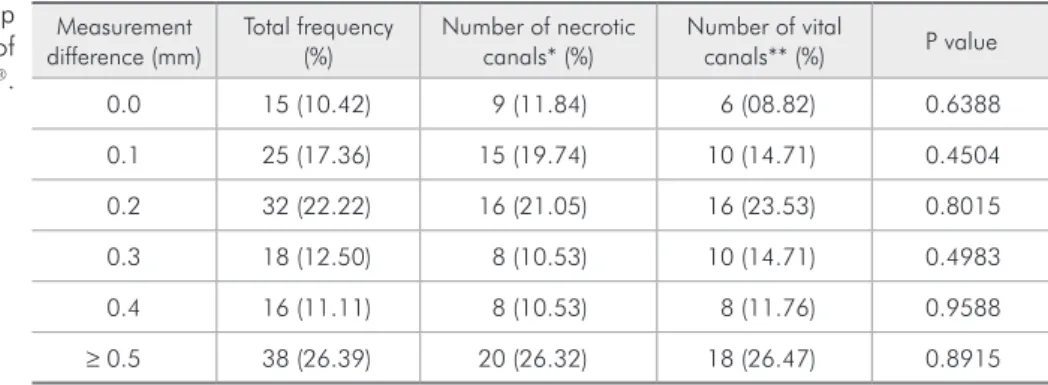
Differences between the two measurement meth-ods (EFL and radiography) are shown in Table 1. Considering the 144 canals submitted to measure-ment, 73.61% (106/144) showed acceptable differ-ences between the two measurements. The Pearson chi-square test revealed no signiicant inluence of pulp condition on measurement accuracy (p > 0.05).
Of the 38 unacceptable measurements obtained (difference ≥ 0.5 mm), there was no case where the ile tip was located beyond the radiographic apex, and 32 cases where it was located short of the NovApexmeasurement. Short measurements oc-curred in 16/20 necrotic canals and in 16/18 vital canals.
Measurement
difference (mm) Total frequency (%) Number of necrotic canals* (%) Number of vital canals** (%) P value
0.0 15 (10.42) 9 (11.84) 6 (08.82) 0.6388
0.1 25 (17.36) 15 (19.74) 10 (14.71) 0.4504
0.2 32 (22.22) 16 (21.05) 16 (23.53) 0.8015
0.3 18 (12.50) 8 (10.53) 10 (14.71) 0.4983
0.4 16 (11.11) 8 (10.53) 8 (11.76) 0.9588
≥ 0.5 38 (26.39) 20 (26.32) 18 (26.47) 0.8915
*n = 76; **n = 68 (χ2 test,α = 0.05). Table 1 - Influence of pulp
Discussion
The NovApex locator has been evaluated in vivo11 and also in in vitro models.19,21,26,27 The
pres-ent in vivo study adds to the existing body of knowl-edge by reporting data regarding accuracy obtained under authentic clinical conditions.
All measurements were conducted by the same experienced and trained operator, thus eliminating the possibility of operator bias. Although the issue of how the operator’s skill inluences EFL accuracy has not yet been described in the literature, exten-sive training and practice are required to ensure familiarity with these devices and consequently ac-curate measurements, as reported by Akisue et al.10
Other measures taken to ensure a standardized and reliable data collection process included the use of stainless steel K iles, based on previous studies that have failed to show greater accuracy of nickel-titani-um iles,15,20 as well as the selection of iles
accord-ing to each canal size. Ebrahim et al.,28 based on the
results of an ex vivo study, recommended that root canal diameter should be estimated irst, and then a snug-itting ile should be used for EFL root canal length determination. The clinical study conducted by Akisue et al.10 also used iles compatible with the
size of each canal.
In the present study, the NovApex locator showed similar accuracy results (p > 0.05) in both vital and necrotic posterior teeth, conirming our null hypothesis. Although some authors8,24 have
demonstrated a higher accuracy of EFLs in deter-mining WL in vital canals, when compared with necrotic canals, the identical accuracy found in our sample regardless of pulp condition is in agreement with other studies.5-7,9,10
The rate of acceptable measurements (73.61%), considering both vital and necrotic pulps, indi-cates that the NovApex EFL is accurate and use-ful to determine WL under clinical circumstances. In 106/144 canals, the difference between the NovApex and the radiographic measurement was between 0.0 and 0.4 mm. As a parameter for our results, the in vivo study by Chevalier et al.11
found 91.3% of acceptable measurements with the NovApex when compared with the radiographic method. However, these authors used the 0.5 mark
on the EFL display, and measurements between 0 and 2 mm from the radiographic apex were consid-ered acceptable. In the present study, a lower toler-ance was used, which can probably explain the low-er plow-ercentage of acceptable measurements obtained. In addition, the fact that our sample was comprised exclusively of posterior teeth, including 110 canals of molars, may account for the lower accuracy ob-served. This hypothesis is supported by the results of Vieyra and Acosta,13 who used four EFL models
to determine the apical constriction in vivo, subse-quently conirming its location after tooth extrac-tion, and who found a lower percentage of precise measurements in premolars and molars when com-pared with anterior teeth.
The need to select a tolerance factor in analyzing EFL accuracy hinders direct comparisons between
in vitro and in vivo results. Nevertheless, the toler-ance rate plays a fundamental role in clinical prac-tice, where it is often not possible to locate the apical constriction precisely, i.e., the ideal WL.2 In the in vitro study conducted by D’Assunção et al.,19 for
ex-ample, none of the 31 electronic measurements per-formed with the NovApex coincided exactly with the actual apical constriction, suggesting poor loca-tor accuracy. However, according to these authors, a comparison of their results with the mean distances observed between the ile tip and the apical con-striction would yield more accurate indings, since all their electronic measurements lay within the ac-ceptable range of ± 0.5 mm. According to ElAyouti and Lost,29 although this difference may affect the
results of laboratory studies, it is not clinically rel-evant. The present study used a tolerance rate of 0.0 to 0.4 mm, which is in agreement with the clinical study of Akisue et al.10
A relevant inding of this study was the great number of short measurements found among the unacceptable results. Short instrumentation of the root canal may pose problems for the adequate treatment of necrotic teeth, since the prognosis of these teeth depends on the successful elimination of microorganisms in infected root canals.30 One
by Nekoofar et al.23 for the location of the apical
constriction). Further studies are warranted to in-vestigate the accuracy of NovApex using different marks on the locator display.
Conclusion
Under clinical conditions, the WL values ob-tained in our study with the NovApex EFL showed
a 73.61% agreement rate with those determined ra-diographically. Pulp condition had no signiicant ef-fect on the accuracy of the NovApex. These results underscore the accuracy of NovApex and allow recommending its use for WL determination in end-odontic therapy, in both vital and necrotic posterior teeth.
References
1. Ricucci D, Langeland K. Apical limit of root canal instrumen-tation and obturation, part 2. A histological study. Int Endod J. 1998 Nov;31(6):394-409.
2. Kuttler Y. Microscopic investigation of root apexes. J Am Dent Assoc. 1955 May;50(5):544-52.
3. Dummer PMH, McGinn JH, Rees DG. The position and to-pography of the apical canal constriction and apical foramen. Int Endod J. 1984 Oct;17(4):192-8.
4. Frank AL, Torabinejad M. An in vivo evaluation of Endex electronic apex locator. J Endod. 1993 Apr;19(4): 177-9. 5. Mayeda DL, Simon JH, Aimar DF, Finley K. In vivo
measure-ment accuracy in vital and necrotic canals with the Endex apex locator. J Endod. 1993 Nov;19(11):545-8.
6. Dunlap CA, Remeikis NA, BeGole EA, Rauschenberger CR. An in vivo evaluation of an electronic apex locator that uses the ratio method in vital and necrotic canals. J Endod. 1998 Jan;24(1):48-50.
7. Lee SJ, Nam KC, Kim YJ, Kim DW. Clinical accuracy of a new apex locator with an automatic compensation circuit. J Endod. 2002 Oct;28(10):706-9.
8. Pommer O, Stamm O, Attin T. Influence of the canal contents on the electrical assisted determination of the length of root canals. J Endod. 2002 Feb;28(2):83-5.
9. Smadi L. Comparison between two methods of working length determination and its effect on radiographic extent of root canal filling: a clinical study [ISRCTN71486641]. BMC Oral Health. 2006 Feb 11;6:4. doi:10.1186/1472-6831-6-4. 10. Akisue E, Gavini G, de Figueiredo JA. Influence of pulp
vital-ity on length determination by using the Elements Diagnostic Unit and Apex Locator. Oral Surg Oral Med Oral Pathol Oral Radiol Endod. 2007 Oct;104(4):129-32.
11. Chevalier V, Arbab-Chirani R, Nicolas M, Morin V. Occur-rence of no-function of two electronic apex locators: an in vivo study. Oral Surg Oral Med Oral Pathol Oral Radiol Endod. 2009 Dec;108(6):61-5.
12. Ravanshad S, Adl A, Anvar J. Effect of working length mea-surement by electronic apex locator or radiography on the adequacy of final working length: a randomized clinical trial. J Endod. 2010 Nov;36(11):1753-6.
13. Vieyra JP, Acosta J. Comparison of working length determina-tion with radiographs and four electronic apex locators. Int Endod J. 2011 Jun;44(6):510-8.
14. ElAyouti A, Weiger R, Lost C. Frequency of overinstrumenta-tion with an acceptable radiographic working length. J Endod. 2001 Jan;27(1):49-52.
15. Nekoofar MH, Sadeghi K, Sadighi Akha E, Namazikhah MS. The accuracy of the Neosono Ultima EZ apex locator using files of different alloys: an in vitro study. J Calif Dent Assoc. 2002 Sep;30(9):681-4.
16. Foster K, Schwan H. Dielectric properties of tissues and biological materials: a critical review. Crit Rev Biomed Eng. 1989;17(1):25-104.
17. Carvalho AL, Moura-Netto C, Moura AA, Marques MM, Davidowicz H. Accuracy of three electronic apex locators in the presence of different irrigating solutions. Braz Oral Res. 2010 Oct-Dec;24(4):394-8.
18. Cianconi L, Angotti V, Felici R, Conte G, Mancini M. Accu-racy of three electronic apex locators compared with digital ra-diography: an ex vivo study. J Endod. 2010 Dec;36(12):2003-7.
19. D’Assunção FL, Albuquerque DS, Salazar-Silva JR, Dos San-tos VC, Sousa JC. Ex vivo evaluation of the accuracy and coefficient of repeatability of three electronic apex locators using a simple mounting model: a preliminary report. Int Endod J. 2010 Apr;43(4):269-74.
20. Sadeghi S, Abolghasemi M. The accuracy of the Raypex5 electronic apex locator using stainless-steel hand K-file versus nickel-titanium rotary Mtwo file. Med Oral Patol Oral Cir Bucal. 2010 Sep 1;15(5):788-90.
21. D’Assunção FL, de Albuquerque DS, de Queiroz Ferreira LC. The ability of two apex locators to locate the apical foramen: an in vitro study. J Endod. 2006 Jun;32(6):560-2.
22. Nekoofar MH. Electronic apex locators. Int Endod J. 2005 Jun;38(6):417-8; author reply 418.
24. Arora RK, Gulabivala K. An in vitro evaluation of the Endex and RCM Mark II electronic apex locators in root canals with different contents. Oral Surg Oral Med Oral Pathol Oral Radiol Endod. 1995 Apr;79(4):497-503.
25. Meares WA, Steiman HR. The influence of sodium hypochlo-rite irrigation on the accuracy of the Root ZX electronic apex locator. J Endod. 2002 Aug;28(8):595-8.
26. Goldberg F, Marroquín BB, Frajlich S, Dreyer C. In vitro evaluation of the ability of three apex locators to deter-mine the working length during retreatment. J Endod. 2005 Sep;31(9):676-8.
27. Goldberg F, Frajlich S, Kuttler S, Manzur E, Briseño-Marro-quín B. The evaluation of four electronic apex locators in teeth
with simulated horizontal oblique root fractures. J Endod. 2008 Dec;34(12):1497-9.
28. Ebrahim AK, Wadachi R, Suda H. Ex vivo evaluation of the ability of four different electronic apex locators to determine the working length in teeth with various foramen diameters. Aust Dent J. 2006 Sep;51(3):258-62.
29. ElAyouti A, Lost C. A simple mounting model for consistent determination of the accuracy and repeatability of apex loca-tors. Int Endod J. 2006 Feb;39(2):108-12.