Middle Latency Responses (MLR) in Brazilian children and
adolescents: systematic review
Potencial Evocado Auditivo de Média Latência (PEAML) em
crianças e adolescentes brasileiros: revisão sistemática
Aline Rejane Rosa de Castro1, Simone Rosa Barreto2, Patrícia Cotta Mancini3, Luciana Macedo de Resende3
ABSTRACT
Purpose: Systematically review the scientific literature on Middle Latency Response (MLR) in Brazilian children and adolescents.
Research strategy: We searched articles published since 2009 in Portuguese, English or Spanish at MEDLINE, SciELO, BIREME and LILACS electronic basis. Selected articles involved the use of MLR in children and / or Brazilian adolescents. After screening process, articles were analyzed according to “Strengthening the Reporting of Observational Studies in Epidemiology” (STROBE) initiative. Selection criteria: Repeated articles (due to database repetition) and case reports were excluded. Results: From 1315 identified articles, eight were selected for the review. It was predominantly observed: cross-sectional studies (75%); click stimulation (100%), with rate up to 11/s (100%) and 70 dBHL intensity (88%); filtering high-pass 10 Hz (50%) and low-pass 200 Hz (75%); electrode array with actives placed at C3/ C4, references at A1/A2 and neutral at Fpz (88%); Na-Pa amplitude as main measure of comparison and normality; and the use of ANOVA test (63%) for statistical analyses. The average latency of Pa wave and Na-Pa amplitude in normal-hearing children and adolescents of the studies was 32 milliseconds and 1.57 microvolts respectively. Conclusion: There is no consensus on MLR collection parameters in Brazilian children and adolescents. Still, the Pa latency average and Na-Pa amplitude found in Brazilian normal-hearing children and adolescents evaluated on the eight articles of this review agreed with normative parameters established internationally.
Keywords: Review; Hearing; Evoked potentials, Auditory; Child; Adolescent
RESUMO
Objetivo: Revisar sistematicamente a literatura científica sobre a rea-lização do Potencial Evocado Auditivo de Média Latência (PEAML) em crianças e adolescentes brasileiros. Estratégia de pesquisa: Foram pesquisados artigos publicados a partir de 2009, em português, inglês ou espanhol, nas bases de dados eletrônicas MEDLINE, SciELO, BIREME e LILACS. Os artigos selecionados envolveram a realização do PEAML em crianças e/ou adolescentes brasileiros. Após triagem, os artigos foram analisados segundo a iniciativa “Strengthening the Reporting of Observational Studies in Epidemiology” (STROBE). Critérios de seleção: Foram excluídos artigos repetidos nas bases de busca e também os relatos de caso. Resultados: A busca inicial identificou 1315 artigos, dos quais oito foram selecionados para compor a revisão. Verificou-se predomínio de estudos observacionais transversais (75%); estimulação tipo click (100%), com velocidade até 11/s (100%) e intensidade de 70 dBNA (88%); uso de filtro passa-alta de 10 Hz (50%) e passa-baixa de 200 Hz (75%); montagem dos eletrodos em C3/C4 (ativos) A1/A2 (re-ferências), e Fpz (neutro) (88%); amplitude Na-Pa, como principal parâ-metro de comparação e normalidade; e uso do teste ANOVA (63%) para análise estatística. Nos estudos revisados, a média da latência da onda Pa e da amplitude Na-Pa em crianças e adolescentes normo-ouvintes foi de 32 milissegundos e 1,57 microvolts, respectivamente. Conclusão:
Não há consenso quanto aos parâmetros de registro do PEAML em crianças e adolescentes brasileiros. Ainda assim, a média de latência de Pa e amplitude Na-Pa encontrada em crianças e adolescentes brasileiros normo-ouvintes, avaliados nos oito artigos desta revisão, concorda com os parâmetros de normalidade já estabelecidos internacionalmente.
Descritores: Revisão; Audição; Potenciais evocados auditivos; Criança; Adolescente
Research conducted at the Speech-Language, Pathology and Audiology Course, Medical School, Universidade Federal de Minas Gerais – UFMG – Belo Hori-zonte (BH), Brazil.
(1) Graduate Program (Master’s degree) in Speech-Language-Hearing Sciences, Medical School, Universidade Federal de Minas Gerais – UFMG – Belo Hori-zonte (BH), Brazil.
(2) Speech-Language, Pathology and Audiology Course, Medical School, Universidade Federal de Minas Gerais – UFMG – Belo Horizonte (BH), Brazil. (3) Speech-Language, Pathology and Audiology Department, Medical School, Universidade Federal de Minas Gerais – UFMG – Belo Horizonte (BH), Brazil.
Funding:Coordenação de Aperfeiçoamento de Pessoal de Nível Superior (CAPES).
Conflict of interests: No
Authors’ contribution:ARRC: literature review, article’s composition; SRB: literature review, article’s proofreading; PCM: analysis of results, article’s composi-tion and proofreading; LMR: outset and drafting of the study, orientation, article’s proofreading.
Correspondence address: Luciana Macedo de Resende. Av. Alfredo Balena, 190, sl 249, Santa Efigênia, Belo Horizonte (MG), Brazil, CEP: 30130-100. E-mail: [email protected]
INTRODUCTION
The Middle Latency Response (MLR) is described as a se-ries of positive and negative waves observed through electroen-cephalographic record, 10 to 80 milliseconds after an auditory stimulus(1). The first records of middle latency responses showed
a negative wave at around 20 ms, followed by a positive peak at around 30 ms, later named Na and Pa(2). With the development
of the averaging techniques and record of the bioelectric signal, the MLR has proved to be very useful in the determination of electrophysiological auditory thresholds, which are similar to the behavioral auditory threshold, and in the evaluation of the central hearing function(1,3).
The middle latency response has multiple generators in the thalamocortical pathway related to primary auditory abilities (discrimination and background figure) and non-primary audi-tory abilities (attention, memory and sensory integration). The Na wave represents the neural activity in thalamus level and can be identified from birth. The Pa wave is generally more robust and reflects the activity of the thalamocortical radiations and of the primary auditory cortex(1,4).
The characteristics of the acoustic signal (type, speed, dura-tion, intensity, etc.) directly affect the morphology, latency and amplitude of the MLR waves, as well as the presence of myo-genic artifacts(5,6). The interpretation of normality should take
into account the collection parameters, alert and relaxation state, and also the age and neural maturation of the individual(7-9).
The maturation of the central nervous system was also reported as essential for the presence and normality of middle latency waves. While the Na wave, generated by thalamic areas, can be observed in babies and infants, the Pa wave, main marker of the MLR, only reaches values close to those of normal-hearing adults at around 10 years old. In addition, in children and adolescents, the advance in age is directly related to the increase in amplitude and decrease in latency of the Na and Pa waves(1,8,9).
There are records of the use of the MLR in the Brazilian population since the 1980s(10). Despite the growing importance
of this potential in the functional evaluation and investiga-tion of the effect of therapeutic interveninvestiga-tions on the central auditory pathway, there is no consensus on the acquisition protocols and interpretation of responses in Brazilian children and adolescents.
PURPOSE
The purpose of this study was to systematically review the scientific literature on the realization of MLR in Brazilian children and adolescents.
RESEARCH STRATEGY
The guiding question adopted was: “What have we found in
the literature about the realization of MLR in Brazilian children and adolescents?”
In order to get answers to this question, bibliographic se-arch was conducted in the MEDLINE (via PubMed), SciELO, BIREME and LILACS (via Virtual Health Library-VHL Portal) electronic databases. The data were collected from August to December 2014. In the search conducted in the Cochrane Library database (via VHL Portal), no studies on thematic similar to this literature review were found.
The MeSH descriptor (Medical Subject Headings) “Evoked Potentials,Auditory”, the operator “AND” and the free term “middle latency” were used for the search in the MEDLINE database (via PubMed). For the search in the SciELO database, the descriptor “Auditory Evoked Potentials” was used. The search in the BIREME and LILACS database (via VHL Portal) used the DeCS (Descriptors in Health Sciences) “Auditory Evoked Potentials “ and their synonyms, as well as the free term “middle latency”, which were combined with each other by the use of the Boolean operators AND and OR. Thus, the search equation was: ((MH: G07.265.500.370$ OR “resposta evocada auditiva” OR “avaliação eletrofisiológica” OR “po-tencial auditivo evocado” OR “auditory evoked potentials” OR “electrophysiological measures”) AND (“média latência” OR
“latência média” OR “middle latency” OR “mid latency”)).
SELECTION CRITERIA
Articles published from 2009 to 2014 in Portuguese, English or Spanish were included in the review.The selected articles involved the realization of the MLR in Brazilian children and/or adolescents. In all articles it was possible to verify the collection procedure and interpretation of the MLR responses as well as its results. This review did not include articles that did not address the subjects “auditory evoked potentials” and “middle latency” in the title or abstract, or that were not realized with a sample of Brazilian children and/or adolescents, articles that were repeated in the search databases and also case reports.
DATA ANALYSIS
After filtering by year and language of publication, all titles and abstracts of the articles found were evaluated by the researchers. After the screening phase, the articles that met the pre-established selection criteria were read in full. The biblio-graphical references of the selected articles were also evaluated in order to identify the works that met the inclusion criteria in this study and that, for some reason, have not appeared in the search conducted.
For the analysis of the selected articles, it was applied the protocol based on the checklist “Strengthening the Reporting of Observational Studies in Epidemiology” (STROBE)(11), an
selected presented, in the summary and/or text, information about the study design, eligibility criteria, number of participants (in general and by groups), descriptive data (gender, age and clinical conditions), response acquisition method and presentation of the MLR results in the population studied through quantitative data and statistical comparison. After analysis, according to the STROBE initiative, the eight articles that met the inclusion criteria for this systematic review were selected.
RESULTS
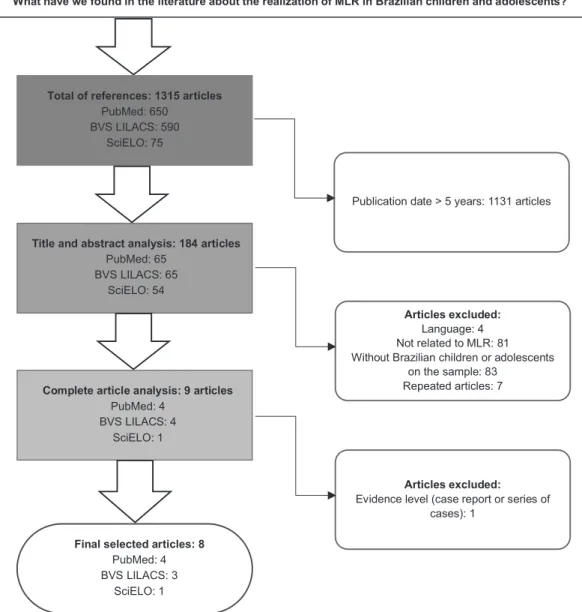
As a result of the initial search, 1315 articles were iden-tified, of which eight(12-19) met the inclusion criteria and were
considered relevant for the sample of this study. The search process and selection of the articles present in this review are outlined in the Figure 1.
In 50% of the articles, the MLR was the main topic of the study. In total, 600 individuals, aged between 5 and 20 years, 12 years in average, were included in the eight studies selected for analysis. All studies contemplated representative samples of males and females.
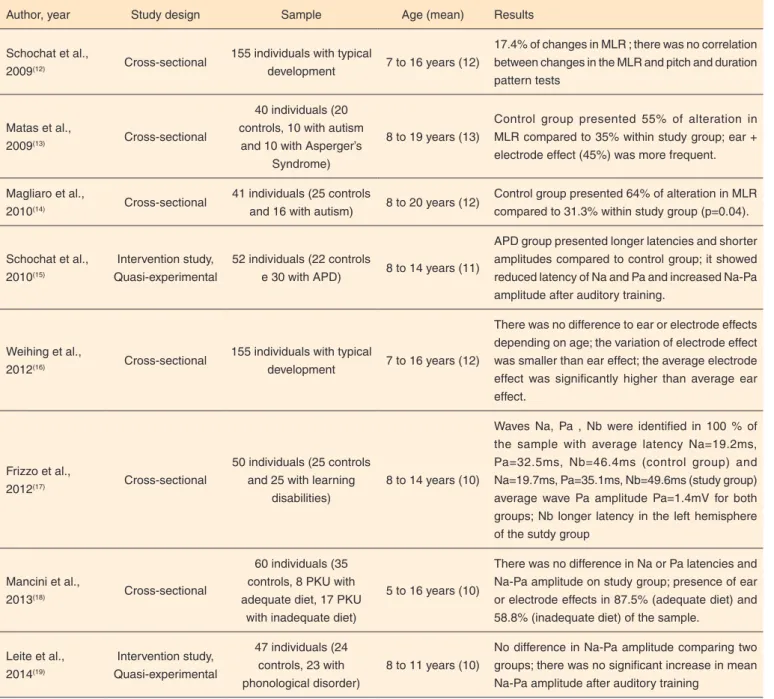
The main characteristics of the included studies, as authors, year of publication, methods, case studies, age of the partici-pants and results were organized in Table 1.
The collection parameters and interpretation of the MLR were described in all the studies evaluated (Chart 1 and Chart 2).
DISCUSSION
Studies with cross-sectional observational design(12-14,16-18)
represented 75% of the analyzed studies. The literature search showed few studies with higher level of evidence(7,20,21), which
Note: MLR = Middle Latency Response
did not allow generalizations regarding the findings and hampe-red the standardization of testing protocols and the possibility to establish normative data of the MLR in different populations. Two studies(15,19) were conducted with almost experimental
methodology and agreed with the authors(22,23) that indicate the
comparison of pre and post- therapeutic intervention middle latency responses as an effective strategy to monitor changes in the auditory pathway. The MLR is a potential greatly influenced by endogenous artifacts (postauricular reflex, relaxation state, etc.) and exogenous artifacts (electrical interference, stimula-tion parameters, etc.)(1), which may explain the increased
relia-bility of the answers for comparisons of the same individual. The samples of the eight studies involved 36 individuals
with autism spectrum disorder (ASD), 30 with auditory pro-cessing disorder, 25 with learning disability, 25 diagnosed with Phenylketonuria, 23 with phonological disorder and 461 with normal development and absence of auditory complaints. The Na and Pa wave generators are related to primary auditory abilities and underlying cognitive processes such as memory and attention, and the most relevant clinical applications of MLR are related to the neurodiagnostic of injuries in the thalamocortical pathway in hearing alterations or its related cognitive processes(1,4). Even in normal hearing individuals
without associated comorbidities, the MLR changes were reported in 17.4%(12) to 64%(14) of the children and adolescents
present in the evaluated studies. In both studies with lower(12)
Table 1. Characteristics of selected studies for review (n=8)
Author, year Study design Sample Age (mean) Results
Schochat et al.,
2009(12) Cross-sectional
155 individuals with typical
development 7 to 16 years (12)
17.4% of changes in MLR ; there was no correlation between changes in the MLR and pitch and duration pattern tests
Matas et al.,
2009(13) Cross-sectional
40 individuals (20 controls, 10 with autism
and 10 with Asperger’s Syndrome)
8 to 19 years (13)
Control group presented 55% of alteration in MLR compared to 35% within study group; ear + electrode effect (45%) was more frequent.
Magliaro et al.,
2010(14) Cross-sectional
41 individuals (25 controls
and 16 with autism) 8 to 20 years (12)
Control group presented 64% of alteration in MLR compared to 31.3% within study group (p=0.04).
Schochat et al., 2010(15)
Intervention study, Quasi-experimental
52 individuals (22 controls
e 30 with APD) 8 to 14 years (11)
APD group presented longer latencies and shorter amplitudes compared to control group; it showed reduced latency of Na and Pa and increased Na-Pa amplitude after auditory training.
Weihing et al.,
2012(16) Cross-sectional
155 individuals with typical
development 7 to 16 years (12)
There was no difference to ear or electrode effects depending on age; the variation of electrode effect was smaller than ear effect; the average electrode effect was significantly higher than average ear effect.
Frizzo et al.,
2012(17) Cross-sectional
50 individuals (25 controls and 25 with learning
disabilities)
8 to 14 years (10)
Waves Na, Pa , Nb were identified in 100 % of the sample with average latency Na=19.2ms, Pa=32.5ms, Nb=46.4ms (control group) and Na=19.7ms, Pa=35.1ms, Nb=49.6ms (study group) average wave Pa amplitude Pa=1.4mV for both groups; Nb longer latency in the left hemisphere of the sutdy group
Mancini et al.,
2013(18) Cross-sectional
60 individuals (35 controls, 8 PKU with adequate diet, 17 PKU
with inadequate diet)
5 to 16 years (10)
There was no difference in Na or Pa latencies and Na-Pa amplitude on study group; presence of ear or electrode effects in 87.5% (adequate diet) and 58.8% (inadequate diet) of the sample.
Leite et al., 2014(19)
Intervention study, Quasi-experimental
47 individuals (24 controls, 23 with phonological disorder)
8 to 11 years (10)
No difference in Na-Pa amplitude comparing two groups; there was no significant increase in mean Na-Pa amplitude after auditory training
Chart 1. MLR register parameters
Author, year Type Rate Intensity # of stimuli Gain Window Filter Electrode
array Schochat et
al., 2009(12) click 9.8/s 70 dBNA 1000 NI 72ms
20-1500Hz (aquisition)/ 20-200Hz (analysis)
C3, C4, A1, A2, Fpz Matas et al.,
2010(13) click 10/s 70 dBNA 1000 100.000 99.8ms 10-150Hz
C3, C4, M1, M2, Fpz Magliaro et
al., 2010(14)
rarefaction
click 9.9/s 70 dBNA 1000 NI NI
20-1500Hz (aquisition)/ 20-200Hz (analysis)
C3, C4, A1, A2, Fpz Schochat et
al., 2010(15) click 9.8/s 70 dBNA 1000 NI 72ms
20-1500Hz (aquisition)/ 20-200Hz (analysis)
C3, C4, A1, A2, Fpz Weihing et
al., 2012(16) click 9.8/s 70 dBNA 1000 NI 72ms
20-1500Hz (aquisition)/ 20-200Hz (analysis)
C3, C4, A1, A2, Fpz Frizzo et al.,
2012(17)
rarefaction
click 11/s 80 dBNA NI NI 100ms 10-100Hz
C3, C4, A1, A2, Fpz Mancini et
al., 2013(18)
alternate
click 7.7/s 70 dBNA 1000 50.000 99.8ms 3-3000Hz
C3, C4, A1, A2, Fpz Leite et al.,
2014(19)
rarefaction
click 9.9/s 70 dBNA 1000 NI NI 10-150Hz
C3, C4, A1, A2, Fpz Note: NI = non informed; C3 = left temporoparietal junction; C4 = right temporoparietal junction; A1 = left ear; A2 = right ear; Fpz = midline frontal polar; Hz = Hertz; ms = milisseconds; dBNA = hearing level decibel
Chart 2. Interpretation parameters and normative data of MLR for normal or control individuals
Author, year Interpretation Pa latency (mean/SD) Na-Pa amplitude
(mean/SD) Statistics
Schochat et al., 2009(12)
Pa peak latency; Pa peak amplitude to calculate EA or EE with 50%
cutting point
NI NI Qui-square
Matas et al., 2010(13)
Pa peak latency; Pa peak amplitude to calculate EA or EE with 50%
cutting point NI C3M1=1.88(1.06) C3M2=2.14(2.48) C4M1=2.10(1.54) C4M2=2.74(3.35) Mann-Whitney, Wilcoxon, CI
Magliaro et al., 2010(14)
Na and Pa peak latency; Na-Pa peak-to-peak amplitude to calculate
EA or EE with 50% cutting point
NI NI ANOVA, CI
Schochat et al., 2010(15)
Latency at the most negative peak between 14-21ms (Na) and positive between 21-45ms (Pa); Na-Pa peak-to-peak amplitude to calculate EA or
EE with 50% cutting point
C3A1=35.49(2.46) C4A1=35.19(2.67) C3A2=35.85(4.73) C4A2=34.87(3.55) C3A1=1.18(0.65) C4A1=1.48(0.77) C3A2=1.00(0.46) C4A2=1.18(0.66) ANOVA
Weihing et al., 2012(16)
Presence of Na (14 to 21ms) and Pa (22 to 35ms); absolute and relative
difference of EA and EE
NI NI ANOVA
Frizzo et al., 2012(17)
Na and Pa peak latency; Na-Pa peak-to-peak amplitude to calculate
EA or EE
C3A1=32.05(5.61) C4A1=32.97(4.95) C3A2=32.65(5.02) C4A2=31.99(5.37) C3A1=1.45(0.61) C4A1=1.49(0.67) C3A2=1.27(0.68) C4A2=1.47(0.70) IC
Mancini et al., 2013(18)
Latency at the most negative peak between 25-35ms (Pa); Na-Pa peak-to-peak amplitude to calculate EA or
EE with 50% cutting point
C3A1=28.91(4.06) C4A1=29.14(4.04) C3A2=28.54(3.91) C4A2=29.33(3.74) C3A1=0.97(0.46) C4A1=0.97(0.46) C3A2=0.92(0.41) C4A2=0.83(0.43) ANOVA, Fisher
Leite et al., 2014(19)
Na and Pa peak latency; Na-Pa peak-to-peak amplitude to calculate
EA or EE with 50% cutting point
NI C3A1=1.83(1.01) C4A1=2.08(1.44) C3A2=1.96(2.36) C4A2=2.51(3.19) ANOVA
and greater(14) prevalence of alteration of the potential in
indi-viduals without complaints or hearing functional alterations, the first considered only the latency and amplitude of the Pa wave and the second, the Na and Pa latency and the amplitude of the Na-Pa interpeak. Studies show the Na-Pa amplitude as the most sensitive parameter to MLR changes, through the analysis of the ear and electrode effect(20-22). Therefore, the
discrepancy between the prevalence data may be explained by a difference in the criteria of interpretation of the results of each study. The variation between the criteria of interpre-tation of the MLR responses is one of the main difficulties for the validation of normative data and studies with higher level of evidence in the area. The presence of altered results in the absence of complaints or functional changes of hearing indicates the low sensitivity and specificity of the potential(24)
and draws attention to the importance of careful interpretation, especially among individuals.
In the reviewed studies, the age of the participants ranged from 5 to 20 years, 12 years in average. The MLR generators, especially of Pa and Pb peaks, develop until the end of adoles-cence and the middle latency response may be absent in 35% to 50% of individuals under 10 years old. Until about 14 years, the latency and amplitude values may not have reached values found in normal adults. Therefore, the age and consequently the maturation of the central auditory pathway is a relevant factor for the analysis of the middle latency response, especially in comparison between individuals(1,7-9) and must be considered
in the interpretation of normality of the results.
Regarding the MLR in Brazilian children and adolescents, there was no consensus in the literature in relation to the sti-mulation and recording parameters used. Even so, similarities were observed in the pattern of data collection of the eight studies evaluated.
The 0.1 millisecond click-type stimulus was the only para-meter of unanimous acquisition among the evaluated studies. According to the literature(1,25), tone burst type stimuli of short
duration and Blackman type envelope are also suitable for the collection of Na and Pa, since the middle latency responses do not depend so much on neuronal synchrony as the brainstem potentials.
The stimulation rate varied from 7.7/s(18) to 11/s(17), being
88% of the results equal to or greater than 9.8 stimuli per se-cond. The literature(1,26) emphasizes that rates below 11/s are
ideal for recording Na and Pa at all ages, and below 5/s may be more suitable for the testing of children under 10 years.
The stimulus intensity is directly proportional to the am-plitude of the response and seems to have less influence on the latency of the Pa wave(3). The 70 dBnHL intensity was
predominant in the studies (88%) and is consistent with other authors(3,4,26) that associate the use of higher intensities to the
occurrence of post-auricular reflex, myogenic artifact charac-terized by a large peak amplitude, at about 12 to 20 ms after the stimulation(27).
Filtration is one of the most important criteria in the capture of MLR. The frequency spectrum of the Na and Pa waves has maximum energy around 30-40 Hz. Too wide low pass or high pass filters in this frequency region can cause artifacts and compromise the capture and the morphology of the waves(25,26).
The use of 10 Hz high pass filters (50%) and 200 Hz low pass filters (75%) was preferred in the studies analyzed, agreeing with the literature mentioned above.
The number of stimuli and the gain in amplification directly depend on the signal/noise ratio during the MLR
registra-tion(21,26). Seven studies analyzed reported the number of stimuli
for the collection of the MLR and all of them used a total of 1,000 clicks. Regarding the gain, its use was mentioned in two studies, with wide variation between the presented values. It is known that the higher the gain, the greater will be the response recorded(26).
All eight studies followed the positioning pattern of the electrodes indicated by the 10-20 system(28). The assembly
A1/A2/C3/C4/Fpz with the active electrodes in the left (C3) and right (C4) temporaparietal junction, references in the lobes of the left (A1) and right (A2) ears and neutral in the midline polar front position (Fpz) is recommended in the literature(6,7,21,24) and
was used in 88% of the analyzed studies. This arrangement allows the response record in the ipsilateral (C3A1 and C4A2) and contralateral (C3A2 and C4A1) derivations, as well as the comparison of results of different hemispheres and stimulated ears, required in neurological diagnosis protocols.
The Na-Pa amplitude was the most used parameter (100%) for definition of normality in the samples. Its results were described in 63% of the studies, while the latency of the Pa wave was reported in 38% of the studies. Even if the results of some studies have not been described, all of them have in-vestigated the presence of Na and Pa waves and compared the Na-Pa amplitude to verify the ear and electrode effect. These data agree with the literature(20-22), which points the amplitude
as a criterion with lower variability among individuals and of the same individual.
The Na wave can be viewed between 14 and 21 ms and the Pa wave, between 22 and 35 ms(29,30). In addition to the
absolute latency of each wave, the Na-Pa interpeak latency was described with values between 12 and 13 ms, and may be also an interpretation criterion(31). Considering the results described
for individuals with typical development or normal hearing controls, the average Pa latency(15,17,18) ranged from 28.91 to
35.85 ms, an average of 32 milliseconds of the reported values. On the other side, the Na-Pa amplitude(13,15,17-19) ranged from
0.83 to 2.74 uV with 1.57 microvolts in average between the reported values. These values are consistent with other national studies(7,21) and international normality parameters(1,4,5,22).
were effective in the identification of differences in the pre and post-intervention MLR response and in the comparison of the ear and electrode effects.
Although the criteria for acquisition and interpretation of the MLR are variable, researches involving the use of this potential show its importance for the evaluation of the central auditory pathway in an objective way and to aid in the neurological diagnosis of injuries and central dysfunctions(12-15,17,19, 32).
CONCLUSION
Through systematic review of eight original articles it could be verified that the MLR depends on several record and inter-pretation factors being necessary to use well-defined testing criteria to acquire reliable results in children and adolescents. There is no consensus regarding the MLR registry parame-ters in Brazilian children and adolescents. Even so, the average Pa latency and Na-Pa amplitude found in normal hearing Brazilian children and adolescents evaluated in the articles analyzed in this review agree with the parameters of normality established internationally.
The results of this study can be used as a reference for the definition of testing criteria appropriate for this population. It is suggested to further explore the methodology of national studies with MLR and to describe it in future studies.
REFERENCES
1 McPherson DL, Ballachanda BB, Kaf W. Middle and long latency evoked potentials. In: Roeser RJ, Valente M, Dunn HH. Audiology: diagnosis. New York: Thieme; 2008. p.443-77
2 Geisler CD, Frishkopf LS, Rosenblith WA. Extracranial responses to acoustic clicks in man. Science. 1958;128(3333):1210-1. http:// dx.doi.org/10.1126/science.128.3333.1210
3 Picton TW, Woods DL, Baribeau-Braun J, Healey TMG. Evoked potential audiometry. J Otolaryngol. 1977;6(2):90-119.
4 Mcgee T, Kraus N. Auditory development reflected by middle latency response. Ear and Hear. 1996;17(5):419-29. http://dx.doi. org/10.1097/00003446-199610000-00008
5 Ozdamar O, Kraus N. Auditory middle-latency responses in humans. Audiology. 1983;22(1):34-49. http://dx.doi. org/10.3109/00206098309072768
6 Musiek FE, Charette L, Kelly T, Lee W, Musiek E. Hit and false- positive rates for the middle latency response in patients with central nervous system involvement. J Am Acad Audiology. 1999;10:124-32. 7 Neves IF, Schochat E. Maturação do processamento auditivo
em crianças com e sem dificuldades escolares. Pro Fono. 2 0 1 0 ; 1 7 ( 3 ) : 3 1 1 2 0 . h t t p : / / d x . d o i . o rg / 1 0 . 1 5 9 0 / S 0 1 0 4 -56872005000300005
8 Suzuki T, Hirabayashi M. Age-related morphological changes in auditory middle-latency response. Audiology. 1987;26(5):312-20. http://dx.doi.org/10.3109/00206098709081558
9 Kraus N, Smith DI, Reed NL, Stein LK, Cartee C. Auditory middle
latency responses in children: effects of age and diagnostic category. Electro-enceph Clin Neurophysiol. 1985;62(5):343-51. http://dx.doi. org/ 10.1016/0168-5597(85)90043-7
10 Munhoz MSL, Sequeira MLC, Fukuda Y, Munhoz MLGS. Potenciais de latência média em indivíduos normais: estudo sobre a latência das ondas. Acta WHO. 1988;7(1):25-8.
11 Malta M, Cardoso LO, Bastos FI, Magnanini MMF, Silva CMFP. Iniciativa STROBE: subsídios para a comunicação de estudos observacionais. Rev Saúde Pública. 2010;44(3):559-65. http://dx.doi. org/10.1590/S0034-89102010000300021
12 Schochat E, Musiek FE, Alonso R, Ogata J. Effect of auditory training on the middle latency response in children with (central) auditory processing disorder. Braz J Med Biol Res. 2010;43(8):777-85. http://dx.doi.org/10.1590/S0100-879X2010007500069 13 Matas CG, Gonçalves IC, Magliaro FCL. Avaliação audiológica
e eletrofisiológica em crianças com transtornos psiquiátricos. Rev Bras Otorrinolaringol. 2009;75(1):130-8. http://dx.doi.org/10.1590/ S0034-72992009000100021
14 Magliaro FCL, Scheuer CI, Assumpção Júnior FB, Matas CG. Estudo dos potenciais evocados auditivos em autismo. Pro Fono. 2010; 22(1):31-6. http://dx.doi.org/10.1590/S0104-56872010000100007
15 Schochat E, Musiek FE, Alonso R, Ogata J. Effect of auditory training on the middle latency response in children with (central) auditory processing disorder. Braz J Med Biol Res. 2010;43(8):777-85. http://dx.doi.org/10.1590/S0100-879X2010007500069 16 Weihing J, Schochat E, Musiek F. Ear and electrode effects reduce
within-group variability in middle latency response amplitude measures. Int J Audiol. 2012;51(5): 405-12. http://dx.doi.org/10.31 09/14992027.2012.658970
17 Frizzo AC, Issac ML, Pontes-Fernandes AC, Menezes PL, Funayama CAR. Auditory middle latency response in children with learning difficulties. Int Arch Otorhinolaryngol. 2012;16(3):335-40. http:// dx.doi.org/10.7162/S1809-97772012000300006
18 Mancini PC, Durrant JD, Starling AL, Iório MC. Children with phenylketonuria treated early: basic audiological and electrophysiological evaluation. Ear Hear. 2013;34(2):236-44. http:// dx.doi.org/10.1097/AUD.0b013e31826a1c99
19 Leite RA, Wertzner HF, Gonçalves IC, Magliaro FCL, Matas CG. Auditory evoked potentials: predicting speech therapy outcomes in children with phonological disorders. Clinics (São Paulo). 2014;69(3):212-8. http://dx.doi.org/10.6061/clinics/2014(03)12 20 Frizzo, ACF, Funayma CAR, Isaac ML, Colafêmina, JF. Potenciais
evocados auditivos de média latência: estudo em crianças saudáveis. Rev Bras Otorrinolaringol. 2007;73(3):398-403.
21 Almeida FS, Pialarissi PR, Paiva LEFJ, Almeida MAO, Silva A. Auditory middle latency evoked responses: a standardizing study. Rev Bras Otorrinolaringol. 2006;72(2):227-74
23 Temblay KL. Training-related changes in the brain: evidence from human auditory-evoked potentials. Semin Hear. 2007;28(2):120-32. http://dx.doi.org/10.1055/s-2007-973438
24 Schochat E, Rabelo CM, Loreti RCDA. Sensitividade e especificidade do potencial de média latência. Rev Bras Otorrinolaringol. 2004;70(3):353-8.