189 189 189 189 189 Mem Inst Oswaldo Cruz, Rio de Janeiro, Vol. 93(2): 189-194, Mar./Apr. 1998
Preliminary Evaluation of the Genetic Relatedness of Three
Species of the Subgenus
Dendromyia
Theobald and
Other Species of the Genus
Wyeomyia
Theobald
(Diptera: Culicidae)
Monique Albuquerque Motta/
+, Ricardo Lourenço-de-Oliveira, Fernando
Araujo Monteiro*, Luciana Ramos Barros
Departamento de Entomologia, Instituto Oswaldo Cruz, Av. Brasil 4365, 21045-900 Rio de Janeiro, RJ, Brasil *Departamento de Genética, Universidade Federal do Rio de Janeiro, Av. Brigadeiro Trompowsky, 21941-590
Rio de Janeiro, RJ, Brasil
An eletrophoretic analysis of three species of the subgenus Dendromyia (Wyeomyia luteoventralis, Wy. ypsipola and Wy. testei) and three species belonging to different groups in the genus Wyeomyia (Wy. negrensis, Wy. mystes and Wy.confusa) was performed. Eight enzyme loci were analyzed. High values of genetic identity were detected among the species of the subgenus Dendromyia: Wy. luteoventralis, Wy. ypsipola and Wy. testei (mean value 0.63). On the other hand lowvalues of genetic identity were observed among Wy. negrensis, Wy. mystes and Wy. confusa (mean value 0.23), suggesting that they belong, at least, to distinct subgenera within the Genus Wyeomyia. The UPGMA phenogram revealed the grouping of the Dendromyia species, while the others clustered at lower identity levels.
Key words: mosquitoes - Wyeomyia - Dendromyia - allozyme - genetic identity
Most Neotropical Sabethini belong to the ge-nus Wyeomyia Theobald. These diurnal sylvatic mosquitoes may be vectors of arboviruses in the Neotropical region (Hervé et al. 1986). The sub-genus Dendromyia Theobald holds most species in the genus Wyeomyia. The subgenus Dendromyia
was previously considered to be composed of 43 species, the majority of which were superficially described from only a few specimens. In general, the immature stages and the morphological char-acters of males and females of Dendromyia spe-cies are poorly known or are unknown. Therefore the phylogenetic relationships among species in the subgenus Dendromyia remain obscure.
Currently, six nominal species are recognized as belonging to the subgenus Dendromyia: Wy. luteoventralis Theobald (the type-species of
Dendromyia), Wy. ypsipola Dyar, Wy. jocosa Dyar & Knab, Wy. testei Senevet & Abonnenc, Wy. trifurcata Clastrier and Wy. complosa Dyar (Motta & Lourenço-de-Oliveira 1995). An extensive mor-phological analysis and redescription of immature stages as well as both males and females of these six species (unpublisheddata) showed that they share more characters than the group of six
spe-cies shares with other Wyeomyia species. The pur-pose of this study is to perform a comparative allozyme analysis and to estimate genetic similari-ties among these species and other related
Wyeomyia species. The level of genetic similarity is expressed by identity values (I) (Nei 1972), and
can be used to determine taxonomic relationships. The technique of allozyme eletrophoresis has been successfully and widely used to assist in resolving taxonomic problems and to infer on genetic rela-tionships (Bullini 1982, Thorpe & Solé-Cava 1994). In the present report we compare six spe-cies, three from the subgenus Dendromyia and three other species previously included in differ-ent groups or series in the subgenus Dendromyia,
as proposed by Lane and Cerqueira (1942).
MATERIALS AND METHODS
Multilocus enzyme eletrophoresis was carried out in agarose gels with adult specimens, as de-scribed by Momen and Salles (1985) with the modi-fications of Rosa-Freitas (1988).
The allozyme study compared three species of
Dendromyia (Wy. luteoventralis, Wy.ypsipola and
Wy. testei) and three species belonging to the fol-lowing groups or “series” (Lane & Cerqueira 1942): series Prosopolepis (Wy. confusa Lutz), se-ries Cleobonnea (Wy. negrensis Gordon & Evans) and series Dendromyia (Wy. mystes Dyar).
The allozyme analysis included field collected larvae and adults (on human bait), in the follow-+Corresponding author. Fax: + 55-21-290.9339
190 190 190 190
190 Genetic Relatedness of Dendromyia Species Monique A Motta et al.
ing localities in Brazil: Porto Velho, State of Rondônia; Manaus, State of Amazonas; Belém, State of Pará; Peixoto de Azevedo, State of Mato Grosso; Itaguaí, Nova Friburgo and Guapimirim, State of Rio de Janeiro; São Paulo, State of São Paulo, and Joinville, State of Santa Catarina. The number of individuals analyzed varied according to species and locality (Table I).
Twenty-six enzymes were tested in different buffer systems: citric buffer (ODH, ALDH, ADH, ACP, LEDH, LDH, ACON, GDH, MPI, G6PDH, PEP, PEPD, a EST, NH and HK); maleic buffer
(ADH, MPI, G6PDH, PEP1, HK and HBDH); and phosphate buffer (LEDH, MPI, G6PDH, PEP2, NH, GOT and HBDH). Only seven of the enzymes were scorable, by producing sharp, defined bands comprising a total of eight enzymatic loci. Enzymes and buffer systems used were: (1) tris - maleic buffer 0.1 M (pH 7.4): malic enzyme 1.1.1.40 (ME), isocitrate dehydrogenase 1.1.1.42 (IDH) and phosphoglucomutase 2.7.5.1. (PGM); (2) phos-phate buffer 0.2 M (pH 8.0): malate dehydroge-nase 1.1.1.37 (MDH), glucose phosphate isomerase 5.3.1.9 (GPI) and fumarate hydratase 4.2.1.2 (FUM) and (3) tris citric 0.2 M (pH 8.1): 6-phosphogluconate dehydrogenase 1.1.1.44 (6 PGDH).
Allozyme data were analysed using the genetic computer program BIOSYS - 1 (Swofford & Selander 1981). Levels of heterozygosity and ge-netic distances and identities (Nei 1978) were esti-mated for all species analyzed. The genetic identi-ties were then used to build a phenogram using the unweighted pair group mean analysis (UPGMA) (Sneath & Sokal 1973).
RESULTS
One out of the eight loci analyzed - GPI - was monomorphic in all species. FUM was monomor-phic in five species except in Wy. confusa, while PGM was polymorphic in all species (Table I).
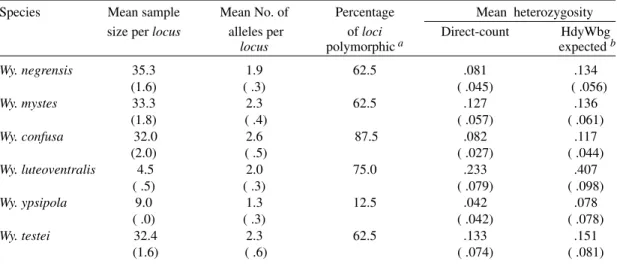
Enzymes that presented polymorphic loci were: in Wy. testei (PGM, IDH 1 and 2, ME and 6-PGDH), Wy. negrensis (MDH, PGM, IDH 1 and 2 and ME)and Wy. mystes (MDH, PGM, IDH 2, ME and 6 PGDH). The frequency of polymorphic loci
was 62% for these three species; the mean heterozy-gosity values were 0.13, 0.08 and 0.13, and mean number of alleles per locus were 2.3, 1.9 and 2.3, respectively (Table II).
Except for GPI, the majority of enzymes was polymorphic (87.5%) in Wy. confusa, with mean heterozygosity of 0.082 and a mean number of 2.6 alleles per locus. In Wy. luteoventralis six loci were polymorphic (MDH, PGM, IDH 1 and 2, ME and 6 PGDH) and the percentage of polymorphic loci
was 75%, with the mean number of 2.0 alleles per
locus and the observed mean heterozigozity of 0.23, which was the highest among the analyzed spe-cies. Wy. ypsipola presented only one polymorphic
locus (PGM), and the values were 12.5, 0.042 and 1.3 respectively (Table II).
Values of genetic identities (I) and distances (D) (Nei 1978) between the species are listed in Table III. High values of genetic identity were de-tected among the Dendromyia species - Wy. testei,
Wy. luteoventralis and Wy. ypsipola (mean value 0.63). On the other hand, low I values were
ob-served among Wy. negrensis, Wy. mystes and Wy. confusa (mean value 0.23). The UPGMA phenogram constructed with identity values dem-onstrated a grouping of Wy. luteoventralis, Wy. ypsipola and Wy. testei, while other species clus-tered at lower identity levels.
DISCUSSION
This is the first allozyme analysis performed with Neotropical species of Wyeomyia. In the course of this study, we found that several enzyme systems used in similar analyses of other culicid mosquitoes (Anopheles, Rosa-Freitas et al. 1990, Narang et al. 1991; Culex, Humeres et al. 1990;
Aedes, Nielsen et al. 1995) did not produce read-able bands.
The limited number of enzymatic loci analyzed may not provide the best estimate of variation that actually exists between the assayed species. Re-gardless, the results of the allozyme analysis still agreed with the morphological studies and the sub-sequent taxonomic treatment by Motta and Lourenço-de-Oliveira (1995) for species belong-ing to the subgenus Dendromyia.
The highest percentage of polymorphic loci
(Table II) was observed in Wy. confusa (87.5%). The percentage of polymorphic loci in this species is higher than those found in some mosquitoes, such as An. albimanus (55%, according to Narang et al.1991), An. aquasalis (27%, Flores-Mendoza 1994) and An. pseudopunctipennis (ranging from 12.1% to 78.8%, Manguin et al. 1995). Alterna-tively, Wy. ypsipola presented a low percentage of polymorphic loci (12.5%).
The mean heterozygosity values found for the analyzed Wyeomyia species are within the range observed for other mosquito groups, such as
Anopheles (Narang et al. 1991, Flores-Mendoza 1994).
191 191191 191191 Mem Inst Oswaldo Cruz, Rio de Janeiro, Vol. 93(2), Mar./Apr. 1998
TABLE I
Allele frequencies for polymorphic enzyme loci in Wyeomyia negrensis, Wy. mystes, Wy. confusa, Wy. luteoventralis,Wy. ypsipola and Wy. testei. Number of specimens tested in parenthesis
Species and populations
Locus Wy. negrensis Wy. mystes Wy. confusa Wy. luteoventralis Wy. ypsipola Wy. testei
Manaus (14) Itaguaí (39) São Paulo (2) Belém (6) Belém (2) Porto Velho (38) Peixoto de Nova Friburgo (7) Porto Velho (4)
Azevedo (27) Guapimirim (14) Peixoto de Belém (6) Joinville (17) Azevedo (3)
MDH (39) (39) (37) (3) (9) (37)
A .013 .000 .000 .000 .000 .000
B .987 .064 .014 .500 .000 .000
C .000 .000 .986 .000 .000 .000
D .000 .936 .000 .500 1.000 1.000
PGM (32) (30) (25) (5) (9) (32)
A .000 .000 .020 .000 .000 .188
B .000 .000 .000 .000 .000 .203
C .891 .000 .040 .000 .000 .000
D .000 .000 .140 .100 .111 .531
E .078 .000 .780 .600 .389 .016
F .031 .900 .000 .000 .500 .016
G .000 .050 .020 .300 .000 .047
H .000 .050 .000 .000 .000 .000
IDH1 (41) (26) (39) (5) (9) (38)
A .000 1.000 .000 .000 .000 .013
B .122 .000 .013 .300 .000 .000
C .000 .000 . 987 .700 1.000 .974
D .854 .000 .000 .000 .000 .013
E .024 .000 .000 .000 .000 .000
IDH2 (40) (39) (39) (5) (9) (35)
A .3l3 .000 .026 .400 1.000 .000
B .688 .526 .962 .400 .000 .000
C .000 .462 .013 .000 .000 .029
D .000 .000 .000 .200 .000 .971
E .000 .013 .000 .000 .000 .000
ME (37) (39) (30) (6) (9) (34)
A .081 .000 .000 .000 .000 .000
B .000 .000 .033 .000 .000 .000
C .919 .013 .000 .833 .000 .206
D .000 .013 .000 .167 1.000 .794
E .000 .026 .967 .000 .000 .000
F .000 .949 .000 .000 .000 .000
FUM (31) (32) (30) (2) (9) (30)
A .000 1.000 .000 .000 .000 .000
B .000 .000 .100 1.000 1.000 1.000
C .000 .000 .900 .000 .000 .000
D 1.000 .000 .000 .000 .000 .000
GPI (31) (31) (30) (6) (9) (28)
A .000 .000 .000 .000 .000 1.000
B 1.000 1.000 1.000 1.000 1.000 .000
6PGD (31) (30) (26) (4) (9) (25)
A .000 .000 .058 .000 .000 .000
B .000 .000 .904 .500 .000 .940
C 1.000 .017 .000 .000 .000 .000
D .000 .917 .019 .500 1.000 .060
192 192 192 192
192 Genetic Relatedness of Dendromyia Species Monique A Motta et al.
TABLE II
Measures of genetic variation of Wyeomyia negrensis, Wy. mystes, Wy. confusa, Wy. luteoventralis, Wy. ypsipola and Wy. testei
Species Mean sample Mean No. of Percentage Mean heterozygosity
size per locus alleles per of loci Direct-count HdyWbg
locus polymorphic a expectedb
Wy. negrensis 35.3 1.9 62.5 .081 .134
(1.6) ( .3) ( .045) ( .056)
Wy. mystes 33.3 2.3 62.5 .127 .136
(1.8) ( .4) ( .057) ( .061)
Wy. confusa 32.0 2.6 87.5 .082 .117
(2.0) ( .5) ( .027) ( .044)
Wy. luteoventralis 4.5 2.0 75.0 .233 .407
( .5) ( .3) ( .079) ( .098)
Wy. ypsipola 9.0 1.3 12.5 .042 .078
( .0) ( .3) ( .042) ( .078)
Wy. testei 32.4 2.3 62.5 .133 .151
(1.6) ( .6) ( .074) ( .081)
a: a locus is considered polymorphic if more than one allele was detected; b: unbiased estimate (see Nei 1978).
TABLE III
Estimates of Nei’s (1978) unbiased genetic identity (above diagonal) and genetic distance (below diagonal) for Wyeomyia negrensis, Wy. mystes, Wy. confusa, Wy. luteoventralis, Wy. ypsipola and Wy. testei
Species 1 2 3 4 5 6
1 Wy. negrensis ***** .214 .255 .478 .190 .029 2 Wy. mystes 1.542 ***** .223 .383 .464 .153 3 Wy. confusa 1.368 1.502 ***** .543 .339 .289 4 Wy. luteoventralis .738 .959 .610 ***** .762 .573 5 Wy. ypsipola 1.661 .768 1.080 .272 ***** .551 6 Wy. testei 3.525 1.880 1.241 .556 .596 *****
193 193193 193193 Mem Inst Oswaldo Cruz, Rio de Janeiro, Vol. 93(2), Mar./Apr. 1998
was obtained between Wy. luteoventralis and Wy. ypsipola (I = 0.76). In spite of Wy. luteoventralis
and Wy. ypsipola having very distinct external male and female characters, the morphological charac-ters of the immature stages are nearly identical.
On the other hand, the allozyme analyses of
Wy. negrensis, Wy. mystes,Wy. confusa (belonging to taxonomically undetermined subgenera) and the above mentioned members of the subgenus
Dendromyia (Wy. luteoventralis, Wy. ypsipola and
Wy. testei) showed low genetic identity among them, with I values ranging from 0.03 to 0.54. This
also agrees with the current taxonomic treatment of the genus Wyeomyia based on morphological analysis by Motta and Lourenço-de-Oliveira (1995) and Motta (1996). The highest I value found
be-tween a member of the subgenus Dendromyia and a non Dendromyia species was that between Wy. luteoventralis and Wy. confusa (0.54). Indeed, Wy. confusa is bionomically similar to the Dendromyia
species, e.g. predatory behavior of larvae and use of Callathea and Heliconia plants as larval habi-tats. Regardless, Wy. confusa belongs to the Prosopolepis group of Wyeomyia because it is nei-ther morphologically related nor has enough ge-netic similarity with other members of the subge-nus Dendromyia.
In reviews on the relationship of I to
system-atic diversity of vertebrates, invertebrates and plants, Thorpe (1982) and Thorpe and Solé-Cava (1994) concluded that generally conspecific popu-lations have I values above 0.85, while between
congeneric species the usual range is about 0.85 to 0.30 and between genera I values are usually in
the range from 0.45 to zero (generally bellow 0.35). The I values observed among Wy. luteoventralis, Wy. ypsipola and Wy. testei,ranging from 0.55 to 0.76, show that they are closely related species and reinforce their congeneric relationship. On the other hand, the allozyme analysis of Wy. negrensis, Wy. mystes and Wy. confusa presented low genetic iden-tity with I values ranging from 0.21 to 0.26,
sug-gesting that they belong to distinct groups, prob-ably different subgenera within the genus
Wyeomyia. Nevertheless, the I values between
some of them were very low, such as between Wy. testei and Wy. negrensis (I = 0.03). These results
suggest that they may belong to different genera. Indeed, Wy. negrensis, Wy. confusa and Wy. mystes
were previously thought to belong to the series Cleobonnea, Prosopolepis and Dendromyia respec-tively (Table III). Our findings suggest that these three series consisted of an unnatural classifica-tion, and that more detailed and comprehensive morphological and genetic studies should be con-ducted to better understand the phylogenetic rela-tionships among the Wyeomyia species.
ACKNOWLEDGEMENTS
To Dr MG Rosa-Freitas and M Monteiro for sug-gestions in the manuscript; Drs H Momen, R Pacheco and NA Honório for the sugestions and support in the laboratory; Dr AT Rosa and OV Silva, Evandro Chagas Institute, for the support on the field.
REFERENCES
Bullini L 1982. Enzyme variants in the identification of parasites and vectors: methodological aspects of the electrophoretic approach, p. 53-69. In BN Newton, F Michal (eds), New Aproaches to the Identification of Parasites and Their Vectors, WHO, Basel, Swit-zerland.
Flores-Mendoza CF 1994. Um Estudo Sobre Alguns Aspectos Comportamentais, Morfológicos e Bioquímicos de Anopheles aquasalis Curry, 1932, MSc Thesis, Instituto Oswaldo Cruz, Rio de Janeiro, 172 pp.
Hervé JP, Dégallier N, Travassos da Rosa APA, Pinheiro FP, Sá Filho GC 1986. Arboviroses - Aspectos ecológicos, p. 409-437. In Instituto Evandro Chagas - 50 Anos deContribuição às Ciências Biológicas e à Medicina Tropical, Vol I., Fund Serv Saúde Pública, Belém.
Humeres SG, Gardenal CN, Almirón W, Sereno R, Sabattini MS 1990. Culex species (Diptera: Culi-cidae) from Central Argentina identification by elec-trophoretic zymograms and genetic relationships. J Med Entomol 27: 784-788.
Lane J, Cerqueira NL 1942. Os sabetíneos da América (Diptera, Culicidae). Arch Zool SPaulo3: 473-849. Manguin S, Roberts DR, Peyton EL, Fernandez-Salas I, Barreto M, Loayza RF, Spinola RE, Granaou RM, Rodriguez MH 1995. Biochemical systematics and population genetic structure of Anopheles pseudopunctipennis, vector of malaria in Central and South America. Am J Trop Med Hyg 53: 362-377. Momen H, Salles CA 1985. Enzyme markers for Vibrio
cholerae:identification of classical, eltor and envi-ronmental strains. Trans R Soc Trop Med Hyg79: 773-776.
Motta MA 1996. O Subgênero Dendromyia Theobald (DIPTERA: CULICIDAE): Um Estudo Morfológico e Bioquímico, MSc Thesis, Instituto Oswaldo Cruz, Rio de Janeiro, 121 pp.
Motta MA, Lourenço-de-Oliveira R 1995. Wyeomyia luteoventralis Theobald, the type species of the sub-genus Dendromyia Theobald (Diptera: Culicidae). Mem Inst OswaldoCruz90: 375-385.
Narang SK, Seawright JA, Suarez MF 1991. Genetic structure of natural populations of Anopheles albimanus in Colombia. J Am Mosq Control Assoc 7: 437-445.
Nei M 1972. Genetic distance between populations. Amer Natur 106: 283-292.
Nei M 1978. Estimation of average heterozygosity and genetic distance from a small number of individu-als. Gen89: 583-590.
194 194 194 194
194 Genetic Relatedness of Dendromyia Species Monique A Motta et al.
morphology and allozymes (Diptera: Culicidae). Mosq Syst 27: 100-109.
Rosa-Freitas MG 1988. Anopheles albitarsis Lynch-Arribálzaga, 1878 (Diptera; Culicidae): Um Estudo Comparativo de Caracteres Morfológicos, Bioquímicos e Comportamentais de Populações de Dez Localidades, MSc Thesis, Instituto Oswaldo Cruz,Rio de Janeiro, 105 pp.
Rosa-Freitas MG, Deane LM, Momen H 1990. A mor-phological, isoenzymatic and behavioural study of ten populations of Anopheles (Nyssorhynchus) albitarsis Lynch-Arribalzaga, 1878 including from the type-locality, Baradero, Argentina. Mem Inst
Oswaldo Cruz 85: 275-289.
Swofford DL, Selander RB 1981. BIOSYS-1: A FOR-TRAN program for the comprehensive analysis of eletrophoretic data in population genetics and sys-tematics. J Hered 72: 281-283.
Sneath PHA, Sokal RR 1973. Numerical Taxonomy, Freeman, San Francisco, 573 pp.
Thorpe JP 1982. The molecular clock hypothesis: bio-chemical evolution, genetic differentiation and sys-tematics. Annu Rev Ecol Syst13: 139-168. Thorpe JP, Solé-Cava AM 1994. The use of allozyme