The action of red wine and purple
grape juice on vascular reactivity
is independent of plasma lipids
in hypercholesterolemic patients
1Unidade de Ateroesclerose, 2Unidade de Terapia Intensiva,
Instituto do Coração, Hospital das Clínicas, Faculdade de Medicina, Universidade de São Paulo, São Paulo, SP, Brasil
S.R. Coimbra1, S.H. Lage2,
L. Brandizzi1, V. Yoshida1
and P.L. da Luz1
Abstract
Although red wine (RW) reduces cardiovascular risk, the mechanisms underlying the effect have not been identified. Correction of endothe-lial dysfunction by RW flavonoids could be one mechanism. We measured brachial artery reactivity by high-resolution ultrasonogra-phy, plasma lipids, glucose, adhesion molecules (ICAM-1 and VCAM), and platelet function in 16 hypercholesterolemic individuals (8 men and 8 women; mean age 51.6 ± 8.1 years) without other risk factors. Twenty-four normal subjects were used as controls for vascular reactivity. Subjects randomly received RW, 250 ml/day, or purple grape juice (GJ), 500 ml/day, for 14 days with an equal wash-out period. At baseline, all 16 subjects were hypercholesterolemic (mean LDL = 181.0 ± 28.7 mg/dl) but HDL, triglycerides, glucose, adhesion molecules, and platelet function were within normal limits. Brachial artery flow-mediated dilation was significantly decreased compared to controls (9.0 ± 7.1 vs 12.1 ± 4.5%; P < 0.05) and increased with both GJ (10.1 ± 7.1 before vs 16.9 ± 6.7% after: P < 0.05) and RW (10.1 ± 6.4 before vs 15.6 ± 4.6% after; P < 0.05). RW, but not GJ, also significantly increased endothelium-independent vasodilation (17.0 ± 8.6 before vs 23.0 ± 12.0% after; P < 0.01). GJ reduced ICAM-1but not VCAM and RW had no effect on either molecule. No significant alterations were observed in plasma lipids, glucose or platelet aggregability with RW or GJ. Both RW and GJ similarly improved flow-mediated dilation, but RW also enhanced endothelium-inde-pendent vasodilation in hypercholesterolemic patients despite the increased plasma cholesterol. Thus, we conclude that GJ may protect against coronary artery disease without the additional negative effects of alcohol despite the gender.
Correspondence
P.L. da Luz
Unidade de Ateroesclerose InCor, HC, FM, USP Av. Dr. Eneas C. Aguiar, 44 05403-000 São Paulo, SP Brasil
Fax: +55-11-3069-5447 E-mail: [email protected]
Research supported by FAPESP (No. 1998/10576-5) and Fundação Zerbini.
Received May 27, 2004 Accepted May 20, 2005
Key words
•Atherosclerosis •Endothelial function •Flavonoids
•Alcohol
•Red wine and grape juice •Brachial artery dilation
Introduction
Moderate drinking is associated with a decreased risk of myocardial infarction, stroke, and cardiac death (1,2), as well as
platelets, some studies indicate that the great-est protection is due to red wine (RW), rather than beer or spirits (8-10). This suggests that phenolic acids, polyphenols, and or fla-vonoids may confer additional benefits.
Flavonoids are polyphenol derivatives of 2-phenyl-1-benzopyran-4-1 that are present in fruits, vegetables, nuts, and seeds (11). In epidemiological studies, flavonoid intake is associated with a reduced risk of coronary events (11,12). In an experimental study (13) we showed that both RW and nonalco-holic wine products can prevent plaque for-mation in hypercholesterolemic rabbits de-spite significant increases in low-density lipoprotein (LDL). Apoprotein E (Apo E)-deficient mice also showed reduced athero-sclerosis progression when fed RW (14). RW also causes monocyte chemotactic pro-tein-1 expression blockade and reduced neointimal hyperplasia after balloon injury in rabbits (15), inhibition of smooth muscle cell proliferation and of cyclin A expression (16), as well as inhibition of the platelet-derived growth factor receptor by RW fla-vonoids in cultured smooth muscle cells (17) - all of them factors contributing to athero-genesis.
More recent evidence (18) indicated that RW, but not vodka, inhibited nuclear factor-κB expression in leukocytes of human vol-unteers fed a high fat diet. Furthermore, RW phenols blocked endothelin-1 production (19) and induced endothelial nitric oxide synthase (eNOS) expression in cultured en-dothelial cells (20).
In vitro, the flavonoid components of RW and purple grape juice (GJ) induce en-dothelium-dependent vasodilation of arteri-al rings (21), a phenomenon mediated by the nitric oxide cyclic guanosine monophos-phate (NO-cGMP) pathway (22). Although improved endothelial function and inhibi-tion of platelet aggregainhibi-tion are potential mechanisms by which RW flavonoids may reduce cardiovascular risk in hypercholeste-rolemic patients, the in vivo effects of RW
and GJ on these parameters are not well known. Despite favorable clinical and ex-perimental evidence, recommendation for wine or any alcohol drinking is controver-sial, due to well known untoward side ef-fects of alcohol.
Hence we decided to compare RW and GJ in humans to determine whether the ben-efits of polyphenols could be achieved with-out the undesirable side effects of alcohol. The specific purpose of this study was to compare the effects of RW and GJ on arterial reactivity, platelet aggregability, adhesion molecules, glucose, and plasma lipids in hypercholesterolemic subjects.
Patients and Methods
Patients
Brachial artery reactivity
Brachial artery (BA) reactivity studies were always performed in the morning after a 10-min rest in a temperature-controlled room (20º to 25ºC). The diameter of the left BA and baseline forearm blood flow ve-locity were measured with a 7.5-MHz linear array vascular ultrasound transducer part of an APOGEE 800 plus ATL ultrasound sys-tem (ATL Ultrasound, Bothell, WA, USA). For the evaluation of endothelial-dependent reactivity (23-25) increased forearm blood flow was induced by inflation of a pneu-matic blood pressure tourniquet placed around the widest part of the forearm to a systolic pressure of 250 mmHg, followed by deflation after 5 min. The first five blood flow scans were obtained continuously immediately thereafter and blood flow ve-locities and BA diameters were measured again after 1 min. Twenty minutes were allowed for vessel recovery, and repeat rest-ing BA diameter and blood flow scans were obtained. For endothelial-independent evaluation, sublingual isosorbide dinitrate (5 mg) was administered and final scans were performed after 5 min. A single-lead ECG was monitored throughout the study. Blood pressure was measured in the right upper arm before the first scan, before admin-istration of sublingual nitroglycerin, and every 5 min thereafter until it returned to baseline.
Ultrasound images were recorded in VHS. The BA was imaged 2 to 15 cm above the elbow and scanned in longitudinal section with the focus zone set to the depth of the near wall. During image acquisition, ana-tomic landmarks such as fascial planes were noted to help maintain the same image of the artery throughout the study. Depth and gain settings were used to optimize the images of the lumen/arterial wall interface. Vessel di-ameters were measured using a software program, developed at InCor, a semi-auto-matic approach to measure artery diameter based on active contour technique improved
by multiresolution analysis. The operator selected a region of interest (1 cm in longitu-dinal diameter) in six series of brachial im-ages obtained from b-mode ultrasound. The distance between near wall media-adventitia and far wall media-adventitia was obtained for all images and the mean value was calcu-lated during diastole (26).
Flow-mediated vasodilation (FMD) was calculated as the ratio of the BA diameter after reactive hyperemia to the baseline di-ameter, expressed as a percent change. Ni-troglycerin-mediated vasodilation (NTGD) was calculated in an analogous fashion.
The intraobserver reliability for meas-urement of BA diameters was 0.987. This value reflects the interclass correlation coef-ficient across all readings and all conditions (baseline, reactive hyperemia, prenitroglyc-erin, and postnitroglycerin).
Lipids and platelet aggregation
Plasma samples were collected in EDTA after a 12-h fast by venipuncture performed on the same day as the BA studies.
Adhesion molecules
Serum was separated from whole blood following centrifugation in a benchtop cen-trifuge for 15 min at 750 g and was stored at -80ºC until assayed. Serum levels of inter-cellular adhesion molecule 1 (h-sICAM-1 ELISA, anti-sICAM-1: monoclonal antibody from murine, parameter R&D Systems, Min-neapolis, MN, USA) and vascular cell adhe-sion molecule (h-sVCAM-1 ELISA, anti-sVCAM-1 biotin, monoclonal antibody from mouse, clone M-1.G11-B1, and anti-sVCAM-1 peroxidase, monoclonal antibody from mouse, clone M-DDV-1 fab fragments) were determined by ELISA.
Protocol
Sixteen subjects were randomized to re-ceive either 500 ml/day GJ or 250 ml/day RW for 14 days as first treatment; a wash-out
period of equal duration was then observed, followed by the second treatment modality.
Patients were examined every 2 weeks after an overnight 12-h fast. Endothelial func-tion was assessed four times: 1) at baseline, 2) at the end of the first treatment period, 3) after a 14-day washout, and 4) after the second treatment period. At all 4 points, blood was collected and vital signs were measured with automated monitor after 20 min of rest.
Statistical analysis
Continuous variables are reported as means ± SD. Changes in FMD and NTGD are described as means with 95% confi-dence. FMD and NTGB were compared by ANOVA with repeated measures and cat-egorical variables were compared by the Fisher test. The level of significance was set at P ≤ 0.05 for all analyses.
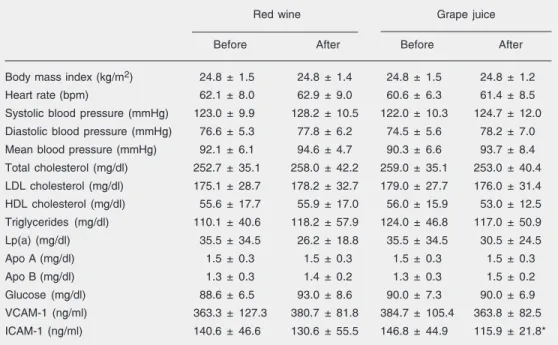
Table 1.Characteristics of hypercholesterolemic patients at baseline and after the ingestion of red wine or grape juice.
Red wine Grape juice
Before After Before After
Body mass index (kg/m2) 24.8 ± 1.5 24.8 ± 1.4 24.8 ± 1.5 24.8 ± 1.2
Heart rate (bpm) 62.1 ± 8.0 62.9 ± 9.0 60.6 ± 6.3 61.4 ± 8.5
Systolic blood pressure (mmHg) 123.0 ± 9.9 128.2 ± 10.5 122.0 ± 10.3 124.7 ± 12.0 Diastolic blood pressure (mmHg) 76.6 ± 5.3 77.8 ± 6.2 74.5 ± 5.6 78.2 ± 7.0 Mean blood pressure (mmHg) 92.1 ± 6.1 94.6 ± 4.7 90.3 ± 6.6 93.7 ± 8.4 Total cholesterol (mg/dl) 252.7 ± 35.1 258.0 ± 42.2 259.0 ± 35.1 253.0 ± 40.4 LDL cholesterol (mg/dl) 175.1 ± 28.7 178.2 ± 32.7 179.0 ± 27.7 176.0 ± 31.4 HDL cholesterol (mg/dl) 55.6 ± 17.7 55.9 ± 17.0 56.0 ± 15.9 53.0 ± 12.5 Triglycerides (mg/dl) 110.1 ± 40.6 118.2 ± 57.9 124.0 ± 46.8 117.0 ± 50.9
Lp(a) (mg/dl) 35.5 ± 34.5 26.2 ± 18.8 35.5 ± 34.5 30.5 ± 24.5 Apo A (mg/dl) 1.5 ± 0.3 1.5 ± 0.3 1.5 ± 0.3 1.5 ± 0.3 Apo B (mg/dl) 1.3 ± 0.3 1.4 ± 0.2 1.3 ± 0.3 1.5 ± 0.2 Glucose (mg/dl) 88.6 ± 6.5 93.0 ± 8.6 90.0 ± 7.3 90.0 ± 6.9 VCAM-1 (ng/ml) 363.3 ± 127.3 380.7 ± 81.8 384.7 ± 105.4 363.8 ± 82.5 ICAM-1 (ng/ml) 140.6 ± 46.6 130.6 ± 55.5 146.8 ± 44.9 115.9 ± 21.8*
Data are reported as means ± SD (N = 16). Lp(a) = lipoprotein a; Apo = apolipoprotein; VCAM-1 = vascular cell adhesion molecule 1; ICAM-1 = intercellular adhesion molecule 1.
Results
Baseline characteristics
For the specific purpose of establishing normal values for vascular reactivity for our laboratory, 24 healthy subjects were stud-ied. Their mean age was 42.6 ± 7.1 years, and blood pressure was 124/80 ± 12/5 mmHg, total cholesterol was 180 ± 9.1 mg/dl, LDL 111 ± 7.9 mg/dl, HDL 53 ± 2.2 mg/dl, tri-glycerides were 155 ± 10.1 mg/dl, and fast-ing glucose was 89 ± 12 mg/dl. The brachial artery diameter averaged 3.55 ± 0.6 mm, FMD was 12.1 ± 4.5% and NTGD was 16.6 ± 9.5%. These subjects were not included in the RW/GJ study.
Of the 16 randomized subjects 8 were males and 8 were females. Their average age was 51.6 ± 8.1 (SD) years. All subjects were hypercholesterolemic and none was receiv-ing lipid-lowerreceiv-ing therapy. Table 1 describes the demographic data of the subjects.
Comparisons were made at different times in the same patients and between treatment groups. There were no statistically signifi-cant differences between baseline, pretreat-ment and washout values for any parameter. There was no interaction between beverage order and treatment effects (P = 0.93).
Brachial artery reactivity
Red wine effects. In the 16 hypercholes-terolemic subjects the mean baseline BA diameter was significantly increased com-pared with control (3.8 ± 0.7 vs 3.55 ± 0.6 mm, P < 0.05). After 2 weeks of RW, the mean baseline diameter remained unchanged (3.9 ± 0.8 vs 3.8 ± 0.7 mm, P = ns).
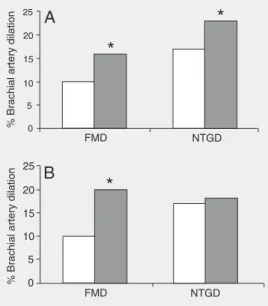
Baseline FMD was significantly impaired in hypercholesterolemic subjects compared with controls (9.0 ± 7.1 vs 12.1 ± 4.5%, P < 0.05). After RW, FMD increased signifi-cantly (10.1 ± 6.4 vs 15.6 ± 4.6%, P < 0.05) in hypercholesterolemic subjects (Figure 1A). Red wine had no effect on the intensity
of reactive hyperemic blood velocity (data not shown).
At baseline, NTGD did not differ be-tween hypercholesterolemic and control sub-jects (18.9 ± 7.6 vs 16.6 ± 9.5%, P = ns). However, after RW, NTGD increased from 16.6 ± 9.5 to 23.0 ± 12.0%, P < 0.05 (Figure 1A).
These effects on vascular reactivity oc-curred in the absence of any significant changes in heart rate and blood pressure, as shown in Table 1.
Grape juice. Similar to RW, the mean baseline BA diameter of hypercholesterole-mic subjects remained unchanged after 2 weeks of GJ consumption (3.9 ± 0.8 vs 3.8 ± 0.7 mm; P = ns). On the other hand, in hypercholesterolemic subjects FMD in-creased significantly (10.9 ± 7.4 vs 16.9 ± 6.7%, P < 0.05) with GJ (Figure 1B). GJ had no effect on the intensity of reactive hyper-emic blood velocity (data not shown).
In contrast, NTGD remained unchanged (19.8 ± 8.8 vs 18.0 ± 9.4%, P = ns) after GJ (Figure 1B). These effects were not accom-panied by any significant changes in heart rate and systolic, diastolic or mean blood pressure (Table 1).
A comparison of the final FMD values in both RW and GJ treatments showed no
nificant difference (unpaired t-test), indicat-ing that the magnitude of response to both treatments was similar.
Lipid and glucose values
As shown in Table 1, subjects were clearly hypercholesterolemic, but triglycerides, HDL-cholesterol and glucose levels were normal. Also, Apo A, Apo B, and Lp(a) were normal. After RW or GJ no effect on fasting plasma lipids, Lp(a), Apo A, Apo B, or glucose was observed (Table 1).
Adhesion molecules
At baseline, mean adhesion molecule val-ues were within normal ranges and RW had no effect on VCAM-1 or ICAM-1 (Table 1). In contrast to RW, GJ ingestion significantly decreased ICAM-1, but had no effect on VCAM-1.
Platelet aggregation
At baseline, platelet aggregation was nor-mal in 12 subjects, decreased in 3 and in-creased in 1. Neither RW nor GJ produced any significant change in platelet aggregation.
Discussion
This study demonstrates comparable im-provement in arterial endothelial dilation after short-term ingestion of both GJ and RW in hypercholesterolemic individuals, without affecting plasma lipids, glucose lev-els or platelet aggregability. RW, but not GJ, also increased endothelium-independent va-sodilation. In addition, GJ reduced ICAM-1 but did not affect VCAM. Since endothelial dysfunction is an early event in atheroscle-rosis (28) and may be of considerable prog-nostic value (29,30), these findings may be relevant for vascular protection in patients at risk.
Since FMD increments were similar in
RW and GJ, such improvement cannot be attributed to alcohol, nor can it be attributed to lipid, glucose or platelet effects, because none changed significantly. Therefore, the improvement in endothelial function is most probably due to other substances present in both RW and GJ. Although various chemi-cals are present in RW and GJ, several lines of evidence point to flavonoids as the most likely to play a role in vascular function.
In vitro the NO-cGMP pathway mediates the endothelium-dependent vasodilating ef-fects of RW and GJ. Ethanol, at the same concentration as contained in red and white wines, does not cause vasorelaxation (31). RW or extracts obtained from it caused en-dothelium-dependent, NO-mediated vasore-laxation of rat (32) or rabbit (33) aorta preconstricted with norepinephrine. Also, in human coronary arteries and rat aortic rings
in vitro, short-term incubation with RW in-duced FMD and increased vascular cGMP content (31). These effects were abolished after endothelial denudation and reversed by NOS inhibition. Ethanol did not affect vas-cular tension or cGMP content.
These rapid effects of RW are likely to involve an acute activation of eNOS. Walle-rath et al. (20) provided evidence that RW can stimulate the expression of the eNOS gene leading to enhanced production of NO. This upregulation was seen in both EA.hy 926 cells and primary human umbilical vein endothelial cells; such phenomenon is medi-ated in part by increases in Ca2+ in
endothe-lial cells (34).
vasodi-lation improves after acute intake (120 min) of RW or RW without alcohol in men. But endothelium-independent vasodilation re-mained unchanged.In contrast, the present study showed that endothelium-independ-ent vasodilation also improves after RW. Therefore, not only endothelial but also smooth muscle cell reactivity function is improved by RW. The mechanisms underly-ing the latter effect are not clear. One pos-sible explanation is the activation of the parasympathetic nervous system and rela-tive inactivation of the sympathetic nervous system which are known to occur after alco-hol consumption (37). Regarding the overall effects, the actions of flavonoids and ethanol on NO production can be invoked. Thus, Matsuo et al. (38) showed an increased acute production of NO with RW and ethanol in the plasma of healthy subjects using diami-nofluoresceins as new selective fluorescent indicators.
Hence, the most plausible mechanism responsible for the observed improvement in endothelium-dependent vasodilation is the action of flavonoids. On the one hand, they can decrease endothelin production which may prevent vasoconstriction and on the other, they increase NO production by endo-thelial cells, thus facilitating vasodilation. Regarding endothelium-independent vasodi-lation, the mechanisms remain speculative. It is noteworthy that these vasodilatory effects occurred independently of changes in lipids, glucose or platelet aggregation. This supports the hypothesis of flavonoid mechanisms. Our findings regarding lipids are consistent with those of Hayek et al. (14), who also did not find changes in HDL or LDL after giving RW or the polyphenols quercetin or catechin to mice. However, pro-longed alcohol ingestion is known to in-crease HDL in humans (39); thus, the ab-sence of an RW effect on HDL in the present investigation might have been due to the short period of administration.
The present study also provides evidence
that GJ, but not RW, candiminish circulat-ing ICAM-1, perhaps because phenolic com-pounds can suppress cytokine-induced acti-vation of nuclear factor κB and subsequent expression of adhesion molecules. However, VCAM-1 was not significantly affected by GJ. The reasons for this selective effect of GJ on ICAM-1 remain unknown.
Limitations
Although the number of subjects in this study was relatively small, the BA ultrasonic technique for evaluating endothelial func-tion is very sensitive and reproducible, and each subject is used as his own control. The sample size was based on published nomo-grams for interventions assessed by this tech-nique. Because of the short duration of this study, it is also not known whether the ob-served vasorelaxing properties of GJ and RW would persist with chronic ingestion. No direct measurement of flavonoids was made; therefore, their influence on reactive vascular is only deductive.
We have shown that short-term ingestion of GJ and RW improves endothelial func-tion and only GJ reduces ICAM-1 in hyper-cholesterolemic patients. Also, endothelium-independent vasodilation was increased by RW. Improved endothelium-dependent va-sodilation is a potential mechanism by which flavonoids in purple grape products may prevent cardiovascular events, as suggested by several epidemiological studies (40). Of particular interest is the demonstration that the improvement in vascular function can be obtained without alcohol. This is of potential clinical relevance for certain sub-groups of patients at risk of cardiovascular events, for whom even moderate alcohol intake is not advisable.
Acknowledgments
References
1. Renaud S & de Lorgeril M (1992). Wine, alcohol, platelets, and the French paradox for coronary heart disease. Lancet, 339: 1523-1526.
2. St Leger AS, Cochrane AL & Moore F (1979). Factors associated with cardiac mortality in developed countries with particular refer-ence to the consumption of wine. Lancet, 1: 1017-1020.
3. Orgogozo JM, Dartigues JE, Lafont S et al. (1997). Wine consump-tion and dementia in the elderly: a prospective community study in the Bordeaux area. Revue Neurologique, 153: 185-192.
4. Leibovici D, Ritchie K, Ledesert B et al. (1999). The effects of wine and tobacco consumption on cognitive performance in the elderly: a longitudinal study of relative risk. International Journal of Epidemiol-ogy, 28: 77-81.
5. MukamaL KJ, Longstreth Jr WT, Mittleman MA et al. (2001). Alcohol consumption and subclinical findings on magnetic resonance imag-ing of the brain in older adults: the Cardiovascular Health Study.
Stroke, 32:1939-1946.
6. Obisesan TO, Hirsch R, Kosoko O et al. (1998). Moderate wine consumption is associated with decreased odds of developing age-related macular degeneration in NHANES-1. Journal of the Ameri-can Geriatric Society, 46: 1-7.
7. Klein R, Klein BE & Moss SE (1989). The Wisconsin epidemiological study of diabetic retinopathy: a review. Diabetes/Metabolism Re-views, 5: 559-570.
8. Gronbaek M, Deis A, Sorensen TI et al. (1995). Mortality associated with moderate intakes of wine, beer, or spirits. British Medical Jour-nal (Clinical Research),310: 1165-1169.
9. Truelsen T, Gronbaek M, Schnohr P et al. (1998). Intake of beer, wine, and spirits and risk of stroke: The Copenhagen City Heart Study. Stroke, 29: 2467-2472.
10. Rimm EB, Klatsky A, Grobbee D et al. (1996). Review of moderate alcohol consumption and reduced risk of coronary heart disease: is the effect due to beer, wine, or spirits? British Medical Journal
(Clinical Research),312: 731-736.
11. Hertog MG, Kromhout D, Aravanis C et al. (1995). Flavonoid intake and long-term risk of coronary heart disease and cancer in the Seven Countries Study. Archives of Internal Medicine, 155: 381-386.
12. Howard BV & Kritchevsky D (1997). Phytochemicals and cardiovas-cular disease: a statement for healthcare professionals from the American Heart Association. Circulation,95: 2591-2593.
13. Da Luz PL, Serrano Jr CV, Chacra AP et al. (1999). The effect of red wine on experimental atherosclerosis: lipid-independent protection. Experimental and Molecular Pathology, 65: 150-159.
14. Hayek T, Fuhrman B, Vaya J et al. (1997). Reduced progression of atherosclerosis in apoliprotein E-deficient mice following consump-tion of red wine, or its polyphenols quercetin or catechin, is associ-ated with reduced susceptibility of LDL to oxidation and aggregation.
Arteriosclerosis, Thrombosis, and Vascular Biology, 17: 2744-2752. 15. Feng AN, Chen YL, Chen YT et al. (1999). Red wine inhibits mono-cyte chemotactic protein-1 expression and modestly reduces neointimal hyperplasia after balloon injury in cholesterol-fed rabbits.
Circulation, 100: 2254-2259.
16. Iijima K, Yoshizumi M, Hashimoto M et al. (2000). Red wine polyphe-nols inhibit proliferation of vascular smooth muscle cells and down-regulate expression of cyclin A gene. Circulation, 101: 805-811. 17. Rosenkranz S, Knirel D, Dietrich H et al. (2002). Inhibition of the
PDGF receptor by red wine flavonoids provides a molecular expla-nation for the “French paradox”. FASEB Journal, 16: 1958-1960.
18. Blanco-Colio LM, Valderrama M, Alvarez-Sala LA et al. (2000). Red wine intake prevents nuclear factor-κB activation in peripheral blood mononuclear cells of healthy volunteers during postprandial lipemia.
Circulation, 102: 1020-1026.
19. Corder R, Douthwaite JA, Lees DM et al. (2001). Endothelin-I syn-thesis reduced by red wine. Nature,414: 863-864.
20. Wallerath T, Poleo D,Li H et al. (2003). Red wine increases the expression of human endothelial nitric oxide synthase: a mechan-ism that may contribute to its beneficial cardiovascular effects. Jour-nal of the American College of Cardiology, 41: 471-478.
21. Chen CK & Pace-Asciak CR (1996). Vasorelaxing activity of res-veratrol and quercetin in isolated rat aorta. General Pharmacology, 27: 363-366.
22. Fitzpatrick DF, Hirschfield SL & Coffey RG (1993). Endothelium-dependent vasorelaxing activity of wine and other grape products.
American Journal of Physiology, 265: H774-H778.
23. Celermajer DS, Sorensen KE, Gooch VM et al. (1992). Non-invasive detection of endothelial dysfunction in children and adults at risk of atherosclerosis. Lancet, 340: 1111-1115.
24. Celermajer DS (1998). Testing endothelial function using ultrasound.
Journal of Cardiovascular Pharmacology,32: S29-S32.
25. Corretti MC, Anderson TJ, Benjamin EJ et al. (2002). Guidelines for the ultrasound assessment of endothelial-dependent flow-mediated vasodilatation of brachial artery: a report of the International Bra-chial Artery Reactivity Task Force. Journal of the American College of Cardiology, 39: 257-265.
26. Gutierrez MA, Pilon PE, Lage SG et al. (2002). Assessment of carotid diameter and wall thickness in ultrasound images using active contours improved by a multiresolution technique. Proceed-ings of SPIE, 4683: 248-255.
27. Allain CC, Poon LS, Chan CS et al. (1974). Enzymatic determination of total serum cholesterol. Clinical Chemistry, 20: 470-475. 28. Mano T, Masuyama T, Yamamoto K et al. (1996). Endothelial
dys-function in the early stage of atherosclerosis precedes appearance of intimal lesions assessable with intravascular ultrasound. Ameri-can Heart Journal,131: 231-238.
29. Celermajer DS (1997). Endothelial dysfunction: does it matter? Is it reversible? Journal of the American College of Cardiology, 30: 325-333.
30. Vogel RA (1997). Coronary risk factors, endothelial function, and atherosclerosis: a review. Clinical Cardiology,20: 426-432. 31. Flesch M, Schwarz A & Bohm M (1998). Effects of red and white
wine on endothelium-dependent vasorelaxation of rat aorta and human coronary arteries. American Journal of Physiology, 275: H1183-H1190.
32. Andriambeloson E, Stoclet JC & Andriantsitohaina R (1999). Mech-anism of endothelial nitric oxide-dependent vasorelaxation induced by wine polyphenols in rat thoracic aorta. Journal of Cardiovascular Pharmacology, 33: 248-254.
33. Cishek MB, Galloway MT, Karim M et al. (1997). Effect of red wine on endothelium-dependent relaxation in rabbits. Clinical Science, 93: 507-511.
34. Martin S, Andriambeloson E, Takeda K et al. (2002). Red wine polyphenols increase calcium in bovine aortic endothelial cells: a basis to elucidate signalling pathways leading to nitric oxide produc-tion. British Journal of Pharmacology, 135: 1579-1587.
Circulation, 100: 1050-1055.
36. Hashimoto M, Kim S, Eto M et al. (2001). Effect of acute intake of red wine on flow-mediated vasodilatation of the brachial artery. Ameri-can Journal of Cardiology, 88: 1457-1460.
37. Martinez C, Vila JM, Aldasoro M et al. (1994). The human deferential artery: endothelium-mediated contraction in response to adrenergic stimulation. European Journal of Pharmacology, 261: 73-78. 38. Matsuo S, Nakamura Y, Takahashi M et al. (2001). Effect of red wine
and ethanol on production of nitric oxide in healthy subjects. Ameri-can Journal of Cardiology, 87: 1029-1031.
39. Kannel WB & Ellison RC (1996). Alcohol and coronary heart dis-ease: the evidence for a protective effect. Clinica Chimica Acta, 246: 59-76.
40. Di Castelnuovo A, Rotondo S, Iacoviello L et al. (2002). Meta-analysis of wine and beer consumption in relation to vascular risk.