A NEW SYSTEM FOR CELL CULTIVATION IN PERFUSED LAYERED CULTURES: I. DESIGN AND OPERATING PRINCIPLES’
George F. Mann2
This article describes the concept, design, and operating principles of a new system for growing cells in a perfused layered culture. The apparatus may be useful in many areas of research and in large-scale production of vaccines and other cell products.
Introduction
Tissue culture systems are playing an ever- increasing role in research, virus diagnosis, and manufacture and testing of biological products. Some twenty viral vaccines for human and animal use are now produced and extensively tested in tissue cultures.
Until recently, the size of vaccine batches at the production stage was limited, often se- verely, by use of potentially infected animal organs as the cell source. This meant that waste and cost were great, and the type of culture system used was of small economic importance. Development of normal diploid cell strains and their use in vaccine production (I, 2, 3) resolved these difficulties. Frozen cell stocks can now be guaranteed free of known extra- neous agents and batch size is potentially unlimited. Under these conditions costs relate directly to scale and efficiency, and the culture system used is of primary importance.
Traditional methods for cultivating cells as monolayers in stationary or rotated bottles are difficult to adapt to large-scale work. The small surface area per bottle means many bottles must be handled-resulting in large facilities, high costs, and unacceptable in-process losses.
Methods have recently been described for raising the cell density per unit area (in stand- ard culture vessels) considerably above the normal level. In fact, perfusion with growth
‘Also appearing in Spanish in Boletin de la Oficina Sanitaria Panamericana, Vol. LXXIV, No. 1.
2Scientist, Pan American Health Organization, Zone II, Mexico.
medium (4) or repeated medium changes (5) have yielded up to sixteen times the normal monolayer cell density for many cell types- including diploid cells. Based on this perfusion principle, a new tissue culture system has now been devised. This system has the potential for meeting many research needs and may permit production of cell cultures and virus vaccines on an unprecedented scale.
Design
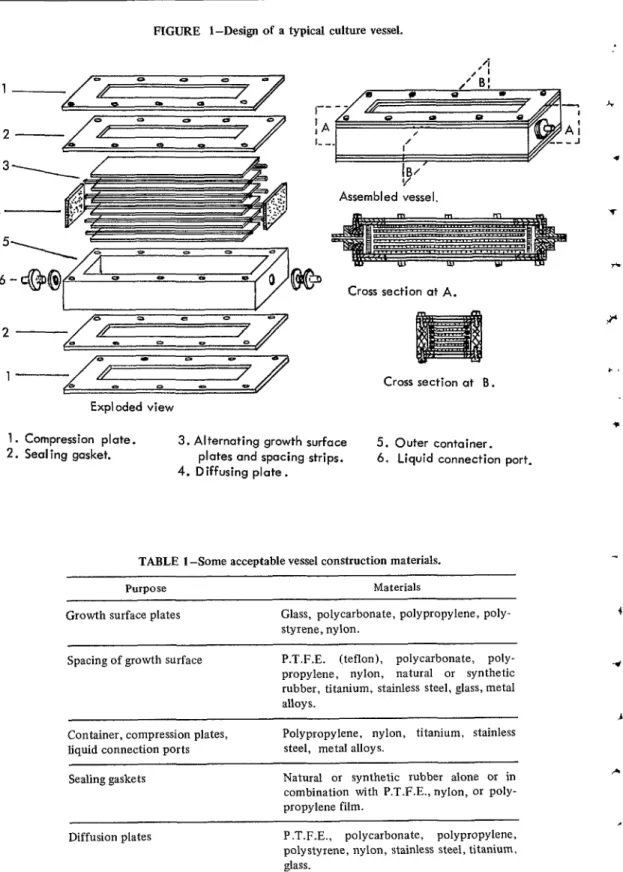
The new apparatus consists essentially of two or more plates of growth surface material, separated from each other and arranged within a sealed container that is equipped with con- nections through which liquid medium can flow.
In the example shown in Figure 1, rectan- gular transparent plates are arranged in a stack and separated from each other by spacing material placed along two of their four edges. The plates and strips of spacing material are arranged within a box provided with ports adjacent to those sides free of spacing material. The box is sealed by compression plates and gaskets that serve as its top and bottom, and which seal the top and bottom transparent plates of the stack. Both compression plates and gaskets are cut away at the center to permit inspection of the outer transparent plates and channels. A layer of porous, slotted, or perfo- rated material may be inserted next to the connection ports to ensure an even distribution of liquid between the plates.
34 ENGLISH EDITION-BOLETIN DE LA OSP vol. VI, No. 3, 1972
FIGURE I-Design of a typical culture vessel.
Assembled vessel,
Cross section at A.
Cross section at B. Exploded view
1. Compression plate.
2. Sealing gasket. 3. Alternating growth surface plates and spacing strips. 4. Diffusing plate.
5. Outer Container. 6. liquid connection port.
TABLE 1 -Some acceptable vessel construction materials.
Purpose Materials
Growth surface plates Glass, polycarbonate, polypropylene, poly- styrene, nylon.
Spacing of growth surface P.T.F.E. (teflon), polycarbonate, poly- propylene, nylon, natural or synthetic rubber, titanium, stainless steel, glass, metal alloys.
Container, compression plates, Polypropylene, nylon, titanium, stainless liquid connection ports steel, metal alloys.
Sealing gaskets Natural or synthetic rubber alone or in combination with P.T.F.E., nylon, or poly- propylene film.
i
Diffusion plates P.T.F.E., polycarbonate, polypropylene,
Mann CELL CULTIVATION IN PERFUSED LAYERED CULTURES
TABLE 2-Characteristics of a typical prototype vessel.
Overall dimensions _ . . . . . Total displacement . . . . . . . Total weight . . . _ . _ . . . Number of growth surface plates . Plate dimensions . . . . _ . . . Spacing material dimensions . .
Total growth surface area . . . . . _ . . _ . . . . . Total vessel capacity . _ . . _ . . _ . . _ . . . . . . Capacity per unit of growth surface . . . . . . . Fluid path length . . . . . . . . . . . . . . . . Growth surface area per unit total weight . _ . . Growth surface area per unit total displacement Effectiveness of seals . . . . . . . . . . . .
45xl6x12cm 8.6 liters 11 kg 66
40x12x0.08 cm 42x1x0.08 cm 5.2 m2
2.28 liters 0.04 ml/cm2 40 cm 4.7 cm2/g 6.2 cmz/ml
Gas and liquid-tight at low pressure.
culture vessels must be non-toxic for the cells being cultured and suitable for the intended methods of cleaning and sterilization. In addi- tion, growth surface materials must permit the adsorption and spread of cells over their entire surface areas; transparent materials with good optical qualities are preferred for this purpose. Some potentially suitable construction ma- terials are listed in Table 1.
The basic design just described is extremely flexible and may be used to make containers with growth surface areas ranging from 10 cm2 to 10 m2 that are suited to a wide variety of applications. Capacity and fluid path length may also vary within wide limits. Table 2 gives detailed specifications of a typical large vessel. Operating Principles
The basic goal is to nourish cells adsorbed on an appropriate surface with a controlled flow of growth medium having known pH and gas tension. Essential steps for conducting this operation are as follows:
1) Assemble and sterilize the culture vessel and associated equipment.
2) Equilibrate the vessel’s temperature and keep it at the optimum level for cell growth.
3) Connect the vessel to a reservoir con- taining a suspended cell inoculum in a volume of medium equal to the vessel’s capacity.
4) Transfer the suspension into the vessel, displacing all air upwards. Seal it, and allow
cells to settle and adsorb on one or both sides of the growth surface plates, as required.
5) Connect the container to a reservoir of growth medium with controlled pH and gas tension.
6) Perfuse the medium through the vessel at controlled rates, permitting growth until the desired cell density is reached.
Step (6) may be carried out in either of two ways. One way is to perfuse the medium at a fixed rate sufficient to provide for maximum cell density, recirculating it through the growth medium reservoir. The other is to perfuse the medium at an increasing rate proportionate to estimated cell density or observed metabolic activity, discharging spent medium into a col- lection reservoir. In the first method, pH and gas tension can be regulated easily, and final cell density can be related to the volume of medium used. With the second method, a gradient of pH, gas tension, and nutrient will occur across the fluid path. The method chosen should depend on the purposes one has in mind.
Associated apparatus may be simple or com- plex depending on the goal at hand. Asimple arrangement may require only two reservoirs, some flexible tubing, and a screw clip. Alterna- tively, a high degree of automated control and processing may readily be achieved using standard equipment. Some possible arrange- ments are diagrammed in Figure 2.
36 ENGLISH EDITION-BOLETIN DE LA OSP . Vol. VI, No. 3, 1972
FIGURE 2-
R
L!f
Ill
CVR
Alternative simple arrangements for culture vessel operation.
Ll
/o
C”
P R
I. simple gravity feed. 3. Pump feed with effluent dirchmge.
phase, it is essential that gas tensions, particu- larly those of oxygen and carbon dioxide, be
controlled outside (in the medium reservoir or on line to the vessel).
In essence, all operations are carried out using a closed system, thus presenting minimal risk of bacterial contamination. Cell growth and other developments can be monitored micro- scopically by observing the container’s outer chambers, and biochemical studies may be conducted with samples taken from the inlet or outlet lines. Vessels may be arranged in series or in parallel to give conditions not attainable in single vessels of fixed dimensions.
Following the cell growth stage, viruses, interferon, or other cell products may be cultivated in a similar manner; or cells may be removed to provide a cell inoculum for other culture vessels.
SUMMARY The design and operating principles of a new system for cultivating cells in perfused layered cultures are described. The culture vessel con- sists of plates of growth surface material arranged within a sealed container provided with suitable connection ports. Design flexi- bility permits construction of vessels that differ greatly in growth surface area, capacity, and
other specific features. In this apparatus, cells are adsorbed on the growth surfaces and nour- ished by a flow of growth medium that has a controlled rate of flow, gas tension, and pH.
Application of this system to research work and production of virus vaccines is now being investigated and will be reported upon at a later date.
REFERENCES (I) Hayflick, L. “History of the Development of
Human Diploid Cell Strains.” In Proceedings, Symposium on the Characterization and Uses of Human Diploid Cell Strains; Opatija, Yugos- lavia; 37-54. 1963.
(2) Haytlick, L. “A Comparison of Primary Monkey Kidney, Heteroploid Cell Lines, and Human Diploid CeII Strains for Human Virus Vaccine Preparation.” Am Rev Resp D&Y. 88: Suppl: 387-393, 1963.
(3) O’Reilly, K. J. and A. M. Whitaker. “The Develop-
ment of Feline Cell Lines for the Growth of Feline Infectious Enteritis (Panleucopaenia) Virus.” JHyg Camb 67: 115-124, 1969. (4) Kruse, P. F. and E. Miedema. “Production and
Characterization of Multiple-Layered Popula- tions of Animal Cells.” J Cd2 Bid 27:273-279, 1965.