Paenibacillus humicus sp. nov., isolated from
poultry litter compost
Ivone Vaz-Moreira,
1Ca´tia Faria,
1M. Fernanda Nobre,
2Peter Schumann,
3Olga C. Nunes
4and Ce´lia M. Manaia
11Escola Superior de Biotecnologia, Universidade Cato´lica Portuguesa, 4200-072 Porto, Portugal 2Departamento de Zoologia, Universidade de Coimbra, 3004-517 Coimbra, Portugal
3DSMZ – Deutsche Sammlung von Mikroorganismen und Zellkulturen GmbH, Inhoffenstraße 7b, D-38124 Braunschweig, Germany
4LEPAE – Departamento de Engenharia Quı´mica, Faculdade de Engenharia, Universidade do Porto, 4200-465 Porto, Portugal
Two bacterial strains, PC-142 and PC-147T, isolated from poultry litter compost, were characterized with respect to their phenetic and phylogenetic characteristics. The isolates were endospore-forming rods that were reddish in colour after Gram staining. They were catalase-and oxidase-positive, were able to degrade starch catalase-and gelatin catalase-and grew at 15–40 6C catalase-and pH 5.5–10.0. The predominant fatty acids were anteiso-C15 : 0, iso-C15 : 0and iso-C16 : 0, the major respiratory quinone was menaquinone MK-7, the cell-wall peptidoglycan was of the A1c type and the G+C content of the DNA was 58 mol%. The 16S rRNA gene sequence analysis and phenetic characterization indicated that these organisms belong to the genus Paenibacillus, with Paenibacillus pasadenensis SAFN-007Tas the closest phylogenetic neighbour (97.5 %). Strains PC-142, PC-147Tand P. pasadenensis SAFN-007Trepresent a novel lineage within the genus Paenibacillus, characterized by a high DNA G+C content (58–63 mol%). The low levels of 16S rRNA gene sequence similarity with respect to other taxa with validly published names and the identification of distinctive phenetic features in the two isolates indicate that strains PC-142 and PC-147Trepresent a novel species of the genus Paenibacillus, for which the name Paenibacillus humicus sp. nov. is proposed. The type strain is PC-147T(5DSM 18784T5NBRC 102415T5LMG 23886T).
In a study designed to characterize culturable heterotrophic bacteria in composts, endospore-forming rods affiliated to the genus Paenibacillus were isolated from poultry litter compost. This compost was produced from chicken wastes from aviaries, meat meal, bird bones, vegetable ash and grape husks. The material was stored for 5–6 months until it had composted. The composting process was conducted in piles, under a covered area, for a period of 45 days. Two isolates from the compost had a randomly amplified polymorphic DNA (RAPD) profile that was distinct from those of other bacterial isolates (identified as members of the genera Staphylococcus, Bacillus and Pseudomonas; data not shown) recovered from the same compost. On the basis of 16S rRNA gene sequence analysis, the two isolates,
designated strains PC-142 and PC-147T, were presumed to be members of the genus Paenibacillus and were further characterized by using a polyphasic approach.
The bacterial isolates were recovered on plate count agar (PCA) at 30uC, purified by subculturing on the same medium and then cryopreserved at 280uC in a nutritive broth supplemented with 15 % (v/v) glycerol. PCA was used for culture maintenance, and biochemical and physio-logical tests were performed in modified Luria–Bertani medium (Tiago et al., 2004) incubated at 30 uC. Colony and cell morphology, Gram-staining, cytochrome c oxidase and catalase activities, motility and flagellation were assessed according to the methodologies of Murray et al. (1994) and Smibert & Krieg (1994). The pH range for growth was examined in culture medium containing 12 mM MES (Sigma), to adjust the pH to 5.5, and 12 mM CAPS (Sigma), to adjust the pH to 9.0 and 10.0. The NaCl tolerance and temperature ranges for growth were assayed, respectively, in culture medium supple-mented with 1, 3 and 5 % NaCl (w/v) or at 15, 36, 40 and
The GenBank/EMBL/DDBJ accession numbers for the 16S rRNA gene sequences of strains PC-142 and PC-147T are AM411529 and AM411528, respectively.
RAPD patterns and an extended phylogenetic tree for strains PC-142 and PC-147Tand related taxa are available as supplementary figures with the online version of this paper.
45uC. The ability of the strains to grow in the presence of 0.001 % (w/v) lysozyme was tested in tryptic casein soy broth medium. Anaerobic growth was tested under a N2
-saturated atmosphere in the presence of 0.1 % KNO3
(w/v). The same medium, under aerobic conditions, was used to assay nitrate reduction. The production of extracellular amylases, gelatinases and tweenases (Tween 80) was tested as described previously (Tiago et al., 2004). Other biochemical tests were performed using API 20E and API 20NE galleries, and the nutritional pattern was
determined using API 50 CH and API 20NE kits, according to the instructions of the manufacturer (bioMe´rieux) at 30uC. The API 50 CH carbon-source utilization kit was used both with the medium recommended for testing acid production (50 CHB/E; bioMe´rieux) and with mineral medium B (Barreiros et al., 2003) supplemented with 4 mM (NH4)2SO4, vitamins (p-aminobenzoic acid, folic
acid, nicotinic acid, pantothenic acid, biotin, cyanocobal-amin, inositol, riboflavin, pyridoxine, thiamine) (40 mg l21) and nitrogenated bases (adenine, cytosine,
Table 1. Distinctive characteristics of strains PC-142 and PC-147Tand P. pasadenensis NBRC 101214T
Strains PC-142, PC-147T and P. pasadenensis NBRC 101214T tested positive for b-galactosidase, for the hydrolysis of gelatin and aesculin and for the assimilation of the following carbon sources: D-glucose,
D-mannitol, N-acetylglucosamine, maltose, potassium gluconate, D-xylose, methyl b-D-xylopyranoside,
D-galactose, D-fructose, methyl a-D-glucopyranoside, amygdalin, arbutin, salicin, D-cellobiose, D-lactose, D-melibiose, sucrose, trehalose,D-melezitose,D-raffinose, starch, glycogen, gentiobiose andD-turanose. All of the strains tested negative for the following: Gram staining, nitrate reduction, arginine dihydrolase, urease, indole production and glucose fermentation. All were unable to assimilate the following carbon sources: caprate, adipate, malate, citrate, phenylacetate, erythritol, D-arabinose, D-ribose, L-xylose, D-adonitol,
L-sorbose, dulcitol, inositol,D-sorbitol, methyl a-D-mannopyranoside, inulin, xylitol, D-lyxose,D-tagatose, D-fucose,L-fucose,D-arabitol,L-arabitol, 2-ketogluconate and 5-ketogluconate. Strains PC-142 and PC-147T were negative for anaerobic growth, lysine and ornithine decarboxylase and tryptophan deaminase activities, citrate utilization and H2S production and for growth at 45 uC, with 5 % NaCl and on Bacillus cereus medium
(P. pasadenensis NBRC 101214Tnot tested). PC-142 and PC-147Twere unable to use the following carbon sources: (fermentation/oxidation) D-mannitol, inositol, D-sorbitol, L-rhamnose, sucrose, D-melibiose,
amygdalin and L-arabinose; (acid production) D-glucose, D-mannitol, inositol, D-sorbitol, L-rhamnose, L-arabinose,D-arabinose, glycerol, erythritol,D-ribose,D-xylose,L-xylose,D-adonitol, methyl b-D -xylopyrano-side,D-galactose,D-mannose,L-sorbose, dulcitol, methyl a-D-mannopyranoside, methyl a-D-glucopyranoside, N-acetylglucosamine, arbutin, inulin,D-melezitose,D-raffinose, starch, glycogen, xylitol, gentiobiose,D-lyxose,
D-tagatose, D-fucose, L-fucose, D-arabitol, L-arabitol, potassium gluconate, 2-ketogluconate and
5-ketogluconate (data not shown for P. pasadenensis NBRC 101214T). Strain PC-142 showed weak acid
production forD-lactose,D-melibiose andD-turanose; strain PC-147Twas unable to produce acids from these carbon sources (data not shown for P. pasadenensis NBRC 101214T).
Characteristic Strains PC-142 and PC-147T P. pasadenensis NBRC 101214T
Growth with 3 % NaCl + 2
Assimilation of:
L-Arabinose 2 +
Glycerol 2 +
Malate 2 +
L-Rhamnose 2 +
Acid production from:
L-Arabinose 2 + D-Fructose 2 + D-Galactose 2 + D-Glucose 2 + Glycogen 2 + D-Mannose 2 + D-Mannitol 2 + D-Melezitose 2 + D-Raffinose 2 + Starch 2 + D-Xylose 2 +
DNA G+C content (mol%) 58 63
Isolation source Poultry litter compost Floor of clean-room entrance
inosine, thymine and uracil) and amino acids (methionine, phenylalanine, tryptophan, arginine, histidine, alanine, glycine, proline and tyrosine) (5 mg l21).
The DNA G+C content, respiratory quinones and fatty acid methyl ester composition were determined as described previously (Vaz-Moreira et al., 2007) using the methods of Mesbah et al. (1989), Tindall (1989) and Kuykendall et al. (1988), respectively. The diaminopimelic acid isomer was determined by one-dimensional TLC on cellulose plates (Merck) by using the solvent system of Rhuland et al. (1955).
The sequence of the 16S rRNA gene was determined after PCR amplification of total DNA extracts as described previously (Rainey et al., 1996). The 16S rRNA gene sequence was compared with others available in the GenBank/EMBL/DDBJ database by using BLASTN (NCBI)
and FASTA (EMBL-EBI) and was aligned with reference sequences. Phylogenetic analysis was conducted using
MEGA, version 3.1 (Kumar et al., 2004). Levels of sequence relatedness were estimated using the model of Jukes & Cantor (1969), and the phylogenetic tree was created using the neighbour-joining method. Other methods (minimum evolution and maximum parsimony) were used to assess the tree stability. A total of 1322 nucleotide positions in each 16S rRNA gene were included in the analysis. Non-homologous and ambiguous nucleotide positions were excluded from the calculations.
After 24 h incubation at 30uC on PCA, isolates PC-142 and PC-147T formed flat, very smooth, translucent colonies that tended to produce a swarming effect. These strains were unable to produce growth on Bacillus cereus medium (Pronadisa) agar after 7 days incubation. They were able to produce acid from, and assimilate, several sugars (see Table 1 and the species description). The major fatty acid methyl esters were anteiso-C15 : 0, iso-C15 : 0 and
iso-C16 : 0, which accounted for more than 60 % of the total.
Other minor components (representing more than 4 %) were iso-C17 : 0, anteiso-C17 : 0and C16 : 0. The DNA G+C
content for PC-147Tand PC-142 was, respectively, 58.3± 0.3 and 58.1±0.2 mol%. Menaquinone MK-7 was the major respiratory quinone in both strains. The diagnostic diamino acid of the peptidoglycan was meso-diaminopi-melic acid, suggesting the presence of peptidoglycan type A1c (Schleifer & Kandler, 1972). Strains 142 and PC-147Tdiffered only in the ability to produce acid from three carbon sources (D-lactose, D-melibiose and D-turanose);
they had similar fatty acid methyl ester compositions and DNA G+C contents and their 16S rRNA gene sequences were identical. These findings were confirmed by the similarity of the RAPD patterns obtained for isolates PC-142 and PC-147T(see Supplementary Fig. S1, available in IJSEM Online).
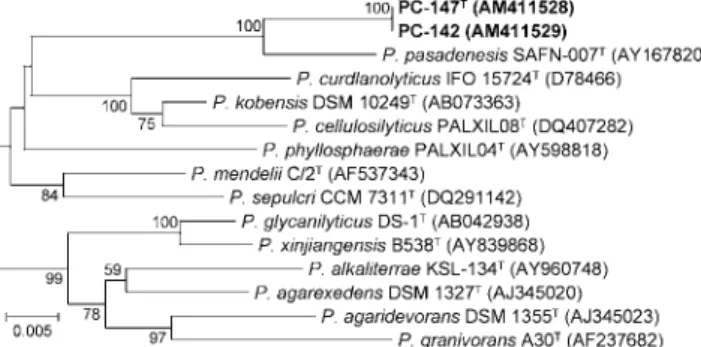
The diagnostic diamino acid of the peptidoglycan, the menaquinone and the fatty acid methyl ester composition of isolates PC-142 and PC-147Tconfirm the results of the 16S rRNA gene sequence comparative analysis, identifying these organisms as members of the genus Paenibacillus. On the basis of the 16S rRNA gene sequence analysis, the closest phylogenetic neighbours of isolates 142 and PC-147T are Paenibacillus pasadenensis SAFN-007T (97.5 %), Paenibacillus kobensis DSM 10249T (94.3 %) and Paeni-bacillus mendelli C/2T(93.8 %) (Fig. 1; an extended version of this tree is available as Supplementary Fig. S2). In the light of these results, the nutritional and chemotaxonomic properties of strains PC-142 and PC-147Twere compared with those of P. pasadenensis NBRC 101214T(Osman et al., 2006) (Tables 1 and 2). The fatty acid methyl ester patterns obtained for PC-142, PC-147Tand P. pasadenensis NBRC 101214T confirm the taxonomic relatedness of these organisms and their affiliation to the same genus (Table 2). However, the DNA G+C contents of these
Fig. 1. Neighbour-joining phylogenetic tree, based on 16S rRNA gene sequences, showing the nearest neighbours of strain PC-142 and PC-147T. Bootstrap percentages were generated from
1000 resamplings; only values greater than 50 % are shown. Bar, 1 substitution per 200 nucleotide positions. An extended version of this tree is available as Supplementary Fig. S2 in IJSEM Online.
Table 2. Fatty acid methyl ester compositions of strains PC-142 and PC-147Tand P. pasadenensis NBRC 101214T
Fatty acid methyl ester PC-142 PC-147T P. pasadenensis NBRC 101214T iso-C14 : 0 1.7 1.5 1.2 C14 : 0 1.2 1.5 – iso-C15 : 0 21.1 16.9 16.4 anteiso-C15 : 0 39.2 41.9 38.2 C15 : 0 2.6 1.6 4.1 iso-C16 : 0 13.2 10.6 12.3 C16 : 0 6.8 8.0 5.1 C16 : 1 – – 3.3 iso-C17 : 0 5.8 4.4 7.3 anteiso-C17 : 0 5.7 6.1 8.3 C18 : 0 1.4 1.6 – Others* 1.4 5.9 3.9
*Includes anteiso-C13 : 0, anteiso-C14 : 0, C16 : 1v7c alcohol,
three organisms (58.3±0.3 mol% for PC-147T, 58.1± 0.2 mol% for PC-142 and 63.4±0.6 mol% for P. pasade-nensis NBRC 101214T) demonstrate the taxonomic dis-tinctiveness of the two isolates. Amongst the highest DNA G+C contents reported for this genus were those obtained for Paenibacillus validus (54–55 mol%; buoyant density method) (Heyndrickx et al., 1995) and Paenibacillus panacisoli (Ten et al., 2006). Strains PC-142 and PC-147T and P. pasadenensis NBRC 101214T form a high-G+C lineage within the genus Paenibacillus.
As strains PC-142 and PC-147Tshow less than 98.5 % 16S rRNA gene sequence similarity with respect to their closest phylogenetic neighbour, P. pasadenensis, DNA–DNA hybridizations to demonstrate their separate species status were considered unnecessary in view of the results of recent investigations (Stackebrandt & Ebers, 2006). Characteris-tics that serve to distinguish PC-142 and PC-147T from their closest phylogenetic neighbour, P. pasadenensis NBRC 101214T, are presented in Table 1. On the basis of the data presented, strains PC-142 and PC-147T represent a novel species of the genus Paenibacillus, for which the name Paenibacillus humicus sp. nov. is proposed.
Description of Paenibacillus humicus sp. nov. Paenibacillus humicus (hu9mi.cus, L. n. humus earth, soil and, in earth sciences or agriculture, humus; L. suff. -icus -a -um suffix used with the sense of belonging to; N.L. masc. adj. humicus pertaining to humus).
Cells are motile rods (2.0 mm long and 0.5 mm wide) with peritrichous flagella. Gram staining is negative. Terminal, ellipsoidal endospores are produced in swollen sporangia. On nutritive medium, such as PCA or Luria–Bertani agar, colonies are white/translucent, very smooth and flat. Swarming is observed. Catalase- and oxidase-positive. Growth occurs in the presence of 3 % NaCl and at 15– 40uC and pH 5.5–10. No growth occurs under anaerobic conditions, at 45uC or in the presence of 5 % NaCl. Nitrate is not reduced. Tests positively for b-galactosidase, Voges– Proskauer (API 20NE) and growth in the presence of 0.001 % lysozyme. Starch, gelatin, Tween 80 and aesculin are hydrolysed. The following carbon sources are assimi-lated: starch, amygdalin, arbutin,D-cellobiose,D-fructose,
D-galactose, gentiobiose, D-glucose, glycogen, D-lactose,
maltose,D-mannitol, D-melezitose,D-melibiose, methyl a-D-glucopyranoside, methyl b-D-xylopyranoside,
N-acetyl-glucosamine, potassium gluconate, D-raffinose, salicin, sucrose, trehalose, D-turanose and D-xylose. Acid is
produced from amygdalin, D-cellobiose, maltose, sucrose
and trehalose. The peptidoglycan cell wall is of the A1c type. The major cellular fatty acid components are anteiso-C15 : 0 (approx. 40 %), iso-C15 : 0 (17–21 %) and iso-C16 : 0
(11–13 %). The major respiratory quinone is MK-7 and the DNA G+C content is 58 mol%.
The type strain, PC-147T(5DSM 18784T5NBRC 102415T 5LMG 23886T), was isolated from final compost produced from poultry litter.
Acknowledgements
The authors acknowledge Luisa Barreiros (Faculdade de Engenharia da Universidade do Porto) for her helpful collaboration, Elisabete Silva (Escola Superior de Tecnologia de Viseu, Instituto Polite´cnico de Viseu) for providing the poultry litter compost and Milton S. da Costa (Departamento de Bioquı´mica da Universidade de Coimbra) for help with the fatty acid methyl ester analyses.
References
Barreiros, L., Nogales, B., Manaia, C. M., Ferreira, A. C. S., Pieper, D. H., Reis, M. A. & Nunes, O. C. (2003). A novel pathway for mineralization of the thiocarbamate herbicide molinate by a defined bacterial mixed culture. Environ Microbiol 5, 944–953.
Heyndrickx, M., Vandemeulebroecke, K., Scheldeman, P., Hoste, B., Kersters, K., De Vos, P., Logan, N. A., Aziz, A. M., Ali, N. & Berkeley, R. C. W. (1995).Paenibacillus (formerly Bacillus) gordonae (Pichinoty et al. 1986) Ash et al. 1994 is a later subjective synonym of Paeni-bacillus (formerly Bacillus) validus (Nakamura 1984) Ash et al. 1994: emended description of P. validus. Int J Syst Bacteriol 45, 661–669.
Jukes, T. H. & Cantor, C. R. (1969).Evolution of protein molecules. In Mammalian Protein Metabolism, vol. 3, pp. 21–132. Edited by H. N. Munro. New York: Academic Press.
Kumar, S., Tamura, K. & Nei, M. (2004).MEGA3: integrated software for molecular evolutionary genetics analysis and sequence alignment. Brief Bioinform 5, 150–163.
Kuykendall, L. D., Roy, M. A., O’Neill, J. J. & Devine, T. E. (1988).
Fatty acids, antibiotic resistance, and deoxyribonucleic acid homo-logy groups of Bradyrhizobium japonicum. Int J Syst Bacteriol 38, 358–361.
Mesbah, M., Premachandran, U. & Whitman, W. B. (1989).
Precise measurement of the G+C content of deoxyribonucleic acid by high-performance liquid chromatography. Int J Syst Bacteriol 39, 159–167.
Murray, R. G. E., Doetsch, R. N. & Robinow, F. (1994).Determinative and cytological light microscopy. In Methods for General and Molecular Bacteriology, pp. 21–41. Edited by P. Gerhardt, R. G. E. Murray, W. A. Wood & N. R. Krieg. Washington, DC: American Society for Microbiology.
Osman, S., Satomi, M. & Venkateswaran, K. (2006).Paenibacillus pasadenensis sp. nov. and Paenibacillus barengoltzii sp. nov., isolated from a spacecraft assembly facility. Int J Syst Evol Microbiol 56, 1509–1514.
Rainey, F. A., Ward-Rainey, N., Kroppenstedt, R. M. & Stackebrandt, E. (1996). The genus Nocardiopsis represents a phylogenetically coherent taxon and a distinct actinomycete lineage: proposal of Nocardiopsaceae fam. nov. Int J Syst Bacteriol 46, 1088–1092.
Rhuland, L. E., Work, E., Denman, R. F. & Hoare, D. S. (1955).The behavior of the isomers of a,e-diaminopimelic acid on paper chromatograms. J Am Chem Soc 77, 4844–4846.
Schleifer, K. H. & Kandler, O. (1972).Peptidoglycan types of bacterial cell walls and their taxonomic implications. Bacteriol Rev 36, 407–477.
Smibert, R. M. & Krieg, N. R. (1994).Phenotypic characterization. In Methods for General and Molecular Bacteriology, pp. 607–654. Edited by P. Gerhardt, R. G. E. Murray, W. A. Wood & N. R. Krieg. Washington, DC: American Society for Microbiology.
Stackebrandt, E. & Ebers, J. (2006).Taxonomic parameters revisited: tarnished gold standards. Microbiol Today 33, 152–155.
Ten, L. N., Baek, S.-H., Im, W.-T., Lee, M., Oh, H. W. & Lee, S.-T. (2006). Paenibacillus panacisoli sp. nov., a xylanolytic bacterium
isolated from soil in a ginseng field in South Korea. Int J Syst Evol Microbiol 56, 2677–2681.
Tiago, I., Teixeira, I., Silva, S., Chung, P., Verı´ssimo, A. & Manaia, C. M. (2004). Metabolic and genetic diversity of mesophilic and thermophilic bacteria isolated from composted municipal sludge on poly-e-caprolactones. Curr Microbiol 49, 407–414.
Tindall, B. J. (1989). Fully saturated menaquinones in the archaebacterium Pyrobaculum islandicum. FEMS Microbiol Lett 60, 251–254.
Vaz-Moreira, I., Nobre, M. F., Nunes, O. C. & Manaia, C. M. (2007).
Gulbenkiania mobilis gen. nov., sp. nov., isolated from treated municipal wastewater. Int J Syst Evol Microbiol 57, 1108–1112.