1 Católica Lisbon School of Business and Economics
POSITIVE OR NEGATIVE?
THE IMPACT OF ANTI-TAKEOVER
LEGISLATION ON R&D INVESTMENTS
MASTER THESIS
RUI JORGE SANTOS
Thesis Supervisor: Professor Raffaele Conti 14/03/2013
2 To Mum and Dad; I hope that everything you invested in me will finally pay off.
3
Abstract
Anti-takeover laws are laws designed to protect target companies from hostile activity by making the bidder’s attempt of acquisition more expensive and/or time consuming, as there are three different types anti-takeover laws. The aim of this dissertation is analyzing the impact of different kind of antitakeover laws (fair price laws, control share acquisition laws, and business combination laws) on firm R&D expenditures. In order to do so, this study uses data about U.S. public firms between 1970 and 2011. The empirical findings indicate that fair Price laws increase R&D activities because of the possibility of increasing the expected takeover premium for managers, whereas control share acquisition laws and business combination laws decrease it by reducing the external pressure, which is the biggest incentive for firm managers to remain
competitive in the market. Alongside, Business Combination laws seem not to have a significant impact on firm’s R&D expenditures.
4
Contents
1. Introduction... 5
2. Literature Review ... 6
2.1. Hostile Takeovers and Anti-Takeover Defenses ... 6
2.2. History of Anti-takeover legislation in US ... 7
2.2.1. Fair Price legislation ... 9
2.2.2. Control Share Acquisition legislation ... 9
2.2.3. Business Combination legislation ... 10
2.3. Previous Literature on Anti-takeover laws – Managerial Welfare hypothesis VS. Shareholder Welfare hypothesis ... 10
2.3.1. The Shareholder Welfare hypothesis ... 11
2.3.2. The Managerial Welfare hypothesis ... 12
2.4. The Impact of Anti-takeover Laws on Innovation ... 13
3. Methods ... 15
3.1. Sample and data ... 15
3.2. Measures ... 16
3.2. Dependent Variable ... 17
3.3. Independent Variables: Anti-takeover Laws ... 17
3.3.1. Fair Price laws (FPANTITK) ... 18
3.3.2. Control Share Acquisition laws (CSAANTITK) ... 18
3.3.3. Business Combination laws (BCANTITK) ... 18
3.4. Control Variables ... 18
3.5. Empirical Strategy ... 19
4. Results ... 20
4.1. Robustness Checks ... 23
5. Discussion and Conclusions ... 26
6. Appendix ... 28
5
1. Introduction
There is a long-strand of empirical studies regarding the impact governments, policy makers and laws have on firm profitability and economic growth (e.g., La Pota et. Al, 2000; Clark, 2012; US Department of State, 2012; Sellers, 2012; Luo, 2006). There are cases where regulation is applied to balance production activities, restrict firm’s pollutant emissions, to control product’s prices, or to establish the acceptable terms for mergers and acquisitions, like the case of anti-takeover laws.
Such laws were created in the 60s to stimulate the existence of competitive markets so that small firms could survive in the market and co-exist with the big and settled players. These laws are supposed to make hostile takeovers harder to accomplish for the acquirer. Whether this legislation is beneficial or prejudicial to company’s shareholders has been widely debated.
The literature is divided in two groups. Supporting de Shareholder Welfare hypothesis, the effect of anti-takeover protection mechanisms has a positive impact on creating long-term shareholder value, for instance, by reducing short-term market pressure on firms (Stein, 1988), which allows managers to engage in the most innovative activities according to company’s interests. The other group supports a Managerial Welfare hypothesis, which says that anti-takeover laws have a chilling effect on the investment market by allowing managers to relax. This reduces corporate efficiency and productivity (Macey, 1988) and, consequently, stock value may go down as well (Gompers, Ishii, and Metrick, 2003).
A stream of research has specifically focused on the impact anti-takeover laws have on innovation. Innovation is directly related with profitability. Previous research has shown that firms that tend to have higher values of R&D investments usually generate more profits than companies that do not consider R&D activities as much (Bogliacino and Pianta, 2010), and that firm long-term sustainability depends on innovation and R&D investments (Gibson and Stigson, 2004). In this respect, if the Shareholder Welfare hypothesis is true, we should expect that antitakeover laws increase firm R&D spending, whereas the opposite should occur if the Managerial Welfare hypothesis is instead true. Past literature presents mixed findings on this issue (Sapra, Subramanian, and Subramanian, 2012; Jain and Wasan, 2009).
6 However, previous literature has not considered that there are different types of antitakeover laws. So, with this paper, my objective is to further assess the impact on R&D spending of three different types of anti-takeover laws, that is, Fair Price laws, Control Share Acquisition laws, and Business Combination laws. In particular, considering the population of U.S. public companies from 1970 to 2011, I will compare the propensity different firms in different states have to invest on R&D activities before and after anti-takeover laws are enacted, arguing that the outcome is dependent on the type of anti-takeover law passed.
2. Literature Review
2.1. Hostile Takeovers and Anti-Takeover Defenses
A hostile takeover occurs when the target company’s management is against the deal. In this case, the acquiring company negotiates directly with the target company’s shareholders instead of negotiating with the target company’s management board. A hostile takeover can be accomplished through a tender offer or a proxy fight.
A tender offer is a bid made by a potential acquirer to all target company’s stockholders to tender their stock for sale at a specified price during a specified period of time, subject to the tendering of a minimum and maximum number of shares. The offer is made directly to stockholders and the management board is not necessarily contacted. For example, if a target corporation's stock were trading at $10 per share, an acquirer might offer $11.50 per share to shareholders on the condition that 51% of shareholders agree.
Instead, a proxy fight occurs when an acquiring company attempts to persuade target company’s shareholders to use their votes and proxy votes to install a new management that will be more willing to accept and acquisition or merger.
So, the main difference between a tender offer and a proxy fight lies on the fact that a tender offer will allow the potential acquirer to become a major stockholder of the target company by acquiring a certain amount of shares at a higher price than the one being traded in the market1 in a specific period of time; a proxy fight will allow the potential
1
7 acquirer to change the current management board for a new one that will defend a future acquisition between both parties.
The target company’s management can use several defensive strategies with the intent of deterring the acquisition, like the “poison pill”, the “golden parachute”, or “pac-man defense”.
With the poison pill defense, the target company makes its stock less attractive to the acquirer. This may occur by allowing current shareholders to buy more shares at a discounted price or, alternatively, by allowing stockholders to buy the acquirer’s shares at a discounted price after the merger took place. The golden parachute defense mechanism offers benefits to current top executives who may lose their job if the company is taken. Those benefits2 act as a deterrent to unwanted takeovers since they make it very expensive for a new owner to change the corporation’s management team. With the pac-man defense, the target firm tries to turn the situation around by acquiring the other company that has made the hostile takeover attempt.
Furthermore, firms may exploit government regulations. In particular, in US, some states passed anti-takeover laws from 1968 on, allowing target companies to protect themselves more efficiently from hostile acquisitions.
2.2. History of Anti-takeover legislation in US
When corporations first started to appear in the US, mergers and acquisitions needed the approval of every existing shareholder to be completed. However, already in the end of the 19th century, this requirement proved to be a huge restriction for economic growth. So, legislators enacted statutes that facilitated mergers and similar transactions. They required only two thirds of the corporation shareholders to vote in favor of the deal, if it had been previously approved by the management.
After World War II, new statutes were established that eroded the position of minority shareholders even further. It was thought that they had too much power on influencing the outcome of mergers, like the possibility of preventing beneficial mergers or acquisitions of a public corporation listed on the national securities exchange (NSE).
2
8 So, from then on, the majority3 of shareholders were able to approve a merger or similar transaction.
Starting in the 60s, statutory provisions were being used mostly in the sequence of tender offers. These tender offers were usually made in two steps: first, the acquiring corporation obtained the majority of the target’s stock; secondly, a new board of directors was appointed. However, the statutory scheme did not guarantee that the shareholders that kept their shares for the second phase of the acquisition would receive a value as high as the previous shareholders. This situation induced many shareholders to accept the tender offer immediately.
The “storm” of corporate takeover activity generated a wave of state and federal laws. Lawmakers in about 40 states started to seek for legislative protections against such intensity of tender offers. So, several anti-takeover laws started to be enacted, in waves. The first anti-takeover law enacted in the US was the “Williams Act of 1968”. It defined the rules of mergers and tender offers, requiring full disclosure of information on part of the bidder to the target company and to SEC – Securities and Exchange Commission. This information included the terms of the bid, the cash source and the plan’s that the acquiring company had for the target company after the takeover was completed. Also, the period of time allowed for shareholders to change their votes was exactly defined, as well as the minimum period of time the bidder needs to have the offer opened4.
A few years after the creation of the Williams Act, the “first generation” of anti-takeover laws started to be enacted. The main goal of this legislation was to reduce the amount of fraudulent processes involving tender offer processes. These “Fair Price” laws assured shareholders that, in the case of a two-part tender offer, the minority of shareholders (second part) would receive the same price for each stock owned as the majority did at first when the initial offered had been made.
However, in 1982, these laws were considered unconstitutional because of extending beyond state jurisdiction.
3 51% of existing shareholders. 4
Shareholders had now a defined period of time after the announcement of an attempt acquisition to decide if they would vote in favor if against the merger. In the same sense, the bidder had to leave the offer opened for a minimum period of time to allow all shareholders to evaluate the terms and conditions and make a conscious and fully informed choice.
9 In June 1987, on the state of Minnesota, Dayton Hudson Corporation found that Dart Group Corporation had acquired a meaningful amount of its common stock and was trying to complete a takeover without even consulting management. Dayton’s CEO went to Minnesota’s governor asking for legislative protection to be able to defend the company from the hostile takeover. Dayton’s main argument was that it would destroy the company internally and it would result in significant job loss in Minnesota. As a result, Minnesota enacted a Control Acquisition Statute which ultimately contributed a lot for Dart Group’s tender offer failure.
This case was just one among many that triggered a second generation of anti-takeover laws: the “Control Share Acquisition” legislation. It was approved to correct for the problems that the first generation of laws created. Corporations acquiring more than 20% of the stock of the target corporation were not allowed to have any voting rights. Finally, in 1990, a third generation of anti-takeover legislation emerged to introduce new ways of protection from hostile takeover activities. They were called “Business Combination” laws and their goal was to impose moratoriums over certain transactions for defined periods of time.
2.2.1. Fair Price legislation
The effect of this provision is to make acquisitions more expensive for the acquirer. Fair price legislation requires a bidder to pay all shareholders the highest price paid to any shareholder during a specified period of time before the commencement of a tender offer. Furthermore, they require that at least 2/3 of the shareholders vote on favor of the acquisition in case the board disapproves or if the bid price is not “fair”5
. Fair price laws are not applied if the deal is approved by the board of directors and by a supermajority (95% at least) of the target's shareholders, or if the acquirer pays a fair price.
2.2.2. Control Share Acquisition legislation
The consequence of the Control Share Acquisitions laws is to prevent acquisitions if shareholders do not agree with the transaction.
5
10 A control share acquisition is defined as an acquisition of 20% or more of the voting shares of the target company. If the shares owned by the potential acquirer overcome this threshold, the acquirer does not have any voting rights. The acquiring entity’s voting rights may only be restored if shareholders holding a majority of shares that are not “interested shares” chose to restore those voting rights.
As an example, we have a software firm called Tyler Technologies, which intended to purchase 32% of another company’s stock, called HTE, from the founding shareholders (these shareholders had recently been dropped from their executive positions at HTE). Tyler’s ownership was above the minimum level of 20%, which meant (under the CSA legislation) that they had no controlling rights. So, they tried to arrange with HTE’s shareholders the restoration of the voting rights to complete the merger. However, HTE board of directors was not very interested in the merge with Tyler and, advised by HTE management, the shareholders voted against Tyler’s proposal, which prevented Tyler from acquiring HTE.
2.2.3. Business Combination legislation
The effect of the business combination laws is to make acquisitions more time consuming to the potential acquirers.
Business Combination legislation impedes an issuing public corporation (acquiring firm) of undertaking business with an affiliated shareholder for a period from three to five years, if it passes the 20% minimum of stockholding. This legislation is directed to certain transactions such as mergers, dissolutions, consolidations, share exchange, and similar ones. These laws are present in more than half of the US states.
2.3. Previous Literature on Anti-takeover laws – Managerial Welfare hypothesis VS. Shareholder Welfare hypothesis
Several studies have been conducted to evaluate the impact of the enactment of anti-takeover legislation at firm-level on various variables, such as remuneration, construction and destruction of plants, efficiency, management entrenchment, corporate disclosure, among others. In principle, hostile Takeovers may have positive or negative
11 effect on corporation’s profitability (DeAngelo and Rice 1983). In this respect, a first group of studies sustain the “Shareholder Welfare hypothesis”: antitakeover laws increase the long-term profitability of the firm. A second group of studies provide instead evidence in favor of the “Managerial Welfare hypothesis” (Mahoney, Sundaramurthy, and Mahoney, 1997), according to which antitakeover laws foster short-term interests of managers.
2.3.1. The Shareholder Welfare hypothesis
The “Shareholder Welfare hypothesis” says that anti-takeover laws induce managers to operate in a long-term perspective for the firm. When anti-takeover laws are passed, managers do not have short-term pressures of hostile takeovers or takeover threats to be concerned about. This allows managers to undertake the projects with the highest potential according to the firm’s interests, rather than strategizing about the mechanisms that must be used to prevent acquisitions.
In other words, anti-takeover protection has a positive effect on creating long-term shareholder value by helping to reduce market pressure6 (Stein, 1988).
There is evidence that the enactment of anti-takeover laws increases white-collar remuneration and decreases the amount of constructions and destructions of plants, which is a consequence of higher productivity and efficiency (Bertrand and Mullainathan, 2003). Garvey and Hanka (1999) found that anti-takeover legislation stimulate firms whose insider holding is less than 25% to reduce their leverage ratio and thus avoiding higher interest rates. Howe, Jain and Pereira (2007) find a decrease in cash holdings and the rate of cash savings when anti-takeover legislation is adopted, which means more inclination to invest in valuable projects.
Garvey (1999)finds that firms protected by control share acquisitions laws and business combinations laws reduce in a significant way the use of debt financing. This reduction is seen as positive for the shareholders; even though debt financing allows for corporate tax discounts, not financing with debt will allow companies to have access to lower interest rates since they represent a lower risk in the market. On the contrary, firms not protected by these laws actually increased their debt usage.
6
12
2.3.2. The Managerial Welfare hypothesis
A contrasting hypothesis called the “Managerial Welfare hypothesis” (Mahoney, Sundaramurthy, and Mahoney, 1997) says that anti-takeover protection allows entrenched managers to act on their individual interests at the odds of firm log-term value. When anti-takeover laws are passed, managers don’t have the pressure of takeover threats to deal with, which allows managers to relax and forego the most potentially lucrative projects (as well as the most innovative practices). Instead, managers invest in projects that increase their own private benefits rather than the long-term benefits of the firm.
For instance, Cheng, Nagar and Rajan (2005) show evidence that directors and officers of Forbes 500 firms reduce their stock ownership by around 12,3% after anti-takeover legislation is enacted; this reduction testifies that managers are less interested in the long-term sustainability of the company and on firm market value.
Macey (1988) says that anti-takeover legislation in the US wastes corporate assets, fails to protect shareholders’ interests, and constitutes a real threat to the American economy. He argues that takeovers maximize shareholder wealth and produce corporate efficiency by fostering lower prices and improvements in productivity. Furthermore, the author concludes that with the passage of anti-takeover laws, shareholders will not be able to capture the maximum value for their shares, and that the corporate investment market will be chilled.
Fu and Liu (2007) found evidence that Anti-Takeover Provisions (ATPs) tend to make entrenched managers going for private benefits instead of focusing on shareholders’ interests. The study concluded that high ATP firms have better quality of reported earnings and tend to disclose private information to the market more than low ATP-firms because they are less worried with market pressure.
13 Ryngaert and Scholten (2010) say that managers that successfully used anti-takeover protection in the 80s (fair price laws) became more entrenched in the subsequent decade7.
John, Li, and Pang (2010) show that firms with high values of free cash flow (which is a source of agency conflicts according to Jensen (1986)) have their operating performance and market value reduced after the anti-takeover legislation enactment. Instead, firms with low levels of free cash flow do not experience any significant changes on the same variables.
Juks (2008) analyzed the effects of anti-takeover legislation on workplace safety and concluded that plants protected by anti-takeover legislation experienced on average 11% more workplace safety violations. He argues that the weakening of corporate governance makes managers less worried with safety measures.
Garvey (1999), building on his own previous literature, finds that legal barriers to hostile takeovers may increase corporate slack.
2.4. The Impact of Anti-takeover Laws on Innovation
Some studies explicitly focus on the impact of anti-takeover legislation on innovation. If the Managerial Welfare hypothesis is true, antitakeover laws should harm innovation, as well-defined innovative strategies tend to increase company profitability (Kearney, 2008). By contrast, if the Shareholder Welfare hypothesis is true, then antitakeover laws should induce managers to spend more in R&D to increase company profitability. The empirical literature regarding this subject presents mixed evidence.
First, there is evidence that shows anti-takeover laws increase innovation. Ederer and Manso (2010) explain anti-takeover legislation may foster innovation for reasons such as by avoiding short-term pressure, while Sapra, Subramanian, and Subramanian (2012) say innovative activities will increase because anti-takeover legislation avoids short-term loss of control.
7 This entrenchment was fostered by the enactment of new anti-takeover laws: control share acquisition laws and business combination laws.
14 Chemmanur and Jiao (2012) construct an analysis that shows some Anti-takeover Provisions can mitigate managerial myopia by alleviating managers from short-term pressures, which allows them to pursue long-term value creation for shareholders. Pugh, Page, and Jahera (1992) and, later, Malekzadeh, McWilliams, and Sen (2005) find an increase in R&D expenditures; similar to the previous authors, Johnson and Rao (1997) find evidence of an increase in unadjusted R&D expenditures after anti-takeover legislation is enacted.
Secondly, there is evidence that supports a negative effect of anti-takeover legislation on innovation. One reason that explains why anti-takeover laws may decrease innovation levels is due to the high takeover pressure imposed by the potential acquirer. The expected loss of control will be high and thus, frequently, providing managers with incentives for entrenchment (Sapra, Subramanian, and Subramanian, 2012).
Meulbroek, Mitchell, Mulherin, Netter, and Poulsen (1990) find a reduction in the market-adjusted R&D to sale ratio; Mahoney, Sundaramurthy, and Mahoney (1997) find later a similar conclusion regarding the industry-adjusted R&D expenditures after the enactment of anti-takeover legislation. Harris and Raviv (1989, 1991) suggest that anti-takeover protection in corporate charters fosters management entrenchment, thus abdicating corporate innovation to levels below optimal, which will lower firm value. Atanassov (2010) studies Business Combination laws, Fair Price laws, and Control Share Acquisition laws to evaluate the impact they have on quantity and quality of innovation, concluding that firms based in states protected by anti-takeover legislation have a smaller number of significant innovations.
Thirdly, there are also studies that show evidence that anti-takeover legislation acts in both ways and may increase and decrease innovation, or that it does not have any significant impact at all.
Sapra, Subramanian, and Subramanian (2012) argue that there’s a U-shaped relationship between the degree of innovation and takeover pressure. When the takeover pressure is very low managers choose to innovate more because the expected loss of control benefits is minimal; when the takeover pressure is high, both expected takeover premium and expected loss of control are high, but the expected takeover premium effect dominates and managers will choose to innovate more. Managers will only act on
15 their personal interests when takeover pressure levels are medium. Furthermore, the authors also defend that innovation levels increase with monitoring intensity since manager’s private benefits will decrease in accordance.
Jain and Wasan (2009) find no evidence of significant changes on firm-level R&D expenditures after the passage of anti-takeover legislation (at a state level). The authors also consider that the previous literature on R&D expenditures had very dispersed and inconclusive results because of unobservable variables correlated with anti-takeover protection and R&D expenditures at the same time - reverse causality.
However, previous studies have considered the different antitakeover laws as perfect substitutes. Instead, as explained in the previous sections, the mechanisms through which they hamper hostile takeovers are quite different. Hence, also the outcome likely differs. In this study, I propose to evaluate the impact of FP laws, CSA laws, and BC laws on R&D investments.
3. Methods
3.1. Sample and data
To investigate the impact of Fair Price, Control Share Acquisition and Business Combination laws on R&D expenditures, I used the Compustat financial database that includes 133.560 observations from U.S. publicly traded firms. The database range is from 1970 to 2011. The first anti-takeover laws started to be implemented in the United States in the beginning of the 80s; so, a database with this range allows me to have a comparable set of results on the effects and impact these laws had on the variables I study, since I can compare the course of action before the laws took place and after they were enacted.
I create three variables corresponding to the year when anti-takeover laws were enacted in the respective states. Those variables are Fair Price laws (FPANTITK), Control Share Acquisition laws (CSAANTITK), and Business Combination laws (BCANTITK). To find out when those laws were passed and in which states, the source was Atanassov (2010) and his work “Do hostile takeovers stifle innovation?”.
16 In conclusion, I exclude observations of companies that do not have available information for R&D expenditures, assets’ value, or number of employees. Therefore, the sample is, in the end, represented by 133.560 observations of 14.059 U.S. public corporations between 1970 and 2011.
3.2. Measures
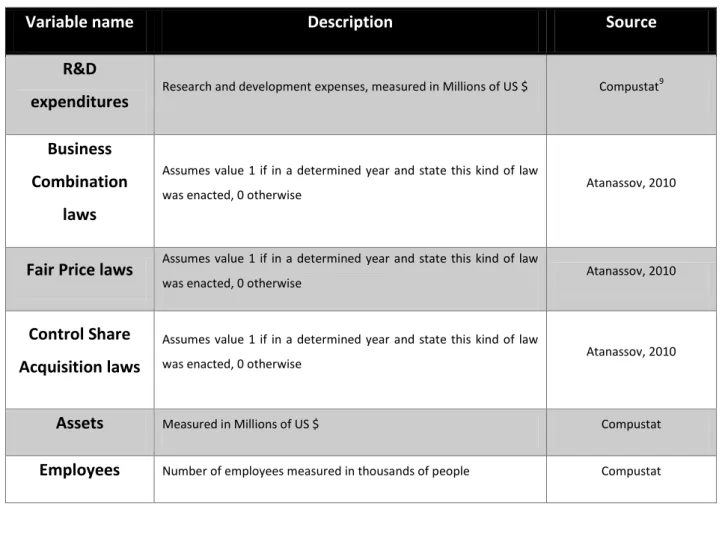
After explaining the sample characteristics used in the analysis, I will now explain the variable construction process to assess the relation between anti-takeover legislation and firms’ R&D expenditures. The following table (Table 1) shows all the variables that were used in the empirical analysis.
Table 1. Variables and Definition
Variable name Description Source
R&D
expenditures Research and development expenses, measured in Millions of US $ Compustat 9
Business Combination
laws
Assumes value 1 if in a determined year and state this kind of law
was enacted, 0 otherwise Atanassov, 2010
Fair Price laws Assumes value 1 if in a determined year and state this kind of law
was enacted, 0 otherwise Atanassov, 2010
Control Share Acquisition laws
Assumes value 1 if in a determined year and state this kind of law
was enacted, 0 otherwise Atanassov, 2010
Assets Measured in Millions of US $ Compustat
Employees Number of employees measured in thousands of people Compustat
9
Compustat is a database of financial, statistical and market information on active and inactive global companies throughout the
world. Provides a broad range of information products directed at institutional investors, universities, bankers, advisors, analysts, and asset/portfolio managers in corporate, M&A, private capital, equity, and fixed income markets. The database covers 99,000 global securities, covering 99% of the world's total market capitalization with annual company data history available back to 1950.
17
3.2. Dependent Variable
The dependent variable of this study is R&D expenditures. As explained before, the novelty on this work is that I evaluate the impact on anti-takeover laws individually, instead of assessing their impact as a whole as previous research has done.
3.3. Independent Variables: Anti-takeover Laws
Understanding whether anti-takeover laws are an exogenous or endogenous is a difficult subject to discuss. One of two things can occur:
First, it is possible that anti-takeover laws are hardly influenced or predicted by individuals or companies. The decisions regarding changes in anti-takeover legislation are taken in Supreme Courts of each state. Thus, assuming the market is are efficient, the variable anti-takeover legislation is exogenous because companies are not aware of the enactment of the laws until the moment it is announced.
However, on the other hand, it is possible that companies and individual can anticipate the enactment of anti-takeover laws. For example, in Texas, some companies started to complain about the lack of protection they had against hostile acquirers. The debate spread and courts also started to address the issue. At this point, companies could almost assume that some legislation was going to be passed because of such high levels of controversy. Therefore, in this case, one can say that companies actually had some power on influencing regulators to take action; so, the impact can be considered endogenous. If managers could expect the change in regulation, they would be able to implement the necessary changes in its practices before the law would be approved. However, overall previous research has concluded that the change can be considered as exogenous (Atanassov, 2010; Sapra, Subramanian, and Subramanian, 2012; Jain and Wasan, 2009), which means the estimated impact of antitakeover laws will not be biased.
18
3.3.1. Fair Price laws (FPANTITK)
To assess the impact of the Fair Price regulation, the variable FPANTITK assumes the value 1 if the state of the firm’s headquarters in a given year has already enacted the law, and 0 otherwise.
3.3.2. Control Share Acquisition laws (CSAANTITK)
To assess the impact of the Fair Price regulation, the variable CSAANTITK assumes the value 1 if the state of the firm’s headquarters in a given year has already enacted the law, and 0 otherwise.
3.3.3. Business Combination laws (BCANTITK)
To assess the impact of the Fair Price regulation, the variable BCANTITK assumes the value 1 if the state of the firm’s headquarters in a given year has already enacted the law, and 0 otherwise.
3.4. Control Variables
It is very likely that the variables R&D expenditures, assets’ value, and number of employees are correlated, since the bigger the company is, the higher the R&D investments in rough values tend to be, the more employees they have, and the higher the assets’ value should be.
A few control variables were introduced in the analysis in order to reduce the risk of over or underestimation. The first variable, number of employees, was introduced with the goal of controlling the effect that big companies have in R&D expenditures since the bigger companies are, the bigger R&D investments tend to be in absolute value. The second control variable introduced was assets owned by firms (in value) with the intent of controlling the effect that they might have in R&D expenditures.
19
3.5. Empirical Strategy
To proceed with the analysis of the impact that anti-takeover legislation has on R&D investments, I used difference-in-differences technique. The diverse states adopted the respective legislation in different years, so I used the procedure of Acharya et al. (2010) using panel estimation to implement differences in differences in a setting of multiple treatment groups over multiple years. Hence, I estimated the following regression through OLS:
xrdist = α FPANTITKst + µ CSAANTITKst + β BCANTITKst + δ log atit + θ log empit + λ log xrdit + Ɛist
In the equation, xrdist represents the R&D expenditures for company i in the year t and state s, and Ɛist is the idiosyncratic error for company i in state s in year t. FPANTITKst =1 for year t in which Fair Price legislation was enacted in state s, and zero otherwise; CSAANTITKst =1 for year t in which Control Share Acquisition legislation was enacted in state s; BCANTITKst =1 for year t in which Business Combination legislation was enacted in state s. atit is the assets’ value of company i in year t and empit is the number of employees in company i and year t.
However, this difference-in-differences analysis may create one problem: the standards errors’ value resulting from correlations may be very high if the estimation includes various periods of time. To control for this, I clustered the errors to the state level as the strategy of Bertrand et al (2004) implies.
20
4. Results
Table 2 presents the descriptive statistics for all variables, whereas Table 3 presents the pairwise correlation among them.
Table 2. Descriptive Statistics
VARIABLES (1) Observations (2) Mean (3) Std. Dev. (4) Min. (5) Max. FPANTITK 133.560 0,3076 0,4618 0,0000 1 CSAANTITK 133.560 0,1950 0,3962 0,0000 1 BCANTITK 133.560 0,3439 0,4750 0,0000 1 Assets’ value 133.560 3.920,12 47.014,01 0,0000 3.771.200 Number of employees10 133.560 6,6412 30,4909 0,0000 2.545,209 R&D expenditures11 133.560 50,3773 351,4758 0,0000 12.183
Table 3. Correlation Matrix
VARIABLES (1) R&D exp. (2) FPANTITK (3) CSAANTITK (4) BCANTITK (5) Assets’ value (6) # employees R&D exp. 1,000 FPANTITK 0,0084 1,000 CSAANTITK -0,0194 0,2998 1,000 BCANTITK 0,0029 0,7636 0,5350 1,000 Assets’ value 0,5858 0,0038 -0,0140 -0,0051 1,000 # employees 0,4602 0,0116 0,0106 -0,0055 0,5409 1,000
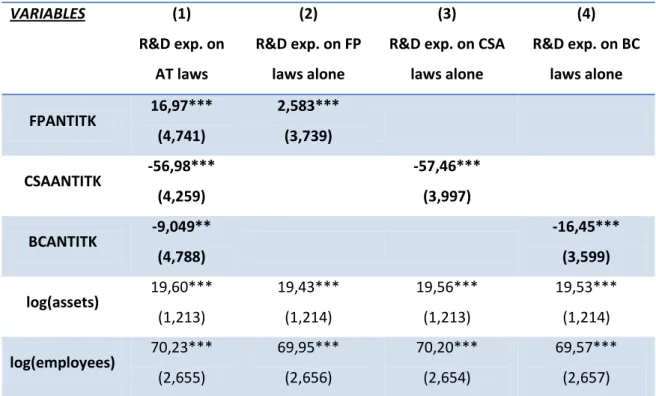
Table 4 presents the results obtained by regressing R&D with all anti-takeover laws, together and separately.
Results in Table 4, column 1, show that, in a determined state, if a Fair Price law is passed, R&D expenditures increase 16, 97 (±4, 741) Million US $ relatively to what R&D expenditures used to be before such enactment. On the other hand, Control Share Acquisition laws impact negatively R&D investments because after the enactment of
10 *10^3 11
21 such a law, its value goes down 56, 98 (±4, 259) Million US $. The Business Combination legislation is negatively related with anti-takeover legislation enactment as well; R&D expenditures feel an average impact of 9, 049 (±4, 788) Million US $ when Business Combination legislation is adopted.
Columns 2, 3 and 4 show the results of running the variable R&D expenditures alone with all the independent variables. The results were still consistent with the previous column where all the variables are run together.
The passage of a Fair Price anti-takeover law in a determined state has, on average, a positive impact of 2, 583 (±3, 739) Million US $ on R&D investments. However, the relation between R&D activities and the enactment of Control Share Acquisition laws is negative in 57, 46 (±3, 997) Million US $. The Business Combination legislation impact on R&D is also consistent with the results when all the variables are run together, and is negative in 16, 45 (±3, 599) Million US $ when such a law is enacted.
Table 4. Impact of anti-takeover legislation on R&D expenditures as a whole (1) and individual impact of FP laws (2), CSA laws (3) and BC laws (4) on R&D expenditures VARIABLES (1) R&D exp. on AT laws (2) R&D exp. on FP laws alone (3) R&D exp. on CSA
laws alone (4) R&D exp. on BC laws alone FPANTITK 16,97*** (4,741) 2,583*** (3,739) CSAANTITK -56,98*** (4,259) -57,46*** (3,997) BCANTITK -9,049** (4,788) -16,45*** (3,599) log(assets) 19,60*** (1,213) 19,43*** (1,214) 19,56*** (1,213) 19,53*** (1,214) log(employees) 70,23*** (2,655) 69,95*** (2,656) 70,20*** (2,654) 69,57*** (2,657)
22
Standard errors in parentheses *** p<0.01, ** p<0.05, * p<0.1
In more detail, I will explain the reasons for the contrasting effects between Fair Price laws and Control Share Acquisition laws regarding R&D activities.
The Fair Price legislation greatly increases investments in R&D because this law makes a takeover more expensive. Typically, shareholders want their managers to own stock options of the company so that their interests are aligned so that managers have the incentive to increase firm value. With this legislation, managers can have some control regarding the expected takeover premium12, which will increase proportionally with the firm market value.
On the other hand, Control Share Acquisition laws and Business Combination laws o have a negative impact on R&D investments, as they simply make the acquisition more difficult or time consuming, but not more expensive. Hence, with the enactment of these laws, the external market pressure is much reduced. The market pressure is what incentives managers to spend money in profitable activities for the company: to remain competitive in the market, to try not to be acquired and to keep their jobs, managers are forced to increase company share value. Consistent with the Managerial Welfare Hypothesis, with anti-takeover legislation managers will not have to be concerned about this feature and will most likely remain focused on wasting money on activities that are not the optimal for the company’s interests.
12 The takeover premium for managers is set as a percentage of the value of each stock owned by them (could you find some source for this information??).
Constant -190,3*** (8,568) -187,8*** (8,573) -191,1*** (8,560) -189,8*** (8,573) Observations 133.560 133.560 133.560 133.560 # of firms 14.059 14.059 14.059 14.059 R-squared 0,067 0,066 0,067 0,066
23
4.1. Robustness Checks
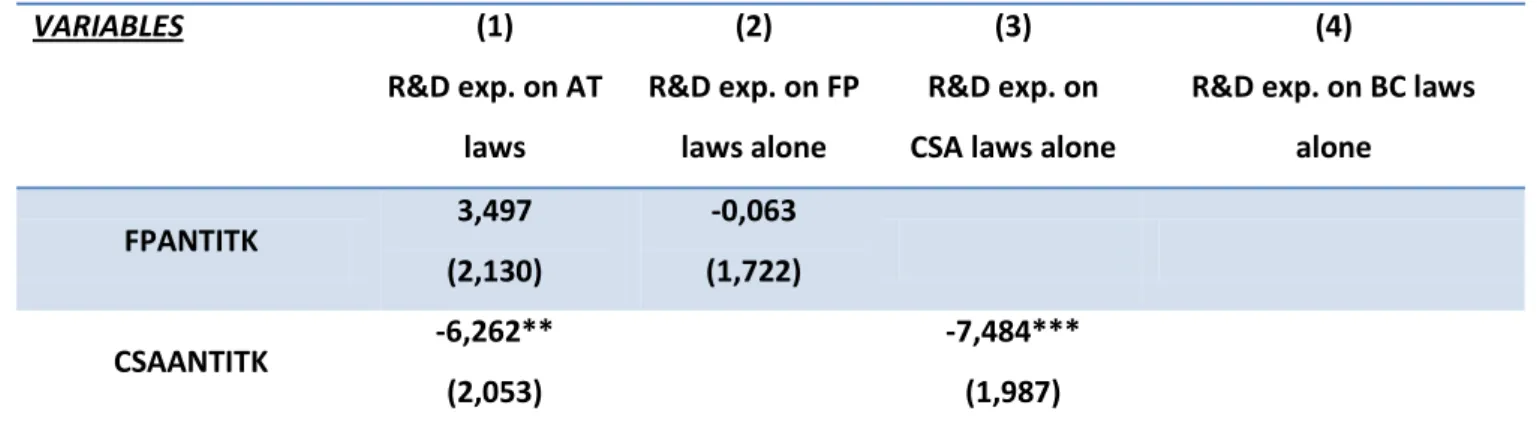
Small effects can show up as statistically significant in a large sample size. To address this problem, which rises from the difference-in-differences analysis, I repeat the analysis two times more using different criteria to authenticate the results of this study. So, at first, I use a shorter period of analysis to conduct the analysis. From the initial sample of 1970 to 2011, I reduce it to only cover the years from 1980 to 1991. I limit the analysis to the period since when the first anti-takeover law was enacted until the last one was implemented. The main reason for this reduction is to decrease the number of overall observations, and to take into account the exact time period where most changes in antitakeover laws actually occur. I find that the new evidence supports the one from the previous analysis: fair price laws increase R&D expenditures while control share acquisition laws and business combination laws decrease R&D investments. However, the sample reduction caused a loss in the significance value of some variables from p<0,01 to p<0,05. Still, the F-Test had a p<0.001 which shows great coherence to the model. In this modified sample, the number of observations accounts for 34,182 of 5,976 publically traded U.S. companies. Results can be seen in table 5, and are consistent with the results of the previous models, where I find that fair price laws increase R&D investments and control share acquisitions and business combination laws decrease R&D expenditures.
Table 5. Impact of anti-takeover legislation on R&D expenditures as a whole (1) and individual impact of FP laws (2), CSA laws (3) and BC laws (4) on R&D expenditures, in the period of 1980 to 1991.
VARIABLES (1) R&D exp. on AT laws (2) R&D exp. on FP laws alone (3) R&D exp. on CSA laws alone
(4)
R&D exp. on BC laws alone FPANTITK 3,497 (2,130) -0,063 (1,722) CSAANTITK -6,262** (2,053) -7,484*** (1,987)
24
Standard errors in parentheses *** p<0.01, ** p<0.05, * p<0.1
In the second modified analysis, I take into account only the “really innovative” companies, that is, companies that in a particular year have produced at least one patented invention. In order to do so, I merge the already presented Compustat database with the patent database from NBER13 (National Bureau of Economic Research).
The findings show the consistency with previous results; fair price laws still increase R&D expenditures while control share acquisition laws and business combination laws go on the opposite direction and tend to decrease, on average, R&D investments. However, the sample reduction caused a loss in the significance value of some variables from p<0,01 to p<0,05, although the F-Test had a p<0.001 which shows great coherence to the model. In this modified sample, the number of observations accounts for 28,841 of 4,603 publically traded U.S. companies. Results can be seen in table 6.
13
NBER is a research organization is an American private nonprofit organization devoted to provide unbiased economic research among public policymakers, business professionals, and academic community. The database used in this study includes information regarding filed patents, received citations, innovative breakthroughs, innovative failures, among others.
BCANTITK -5,760*** (2,137) -5,070*** (1,684) log(assets) 10,42*** (1,192) 10,28*** (1,192) 10,37*** (1,192) 10,37*** (1,192) log(employees) 10,20*** (2,802) 10,29*** (2,803) 10,28*** (2,802) 10,22*** (2,803) Constant -39,96*** (3,597) -39,54*** (3,597) -39,86*** (3,596) -39,83*** (3,596) Observations 34.182 34.182 34.182 34.182 # of firms 5.976 5.976 5.976 5.976 R-squared 0,035 0,035 0,035 0,035
25 Table 6. Impact of anti-takeover legislation on R&D expenditures as a whole (1) and individual impact of FP laws (2), CSA laws (3) and BC laws (4) on R&D expenditures, regarding the most innovative companies.
Standard errors in parentheses *** p<0.01, ** p<0.05, * p<0.1 VARIABLES (1) R&D exp. on AT laws (2) R&D exp. on FP laws alone (3) R&D exp. on CSA laws alone
(4)
R&D exp. on BC laws alone FPANTITK 40,93*** (10,86) 27,44*** (8,758) CSAANTITK -35,56*** (10,04) -37,61*** (9,350) BCANTITK -24,66*** (11,44) -9,071 (8,716) log(assets) -24,84*** (4,809) -22,5*** (4,810) -22,38*** (4,809) -22,62*** (4,810) log(employees) 25,69*** (8,405) -22,5*** (8,409) 25,76*** (8,408) 22,50*** (8,410) Constant -187,0*** (17,08) -184,6*** (17,08) -187,9*** (17,07) -187,3*** (17,09) Observations 28.841 28.841 28.841 28.841 # of firms 4.603 4.603 4.603 4.603 R-squared 0,139 0,138 0,138 0,138
26
5. Discussion and Conclusions
With this study I assess the impact anti-takeover laws have on innovative investments, more specifically, research and development expenditures. It shows that firm’s R&D expenditures variations depend on the anti-takeover law enacted, and the results are not always positive. Different laws stimulate R&D activities differently.
The findings show evidence to support both MWH and SWH: fair price laws encourage innovation while control share acquisition laws and business combination laws tend to incentive managers to reduce R&D investments and become more entrenched.
In more detail, fair price laws make the acquisition more expensive, providing companies with the only defensive mechanism that fosters innovation. By owning company stock, managers also have interest in making the firm more valuable. If they are able to increase firm value, the expected takeover premium will be higher, even if the probability of takeover decreases.
Instead control share acquisition laws turn takeovers into a more difficult and time consuming process. This law reduces the external pressure, which is supposed to force managers to work on maintaining the company competitive in the market (by spending money in activities that are profitable and healthy for the company). By providing managers with mechanisms that mitigate hostile takeover pressure, they feel better protected and do not have to be concerned with having their position threatened. Thus, in line with the Managerial Welfare Hypothesis, managers tend to decrease investments in R&D activities.
Business combination laws only make the acquisition more time consuming (and not more expensive, as the control share acquisition legislation). The merger or acquisition is possible to be concluded after the moratorium period, so it can be considered to provide managers with a weaker defense relatively to CSA laws. So, in line with the Managerial Welfare Hypothesis, managers reduce R&D investments and focus instead on their own private benefits, and invest in projects with quicker and guaranteed returns but also less valuable.
These findings are significant for both companies and policy-makers. On one side, companies that operate in highly technologically advanced and competitive markets,
27 where innovation plays a key role on term sustainability, might obtain better long-term results if settled in a state where fair price laws are enacted. On the other side, policy makers can also benefit from understanding this piece of literature. Depending on what they believe it is best or it is needed to a specific region (and companies or businesses that operate in the state), policy makers might make their decisions based on more available information. For example, if they believe that innovation is critical to foster the economy, they may choose to enact fair price laws. On the contrary, if they believe that intense competition and innovation may be destroying companies in an unhealthy way, they may choose to enact control share acquisition laws or business combination laws, conferring a reduced emphasis to R&D investments.
An area that remains interesting for further research is checking the propensity for companies to invest in firms that belong to states protected by different types of antitakeover laws. It could be possible to argue that this propensity might change according to the kind of law that is established in that same state, and I leave this as a possible topic for future research.
28
6. Appendix
This table reports the year, in which Fair Price (FP), Control Share Acquisition (CSA), and Business Combination (BC) laws were passed in different states. Fair Price laws require shareholders acquiring a percentage of stocks beyond a threshold level to pay a “fair price" for all stocks acquired; Control Share Acquisition laws give the right to non-interested shareholders to decide whether a large shareholder has voting rights; Business Combination laws impose a moratorium (three to five years) on specified transactions between the target and the acquirer holding a specified threshold percentage of stock unless the board votes otherwise before the acquiring person becomes an interested shareholder. Source: Atanassov 2010
State Year FP Passed Year CSA passed Year BC Passed
Arizona 1987 1987 1987 Connecticut 1984 - 1989 Delaware - - 1988 Hawaii - 1985 - Georgia 1985 - 1988 Idaho 1988 1988 1988 Illinois 1984 - 1989 Indiana 1986 1986 1986 Kansas 1989 1988 1989 Kentucky 1989 - 1987 Louisiana 1985 1987 - Maine - - 1988 Maryland 1983 1988 1989 Massachusetts - 1987 1989 Michigan 1985 1988 1989 Minnesota - 1984 1987 Mississippi 1985 1991 - Missouri 1986 1984 1986 Nebraska - 1988 1988 Nevada - 1987 1991 New Jersey 1986 - 1986 New York 1985 - 1985 North Carolina 1987 1987 - Oklahoma - 1987 1991 Ohio 1990 - 1990 Oregon - 1987 - Pennsylvania 1989 1989 1989 Rhode Island - - 1990 South Carolina 1988 1988 1988 South Dakota 1990 1990 1990 Tennessee 1988 1988 1988 Utah - 1987 - Virginia 1985 1988 1988 Washington 1990 - 1987 Wisconsin 1985 1991 1987 Wyoming - 1990 1989
29
7. References
Aghion P., Bloom N., Blundell R., Griffith R., and Howitt P., 2005. Competition and Innovation: An Inverted-U Relationship. Quarterly Journal of Economics. Vol. 120: 701-728.
Aghion P., Howitt P., 2006. Appropriate Growth Policy: A Unifying Framework. Journal of the European Economic Association, Vol. 4: 269-314.
Ankier J. C., January 1991. Anti-Takeover Statutes, Shareholders, Stakeholders and Risk. 51 Louisiana Law Review. Vol 51, No.3: 561-622. Available at:
http://digitalcommons.law.lsu.edu/lalrev/vol51/iss3/9
AT Kearney, 2008. Profitable Growth through Innovation.
http://www.atkearney.com/documents/10192/9f8dcf2f-0db2-4258-b819-f6e2139ec210 Atanassov J., 2010. Do hostile takeovers stifle innovation? Evidence from Antitakeover Legislation and Corporate Patenting.
Bertrand, Mullainathan, 2004. How Much Should We Trust Differences-in-Differences Estimates? Quarterly Journal of Economics, Vol. 119: 249-275.
Bogliacino F., Pianta M, 2010. Profits, R&D and Innovation: a Model and a Test. JRC-IPTS Working Papers on Corporate R&D and Innovation 2010-05, Institute of
Prospective Technological Studies.
Chemmanur T., Jiao Y., 2012. Dual Class IPOs: A Theoretical Analysis. Journal of Banking and Finance. Vol.36: 305-319.
Cheng S., Nagar V., Rajan M. V., 2005. Insider Trades and Private Information: The Special Case of Delayed-Disclosure Trades. The Review of Financial Studies, Vol. 20, Issue 6: 1833-1864.
Clark P., June 2012. A Look At How Possible Court Decisions Will Impact the Federal Government, For-Profit Health Care Industry. Available at:
http://www.investopedia.com/articles/economics/11/how-governments-influence-markets.asp#axzz2MtcNOYd7
Comment R., Schwert G.W., 1995. Poison or Placebo? Evidence on the deterrence and wealth effects of modern antitakeover measures. Journal of Financial Economics, Vol.39: 3-43.
Conti R., forthcoming Do non-competition agreements lead firms to pursue path-breaking inventions? Strategic Management Journal.
DeAngelo H. Rice E. M., 1983. Antitakeover charter Amendments and Stockholder Wealth. Journal of Financial Economics. Vol. 11: 329-359.
Ederer, Manso, 2010. Is Pay-for—Performance Detrimental to Innovation?
Forthcoming in Management Science Journal. University of California, LA. Available at: http://sites.kauffman.org/efic/conference/em.pdf
30 Fleming L., Sorenson O., 2004. Science as Map of Technological Search. Strategic Management Journal. Vol. 25: 909-928.
Fu H., Liu M. H., 2007. Anti-Takeover Provisions and Corporate Disclosure. Working Paper. Available at: http://papers.ssrn.com/sol3/papers.cfm?abstract_id=930528
Garvey G.T. and Hanka G., April 1999. Capital structure and corporate control: The effect of antitakeover statutes on firm leverage. The Journal of Finance. Vol. LIV, No.2: 519-546.
Garvey G.T., Hanka G., April 1999. The effect of antitakeover statutes on firm leverage. Vol. 54, Issue 2: 519-546.
Gibson JM., Stigson B., 2004. How Innovation Supports Sustainability. Dow Corning, Smart Innovation Series. Available at:
http://www.dowcorning.com/content/publishedlit/solarticles/How_Innovation_Supports _Sustainability.pdf
Godin B., 2001. Project on the History and Sociology of S&T Statistics. Working Paper No. 16. In International Conference in Honor of K. Pavitt "What We Know About Innovation", 13-15 November 2003, SPRU, University of Sussex, Brighton (UK). Godin B., 2009. National Innovation System (II): Industrialists and the Origins of an Idea, Working Paper no. 4, Project on the Intellectual History of Innovation, Montreal : INRS.
Golec J. H., Vernon J. A., November 2006. European Pharmaceutical Price Regulation, Firm Profitability, and R&D Spending. National Bureau of Economic Research,
working paper 12676. Available at: http://www.nber.org/papers/w12676
Gompers P., Ishii J., Metrick A., 2003. Corporate Governance and Equity Prices. The Quarterly Journal of Economics. Vol. 118, Issue 1: 107-156.
Hall B. H., Jaffe A. B., Trajtenberg M., 2001. The NBER patent citations data file: lessons, insights and methodological tools. NBER working paper 8498.
Harris M., Raviv A., 1991. The Theory of Capital Structure. The Journal of Finance, Vol. 46, Issue 1: 297-355.
Howe, Jain, Pereira, 2007. Managerial Discretion and Firm Cash Policy: Evidence from the Adoption of Anti-takeover Legislation. University of Missouri-Columbia, Working Paper.
Jahera J. S., Pugh W. N., Page D., 1992. Antitakeover Charter Amendments: Effects on Corporate Decisions. Journal of Financial Research, Vol. 15, issue 1: 56-67.
Jain R., Wasan S., 2009. Adoption of antitakeover legislation and R&D expenditure. Investment Management and Financial Innovations, Vol. 6, Issue 3: 63-72.
Jensen M. C., 1986. Agency Costs of Free Cash Flow, Corporate Finance, and Takeovers. The American Economic Review, Vol. 76, Issue 2: 323-329.
John K., Li Y., Pang J., 2010. Does Corporate Governance Matter for High Free Cash Flow Firms? Available at: http://astro.temple.edu/~yzli/FCF_2012.pdf
31 Johnson M.S., Rao R.P., 1997. The Impact of Antitakeover Amendments on Corporate Financial Performance. Financial Review, Vol. 32, Issue 4: 659-689.
Juks R., 2008. How does anti-takeover regulation affect workplace safety?. Department of Finance, Stockholm School of Economics. Available at:
http://www.econ.ucl.ac.uk/jamboree/downloads/london2009-1.pdf
Li Z., Sun L., 2011. The impact of the government policy on the Chinese electric vehicle industry and business strategy management: Case of FAW. Available at:
http://www.iei.liu.se/fek/722a31/file-archive/1.273563/LiZhe_SunLu-TheimpactofthegovernmentpolicyontheChineseelectricvehicleindustryandbusinessstrate gymanagement.pdf
Luo J., 2006. The Impact of Government Policies on Industrial Evolution: The Case of China’s Automotive Industry. Massachusetts Institute of Technology. Available at:
http://dspace.mit.edu/bitstream/handle/1721.1/38511/154715433.pdf
Lyons B.R., 2001. Incomplete Contract Theory and Contracts Between Firms: a
Preliminary Empirical Study. Centre for Competition Regulation, Working Paper CCR 01-1. Available at: http://competitionpolicy.ac.uk/documents/107435/107587/ccp1-1.pdf
Macey J.R., 1988. State Anti-Takeover Statutes: Good Politics, Bad Economics. Faculty Scholarship Series. Paper 1739: 467-490.
Malekzadeh A.R., McWilliams V. B., Sen N., 2005. Antitakeover Amendments, Ownership Structure and managerial Decisions: Effects on R&D expenditure. Working Paper, St. Cloud State University.
Meulbroek L.K., Mitchell M. L., Mulherin J. H., NetterJ. M., Poulsen A. B., 1990. Shark Repellants and Managerial Myopia: An Empirical Test. Comment in the Journal of Poliical Economy. Vol. 98: 1108-1117.
Rafael LP., Lopez-de-Silanes F., Shleifer A., Vishny R. W., 2000. Investor Protection and Corporate Governance. Journal of Financial Economics, Vol. 58(1-2): 3-27. Ryngaert M., Netter J. M., 1988. Shareholder Wealth Effects of the Ohio Antitakeover Law. Journal of Law, Economics & Organization, Vol. 4, Issue 2: 373-383.
Ryngaert M., Scholten R., 2010. Have changing takeover defense rules and strategies entrenched management and damaged Shareholders? The case of defeated takeover bids. Journal of Corporate Finance, Vol. 16 (1): 16-37.
Scriggins L. P., Clarke Jr. D., 2012. Takeovers and the 1983 Maryland Fair Price legislation. Vol. 43, Issue 2, article 5: 266-291
Sellers R., 2012. How Government Policies May Affect Poultry Industry Profitability. American Feed Industry Association, Arlington, VA. Available at:
http://www.thepoultryfederation.com/public/userfiles/files/Goverment%20Policies%20t hat%20Impact%20US%20poultry%20industry%20Sellers.pdf
Sokolyk T., July 2010. The Effects of Anti-takeover Provisions on Acquisition Targets. Working Paper, University of Wyoming. Available at:
http://www.edwards.usask.ca/csfm/_files/papers2010/4a-32
The%20Effects%20of%20Anti-takeover%20Provisions%20on%20Acquisition%20Targets,%20T.%20Sokolyk.pdf
Stein J. C., 1988. Takeover Threats and Managerial Myopia. The Journal of Political Economy, VOL. 96(1): 61-80.
Subramanian A., Sapra H., Subramanian K., 2012. Corporate Governance and
Innovation: Theory and Evidence. In 3rd annual Conference on Empirical Legal Studies Papers Chicago Booth Research, Paper No. 08-05.
Suggs R. E., 1995. Business Combination Antitakeover Statutes: affairs doctrine and constitutional constraints on choice of law. Vol. 56: 1098-1152.
Sundaramurthy C., Mahoney J. M., Mahoney J. T., 1997. Strategic Management Journal, Vol. 18:3: 231-245.
US Department of State, 2012. Regulation and Control in the US Economy. Available at: http://economics.about.com/od/howtheuseconomyworks/a/regulation.htm