Diana Vieira Fernandes
Power Purchase Agreements
Energy contracting under Private Law
Dissertation as part of the requirements for the
Award of a Master Degree in Law and
Management (“Mestrado em Direito e Gestão”)
from NOVA Law School and NOVA School of
Business and Economics
Advisor: Professor Doutor Vítor Pereira das Neves
Statements
I.
This master’s dissertation was written by myself and in my own words, except quotations from published and unpublished sources which are clearly indicated and acknowledged as such. I am conscious that the incorporation of material from other works or a paraphrase of such material without acknowledgement will be treated as plagiarism, subject to the customs and uses on the subject, according to the art. 20.º- A of the Regulation of the 2.º Cycle and, the art. 8.º of the Regulation of the 3.º Cycle of NOVA Law School. The source of any picture, figure or other illustration is also indicated, as is the source, published or unpublished, of any material not resulting from my own experimentation, observation or specimen-collecting.
II.
This work has:
Abstract: 2495/2 500 (EN) + 2500/2 500 (PT) characters w/spaces and footnotes Corpus: 199 9997/200 000 | characters w/spaces and footnotes | 80 pages Annexes: 25/25 pages
III.
Modus Citandī
It will be used abbreviations throughout the text; at the beginning of this dissertation, the list of those that were most used. Regarding citations, are cited, with the mention of the author's name, the title of the work, the year of publication and the respective pages. In addition, in cases where the work is the same as in the previous reference, differing only the page in question, it will be used the expression "op. cit." afterwards. If the reference is the same as the previous one, the used expression will be "ibid.". At the end of the dissertation, there is references list with complete bibliographic indications. Regarding jurisprudence, it will be mentioned with an indication of the country, court, number and date of the decision, and, where possible, the web page on which it will be possible to access it. When using a direct translation (free translation), will be within quotation marks and, its author will be referenced, with the location, explicitly, as well.
Abstract
The constructions created through abstraction and fīdūcia, as currency, needed different constructions of the ones applied to corporeal realities. Energy, by nature, and now, by legal intent, is dynamic, fungible and represents a change that is not possible to harmonise with the logic of the immutable, determined and concrete set of “things”.
This demands a meta-juristic analysis (as the dominant construction does not hold incorporeal and dynamic phenomena) and, reconstruction of entities and classes, from an entity (substantia), to the system. Besides “things” there are facts, not only those “perceived by the senses” but also, emerging from the autonomy of the will. Also, time is a continuous variable and, we cannot postulate a legal system where all phenomena (and norms) are discrete.
This dissertation is structured into 5 chapters, whereas:
I - Substantia, as electricity, is the subject matter of the analysed contract, it will be analysed:
§ The (de)construction of (constitutive) unilateral juridical position (fōrma), based on the principle of autonomy of the will (associated with responsibility), limited by the principle of good faith. Its attributes, namely regarding other acquisitive positions (tested), as the right of disposal and effects and, subsequent solutions (and corrections) within the legal system.
§ Categories, as entity creation or definition, as attributes of a given substance. As a derivative, the concepts of Commixtiō and Cōnfūsiō are also addressed.
§ Position, where it is defined the substantia of the PPA.
II - Vectors, the direction (as the transfer of a given position) linked with time, under a causal and
consensual system, integrated with MIBEL, its contracting modalities, namely as a futures market). Lastly, will be constructed, as a continuous contract with several dispatches (as a vector value function).
III – Tensors, presents several transformations, that a set of elements and entities may define, for
IV - System, takes substantia, vectors and tensors, and are inserted in a coordinate system, namely
the main terms and conditions, connecting with the current regulations that (may) shape such terms, as transportation and dispatch.
V - Epilogue, are the final conclusions and remarks.
There are summarised in the annexes:
§ Description of the market and its dependencies, due to the nature of energy;
§ Understanding, doctrine, jurisprudence and, other legal systems.
Keywords: Power Purchase Agreement (PPA), Electricity, Juridical System, Private Law, Contract,
Resumo
As construções criadas através da abstração e fīdūcia, como moeda corrente, precisam de construções diferentes das aplicadas às realidades corpóreas. Energia, por natureza e, agora, por intenção legislativa, é dinâmica, fungível e representa mudança que não é possível harmonizar com a lógica do conjunto de “coisas” imutáveis, determinadas e concretas.
Isto exige análise meta-jurídica (como a construção dominante não se sustenta para fenômenos incorpóreos e dinâmicos) e uma reconstrução de entidades e classes, de uma entidade (substância), para o sistema. Além de "coisas", são rēs, não apenas o que é "percebido pelos sentidos", mas também, o que emerge da autonomia da vontade. Além disso, o tempo é uma variável contínua e, não podemos postular um ordenamento jurídico onde todos os fenômenos (e normas) são discretos.
Esta dissertação está estruturada em 5 capítulos:
I - Substantia (como a eletricidade, é o objecto do contrato) vai ser tratado:
§ (De)construção (constitutiva) de posição jurídica unilateral (fōrma), com base no princípio da autonomia da vontade (associado à responsabilidade), limitada pelo princípio da boa fé. Seus atributos, em relação a outras posições aquisitivas (testando), como um direito dispositivo e seus efeitos e, soluções subsequentes (e correções) dentro do ordenamento jurídico.
§ Categorias, como a criação de entidade ou definição, dos atributos de uma determinada substância. Derivado, os conceitos de Commixtiō e Cōnfūsiō também serão abordados.
§ Posição, em que é definida a substantia do PPA.
II - Vectores, a direcção (como a transferência de uma determinada posição) ligada com o tempo,
sob um sistema causal e consensual, integrados no MIBEL e as suas modalidades contratuais, como mercado de futuros. Por fim será construído, como um contrato contínuo com vários despachos (como uma função vectorial).
III – Tensores, são apresentadas as várias transformações, que um conjunto de elementos e
entidades podem definir para alcançar a sua causa final, nomeadamente, se for utilizada uma infraestrutura comum.
IV - Sistema, onde substantia, vectores e tensores se inserem, no sistema de referência,
nomeadamente os termos e condições, em conexão com os regulamentos actuais que (podem) formatar tais termos, como o transporte e despacho.
V - Epílogo, são as conclusões finais e observações.
É resumido nos anexos:
§ Descrição do mercado e suas dependências, devido à natureza da energia.
§ A compreensão na doutrina, jurisprudência e, outros sistemas jurídicos.
Palavras-chave: Contrato de Aquisição de Energia (CAE), Eletricidade, Ordenamento Jurídico,
Table of Contents
S
TATEMENTS3
A
BSTRACT5
T
ABLE OFC
ONTENTS9
A
CRONYMS11
T
ABLE OFF
IGURES19
I - SUBSTANTIA
23
I
-
P
RŌPOSITIŌ(
INTRODUCTION)
23
II - SUBSTANTIA FORMULAE (DEFINITION AND PURPOSE)
25
III - MĀTERIA SUBSTANTIALIS (PRĪMA)
25
E
LECTRICITY25
I
NITIAL DECONSTRUCTION28
IV
-
FŌRMA SUBSTANTIALIS (SECUNDA)
30
C
ONSTITUTIVE LEGAL POSITIONS30
(S
UBJECTIVE)
C
ONSTRUCTION37
L
EVELISEDR
IGHTS(
OF DISPOSAL AND USE)
40
V
-
C
ATĒGORIAE44
A
CCIDENT44
C
OMMIXTIŌ ETC
ŌNFŪSIŌ46
W
ATERSR
EGIME IN THEC
IVILC
ODE48
VI - POSITION
51
II - VECTOR (QUANTITAS ET DĪRĒCTIŌ)
53
I
-
Ā
CTIŌ ET EFFECTŪS54
II
-
D
ĪRĒCTIŌ(S
ALE ANDP
URCHASEA
GREEMENT)
59
III
–
Q
UANTITAS(
SCALARS)
60
IV
-
V
ECTORF
UNCTION64
III - TENSORS
69
I - MODELS INVOLVING PPAS
69
PPA
WITH BACKUPS
YSTEMF
RAMEWORK70
II - PPA STRUCTURES
71
W
HOLESALEPPA
71
O
NSITE DIRECT WIREPPA
71
S
LEEVED OFF-
SITEPPA
72
M
INI-
UTILITY72
S
YNTHETICPPA
73
IV - COORDINATE SYSTEM
75
I
–
PPA
C
ONTRACTUALT
ERMS75
C
ONDITIONSP
RECEDENT75
T
ERM76
O
BLIGATIONS RELATED TO THEE
NERGYS
YSTEM(
CONTROL,
QUALITY AND SAFETY STANDARDS)
76
P
URCHASE AND SALE OF OUTPUT77
O
BLIGATIONS TOP
ROVIDEC
ONTRACTC
APACITY ANDE
LECTRICALO
UTPUT78
P
RICING MECHANISMS78
T
HIRD-
PARTY SALES81
R
ENEWABLEE
NERGYC
ERTIFICATES81
II
–
T
RANSPORT ANDD
ISTRIBUTION82
III
-
D
ISPATCH ANDS
ETTLEMENT83
IV – METERING AND DATA
88
V - INTERRUPTION OF SERVICE, SCHEDULED OUTAGE
91
C
URTAILMENTS95
VI - EVENTS OF DEFAULT
98
R
EMEDIES98
C
ONTINUEDO
PERATION OFS
YSTEM99
V - EPILOGUS (CONCLUSIONS AND FINAL REMARKS)
101
ANNEXES
103
W
HAT IS ENERGY105
F
ROM RAW FUEL TO ENERGY END USE106
M
ARKETD
ESIGN107
P
LAYERS108
I
NFRASTRUCTURE ANDS
UPPLYC
HAIN109
I
NTERMITTENCY ANDS
ECURITY OF SUPPLY OFRES
110
P
ORTUGUESEE
LECTRICALS
YSTEM-
S
ISTEMAE
LÉTRICON
ACIONAL(SEN)
111
P
ARTIES112
MIBEL
113
C
ONCESSION OF THE ELECTRICITY INFRASTRUCTURE114
RES
F
LEXIBILITY IN THE OVERALL SYSTEM115
P
REVIOUS FRAMEWORK118
S
UBJECT MATTER-
E
NERGY(
ELECTRICITY)
120
O
THER LEGAL SYSTEMS128
T
HE DEFINITION OF COMMODITIES IN WHOLESALE ENERGY MARKETS130
REFERENCES
131
W
ORKS CITED131
Acronyms
Acronym – Original - English
AC – Alternating Current
ACER – Agency for the Cooperation of Energy Regulators art. – artigo – article
AT – Autoridade Tributária - Tax Authority
BGB – Bürgerliches Gesetzbuch – German Civil Code BOOT – Building-Own-Operate-Transfer
CAE – Contrato de Aquisição de Energia – Power Purchase Agreement CC – Código Civil – (Portuguese) Civil Code
CCom – Código Comercial – (Portuguese) Commercial Code CfD – Contract-for-differences
chap. – Capítulo - Chapter
CHP – Combined heat and power
CMEC – Custos para a Manutenção do Equilíbrio – Contractual Balance Maintenance Costs CMVM – Comissão de Mercado e Valores Mobiliários – Securities Exchange Commission (Portugal) CNE – Comisión Nacional de Energia – National Energy Commission (Spain)
CNMV – Comisión Nacional de Mercado de Valores – Securities Market Commission (Spain) CPA – Código do Procedimento Administrativo – (Portuguese) Administrative Procedure Code CSC – Código das Sociedades Comerciais – (Portuguese) Commercial Companies Code CVM – Código dos Valores Mobiliários – (Portuguese) Securities Code
COD – Commercial Operation Date D – Digest (of Justinian)
DC – Direct Current
DGEG – Direcção Geral de Energia e Geologia – General Directorate for Energy and Geology DL - Decreto-Lei - Decree-Law
DR – Demand Response
DSM – Demand Side Management DSO – Distribution System Operator Ed. – Edição - Edition
ERSE – Entidade Regulatória Serviços Energéticos - Energy Services Regulatory Authority EC – European Commission
EE – Energy Efficiency
EIA – Estudo de Impacto Ambiente – Environmental Impact Study EIB – European Investment Bank
ENTSO – E – European Network of Transmission System Operators for Electricity EU – European Union
ES – Energy System EV – Electric Cars FiT – Feed in Tariff
GGS – Gestor Global do Sistema - Global System Technical Manager
GMLDD – Guia de Medição, Leitura e Disponibilização de Dados – Guide for the Procedures of
Measurement, Reading and Data Availability
HV – Alta Tensão (AT) – High Voltage IP – Intellectual Property
kWh – kiloWatt hour kVA – kiloVoltAmpere
LCOE – Levelised Cost of Energy LV – Baixa tensão (BT) – Low Voltage
MIBEL – Mercado Ibérico de Energia – Iberian Energy Market
MPGGS SE – Manual de Procedimentos da Gestão Global do Sistema do setor elétrico – System
Network Procedures Manual
MS – Member States
MV – Média tensão (MT) – Medium Voltage
MVH – Média e Alta Tensão (MAT) – Medium and High Voltage MWh – MegaWatt hour
NRA – National Regulatory Authorities
OMIE – Operador do Mercado Ibérico de Energia – Pólo Espanhol, S.A. OMIP – Operador do Mercado Ibérico de Energia – Pólo Português, S.A. ORD – Operador da Rede Distribuição – Distribution network operator (DSO) O&M – Operations & Maintenance
P. – Procedimento – Procedure (of the MPGGS SE) para. – (número do artigo) – paragraph
PatG – Patentgesetz – (German) Patent Act
PDBC – Programa Diário Base de Contratação – Daily Base Contracting Schedule PDBF – Programa Diário Base de Funcionamento – Daily Basic Operating Schedule PDVD – Programa Diário Viável Definitivo – Daily Definitive Viable Schedule
PHF – Programa Horário Final – Final Schedule
PHL – Programa Horário de Liquidação – Settlement Schedule PHO – Programa Horário Operativo – Operating Schedule
PHOF – Programa Horário Operativo Final - Final Operating Schedule POD – Point of delivery
PPA – Power Purchase Agreement PPP – Public Private Partnership
PPR – Programa Previsional de Reserva – Provisional Reserve Schedule PV – PhotoVoltaic (solar)
RARI – Regulamento de Acesso às Redes – Network and Interconnections Access Regulation RES – Renewable Energy Source
RegCom – Código do Registo Comercial – Commercial Register Code RegPredial – Código do Registo Predial – Building Register Code REN – Rede Eletrica Nacional S.A.
RESP – Rede de eletricidade de serviço Publico – National Electric Public Service RND – Rede Nacional de Distribuição - National Distribution Network
RNT – Rede Nacional de Transporte – National Transportation Network
RQS – Regulamento de Qualidade do Serviço – Quality of Service Regulation RRC – Regulamento de Relações Comerciais – Commercial Relations Regulation RRCEE – Regulamento de Relações Comerciais do setor elétrico
RRCGN – Regulamento de Relações Comerciais do setor do gás natural SA – Sociedade Anónima - PLC
SEN – Sistema Eletrico Nacional Portuguese - National Electrical System SEP – Sistema Electrico Português - Portuguese Electric System
SLV – Baixa tensão especial (BTE) – Special Low Voltage SPV – Special purpose vehicle
STA – Supremo Tribunal Administrativo – Supreme Administrative Court STJ – Supremo Tribunal de Justiça – Supreme Court Justice
ToU – Time-of-Use
TSO – Transmission System Operator
TRC – Tribunal Relação Coimbra - Coimbra Higher Court TRL – Tribunal Relação Lisboa – Lisbon Higher Court UK – United Kingdom
USA – United States of America VA – Volt-ampere
VAR – volt-ampere reactive VAT – Value Added Tax – IVA W – Watt
WpHG – Gesetz über den Wertpapierhandel – (German) Securities Trading Act
Where (in accordance with MGSS, Procedure.1, General Provisions) the Manual of Procedures establishes the provisions applicable to the operation of the Global System Management activity, developed by the transmission system operator, and defines:
Daily Base Contracting Schedule (PDBC) - Program elaborated by the OMIE with hourly
Daily Basic Operating Schedule (PDBF) - Daily Schedule elaborated by the GGS, with hourly
discrimination, which aggregates the information presented in the PDBC and affects the implementation of the bilateral contracts communicated by the Market Agents;
Definitive Viable Daily Schedule (PDVD) - Daily Schedule, with hourly discrimination, incorporating
the modifications introduced in the PDBF to solve technical restrictions in the PDBF and later rebalance between generation and consumption;
Final Schedule (PHF) - Schedule established after each session of the intraday market with the
aggregation, by time period and Programming Unit, of all firm transactions after resolution of the technical restrictions identified in the transactions established in the intraday market session;
Settlement Schedule (PHL) - Settlement program, which results from the algebraic sum of programs
related to the participation in MIBEL, a Portuguese control area, to determine deviations from programming by settlement unit;
Operating Schedule (PHO) - Operational Schedule established by the GGS, with hourly discrimination
until the end of the daily programming horizon, and by Program Unit. Includes transactions carried out in the organised market and through bilateral contracting that have been technically validated, the regulatory reserve mobilisations included in the PPR and all other mobilisations executed by the GGS until its publication, 15 minutes before the start of each hour;
Final Operating Schedule (PHOF) - Operating schedule resulting at the end of the daily programming
horizon. It includes transactions carried out in the organised market and through bilateral contracting that have been technically validated, the mobilisations resulting from the PPR and all other programming changes associated to the processes of resolution of technical restrictions and system services;
Provisional Reserve Schedule (PPR) - Daily Schedule, with hourly discrimination, with the expected
mobilisations of regulatory reserve to eliminate the differences between the consumption forecast by the GGS and the one defined by the PDVD;
Primary regulation (Regulação primária) - Decentralised automatic function of the turbine speed
regulator to adjust the power of the generator as a result of a frequency deviation;
Regulation Reservation (Reserva de Regulação) - Maximum variation of power up or down of the
system and program groups in the interconnection, which can be mobilised during the schedule of the operation in force;
Technical Restriction (Restrição Técnica) - Any limitation, derived from the situation of the
transmission network or the system, so that the electric power supply can be carried out under the conditions of safety, quality and reliability defined in Procedure nº 6;
Interruptibility Service (Serviço de Interruptibilidade) - System Service consisting of the voluntary
reduction of electricity consumption to a value less than or equal to the residual power value, in response to a power reduction command given by GGS;
Balance Area (Área de Balanço) - Set of Physical Units connected in the same network area and
belonging to the same Market Agent, to which are added the deviations to the production schedule or consumption in pumping;
Secondary regulation band (Banda de regulação secundária) - Range of variation of the power in
which the secondary regulator can act automatically to rise, in a time less than five minutes, starting from the point of operation in which it is at each instant, multiplied by 1.5. The total value is obtained by adding, in absolute value, the individual contributions of each physical unit submitted to this type of regulation;
Interconnection Capacity (Capacidade de Interligação) - Maximum technical capacity of transit of
electrical energy between two interconnected electrical systems, compatible with the fulfilment of the safety criteria established in the respective electrical systems. An interconnection capacity is defined in each of the directions of the power flux of an electrical interconnection, as the maximum value of the net interconnection program that can be established in said power flow direction;
Bilateral Contract (Contratação Bilateral) - a contract freely established between two parties, in
which one party undertakes to place on the network and the other party to receive the electric energy contracted, at the prices and conditions established in the same contract;
Programming Horizon (Horizonte de Programação) - the period between 23:00 hours of the day
d-1 and 23:00 hours of the day d;
Interconnection Schedule (Programa de Interligação) - Energy programmed to transit between two
interconnected electrical systems, in each programming period, agreed jointly between the respective electric system operators;
Production Unit (Unidade de Produção) - Hydro or thermal group of a given production facility; Programming Unit (Unidade de Programação) - Unit that allows each market agent to execute the
programming of purchases and/or sales of electricity related to its participation in MIBEL, Portuguese control area;
Generic Programming Unit (Unidade de Programação Genérica) - Unit that temporarily registers
the assumption by the Market Agent of commitments to purchase and/or sell energy, which is then obligated to convert into effective operations with other programming units, through mechanisms of bilateral contracting, or to be paid through participation in the organised market;
Commercial Deviation Unit (Unidade de Desvio de Comercialização) - A unit that allows the
aggregation of economic values determined by settlement units of the Marketing Agents, authorised by ERSE, through an annual communication, and signalling to the GGS the willingness to aggregate their consumption for the purpose of consolidating deviations;
Settlement Unit (Unidade de Liquidação) - Unit that allows aggregating economic values determined
by programming unit/physical unit, and determining physical values to be valuated, for accounting by Market Agent, according to the type:
- Programming Unit, for Marketing Agents, commercialisation entities of last resort and customers; - Deviation of Commercialisation Unit, for Marketing Agents;
- Area of Balance and, in some cases, physical unit, for Producing Market Agents and Commercial Agent;
- Generic Programming Unit for any Market Agent considered above.
Where (in accordance with MGSS, Procedure. N. º 3, Programming Units) defines the types (of allowed) of Programming Units as:
Commercialisation (Comercialização) - Each Commercialisation Market Agent may request the
registration of a Programming Unit to be able to execute the scheduling of purchase and sale of electricity related to the supply of its customers.
Consumption (Consumo) - Each Consumer Market Agent may request the registration of a
Programming Unit to program the purchase and sale of electricity corresponding to the consumption of its facilities. A Producer Market Agent may request the registration of a Programming Unit regarding its own consumption of energy in the auxiliary services of its facilities.
Pumping Consumption (Consumo em Bombagem) - Programming Unit registered by a Market
of hydroelectric plants belonging to the same Area of Balance. This Programming Unit shall be distinct from that relating to the production of electric energy and that relating to the own consumption of energy in auxiliary services.
Generic (Genérica) - Any Market Agent may request the registration of a Programming Unit intended
to temporarily record the purchase and/or sale of electricity commitments, which the Market Agent undertakes to convert into effective operations with Units of other type, through bilateral contracting and/or participation in the daily organised market session.
Production in Special Regime (Produção em Regime Especial) - Programming Unit registered by
a Producer Market Agent, Last Resort Supplier or Representative to carry out the production scheduling on a special regime.
Production in Ordinary Regime (Produção em Regime Ordinário) - Programming Unit registered
by a Producer Market Agent to carry out the scheduling of production under the ordinary regime. A Programming Unit shall be set up for each group of a thermoelectric power station, with a power plant being defined as the set of production facilities which may operate autonomously from the rest of the installations with which it shares the connection to the transmission or distribution network or the set of hydroelectric projects belonging to the same Area of Balance.
(as it was written in English, the meaning of the following expressions should be understood in the Portuguese meaning):
Accession - acessão
Arrears/Delay – Mora (no cumprimento)
Assignment of Contractual position - Cessão posição contractual Benefit - Prestação
Breach of contract – Incumprimento (do contrato)
Business Assignment – Trespasse (de estabelecimento comercial)
Compensation (for damages) – Compensação, Restituição (responsabilidade civil) Decree-law (DL) - Decreto-Lei
Economic Unit - Unidade económica
Enforceability ergā omnēs - Oponibilidade erga omnes Expire – Caducidade
Immovable Things - Coisas Imóveis Legal/Juridical situation - Situação Jurídica
Legal/Juridical position (as related to) – Posição jurídica Lien in Payment - Dação em cumprimento (pro solvendo) Movable Things - Coisas Móveis
Occupation - ocupação Ordinance - Portaria
Performance – Cumprimento Prescription - prescrição
Pre-formation Responsability - Responsabilidade Pré Contratual (Culpa in contrahendo) Real Rights/ Rights in rem - Direitos reais
Usocapion - usocapião
Table of Figures
Figure 1 - Wind Farm and Solar Farms (Total Installed Capacity (as of February 2018) ... 23
Figure 2 - Installed capacity by technology (2007 – 2016) ... 24
Figure 3 - Installed capacity and Energy Consumption (per technology, 2016) ... 24
Figure 4 - Electricity in the infrastructure (transfer across parties) ... 26
Figure 5 - Legal Situation (Mediate and Immediate) ... 34
Figure 6 - Abstract and concrete rights (Kelsen) ... 34
Figure 7 - Actualisation (Expectation to Reality) ... 35
Figure 8 - Real Right and Credit Right ... 40
Figure 9 - Iūs (Disponendī, Utendī, Fruendī) ... 43
Figure 10 - Cross Section of a hydroelectric power plant ... 50
Figure 11 - Obligational and real effects ... 56
Figure 12 - Continuous supply (future credits) obligational and real effects across time ... 66
Figure 13 - PPA with backup System Framework ... 70
Figure 14 - Wholesale PPA ... 71
Figure 15 - Onsite direct wire PPA ... 71
Figure 16 - Sleeved off-site PPA ... 72
Figure 17 - Mini-utility ... 72
Figure 18 - Synthetic PPA ... 73
Figure 19 - Dispatch and Settlement (under RESP) ... 84
Figure 20 - extreme variations in RES ... 92
Figure 21 - Illustration of wind/solar peaks and the curtailment potential ... 95
Figure 22 - Daily Load Diagram (of occurrence of – wind - curtailment) ... 96
Figure 23 - 2017 Curtailment (wind) ... 96
Figure 24 - Cullen et Allwood, Sankey diagram of the world extended to the final energy service ... 106
Figure 25 – Primary energy Source to Energy End (contracting across chain) ... 106
Figure 26 - Market Design Shift ... 107
Figure 27 - Market Shift ... 108
Figure 28 - Simplified diagram of AC Electricity distribution from generation to consumers ... 109
Figure 29 - Daily Load (extreme delta) MWh Source: REN ... 110
Figure 30 - Daily Load (extreme ramp events) MWh Source: REN ... 110
Figure 31 - Main actors per function in the supply chain ... 112
Figure 32 - "Non-dispatchable" Capacity (2007 – 2016) ... 115
Figure 33 - Adjusted load shapes as a result of DSM ... 116
Figure 34 - Total Consumption Daily Diagram (08/02/2018, Portugal (Source: REN) ... 117
“You can know the name of that bird in all the languages of the world, but when you're finished, you'll know absolutely nothing whatever about the bird. You'll only know about humans in different places, and what they call the bird. … I learned very early the difference between knowing the name of something and knowing something” 1
Richard P. Feynman, in What Do You Care What Other People Think? (1988)
“The 2nd law of thermodynamics has the same degree of truth as the statement that if you throw a
tumblerful of water into the sea, you cannot get the same tumblerful of water out again”2
James Clerk Maxwell, in a letter to Lord Rayleigh (1924)
“The representation of a body in intuition, on the other hand, contains nothing that can belong to an object in itself, but merely the appearance of something, and the mode in which we are affected by that something; and this receptivity of our faculty of knowledge is termed sensibility. (…) If our subjective constitution be removed, the represented object, with the qualities which sensible intuition bestows upon it, is nowhere to be found, and cannot possibly be found. For it is this subjective constitution which determines its form as appearance. (…) Since, however, in the relation of the given object to the subject, such properties depend upon the mode of intuition of the subject, this object as appearance is to be distinguished from itself as object in itself. Thus when I maintain that the quality of space and of time, in conformity with which, as a condition of their existence, I posit both bodies and my own soul, lies in my mode of intuition and not in those objects in themselves, I am not saying that bodies merely seem to be outside me, or that my soul only seems to be given in my self-consciousness.”3
Immanuel Kant, Critique of the pure Reason, Transcendental Doctrine of elements (1881)
1 Feynman, Richard P., What Do You Care What Other People Think? (1988) The Making of a Scientist," p. 14
2Maxwell, James Clerk, (1870) in a letter to Lord Rayleigh, as quoted in John William Strutt, Third Baron Rayleigh (1924), p. 47 3Kant, Immanuel, Critique of the pure Reason, Transcendental Doctrine of elements, (1881) pp. 84-89
I - Substantia
i - Prōpositiō (introduction)
Energy is essential to manufacture most goods, and this is namely visible in energy-intensive industries. Most economic activities need energy to be able to transform, create or perform a given activity.
Figure 1 - Wind Farm and Solar Farms (Total Installed Capacity (as of February 2018)
Source: “Database of electric power plants based on renewable energy sources”, INEGI
Most PPA’s (under FiT), from the previous auctions, will expire (i.e. 15y term or until 33 GWh in the case of wind power, or solar, until 21 GWh delivered to the grid with the possibility to extend for more 5 to 7 years4) and, with liberalisation of the market, namely generation and commercialisation, in line with the EU Energy Market, which aims to have an integrated market. There are 3 main challenges: the definition of a PPA (namely its substance and transfer), the relationship with electricity infrastructure (or how transportation and distribution - delivery - influences the overall agreement) and, security of supply (namely due to the intermittency of RES).
4 After the guaranteed FiT period expires, and as an alternative to free-market pricing, under DL n. º 35/2013 (art. 5.º) allowed
for an extension of regulated tariffs for wind power plants (as other technologies), through agreements between the Government and individual producers.
PV: 315,698 MW (101 Solar farms)
Min.: 0,005 MW Max.:45,800 MW Average: 3,323 MW Median: 2,000 MW
Starting Operating Year
Peak: 33 solar farms in 2014 > 10 park
46 in 2 years
Range: 2013 (13) and 2014 (33)
Wind: 5340,270 MW (262 Wind farms)
Min.: 0,020 MW Max.: 263,500 MW Average: 20,860 MW Median: 10,00 MW
Starting Operating Year
Peak: 37 solar farms in 2006 > 10 park
186 in 8 years
Figure 2 - Installed capacity by technology (2007 – 2016)
Source: REN
Figure 3 - Installed capacity and Energy Consumption (per technology, 2016)
Source: REN
Consumption Installed capacity
ii - Substantia formulae (Definition and purpose)
A power purchase agreement (PPA), has been defined as a contract between two parties, where one which generates electricity (the seller) and, another purchases electricity (the buyer). The PPA defines the commercial terms for the sale of electricity between the two parties, the schedule for the dispatch of electricity, penalties for underperformance, payment terms, and termination. A PPA it is the principal agreement that defines the revenues of an energy generating project and thus, a fundamental instrument.
According to the current MPGGS SE, “The bilateral contracting between Market Agents allows the
transaction of electric energy between two National Programming Units. Where with the conclusion of a bilateral contract, one party undertakes to place on the network and the other to receive the contracted electricity, adjusted for losses, at the prices and conditions established. Each Party shall be responsible for the respective charges resulting from its participation in the electricity market”
(Procedure n. º 8).
iii - Māteria substantialis (prīma)
Electricity
I.
One of the questions is how would be classified “energy” or, in this case, “electricity”, under the Legal System.
“Energy” (ἐνέργεια5) as “work” (opus, ŏpĕra), the “change in a given system”. Delivering 1 barrel of Brent (after extraction and separation) is not the same thing as delivering 1 kWh. Energy is not a “thing” (like mass or, māteria in rest) and even measurable, so other dynamic phenomena are susceptible to be measured (i.e. a car moving in a road at a certain speed per hour). If applied same criterion to communications bandwidth for certain time6 (e.g. to make a phone call) also would be susceptible of physical appropriation (similar elements: infrastructure, availability and time).
5 In the concepts of actuality and potentiality (Aristotle, Physics) a key distinction is between potentiality (dunamis, - δύναμις -
"potentia") and actuality (Energeia, - ενέργεια - as “being at work” and, entelecheia - ἐντελέχει - as “being-at-an-end"). Aristotle argued for the priority in substance of actuality over potentiality. Things that come to be move toward an end (telos) and “the actuality is the end, and it is for the sake of this that the potency is acquired. For animals do not see in order that they may have sight, but they have sight that they may see (...) matter exists in a potential state, just because it may come to its form; and when it exists actually, then it is in its form” (Book IX, part 8).
6 Cf. art. 30.º (Allocation of frequency usage rights) and art. 34.º (Transfer and lease of frequency usage rights) of Law n. º
Most authors defined electricity (or energy) as a movable thing (ā contrāriō, that if not a movable thing, would be a credit right), in several examples (being afterwards used in several court decisions7). Similar problems were observed, e.g. on the right of use of waters, namely its current, unfortunately, that understanding and distinction are yet to be made.
II.
Secondly, to qualify the act of delivering electricity in the electricity infrastructure.
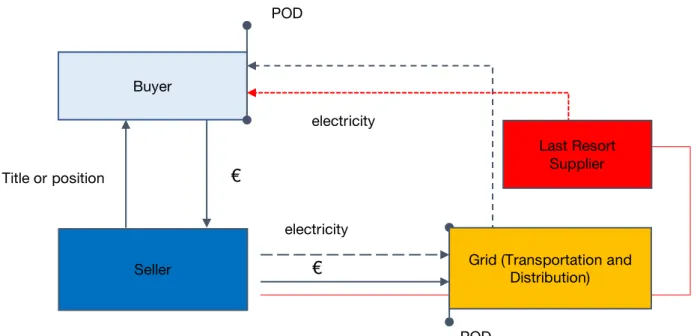
Following the electricity transfer in the infrastructure, only it is visible (and measurable) the entry point and exit point (circles) as shown in the figure 4 infra:
Electricity, from generation to final use, it is only measurable within the electricity infrastructure in a moment and place (e.g. where a meter is installed). Although the amount measured between the entry and the exit points, changes dominium across multiple parties, where there are also losses (or the quantity measured is not the same at exit point). It should be noticed that there is also capacity (green dashed line) and actual electricity (in blue), where it mixes with all the other power generating units. As part of the system also exists last resort units (if needed to fulfil all contracted electricity). With its natural fungible trait, so as its continuous supply (only concluding each time it passes the POD of the end user, questions emerge on the subject matter of the contracts that take place within the electricity infrastructure (the problem of mix goods of several owners).
7General opinions of the doctrine, court decisions and historical categorisation of energy or “rēs” are on the annexes.
Prod. A Com D User 1
Prod. B Com. b User 2
PPA
(kWh injected POD) - %losses
Electricity Supply Contract kWh measured (POD) All electricity injected in the Grid Last resort
Transportation and Distribution Grid
Distribution Agreement (Com. D and b do on behalf of Users 1 and 2 and Producer with DSO or TSO
Point of Delivery (POD) Capacity
Losses
Losses
Indeed as, soon as is injected into the grid, does not hold any characteristic that makes it possible to distinguish between producer A or B, if generated using coal or solar (where “green energy” is in most cases an abstraction represented by a title issued), where a fungible asset is being traded across multiple entities, namely when the producer does not contract directly with the end beneficiary. As also, when this primitive acquisition would emerge, before analysing the derived acquisition, if no appropriation was visible to determine or, separation occurs) or, the issue of time of the transfer and corresponding risk, across all chain, for a given right to a quantity of kWh. If for producers is considered, that the price is the amount of kWh injected into the grid and for commercialisation entities is that minus the losses (pre-determined) and for the consumer the amount of kWh measured (actual or estimated), the question is if A (producer) sells to ∆ (commercialisation entity) and then sells to User 1 (end user), how (and when) this transfer would occur (e.g. in case of underperformance, who would be liable?) If using the public electricity grid, the RQS assumes that the DSO (or TSO) is liable and, there is a shared burden between generators and DSO and, a right of return of the last against the first.
As the new European Network Codes are harmonising technical specifications, so that it is possible to integrate generation and consumption in different places (i.e. to transform into generic rēs or placing as a “commodity”). If it involves the use of the public electricity infrastructure (RESP), energy (namely electricity), turns out to have a very similar configuration of money (fungible trait, function, representation and circulation).
In similar terms, the TSO or DSO as managers of the network, turns out to be the central depository8
(equal elements, registration in an aggregated account, communication obligations, network management, even in the measurement regulation, is what is registered, that is "valid" for billing/metering), in fact, considering a supplier, turns out to have a right and, if not enough to meet the portfolio, can "buy" more of the same kind or quality, in the market, to an aggregator or last resort supplier. One could never say that there is an "absolute right" of x kWh, since it is neither possible to determine, isolate and separate, in specific.
III.
The question is:
a. if incorporeal “rēs” with economic value (where there´s no physical possession9) and; b. not a credit (emerging from a bilateral contract or civil responsibility).
This is the initial paradox that emerges, demanding a deconstruction of concepts, under penalty of leaving to impossible solutions.
8 The TSO is not either the counterpart and would not be assumed as a default the regime for irregular deposits for fungible
things (art.1205.º CC), in contrast with the CCom (406.º), and CVM (para. 1 of art. 100.º).
9 Possession will be used due to the initial (juridical) fact that puts a certain person in a potential position to claim ownership
Initial deconstruction
I.
The “Law of Things”, encompass in its derived10 legal definition, to things that are capable of possession (discussion of animus and corpus11). Although, where there was a great discussion over the cumulative existence of the animus, the corpus (as individualisation, externalisation of a given rēs), in the CC the definition is absent (art. 207.º refers as capable of). Or rather, with no corpus, the discussion of animus is subsequent and without content.
Moreover, applies to incorporeal realities (e.g. usufruct) and, others derived (e.g. securities and IP) and, have their own autonomous branch and, share a common trait: process to create an externalisation of legitimacy (title), to comprise (as a kernel) a given economic and social right (as representation and its public manifestation12), or a derived reality, so it could be object of property rights (as “a shell that covers and protects as a kernel of enjoyments”13), as corpus mēchanicum, that aims to determine, individualise an abstract right in the market. The question is how those titles are constituted, that for incorporeal things, the Civil Code has no direct answers14.
If under “obligational” rights (as opposed to real rights), more than inserting in one or another classification, as Jhering pointed out, there is the economic function of a given right, or beside the abstract construction, rights do not exist empty of an economic function.
II.
The ultimate interest protected by Law intermediates the objective and subjective rights between individuals. From this, the substantive property of a right cannot be done by the procedural norms - as a direct transposition of “āctiō” to “rights”, denying its own ontology and meaning - of the Institutes of the Justinian’s Corpus Juris Civilis15, where in the French case, comes closer to the definition of
rēs16, as “Biens”, being separated under Book II “Goods and various modifications of the property”, where includes rights and incorporeal things, from the “Different forms in which one acquires property”, under Book III) to achieve its end. This seems the original sin of the doctrine, namely when the Civil Code it is an abstract normative system17, leaving its application and interpretation to each individual and concrete case (as opposing common law systems). Although, both systems (with
10 Due to the notion of iūrisdictiō and dominium (over a certain rēs), should be understood within its normative system and time
(i.e. political structure). The notion of rēs is not strictly dependant on the last, although it changed considerably, namely autonomy of will as inherent to every human being.
11 There is a shift from substantia (from “essentia”, “οὐσία”) to corpus, which is not a perfect synonym.
12 As possession (act, dependant on will, peaceful (undisputed by third parties) in good faith, that precludes with time and can
be assigned.
13 Cf. Philbrick, Francis S., Changing Conceptions of Property Law, University of Pennsylvania Law Review, V. 86, N. 7 May,
1938
14 Concerning the structural options of the CC, namely, Luís Correia de Mendonça, As origens do Código Civil de 1966: esboço
para uma contribuição, Análise Social, vol. xviii (72-73-74), 1982-3.º-4.º-5.º, 829-867
15 Corpus Juris Civilis (comprises Institutiones Justiniani (based on Institutes of Gaius, with three books covering "persons",
"things" and "actions"), the Digest, the Codex Justinianus, and the Novellae Constitutiones
16 Moncada, Luís Cabral, Elementos de História do Direito Romano, Vol. 02, 1824, concerning the classification of rēs (chap. III) 17Considering the fundamental principles (axioms), the principle of non-contradiction where “the same attribute cannot at the
different constructions), Common Law is closer to the old Roman Law as it keeps “choses in action” and “choses in possession”, both under (personal) property rights, have these dual projections. Using the Common Law definition, of Choses in action, initially comprised all, where the definition is given by Channel, J., in Torkington v. Mage “Chose in action” is a known legal expression used to describe all personal rights of property which can only be claimed or enforced by action, and not by taking physical possession."18, then derived, by uses and namely, the admissibility of its assignment and, own regulation to different branches of Law.
However, was that impossibility to appropriate (as the need for “āctiōnēs” to enforce those rights), that the distinction emerged (as the procedural form to claim for a certain “āctiō”). Before questioning if a thing is movable or immovable, should be asked if the element “corpus” is there; if it is able to be object of appropriation or, legal rights, where depending on the personal bonds of the holder, may or may not (as a right to sue, as the original problem in common law) be assigned as the right is not intricately related to the holder.
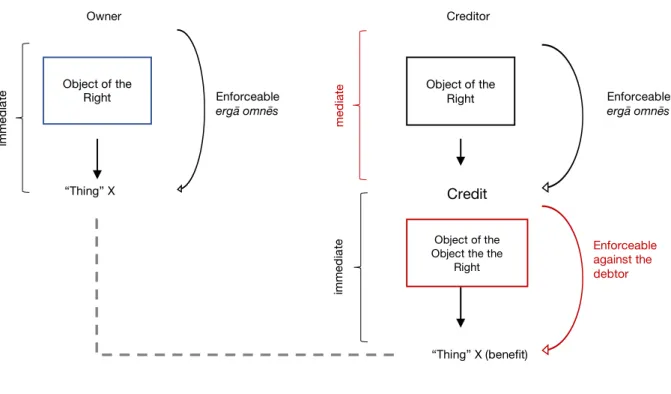
Strictly speaking, the enforceability is not a predicate of the objective right (real or obligational), but the juridical fact or act from which emerges (animus and anima). It may be said that, by virtue of the specific difference which is noted, the credit right, because it interconnects two persons, implies a horizontal relationship, whereas a real right, because it attributes certain dominium over a thing (or event19), implies a vertical relation.
III.
A certain record of a given kWh injected into the grid is not confused with the actual electricity injected. Although, this record serves to express its material representation (money - e.g. coins - is to value of exchange). There is no incorporation but a representation of a given right to a certain quantity of electricity that can be traded and discharged within the electric system.
By design, electricity can only be delivered using the electricity infrastructure (except the cases of direct wired PPA), where the DSO or TSO must know and keep records of who delivered and to who deliver. Considering the mechanism and purpose, money (and the banking system), securities (and the capital markets) and electricity (and the electricity infrastructure and market) share common attributes, where the first two have a given object of representation that is not confused with the represented right.
Using the definition of money, it is not consumable as a “thing”, although depreciates if considering its utility as a medium of exchange, by the effect of time in its value (1 + 𝑖)& and, also by the relative value, in nominal terms, of the exchange goods and services (i.e. impact of inflation). As a currency, its value is no longer attached to the object (e.g. paper money and not the gold standard20), but as being backed by central banks, where the last may artificially increase or decrease the relative value of a given currency (e.g. quantitative easing). The difference between the representative object of money (so as regarding securities) and the social function of money is also object of discussion.
18 as quoted in by W. S. Holdsworth, The History of the Treatment of "Choses" in Action by the Common Law, Harvard Law
Review, Vol. 33, No. 8 (Jun. 1920), pp. 997-1030, on Torkington v. Mage [1902] 2 KB 427
19 In the labour contract, (operum, not operis as the “services contract”) also the discussion is on the dominium, who can direct
a given work, not in the actual “opus”
There is no confusion between a given event or thing and the records of such events or things. Looking to what is being measured, is the number of kilowatts generated or consumed over one hour (e.g. 0.04 kW light bulb for five hours is equal to 0.2 kWh, of electrical energy). There is no separation in a physical sense, just that a certain amount of electrical energy flow passing through a certain measuring point, for a given period.
Electricity, in the same manner, needs these elements to allow its circulation, being forced by its nature, to be represented by a record21 (as possession, if this record - in paper or joint account (by book entry of the TSO or DSO) - assumes the assumption of the dominium) as one cannot own a specific quantity of electricity injected into the grid.
IV.
The rēs definition, going back to its initial and broader concept (iūs in rem), is not univocal, as one says “The thing is mine” (“rēs mea est”) but also, “Something happened” or, “X has to perform (facere) something”. The object can be a thing, as an act, or the result of such act (the case of locātiō operis). One may hold a thing but is not able to hold (physically) an event (or fact). No one confuses the records of events, with their actual manifestations. But realities, encompass time (namely futures) and, some “things” hold their substance in rest, others are motion or, the result of such motion (work22, “opus”) in a given matter.
iv - Fōrma substantialis (secunda)
“If there is a conceptual, and not simply a contingent, connection between dispositive concepts and legal rights and duties, there is also a conceptual, and not merely a contingent connection between such concepts and the types of event they report.” 23
Constitutive legal positions
I.
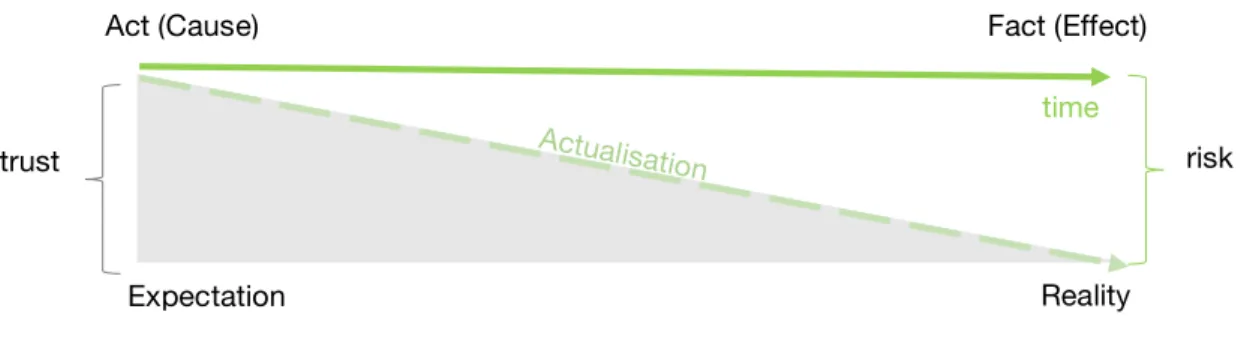
The figure of possession is not suitable so leaves to the construction of legal position (initial) related to a certain actual or future reality or, an act that would constitute a positive legal situation, based on capacity (potestās). It leaves to the general theory of juridical fact and its subjective imputation. Or the objective right (abstract), that confers a certain position to an individual, if out of will or physical event, namely a right of disposal. In the case of exploitation of a given work, the construction was held under a right of freedom and speech, considering currency and banking24, under an authorisation, where the
21 Cf., e.g. Plato’s theory of Forms (Ideas), as "shape" (μορφή, fōrma), and its "appearance" (φαινόμενα, phaenomena) 22 The discussion of an obligation of means or results, parallel with the criteria to distinguish employment or a services contract,
or guarantees and comfort letters.
23 Dworkin, Ronald, A matter of principle, Is there really no right answer in hard cases. Harvard University Press, 1985, reprint,
p. 125
24 Cf. ‘electronic money institution’ and ‘electronic money issuer’ definition under Directive 2009/110/EC of 16 Sep. 2009,
issuance of currency is reserved to central banks. IP, under the right of work and self-establishment, where the concrete subjective right emerges from an act (invention), where if granted (specification), there is an attribution of an exclusive monopoly to be exploited25. Hence, a license (to generate
electricity) confers this initial right of disponendī, similar to the corporeal things and its fruits26 or, where its use and fruition and the subsequent determination27 is dependent on the act that produces and delivers electricity, but keeping its legitimacy (cause) in the new constituted right.
Subjective rights28 are constituted towards a given individual based on potestās29, or the faculty of, given by an objective right (this is the reasoning why most Civil Codes lay down on the beginning the definition of capacity (as within emerge volūtās, but also responsibility), as general and common rules 30, to all matters and, the rātio of the separation principle (Trennungsprinzip) and abstraction principle (Abstraktionsprinzip) of the BGB.
Given an objective31 right (i.e. right to work, or the right of appropriation, as in the Code of 1887, not property), the physical reality (an event out of nature or, will or, agreed will), the Law only gives legal significance to events that can have legal effects32.
From this, a pure unilateral juridical act (under 295.º), must be adapted, otherwise, is a denying of logic of the system, as the legal situation does not necessary emerges from cooperation with two individuals, when all general part assumes more than one part, which operates in a mediate intersubjective level33 (and not as several times confused at the mediate objective level). When describing benefits, it is done under obligations, but the immediate result, namely if constitutive (or acquisitive) may, or may not be out of an agreement or delict.
Considering the constitution of subjective rights (not its modification or extinction), volūtās depends on potestās and, the system protects the legal certainty (effects should be in accordance with the intended will) of the parties (or individual) and, third parties in the legal traffic (as generic, where within each case, is determined by the legitimate interest not a generic and abstract interest).
Recalling the general principle of autonomy of will, and its corollaries, as the principle of freedom of stipulation (and to limit the legal effects) and, the general principles of good faith, against the public law, which operates under the principle of legality (e.g. art 3.º CPA).
II.
25 Similar to the right of use
26 Cf. para. 2 of art. 212.º and 213.º CC. Similar §99 BGB, although, the §100 also extends to uses. 27 In this case, the fruits emerge on the person with the right of use.
28 Moncada, Luís Cabral, Lições de Direito Civil (Parte geral), Volume 01, 1932, p. 50 "Things are synonymous with assets,
meaning by this word those things which may be used by man, by the powers that exercise upon them: Bona discuntur ex eo
quod beant, hoc est, beatos faciunt; bera est prodesse (DL. L. 16 49), and Moreira, Guilherme Alves, Instituições de Direito Civil
Português, Tomo 01, 1907, p. 337
29 "The right to property, mancipium, domimum, corresponds, in the content of the powers and faculties which constitute it, to
his potestas over the alleni juris" cf. Moncada, Luís Cabral, Elementos de História do Direito Romano (Fontes e instituições), 1923, p. 83
30 Moreira, Guilherme Alves, Instituições de Direito Civil Português, Tomo 02, 1925, p. 28-29
31 Cf. “They define the object of the law the things that are subject to our power or on which the will to be able to exercise its
dominion. This notion of the subject-matter of the law is rigorous with respect to real rights, but it cannot apply to all subjective rights, nor is there any domain at all." Moreira, Guilherme Alves, Instituições de Direito Civil Português, Tomo 01, 1907, p. 331
32 For Aristotle, substance is a “principle and a cause” of being. aitia (“cause” or “explanation”), is “that out of which a thing
comes to be, and which persists” (Physics), as material cause. In a second sense, a cause is “the form (…) the account of the essence”, the formal cause. A third sense, efficient cause, is “the primary source of change or rest”. Fourth is the final cause, as “the end (telos), that for which a thing is done”.
Even under the previous Code, José Tavares defined a "juridical fact, therefore, is all the event that the objective law attributes effects to the acquisition, modification or extinction of a right. (...) the fact that the right is acquired is what is called the title or cause of the right.”34 as "In the original acquisition the extension of the acquired right depends only on the fact or constitutive title".35
The same Author writes "Any constitution of a right implies its acquisition36, since there are no
subjective rights without an individual."37 and "are cases of original acquisition, the occupation of movable things (art. 1318.º et seq.), usucapion38 (art. 1287.º et seq.), the acquisition of copyright by
literary or scientific creation, etc.”.39
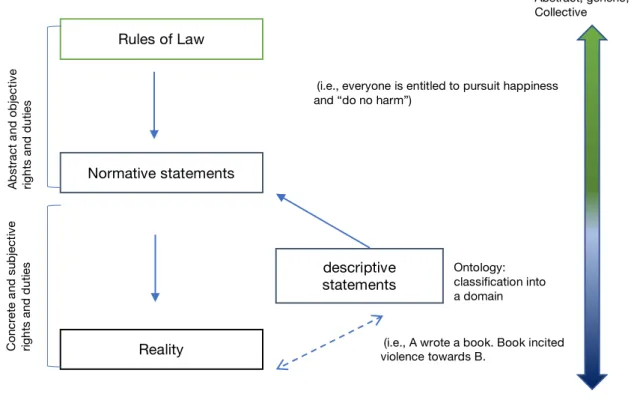
There is not (always) agreement or delict, but under the right of freedom40 (abstract), e.g. writing a book
creates (a new) legal situation, where an individual has the power (potestās, as a positive legal situation) to either use or not (potential or, a right of disposal)41, so as negative (generic) position externally (as abstention to perform a certain - illicit - act42). There are two sets of bonds, the last; we could say it that for every abstract right, there is also a generic duty.43 One can write a book within his liberty but also has a duty (or a generic obligation44) to not infringe other people’s rights. There is no direct bilateral
negōtium with any party, there is a generic duty that limits or a contrāriō, there aren’t rights ergā omnēs
without obligations (or duties) ergā omnēs.
It is on the last, i.e., that regimes of tort and delict, unfair enrichment are based. There is no concrete
nexus before potential delict, there is, at the same level of rights, the correspondent (generic) duty.
III.
As the preference of using the negōtium (iūris) instead of a situation (or act), increases the confusion (the legal situation is not an equivalent of an intersubjective relation45. When stating that if not a thing, then is a credit46, implies the idea of an obligation (out of cooperation between two parties or emerging under civil liability).
34 Tavares, José, Os principios fundamentais do Direito Civil, Coimbra Editora, 1922, p. 65 35 Pinto, Carlos Alberto Mota, op. cit., p. 365
36 Cf. 1316.º and a) and c) of 1317.º CC 37 Pinto, Carlos Alberto Mota, op. cit. p. 359 38 or acquisitive prescription
39 Pinto, Carlos Alberto Mota, op. cit., p. 360
40Cf. “No one can compel me to be happy in accordance with his conception of the welfare of others, for each may seek his
happiness in whatever way he sees fit, so long as he does not infringe upon the freedom of others to pursue a similar end which can be reconciled with the freedom of everyone else within a general workable law — i.e. he must accord to others the same right as he enjoys himself.” (…) The only conceivable government for men who are capable of possessing rights, even if the ruler is benevolent, is not a paternal but a patriotic government.” Kant, On the Relationship of Theory to Practice in Political Right
41 Cf. Ac. STJ 08A1920 of 01/07/2008, where “The intellectual creator of the work has its right recognised regardless of
registration, deposit or any formality whether it is simple (singular) or complex (collaborative, composite or collective) authorship.”, “3) Copyright implies exclusive rights of a patrimonial character (disposition, enjoyment, use, reproduction and presentation to the public with a perception of remuneration) and moral rights.”
42 Cf. Kant stated, “What essentially distinguishes a duty of virtue from a juridical duty is the fact that external compulsion to a
juridical duty is morally possible, whereas a duty of virtue is based on free self-constraint.” (The Doctrine of Virtue). Since hypothetical imperatives, such as the prudential maxims will promote personal happiness, cannot be applied universally to every human being, as do not meet the formal test for moral laws, as expressed in the Categorical Imperative, but are not “immoral”, as well.
43 Cf. Tavares, José, op. cit., p. 254
44 Moreira, Guilherme Alves, Instituições de Direito Civil Português, Tomo 03, 1907, p. 3
45 Cf. Moncada, Luís Cabral, Elementos de História do Direito Romano, Vol. 02, 1824, concerning the classification of a juridical
act (chap. IV)
46 "The obligation or right of credit, as a legal bond whereby one person may be compelled to provide a benefit to another,
under penalty of satisfaction of his or her patrimony, is a relatively recent concept of formation in Roman law." Moncada, Luís Cabral, op. cit., p. 86-87