
Universidade Católica Portuguesa
Faculdade de Engenharia
The power of credit card numbers and enhanced CVVs
Valentim Vieira de Oliveira
Dissertation submitted as a fulfilment for the degree of
Master of Information Systems Security
Jury
Professor Manuel José Martinho Barata Marques, PhD (President)
Professor Rui Jorge Correia Mendes Alves Pires, PhD
Professor Tito Lívio dos Santos Silva, PhD (Supervisor)
September 2013
Declaration
These studies were conducted under the supervision of Professor Tito Santos Silva. The work presented in this thesis is the result of original research carried out by myself, in collaboration with others, whilst enrolled in the Faculdade de Engenharia da Universidade
Católica Portuguesa as a candidate for the degree of Master of Information Systems
Security. This work has not been submitted for any other degree or award in any other university or educational establishment.
Valentim Oliveira September 2013
Resumo
O roubo de informação respeitante a cartões de crédito é uma ameaça ao comércio electrónico. Os sistemas de pagamento introduziram o conceito do CVV2 como forma de mitigar o risco baseado no princípio de que estes valores não deveriam ser armazenados uma vez completa a transação. Sistemas, comunicações e bases de dados comprometidos resultam na captura ilícita desta credencial de autenticação frustrando assim o seu propósito inicial. Este estudo propõe a criação de CVVs dinâmicos (enhanced CVVs) como forma de contrariar estes ataques. Desta forma, o compromisso de todos os elementos presentes numa ou mais transações não são suficientes para garantir o sucesso na autenticação de transações subsequentes.
É essencial que qualquer novo método de pagamento tome em conta os factores determinantes para que seja aceite por todas entidades participantes. Este estudo propõe dois métodos de CVVs dinâmicos: Matriz de CVVs e CVVs Longos. Os métodos propostos baseiam-se na infraestrutura atual de pagamentos baseados em cartões, com o objectivo de mitigar as maiores ameaças atuais, tendo o cuidado de manter o delicado equilíbrio dos factores determinantes para todos os participantes.
Ambos os métodos são analisados na vertente da segurança de forma a avaliar, e comparar, o nível de resistência perante situações de compromisso de transações. Questões relativas à implementação e à migração são igualmente analisadas de forma a determinar os impactos respeitantes à adoção dos métodos propostos
Palavras chave: pagamentos electrónicos, comércio electrónico, número de cartão de crédito, CVC2, CVV2, Problema do Colecionador de Cromos.
Abstract
Theft of credit card information is an increasing threat to e-commerce. Payment systems introduced CVV2 as a method to mitigate the threat based on the principle that these values would not be stored once the transaction has completed. Compromised systems, communications and databases result in the unlawful capture of this authentication credential and therefore thwart its initial purpose.
This study proposes the creation of dynamic CVVs (enhanced CVV2s) in order to counter these attacks. Thus a compromise of all the elements in one or more transactions will not be sufficient to guarantee successful authentication of subsequent payments.
It is essential for success, that any new payment scheme take into account the key factors determinant for the acceptance of each of the participating parties. Two implementation schemes of enhanced CVVs are proposed: Matrix CVVs and Long CVVs. The proposed methods build upon the current card based e-payment infrastructure with the objective of mitigating present day threats whilst maintaining the delicate equilibrium of key factors for all participating parties.
Both schemes are analysed at a security level so as to evaluate, and compare, the level of resistance function of the number of previously compromised transactions. Implementation and migration issues are equally analysed so as to determine the impacts of adoption of the proposed schemes.
Key words: e-payments, e-commerce, credit card number, CVC2, CVV2, Coupon Collectors Problem.
Acknowledgement
A realização desta tese só foi possível com o contributo e apoio de inúmeras pessoas. Gostaria de aproveitar esta oportunidade para agradecer a todos os que tornaram este estudo possível.
Agradeço ao Professor Tito Santos Silva por me dar liberdade nas linhas de pesquisa e por me desafiar a fazer melhor.
Não posso deixar de agradecer à SIBS (Sociedade Interbancária de Serviços) por proporcionar a oportunidade de aprender mais; por me dar um contexto de desafio constante e estimulante. Gostaria de agradecer ao Dr. Vítor Bento por ser um exemplo a seguir, ao Eng.º João Luís Batista por me ensinar a fazer sempre melhor e ao Dr. Francisco Roxo por ter despoletado esta viagem.
A todos os meus colegas que carinhosamente me apoiam e que juntos formam uma equipa fantástica. Aos colegas com quem tenho trabalhado diretamente, em especial à equipa atual que formam um grupo de elite; obrigado.
Ao António Teixeira, que é um exemplo como profissional mas acima de tudo como Homem, um agradecimento especial.
Acima de tudo, esta dissertação não teria sido possível sem o apoio da minha família. Dedico esta dissertação aos meus pais, Valentim e Purificação, a minha esposa Susana, que me apoiou incondicionalmente, e às minhas filhas Raquel e Carlota por me darem carinho e força ao longo destes anos.
Table of contents
Chapter 1: Introduction to the study ... 1
1.1 Introduction to the Problem ... 1
1.2 Background of the Problem ... 2
1.2.1 Fraud Context ... 2
1.2.2 Protecting Financial Services on the Internet ... 2
1.2.3 CVV2 Introduction ... 3
1.2.4 Security Properties for CVV2 ... 3
1.3 Statement of the Problem ... 4
1.4 Statement of Purpose ... 4
1.5 Aims and Objectives of Study ... 5
1.6 Research Question ... 5
1.7 Definition of Terms ... 5
1.8 Research Method ... 5
1.9 Description of Thesis Organisation ... 6
Chapter 2: Review of Publications ... 7
2.1 Introduction ... 7
2.2 Research streams ... 7
2.2.1 Electronic Payments ... 7
2.2.2 Payment systems success factors ... 8
2.2.3 Passwords... 8
2.2.4 Coupon Collectors Problem ... 8
2.3 Conclusions ... 9
Chapter 3: Current card based payment schemes description... 10
3.1 Introduction ... 10 3.1.1 Overview... 10 3.2 CVV2 scheme description ... 10 3.2.1 Authentication elements ... 10 3.2.2 Parties ... 12 3.2.3 Infrastructure setup ... 13 3.2.4 Transaction flow ... 14
3.3 3-D Secure scheme description ... 15
3.3.1 Authentication elements ... 15
3.3.2 Parties ... 16
3.3.3 Infrastructure setup ... 17
3.3.4 Transaction flow ... 17
Chapter 4: Key success factors for new e-payment scheme proposals ... 19
4.1 Introduction ... 19
4.1.1 Overview... 20
4.2 Key factors for user acceptance ... 20
4.2.1 Characteristics analysis ... 20
4.3 Key factors for merchant acceptance ... 24
4.3.1 Characteristics analysis ... 25
4.4 Key factors acceptance by other parties ... 26
Chapter 5: Enhanced CVV2 scheme proposals ... 27
5.1.3 Chapter overview ... 27
5.2 Multiple CVV implementation for 3-D Secure merchants ... 28
5.2.1 Issuer card data preparation ... 28
5.2.2 Card personalisation ... 29
5.2.3 Merchant checkout process ... 30
5.2.4 Issuer cardholder authentication ... 31
5.3 Long CVV implementation for 3-D Secure merchants ... 33
5.3.1 Issuer card data preparation ... 33
5.3.2 Card personalisation ... 34
5.3.3 Merchant checkout process ... 34
5.3.4 Issuer cardholder authentication ... 35
5.4 Multiple CVV implementation for non 3-D Secure Merchant ... 37
5.4.1 Merchant checkout process ... 37
5.4.2 Issuer authorisation process ... 41
5.5 Long CVV implementation for non 3-D Secure Merchant ... 42
5.5.1 Merchant checkout process ... 42
5.5.2 Issuer authorisation ... 46
Chapter 6: Enhanced CVV2 scheme security analysis ... 49
6.1 Introduction ... 49 6.1.1 Chapter overview ... 49 6.2 Attack scenarios ... 49 6.2.1 Data Breaches ... 50 6.2.2 Botnets ... 51 6.3 Mathematical background ... 52
6.3.1 MCVV Coupon Collectors Problem ... 52
6.3.2 LCVV Coupon Collectors Problem ... 53
6.4 Multiple CVV guessing probability... 53
6.4.1 Expected number of known MCVV positions after t transactions ... 54
6.4.2 Probability of occurrence of situations of coinciding positions ... 55
6.4.3 Guessing probability for situations of coinciding positions ... 58
6.4.4 TCVV guessing probability ... 58
6.5 Long CVV guessing probability ... 60
6.5.1 Expected number of known LCVV positions after t transactions ... 60
6.5.2 Probability of occurrence of situations of coinciding positions ... 62
6.5.3 Guessing probability for situations of coinciding positions ... 65
6.5.4 TCVV guessing probability ... 65
6.6 Multiple CVV vs. Long CVV analysis ... 67
6.6.1 Comparing ECVV sizes function of number of compromised TCVVs .... 67
6.6.2 Comparing ECVV sizes for one compromised TCVV... 69
Chapter 7: Enhanced CVV2 scheme implementation analysis ... 71
7.1 Introduction ... 71
7.1.1 Chapter overview ... 71
7.2 Issuer ... 71
7.2.1 Card data preparation ... 72
7.2.2 Card personalisation ... 73
7.2.3 3-D Secure cardholder authentication ... 73
7.2.4 Card payment authorisation ... 74
7.2.5 Merchants ... 74
7.2.6 Non 3-D Secure merchant checkout process ... 75
7.3 Cardholders ... 76
Chapter 8: Summary and conclusions ... 77
8.1 Summary of Findings ... 77
8.1.1 Payment systems success factors ... 77
8.1.2 Security ... 78
8.2 Directions for future work ... 79
8.3 Conclusion ... 81
Table of tables
Table 5.1 – TCVV PC table and respective permutation example ... 44
Table 5.2 – LCVV PC table entry example ... 47
Table 6.1 – Average number of known MCVV matrix positions after t transactions... 55
Table 6.2 – Probability of occurrences of coinciding MCVV positions ... 57
Table 6.3 – MCVV guessing probability ... 59
Table 6.4 – Average number of known LCVV digits after t transactions ... 61
Table 6.5 – Probability of occurrences of three coinciding LCVV digits ... 64
Table of figures
Figure 3.1– Traditional bank card ... 14
Figure 3.2– Standard payment authorisation transaction flow ... 15
Figure 3.3 – 3-D Secure transaction flow ... 18
Figure 5.1 – MCVV card example ... 30
Figure 5.2 – Traditional checkout example ... 30
Figure 5.3 – Issuer cardholder authentication with MCVV example... 32
Figure 5.4 – MCVV example. ... 32
Figure 5.5 – LCVV card example ... 34
Figure 5.6 – Traditional checkout example ... 35
Figure 5.7 – Issuer cardholder authentication with LCVV example ... 36
Figure 5.8 – LCVV example ... 36
Figure 5.9 – Checkout with MCVV example ... 39
Figure 5.10 – MCVV example. ... 39
Figure 5.11 – ECVV card front example ... 40
Figure 5.12 – TPAN construction example ... 40
Figure 5.13 – Checkout with LCVV example ... 45
Figure 5.14 – LCVV example ... 45
Figure 5.15 – ECVV card front example ... 46
Figure 6.1 – Average number of known MCVV positions after t transactions ... 55
Figure 6.2 – Probability of occurrences of coinciding MCVV positions ... 58
Figure 6.3 – MCVV guessing probability ... 59
Figure 6.4 – Average number of known LCVV digits after t transactions ... 62
Figure 6.5 – Probability of occurrences of three coinciding LCVV digits ... 65
Figure 6.6 – LCVV guessing probability ... 67
Figure 6.7 – Guessing probability function of the number of compromised TCVVs ... 68
Figure 6.8 – Guessing probability for one compromised TCVV, function of the ECVV size ... 69
Figure 6.9 – Guessing probability for ten compromised TCVVs, function of the ECVV size ... 70
Figure 7.1 – Card personalisation examples ... 73
Figure 7.2 – Checkout modifications ... 75
Abbreviations
Abbreviation Description
3-D SET Three Domain Secure Electronic Transaction protocol.
BIN Bank Identification Number.
CAP Chip Authentication Program.
CD Check Digit. Protects the coherency of the PAN with the Luhn formula for modulus 10 check digit.
CID Card Identification Number. American Express terminology for the three digit cryptogram placed on or besides the card signature panel that protects the integrity of the Card Number and the Expiry Date on card not present transactions.
CNP Card Not Present transaction.
CVC Card Verification Code. Also referred to as CVC1. Mastercard terminology for the three-digit cryptogram placed on the magnetic track 2 that protects the integrity of the magnetic track data namely that Card Number, the Expiry Date and the Service Code.
CVC2 Card Verification Value 2. Mastercard terminology for the three-digit cryptogram placed on or besides the card signature panel that protects the integrity of the Card Number and the Expiry Date on card not present transactions.
CVK2 Cryptographic key used in the calculation of the CVV2 cryptograms. CVV Card Verification Value. Also referred to as CVV1. Visa terminology
for the three-digit cryptogram placed on the magnetic track 2 that protects the integrity of the magnetic track data namely that Card Number, the Expiry Date and the Service Code.
CVV2 Card Verification Code 2. Visa terminology for the three-digit cryptogram placed on or besides the card signature panel that protects the integrity of the Card Number and the Expiry Date on card not present transactions.
ECVV Enhanced Card Verification Value. Abbreviation used in this study in order to refer to MCVVs or LCVVs indistinctly.
EMV Chip card application on payment bank cards. EMV stands for Europay Mastercard and Visa who first developed the chip card based standards. iCVV Card Verification Value that is placed on the EMV chip application on
payment card
IIN Issuer Identification Number. Referred to as the BIN in the banking industry.
IPS International Payment Systems.
LCVV Long CVV. Refers to one of the Enhanced CVV2 techniques that constitute in a long multi-digit CVV2.
MCVV Multiple CVV. Refers to one of the Enhanced CVV2 techniques that constitute matrix or group of CVV2s.
MOTO Mail Order / Telephone Order payments
PAN Primary Account Number. Also generally referred to as the Card Number.
PIN Personal Identification Number.
PVV PIN Verification Value. A four-digit cryptogram used to validate PINs. TCVV Transaction Card Verification Value. Enhanced CVV2 present in a
transaction making use of the MCVV or LCVV scheme.
TCVV PC Transaction CVV Positions Code. Indicates the position of the CVV in the Matrix CVV or the positions of the CVV digits in a Long CVV. TPAN Transaction PAN. Transformed PAN used in the Enhanced CVV
scheme transaction.
SET Secure Electronic Transaction.
SMS Short Message Service.
Chapter 1: Introduction to the study
1.1 Introduction to the Problem
The credit card and the PIN together are one of the most successful authentication mechanisms of all times. Tens of millions of transactions are authenticated daily through the combined use of cards and PINs [6] [11]. This dual factor authentication mechanism seems to have achieved a favourable balance between security and user convenience.
Throughout the years the card number and expiry date has been gradually adopted for authenticating MOTO (Mail order and Telephone Order) transactions. With the growth of the Internet, and the consequent need to perform commerce over this channel, the same authentication means was adopted for yet this CNP (Card Not Present) environment. Credit card numbers are the dominant payment method in overall e-commerce [9] [10] [27]. The anonymous nature of the Internet together with the possibility of accessing high volumes of transactions, among other factors, created a propitious context for some attack vectors to evolve. Various attempts have been made to implement a standard for secure electronic transactions over the Internet [26] [32]. SET (Secure Electronic Transaction) [2] was the first major attempt by Visa and Mastercard to establish a de facto standard for securing credit card transactions over the Internet. Various initiatives have followed such as D SET and 3-D Secure (under the brand names "Verified by Visa" for Visa and SecureCode for Mastercard) but none have yet managed to prevail as the dominant e-payment authentication mechanism.
Meanwhile the payment systems have created an auxiliary authentication token, for CNP transactions, that consists on three digits printed on the signature panel. This Card Security Code is known as the CVV2 (Card Verification Value 2) by Visa, CVC2 (Card Verification Code 2) by Mastercard and CID (Card Identification Number) by American Express. The concept behind this code is that the cardholder, by supplying this number proves that he is, or has been, in physical possession of the card.
The CVV2 has been placed on cards since 1998. Since then the adoption by merchants has been slow and gradual. The CVV2 has been effective in deterring certain types of attacks such as card number generation and extrapolation or attacks resulting from the capture of card magnetic track data.
Recent attacks tend to capture large quantities of card transaction data [27] [28], sometimes together with the CVV2. The static nature of the CVV2 constitutes a vulnerability in these
cases, given that with the compromised card number, expiration date and CVV2 a fraudster may perform subsequent transactions at ease.
1.2 Background of the Problem
1.2.1 Fraud Context
Fraud on the Internet has risen in the first years of this century in scale and in sophistication [8]. E-commerce and online banking systems have been the preferred targets for these attacks. The capture of financial services authentication credentials has been the main objective for these attacks [7]. A specialized electronic payment fraud industry has emerged covering all areas of the value chain, from the search of vulnerabilities, and malware development, through system compromises and botnet commercialization to the fraudulent use of compromised credentials and money laundering [28].
Two types of attacks have been taking place, compromising a vast number of credentials: malware [46] and data breaches [43].
Malware distributed from an ever growing fleet of compromised systems drawn into botnets [44], of unimaginable scale, have put at risk millions of users. The openness nature of the Internet and the non security aware computing techniques of the beginning have left open a vast scope of vulnerabilities that have been challenging to patch-up. The number of vulnerabilities that are disclosed yearly [47] denote a long struggle yet ahead. Botnets have made use of these weaknesses to propagate through the Internet, hijacking computers into their net and subsequently harvesting whatever data they can from the users' systems.
In recent years a number of incidents of data breaches have occurred [44] at payment processors and merchants compromising tens of millions of card detail records with authentication data, such as CVVs. The number of compromised cards has been of an unprecedented scale affecting at some times in a single incident a 100 million cards [28], corresponding to 2% of bank cards in circulation in the world.
1.2.2 Protecting Financial Services on the Internet
The simpler "bank to client" context of online banking systems makes the adoption of new authentication mechanisms a manageable task. Password matrixes, SMS or CAP are examples of the instruments that the banks have been introducing so as to authenticate their
Unfortunately e-commerce poses a more complex context than online banking systems. The adoption of a viable solution in this multi-sided platform environment depends on attaining critical mass over a reasonable space of time for the involved parties[30]. Thus all parties (issuers, payment systems, acquirers and namely cardholders and merchants) have to be assured enough value to embark in any proposed solution.
Various attempts have been made to implement a standard for electronic transactions over the Internet by the payment systems. SET, 3-D SET, SPA and 3-D Secure [26] are the major initiatives in this field. Some have failed whilst others struggle to achieve a widespread adoption in the market.
The lack of a generally accepted de facto standard for e-commerce security has given way for the credit card number and expiry date to sustain itself as one of the preferred methods for these transactions [9].
1.2.3 CVV2 Introduction
The credit card number and the expiry date were the elements that secured most of the transactions on early e-commerce sites. This method of payment was very convenient for the common shopper and the fact that most potential buyers carried credit cards with themselves guaranteed a vast base as a starting point.
Unfortunately the security level of this adopted method was not enough to resist the harsh environment of the Internet.
Attacks, such as credit card number and expiry date generation or extrapolation, are extremely simple to perform and have a success rate that cannot be ignored. Large-scale attacks, sometimes performed from jurisdictionally uncontrolled geographical regions, are relevant, if not protected.
To counter these relevant threats, payment systems introduced, as early as 1997 the CVV2 concept. The principle behind this three-digit number was that it would give some assurance that the person performing the payment had the card physically available at the moment of purchase.
1.2.4 Security Properties for CVV2
The CVV2 value is calculated through a CVV calculation algorithm that is based on several rounds of DES calculations making use of a double length (112 bit) cryptographic key. The end result are three decimal digits that are printed on or near the signature panel. In principle
this value will only be printed on the card and can only be validated by the card issuer, or any delegated party, that has the cryptographic keys to validate the CVV and an HSM to perform the validate CVV function.
At the moment of purchase the merchant will prompt the customer for these three digits, along with the card number and expiry date. These values will be routed through to the issuer that will validate the correctness of the value. After the transaction has been authorized all traces of the CVV2 should be eliminated.
An attacker trying to perform a transaction by guessing a CVV2, for a known card number and expiry date, will have a one in a thousand chance of getting the right CVV2.
1.3 Statement of the Problem
Botnets spreading malware have compromised millions of computers worldwide. Customer education, antivirus developments and a whole range of other protection initiatives have not been able to deter this threat and as a consequence many attacks make use of data collected at the users’ systems, including card numbers and CVV2s.
Data breaches have, during recent years, reaped hundreds of millions of records with card data [44], sometimes with CVV2 data. The payment systems have taken great efforts in establishing best practices through the Payment Card Industry - Data Security Standard [5] initiative. In this program all parties that process, transmit or store card data are only allowed to keep cardholder data if properly protected, and no sensitive authentication data, such as CVV2s, may be stored after authorization, even if encrypted. By doing so risks deriving from the compromise of databases are greatly reduced.
The lack of a robust and simultaneously convenient method for authenticating transactions on the Internet hinders the growth of e-commerce. The CVV2 is not effective to counter these major attacks.
1.4 Statement of Purpose
A new method for authenticating e-commerce transactions is required to enhance the security needed to mitigate present-day major threats. It is however crucial that the subtle balance of characteristics be maintained so as to have success.
User convenience must be maintained at an acceptable level, and user security perception must be preserved to ensure confidence in any new scheme.
Attaining critical mass on a cardholder perspective and on a merchant perspective has been behind many failures. Building upon the unprecedented existing infrastructure, minimizing impacts and guaranteeing a migration process is critical for the success of any new scheme.
1.5 Aims and Objectives of Study
This dissertation proposes and analyses two methods for securing e-commerce transactions that consists on having specific CVV2s for each transaction, thus a CVV2 of dynamic nature. In this way, the illicit capture of transaction data, including one of these new Enhanced CVVs, will not be sufficient to perform subsequent transactions. Both methods are compared so as to attain their resistance in case of a compromise of transaction data.
The proposed schemes maintain impacts on involved parties and infrastructure at a minimum and guarantee ease of migration.
1.6 Research Question
The main focus of this study is to determine the extent to which the Enhanced CVVs grant security in a case of compromise of card data.
The study will determine the probability that an attacker, that has obtained compromised data by intercepting a determined number of transactions, will have in successfully executing a fraudulent transaction.
1.7 Definition of Terms
Card Security Codes have been introduced by the payment systems to protect the integrity of certain authentication elements. The first Card Security Code introduced by the payment systems had the objective of protecting the track 2 data from being doctored. Visa named it CVV and Mastercard CVC, although both are calculated using exactly the same algorithm. The CVV2 or CVC2 was introduced to secure the card number and the expiry date making use of the same algorithm with some variations on the input.
This study will refer to the CVV2, CVC2 and the CID as the CVV2.
1.8 Research Method
This study will announce two implementation variants for Enhanced CVV2s and will analyse their security robustness in face of a situation of compromised transactions. Impacts resulting from the effort necessary to prepare the existing card payment system infrastructure
to support this new method as well as migration issues are scrutinised given the importance these factors have towards a global acceptance.
1.9 Description of Thesis Organisation
The following chapter, "Chapter 2: Review of Publications", will look into the publications pertaining to the streams of knowledge developed in this study in order to perceive the essence of current knowledge.
In "Chapter 3: Current card based payment schemes description" the current CVV2 based scheme and the 3-D Secure scheme are described. The authentication elements, the involved parties and their respective roles are described. An analysis of the flux of information during the setup and during a transaction will complement the understanding of these systems. “Chapter 4: Key success factors for new e-payment scheme proposals” describe the factors that are determinant for the acceptance by each party and comments the changes that the proposed schemes entail.
In “Chapter 5: Enhanced CVV2 scheme proposals” the proposed solutions are described on a functional point of view.
A security analysis is conducted in "Chapter 6: Enhanced CVV2 scheme security analysis" calculating the robustness level of either of the Enhanced CVV2 implementation variants in a situation where transaction data is compromised.
Implementation issues, identifying the modifications that have to be implemented at each phase by each party and identifying the involved effort is analysed in "Chapter 7: Enhanced CVV2 scheme implementation analysis".
Finally “Chapter 8: Summary and conclusions” Summarizes the study suggests future research streams and draws final conclusions.
Chapter 2: Review of Publications
2.1 Introduction
Research into the themes covered by this study led to the compilation and analysis of an extended number of publications. The main streams of research were in the following fields:
Electronic Payments - key words: Electronic Payments, Card Payments, CNP, Card
Not Present Payments, E-commerce Payments Security, Electronic Commerce Payments, Internet Payments, Web Payments, Payment Protocols, micropayments;
Bank cards - key words: Bank card, Credit Card, Debit Card, ISO 7812;
CVV2 - key words: CVV, CVV2, Card Verification Value, CVC, CVC2, Card
Verification Code, CSC, CSC4, Card Secret Code;
Payment Fraud - key words: Payment Fraud, Card Payment Fraud, Malware,
Phishing, Skimming, Counterfeit, LSNR, Lost Stolen and not received, Key logger, Trojan, Data Breach;
Authentication Criteria- key words: Authentication, Authentication: Requirements,
Criteria, Effectiveness, Quality, Security;
User convenience - key words: User convenience, Human Factors, Usability,
Acceptability.
Password - key words: Password, Password Card, Password Matrix, Password Table,
Code Card, TAN, Transaction Account Number, OTP, one-time password;
Coupon Collectors Problem - key words: Coupon Collectors Problem.
Payment systems success factors - key words: Payment systems success factors,
Critical mass, Start-ups.
2.2 Research streams
2.2.1 Electronic Payments
A vast number of Internet payment protocol publications [14] [17] have been issued throughout the last two decades and many have been implemented [32]. Most publications refer to the credit card transactions as being the most used means to pay on the Internet [9] [10] [27], at their time, and then go on to announce or analyse yet one more protocol (ex. CAFE, CyberCash, DigiCash, iKP, MicroMint, MilliCent, MiniPay, NetBill, NetCard, NetCash, NetCents, NetCheque, NetChex, PayWord, QIPP, SEPP, SET, 3-D SET and STT). Although credit cards have been the predominant means of payment on the Internet, a limited body of knowledge examine these payments with or without the CVV2, and even so in very broad terms.
No studies analyse the card payments in order to understand what are the fundamentals that cause to be the most popular means of payments.
2.2.2 Payment systems success factors
Many studies, some proposing new Internet payment protocols, identify the requirements that authentication mechanisms on Internet payment protocols should accomplish [6] [13] [16].
Earlier studies gave great relevance to technical criteria namely security issues, including anonymity, accountability, authentication and irrefutability. Subsequent studies [21] [22] [31] add user related criteria such as ease of use, security perception and trustworthiness. This shift results from the failed adoption of the SET protocol, backed by the major international payment systems, that had user convenience issues.
Later studies [33] [34] focus on the multi-party aspects of these systems and on the fact that all parties must perceive benefit from the adoption of these systems. If any participating party does not have their interests safeguarded then they by themselves may embargo the adoption of the new systems. Out of these studies requirements for merchants and all other participating parties have been identified.
2.2.3 Passwords
Although passwords can be considered a part of modern society's day-to-day activity, few in-depth academic studies covering the subject of passwords have been published [15] [20] [21] [29]. References to password matrixes or partial password authentication are found but studies on these mechanisms are scarce.
2.2.4 Coupon Collectors Problem
The Coupon Collectors Problem[35] determines the expected number of coupon draws, with replacement, to complete a set of a determined number of coupons. Recent studies [40] [41] [42] have researched various variations of this problem.
Having k coupons drawn at each draw, or choosing the least withdrawn coupon at each k coupon draw, completing m number of coupon sets are but some of the variations studied along these papers.
In this study two particular variations are studied that consists in determining the expected number of drawn distinct coupons after a number of j draws, where the draw reveals one or three coupons at a time. These variants are used to determine:
The number of CVVs, out of a set of n CVVs, that are known to an attacker intercepting transactions with these CVVs.
The number of digits, out of a set of n CVV digits, that are known to an attacker intercepting transactions where each transaction holds three of these CVV digits.
2.3 Conclusions
Much study on the search for an adequate Internet payment protocol has been carried out. The dominant Internet payment protocol, based on credit cards, has not been the focus of most research. The CVV2 cryptograms have contributed to elevate the security level of Internet credit card based payments however this mechanism has not been a subject of interest in academic research. Although some research has covered the properties of passwords, very little mention of partial passwords and password lists, matrixes, cards, etc., can be found. Global fraud statistics are frequently noted as lacking but regional and industry fraud trends are increasingly available.
Chapter 3: Current card based payment
schemes description
3.1 Introduction
With the public adoption of the Internet came the need to develop a commerce platform that could insure security to payments. Due to the lack of an adequate e-payment protocol the credit card number and expiry date sustained itself as a de facto electronic payments method for the Internet from the very beginning to this date. Due to the fact that a valid card number and expiry date are easily guessable it has been vulnerable to attacks that simply generate card numbers and expiry dates in the hope that a valid pair will be accepted.
The payment systems meanwhile introduced the CVV2 [4] [23] [24]. This three-digit token, printed on or besides the signature panel on the back of the card, was introduced in order to validate that the cardholder is in possession of a genuine card in CNP transactions. Guessing valid card data became improbable given this extra authentication element.
Since 2002 the payment systems have invested further in securing e-payments through the introduction of the 3-D Secure protocol. This protocol adds an extra mechanism through which the issuer may authenticate the cardholder before the transaction is processed and thus gives guarantees that the cardholder is the legitimate one.
3.1.1 Overview
In this chapter the current CVV2 based scheme is described through the identification of the authentication elements and the involved parties in an e-commerce system and their respective roles. An overview of the infrastructure setup and of a transaction flow is described. Finally the 3-D Secure protocol is covered, equally through the description of the involved elements, parties and the flux of messages.
3.2 CVV2 scheme description
3.2.1 Authentication elements
The CVV2 based system makes use of three data elements:
Card number;
Card number
The card number is a series of up to 19 digits and is standardized by the ISO/IEC 7812 standard [1]. In the financial industry this number is also referred to as the Primary Account Number (PAN) and is constituted by the following elements:
Issuer Identification Number (IIN);
Account Identification (IAI);
Checksum Digit (CD).
Issuer Identification Number (IIN);
In the financial industry the IIN is called the BIN (Bank Identification Number). The BIN is constituted by 6 digits and identifies the institution that issued the card to the cardholder. The BIN is used as a routing mechanism so that transactions occurring with a given card may be sent to the respective issuer.
Account Identification (IAI);
The IAI is assigned by the issuer and is of variable length however it may not have more than a maximum of 12 digits.
Checksum Digit (CD).
The last digit of the PAN is a Check Digit. This digit is calculated on all of the previous PAN digits making use of the Luhn formula for modulus 10 check digit as described in [1].
A high majority of card numbers are 16 digits long although card numbers with lengths between 12 and 19 digits can be found currently in circulation.
Expiry Date
The expiry date indicates the year and month up to which the card is valid. Following the last day of the referred month the card will be considered expired. This data element is constituted by two groups of two digits (MMYY): two for the month (MM) followed by two for the year (YY).
CVV2
This card verification element is a cryptogram that is calculated over the Card Number and the Expiry Date, and Service Code field (forced to a specific constant) making use of a secret issuer key known as the CVK2 (Card Verification Key for CVV2). This element
is referred to as the CVV2 (Card Verification Value 2) by Visa and CVC2 (Card Verification Code 2) by Mastercard.
The presentation of these three data elements by the cardholder is widely used to authenticate e-commerce transactions as well as other card not present (CNP) transactions such as Mail Order and Telephone Order (MOTO) transactions.
3.2.2 Parties
In order for a cardholder to transact with an e-commerce merchant various entities will have to participate, namely the following:
Cardholder Merchant Acquirer Payment system Issuer Card personalizer
Cardholder
The E-commerce cardholder will be supplied with a set of credentials that will enable him to authenticate the transaction at the e-commerce site. The cardholder shall obtain, at a time prior to the transaction, a card number, expiry date and a CVV2. These data elements are typically mailed to or directly handed to the cardholder printed or embossed on a traditional plastic credit card. Another way to be granted such information can be through the use of proxy or virtual cards. In this case the three data elements may be obtained for example at an ATM, an Internet site, via SMS or through a dedicated mobile app.
At the moment of transaction at the e-commerce site the cardholder will be prompted for the three elements: card number, expiry date and CVV2. The cardholder might still be requested the payment system (ex: Visa, Mastercard, Amex etc.).
Merchant
So that an E-commerce Merchant may accept card based transactions he must contract with one or more acquirers the ability to do so. At the moment of transaction the merchant will prompt for the card number, expiry date and CVV2. The merchant will send the authorization request to the payment system including the prompted data together with the amount and the respective currency.
Acquirer
Acquirers are payment system members that establish contractual relationships with merchants.
The acquirer shall receive transactions forwarded by the merchants and send them to the respective payment system network so that they be routed to the card issuer.
Payment system
The payment system will enrol acquirers and issuers establishing a network connecting these parties in order to route transactions between acquirers and issuers.
Issuer
The issuer shall enrol and supply the e-commerce cardholder with credentials that will enable the cardholder to authenticate the transaction at the e-commerce site.
The issuer will supply credentials in the form of physical or virtual credit cards. In either case, card data will have to be generated, and in the case of physical cards, card personalization will have to take place by a card personalizer.
The issuer shall also authenticate and authorise the transactions originated by their clients when performing transactions as e-cardholders using the supplied credentials.
Card personalizer
The card personalizer shall personalize cards with the data supplied by the issuer. The data comprises typically of magnetic card data (card number, expiry date, CVV1/CVC1, PVV, etc.), embossing card data (card number and expiry date), signature panel printing data (CVV2) and chip data for EMV cards.
3.2.3 Infrastructure setup
In order to set up the infrastructure to process transactions the various parties have to establish contractual agreements as well as establish connections between themselves. The following relationships must be established:
Merchant to acquirer
Acquirer to payment system
Payment system to Issuer
Issuer to cardholder
Furthermore the issuer must generate card data and issue the physical cards to the cardholder, through a card personalizer, so that the cardholder is able to authenticate himself during transactions.
The issuer shall generate card data to be placed on the card namely plastic card data, magnetic stripe and chip data. The plastic card data comprises in a card number and an expiry date to be embossed or infilled on the front of the card and a Card Security Code to be printed on or near the signature panel to be printed on the back of the card.
Figure 3.1– Traditional bank card
3.2.4 Transaction flow
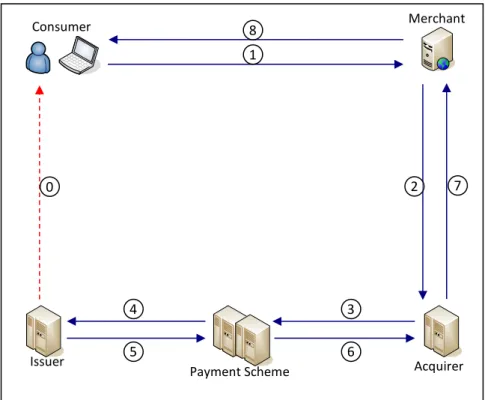
Following is a high-level overview of the transaction flow for an e-payment based on CVV2: 0. The Issuer has issued a bank card to the consumer with a CVV2.
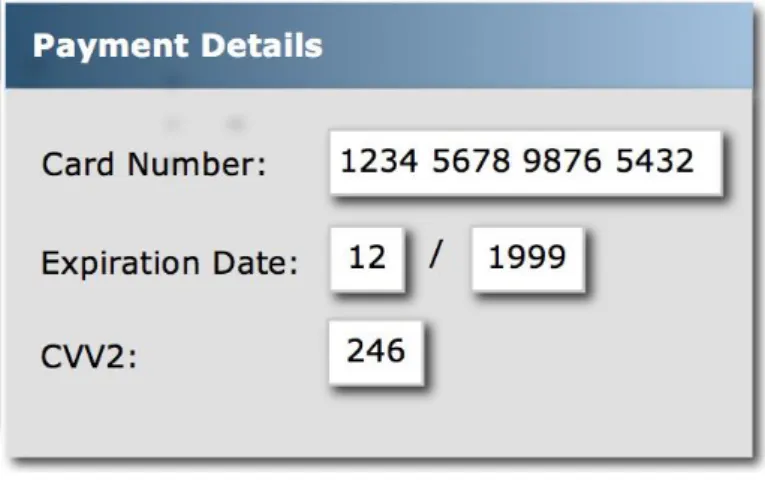
1. At checkout moment, in order to pay for the goods, the Cardholder inputs payment data by typing in the card number, the expiry date and the three-digit CVV2.
2. The Merchant sends payment data to the acquirer.
3. The Acquirer sends payment data to the payment system corresponding to the payment scheme
4. The Payment system sends the payment data to the issuer owner of the BIN
5. The issuer identifies the cardholder through the card number, validates the expiry date and authenticates the cardholder through the validation on an HSM of the Card Security Code.
6. After verifying additional authorisation criteria the issuer sends back an authorization to the payment system.
7. The payment system routes back the authorisation to the respective acquirer. 8. The acquirer informs the merchant of the authorisation for the transaction.
9. The merchant finalises the transaction giving the cardholder feedback on the success of the transaction.
Figure 3.2– Standard payment authorisation transaction flow
3.3 3-D Secure scheme description
3.3.1 Authentication elements
The 3-D Secure protocol [3] involves a series of functionalities in order for the cardholder to be authenticated prior to the transaction. The main functionalities are the following:
Merchant plug-in (MPI);
Payment System Directory Server
Access Control Server (ACS)
Authentication History Server.
MPI
MPIs are installed on the merchant systems and will transact with the Payment System Directory Server so that the cardholder be verified prior to forwarding the standard payment authorisation transaction. Once the cardholder has introduced the card details the MPI will query the Payment System Directory Server in order to verify enrolment of the card and obtain the ACS URL. If the card is enrolled, and upon reception of the ACS URL, the merchant will send an authentication request to the ACS through the cardholder’s browser. Upon completion of the cardholder verification the MPI will receive a signed authentication confirmation from the issuer’s ACS.
Consumer Merchant Acquirer Payment Scheme Issuer 5
6
4
3
1
8
7
0
2
Payment System Directory Server
The Payment Systems setup a Directory server that will answer to the MPI upon verification requests, indicating if the card is enlisted in the 3-D Secure protocol. So that the Directory Server is able to give an answer to the merchant, the Directory Server will contact the issuer’s ACS to check the validity of the card and query its participation in the 3-D Secure scheme. The ACS will forward the ACSs URL to MPI so as to redirect the cardholder’s browser so that the issuer may authenticate the cardholder.
ACS
The ACS will respond to the Payment Directory Servers queries on card 3-D Secure enlisting and provide the URL to which the cardholder be directed for issuer verification of the cardholder authenticity. When the cardholder is redirected by the MPI to the ACS, the ACS will authenticate the cardholder by whatever means he has adopted (ex. static password, SMS token, etc.). After authentication has been performed the ACS shall respond with the authentication result to the MPI and shall equally inform the Authentication History Server of the result.
Authentication History Server
The Authentication History Server shall hold the results of the authentications performed by the ACS for eventual disputes.
3.3.2 Parties
In order for a transaction to be processed via the 3-D Secure protocol various services will have to be implemented. These services may be implemented by the Issuers, Acquirers and the Payment Systems themselves or may be performed by third party service providers. The new players that support the 3-D Secure protocol are the following:
MPI (Merchant Plug-In) Provider
Payment System Directory Server
ACS (Access Control Server) Provider
Payment System History Server
MPI Provider
Merchants will have to install the MPI in their systems. Payment systems license the software to MPI providers.
ACS Provider
Issuers will setup an ACS or contract an ACS provider so that queries from the Payment System Directory are answered and cardholder authentications executed upon authentication verification requests from MPI.
3.3.3 Infrastructure setup
In order for the 3-D Secure process to be in place various preparation activities must take place.
Issuers must setup an ACS and enrol cards to the scheme. Cardholders will be informed of the authentication mechanism to be used prior to the usage. Some issuers have opted to enrol and choose authentication mechanism at the moment of the first cardholder’s 3-D Secure based transaction.
Merchants must enrol and integrate the MPI in their e-commerce systems so that prior to standard payment authorisation transaction the MPI query about the card enrolment in to the 3-D Secure and request authentication verification if enrolled.
3.3.4 Transaction flow
In a 3-D Secure transaction the following steps will take place:
0. The Issuer has enrolled the card BIN into the 3-D Secure scheme and the Merchant has enrolled into the 3-D Scheme.
1. At checkout moment, in order to pay for the goods, the Cardholder inputs payment data by typing in the card number, the expiry date and the three-digit CVV2.
2. Prior to sending payment data to process the standard payment authorisation, the MPI queries the Directory Server for card 3-D Secure enrolment.
3. The Directory Server queries the ACS to validate that the card is enrolled.
4. The ACS responds with the enrolment status of the card and with the URL that will authenticate the cardholder.
5. The Directory Server routs the card enrolment status and URL to the merchant. 6. The MPI sends an authentication request to the ACS via the Cardholders browser. 7. The ACS requests the cardholder to authenticate and the cardholder authenticates
himself.
8. The ACS verifies authentication and responds to the MPI with authentication response.
9. The ACS informs the History Authentication server of the authentication result. 10. The MPI validates the response and if the authentication was successful the standard
Figure 3.3 – 3-D Secure transaction flow Consumer Merchant Acquirer Payment Scheme Directory Issuer ACS
4
3
2
1
6
10 Payment Scheme History Server
5
6
7
8
8
9
0
0
Chapter 4: Key success factors for new
e-payment scheme proposals
4.1 Introduction
Hundreds of e-payment schemes have been proposed in the last two decades [14] [17] but very few have withstood time and have been able to declare even limited success. Meanwhile payments with bank cards on the Internet have been the preferred means of e-payment and have dominated the e-e-payments landscape [9]. E-e-payments with bank cards may be considered a crude authentication method, security wise, given the rudimentary fundamentals that are based on a sixteen digit number, an expiry date and sometimes a three digit CVV2. Frequent data breaches [28] through the last decade, and millions of virus infected PCs [43] have highlighted its vulnerabilities. However users continue to prefer this payment method.
Various studies have outline key success factors for e-payments schemes. A first phase of studies covered technical attributes that should be fulfilled by e-payment systems. These focused mainly on security issues [6] [13] [16] such as anonymity, privacy, non-repudiation, integrity, etc.
As a result of failure in adoption of IPS backed major initiatives, namely SET [2] and 3-D SET, due to user convenience issues, many subsequent studies [18] [19] [22] highlighted user related criteria. Ease of use, trust, reliability, user acceptance, are but some of the criteria that were evaluated in order for an e-payment system to succeed.
Recent studies [33] [34] have a holistic approach in regard to the criteria that an e-payments system shall withhold in a sense that all parties in the e-payment systems must have their interests attended to. Users, merchants, and all other participating parties must yield benefit from the system, given that if this isn’t guaranteed any one of these participants may embargo the adoption of a proposed scheme. Critical mass has been identified as an important characteristic that has to be overcome by any new scheme [30]. Users want to adopt schemes that are accepted at all merchants with whom they transact, and on the other hand merchants will only support payment methods that are used by a relevant number of their client base.
4.1.1 Overview
This chapter describes the factors that are important for each of the payment system participants for a new e-payments proposal to succeed. These are divided into three orders of factors:
Key factors for user acceptance;
Key factors for merchant acceptance;
Key factors acceptance by other parties;
4.2 Key factors for user acceptance
Many studies have covered the characteristics that should be present in an e-payments scheme. Dennis Abrazhevich has elaborated an extensive analysis [18] of the characteristics that users deem as determinant for acceptance of an e-payment scheme. His study reveals a survey that has been conducted over a universe of 1328 respondents in order to obtain empirical evidence of the importance of the characteristics to end users for e-payments. The characteristics that have been surveyed are the following:
Anonymity, privacy, Applicability (acceptability) Convertibility Efficiency Reliability Security Traceability Trust
Usability (ease of use)
Following, an analysis of these characteristics and an interpretation of their importance for the user, resulting from the survey, will be performed. The applicability of these characteristics to the traditional bank card based payments will be commented, and finally a comment on the changes that the proposed schemes of this study have on the characteristics will be noted.
4.2.1 Characteristics analysis
Anonymity, privacy
Although many studies have highlighted anonymity as being an essential characteristic, the survey showed that only 13.5% of respondents were concerned or very concerned that shops could register their purchases. Actually 72.9% would prefer that their purchases were registered to avoid disputes and 72.8% would never refrain from paying because of revealing identity when paying.
Bank cards do not guarantee anonymity but through the survey we may conclude that users do not give much importance to this characteristic and are ready to sacrifice it to avoid or resolve disputes.
The proposed schemes in this study maintain this characteristic intact, thus will neither augment nor hinder the level of privacy to which the user is subject.
Applicability (acceptability)
Applicability (or acceptability) of an e-payment system is the characteristic that indicates the extent to which it is accepted at e-commerce sites.
Respondents to the survey gave great importance to the fact that one single particular payment scheme be used in most places where they pay; 59.8% considered it very important and 28.3% quite important that a single mechanism be used. Furthermore 85.8% emphasised that the ability to pay with a payment system at multiple and diverse points of sale was important.
Bank cards are, indisputably, the most used payments means on the Internet and any e-merchant wanting to accept payments on the Internet cannot ignore this payment means to achieve scale.
The proposed scheme builds upon the fact that bank cards are presently widely accepted and that the installed base is global from the very beginning. The proposed schemes are readily acceptable at any 3-D Secure merchant, once the issuer adopts the payment scheme. For non-3-D Secure merchants the users may still fallback to the traditional card payment experience with or without the CVV2.
Convertibility
The ease in converting funds between payment systems is defined by the characteristic of convertibility.
The survey did not cover convertibility between bank cards and accounts or cash, however, most respondents considered that conversion between payment systems is important specially the conversions between account and cash.
Given the direct link between debit cards and accounts, and that credit cards have well established processes to convert between credit card and accounts, bank cards in general satisfy this characteristic.
The proposed mechanism does not influence any change on convertibility when compared with standard bank card e-payments.
Efficiency
Efficiency underlines characteristic of cost per transaction and is of special importance for low value transactions.
Many proposed e-payment protocols have given weight to this characteristic however few (13.4%) respondents considered it had any importance at all.
Payments with bank cards are not as efficient as could be to handle low payment values; on the other hand, millions of e-payments based on cards are performed daily and news on dissatisfaction on costs of payments on the Internet with cards is residual.
The proposed scheme does not alter the costs of transactions based on cards.
Reliability
The availability of a payment system and the capability to function as expected is translated in to the reliability characteristic.
The survey highlighted the preference of respondents for bank cards (58.1%), compared to cash and smart cards, when questioned which are more reliable.
The payment industry has established a resilient infrastructure to process traditional bank cards. This same infrastructure has been used to process e-payments capitalizing on a well-proven installed base.
The proposed schemes support themselves on the well-established systems used by the present day and no modification is necessary. No changes are necessary to current messages between the systems.
Security
The security characteristic, on a user perspective, is the level to which a user’s funds are secure when paying online.
Security is one of the most stressed characteristics on numerous studies on e-payment methods. Aligned with this concern, a very high proportion of respondents considered security as very important (84.7%) or quite important (13.7%). Conversely when questioned
if the respondents would refrain from using debit cards or credit cards if thought they were insecure, 96.7% would not refrain to use debit cards and 81.2% credit cards.
Payments with bank cards have suffered various security setbacks such as large-scale data breaches and continuous news on card data collecting malware situations. Although the general public perception is that card based e-payments are not secure, it seems that the lack of viable alternatives has avoided the decrease in usage of these means.
The proposed solution will enhance security of these payments and enhance protection against the major threats to the bank cards based payments, namely data breaches and data collecting malware.
Traceability
The traceability characteristic reflects the ease with which money flows, including fund sources and fund destinations, may be traced.
45.3% of respondents are concerned that sources of their income may be known to vendors. Although respondents are not concerned with strong anonymity, responses reveal that consumers still would like to have a certain degree of privacy. 58.3% of responses indicate that users consider it important that they do not leave personal information such as name, address and bank account, to merchants.
Payments based on bank cards leave traces of transactions that are essential for dispute resolutions. Apart from the card number no other personal information is revealed in most standard payments, although some merchants require names or addresses to increment verification levels.
The proposed scheme does not reveal further information when compared to a standard card based e-payment.
Trust
The trust characteristic denotes the degree of confidence that the user places on the system so that its funds and its interests be protected.
The survey revealed that trust was considered as being very important. 97.6% would only trust a system introduced by an established organization and 94.4% would stop using a system that they felt that was not trustworthy.
Although much negative publicity on the security of cards has come to light throughout its existence, card based payments continue to be the preferred mechanism for e-payments. Given the importance that the survey result emphasises on trust it leads us to conclude that cards seem to be the most trusted means of e-payments. The fact that the user understands
the mechanism and that he has a sense of control (i.e. the secret is on a plastic that he keeps in his wallet) gives him a sense of security.
The proposed scheme adds further perception of security to the user given that at each payment he will be asked for a different part of a secret, thus we will not reveal the whole secret to any one, as is the case with traditional payments.
Usability (ease of use).
The ease with which users perform the e-payments is known as the usability characteristic. The ease of use has been indicated as one of the most importance characteristics special given some major initiatives that failed in this field such as the SET protocol backed by the main international payment systems. 81.7% of respondents referred that they feel more comfortable when using something tangible to pay.
Most respondents indicated that it was easy to pay with credit cards over the Internet (68.2% - “very easy” and 28.0% - “easy”).
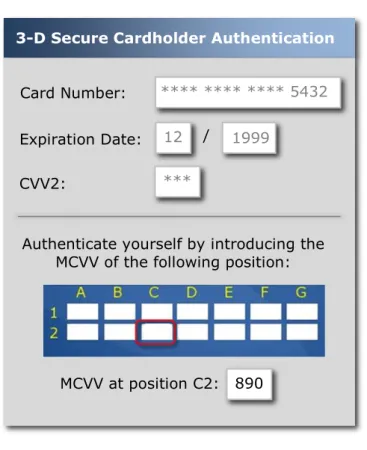
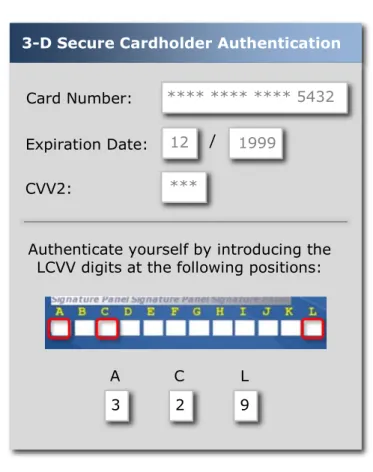
The proposed solutions will impact the usability characteristic negatively. The user will be challenged to type in one of the CVVs or three digits of a long CVV. Either challenge makes use of mechanisms that have been adopted in the market and have been successful. The impacts on usability will depend on the size of the secret to be adopted but can be kept at a minimum, resulting in a residual impact.
4.3 Key factors for merchant acceptance
Millions of e-merchants make up today’s e-commerce ecosystem. Along with the users, merchants are instrumental so that a new scheme is successfully adopted. A merchant’s main requirements are that a payment scheme offers secure and reliable transactions and that the implementation and operational costs be justified by the user base that will be gained with the new payment scheme.
The following characteristics will be commented, and changes to the proposed schemes will be noted:
Security
Applicability
Cost of implementation
4.3.1 Characteristics analysis
Security
The security characteristic, on a merchant perspective, is the level to which a merchant has guarantees that the payment will be honoured.
Merchants have been attacked throughout recent years, having had their systems compromised and card data being stolen. Payment systems have forced the PCI DSS program on to merchants so that systems protect against card data compromise. Implementing the PCI DSS program is costly and furthermore does not guarantee that vulnerabilities are all mitigated. In fact many data breaches have occurred at merchants that were at the time of compromise, certified as being compliant to PCI DSS.
The proposed solution is based on the adoption of dynamic CVVs. The compromise of one of these dynamic CVVs, present in a transaction, will frustrate the intentions of the attackers given that it may not be used in any subsequent transaction. With this scheme the compromised card data, namely the enhanced CVV2, has less value for the attacker and so will discourage attacks.
Applicability (acceptability)
Applicability (or acceptability) of an e-payment system on a merchant perspective reflects the user base that will be able to perform payments through the new means.
Payments based on bank cards are the most popular means of payments on the Internet. Attaining critical mass is an essential factor to justify cost in implementing any new payments system.
The fact that bank cards are widely used by most users and that a migration process may be supported in order to migrate users into the new proposed scheme, guarantees the merchant with the much-needed critical mass.
Cost of implementation
Changing millions of e-commerce sites to be able to process a new payments scheme implies a formidable investment by merchants. History has proven that there is great inertia in these kinds of changes. Simple changes such as the support for CVV2 at merchant sites has taken more than a decade and still many sites do not support payments with CVV2. The SET protocol required merchants to perform significant changes to their systems; some argue that this impact was one of the factors that crippled the adoption of this protocol. As a final example, adoption of 3-D Secure has been backed by the International Payment Systems
through liability shift incentives, and although merchants require minor changes to their systems, many merchants haven’t yet migrated.
Changing a site to adopt a payment means that is uncertain to succeed and that does not have guarantees of a critical mass of customers from the very beginning discourages merchants. The proposed schemes build upon present infrastructure. 3-D Secure merchants do not have to change their systems in order to support the proposed schemes. Non 3-D Secure merchants have the option to adopt 3-D Secure or to perform minor changes to their existing systems, to benefit from the enhanced security inherent to the proposed schemes.
Cost of operation
Operational costs are a major concern for merchants and all parties alike. Interchange fees have been a notable battlefield in the payments, as well as the e-payments, arena.
Synergies between the physical world payments and the e-payments have proven to be advantageous. The fact that billions of consumers hold a card in their wallets that can be used on the Internet and that many merchants already have systems that process payments through contracted merchants is a favourable starting point. The existence of support processes such as dispute handling, blacklist management, fraud detection and management systems, are essential to support any payment scheme.
The proposed schemes build upon this existing context with no need for changes.
4.4 Key factors acceptance by other parties
Implementing any system based on a multi-sided platform is a particularly difficult challenge. Many aspects have to be accounted for in a balance that brings benefits for all participating parties. By building upon a well-tuned existing infrastructure, all parties such as acquirers, issuers, financial institutions, network operators, processors and regulators, have their interests assured.
The proposed scheme brings on little or no changes to this context whilst augmenting protection to relevant attacks.





![Figure 5.11 – ECVV card front example Inputs PAN = 1234 5678 9876 5432 TCVV PC = 032 TPAN construction TPAN[19] = PAN[16] || TCVV PC[3] TPAN = 1234 5678 9876 5432 032](https://thumb-eu.123doks.com/thumbv2/123dok_br/15679399.1063322/52.892.305.611.127.320/figure-ecvv-front-example-inputs-tcvv-tpan-construction.webp)
