FUNDAÇÃO GETULIO VARGAS ESCOLA DE ECONOMIA DE SÃO PAULO &
NOVA SCHOOL OF BUSINESS AND ECONOMICS
THE POWER OF A SINGLE LARGE SHAREHOLDER IN
IBERIAN FIRMS: FRIEND OR FOE?
Matthew Robert Bray
Student Number: 26271 (Nova)
333947 (FGV/EESP)
A project completed to fulfil the requirements of the International Masters in Finance Brazil-Europe program under the supervision of:
Professor Duarte Pitta Ferraz (Nova SBE) Professor Ricardo Rochman (FGV/EESP)
Abstract
Agency costs as a result of the separation of ownership and control within a firm can be a hurdle to the performance and profitability. It has been suggested that these costs can be reduced by the presence of a single large shareholder monitoring management and their decisions. On the contrary it has also been argued that a large shareholder negatively affects firm performance by deriving personal benefits from the firm and making sub-optimal decisions. This research aims to investigate the relationship between the profitability of a firm and the level to which the shares of that firm are concentrated into a single shareholder. A random effects GLS panel regression is used to determine the effect of a large shareholder being present in Spanish and Portuguese firms by studying firms listed on these bourses over the period 2005 – 2014. The results show that a large shareholder has a negative influence in the Portuguese market, and no statistically significant effect in the Spanish market.
Table of Contents
Abstract ... ii 1 Introduction ... 2 2 Literature Review ... 5 3 Data and Sample Collection ... 11 4 Empirical Model ... 12 4 Results and Interpretation ... 16 5 Conclusions and Final Remarks ... 18 6 Limitations ... 20 References ... Error! Bookmark not defined. Appendix ... 281 Introduction
Entrusting the everyday business of the firm to the managers, shareholders of any company place a great deal of trust in those agents to make decisions that are value maximizing. This separation of ownership and control has been termed the “Principle-Agent Problem”, and can cause agency costs which may damage the long term future of the firm and arise when these managers make decisions in their own interests and not for the good of the firm as a whole (Jensen & Meckling, 1976).
These agency costs, which will be defined more clearly later in the paper, take various forms but have the common characteristic of decreasing the profitability of the firm and causing unnecessary costs. Therefore, the most obvious place that these costs can be seen is in the return on equity capital. There are various mechanisms, both internal and external, suggested in literature to control agents and mitigate these costs. The one in focus in this research is the presence of a large controlling shareholder. The core proposition is that the presence of a shareholder with a stake in the firm large enough to take action against the managers in the event of sub-optimal management will lead to the managers making better decisions in line with the interests of shareholders. They have both the incentive and the ability to monitor managers, and this should translate into lower agency costs for the firm as a whole.
The base paper for this research, Gedajlovic & Shapiro’s 1998 paper, studied this effect in multiple markets and analyzed the interplay that this had with the local forms of corporate governance. It is their framework that will be applied to the Spanish and Portuguese universe of companies, in order to investigate if such a relationship exists within these markets.
This research has also been conducted in other markets (Elyasiani & Jingyi, 2010; Gedajlovic & Shapiro, 1998; Kang & Sorensen, 1999), as well as the effect of this ownership dynamic on share performance (Edwards & Weichenrieder, 2004). It is the objective of this research to determine if there is a relationship between ownership concentration and firm profitability for publically listed firms within Spain and Portugal. The null hypothesis in this case is that there is no relationship between the percentage of the firm’s shares held by the largest shareholder and the return on common equity (profitability). The alternative hypothesis is therefore that there exists a positive relationship between the percentage of the firm’s shares held by the largest shareholder and the profitability of that firm.
The purpose of this research is to add to the body of corporate finance research relating to the principle-agent problem and explores the dynamic of this problem within the Iberian context. It will be useful to determine if the relationships that have been clearly identified in an international context apply here, and if so, some possible reasons for this. These conclusions have their most relevant and contributory application in the asset management and investment analysis universe. For investors analyzing a potential investment,
it is vital to consider the corporate structures and dynamics within the management and ownership of a firm, in order to pick a long term winner. Having an understanding of the relationship that may exist between shareholders and management, and how the size of the largest shareholder affects this, will add an additional dimension to their decision-making process. If ownership concentration positively affects profitability, a firm with a single large shareholder that is able to monitor and discipline firm management will be more attractive than a firm that is widely held by a diverse shareholder base that relies on internal corporate governance to represent their interests. If this relationship is found to exist, management would be incentivized to build relationships with their existing large shareholders in order to reinforce the positive perception of close monitoring by these parties in the eyes of the market – hopefully having a positive effect on the value of their shares and their potential growth prospects. This research will also aid future corporate finance research into the Iberian environment, identifying potential relationships that could be investigated to a more thorough extent, both within the corporate governance space as well as from an investor perception perspective.
In order to define the scope of this research, some delimitations were decided in the early stages. Firstly, the focus was placed on firms within the listed Iberian investment universe (Spain & Portugal). The reason for this was the high concentrations of family owned and large shareholder companies in this market, making it a prime candidate for this type of research (Arosa, Iturralde, & Maseda, 2010; Miralles-Marcelo, Miralles-Quirós, & Lisboa, 2014). Also, it
has not been included in many studies of this type (Gedajlovic & Shapiro, 1998).
The scope of the research was also stringently limited by the type of data that was available from the sources used, with only companies with complete financial data and sufficient disclosures of ownership splits included. Unfortunately this meant that many firms were excluded. Certain variables that would have added dimensions to the research, such as identity of the blockholder and the change in ownership levels of individual blockholders, were not available, once again limiting the scope. Certain measures used in the base paper, such as diversification, were also not able to be collected in this case. The data collected however, is sufficient to give a window into this ownership/profitability dynamic and add to the body of research in a meaningful way.
2 Literature Review
The foundation of the question at hand is the concept of agency costs. Defined and described in the seminal article by Jensen and Meckling (1976), these are costs that arise from the separation of ownership and control of a firm between the shareholders and the management. These consequences come in many different forms and are detrimental to the firm to varying degrees.
Free cash may be held within the firm by managers to decrease reliance on external capital markets, leading to the development of a less than optimal capital structure and lower dividends for shareholders (Jensen M., 1986). Managers themselves may become entrenched in their positions in spite of poor performance, due to the lack of oversight from an empowered shareholder (Shleifer & Vishny, 1986). This can extend to subordinates as well, who are often kept in their positions for their value as friends or colleages of management rather than their performance in their roles, creating an organisation rife with inefficiencies and affecting the long term profitability of the firm (Tosi, Bebchuck, L., & Fried, J., 2005). Managers may also wish to make the firm larger and expand into additional industries. This behaviour is termed ‘empire building’, where the goal of the manager is to be at the head of a larger organisation and these expansions are not due to the belief that the individual merits of the investments will improve the long term health of the firm as a whole (Williamson, 1964). Executive compensation plays a role here too, with direct agency costs arising from excessive compensation. Managers that have minimal oversight are more able to negotiate more generous packages for themselves (Bebchuk & Fried, 2003; Blanchard, Lopez-de-Silanes, & Shleifer, 1994). It is evident from the above that an organisation that is plagued by management incurring agency costs will be less profitable than a competitor that has management that are making value-maximising decisions under effective oversight.
Literature has described methods by which these agency costs can be mitigated, including executive compensation, which can be used as an
incentive to align the interests of the management and the owners (Core, Holthausen, & Larcker, 1999; Murphy, 1999). Another key method, and the focus of this research, is the ownership structure of the firm and its influence on corporate governance (Jensen M. C., 2000). The identity of the shareholders as well as the amount of ownership that lies in the hands of managers are elements of ownership structure that can have an effect on profitability, but the one in focus here is the presence of a large shareholder. Often occuring in family-owned firms, a single large blockholder is the most common way in which shareholding is concentrated, rather than in the hands of a group of large shareholders (La Porta, Lopez-de-Silanes, Shleifer, & Vishney, 2000).
A single large shareholder present in the ownership structure of a firm can be viewed as a double-edged sword, depending on the actions and incentives of that shareholder. On the one hand it can increase the level of monitoring that management is subject to and prevent decisions and activities that are value destroying from occuring, as is the hypothesis in this research. The other perspective is that having a single large shareholder will allow that shareholder to extract personal benefits from the firm and make decisions that are not in the interests of the minority shareholders and the firm as a whole (Andres, 2008; Edwards & Weichenrieder, 2004).
Looking at the negative perspective first, the core of the problem with the presence of a majority shareholder is that the very powers that they are endowed with to monitor managers and influence the operations of the firm
can be abused for their own benefit, such as by diversion of assets or income, or decisions to do business with parties in which they have and interest (Fama & Jensen, 1983; Chen, Firth, & Xu, 2009). One example is found within the Canadian market, and studied in depth by Rojas (2014). Here the model of a single large blockholder and many minority shareholders is commonplace, and the minorities in this case can be viewed as the ‘principles’ and the blockholder as the ‘agents’, due to the power that they can exert over the firm. Rojas found that this setup encouraged majority shareholders to make decisions in their own interest rather than those of the firm as a whole, with examples such as sub-optimal investment selection, transfers of economic rents and inefficiencies in the management and transfer of firm control. Similar processes have been found to be at work in Sweden (Bergstrom & Rydqvist, 1990) and the US (Barclay & Holderness, 1989). Large shareholders have also been found to be unwilling to discipline management in some cases, leading to an entrenched management team (Arosa, Iturralde, & Maseda, 2010).
The positive influences of a major shareholder have also been well documented. From the basic premise that the major shareholder has a stronger incentive to monitor management (Arosa, Iturralde, & Maseda, 2010), to their presence being a solution to the free rider problem of small shareholders not having the incentives to monitor management (Shleifer & Vishny, 1986), positive impacts on firm value and performance have been observed in multiple markets under a variety of conditions (Aisjah, Juhandi, Rofiaty, & Sudarma, 2013; Belkhir, 2009; Edwards & Weichenrieder, 2004;
Elyasiani & Jingyi, 2010; Holderness, 2003; Kang & Sorensen, 1999; Kumar, 2003; Kvist, Pedersen, & Thomsen, 2006; McConnell & Servaes, 1990).
Numerous studies have also found that there is no clear relationship between firm performance and the presence of a large majority shareholder (Andres, 2008; Arosa, Iturralde, & Maseda, 2010; Chirinko, Garretsen, Sterken, & van Ees, 2004; Demsetz & Villalonga, 2001; Mehran, 1995). Geographic complications have also yielded very different results, with positive relationships being found in Germany, negative in the UK and no significant relationships found in the US and Japan (Gonenc, Seifert, & Wright, 2005).
Within the Iberian space, the majority of research has focused on the dynamics within family-owned firms. Family owners are found to be beneficial, particularly early on in the life cycle of the firm (Marcelo, Miralles-Quirós, & Lisboa, 2014). Here the benefits are primarily behavioural, with the family presence adding an element of multigenerational thinking to the decisions of the managers, leading to better long term performance (Patel & Chrisman, 2013). The presence of a single large blockholder at the listed firm level has not been investigated in depth in this market.
A key element of this question is the role played by the different methods of control on the management of a firm. Core to the research of Gedajlovic & Shapiro (1998), was the question of internal versus external monitoring. Internal monitoring is in the form of pressure exerted from stakeholders within the firm, such as the board of directors. External monitoring is driven by
pressures that primarily stem from the market for corporate control. Their hypothesis was that in the presence of strong internal control mechansisms the relationship between ownership concentration and firm profitability would not hold, due to the fact that the other internal controls were correctly functioning and disciplined managers, and this was the case for France and Germany in their analysis (Gedajlovic & Shapiro, 1998).
In the context of our question, for ownership concentration to have a marked effect on firm performance, Spain and Portugal would need to have internal control mechanisms that are either not strong enough or not functioning correctly. These two markets would fit within the European framework discussed by Gedajlovic & Shapiro where internal controls are strong, however evidence has been found that here internal corporate governance measures are very often usurped by the power of shareholders, and the owner of a company plays a far more active role (Leech & Manjon, 2002). Therefore, this research is a test not only of the effect of a large shareholder, but also of the corporate governance measures that are intended to be disciplining management
As can be seen by the diversity of results and the mulitfaceted nature of the question, this is still a very complex issue in corporate governance research. This research will aim to investigate this question within the Iberian market, and determine what relationships exist in this market and what conclusions can be drawn from the investigation.
3 Data and Sample Collection
In order to complete this empirical study, a dataset containing financial performance and ownership data for all firms publically listed on the Portuguese and Spanish bourses was collected from Bureau Van Dijk’s Amadeus database. Firms with missing data were excluded from the sample. The incompleteness of the data provided by this database is a cause for concern, with many firms missing financial data or not disclosing the complete distribution of their shares. The final data sets contained 16 Portuguese firms and 60 Spanish firms. The time period used was 2005 to 2014, with annual data points for all of the variables. This time period was chosen because it is the longest period available from the database, and the effects of having a large shareholder should only become evident in the profitability of the firm in the long run. This relatively large panel dataset should ensure that sufficient data points exist to draw meaningful conclusions to test the hypotheses in question. All statistical tests were performed using STATA 13.
A panel data regression was chosen for this empirical study, because it allows the researcher to control for variables that cannot be measured or controlled, as well as variables that change over time but not across entities. That is, it allows the researcher to account for individual heterogeneity (Baltagi, 2008), which should allow it to isolate the effect that a large shareholder has on the dependent variable; this was the procedure used in the base article (Gedajlovic & Shapiro, 1998).
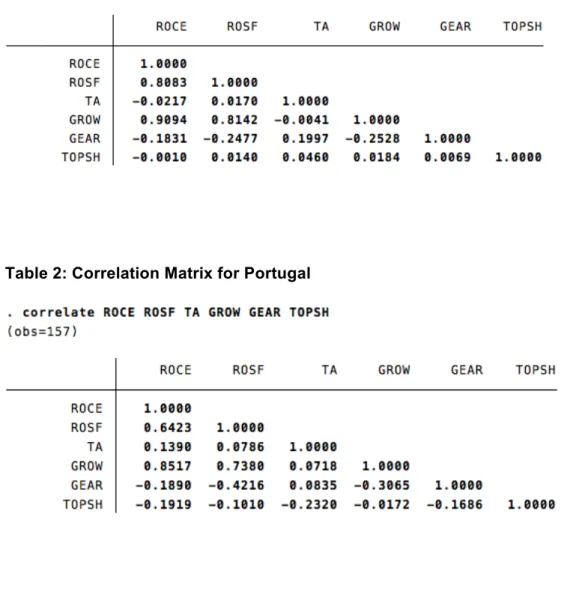
Prior to the final regression procedure, a number of tests need to be performed to ascertain the correct regression procedure to apply to the panels. Firstly, variables are checked for any correlations that may have become an issue in the regression procedure.
Growth was highly correlated with the return on common equity in both samples. This could possibly cause an issue in the regression, however considering the importance of this control variable to the regression it remained in the final regression. The remaining variables do not seem to be correlated with the dependent variable in a meaningful way. See appendix for correlation tables.
4 Empirical Model
As mentioned above, the method of statistical analysis being used in this study is a panel data linear regression. This method is perfect for the analysis of the hypothesis in question because it allows the researcher to isolate relationships that apply across and within the entire dataset while accounting for individual heterogeneity of the entities. This is achieved by controlling for variations between entitles over time in multiple dimensions. Here, it is useful to isolate the effect of a single large shareholder while controlling for the myriad of other factors that may affect the profitability of a firm.
The general starting point for the regression in this case is as follows (Gedajlovic & Shapiro, 1998):
! = ! + ! !"#$% + ! !
Where π represents the level of profitability, TOPSH the level of ownership performance and X a vector of control variables. The proposed regression equation is as follows:
!!"= ! + !!!" !"#$% + !!!" !"#$ + !!!" !"#$ + !!!" !"#$ + !!! !"#$ + !!"
Where:
!!" = Profitability of ! firm at time !
!"#$% = Level of ownership concentration !"#$ = Size of the firm
!"#$ = Growth rate of the firm DEBT = Gearing ratio of the firm TEMP = Temporal dummy variable
!!" = Error term
! = Intercept value
These variables are defined and mesured as follows:
Profitability (π)
The dependent variable in question here, profitability is measured in this case as the return on common equity (ROCE), which is calculated as the ratio of net income to shareholders equity. It is essentially a measure that quantifies
how well the equity of the shareholders is being put to use and how effectively the company is being stewarded – this should allow us to answer the core question of the influence of a major shareholder on management and their actions.
Ownership Concentration (TOPSH)
This variable is measured as the percentage of the firm that is owned by the largest shareholder for each year. Used by Gedajlovic & Shapiro (1998) in the same way, the percentage held by this shareholder is assumed to be static over the period at the intial value due to the fact that dynamic ownership data was unavailable.
Firm Size (SIZE)
In order to control for the effect that the size of a firm may have on profitability, this variable is included. This relationship is rooted in potential economies of scale and scope that such size provides, and has been found both in early industrial literature and more recently (Hall & Weiss, 1967) (Markides, 1995). This variable is measured as the logarithm of total firm assets.
Grow (GROW)
Product cycle effects and demand dynamics have a large influence on profitability, with firms in the growth phase of a new product or facing high demand pressures having above-average ROCE. This relationship has been observed in previous research and was included in the base paper, and is
measured in this case as the year-to-year growth of turnover (Hall & Weiss, 1967) (Gedajlovic & Shapiro, 1998).
Gearing (DEBT)
The capital structure affects the firm both from a managerial decision-making perspective as well as operationally, hence it is vital to control for this. This variable is measured as the percentage of debt to assets of the firm.
Temporal Effects (TEMP)
Time can be considered an exogenous factor, with the business cycle and general economic conditions affecting firm operations. This is controlled for by including a dummy variable with a different value for each of the 10 years that the study spans (Rumelt, 1991).
4 Results and Interpretation
Variables Coefficients Standard Error z P>z
Portugal TOPSH -0.846922 0.0429869 -1.97 0.049 SIZE 2.946695 1.418014 2.08 0.038 GROW 1.056342 0.0693729 15.23 0.000 GEAR 0.0021064 0.006771 0.31 0.756 TEMP -0.351136 0.1293715 -2.71 0.007 Constant -15.63565 11.25106 -1.39 0.165 Wald Chi2(5) 268.81 Prob > Chi2 0.0000 R-Squared 0.7629 Hausman Test chi2(8) = 1.65 Prob > chi2 = 0.7995 Modified Wald Test chi2(8) = 5334.61 Prob > chi2 = 0.0000
Variables Coefficients Standard Error z P>z
Spain TOPSH -0.0124335 0.0324982 -0.38 0.702 SIZE 0.6539334 1.04405 0.63 0.531 GROW 1.800984 0.1378531 13.06 0.000 GEAR 0.005076 0.0068014 0.75 0.455 TEMP -0.2743595 0.2491779 -1.10 0.271 Constant -2.549968 9.541302 -0.27 0.789 Wald Chi2(5) 291.81 Prob > Chi2 0.0000 R-Squared 0.8292 Hausman Test chi2(8) = 12.24 Prob > chi2 = 0.1571 Modified Wald Test chi2(8) = 5300 Prob > chi2 = 0.0000
A number of tests need to be done to determine the correct regression procedure to be applied to the data. Firstly, a Hausman test needs to be performed on both datasets to determine if fixed or random effects regression
methods should be applied. If the p-value of the test statistic is higher than the level of significance (5% in this case), then the null hypothesis of the test is rejected and the fixed effects model should be applied. In both cases the null hypothesis of the test was not rejected, implying that the random effects method should be applied (p-values of 0.7995 and 0.1571 respectively).
Heteroskedasticity is also an issue to consider, as unaccounted for differences in the variance of the variables can lead to inaccurate conclusions being drawn from the data in question. In order to test for heteroskedasticity the modified Wald test for groupwise heteroskedasticity was applied. The null hypothesis of the test is that there is no heteroskedasticity present in the data. For both the Spain and Portugal datasets the null hypothesis was rejected, and heteroskedasticity was deemed to be present. Based on the conclusions of these tests, the regression procedure utilized for both datasets was a random effects GLS panel regression with robust standard errors to correct for heteroskedasticity.
The regression testing aims to isolate the effects of a single large shareholder on the firm and the returns that it generates. Hence, the key metric in this case is the significance of the test statistic relating to the level of ownership concentration (TOPSH). In the case of Portugal, this variable in the regression is significant at the 5% significance level and the coefficient of the variable is -0.012, indicating that there is a statistically significant negative relationship between the level of ownership and concentration and firm profitability. For Spain, the TOPSH variable was not significant at the 5%, 10% or 15% levels.
Within the Portugal regression, the variable for size was significant at the 5% level with a positive coefficient, indicating that there was a positive relationship between the size of a firm and the return on equity. This implies that there are economies of scale and scope at work within this market. Growth also shows a significant positive relationship, with firms growing at a faster rate having a better return on equity. The temporal dummy is also significant, indicating that the business cycle and overarching economic conditions prevailing in each year had a significant effect on the performance of the firm.
The regression for Spain indicated that the environment was different to that one prevailing in Portugal. The only significant variable at the 5% level was growth, indicating that there are major advantages for shareholders of being involved in a growing firm, but things like size and temporal factors were not impactful.
5 Conclusions and Final Remarks
The interplay between shareholders and management is one that has been the focus of researchers in many different fields of finance and corporate governance. It is key to understand how these actors interact and make decisions within the legislative and corporate framework in which they find themselves. This work focused on the presence of a shareholder with a large
stake in the firm, and the effects that this had on the return on equity and hence the profitability of the firm.
In order to test the hypothesis put forward in this paper – that the presence of a single large shareholder would discipline management and hence improve profitability – a random effects GLS panel regression was run on data from companies listed on the Spanish and Portuguese bourses. The results showed that the presence of a single major shareholder was detrimental for the return on common equity for firms in Portugal. This result contradicted the initial expectations from theory and previous research, where the positive benefits of a large shareholder were expected to improve profitability, or the strength of European internal corporate governance measures should have meant that there was no significant relationship. This indicates that within the Portuguese market, large blockholders are extracting personal benefits and not disciplining management in the correct ways to benefit the firm as a whole, its stakeholders and the minority shareholders.
In the case of Spain, no significant relationship was found between ownership concentration and firm profitability. This is in line with the theory put forward by Gedajlovic and Shapiro (1998) that the internal governance measures were sufficient to discipline management and prevent the presence of a large shareholder being either significantly positive or negative.
Going forward, these results could be useful to investors in each of these markets, with caution being exercised in Portuguese markets when investing
in a firm with a single large shareholder. The tendency for these shareholders to extract personal benefits and have an overall detrimental effect on firm performance could mean that the investment is sub-optimal in the long run. There are also supplementary conclusions that reinforce previous findings in literature and may assist investors in their analysis, such as the positive influence of the growth rate of a firm in both markets and both growth and size in the Portuguese market.
6 Limitations
An undeniable obstacle to the clarity and scope of this research has been data availability. The dataset that was accessed missed key variables that would have improved the regression and added extra depth to the analysis. The proportion of the firm’s assets that are foreign along with the number of industries in which it operates were key variables to determine the level of diversification of the firm, one of the variables used by Gedajlovic & Shapiro (1998). Industry codes for each of the firms would have also been useful so as to eliminate the effect that the different industry that a firm operates has on its profitability. The fact that numerous data entries had to be removed from the dataset is also a major issue, as the lack of ownership information may be systematic, with companies with certain structures of ownership choosing to omit their information. Therefore there may be a sampling bias present in the data.
Although a topic of other potential research in and of itself, the identity of the individual blockholder could have been a useful area to consider. The effect could be different if the blockholder is the founding family versus if it is a private equity fund that has recently acquired the shares. The other holdings of the major shareholder are also key. For example, evidence has been found that when a controlling stakeholder in a corporation is very highly diversified in their own right, that entity is more likely to be risk-taking (Faccio, Marchica, & Mura, 2011).
There may also be a question mark remaining around the effect of a group of large shareholders, acting either cooperatively or at odds with one another, on the firm. Therefore a more detailed shareholding breakdown would be useful and would allow for more analysis as to this potential dynamic and its effects on management.
Life cycle may also be a very valuable consideration to include. This research and much like it focuses on listed companies, and the fact that they are listed means that they are fairly far along in their life cycle. The dynamic of shareholder involvement and effect would be very different for a firm that is very early on in its life cycle, as the incentives of the owners would be to grow and mature the firm to greater profitability. This is different to the later stages, in which the firm could be seen as a ‘cash cow’ for the owners, who seek to derive benefits and are not in any doubt as to the status of the business as a going concern.
Future research could also be qualitative, with the managers and shareholders of these concentrated firms being interviewed for their perspectives on the pressures and relationships that exist and how they believe they affect firm performance.
References
Agrawal, A., & Mandelker, G. (1987). Managerial Incentives and Corporate Investment and Financing Decisions. Journal of Finance(42), 823-837. Aisjah, S., Juhandi, N., Rofiaty, & Sudarma, M. (2013). The Effects of Internal
Factors and Stock Ownership Structure on Dividend Policy on Company's Value. International Journal of Business and Management Invention, 2(11), 6-18.
Andres, C. (2008). Large Shaareholders and Firm Performance - An Empirical Examination of Founding-Family Ownership. Journal of Corporate Finance, 14, 431-445.
Arosa, B., Iturralde, T., & Maseda, A. (2010). Ownership Structure and Firm Performance in Non-listed Firms: Evidence from Spain. Journal of Family Business Strategy, 1, 88-96.
Baltagi, B. (2008). Econometric Analysis of Panel Data. John Wiley & Sons. Barclay, M. J., & Holderness, C. J. (1989). Private Benefits form Control of
Public Corporations. Journal of Financial Economics, 25, 371-395. Bebchuk, L., & Fried, J. (2003). Executive Compensation as an Agency
Problem. Journal of Economic Perspectives, 17(3), 71-92.
Belkhir, M. (2009). Board Structure, Ownership Structure and Firm Performance: Evidence from Banking. Applied Financial Economics, 19, 1581-1593.
Bergstrom, C., & Rydqvist, K. (1990). Ownership and Equity in Dual-Class Firms. Jounal of Banking and Finance, 14, 255-269.
Blanchard, O., Lopez-de-Silanes, F., & Shleifer, A. (1994). What do Firms do with Cash Windfalls? Journal of Financial Economics, 36(3), 337-360.
Boubaker, S. (2007). On the relationship between ownership-control structure and debt financing: New evidence from France, Corporate Ownership & Control. Corporate Ownership and Control(5), 139-154.
Chen, G., Firth, M., & Xu, L. (2009). Does the Type of Ownership Control Matter? Evidence from China's Listed Companies. Journal of Banking and Finance, 33, 171-181.
Chirinko, R., Garretsen, H., Sterken, E., & van Ees, H. (2004). Investor Protections and Concentrated Ownership: Assessing Corporate Control Mechanisms in the Netherlands. German Economic Review, 5(2), 119-138.
Core, J., Holthausen, R., & Larcker, D. (1999). Corporate Governance, Chief Executive Compensation, and Firm Performance. Journal of Financial Economics, 51(3), 371-406.
Demsetz, H., & Villalonga, B. (2001). Ownership Structure and Corporate Performance. Journal of Corporate Finance, 7, 209-233.
Edwards, J. S., & Weichenrieder, A. J. (2004). Ownership Concentration and Share Valuation. German Economic Review, 5(2), 143-171.
Elyasiani, E., & Jingyi, J. (2010). Distribution of Institutional Ownership and Corporate Firm Performance. Journal of Banking and Finance, 34, 606-620.
Faccio, M., Marchica, M., Mura, R. (2011) Large Shareholder Diversification and Corporate Risk-Taking. Review of Financial Studies, 24(11), 3601-3641.
Fama, E. F., & Jensen, M. C. (1983). Separation of Ownership and Control. Journal of Law and Economics, 26(2), 301-325.
Gedajlovic, E. R., & Shapiro, D. M. (1998). Management and Ownership Effects: Evidence From Five Countries. Strategic Management Journal, 19, 533-553.
Gonenc, H., Seifert, B., & Wright, J. (2005). The International Evidence on Performance and Equity Ownership by Insiders, Blockholders and Institutions. Journal of Multinational Financial Management, 15(2), 171-191.
Hall, M. & Weiss, L. (1967) Firm Size and Profitability. Review of Economics & Statistics, 49(5), 319-331.
Holderness, C. (2003). A Survey of Blockholders and Corporate Control. FRBNY Economic Policy Review, 54-64.
Jensen, M. C. (1986). Agency Costs of Free Cash Flow, Corporate Finance, and Take- overs. American Economic Review, 72(2), 323-329.
Jensen, M. C. (2000). A Theory of the Firm. Cambridge, Mass.: Harvard University Press.
Jensen, M. C. (2005). The Agency Costs of Overvalued Equity. Financial Management, 34(1), 5-19.
Jensen, M. C., & Meckling, W. H. (1976). Theory of the firm: Managerial behaviour, agency costs and ownership structure. Jornal of Financial Economics, 3, 305-360.
Kang, D. L., & Sorensen, A. B. (1999). Ownership Organisation and Firm Performance. Annual Review of Sociology, 25, 121-144.
Kim, W., & Sorensen, E. (1986). Evidence of the impact of agency costs of debt in corporate debt policy. Journal of Financial and Quantitative Analysis(21), 131-144.
Knyazeva, D. (2007). Corporate governance, analyst following and firm behaviour. Working Paper, SSRN.com, 1, 34-35.
Kumar, J. (2003). Does Ownership Structure Influence Firm Value? Evidence from India. SSRN Working Paper, 464521.
Kvist, H. K., Pedersen, T., & Thomsen, S. (2006). Blockholder Ownership: Effects on Firm Value in Market and Control Based Governance Systems. Journal of Corporate Finance, 12, 246-269.
La Porta, R., Lopez-de-Silanes, F., Shleifer, A., & Vishney, R. W. (2000). Agency Problems and Dividend Policies Around the World. The Journal of Finance, 55(1), 1-33.
Lang, M., Lins, K., & Miller, D. (2004). Concentrated control, analyst following and valuation: Do analysts matter most when investors are protected least? Journal of Accounting Research(42), 589-623.
Leech, D. & Manjon, M.C., (2002) Corporate Governance in Spain (with an Application of the Power Indices Approach). European Jouornal of Law and Economics, 13(2), 157-173.
Markides, C. C., (1995) Diversification, Refocusing and Economic Performance. Cambridge, MA, MIT Press.
McConnell, J. J., & Servaes, H. (1990). Additional Evidence on Equity Ownership and Corporate Value. Journal of Financial Economics, 27, 595-612.
Mehran, H. (1995). Executive Compensation Structure, Ownership and Firm Performance. Journal of Financial Economics, 38, 163-184.
Miralles-Marcelo, J. L., Miralles-Quirós, M., & Lisboa, I. (2014), The impact of family control on firm performance: Evidence from Portugal and Spain. Journal of Family Business Strategy, 5, 156-168.
Murphy, K. (1999). Executive Compensation. In O. Ashenfelter, & D. Card (Eds.), Handbook of Labor Economics (pp. 2485-2563). Amsterdam, North Holland.
Patel, R. & Chrisman, J. (2013). Risk abatement as a strategy for R&D investments in family firms. Strategic Management Journal.
Rojas, C. (2014). An Indeterminate Theory of Canadian Corporate Law . University of British Colombia Law Review(47), 59-128.
Rumelt, R. P. (1991) How much does industry matter? Strategic Management Journal. 12(3), 167-185.
Shleifer, A., & Vishny, R. (1986). Large Shareholders and Corporate Control. Journal of Political Economy, 94, 461-488.
Sushanta, M., & Yong, Y. (2011). Sources of Financing, Profitability and Productivity: First Evidence from Matched Firms. Financial Markets, Institutions & Instruments, 20(5), 221-252.
Tosi, H. Bebchuck, L., & Freid, J. (2005) Pay without performance: The unfulfilled promise of executive compensation. 16
Williamson, O. (1964). The Economics of Discretionary Behavior: Managerial Objectives in a Theory of the Firm. Englewood Cliffs, NJ: Prentice Hall.
Appendix
Table 1: Correlation Matrix for Spain