R E S E A R C H
Open Access
Comparative analysis of the venom proteome of
four important Malaysian snake species
Jaya Vejayan
1*, Too Lay Khoon
2and Halijah Ibrahim
2Abstract
Background:Naja kaouthia, Ophiophagus hannah,Bungarus fasciatusandCalloselasma rhodostomaare four venomous snakes indigenous to Malaysia. In the present study, their proteomic profile by two-dimensional gel electrophoresis (2-DE) have been separated and compared.
Results:The 2-DE of venoms of the four species snake demonstrated complexity and obvious interspecies differences in proteome profiles. A total of 63 proteins were identified in the four species:C. rhodostoma–26,N.
kaouthia–16,O. hannah–15 andB. fasciatus–6.
Conclusions:Despite the identifications of major proteins in the four snake species, a large number of protein spots from the 2-DE were unidentified even though the spots displayed high-quality MALDI-TOF-MS spectra. Those identified included phospholipase A2proteins in all four venoms, long neurotoxins in both cobra species and theC. rhodostomavenom found with the most varied types of peptidases, i.e. metalloproteinase kistomin, halystase and L-amino acid oxidase.
Keywords:Mass spectrometry, Snake venoms, Proteomics, Two-dimensional gel electrophoresis
Background
In Malaysia, more specifically Peninsular Malaysia, a very rich snake fauna is present, consisting of approximately 141 known species of land and sea snakes. Of these, only 16 species of land snakes and all 21 sea snake species are venomous [1]. This study focused on four of these venom-ous species, namelyNaja kaouthia,Ophiophagus hannah, Bungarus fasciatus and Calloselasma rhodostoma. The first three are of the Elapidae family whileC. rhodostoma belongs to the Viperidae family. The venoms of N. kaouthia (monocled cobra, 1.5-2.0 meters long),O. han-nah (king cobra, 3 to 4 meters long) and B. fasciatus (banded kraits, 1.6 meters long) are comprised mainly of neurotoxins [2,3]. Other potent basic polypeptides–such as cardiotoxin, cytotoxin and cobramines–are also found abundantly in the venoms of elapids. The short-tempered, quick-to-attack cobra is one of the most frightening; while kraits, though much more subdued, are also highly feared for their toxic, frequently death-causing bites. The venom of C. rhodostoma (Malayan pit viper, 0.6-1 meters long,
previously known as Agkistrodon rhodostoma and Ancis-trodon rhodostoma), is rich in peptidases that exhibit hemorrhagic activities and is capable of affecting blood co-agulation, leading to a hemotoxic effect [4].
Since the early biochemical characterization of venoms, scientists have been unravelling the biological and pathological significance of their proteins and pep-tides. The advances in mass spectrometry (MS) for pro-tein identification have revolutionized snake venom proteomics, shedding light into the global complexity of venom proteomes and, subsequently, their pathological activities. Using a multitude of proteomic approaches, venom proteomes have been analyzed in 55 snake gen-era [3]. The application of proteomics, including the use of two-dimensional gel electrophoresis (2-DE) and MS in studying venoms, has attracted considerable attention from researchers. The effective use of the 2-DE tech-nique, coupled with MS, was first demonstrated in a study conducted by Fox and colleagues [5] in their com-parative analysis of the venoms of Dispholidus typus, Crotalus atrox and Bothrops jararaca. The correlation between genetic, ecological and phylogeny factors with intraspecific variations in the composition of the Trimer-esurus stejnegeri venom was investigated by Creer and * Correspondence:[email protected]
1Faculty of Industrial Sciences and Technology, University Malaysia Pahang,
Lebuhraya Tun Razak, Kuantan, Pahang Darul Makmur 26300, Malaysia Full list of author information is available at the end of the article
colleagues [6] by employing matrix-assisted laser desorp-tion ionizadesorp-tion-time-of-flight (MALDI-TOF)/MS and isoelectric-focusing (IEF) technologies. To further assess the extreme complexity of natural venoms, Li et al. [2] assessed the global venom proteomics profiles of Naja naja atra and Agkistrodon halys by a combination of four different approaches. Nawarak et al. [7], on the other hand, used 2-DE and MALDI-TOF MS to identify moderate- to high-molecular-mass glycoproteins in N. kaouthiavenom, which had been previously fractionated by binding with concanavalin A. These approaches have also been utilized for the characterization of novel pro-teins that are yet to be inserted into protein databases. For instance, MALDI-TOF MS has been employed to determine the molecular mass of purified proteins while 2-DE has been used to ascertain both the molecular weights as well as pI values of isolated proteins [8-10].
Numerous additional investigations into venom pro-teomes and subpropro-teomes, using a wide array of prote-omic strategies, have provided novel insights into venom contents, their biological activities and the evolutionary relationships among snakes [3]. Nevertheless, as experi-enced by Li et al. [2], only 50% of the spots were con-firmed to be venom proteins although approximately 80% of the gel spots from 2-DE displayed high-quality MALDI-TOF MS spectra. Scarcity of venom sequence databases for the analysis of MS data has posed a chal-lenge to all snake venom proteomic studies. Proteomics tools provide enormous versatility in diverse applica-tions, ranging from unravelling the complexity of varies venoms to potentially identifying the minute differences between very closely related organisms [11]. The current study aims to further underline the importance and challenges of proteomics in the study of snake venom by profiling the venom of four snake species indigenous to Malaysia.
Methods Snake venoms
All venoms used were from common venomous snakes in Malaysia, obtained from a local vendor, Bukit Bintang Enterprise Sdn Bhd. The venoms were freeze-dried and stored at–20°C.
Protein content determination
The protein content in the four venoms was estimated using the dye-binding technique of Bradford [12] with bovine serum albumin (BSA) at 2.0 mg/mL concentra-tion, purchased from Thermo Scientific.
Two-dimensional Gel electrophoresis (2-DE)
Eighteen-centimeter IPG strips (GE Healthcare, Sweden) with a linear pH range of 3 to 10 were rehydrated over-night with 340 μL of rehydration solution. After
rehydration, the IPG strips were introduced with the ven-omous proteins (100μg for silver staining and 300μg for Coomassie blue staining) via a sample-loading cup. Prior to this the venomous proteins had been dissolved in 100 μL of rehydration solution containing 8 M urea, 2% (w/v) CHAPS, 20 mM DTT (dithiothreitol), 0.5% (v/v) IPG buffer, 0.002% (w/v) Bromophenol blue. Electrofocus-ing was carried out at 30 kVh usElectrofocus-ing IPGphor (GE Health-care) at 20°C according to the manufacturer’s instruction. Before the second dimensional electrophoresis, the IPG strips were equilibrated by two equilibration steps: reduc-tion buffer with 50 mM Tris/HCL, pH 8.8, 6 M urea, 30% (v/v) glycerol, 2% (w/v) SDS, a trace of Bromophenol blue and 1% (w/v) DTT on a rocking table for ten minutes; al-kylation buffer with 50 mM Tris/HCL, pH 8.8, 6 M urea, 30% (v/v) glycerol, 2% (w/v) SDS, a trace of Bromophenol blue and 2.5% (w/v) iodoacetamide for an additional ten minutes. The equilibrated strips were loaded and run on 15% polyacrylamide Laemmli gels (26 cm × 20 cm) using the Ettan Dalt II system (GE Healthcare) with a programmable power control, initially 0.5 W per gel for 40 minutes, followed by 15 W per gel till the dye front reached the bottom of the gel. The separated gel proteins were visualized by Coomassie brilliant blue.
MALDI-TOF MS
The Coomassie-stained gels were scanned using the Image Scanner (Amersham Biosciences Limited, Sweden) and the spots were detected, edited and annotated with ImageMas-ter 2D PlatinumW
software (Amersham Biosciences Lim-ited, Sweden). The stained spots were selected, excised and dehydrated with 50μL of acetonitrile for 15 minutes. To re-hydrate, the supernatant was then replaced with 25 μL of 25 mM NH4HCO3for ten minutes. These steps of rehydra-tion followed by dehydrarehydra-tion were repeated to give a total of three washes. Finally, the spots were dried for five mi-nutes using a centrifugal evaporator (SpeedVacW, Thermo Scientific, USA).
In-Gel tryptic digestion
The dried spots were then re-suspended in 10 μL of 10 ng/μL trypsin in 25 mM NH4HCO3 and incubated for complete digestion at 37°C overnight. On comple-tion, the gel was once again dehydrated with the addition of acetonitrile. Finally, the gel piece was re-moved and the supernatant was dried down in the SpeedVacW
for 20 minutes.
Sample preparation for MS
Mass spectrometry
MALDI-TOF mass spectra of peptide mixture were ob-tained on an Ettan MALDI-TOF-Pro mass spectrometer (Amersham Biosciences AB, Sweden) by a delayed ion source with nitrogen laser of 337 nm. The acceleration voltage was set to 20 kV with positive ion reflectron mode. The low mass rejection was activated. The instru-ment was calibrated externally with peptide samples of adrenocorticotropic hormone and angiotensin III that gave respective spectrum peaks at 897.531 and 2465.199.
Database searching
Proteins were identified via monoisotopic masses (as shown in the table found in Additional file 1) with the aid of the Internet search program MASCOT (http:// www.matrixscience.com) as well as ExPASy (http://www. expasy.org). For the MASCOT search, the search param-eters were: NCBInr database, SwissProt and/or MSDB; species: Chordata vertebrates and relatives; missed cleav-ages: 1; enzyme: trypsin, tolerance: 1.0 Da and charge state: MH+. The parameters for the ExPASy search were: Swiss-Prot database; species: other vertebrata; missed cleavages: 1; enzyme: trypsin, ion mode: MH+.
Ethics statement
This study required no approval by any animal ethics committee as decided by the Animal Ethics Committee of University Malaya based on reasoning that the study dealt with venom milked from snakes of the wild rather than experimenting on them in the laboratory. All pre-cautions were taken to ensure no harm were inflicted on the snakes by an expert snake handler.
Results
Comparative analysis of 2-DE on various snake venoms In the first-dimension isoelectric focusing, 18 cm IPG (pH 3-10) strips were used with the cup-loading tech-nique, which was found to produce better results than sample application by in-gel rehydration. It was also ideal for separating the more basic proteins of the snake venoms when the loading cup is applied at the anodic site. Subsequently, the proteins were separated in the second dimension by 15% SDS-PAGE. The 2-DE images of the four snake venoms demonstrated different degrees of complexity in polypeptide constituents in general. The visual inspection of 2-DE maps showed notable dif-ferences in proteome profiles among the venoms of N. kaouthia, O. hannah, B. fasciatus and C. rhodostoma (Figure 1). In particular, basic (high pI) and low-molecular-mass protein spots were found to be highly prominent in the venoms of N. kaouthiaand B. fascia-tus. This is typical of venom of Elapidae origin, which is comprised mainly of neurotoxins. Nawarak et al. [13] had also demonstrated similar proteomic profiles in
snake venoms from Elapidae families using multidimen-sional chromatographic approaches. Nevertheless, the proteomic profiles of O. hannah displayed certain de-grees of disparity against those of elapids and showed similarities with those of C. rhodostoma, where the venom proteins were evenly dispersed across the pI and mass range.
Peptide mass fingerprinting (PMF) identification of protein spots from four snake venoms
Spots were selected and carefully identified from the 2-DE gel stained by Coomassie blue, tryptic-digested, extracted and analyzed in duplicates per spot with MALDI-TOF MS in reflectron mode. Identification by PMF on proteins isolated from 2-DE gels of the four venoms was performed by scanning the monoisotopic masses with two separate Internet search programs, MAS-COT (http://www.matrixscience.com/cgi/search_form.pl? FORMVER=2&SEARCH=PMF) and ExPASy (previously located URL: http://www.expasy.org/tools/aldente/). In PMF, the profile of the unknown protein was compared with theoretical peptide libraries generated from se-quences in the different databases. Identified proteins were chosen from either MASCOT or ExPASy, which yielded more numerous hits and higher sequence coverage. The latter search program was taken out of the public domain and continued as a licensed data-base until recently discontinued altogether.
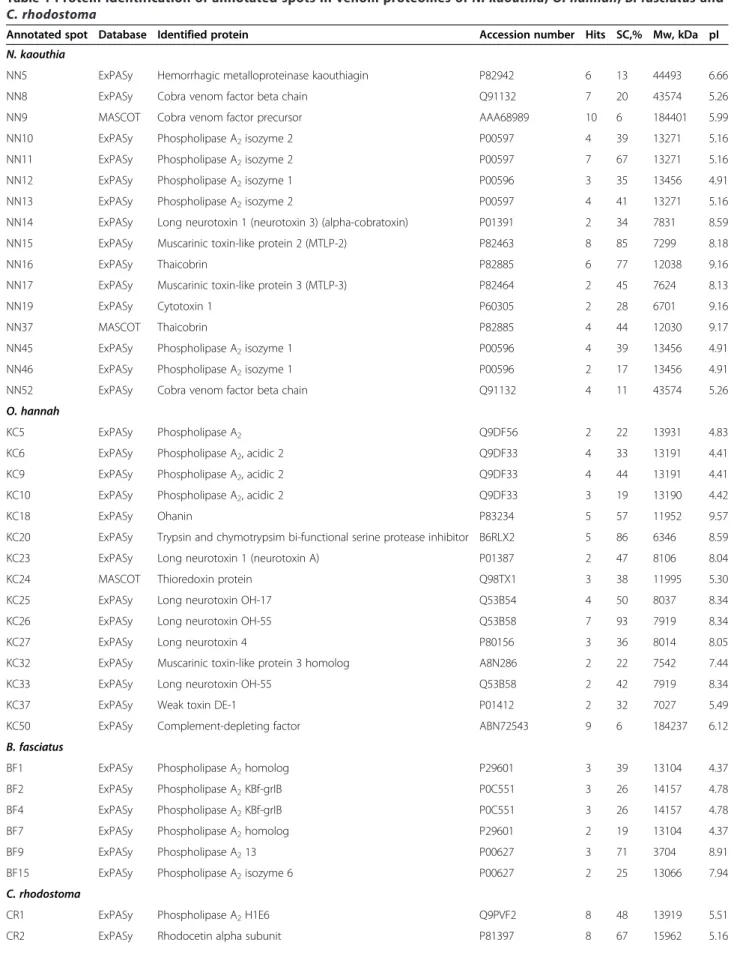
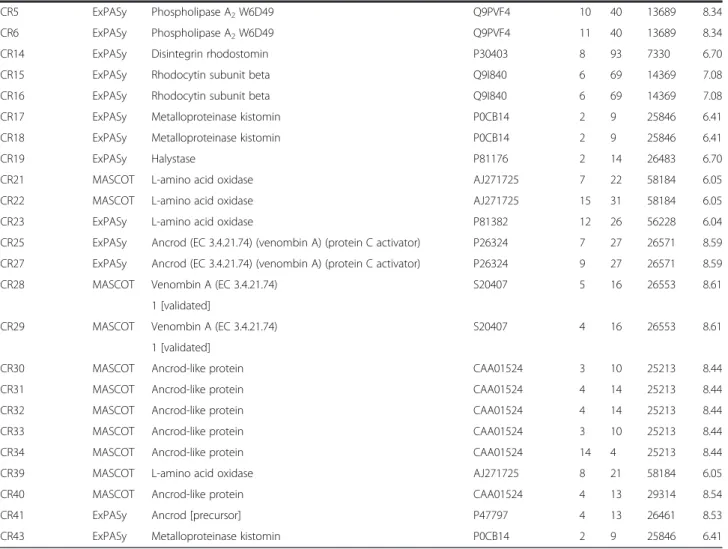
A total of 113, 50, 26, and 115 spots were analyzed to obtain the venom protein compositions ofN. kaouthia, O. hannah, B. fasciatus,andC. rhodostoma, respectively, but only the corresponding 34%, 86%, 54%, and 40% of these spots produced quality MALDI-TOF MS spectra. These spots were annotated and displayed in Figure 1. The remaining spots failed to give any spectra (not annotated within the figure). Respective totals of 16, 15, 6, and 26 spots linked to the database ofN. kaouthia,O. hannah, B. fasciatus, and C. rhodostoma were identified by PMF (Table 1). Some proteins were mapped to more than one spot, for example, those of the cobra venom factor, phospholipase A2isozymes and L-amino-acid oxidase. Al-though they produced relatively good quality spectra, a few spots from the 2-DE of the four venom species were unmatchable with proteins belonging to their respective venoms by either of the two database searches.
Discussion
As expected, the 2-DE images from the venoms of the four snake species demonstrated the complexity of poly-peptide constituents and the known fact that the com-position of snake venoms is 70 to 90% proteins [16]. The 2-DE of the four species showed obvious variations in protein map patterns. The distinctive protein maps ob-tained in this study may enable species identification, which is of clinical importance. The characteristic pro-tein map ofO. hannah, which displayed dissimilarities in relation to the other two elapids, exemplified the signifi-cance of this purpose. The 2-DE venom proteome profile of O. hannah displayed numerous protein spots at the higher molecular mass region similar to the viper rather than the other two elapids. This finding is substantiated by reports from Ohsaka [17] describing the exceptional existence of hemorrhagic activity provoked by O. han-nah venom similar to that exerted by Viperid venoms
while none of the Elapidae venoms exhibits similar hemorrhagic activity. The hemorrhagic activity of the major hemorrhagin, known as hannah toxin in O. han-nah, was first demonstrated by Tan and Saifuddin [18] in rabbits. Further investigation may enable potential species-specific molecular markers to be identified or detected under different gel conditions, similar to bio-markers for the purpose of species identification or dis-ease specification (e.g. in prognosis/diagnosis of various cancers). A study by Guércio et al. [19] had also postu-lated the potential of differential analyses of snake venom proteomes on the development of ontogenetic molecular markers via the identification of group-specific proteins.
To assess the venoms’ proteomics profiles, the com-bination of 2-DE with MALDI-TOF was used. Our study, unlike that done by Li et al. [2], matched the
45kDa 66kDa 97kDa
30kDa
20kDa
14kDa
A
97kDa 66kDa
45kDa
30kDa
20kDa
14kDa
B
97kDa 66kDa 45kDa
30kDa
20kDa
14kDa
C
D
Table 1 Protein identification of annotated spots in venom proteomes ofN. kaouthia,O. hannah,B. fasciatusand C. rhodostoma
Annotated spot Database Identified protein Accession number Hits SC,% Mw, kDa pI
N. kaouthia
NN5 ExPASy Hemorrhagic metalloproteinase kaouthiagin P82942 6 13 44493 6.66
NN8 ExPASy Cobra venom factor beta chain Q91132 7 20 43574 5.26
NN9 MASCOT Cobra venom factor precursor AAA68989 10 6 184401 5.99
NN10 ExPASy Phospholipase A2isozyme 2 P00597 4 39 13271 5.16
NN11 ExPASy Phospholipase A2isozyme 2 P00597 7 67 13271 5.16
NN12 ExPASy Phospholipase A2isozyme 1 P00596 3 35 13456 4.91
NN13 ExPASy Phospholipase A2isozyme 2 P00597 4 41 13271 5.16
NN14 ExPASy Long neurotoxin 1 (neurotoxin 3) (alpha-cobratoxin) P01391 2 34 7831 8.59
NN15 ExPASy Muscarinic toxin-like protein 2 (MTLP-2) P82463 8 85 7299 8.18
NN16 ExPASy Thaicobrin P82885 6 77 12038 9.16
NN17 ExPASy Muscarinic toxin-like protein 3 (MTLP-3) P82464 2 45 7624 8.13
NN19 ExPASy Cytotoxin 1 P60305 2 28 6701 9.16
NN37 MASCOT Thaicobrin P82885 4 44 12030 9.17
NN45 ExPASy Phospholipase A2isozyme 1 P00596 4 39 13456 4.91
NN46 ExPASy Phospholipase A2isozyme 1 P00596 2 17 13456 4.91
NN52 ExPASy Cobra venom factor beta chain Q91132 4 11 43574 5.26
O. hannah
KC5 ExPASy Phospholipase A2 Q9DF56 2 22 13931 4.83
KC6 ExPASy Phospholipase A2, acidic 2 Q9DF33 4 33 13191 4.41
KC9 ExPASy Phospholipase A2, acidic 2 Q9DF33 4 44 13191 4.41
KC10 ExPASy Phospholipase A2, acidic 2 Q9DF33 3 19 13190 4.42
KC18 ExPASy Ohanin P83234 5 57 11952 9.57
KC20 ExPASy Trypsin and chymotrypsim bi-functional serine protease inhibitor B6RLX2 5 86 6346 8.59
KC23 ExPASy Long neurotoxin 1 (neurotoxin A) P01387 2 47 8106 8.04
KC24 MASCOT Thioredoxin protein Q98TX1 3 38 11995 5.30
KC25 ExPASy Long neurotoxin OH-17 Q53B54 4 50 8037 8.34
KC26 ExPASy Long neurotoxin OH-55 Q53B58 7 93 7919 8.34
KC27 ExPASy Long neurotoxin 4 P80156 3 36 8014 8.05
KC32 ExPASy Muscarinic toxin-like protein 3 homolog A8N286 2 22 7542 7.44
KC33 ExPASy Long neurotoxin OH-55 Q53B58 2 42 7919 8.34
KC37 ExPASy Weak toxin DE-1 P01412 2 32 7027 5.49
KC50 ExPASy Complement-depleting factor ABN72543 9 6 184237 6.12
B. fasciatus
BF1 ExPASy Phospholipase A2homolog P29601 3 39 13104 4.37
BF2 ExPASy Phospholipase A2KBf-grIB P0C551 3 26 14157 4.78
BF4 ExPASy Phospholipase A2KBf-grIB P0C551 3 26 14157 4.78
BF7 ExPASy Phospholipase A2homolog P29601 2 19 13104 4.37
BF9 ExPASy Phospholipase A213 P00627 3 71 3704 8.91
BF15 ExPASy Phospholipase A2isozyme 6 P00627 2 25 13066 7.94
C. rhodostoma
CR1 ExPASy Phospholipase A2H1E6 Q9PVF2 8 48 13919 5.51
venom peptide masses of the particular snake species to their corresponding protein databases, found in the Tax-onomy Browser. The TaxTax-onomy Browser contained in the Entrez database (http://www.ncbi.nlm.nih.gov) pro-vided the total number of proteins available for match-ing for each of the four snake venoms. The respective numbers of known proteins available as of October 2013 were 157 for N. kaouthia, 192 forO. hannah, 130 forB. fasciatus and 84 for C. rhodostoma. The protein data-base was constructed data-based on the sequence data from the translated coding regions from DNA sequences in GenBank, EMBL, and DDBJ as well as protein sequences submitted to Protein Information Resource (PIR), SWISS-PROT, Protein Research Foundation (PRF), and Protein Data Bank (PDB) (sequences from solved struc-tures). It was obvious that the database was incomplete for snake venom matching, compared with 784,406 pro-teins available for Homo sapiens (human), and 123,173 for Bos taurus(cattle) proteins. Nevertheless, the snake
venom protein database is still of greater value than those of some other venomous species such asChironex yamaguchii(sea wasp) with only two proteins,Hadrurus aztecus (scorpion) with one, and Dolomedes plantarius (spider) with none, to name a few, for matching.
A closer examination of the snake-venom-protein database disclosed the following information: some of the proteins were not found in the venom but were evi-dently found elsewhere in the snake’s body, for example, the nerve growth factor (located in the nervous system), NADH dehydrogenase and cytochrome b (located in mitochondria) and oocyte maturation factor (located in the reproductive system). Also, most of the venom pro-teins were precursor forms or polypeptide chains of the same protein, for example: phospholipase PLA2 precur-sor and chain A, crystal structure of L-amino acid oxi-dase. Based on these factors, therefore, the snake venom proteins available for matching in the database were, in fact, much more limited.
Table 1 Protein identification of annotated spots in venom proteomes ofN. kaouthia,O. hannah,B. fasciatusand
C. rhodostoma(Continued)
CR5 ExPASy Phospholipase A2W6D49 Q9PVF4 10 40 13689 8.34
CR6 ExPASy Phospholipase A2W6D49 Q9PVF4 11 40 13689 8.34
CR14 ExPASy Disintegrin rhodostomin P30403 8 93 7330 6.70
CR15 ExPASy Rhodocytin subunit beta Q9I840 6 69 14369 7.08
CR16 ExPASy Rhodocytin subunit beta Q9I840 6 69 14369 7.08
CR17 ExPASy Metalloproteinase kistomin P0CB14 2 9 25846 6.41
CR18 ExPASy Metalloproteinase kistomin P0CB14 2 9 25846 6.41
CR19 ExPASy Halystase P81176 2 14 26483 6.70
CR21 MASCOT L-amino acid oxidase AJ271725 7 22 58184 6.05
CR22 MASCOT L-amino acid oxidase AJ271725 15 31 58184 6.05
CR23 ExPASy L-amino acid oxidase P81382 12 26 56228 6.04
CR25 ExPASy Ancrod (EC 3.4.21.74) (venombin A) (protein C activator) P26324 7 27 26571 8.59
CR27 ExPASy Ancrod (EC 3.4.21.74) (venombin A) (protein C activator) P26324 9 27 26571 8.59
CR28 MASCOT Venombin A (EC 3.4.21.74) S20407 5 16 26553 8.61
1 [validated]
CR29 MASCOT Venombin A (EC 3.4.21.74) S20407 4 16 26553 8.61
1 [validated]
CR30 MASCOT Ancrod-like protein CAA01524 3 10 25213 8.44
CR31 MASCOT Ancrod-like protein CAA01524 4 14 25213 8.44
CR32 MASCOT Ancrod-like protein CAA01524 4 14 25213 8.44
CR33 MASCOT Ancrod-like protein CAA01524 3 10 25213 8.44
CR34 MASCOT Ancrod-like protein CAA01524 14 4 25213 8.44
CR39 MASCOT L-amino acid oxidase AJ271725 8 21 58184 6.05
CR40 MASCOT Ancrod-like protein CAA01524 4 13 29314 8.54
CR41 ExPASy Ancrod [precursor] P47797 4 13 26461 8.53
Nevertheless, even with these limitations, many im-portant proteins were identified in the 2-DE of the 4 species. A total of 63 proteins were identified:C. rhodos-toma- 26,N. kaouthia- 16,O. hannah–15 andB. fas-ciatus–6. Venoms from snakes contain various types of toxins such as cardiotoxins and neurotoxins, biological factors that are coagulant, thrombotic, anti-platelet binding, as well as active enzymes including phospholipase, endo- and exonucleotidases, hyaluroni-dase, neuraminihyaluroni-dase, protease and many others. Gener-ally, the non-enzymatic protein or polypeptide toxins dominate the lethal actions of elapids (e.g. cobra and krait) and sea snakes, whereas enzymes appear to play a more important role in the lethality of viperid (viper) and crotalid (pit viper) venoms [16].
In the present study, the phospholipase A2 (PLA2) group of enzymes was identified in all four species. At least one of these enzyme types was identified in each of the four species studied (Table 1). This finding is not sur-prising given that extensive studies on venom have dem-onstrated an accelerated natural selection force that drives the evolution of a multitude of extremely potent snake toxins from an ancestral PLA2 with digestive function [20,21]. Hundreds of species of venomous snakes of the families Elapidae and Viperidae were shown to have evolved a wide variety of venoms that contain varying pro-portions of toxins endowed with PLA2activity, character-ized by their neurotoxicity, myotoxicity, as well as anticoagulant and edema-inducing properties [21-23]. Hence, in snake venom, PLA2 enzymes, in addition to their possible role in digesting the prey, exhibit a wide var-iety of pharmacological effects through interfering with normal physiological processes [24]. It is well known that some of the most toxic and potent pharmacologically ac-tive components of snake venoms are either PLA2 en-zymes or their protein complexes. For example, all known presynaptic neurotoxins from snake venom are PLA2 en-zymes or contain at least one PLA2 as an integral part [25,26]. PLA2myotoxins are more potent and act faster than their non-enzymatic counterparts [27].
PMF using MS also allowed the identification of long neurotoxins in both the cobra species studied. Unlike presynaptic beta-neurotoxins that exhibit varying PLA2 activities, these long neurotoxins are classified as alpha-neurotoxins that affect the post-synaptic mem-brane [28]. Post-synaptic neurotoxins have been iden-tified only in venoms from the families Elapidae and Hydrophiidae (sea snakes). They are nicotinic recep-tor antagonists on the skeletal muscle and display dif-ferent binding kinetics and affinity for subtypes of nicotinic receptors [29]. Other significant neuro-toxins, such as the muscarinic toxin-like proteins (MTLP), including ohanin and thaicobrin, were also identified in the cobra venoms.
Rhodocetin, another important protein identified inC. rhodostoma venom, is a Ca2+-dependent lectin-related protein (CLP) that is a potent platelet aggregation inhibi-tor induced by collagen. It is a prime example of a CLP dimer, in which the two subunits are held together by non-covalent interactions and act synergistically to elicit the biological activity, affecting platelet aggregation and blood coagulation, important in cellular thrombosis and non-cellular processes in homeostasis [30,31]. This pro-tein was also demonstrated to antagonize stromal tumor invasion in vitro and other α2β1 integrin-mediated cell functions [32]. The proteomic approach applied in the present study also successfully identified a significant number of peptidases, namely zinc metalloproteinase or disintegrin, ancrod or venombin A, and L-amino-acid oxidases which display the well-documented hemotoxic properties of the viper's venom. Disintegrin exhibits hemorrhagic activities by binding to the glycoprotein IIb-IIIa receptor on the platelet surface, thus inhibiting fibrinogen interaction with platelet receptors while L-amino-acid oxidases exert hemorrhagic effects by cata-lyzing oxidative deamination of hydrophobic and aro-matic L-amino acids [33-36]. L-amino-acid oxidases have also recently been shown to display antibacterial properties [37]. On the other hand, ancrod is a thrombin-like serine protease that selectively cleaves the fibrinopeptides, resulting in aberrant fibrinogen that is unable to form dispersible blood clots [38].
the most recent Entrez protein database. Among these the protein database of B. fasciatus shows the most promising development, an augmentation of approxi-mately 380%, while those of O. hannah increased by 125%,N. kaouthiaby 235%, andC. rhodostomaby 140%. With the comprehensive cataloguing of venom toxins, the characterization of species-specific venom proteome is therefore greatly facilitated when studying the patho-physiological effects arising from species-specific snakebites. For instance, the sequential, comparative 2-DE analysis of in vivoandin vitroeffects of venom on specific plasma pro-teins from a patient bitten by a rattlesnake has demon-strated the pathological relationship between the snake toxins and the injury-related physiological alterations [40]. The application of proteomic tools by Escalante et al. [41] on wound exudates also revealed the tissue-damaging mechanisms of different snake venom toxins.
Conclusions
The 2-DE map of these venoms will play a vital role in the purification of their proteins by utilizing the 2-DE-guid purification applications as described by Tang et al. [42].
Additional file
Additional file 1:The peptide masses used for identifying the proteins.
Competing interests
The authors declare that they have no competing interests.
Authors’contributions
All authors contributed equally to the present work. All authors read and approved the final manuscript.
Acknowledgments
The authors would like to thank University of Malaya for providing the proteomic instrumentation to complete this study.
Author details
1
Faculty of Industrial Sciences and Technology, University Malaysia Pahang, Lebuhraya Tun Razak, Kuantan, Pahang Darul Makmur 26300, Malaysia.
2
Institute of Biological Sciences, University of Malaya, Kuala Lumpur 50603, Malaysia.
Received: 23 October 2013 Accepted: 17 February 2014 Published: 4 March 2014
References
1. Lim BL:Poisonous snakes of Peninsular Malaysia. 3rdRevised edition.Malaysian Nature Society: Kuala Lumpur; 1991.
2. Li S, Wang J, Zhang X, Ren Y, Wang N, Zhao K, Chen X, Zhao C, Li X, Shao J, Yin J, West MB, Xu N, Liu S:Proteomic characterization of two snake venoms:Naja naja atraandAgkistrodon halys.Biochem J2004,
384(Pt 1):119–127.
3. Fox JW, Serrano SM:Exploring snake venom proteomes: multifaceted analyses for complex toxin mixtures.Proteomics2008,8(4):909–920.
4. Lee CY:Chemistry and pharmacology of polypeptide toxins in snake venoms.Annu Rev Pharmacol1972,12:265–281.
5. Fox JW, Kamiguti AS, Theakston RDG, Shannon JD, Stefansson B, Serrano SMT, Camargo ACM, Sherman N:Role of discovery science in toxinology:
examples in venom proteomics.InPerspectives in molecular toxinology.
Edited by Menez A. Chichester: John Wiley & Sons; 2002:97–106.
6. Creer S, Malhotra A, Thorpe RS, Stöcklin R, Favreau PS, Hao Chou WS:
Genetic and ecological correlates of intraspecific variation in pitviper venom composition detected using matrix-assisted laser desorption time-of-flight mass spectrometry (MALDI-TOF-MS) and isoelectric focusing.J Mol Evol2003,56(3):317–329.
7. Nawarak J, Phutrakul S, Chen ST:Analysis of lectin-bound glycoproteins in snake venom from the Elapidae and Viperidae families.J Proteome Res
2004,3(3):383–392.
8. Juarez P, Sanz L, Calvete JJ:Snake venomics: characterization of protein families inSistrurus barbourivenom by cysteine mapping, N-terminal sequencing, and tandem mass spectrometry analysis.Proteomics2004,
4(2):327–338.
9. Toyama OD, Boschero CA, Martins AM, Fonteles CM, Monteiro SH, Toyama MH:Structure-function relationship of new crotamine isoform from the Crotalus durissus cascavella.Protein J2005,24(1):9–19.
10. Oliveira DG, Toyama MH, Novello JC, Beriam LO, Marangoni S:Structural and functional characterization of basic PLA2 isolated fromCrotalus durissus terrificusvenom.J Protein Chem2002,21(3):161–168.
11. Vejayan J, Shin Yee L, Ponnudurai G, Ambu S, Ibrahim H:Protein profile analysis of Malaysian snake venoms by two-dimensional gel electrophoresis.J Venom Anim Toxins Incl Trop Dis2010,16(4):623–630.
12. Bradford MM:A rapid and sensitive method for the quantitation of microgram quantities of protein utilizing the principle of protein-dye binding.Anal Biochem1976,72:248–254.
13. Nawarak J, Sinchaikul S, Wu CY, Liau MY, Phutrakul S, Chen ST:Proteomics of snake venoms from Elapidae and Viperidae families by multidimensional chromatographic methods.Electrophoresis2003,24(16):2838–2854.
14. Marshall T, Williams KM:Analysis of snake venoms by sodium dodecyl sulfate-polyacrylamide gel electrophoresis and two-dimensional electrophoresis.Appl Theor Electrophor1994,4(1):25–31.
15. Saravia P, Rojas E, Escalante T, Arce V, Chaves E, Velásquez R, Lomonte B, Rojas G, Gutiérrez JM:The venom ofBothrops asperfrom Guatemala: toxic activities and neutralization by antivenoms.Toxicon2001,
39(2–3):401–405.
16. Tu AT:Venoms: chemistry and molecular biology.New York: John Wiley & Sons; 1977.
17. Ohsaka A:Hemorrhagic, necrotizing and edema-forming effects of snake venoms.InHandbook of Experimental Pharmacology, Volume 52. Edited by Lee CY. Berlin: Springer; 1979:481–546.
18. Tan NH, Saifuddin MN:Isolation and characterization of a hemorrhagin from the venom ofOphiophagus hannah(king cobra).Toxicon1990,
28(4):385–392.
19. Guércio RAP, Shevchenko A, Shevchenko A, López-Lozano JL, Paba J, Sousa MV, Ricart CAO:Ontogenetic variations in the venom proteome of the Amazonian snakeBothrops atrox.Proteome Sci2006,4:1–14.
20. Ogawa T, Nakashima K-I, Nobuhisa I, Deshimaru M, Shimohigashi Y, Fukumaki Y, Sakaki Y, Hattori S, Ohno M:Accelerated evolution of snake venom phospholipase A2 isozymes for acquisition of diverse physiological functions.Toxicon1996,34(11–12):1229–1236.
21. Montecucco C, Gutierrez JM, Lomonte B:Cellular pathology induced by snake venom phospholipase A2 myotoxins and neurotoxins: common aspects of their mechanisms of action.Cell Mol Life Sci2008,
65(18):2897–2912.
22. Boffa GA, Boffa MC, Winchenne JJ:A phospholipase A2 with anticoagulant activity. I. Isolation fromVipera berusvenom and properties.Biochim Biophys Acta1976,429(3):839–852.
23. Vishwanath BS, Kini RM, Gowda TV:Characterization of three edema-inducing phospholipase A2enzymes from habu (Trimeresurus flavoviridis)
venom and their interaction with the alkaloid aristolochic acid.Toxicon
1987,25(5):501–515.
24. Kini RM:Excitement ahead: structure, function and mechanism of snake venom phospholipase A2 enzymes.Toxicon2003,42(8):827–840.
25. Bon C:Multicomponent neurotoxic phospholipases A2.InVenom phospholipase A2 enzymes: structure, function and mechanism.Edited by Kini RM. Chichester: John Wiley & Sons; 1997:269–285.
26. Fletcher JE, Rosenberg P:The cellular effects and mechanisms of action of presynaptically acting phospholipase A2 enzymes.InVenom
27. Gubensek F, Kriaj I, Pungerar J:Monomeric phospholipase A2 neurotoxins.
InVenom phospholipase A2 enzymes: structure, function and mechanism.
Edited by Kini RM. Chichester: John Wiley & Sons; 1997:245–268.
28. Lewis RL, Gutmann L:Snake venoms and the neuromuscular junction. Semin Neurol2004,24(2):175–179.
29. Hodgson WC, Wickramaratna JC:In vitroneuromuscular activity of snake venoms.Clin Exp Pharmacol Physiol2002,29(9):807–814.
30. Kornalik F:The influence of snake venom proteins on blood coagulation.
InSnake Toxin.Edited by Harvey AL. New York: Pergamon Press; 1991:323–383.
31. Wang R, Kini RM, Chung MC:Rhodocetin, a novel platelet aggregation inhibitor from the venom ofCalloselasma rhodostoma(Malayan pit viper): synergistic and noncovalent interaction between its subunits. Biochemistry1999,38(23):7584–7593.
32. Eble JA, Niland S, Dennes A, Schmidt-Hederich A, Bruckner P, Brunner G:
Rhodocetin antagonizes stromal tumor invasionin vitroand other alpha2beta1 integrin-mediated cell functions.Matrix Biol2002,
21(7):547–558.
33. Dennis MS, Henzel WJ, Pitti RM, Lipari MT, Napier MA, Deisher TA, Bunting S, Lazarus RA:Platelet glycoprotein IIb-IIIa protein antagonists from snake venoms: evidence for a family of platelet aggregation inhibitors.Proc Natl Acad Sci U S A1990,87(7):2471–2475.
34. Gould RJ, Polokoff MA, Friedman PA, Huang TF, Holt JC, Cook JJ, Niewiarowski S:Disintegrins: a family of integrin inhibitory proteins from viper venoms.Proc Soc Exp Biol Med1990,195(2):168–171.
35. Au LC, Lin SB, Chou JS, Teh GW, Chang KJ, Shih CM:Molecular cloning and sequence analysis of the cDNA for ancrod, a thrombin-like enzyme from the venom ofCalloselasma rhodostoma.Biochem J1993,
294(Pt 2):387–390.
36. MacHeroux P, Seth O, Bollschweiler C, Schwarz M, Kurfurst M, Au LC, Ghisla S:L-amino-acid oxidase from the Malayan pit viperCalloselasma rhodostoma. Comparative sequence analysis and characterization of active and inactive forms of the enzyme.Eur J Biochem2001,
268(6):1679–1686.
37. Tonismagi K, Samel M, Trummal K, Ronnholm G, Siigur J, Kalkkinen N, Siigur E:L-amino acid oxidase fromVipera lebetinavenom: isolation, characterization, effects on platelets and bacteria.Toxicon2006,
48(2):227–237.
38. Au LC, Chou JS, Chang KJ, The GW, Lin SB:Nucleotide sequence of a full-length cDNA encoding a common precursor of platelet aggregation inhibitor and hemorrhagic protein fromCalloselasma rhodostoma venom.Biochim Biophys Acta1993,1173(2):243–245.
39. Serrano SMT, Shannon JD, Wang D, Camargo ACM, Fox JW:A multifaceted analysis of viperid snake venoms by two-dimensional gel
electrophoresis: an approach to understanding venom proteomics. Proteomics2005,5(2):501–510.
40. Bagley EA, Lonberg-Holm K, Pandya BV, Budzynski AZ:Two-dimensional gel electrophoretic analysis of plasma proteins from a patient bitten by a rattlesnake.Electrophoresis1983,4(3):238–241.
41. Escalante T, Rucavado A, Pinto AFM, Terra RMS, Gutierrez JM, Fox JW:
Wound exudate as a proteomic window to reveal different mechanisms of tissue damage by snake venom toxins.J Proteome Res2009,
8(11):5120–5131.
42. Tang MS, Vejayan J, Ibrahim H:The concept of two-dimensional electrophoresis-guided purification proven by isolation of rhodocetin fromCalloselasma rhodostoma(Malayan pit viper).J Venom Anim Toxins Incl Trop Dis2011,17(4):442–450.
doi:10.1186/1678-9199-20-6
Cite this article as:Vejayanet al.:Comparative analysis of the venom proteome of four important Malaysian snake species.Journal of Venomous Animals and Toxins including Tropical Diseases201420:6.
Submit your next manuscript to BioMed Central and take full advantage of:
• Convenient online submission
• Thorough peer review
• No space constraints or color figure charges
• Immediate publication on acceptance
• Inclusion in PubMed, CAS, Scopus and Google Scholar
• Research which is freely available for redistribution